|
[Back to Chapter 7]
CHAPTER EIGHT
FULFILMENT AND THANATOS
[1887 - 1907]
|
|
Death is the separation of a
duality, and effects no change in the spirit, morally or intellectually.
(Alfred Russel Wallace)
|
|
|
THIS last period in
Massey's life, although almost as productive as in previous sections,
was mainly a period of consolidation of ideas and completion of purpose.
He had refuted many of his previously held opinions, published fifteen
years earlier in Concerning Spiritualism, and extended his
research-based conclusions to anti-orthodox Christianity. His
published lecture series demonstrated those issues very fully, as did
his appearances at public meetings. A series of six at St George's
Hall, Langham Place, commencing on 12 June 1887, clearly stated his
position. Titles included ‘The mystery of Paul, "Apostle of the
Heretics", and not of historic Christianity', and 'Christianity, an
anti-Spiritualistic system’. He had, in broad terms, clashed with
the Christian Spiritualists, whose undeveloped mediums preached nothing
but Christianity through ‘spirit guides’, which same 'spirits'
continually endorsed exploded myths as facts. He maintained this
position in his lectures, when he stated, ‘phenomenal Spiritualists who
go philandering with the fallacies of the Christian faith, and want to
make out that it is identical with Modern Spiritualism, have to face the
great indubitable fact that Historic Christianity was established as a
non-Spiritualist and an anti-spiritualistic religion.’[1]
During these lectures he had occasion again to refer to the presumptions
of the Christian Spiritualists, this time on remarks made by Alfred
Russel Wallace. Wallace had been stating that Spiritualism alone
could reconcile the Bible with an intelligent belief, particularly in
regard to the miracles which, as facts, need not be explained away.
Massey was astounded by this position taken by one of the foremost men
of science and co-contributor with Darwin. Wallace's opinion, he
said, was unscientific, false, and based on the confusion with
symbolical representation. It was the pre-Christian, Gnostic
religion that based immortality or continuity of existence upon the
evidence of abnormal phenomena and clairvoyant vision. The
resurrection of the Christ of historic Christianity was physical, and
you cannot demonstrate a spiritual continuity by means of a bodily
resurrection. Mythical miracles could not be converted into
spiritual phenomena.[2] With the much firmer
stance he was taking on religious origins, particularly Christianity, he
commenced to use the term ‘Neo-Naturalistic’ in place of
‘Spiritualistic’, as he claimed that Spiritualism was a newer, larger
Naturalism.
Since the publication of his
Natural
Genesis he had been engaged at intervals on a recast version of
his work on Shakespeare's Sonnets. In this, he hoped to give a
closer clinch to his conclusions, complete his case, and leave a
permanent memorial of his love and admiration for Shakespeare the Poet
and Man. The Secret Drama of
Shakspeare's Sonnets
was published in 1888 and restated his earlier premise that the sonnets,
partly personal and dramatic, require regrouping in order to maintain
the series. A section of ‘Biographia
Literaria’ included the Earl of Southampton, Lady Penelope Devereux,
Shakespeare, and Francis Bacon. This latter claimed Massey's
attention on account of Ignatius Donnelly's recently published book
The Great Cryptogram. In 1856 Putnam's Magazine
had printed Delia Bacon's opinion that a number of well-known persons
could have authored Shakespeare's plays. She followed this in 1857
with her book on the theme, The Philosophy of the Plays of
Shakespeare unfolded. This hypothesis received some support,
as well as opposition. William Henry Smith, politician, published
his
Bacon and Shakespeare: an Inquiry… in the same year. Later,
another group who were advocates of the ‘Oxford Theory’, promoted Edward
de Vere (1550-1604), Earl of Oxford, as the author. The Baconians
gained some ground following the formation of the Bacon Society in 1885,
and the publication of Donnelly's book that proposed a secret cypher
encoded in Shakespeare's plays. That cypher was supposed to reveal
political intrigues and scandals of the time.[3]
Donnelly was also a supporter of the theory of ‘Atlantis’. Massey
devoted a section of his book in demolishing the theory, which received
approval by the reviewer in
Punch, under the heading:
|
DOWN ON DONNELLY;
Or, Crushing the Cryptogram.
A POET on the Poet! That should herald
A real Champion's advent. Go it, GERALD! …
IGNATIUS now, the “Moon-Raker” gone frantic,
Who hunts for mare's-nests under the Atlantic,
And SHAKESPEARE'S text, is naturally stilted,
But under MASSEY'S mace he must have wilted …
Your monumental book's a trifle bulky
(Five hundred pages turn some critics sulky,
My massive MASSEY), but 'tis full of “meat”,
And sown with song as masculine as sweet …
Whilst all will track with grateful heart and eye
Your slaughtering of that colossal Sham
Egregious DONNELLY'S Great Cryptogram![4] |
St James' Gazette also approved, saying ‘In
justice to Mr Massey, it must be said that many of his most important
conclusions have been stolen—or let us say ‘conveyed’—by some critics
who are loudest in repudiating his dramatic interpretation.’[5]
Amos Waters, reviewing the 1890 edition in Watt's Literary Guide,
praised the intricacies of research and excellent tissue of relevant
detail. ‘Massey's chivalrous and monumental book will arise in the
average reader added joy, new light on Shakespeare's sonnets, and a new
love for Shakespeare the man.’[6]
A number of years later, a correspondent in the
Times Literary Supplement wrote concerning Marston's reference to
Drusus, in his The Scourge of Villanie 1599, which suggested
there had been a revival of Romeo and Juliet in 1598. After
reading Marston's book, Massey had proposed that Drusus was an allusion
to Shakespeare, which prompted the disagreement of Dr C. M. Ingleby.
The correspondent was surprised that Massey had not presented all the
evidence contained in Marston's book, which would have made a stronger
case for his proposal.[7]
The last article he wrote for a journal was ‘Myth
and Totemism as primitive modes of representation’. As with
his published lectures, it was a summary of sections in his main works,
principally The Natural Genesis, and therefore more explicit.
His thesis proposed that as primitive mythology belonged to external
nature, the actors in the drama were the elements themselves, birds,
animals, reptiles, and not human beings. For example, the
elemental conflict of light and darkness was portrayed by two birds as
zootypes of the air. In Egypt, this was the golden hawk of day and
the black vulture of night, and for the Australian aborigines, the eagle
and crow. Later in development, the phenomena were interpreted
using human beings in place of zootypes, as in the brothers Cain and
Abel, Sut and Osiris, etc., who were always working to slay each other.
Thus once the powers were humanised, and related as history, the myths
became misrepresented, and considered as savage, senseless or obscene.
Particularly so when the first parent in mythology was the dragon of
darkness, or the cow, that brought forth the child of light in Egyptian
mythology. Later in the development her child, who was also her
consort, attains to the fatherhood, when his own mother becomes his own
daughter. Therefore the mother, wife and daughter of, for example,
the Egyptian sun-god Ra, are all one. As a mode of representation
it was natural, the unknown being expressed by the known. As a
modern belief, it is of course false and immoral, and it is the modern
beliefs that misrepresent the ancient myths. In totemism, a nature
power represented by a zootype was adopted as a badge of distinction for
social groups. It was a primaeval coat of arms, extended by blood
covenant, to form a sept, clan, and tribe. Continuing development
extended the totem's blood covenant to the actual powers of the zootype,
considering them as elemental spirits, giving rise in some instances to
human sacrifice and cannibalism.[8] (Appendix
F.)
He continued with some public lectures during 1887
and 1888, mainly in London at the Cavendish Rooms, Mortimer Street, and
at his favourite venue, the St George's Hall, Langham Place, but as a
source of finance they were inadequate for his needs.[9a]
Seasonal lecture tours arranged by agents were held in the winter
months, and that time of year was difficult for him due to chronic
bronchitis. Early in 1888 he was again in debt. His sponsor
for thirty-five years, Lady Marian Alford, had died earlier in the year
so he was compelled to apply to the Royal Literary Fund for a further
grant. The fund gave him assistance in the sum of £80, but it was
quite obvious that unless he could obtain a further source of funding
his next book as well as his whole livelihood would be compromised.
The only way out of the predicament, before his health suffered further
decline, would be to make a final, and hopefully equally financially
rewarding, third tour of America. Therefore he began again to make
arrangements, despite his previous second visit having been interrupted
by illness. The advance list of Evolutionary, Anthropological,
Gnostic and Neo-Naturalistic subjects was the largest he had ever
presented, the recently published series of ten lectures being
supplemented by a further twenty-one. Topics on Zootypology,
Totemism, Fetishism and Sign language were condensed from his published
four volume works. These were augmented by the literary subjects
of Charles Lamb, Robert Burns and Thomas Hood and, additionally to
enhance the sales of his Shakespeare book, ‘The AntiShakspeare Craze;
or, Shakspeare and Bacon,’ and ‘The Man Shakspeare; His Life and Work’.
New Southgate
London N.
August 2nd [1888]
Dear Alfred Bull,
Yours to hand. I was vexed not to have seen you. It was Measles my
children had – and badly too. I have recently announced my intention of
another trip and expect to sail in the Umbria 4 Weeks come Saturday.
Dont know if I can stand your Winter but I must try. Whether I shall see
Chicago or not is more likely to depend on you than anyone I know. But
more of that anon. I have no wish for any further dealings with Cundy.
He served me too badly in the Affaire Column. [?] (Lee pamphlet sent)
When I sent him a Reply he burked it. That is friendship enough for one
life time. I have no great anticipations in Lecturing, on account of my
health, but I have other business. Moreover I shall have 10 Printed
Lectures on Sale this time – may help a little. I send a few Circulars,
but the Lecture List will require a careful handling with the orthodox.
If you should be writing within [?] the time you can address me c/o
Judge Dailey 16 Court St Brooklyn. You might perhaps get me a Subscriber
or two to the Shakspeare Book, five Dollars? It will be out forthwith,
[9b]
With the kindest regards to your Wife and a kiss for the Boy
I am yours
Gerald Massey
Alfred Bull Esq.

The Cunard liner RMS Umbria made its maiden voyage from
Liverpool to New York on 1st November 1884.
Arriving in Boston, he commenced with a series of two
lectures for the Independent Club, at Berkeley Hall on 11 November 1888.
The Boston Herald described him as an elderly gentleman, with
greyish moustache and chin whiskers, and wearing glasses. He read
from manuscript very quickly and clearly, and was received with
approbation by the audience.[10] During his
time in Boston, he stayed with A. E. Giles at Hyde Park, and enjoyed
social evenings with, among others, Theodore D. Weld, the old-time
Abolitionist. Continuing to Providence, Rhode Island, for the 25
November and 2 December, he returned to Boston again for ‘The
Coming Religion’ on 9 December.[11]
During his time in America he hoped to make
arrangements for a new edition of his poetical works, and to sell copies
of his lectures of which he had brought a supply to deposit with Colby
and Rich, as agents. But that lecture in Boston was the last he
gave in America. He received a telegram requesting his urgent
return to England, where his daughter Hesper, described as ‘a beautiful
girl of eighteen’ who was a sufferer from tuberculosis, had become
seriously ill. She died on 3 March 1889.
|
We called her Hesper; for it seemed
Our Star of Eve had on us beamed,
Like Hesper, from the Heaven above,
To latest life a Lamp of love. . .
Beyond the Shadow of the night
That parted us, she lifts her light
To beacon us the Homeward way,
Where we shall meet again by day.
The Star of Eve may set, but how
It shines, the Star of Morning now … |
That same year Massey compiled a two volume edition
of the greater part of his published poems, as
My Lyrical Life. In the
explanatory preface he
considered that a lyrist has the liberty of the dramatist in
representing other characters, situations, or moods which may not be
personal to the writer. Hence Robert Browning's descriptive title
of ‘Dramatic Lyrics’. Many of Massey's lyrics are dramatic also,
in that sense. His dramaticism extended to patriotic and political
affiliation, and causes which were unpopular at the time. Women's
liberation movements would have been proud of him, when he considered
that the Fall of Man was being gradually superseded by the Ascent of
Woman, and he regarded the first necessity was for them to obtain
parliamentary franchise. They could then hope to stand upon a
business footing of practical equality with men. Of his poems, he
had no extravagant estimate of their value which, some twenty years
earlier he had ceased to regard as the special part of his literary
life. He had been referred to as a poet who had not fulfilled the
promise of his early achievements; yet had received testimony that his
poems had done welcome work, if only in helping to destroy the tyranny
of death, which made so many mental slaves afraid to live. The
Athenæum, who could be relied upon in giving fair appraisals of his
poetical works, treated him quite kindly. After commenting that
his name in recent years had been less familiar than it deserved to be,
it referred to some over-exuberant rejoicings from authoritative critics
that had been quoted in the introduction. It agreed also with
Massey's own comments that in general, the range of his poems was
limited. Not over happy with his political ‘Home Rule’ advocacy,
the reviewer recommended that the reader turn to the reprints of his
first volumes and be soothed by their idyllic, almost holy, graciousness
of domestic piety.[12] The
Saturday Review likened him to an inoffensive and amiable Robert
Buchanan, with the same fluency, the same mastery of the manifest, the
same ease in the obvious, the same sort of creditable approach to
success. Saying that they really liked Mr Massey's Muse, they had
strong reservations on his mixed metaphors and outworn ideas. The
less ambitious he was, the more he spoke through the heart, not the
head, and the more briefly he spoke the more he attained true, though
not lofty, poetry. Although he appeared more at home with domestic
sentiment, they noted as had reviewers in his early days, that there was
too much of the ‘wee shrouds, wee bits, wee graves, wee wifes and other
phrases endearing in the sacred intimacies of home, but unworthy of the
Muse’. Of his
Tale of Eternity they
remarked that they could not believe in the sublime, though he had a
thousand claims on their sympathy.[13] The
volumes however, proved their popularity by raising a second edition the
following year.
That year, 1890, saw the death of another daughter,
Elsie, aged 16 years. She died on the 22 July of peritonitis.
It may have been due to this, and the memory of Hesper's death, that
induced him to move at the end of that year from Southgate to a similar
property, ‘Rusta,’ 266 Lordship Lane, East Dulwich.
|
 |
|
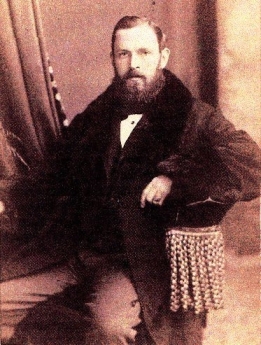
Dr Albert Churchward MD., MRCP., FGS.,
PM., PZ., 30º MDU
(Photo: © Jack Chuchward) |
It was about this time ,or perhaps a few years earlier, that he had come
into contact with Dr Albert Churchward (1852-1925), a general
practitioner and high ranking (30 degree) freemason who lived at Erroll
Lodge, 206 Selhurst Road, South Norwood. Born in Bridestowe,
Devonshire, Churchward obtained his medical qualifications from Guy's
Hospital, Brussels and Edinburgh. He was particularly interested
in Ancient Egypt from a masonic perspective. In this connection he
made a particular study of early African and other peoples from a
medical viewpoint in order to research and give support to his theories
that were very similar to Massey's, though in a more restricted sphere.
Like Massey, his theories were not accepted by orthodox anthropologists
and ethnologists at the time, but he held their opinions in scant
regard. Their association may have come about due either to
Massey's public lectures or his published works on religious origins.
Churchward's first book The Origin and Antiquity of Freemasonry
was published in 1898. There was extensive collaboration between
these two men that continued up to the time of Massey's death, and
Churchward's subsequent publications owe more than a great deal to
Massey's ideas. Churchward's main work Signs and Symbols of
Primordial Man is his best known. It can be noted that his
brother was Lt. Col. James Churchward (b.1850), author of controversial
books on
Atlantis. Although Massey was not a freemason, disliking
any form of secrecy, and Churchward had staunch Conservative opinions,
there was sufficient compatibility of interests to produce an enduring
friendship.
As Massey's health during the winter months was
becoming increasingly precarious, the American lectures were the last he
gave to large public audiences, and he restricted himself to smaller
organisations, by invitation. In 1891 a proposal was made to form
a Gerald Massey Society. The promulgator, Mr F. Dever-Summers of
Wandsworth, considered that the formation of such a society would,
through meetings, discussions and the formation of provincial branches,
clear a way through a jungle of false doctrines. Suggesting a
weekly subscription towards the purchase of Massey's and other similar
books to make up a small library, members of any religious denomination
would be welcome. This was seconded with grateful sympathy for
Massey's work, and a proposition that he could then prepare lectures,
papers or articles on subjects relating to the work of the society.[14]
The amount of support received for the proposed society is not known,
but it was never formed. This may have been due to preparations he
was making for the last two volumes of his trilogy on evolutionary
themes. In any case, despite his idealism, he was very wary in
later years of committing himself to anything that did not suit his
purpose at the time, or might interfere with plans already made.
In connection with Massey's earlier opinion on the
unreliability of spirit communication, a correspondent in an issue of
Medium and Daybreak
in 1893 asked if a book written by the medium David Duguid, entitled
Hafed, Prince of Persia, should not be truthful, emanating as it
did from the spiritual world. The book was stated to have been
dictated by a ‘control’ who lived at a time contemporary with Jesus
Christ, and was a witness of his birth and death. The writer
questioned that account, as it conflicted with Massey's argument as an
evolutionist, that these chronicles were mythical. The opinions of
other readers were sought, as embodied and disembodied spirits ought to
be agreed on fundamental truths. The editor, James Burns,
explained that Massey's ‘Christ’ was the immortal part of man, while
‘Jesus’ was the name given to the person who may have suffered and died
as stated in the gospels. They were two very different subjects.
The faculty of mediumship was greatly abused because of the ignorance
and fanaticism of so-called Spiritualists. Had Massey responded,
he would undoubtedly have been more forthright in providing a suitable
answer.[15] Twenty years earlier Massey had
complained about poetry purported to have been transmitted by departed
bards to Thomas Lake Harris, poet, Christian Spiritualist and prolific
author on religious mysticism. On examination, Massey had found
some of Harris' inspiration to contain plagiarism and mental piracy—an
imposture, he stated, from whichever world it originated.[16]
Massey's financial position was reasonable at that
time, but apart from purchasing a small ‘cottage’ of unknown address,
and from which he obtained an annual rent of £35, he ignored
well-intentioned advice regarding any form of monetary investment.
This was ultimately to be an unwise decision. His next move at the
end of 1893 was to a large detached rented property at 11 Warminster
Road, a quiet residential area of South Norwood. In naming the
house ‘Anru’, the Egyptian word for ‘Paradise’, he hoped that move would
be his final address.
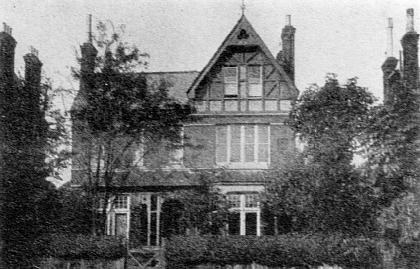
Anru, Warminster Road, South Norwood.
From the Bookman, Nov. 1897 (The British
Library).

Massey in his study at Anru.
From the Bookman, Nov. 1897 (The British
Library).
Meanwhile Fabyan, Massey's only son, had obtained a
post as a telegraphist in Bermuda when, following two years in that
country, he became ill and was diagnosed as having pulmonary
tuberculosis. His sister, Hesper, had died of the disease seven
years earlier, and it is possible that he obtained the primary focus
from her. Due to Fabyan's deteriorating condition, Massey's eldest
daughter Christabel then aged 36 went out to nurse him, but he died in
Warwick, Bermuda, on 7 January 1896, aged nineteen.
George Julian Harney's eightieth birthday fell on 17
February 1897. Confined to bed at his home in Richmond due to
severely painful rheumatoid arthritis, he had been contributing articles
until recently to the Newcastle Weekly Chronicle. With
nostalgia he had heard at intervals of the deaths of his Chartist
friends
Thomas Cooper in 1892, and J. B. Leno
in 1894, aged 68. Other leading members of the movement had
preceded them by many years. Bronterre O'Brien, editor of the
Poor Man's Guardian and a founder of the National Reform League,
ended as a shabby, beery loafer in Fleet Street, dying in 1864.
John Arnott, the capable general secretary of the National Charter
Association was seen by W. E. Adams in 1865 half starved, begging in the
Strand (see author's
brief biography), and Ernest Jones
had died in 1869, his earlier political opposition with Harney
reconciled.[17] W. E. Adams, George Jacob
Holyoake, James Linton and Massey were among the few remaining Chartists
who had been active in the revival of the movement. At the end of
1896 the Weekly Chronicle and the
Free Review
promoted a subscription fund for Harney in order to make him a gift on
his birthday. In a letter to Henry Wonfer, secretary to the fund,
Massey subscribed five pounds, and asked for Harney's address so that he
could send him a copy of his collected poems.[18]
Unable to make the visit due to poor health, he arranged for his
daughter, Christabel, to represent him. Two hundred pounds had
been raised for the presentation, the delegates meeting in Harney's
book-lined bedroom. Telegrams and letters of appreciation were
read out, and Mr Stroud, treasurer of the fund, made the presentation to
Harney, pointing out that many of the political changes that he and his
fellow Chartists had so ardently advocated at that time were now part of
the statutes. Harney's name would live on for generations to come.
Harney responded, with references to his early republican days,
confirming that he was the sole survivor of the delegates who
constituted the first Chartist Convention which met on 4 February 1839,
at the British Coffee House, Cockspur Street. The presentation to
Harney was made with only months to spare. He died, in continual
pain from arthritis, the following December.[19]
Massey was now fully occupied with the final part of
his trilogy, helped by his daughter Christabel who typed his
manuscripts. On being interviewed by a young reporter during one
of his more restful days early in November 1897, he admitted that
bronchitis confined him to his house during the winter months, but he
was able to venture out for short distances during the summer, though
rarely went into town. Whilst he was at Ward's Hurst in the late
1860s he had worked a twelve hour day, seven days a week, but allowed
himself now a much looser regime, while not wasting time or energy.
At his desk at 9.30 after reading the Daily Chronicle, he had a
light lunch at 1 p.m. followed by a short nap, then worked until supper
at 6.30, going to bed at 10 p.m. ‘No,’ he said, ‘I don't find my
life monotonous or tedious. The explanation of my health and
happiness is that I do not rely on externals … I never felt younger than
I do now.’[20] The reporter had impressed
Massey with his genuine interest and enthusiasm and, with Massey's help,
was able to interview Alfred Russel Wallace the following month.[21]
Massey wrote a letter dated 9 November to Wallace, expressing the
reporter's desire for an interview:
Dear Alfred Russel Wallace,
I don't know whether you see the Bookman, but it is giving a
series of Sketches based on Interviews with authors. The other day
it was Mrs Humphrey Ward. Then I was invited to sit, and in the
course of conversation I happened to mention your name, and to say that
I knew you personally. When Mr Dawson, the Interviewer, said how
glad he would be if you would favour him with a chat, I wish you could,
not only for the interest we should all take in reading a Sketch of you
and your work, but because Mr Dawson is a young Journalist on the climb
and trying to lay hold where he can in his upward struggle, and because,
as he explained it, it would be ‘a feather in his cap’ if Alfred Russel
Wallace would be kind enough to see him. I don't know where you
are living now, but if at one of the ends of the earth he would seek you
out.
I am, with all good wishes, and with the hope that you are still working
happily and finding life worth living, and with the Kindest remembrances
to Mrs Wallace
yours faithfully
Gerald Massey.[22]
Of his daughters, Evelyn was the only one who
married. This was to John Henry Bruton aged 31, a private
secretary, on 4 August 1897, their only daughter Helena Viola Massey
Bruton being born on 23 July, 1899. Unfortunately their marriage
did not last long, John Bruton dying from intestinal obstruction two
years later.
|

Gerald Massey's married daughter, Evelyn (Bruton)
with daughter Helena (Miss H. Bruton).
|
|
 |
|
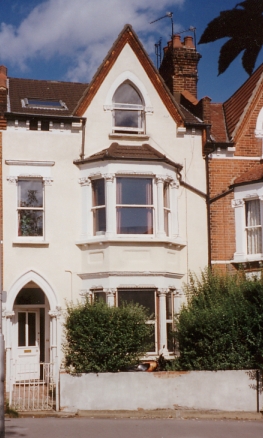
Redcot, South Norwood Hill. |
Early in 1903 due to a continuing reduction in
his financial circumstances, Massey was forced reluctantly to make a
last move to a smaller semi-detached house not far from Warminster
Road. At ‘Redcot,’ 46 South Norwood Hill, (now number 24), he
settled finally to complete his writing. Using an upstairs
room as a study that overlooked a vista of trees towards the Crystal
Palace, he had a speaking tube fitted to connect with the drawing
room downstairs. Before venturing down during the day, this
room had to be at a temperature of 60 degrees, so as not to
exacerbate his increasingly severe attacks of bronchitis during the
winter months. Compared with the previous two works, his last
book took a long while to complete, due to his frequent
interruptions by illness. Because of the unforeseen expense he
was compelled in 1904 to apply yet again for a Literary Fund grant.
Supported by John Churton Collins and George St Clair, a member of
the Palestine Exploration Society and Society of Authors who had
reviewed his
Book of
the Beginnings favourably in the Modern Review, he
received £150. By July 1906 with his book nearing completion,
he was obliged to consider the costs of publication. The
property that had provided him with a small rental had been sold
some years earlier, and he was left with the annual £100 Civil List
pension as sole source of income. However, with backing from
Dr Albert Churchward and John Tannahill, a previous neighbour from
Warminster Road, the Royal Literary Fund allowed him £100 towards
the publication of his book. Author friend James Milne, editor
of the Bookman and literary editor of the Daily Chronicle
visited him in 1905, and again in early 1907 just as
Ancient Egypt
was being prepared for publication. He saw that Massey was
cheerful and fresh in mind, although frail and weary. In
comparing the writing of poetry with that of prose, Massey said that
he found the writing of verse more exhausting, sometimes spending a
night in getting a stanza, though he wrote very little poetry now.
It was necessary to feel a thing vitally before giving it out in
words. Mentioning his visit to Tennyson whom he had met in
London when Tennyson was in bed with poor health, he remembered his
frank bluntness, almost roughness of his personality which did not
seem to agree with the Italian suavity of his poetry. If he
himself had been a poet of society, he might have been supping with
duchesses instead of living apart and writing books about the
origins of civilisation. He remembered sending a poem at one
time to either the
Morning Herald or Standard which replied that although
they liked the piece very much, they wanted something milder on the
same lines. They did not get their poem as he always refused
to do anything to order. Concerning his earlier Book of the
Beginnings he found a reference to a review [stated to be in the
Dutch Litteraturzeitung] by Richard Pietschmann (1851-1927) a
German scholar and Egyptologist who had written that:
“This book belongs to the most advanced reconstruction
researches, by which it is intended to reduce all language,
religion, and thought to one definite historic origin . . . The
author, however, differs from all similar writers in that he is an
Evolutionist, holding that he who is not, has not begun to think for
lack of a starting point . . . This view, of which modern philology
has not yet dreamed, has not hitherto had any Egyptian researches
brought to bear in its support. This the author saw, and saw also
that not only must one be an Egyptologist, but also an Evolutionist,
and one of the newer theology.”
Replying to a question as to his next work,
Massey gave a cheerful laugh, and quoted a verse:
|
‘Fight on my men!’ Sir Andrew saith,
‘I am hurt a little yet not slain.
I'll but lie down and bleed awhile,
And then I'll up and fight again.’ |
Then, as if speaking to himself, he added, ‘In this life or some
other.’[23] There was a hint of regret that
he had been unable to devote sufficient time to the younger members
of his family:
|
Child after child would say—
‘Ah, when his work is done,
Father will come with us and play.’
'Tis done; but Play-time's gone. |
In the Norwood area Massey was still regarded as
a notable Victorian poet, and just prior to his 79th birthday a
reporter from the
Norwood News went to obtain an interview. As Massey did
not feel well enough at that time, his daughter Christabel supplied
the reporter with a brief history of her father's early life.
Unfortunately Christabel's memory was not always accurate, and the
reporter had to supplement his article from the introduction to
My Lyrical Life. The outcome, apart from some publicity,
was therefore devoid of any anecdotal interest.[24]
The
Daily Mirror also noted that latest period of ill-health
which confined him to bed for several weeks, and mentioned that some
of his friends were attempting to procure him a grant from the Royal
Bounty Fund.[25]
Ancient Egypt. The Light of the World. A work
of reclamation and restitution in twelve books was published on
the 30 September 1907, financed in part with his grant from the
Literary Fund. Even so, he could afford only to have 500
copies printed. Totalling just under a thousand pages, the
‘twelve books’ were subject sections. The Book of the
Beginnings had dealt principally with comparative philology, the
Natural Genesis with typology, and he wrote Ancient Egypt
as being necessarily more fundamental to the two, being based to a
great extent on astronomical mythology and its development through
to the Christian religion. Massey's thesis, as follows, is
primarily Afro-Egyptian in foundation. Postulating that man,
who was continually evolving, had his earliest origins in Africa
around the area of the great lakes, Tanganyika and Victoria, he
considered that there were several migrations via Egypt which
gradually extended to Europe, Asia, Australia and the Americas.
The earliest was of the paleolithic negroid pygmy people, who were
pre-Totemic. At least two further migrations by Nilotic
Negroes followed, who were Totemic, believed in a Great Mother and
propitiated elementary (superhuman) powers and ancestral spirits.
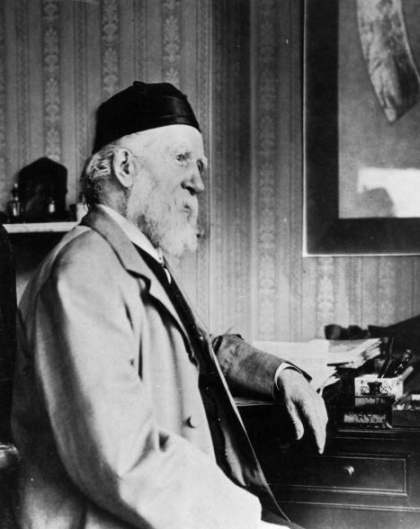 |
|
Gerald
Massey in his study at Redcot. The last year.
From Book Monthly, 4, 1907.
(The British Library) |
Three other main migrations followed, which could
be determined by the type of myth they had developed up to that
time.[26] At the beginning when the
earliest myths were shaped in the equatorial region, when heaven
rested on the earth, there was equal division of night and day, thus
making the first division of a circle. This tradition was
maintained in the Egyptian ‘Book of the Dead’ where the twelve hours
of darkness were imaged by twelve gates of the underworld in Amenta.
The pole stars were on the two horizons, with the risings and
settings of the stars being vertical. During northward
migration the heaven of that pole, or tree, would appear to rise up
from the mount of earth, while the southern pole star and
constellations would sink below the south horizon—an astronomical
‘deluge’ or ‘fall from heaven’—the beginning of sign language
constellated in the stars.
Passage of time was reckoned by the precession
and circling of the seven pole stars, represented by the seven souls
of the god Ra, and the seven steps for ascending heaven which the
souls climbed to reach their eternal rest among the never setting
stars.[27] This imagery was maintained in
the book of seven seals in Revelation, the Watchers in the Book of
Enoch, the seven footsteps of Buddha, the seven Stations of the
Cross, etc. The northern heaven, therefore, depicted the
Egyptians' primeval homeland in objective uranographic picture form.
Another example of the duality present in Egyptian representation
was that of the water cow, the mother of earth. Symbolised in
part as a thigh, it was constellated in the northern heavens both as
the place of birth on earth, and rebirth in heaven. It is
important in following Massey's thesis to remember that many of the
Egyptians' earliest representation of forms of power were as
zootypes. Therefore the serpent was later translated in
mythology as a form of renewal, and developed in the eschatology as
eternal life. The jackal was the seer in the dark, and became
the guide of the soul in death. Similarly, the hawk became the
soul of the sun, and later Ra, the divine spirit. Solar-based
mythology developed to denote the subterranean path of the nocturnal
sun. The soul's road to the heaven of eternity was now
through, and not round, the subterranean earth, which now had a
firmament - the celestial water—both above and below it. One
pillar supported the firmament above the earth, another below.
There was therefore a dual plan, both stellar and solar, upon which
the Egyptian temples were built. The soul travelled through
twelve gates, corresponding to the twelve hours of darkness, from
the gate of glory at sunset with a first weighing and judgement of
the soul in the great hall of Amenta, to the gate of glory at
sunrise. By means of the Milky Way the soul travels by boat,
climbing a ladder of seven steps—figured on earth in the
seven-stepped pyramid of Saqqara—to join another boat for the final
journey to the circumpolar paradise.
The pyramid, as a form of mount by which the soul
ascends to heaven, is represented also by the Great Pyramid, where
the north shaft in the king's chamber showed the way to heaven,
focused on the then pole star Alpha Draconis, and above the
constellation Cassiopeia. The Sphinx is a commemorative and
representative image of the solar god of the ‘double horizon’, or
two equinoxes. Humanly male in front, and female as a lion
behind, it shows the Pharaoh as the lion-image of solar glory.
It is a compound image of the mother earth, and young god whom she
brought forth upon the horizon of the resurrection. Massey
considered that the Sphinx, or an earlier representation built on
the same site, was older than the pyramids.[28]
Identification of Egyptian deities as gods, goddesses and zootypes
that are depicted in the constellations can be made in the Dendera
zodiac which, although drawn by Greeks, are earlier Egyptian in
type.
Identified with the last division of heaven into
twelve parts are the Sumerian legends of the solar Gilgames, the
Greek twelve labours of Hercules, and the voyages of Jason and the
Argonauts. The journey of the soul from human death to eternal
life has many parallels in world mythology, and formed the basis for
development of religious eschatology. All the Egyptian
religious writings are therefore of particular interest during the
Middle Eastern diaspora with its fusion of Greek and Semitic
systems. This is particularly so in the development of
Christianity, with specific regard to the influence of the
Egypto-Gnostics.
Massey considered that the Egyptian ‘Book of the
Dead’, although being the latest development of Egyptian religious
belief and solar based, combined some of the previous modes of
thought illustrated in the earliest pyramid texts and intermediate
coffin texts. It became ultimately the Egyptian book of life,
and the pre-Christian word of God.
There were only a few reviews of his book, which
he did not live to see. Nature, in common with reviews of his
earlier works, dwelt on his philology which they thought
particularly suspect, and suggested, strangely, that he had not read
deeply enough. It considered his statement that mythology was
not to be fathomed to its depth by means of the folk-tales in
Frazer's Golden Bough, did not accord the right of Massey to
criticize Mr Frazer.[29] Massey had
commented in vol. II, p. 672 that “… mythology is not to be fathomed
in or by a folk-tale, and the Golden Bough is but a twig of the
great tree of mythology and sign-language - a twig without its root
… it was hailed as if it had plumbed the depths instead of merely
extending the superficies …” Massey continued, giving examples
of comparisons. In vol. I, p.9 and in his ‘A
Retort’ (Lectures, ‘The Seven
Souls of Man’, 1887), he replies, very abrasively to critical
comments made by William Coleman, Prof. Le Page Renouf and Prof.
A.H. Sayce. He had already presented his theories, which he
had taken a stage earlier in time than Fraser, that in the most
primitive phase mythology is a mode of representing certain
elemental powers by means of living types that were superhuman, like
phenomena in nature. Mythology exhibits a series of types as the
representatives of certain natural forces from which the earliest
gods were evolved. How these were thought and expressed of old
in this language constitute the primary stratus of what is called
‘Mythology’ today. Early man made use of things to express
their thoughts, and those things became symbols, the beginnings of
gesture sign-language by imitation being earlier than words.
Myths were founded upon natural phenomena and remain the register of
the earliest scientific observation. Massey treats mythology
as the mirror of prehistoric sociology (Natural
Genesis, I, xiv and section I). A brief mention in the
New York Times noted his wide knowledge and elaborate
treatment.[30] The review by George St
Clair, for the
Literary Guide, complained yet again about his philological
renderings, particularly on his interpretation of Hebrew proper
names.[31]
Presentiment that his work had been completed
became reality only a few weeks later. On 9 October he
developed pneumonia.
|
Slow step by step, day after day,
I journey on my homeward way;
And darkly dream the Land of Light
Is drawing near, night after night;
Where I shall reach my
Rest at last,
And smile at
all the troubles past … |
Despite the devoted attention of his daughter
Christabel and the aid of Dr Churchward, he succumbed gradually to
exhaustion and died on 29 October. Obituaries in the
Athenæum, Literary Guide,
Daily News,
Times and
Two Worlds all praised his poetry.[32]
The
Literary Guide
made brief favourable note of his subversions of the Christian
faith, and Two Worlds focused on his Spiritualistic
activities. At local level, the Norwood News summarised
his life, and considered that the moral of his life was the power of
genius to triumph over the most adverse circumstances. From
the Town Hall, Croydon, H. Keatley Moore mentioned that when the
library purchased Massey's Ancient Egypt, he autographed the
copy and wrote a verse for them, adding that it was not every
borough that could boast of a living poet amongst its burgesses … [33]
The following week a local resident, A. R. Speake, sent a poem in
praise of Massey:
… O! we would fain not say to thee ‘Farewell,’
It may be that beyond this universe
We yet shall look, dear Poet, on thy face,
And hear the sweetness of thy voice again.[34] |
|
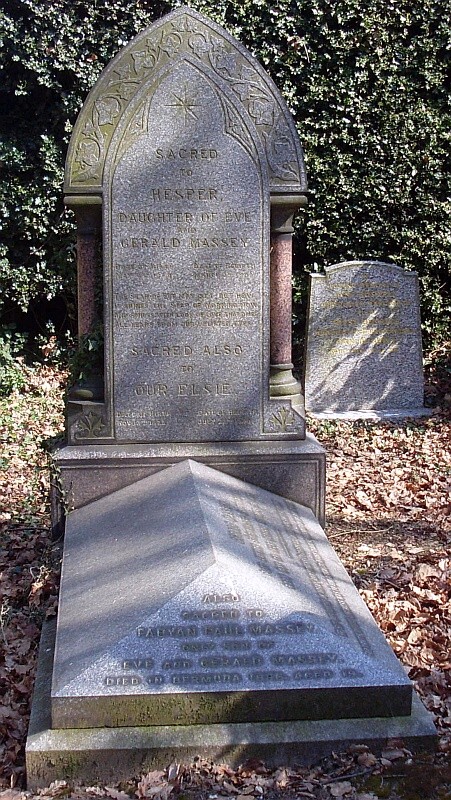
Massey family grave at Southgate Cemetery
(location Grave No. W.164).
The inscription on the headstone reads . . . .
|
THE STAR OF EVE MAY SET BUT HOW IT
SHINES THE STAR OF MORNING NOW
AND SMILES WITH LOOK OF LOVE THAT DRIES
ALL TEARS FROM OUR UPLIFTED EYES. |
|
The funeral, a quiet family affair with about
fifteen people being present, took place in Southgate Cemetery on
the 4 November. Mrs Massey together with her daughters and a
few friends arrived in two carriages, and the coffin with twelve
wreaths was carried straight to the grave where James Milne, at
Christabel's request, gave a brief address prior to the interment.
An epitaph added later by the family referred to Massey as ‘Poet,
Author, Spiritualist, Egyptologist’, and his uncompromising
allegiance to the Spiritualist's view of death by the inscription,
‘Born May 29 1828. Reborn October 29 1907’.[35]
Massey's will, made on 13 October, witnessed by
Dr Churchward and a neighbour, disclosed the extent to which he had
been reduced financially. The Leader reporting his death had
commented:
If the late Gerald Massey had lived in Johnson's time, he would
probably have incurred, as Milton had done, the Doctor's ungenerous
condemnation, by doing what the Doctor himself did—accepting aid
from the state. Few men could claim to have earned their
modest Civil List Pension more thoroughly than Massey … [36]
But the annual Civil List pension ceased with his
death, and his wife and three unmarried daughters, two of whom were
invalids, found that they had £106 0s 1d (in today's value this
would be equivalent to some £6,000) to live on for an indefinite
period. Acting on the advice that had been suggested to them
just prior to their father's death, they applied for a grant from
the Royal Bounty Fund and, in January 1908, were awarded £200 by the
Prime Minister, Sir Henry Campbell-Bannerman.[37]
The following March, Christabel made application for assistance to
the Royal Literary Fund. She received strong backing from
James Milne and Claude Montefiore, and sent the committee a copy of
review extracts from a circular issued for one of Massey's lecturing
tours. The Literary Fund responded with a final grant of £100.
Earlier that year, James Robertson of Glasgow; a
Spiritualist friend, had suggested that a subscription fund be
commenced on behalf of Massey's widow and daughters. They were
hardly in a position to refuse. Robertson commenced this in
May by making a personal donation of £10, distributing a printed
circular to friends, and publicising the fund in
Two Worlds.[38]
The subscription was headed by the Bounty Fund grant, and it was
hoped that a sum in excess of £1,000 would be donated in order to
provide the family with a small yearly income. Although the
final total of the subscription has not been traced, it is likely
that the target figure was reached.
Christabel and the family remained in ‘Redcot’
until 1912, when Massey's widow Eva, and daughters Maybyrn, Cecilia
and Evelyn moved to 43 Casewick Road, Norwood. Maybyrn died of
tuberculosis on 22 June, 1919. Due to Eva's increasing
senility, Christabel joined them in 1923 but the family was unable
to cope. Eva was then placed in a nursing home at 129 Tulse
Hill, where she died on 12 March 1924. She was buried in her
husband's grave at Southgate, but is unnamed in epitaph, due
probably to the family's straitened financial circumstances.
Cecilia died of pleurisy on 30 November 1932 at 7 Stodart Road,
Penge, where she had moved with Christabel following Eva's death,
and Christabel died at 214 Anerley Road, Penge, on 24 February 1934
from chronic bronchitis (for an article by her see under Christabel
Massey in the
Miscellanea section).
Massey's last daughter, Evelyn, who was living then with her
daughter Helena at 26 Palace Road, Streatham, died in Weir Hospital,
Balham, on 1 June 1940 of lung cancer. Following the death of
Helena on 26 February 1988, Massey's direct line had come to an end. |

Mayburn Massey. One of Gerald Massey's unmarried daughters
(Miss H. Bruton).

Gerald Massey's married daughter, Evelyn (Bruton)
(Miss H. Bruton).

(see updates in the passage below)
|
Of Massey's (known) siblings - additional
information to the Family Tree diagram:
-
Edwin was the brother whom Massey had referred as “never able to
look after himself.” Following a few years in the army, he
became an itinerant hawker, dying in the Union Workhouse,
Lincoln, on 1 February 1904. His death certificate states
that he was “accidentally killed by being knocked down by Pony
and Cart”. Edwin appears to have had 4 children—Elizabeth,
b 1856, Mary, b. 1862, Joseph, b. 1867, Lydia, b. 1870, none of
whom are believed to have reached adulthood. The last
record of Edwin's wife, Mary, is in the 1901 Census which shows
her an inmate of the Berkhamsted workhouse.
-
Frederick, then 68 years, appears in the 1901 census as a
“Ladies' Hatter”, a job that seems appropriate taking account of
the importance in Tring, during his childhood, of straw plaiting
to the nearby Dunstable and Luton-based straw hat industry.
In 1901 he lived at 2 Draper Street, Newington, London, with his
wife, daughter and two in-laws. Frederick died of
pneumonia in Forest Hill, London on 10 November, 1910. He
had 10 children including 4 sons—Frederick William, b. 1859 (he
set up the cab drivers' union in South London), Henry, b. 1861,
Thomas Jerrold, b. 1864, and Percy, b. 1882 (died in infancy).
-
Henry Massey is recorded in the 1861 Census as an “Author in
Prose”, but no publications have been traced. At that time
he was staying with the Massey family in Rickmansworth, but does
not appear to have been resident in that locality. Henry
died of pulmonary tuberculosis in Marylebone, London, on 12
July, 1875, the occupation entered on his death certificate
being a "painter's labourer". He appears to have had 3
children — William, b.1867, Percy, b.1872 and Bertha, b.
1873.
Of Massey's other known relatives of the time,
the 1861 census shows Elizabeth Massey, a niece then aged six
(Edwin's daughter), staying at Tring Wharf with Massey's parents.
Born in Sydenham, no registration has been traced. Another
niece, Adelaide Massey (Frederick's daughter), aged 39 and described
as an “Assistant High School Mistress”, is listed in the 1891 Census
staying with the Massey family in London. |
|
 |
 |
|
Photo, thought to be of Frederick Massey,
one of Gerald Massey's brothers.
(Photo: Heather Massey.) |
|
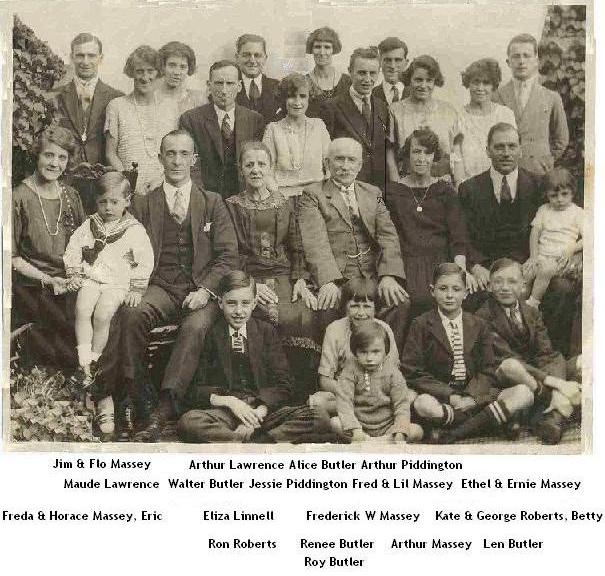
Descendents of Frederick Massey, ca 1927.
(Photo: Heather Massey.)
|
There is no major holding of Massey's correspondence, which is dispersed
in UK and American libraries. The Location Register of 20th
Century English Literary Mss (British Library, 1988) is incomplete and
the 1995 edition contains no further Massey entries. All other
items of relevance have been sourced and are cited in footnotes.
Two references to Massey are made in areas in which
he had resided. Grove Road, Southgate, has an entrance to the New
Southgate Roundabout named ‘Massey Close’, at the corner of which are
‘Massey Close Flats’. The original houses and Baptist Chapel in
the road have been demolished. The name of Massey is remembered
also in his native town of Tring, where a luxury block of flats in Brook
Street—not far from the Silk Mill in which Massey was employed as a
child—is named Massey House in his honour. From 2005 the Tring and
District Residents' Association commenced funding an annual Lyric Poetry
Competition open to pupils at Tring School. The winner accepts the
‘Gerald Massey Prize for Lyric Poetry’. At his last residence in
Norwood it is hoped that the borough will eventually provide a
commemorative plaque under their Croydon Heritage Plaques Scheme.
A number of Massey's early, more pious poems were
incorporated for use as hymns, including number 47 in the Labour Church
Hymn Book, 313 in Songs of Praise, and three in the Spiritualists Hymn
Book. A slightly altered verse from his poem ‘Today
and Tomorrow’ was used by the Welsh miners' Cambrian Combine Strike
Committee in their manifesto of 1911.[39] In
1915 his poem ‘That Merry, Merry May’
was set to music by Christabel Baxendale (Ricordi & Co.). See also
fn. 39 for further listings of his poems that were
set to music.
No evidence of a Spiritualistic post-mortem
communication has been found, although he did appear some years later in
front of his grand-daughter—in the form of a motto in a Xmas cracker:
|
Warm is the Welcome! 'Tis our
way to grasp,
The hand in love or greeting
Fondly clasp.
Gerald Massey.[40] |
While this would no doubt have appealed to Massey's sense of humour, his
grand-daughter was constrained to comment, ‘How have the mighty fallen!’
Following that, he put in an even more physical appearance as the
subject of a cigarette card.

This was one of a series of personalities issued by
Cousis & Co., Malta in the early 1900's. The picture was part of a
larger one published in England in the late 1890's.
[Chapter 9]
NOTES
|
|
1. |
Medium and Daybreak,
17 Jun. 1887, 377-8. |
|
2. |
Ibid. 22 Jun. 1887, 454-5. |
|
3. |
The
Great Cryptogram: Francis Bacon's cipher in the so-called
Shakespeare plays by Ignatius Donnelly, 2 vols. (London, Sampson
Low, 1888). In support of the cypher theory in the plays, see also
E. Johnson's Shakespearean Acrostics (London, Cornish, 1942).
Against the theory, see W. and E. Friedman's The Shakespearean
Cyphers Examined (Cambridge, U.P., 1957).
So far (at least) as the Sonnets are concerned,
Massey was unequivocal in “Admitting
as we all do that Shakspeare wrote his Sonnets …”
Delia Bacon's (unsigned) article, William
Shakespeare and his Plays; an Inquiry concerning them appeared
in Putnam's Magazine, Vol. VII., January—July, 1856 (pp
1-19). Following publication of her first article, the
magazine received such negative comment and criticism that the
proposed series did not materialize. Delia Bacon later
published her theories that Shakespeare was authored by Sir Francis
Bacon, Sir Walter Raleigh and Edmund Spenser (receiving some support
from, among others, Ralph Waldo Emerson) in The Philosophy of the
Plays of Shakspere Unfolded (London, Groombridge, 1857).
She died in 1859. The politician William H. Smith also wrote a
book on the theory that Bacon authored Shakespeare. Bacon and
Shakespeare: an Inquiry … (London, Smith, 1857). The
“Oxford" theory of Shakespearean authorship was apparently first
proposed by J. T. Looney in his ‘Shakespeare’ identified in
Edward De Vere, the seventeenth earl of Oxford (New York,
Stokes, 1920). Looney's theories regarding de Vere promoted,
in 1957, the establishment of the ‘Oxford Society’, which has since
gained many supporters.
Scholarly theories continue to be published that
assign differing authorship to Shakespeare's works, either complete
or in part. In his large work on the Sonnets (The Monument:
Shake-Speares Sonnets, Meadow Geese Press, Mass. USA., 2005),
Hank Whittemore identifies the author of the Sonnets as Edward de
Vere, 17th Earl of Oxford, whose objective in writing them was to
preserve a record of Henry Wriothesley, 3rd Earl of Southampton.
In Whittemore's view, Henry Wriothesley was the unacknowledged son
of Edward de Vere and Elizabeth I, and thus had the right to be King
Henry IX of England, a claim that would have been treasonable unless
concealed within the historical parts of the Sonnets.
Whittemore identifies the “Fair Youth” as Southampton and the “Dark
Lady” as Elizabeth I (whereas Massey identifies Lady Penelope Rich,
sister of the Robert Devereux, 2nd Earl of Essex, as the Dark Lady).
The authors of The Truth Will Out. Unmasking
the Real Shakespeare
(Brenda James and William Rubenstein, Longman, 2005) claim a new
contender, Sir Henry Neville, wrote Shakespeare's works. They
assert also that Neville addressed the ‘Dedication to the Sonnets’
to Southampton, identifying him as the ‘Mr. W.H.’, the mysterious
dedicatee of the work, and that ‘Mr. W.H.’ was Neville's
affectionate nickname for Southampton.
To Shakespeareans, all scholarly theories on
authorship have their own validity and, as such, are worthy of some
attention rather than outright dismissal. While such theories
continue to cast some doubt on the subject, until positive
supporting primary material is discovered they remain a matter of
interesting speculation. |
|
4. |
Punch, 95, (10 Nov. 1888), 221. Donnelly did not wilt too
much. In 1899 he published The Cipher in the Plays and on
the Tombstone [of Shakespeare] (London, Low). |
|
5. |
St.
James' Gazette, 7 Jan. 1889, 7. |
|
6. |
Quoted
in Medium and Daybreak, 5 Feb. 1892, 91. |
|
7. |
Times Literary Supplement, 30 Oct. 1937, 803. Massey's remarks
are on p.420 and in fn. 163
of his
Shakspeare's Sonnets. |
|
8. |
National Review, 12 Oct. 1888, 238-59. |
|
9a. |
See the
Daily Chronicle, 28 May 1888, 5, and 18 Sep. 1888, 3. |
|
9b. |
(i)
W.H. Cundy was a printer and publisher in Washington Street, Boston.
During Massey's first American tour, Massey was hosted at a meeting
of the Franklin Typographical Association in 1874. Cundy was then
president of the society. (ii) The reference to which Massey refers
is not clear. His 10 lectures had been published privately in 1887.
(iii) The Shakspeare book to which he refers would be his Secret
Drama of Shakspeare's Sonnets, 1888. |
|
10. |
Cited
in Banner of Light, 17 Nov. 1888. Lecture report in the issue
of 24 Nov. |
|
11. |
Banner of Light,
15 Dec. 1888, 4. H.P. Blavatsky's journal
Lucifer,
1888, vol. III, 74-78 under 'Gerald Massey in America' gives the
titles of these lectures. |
|
12. |
Athenæum, 9 Nov. 1889, 629-30. |
|
13. |
Saturday Review, 31 Aug. 1889, 245-6. |
|
14. |
Medium and Daybreak, 17 Apr. 1891, 247, and 24 Apr. 264. |
|
15. |
Ibid.
10 Nov. 1893, 709-10. |
|
16. |
Thomas
Lake Harris' Hymns of Spiritual Devotion (New York, 1857)
referenced in Massey's Concerning Spiritualism, 20-21. |
|
17. |
Memoirs of a Social Atom, op. cit., 1, 161-2. |
|
|
18. |
The
Harney Papers, letter 214. Massey's inscribed copy of
My Lyrical Life that
he sent to Harney is in Vanderbilt University Library. |
|
19. |
Harney's biography is excellently presented by A. R. Schoyen in
The Chartist Challenge (London, Heinemann, 1958). John Saville's
introduction to the reprint of Harney's Red Republican and Friend
of the People 2 vols. (London, Merlin, 1966) also has much
information. |
|
20. |
The
Bookman, Nov. 1897, 33-36. |
|
21. |
Ibid.
Jan. 1898, 121-24. |
|
22. |
British
Library Add. Mss. 4644 1.f. 154. |
|
23. |
Book
Monthly, 2, (Jul. 1905), 703-6. 4, (Sep. 1907), 845-51.
(Referred to also, and expanded in an article by W. H.Simpson in
Two Worlds, 7 May 1906.) |
|
24. |
Norwood News, 25 May 1907, 5. |
|
25. |
Daily Mirror, 21 May 1907, 4. |
|
26. |
See
Churchward, Signs and Symbols of Primordial Man (op. cit.)
437, for a chart of these proposed migrations. See also his
Origin and Evolution of the Human Race (1921). He closely
follows, and summarises Massey. |
|
27. |
Massey
used the (then) up-to-date information in Sir J. Norman Lockyer's
Dawn of Astronomy (London, Cassell, 1894), the first book to
demonstrate an astronomical basis in Egyptian temples. Massey
reprinted the diagram on p. 127 showing the precession of the
equinoxes. In a letter to Lockyer dated 30 June 1906 written by his
daughter Christabel and signed by him, he requested permission to
publish that and two other diagrams. Ms. Exeter University. |
|
28. |
Ancient Egypt, 1, 336-39. |
|
29. |
Nature, 77 (30 Jan. 1908), 291-2. |
|
30. |
New
York Times, 15 Feb. 1908, 89. |
|
31. |
Literary Guide, 1 Feb. 1908, 21-22. |
|
32. |
Athenæum, 2 Nov. 1907, 553. Literary Guide, 1 Dec.
1907, 183 and 187-8. Daily News, 31 Oct. 1907, 4. Times,
30 Oct. 1907, 8.
Two Worlds,
8 Nov. 1907, 558-9. |
|
33. |
Norwood News, 2 Nov. 1907, 8. |
|
34. |
Ibid.
9 Nov. 1907, 3. |
|
35. |
Grave
No. W.164. The grave was initially prepared and used for Massey's
daughter, Hesper, as the main headstone depicts. See
photo. |
|
36. |
The
Leader; 30 Oct. 1907, 3. |
|
37. |
Acknowledgement in British Library Add. Mss. 412401.215. |
|
38. |
Two Worlds, 8
May, 1908, 23 1. |
|
39. |
Benn,
Tony, (ed.) Writings on the Wall. A Radical and Socialist
Anthology 1215-1984 (London, Faber, 1984), 157. The poem was
used in the context of a manifesto by the South Wales miners, 16
June 1911, in their minimum wage dispute. Further poems of Massey's
that have been set to music are held at the following Libraries (see
also 'Sheet Music' under
Miscellanea):
• No Jewelled Beauty is my Love, poetry by Gerald Massey.
This is a single copy of 'In Happy Moments' ballad, from W. Vincent
Wallace's Grand Opera Maritana performed at the Theatre Royal, Drury
Lane, and dated 1845. The original words by Edward Fitzball have
been covered in manuscript by part of the first two verses of
Massey's 'No Jewelled Beauty is my Love.' The top of the score
carries the citation: 'The Poetry of this Ballad is by Gerald Massey
Esq.r'. This copy of the Ballad was obtained by the British Library
in 1873, and the origin and date of the copy is not known. British
Library Shelfmark H 1654.q.(14). Photocopy in The Gerald Massey
Collection, Upper Norwood Joint Library.
• Before Sebastopol, poetry by Gerald Massey, music by Joseph
Frederick Leeson. Published by J. Purdie, Edinburgh; Chappell,
London, c. 1855. (British Library).
• Desolate, music by Flora, published by Chappell & Co,
London, 1875 (Cambridge University Library).
• A Maiden's Song, music by William Shepherd, published by
Weekes & Co, London, 1877 (Cambridge University Library).
• O! Clasp thy hands little one, music by Beta, published by
Metzler & Co, London 1877 (Cambridge University Library).
• That merry, merry, May, music by Charles W. Thomas,
published by Novello, Ewer & Co, 1878 (Cambridge University
Library).
• The People's Advent: a new Quartette for the Times. Words
by Gerald Massy [sic]; music by James G. Clark. (1830-1897).
Published by H.M. Higgins, Chicago c. 1864. (Rare Books & Special
Collections Division, Library of Congress). Copy available in the
Gerald Massey Collection, Upper Norwood Joint Library.
• Together. Song for Medium Voice. Words by Gerald Massey,
music by J.A. Parks, published by J.A. Parks Co, York, Nebraska.
(Kilgore Memorial Library, York, Nebraska.)
• Down in Australia. Two-part song. Words by Gerald Massey,
music by Clara Angela Macirone. Published by J. Curwen & Sons,
London, 1903 (British Library). |
|
40. |
From
the first verse of his poem 'The
Welcome Home.' |
|


