|
[Previous
Page]
FROM THE
DENVER MIRROR
25 Jan. 1874.
CONVICTION AND CONVERSION
________
Gerald Massey, the Famous Poet and Philosopher,
Tells How and Why he Became a Spiritualist.
________
Startling Personal and Family Experiences—Groping for Light
Through Fogs of Doubt and Conjecture.
________
The Continuity and Intimate Relations of Spiritual
Life in This World and the Next Explained.
________
Death, the Process of Birth Into a New Existence—
The Immortal Progress of the Soul.
________
I begin with my own facts, because they are more to me
than anybody else's facts received on hearsay. Indeed, if I had
not known certain things were true and real, I think I never could have
believed them at second hand, no matter what the amount of testimony
might be. I may say with Horatio, "Before my God I might not this
believe, without the sensible and true avouch of mine eyes and ears."
Dear me! how I doubted, and doubted in the presence of the
phenomenon itself! In truth, it seems to me that I only arrived at
belief by doubting and doubting until I doubted my doubts. I see
it stated that Prof. Agassis saw at one single glance the whole thing as
all imposture. It took a great wrench to lift me out of the old
ruts of thinking. I did not reach my present conclusions for
years.
SLOW TO BELIEVE.
It has been remarked on as an oversight of Shakspeare's
that he should have shown the great sceptic, Hamlet, as positively
doubting the continued existence of the soul, just after it had been
revealed and demonstrated to him by the spirit of his own father, who
came to prove his identity by word of mouth and to unfold the secrets of
both worlds. My own experience leads me to look on this not as an
oversight, but as one of the poet's profoundest insights. He knew
how hard it is for many to accept those facts of the spiritual, even
though (as was said of old), "one came from the dead." The facts I
shall make use of are those that I recorded just as they occurred.
I will answer for most of my facts with as much certitude as Mr. Crooks
can for his. I speak in all sincerity, meaning exactly what I say,
and do not doubt that the truth, truly spoken, will ring true on the
touchstone of all true souls.
WONDERFUL CLAIRVOYANT POWERS.
Some twenty-two years ago I was invited to see a young
clairvoyant read without the use of the eyes. So little did I know
of the subject, that when I was asked to hold the eyelids down whilst
she read, I left my fingers as far apart as possible, so that she might
see through them if she liked. I did not wish to prevent her
reading. Possibly my intended kindness told in my favour, for that
clairvoyant became my wife, and her first consciousness of meeting me, I
found afterwards, was when she was in the magnetic trance. I was
indignant at the treatment and the torture to which I thought she was
subjected to gratify people's curiosity, and it ended in our running
away from it. I afterwards found that this reading by some
abnormal vision was a fact, however unbelievable. She had
manifested the power from nine years of age. I have seen her read
so hundreds of times, and convince hundreds of people, including men
like Brewster, Hallam, late Earl of Carlyle, and the present Duke of
Argyle and Bishop of Winchester. Many persons were prepared for
the phenomena of Spiritualism by what they saw of her clairvoyance.
The speaker then detailed at some length the various
methods which himself and others had taken to prevent the lady from
reading in this manner, and the uniform failure of these plans, and
specified several instances of the remarkable clairvoyant powers
possessed by her, which in time broadened to the shores of a wider
development in mediumship, and then proceeded in touching language to
refer to his departed daughter and the sickness of his wife.
MENTAL ECLIPSE NO INSANITY OF SOUL.
The loss a of peculiarly dear little child had preyed
on the mother's mind. This was our "wee white rose of the world."
Also the brain had been injured in childhood by ignorant parents.
Indeed, a spirit once said to me, "She is one of those who receive the
mortal wound from before birth."
I take it that was a part of the conditions. The
partition that divided one kind of consciousness from another was very
thin—the mind would waver at times. I am satisfied, though, that a
great deal of supposed insanity is only a disordered kind of
somnambulism, as will be seen when the subject comes to be judged from
the spiritual side. You may remember what Charles Lamb says about
his poor sister's brilliant, witty talk; when her mind wandered, as we
say, it was incomparably better than most sane people. When the
aberration became most apparent, if I could only induce the magnetic
trance I found there was no such thing as insanity of the soul, however
the brain consciousness might be arrested. There was serenity and
clearness in the depths of the spirit-life, while the troubled life of
the brain ran on a river of oblivion above; so I saw how in madness,
idiocy, under chloroform or in infancy, the spirit that is eclipsed for
the time being and shut in darkly from us, may have its lucidity and be
fed with light from the spirit world to which it is united, with which
it communicates through life, and into which we pass in death with an
internal waking.
CONTINUED MENTAL ILLNESS.
I am bound to admit there were times when I could not
mesmerize, that the mind has been righted again in response to prayer.
You see I did not know there was any natural law opposed to such a
possibility, and no doubt was very much in earnest. Our knowledge
and recognition of the impossible is often just the thing that prevents
the possible.
In the year 1863 this mental illness took a bad turn.
For seven days and nights it had been permanent. Doctors insisted
that I must put her away. Hitherto I had held out against them,
for it seemed to me that I knew so much more about the case than they
did.
But now I wavered. I could not get her mesmerized
to consult her. One Sunday night I held a consultation with the
doctors. They insisted on her removal. I said I would decide
next morning. I got to bed about 11 o'clock, having given my wife
some medicine; put out the light, and lay down beside her.
FIRST MANIFESTATIONS.
Still she was violent, but in spite of that, I heard a
strange noise at the foot of the bed. At first I thought it must
be her feet pushing the hot water bottle against the foot-board of the
bedstead. At length the noise arrested her attention, and she
blamed me for not keeping my feet still. I told her it was not me.
This seemed to steady her mind somewhat in a listening and fearful
attitude. The noise again began, and increased, I got a light, and
removed the hot water bottle. The sounds still went on. My
wife drew up her feet instinctively from the bed-foot, for by this time,
the sound were partly as though a rat were gnawing the mattress, or a
dog's tail whisking the foot-board. I thought perhaps one of the
dogs was in the room—no, I did not think so; I tried to feel that it
might be so. My wife insisted that one of the dogs was
in the room. We called, and I got out of bed to look. There
was no dog—nothing to account for the noise. I turned up the bed
and mattress at the foot to search. There was no explanation
there. I returned to bed again. The noise began anew—a
scratching, scribbling sound on the board, with an occasional slight
rap, in which the sound culminated, or made itself out more perfectly.
My wife screamed that she could not stand it, and would not lie in the
bed any longer. I tried to quiet her—for the sounds were quite
enough for me to attend to. I bore it for some twenty minutes
after being convinced that it was produced by neither or us.
INEXPLICABLE PHENOMENA.
Once indeed, I wondered whether it was possible for
thieves to be in the room underneath with an electric battery, trying to
occupy our attention by shaking our bedstead electrically while they
robbed the room. I invented all sorts at natural or unnatural
explanations. The sounds continued. Then I called the
servant, to see what effect the sounds would have on another person not
a poet, but of cool and unimaginative temperament. I did not tell
her why I called her. She thought it was because her
mistress was worse. She sat down and leaned against the bed.
The sounds came again louder and clearer. She passed through a
similar stage of wonderment, looked at me, as she said afterwards, to
see if I were frightened, and finding I was not, she did not see why she
should be, and so she did not bolt and leave me.
The servant girl's mother was then called, but the fact
produced no effect upon the continuance of the sounds. Mr. Massey
was convinced by this time that they proceeded from some other source
than a mortal one, but could not seem to attach them, on account of
their grovelling nature, with spirits according to his conception of
such beings. If a spirit were making these noises, he thought it
must be one of a low kind, and therefore bade it begone several times,
but to no effect.
SPIRITUAL SPIRITUAL PRESENCE.
Finally the spirits rapped, and he, by requesting them
to give three raps for yes, obtained from them the information that his
daughter Marian and his wife's mother were present, though invisible,
and had come to help his wife's head. Strong physical phenomena
supervened, the bedstead being rocked, and the feet of Mr. Massey being
"heaved up with force." After which he says:
My wife, who had leaned back, now rose up white and
rigid, and straight as a corpse might rise from a coffin, with the
fixed, staring eyes, not yet able to pierce the grave gloom, but
bursting through it. When quite upright, the face lighted.
She leaned a little forward, looking out over the bed foot, and in a
weird, intense whisper said with an ineffable smile, "Mother, Marian!"
and then sank gently back on my arm, and soon lay breathing softly, with
two tears steaming out of her closed eyelids. Spiritual presences,
apparently recognisable to her as persons, had succeeded in putting her
into the trance condition. In this state, consciousness began
where it left off a week before; all was a blank between, as was shown
by her first question. Of what we had passed through that night,
she knew nothing. The noise began again. "Oh, what's that?"
she said. I told her what had occurred. We continued the
conversation a long time that night. The upshot of the
communication was this: I was not to put her away on the morrow, though
she would be worse than she had yet been, and on the following Sunday
night she would be permanently better. And at ten minutes to 12
o'clock on that night week she was comparatively well. Thus in all
likelihood she was saved from spending some years in a mad house.
That purported to be the object of what I now consider the spiritual
world audibly breaking through, to communicate intelligently with me;
proving, in doing so, that invisible beings could see us, hear us, talk
with us, help us.
MULLER AND SHAKSPEARE.
From that time forward he had plenty of proofs of the
possibility of spirit communication, among them being the raps carried
to a greater perfection of telegraph signification—a species of
planchette—and the visions and descriptions by his wife. Among
other remarkable things given him, was a written communication relating
to Muller, the railway carriage murderer, who was captured on this side
of the water, and was undergoing his trial, said communication citing
facts to show that he was not fully responsible for the homicide.
On the strength of this, the speaker sent a communication to the London
press, calling attention to these circumstances, but, as it happened, it
was printed in only one of the papers, the News, but the writer
did not learn of its appearance till long afterwards. However,
Muller was found guilty and hanged, and after his death came to them in
spirit, and thanked the lecturer for the pains he had taken to save "his
poor neck."
The aid which the speaker had received from the
invisibles in unravelling the mystery attached to Shakspeare's
sonnets—through the mazes of which neither the medium of Mr. M had
any intellectual clue— was to him simply wonderful, and to it he bore
willing testimony. He had frequently in perusing the work, been
referred by the spirit to books thoroughly unknown to the medium or
himself, and on searching up the volumes, had found therein the
corroborating proof promised.
THERE IS NO DEATH.
The speaker then related a story concerning his
experience at a new residence whither he had just removed—said narrative
being of a nature akin to the various "haunted houses," the stories of
which so frequently of late have filled the columns of the secular
press.
Before passing away to the spirit-side of his wife, he
formed an agreement with her that raps should be made upon the clock,
where none had sounded before, and subsequent to her decease raps were
heard in abundance. On his first sitting with the medium, Home [Ed.
— Daniel Dunglas Home, a famed Victorian medium], a spirit took
possession purporting to be his wife and said "Oh, Gerald, when I turned
upon my left side to pass that night, and had got through, I could not
believe it. I kept on talking, and thought that you had gone
suddenly deaf, as I could not hear you answer me." That was
exactly what had occurred with me on this side of death. I
kept on talking and she did not hear. I have no doubt but that
truly represents the continuity of consciousness in death. There
is no break—no cessation of motion: it is like the top when we say it
sleeps—that seems to stand still when it spins perfectly.
CONVINCING EVIDENCE.
It is not my purpose merely to tell you a wonderful
story, or I might have filled my lecture with personal details.
But I would rather set people's brains at work inside their skulls, than
see hair standing on end outside of it.
Since my first gropings in the darkness of this
subject, light has dawned on me more and more, and the facts have gone
on unfolding their meanings until the presence of the spiritual world is
to me as real as that of the natural world; the unfeatured darkness has
unveiled a living face. I have felt the touch of spirit hands with
nobody within seven yards of me, and have had my own hand impelled to
write massages without any volition of mine.
Standing on this side of my facts, how should I care to
argue with those who stand on the other to assert they can't be true?
Where is the use of arguing when sheer ignorance of the subject is to be
the base of our opponent's reasoning, and his fundamental assumptions
are false, which are that he sufficiently divines the relationship of
mind and matter in the life which is known, so as to say that these
things are impossible to their relationship in a life that is to him
unknown!
UNCONSCIOUS CEREBRATION.
Sergeant Cox will tell you that this sort of abnormal
action implies a new force in nature: he calls it "Psychic Force."
But our "Psychic Force" friends do not touch physically the veriest
fringe of the phenomena. They have made a study of one ripple,
registered on the sand by the great ocean that is out of sight.
I know that Mr. Crooks has seen a thousand-fold more
than he can scientifically demonstrate to others. If the force be
spiritual, as we contend, it follows that physical science can only deal
with that registered record in the sand of the ripple passed away.
The speaker then paid his respects to Dr. Carpenter and
the "unconscious cerebration" theory, giving the subject caustic
treatment; cited the fact that the mesmeric phenomena, once ignored by
the scientist, were not brought forward to explain away those of
Spiritualism, and said: But it is too late. Our scientific
opponents,
|
"Like the
hindermost chariot wheels, are curst
Still to be nearer, but never to be first." |
When a medium
goes into the trance condition now, we presume it to be under spirit
influence. A spirit is the magnetizer. You will find by the
Bible, that this is an ancient form of mesmerism. "Where is the
angel Uriel," says Esdras, "the angel who came to me at the first? for
he hath caused me to fall into many trances. And as I was speaking
these words, behold he came unto me, and looked upon me, and lo! I
lay as one who had been dead!" At other times the hand is used in
this spiritual process, as it might be in magnetism. The hand of
the Lord, that is, of some spiritual presence, came upon the head of the
seer, Eliuan, and he saw and prophesied.
SPIRIT MESMERISM.
When the fact of the power of the mesmerist over his
subject was called to mind, we could see what a vision of
possibilities—seemingly limited only by the communicating power, and the
receptivity of the medium—was opened, if we came to accept as a fact
that a spirit, an inhabitant of another world, could become the
magnetizer. There was such a thing as "unconscious cerebration" of
thought. Half our mental life was passed in the process of thus
drawing from the wells of the world of the unknown. But, so far
from this "unconscious cerebration" furnishing an argument against
Spiritualism, it was one of the most vital proofs of its truth, the
brain being shown to be not the cause of action, but merely the agent of
the spirit's will. The spirit itself, said the speaker, dwells and
lives a life of which we on the outside catch only the shadows of its
motion on the curtain—the lightning of its presence, flashing through
its cloud.
THE BRAIN A MEANS, NOT A CAUSE.
Unconscious cerebration is simply an automatic motion
of brain in signifying the wish or will, of the spirit
consciousness; and the brain is not the cause, but the means of the
external consciousness. Here we may get a glimpse of the spirit's
living on, even though the brain becomes unconscious in sleep, feeble in
age, decayed by disease, or destroyed by death—the sun shining on after
it has set, and gathering to itself the rays that once illuminated and
warmed the world of sense. His experience was like living in a
kind of half way house, having windows in it, through which he could
look into two worlds. We did not know our own mental life anywhere
as beginning, but only as
becoming. There was an undredged ocean in our mental world which
has no bottom. Deep as we might plumb, we could not sound it.
There is illimitable continuity. It was because the mere
physicists failed to appreciate the world of spiritual causes that they
had no beginning, no origin for phenomena; they tried to commence with
the atom which had no existence as a postulate, and ignored the subtler
phenomena which preceded such supposed atom. Plate was right when
he proclaimed that man was a plant not of the earth, but of heaven.
As the tree which drew by its leaves from Sun and dew the power to send
down its roots into the earth, so men, rooted for a while in the
natural, drew from the spiritual world his true soul sustenance—he
existing at the same time—a denizen of two worlds, which blended in his
being, and between which he was the only division.
OBJECTIVE COMMUNICATION.
Spiritualism claims to have established objective
communication with this veritable world of being, which has been
subjectively whittled away to a vanishing point by Metaphysics and
Theology. Through our magnetic mediums it used to murmur strange
things to us—like one talking in a dream. But now we can get at
it, as it were, in the waking state, and know the force behind the veil
of matter in a mental form, as Intelligence, Affection, and Will.
If it were possible to set aside our facts, we should
still only be acting on a belief professed by the whole Christian world.
It is asserted by them that the soul of man is forever influenced by
good or evil suggestions, invisibly conveyed of course. Neither
God nor Devil could get at our souls without impinging somehow,
somewhere; without contact no force could be brought to bear; there must
be a spirit communication—no matter by what name you call it.
Also, the suggestion must come from beyond our consciousness—which is
just what we say, only we act on it as a living truth; the orthodox and
scientific mind, as if it were a lying force.
MATERIALISM REVIEWED.
It is difficult to demonstrate to those physicists—who
are the only fossil specimens on Earth, I think, of the petrified
soul—that we are living spirits; difficult to prove the existence and
presence of spirits
outside of us to those who have not realized a spirit within us.
Still, it is impossible to fully discuss natural laws apart from
spiritual causes; the two are indissolubly bound up together. You
cannot treat the natural by ignoring the spiritual; you cannot
insulate the most material man, like a metal in a non-conductor, so
as to be sure that the spiritual world is not brought to bear in the
production of certain phenomena. In man it is with the natural and
the spiritual as the Hindoos say of the melon; you can hold a melon in
one hand which contains seven handfuls of seeds. And such is the
spiritual relationship here to the natural facts.
I think it is greatly owing to our dim and distant
conception of a spirit world that it seems so impossible for our spirit
friends to be near us and to communicate with us. Our ideas have
been so limited to the more visible relations of time and space.
Metaphysics have so dissipated all spiritual reality. And then,
What is spirit? we say or think, trying to feel the texture of it, as if
to see how much it would sell for, and mentally figure it forth from the
sense-perceptions, and realize it in a material form. We conceive
of spirit as attenuated matter, forgetting that no attenuation of matter
will ever arrive at spirit. In doing thus, we are somewhat like
those English people who, when in a foreign land, seem to fancy the more
they make their own language un-English, the more it must be like the
language spoken there! The only startling point, I think, is this:
We are spirits here and now; spirits in a material form, but not
spirits because of this shape.
THE AFFECTIONS DIVINELY PERSONIFIED.
And in trying to conceive spirits out of the present
body, I don't think we can do better than remember what
constitutes us as spirits in the body, which is this: a man's real,
spiritual self is his will
and his affections personified. Take a man's love for
example; you cannot know that by its weight, or texture, or material
presence; you can only know it by its own manifestations, whether it
embodies itself to us or not, and where it may not manifest itself
publicly, it will do so by many secret ways. We cannot see
it in itself; we can only know it by its signs. But this love
and this will are the very being that lives on as the
crystallized, immortal self called a spirit, not likely to be commonly
visible to us in the sense, though very real and quite near to us still.
In fact, nearness would be the most natural manifestation of love
directed by will in whatever state of existence it found itself.
I prefer, then, to speak of spirits as human affections
more divinely personified; increasingly in their power as they increase
in the intensity of their life, just as I prefer to think of God as "our
Father" to all
chemical considerations of His nature, or metaphysical
mysteries of His attributes. We know this will, this love,
will find another fitting form of embodiment, because they have proved
it to us again and again, and are always ready to prove it by the
will
coming back to us and demonstrating the continuity of the love in
person; not only influencing us in the secret places of the soul, but
with a presence palpable to the commonest sense.
ANGEL SPIRITS NEVER NEAR.
Thousands ignore the spiritual world because, as they
think, it is so far off—out of sight with them being out of
mind. But once in the presence of our facts, and fully
possessed by them, you cannot adopt the ostrich policy, and try to get
rid of the other world by sticking your head in any sand hole in this!
|
You lose the
power to self-deceive
With shallow forms of make-believe! |
Let men but
truly realize that the better angels of themselves, whether in the shape
of a loving wife, or mother, or child gone before, can still see them,
are with them still, and try to get nearer to them than ever they could
in this life, that they look at their sins and failings, their
worldliness and greed with rebuking eyes, divinely grave, filled with
their larger, purer love, and they must take thought and strive not to
turn them away when they seek to draw near on their mission of comfort
and errand of love; they should try not to do that which would make them
veil their eyes in anguish. They should not continue the life of
selfishness that darkens round their souls like the black cloud of the
ink-fish, and rises up betwixt them and their darlings, to sully their
innocent brightness, and put them out as the darkest midnight may put
out the stars!
You would not dare linger thoughtlessly in the
palace or hovel of sin if you felt the spirit touch you upon your
shoulder, or heard the whisper at your ear of a voice you know.
"I'm glad that my poor dead mother does not know what I have come to,"
says some wretched outcaste who thinks the ache was all over for her
when the grave sod covered up that bowed frame and broken heart from
human sight. But my God! she does know, and
sees more than ever, and suffers with the strength of a thousand
heart-breaks for that miserable but dearly loved daughter.
GOLD THE VERIEST DROSS.
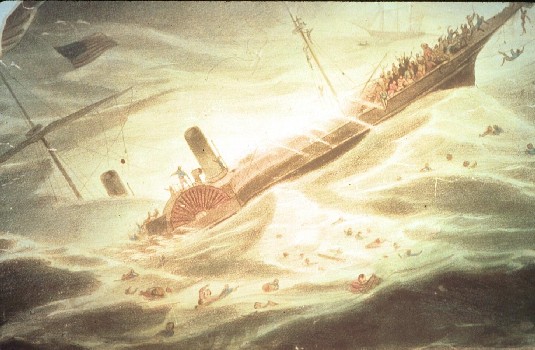
You may remember the wreck of a large steam vessel some years
ago, called the "Central
America." She had about 500
people on board, the greater portion of whom were miners returning from
California. They were coming home from El Dorado, bringing their
treasure with them. They had toiled terribly to accumulate their
wealth, and now they were going to invest it and live sumptuously and
dwell at their ease.
Often and often their eyes turned to the bags of gold dust
with a golden sparkle of delight. But, says the account, as the
storm continued, the gold was less and less thought of; and when it
became evident that they might at any moment go to the bottom, men
pulled off their belts of treasure, and opened their bags of gold, and
scattered their riches on the cabin floors, telling those who liked to
take it, for aught they cared. Full purses containing $2,000 were
lying untouched on sofas. Carpet bags were opened by their owners,
and the shining stream poured forth on the floors. One passenger
opened a bag and dashed about the cabin $20,000 in gold dust, and told
any man who wanted to gratify his greed to take it; but it was left
untouched as the veriest dross. A little while before he would
have struck down any man who dared to touch a single grain of it!
The other world had looked closely into their faces, and greatly changed
the relative value of things. In its immediate presence the
glittering hoards were the veriest tinsel, and undistinguishable from
the other dust of Earth. When the ship was sinking a brig was
described, and boat after boat put off to save the women and the
children. These were all that could be rescued.
TRUE HEROISM.
Fathers perished from their children, husbands parted from
their wives, with a resolute resignation. They saw the women and
little ones push off in the boats; there were no boats for them.
Nevertheless, not one of those rough gold diggers rushed at the last
chance of saving himself. All selfishness had died out of them
with the other world in the presence. Each heart knew its own
bitterness—each was busy with its own peculiar sorrow. A last look
at the boats vanishing forever in the distance—a last thought of home
and friends far away—a last silent prayer to God above, but no sign of
selfishness was seen or heard, with death within arm's length of them
and staring close into their faces. As the last boat put off with
its precious freight, the ship went down, head first, to the bottom.
But those hardy, bronzed fellows had first touched bottom, and in that
trying time their manhood range heroically true.
A CONSTANT REMINDER AND APPEAL.
I think that Spiritualism must have partly an effect upon
those whom it really and truly lays arresting hands on, for the other
world to look closer into their face. Surely if the other world
once demonstrates its immediate presence in life as well as in death,
the result must be living and life-long—once brought home to us in this
way, with a continual appeal to your moral consciousness and reminder of
your spiritual destiny. The spirit world is always trying to
influence us, but ordinarily it is like sewing without a knot in the
thread, that slides through unfelt. Our facts put a knot in the
thread for the first time, so that they can hold on and pull, and draw
us nearer to them. For lack of our facts, the other world has
become a far-off country, which men traded with of old, but the current
of commerce has set in other directions, and it has drifted out of
sight, and almost lives in legend alone! There was greater need of
news from it—signs of existence—than now: it has become so dim and far
away as to look like an evening cloud on the horizon across the dark
water of death, which may not be solid land, or habitable, after all,
when we try to set foot on it in Eternity! And the "Word" we had
from it so long ago is as much doubted as any old traveller's
enthusiastic story!
"THIS TINY AND ARRESTING RAP."
See the myriads whose thoughts are trying to reach that other
world by grave-digging and body-snatching and hopes of physical
resurrection!
What matters the shape in which it may prove its
existence?—its actual presence with us? Shipwrecked people do not
usually quarrel with the message sent from the land they seek, even
though it comes to them in the form of muddy water and sea-drifted weed.
And this tiny, and arresting rap may be and has been the
turning point in many lives, where all other modes of appeal had been
resisted. I believe that, as evidence of a future life, one single
proof in spiritual manifestation is worth the hear-say revelation of a
world. It is the resurrection and the life of all the rest.
Immortality is no longer a glorious possibility or a desolate 'perhaps';
it is a positive fact.
Once our immortality has been grasped in this way, as a fact,
all mere words on the subject, or about it, seem impertinent, and are as
much superseded as the leaves of other years. A man who has once
felt assured of actual spirit presence, once heard the voice of a
spirit, once recognized the spirit touch, or been breathed upon
consciously with spirit breath, is in a different position, and far
above the pulpit, for resting his lever to move the world and lift the
soul. His has found the firmest fulcrum known.
DEATH A TREMENDOUS BUGBEAR.
Spiritualism shows us the visible foothold before it gets too
dark to see to take the step. We know the other world is soundly
based before leaving this. Our faith does not only conquer death
in the last grim moment, at the edge of the grave, but is triumphant the
whole life through. Our thoughts have been climbing upward, by
palpable means, all along. And with such an irradiation as this
faith sheds, a man can walk right through the shadow of Death itself and
turn round with an amused smile as if asking if that were the tremendous
bugbear which has frightened so many poor mortals from ever living.
We cannot say farewell with the old desolate feeling of
sadness and uncertainty, who know how surely we are one still in the eye
of God, and how the spiritual relationship lives on and holds good when
the hands unclasp in parting and the temporary tie is severed.
|
What care we for
the broken shell who have heard
The free chirp of the fledged immortal bird? |
Death is no
longer Lord of Life for us; 'tis but the attendant shadow of Life's
presence.
|
The cloud is
lifted from the vapoury bourne,
With recognition sweet, our dead return
To dry the mourner's tear and hush the wail,
There's nothing twixt us but a Viewless veil!
(Massey: A
Tale of Eternity) |
Indeed, they reappear in front
of the drop scene, after the last act of the Life-Drama is over, and
give us the greeting of spiritual gladness.
IT IS A REAL REVELATION.
....which makes you feel at times as if the lease of your
existence has been renewed on far more satisfactory terms and placed in
your hand visibly by God, and dated "forever".
Here was the vast difference betwixt Jesus
Christ and his professed followers. [His was a living] intercourse
with a living God, a daily converse with Heaven, from which he was
freshly fed day by day with its dews of healing and waters of life.
The others drew mainly from a dead well whose waters have been
collecting and getting stagnant for centuries, but seldom troubled by
any descending angel that stirred them into brightness, or brought a
breath of freshness, and the waters have become tainted through their
muddy mediumship; they have been filtered of their heavenly properties
and discoloured with earthiness, and dreadfully impregnated with those
sulphur springs from below. They have become the drainage of earth
and the oozings of Hell, rather than a drinking fountain fresh from
Heaven, giving disease instead of medicating it.
A LIVING WORD TO A LIVING PEOPLE.
Things that have been looked to and clasped as the pillars of
Heaven itself, and prop and stay of sinking souls on Earth, are holding
the heavens aloof from us—keeping them afar off, and interposing between
us and God be preventing the descent of Heaven itself into the human
soul, and hindering the coming of the Kingdom in this life by their very
exaltation of it for show-purposes, to make us look up to it and aspire
to it as something only to be possessed hereafter. They prohibit
any further revelation, lest it should not tally with that shut up in
the Book. They have no vision, no divination, no word from the
living God for living people—no Bread of Life to break up for the
famishing souls of men!
The lamp still burns upon their altars. It did good
service in the dark night of the past, but it contends in vain with its
tiny twinkle against the flood of broad daylight poured direct from
Heaven in the world outside.
WE CANNOT INHERIT OUR FAITH.
The life of their Urim and Thummin has gone out, and its
glory has departed. Though worn upon the breastplate for show,
there is no sign of the divine presence there. There is not warmth
enough at heart to quicken the mystic splendours into life. Nor is
it a divine response to the yearnings of humanity, eighteen hundred
years ago, that will satisfy the yearnings of today. We can't live
on the manna that fell from Heaven to feed the Israelites. However
sedulously we garner up the treasure of past experience, we cannot start
in these or in other life-matters just where the wisest and best of all
time left off. Every man for himself must live his spiritual life
from a king of primal beginning. He must make out his own belief
by such illumination that God gives to his individual soul, and it is by
that he must read all other revelation. We cannot inherit our
faith, then, ready made, or perfected to pattern. Those who think
most, and live their life at the deepest, will be most perplexed before
they can make it out for themselves. Therefore there is a never
ceasing need for revelation and manifestation of spirit world, and a
revelation for all, which gives an anchorage of fact to trust to.
Possibly you thought Spiritualism was the turning and tipping of tables?
Spiritualism means just what you have the ability to make of it, when
once you have grasped it.
SPIRITUALISM DEFINED.
Spiritualism as I understand it means a new light of
revelation in the world from the old eternal source, and you cannot have
a new light let in without seeing many old acquaintances with a new
face! Many aspects of things will change, and some things that we
mistook for living faces will turn into the sheerest masks of mockery,
and whiten with the sweat of dissolution running down them. But no
letting in of new light will change the nature of that which is
eternally true. It is only falsehood that needs to shrink from the
transfiguring touch of light. That need must shrink and shrivel
away. Spiritualism, as I
interpret it, means a new life in the world, and new life is not born
without pain and partings, and sheddings of old decay. But new
light and life do not come to impoverish; they come to enrich.
Spiritualism will prove a mighty iconoclast, but the fetishes and idols
it destroys will yield up their concealed treasure of innermost truth,
as did the statue which was destroyed by Mahmoud, the image breaker.
The priestly defenders offered him an enormous sum to spare their god,
but he resisted the bribe and smote with his iron mace. Down fell
the image, and as it broke, there rolled out a river of pent-up wealth
which had been hoarded and hidden within it.
THE GREAT SOLVENT OF DOGMAS.
And so it will be with Spiritualism and the blows it strikes.
It has already proved itself the greatest of dogmas yet known. It
is the truth that sets you free for good as well as for evil. It
has acted and is acting like Hannibal's vinegar on the most stupendous
obstacles of progress, and an imposture cannot do that. It will
finally break up many a poor miserable effigy of God to fully reveal the
Divinity himself to the unfettered human soul.
_______________
Ed. In 1857 the paddle-steamer SS Central
America
was on passage to New York City laden with gold coins, ingots and
specimen gold fresh from the California Gold Rush, when it foundered in
a hurricane off the coast of North Carolina. |
|
__________________________
|
 |
|
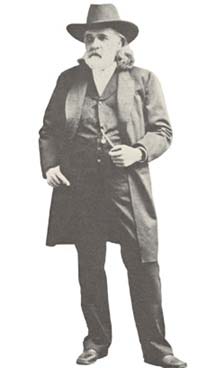
Josh Billings |
FROM THE
DENVER DAILY TIMES
23 Apr. 1874.
Gerald Massey, Gen. John C.
Fremont and Josh Billings, forming a unique trio, breakfasted together
at Laramie, Tuesday, and passed on eastward.
[Massey
admired Billings' writing; see Massey's essay, "Yankee
Humour" -
Ed.] |
|
__________________________
FROM THE
DENVER MIRROR
10 May. 1874.
GERALD MASSEY
________
We announced a few weeks since the probability of a
visit to Denver from the distinguished poet and orator, Gerald Massey,
who is about to sail for England, but will at some future time we trust
revisit this country, where he has accomplished so much, and where his
friends and admirers can by numbered by the tens of thousands. In reply
to numerous letters of enquiry from all parts of the Territory, we deem
it not improper to publish an explanatory statement, which will account
for the disappointment we experienced in common with hundreds of others
in Denver and adjacent towns, over Mr. Massey's failure to include this
city in his lecturing tour of the Pacific coast.
Last march we addressed a letter of invitation to Mr. Massey,
urging him to come to Denver to deliver one or more of his famous
lectures. The following acknowledgement of its receipt from the author
of the [Western Rural], owing to faulty address, we did not receive
until last Tuesday:
|
CHICAGO,
March 16, 1874
S. G. Fowler, Esq.:
MY
DEAR
SIR—Mr.
Massey passed through Chicago from Cincinnati to Minnesota on Friday
night, receiving a letter from you among others, which he showed me.
He will write to you from Minneapolis. I hope he may give you an
evening at least on his return from California. He has done a great work
in Chicago.
How are you "getting on" at Denver? Your paper is excellent.
Yours truly,
H. N. F. LEWIS |
In due course of time Mr. Massey
wrote us from St. Paul, Minn., as follows:
|
ST.
PAUL,
Sunday, 15.
DEAR
SIR—I
go straight through from Omaha to San Francisco, with engagements made.
Nor have I the time or means to speculate or run risks. Nor can I
fill in, Westward, half the possible engagements offered, my time is so
limited, and I have fixed dates to go back on, in Boston and elsewhere.
At the present moment I think I could offer one or two
evenings for Denver on my way back, or rather I am open to an offer:
terms $100 per lecture, which is not large considering I shall travel
18,000 miles (sic) for it. I cannot judge of places for
myself but I do not want any risks run by others where they are not
likely to succeed. Time, towards the end of the third week in
April, or beginning of the fourth week—this to be settled later.
Please see what can be done and address me care of T. L.
Kimball, railway manager, Omaha, where I pass on Tuesday, 24th, for San
Francisco, where I am due on Saturday night, 28th. Address there,
care of Albert Kendrick, 201 Montgomery street, San Francisco.
Yours cordially,
GERALD
MASSEY. |
The same date
the above letter reached us, a prominent and wealthy resident, who was
in our office, signed his obligation guaranteeing Mr. Massey $200 for
two lectures, to be delivered here in the month of April. We enclosed it
as directed, to care of our valued friend Thos. L. Kimball, at Omaha, at
the same time addressing Mr. Massey another letter, stating that every
provision would be made on the part of friends here to render his stay
agreeable.
We never understood why no attention was paid to these
letters, and charitably attributed Mr. Massey's neglect to overwhelming
pressure of engagements, and inability to arrange his programme of
travel so as to meet the wishes of his many friends here, until a letter
came to hand on Thursday last from friend Kimball. he will pardon us
from quoting therefrom:
|
GENERAL
TICKET
OFFICE,
OMAHA,
Neb., May 6, 1874
Stanley G. Fowler, Esp.,
MY
DEAR
SIR—If
I had been at home when your letters regarding Massey's lectures were
received, I have no doubt that arrangements could have been made to
secure him for Denver. As it was, his plans were sadly bungled, and by
the failure to receive a telegram from San Francisco, he lost the
opportunity of speaking in many points in the est. I am sorry on your
account, as it is a rare treat to hear him in public, and rarer still in
private. He is a wonderful man,— gifted beyond his fellows, cultivated
to a degree that is rare among self-made men, and inspired by love,
truth, and intense hatred of all forms of mental thraldom. I know you
would have heartily enjoyed his visit. He promised to visit this country
again, and take time enough to speak wherever there is a desire to hear
him.
Yours truly,
THOS.
L. KIMBALL. |
The above
correspondence fully elucidates "why and wherefore" Mr. Massey failed to
take in Denver on his Western trip. Another year, should
Providence spare his life, we hope he will visit this city in person,
where his "thoughts that breathe and words that burn" have already made
themselves felt, and where he will most cordially be welcomed. |
|
__________________________
BANNER OF LIGHT
May 2, 1874.
GERALD MASSEY,
From England, will commence a two weeks' engagement at the Music Hall,
Boston, on the afternoon of Sunday, May 3, taking for his subject "The
Serpent Symbol; its Spiritual and Physical Significance." On the
following Sabbath (10th) Mr. Massey will give his closing address in
Boston by a delineation of "The Coming Religion." The San
Francisco, Cal., papers speak well of his late discourses in that city,
and from their accounts we select the following paragraphs. The
Daily Evening Bulletin of April 16 stated in the commencement of its
report: "Gerald Massey, the renowned poet and agitator, appeared in his
special field last evening as an exponent of the views of advanced
scepticism of the English school, the subject of his lecture being the
startling query, 'Why don't God kill the Devil?' The discussion of
a question of such direct interest to the generality of the people
attracted a large attendance, and Platt's Hall (seating capacity, 3,000
persons) was completely filled on the occasion by a very earnest and
attentive audience." Concerning his lecture on "The Coming
Religion," the
Daily Morning Call of April 18 said: "Gerald Massey had a splendid
house in Platt's Hall last evening, to lecture on the 'Coming Religion.'
It was his last public appearance on his present visit to the Pacific
Coast, and there were doubtless not a few in the Hall who wanted to see
him, whatever their desire might be as to the lecture. On what the
coming religion is of which he was to spark, hardly anyone could have
been in perplexity. Mr. Massey fearlessly espoused Spiritualism,
was vituperative and startling on the modern creeds, and lugged in the
devil-and-brimstone terrors very frequently for the purpose of railing
at them and whacking them with ridicule. Some of his strongest
passages—for the utterance of which a couple of centuries ago he would
reverently have been burned—were warmly applauded, though not by many
persons; and at no time was there the slightest indication of
disapproval." |
|
__________________________
THE MEDIUM AND DAYBREAK.
SEPTEMBER
21, 1883.
GERALD MASSEY'S SECOND LECTURE.
Sunday was a glorious day, altogether too sunny and pleasant to go within
doors and get immersed in a profoundly intellectual disquisition, yet a
quite satisfactory audience elected so to spend Sunday afternoon in St.
George's Hall. The Lecturer appeared to be in excellent health,
much stronger after one week's contact with the world. He
proceeded with greater confidence and comfort, and was quite himself
when compared with his best appearances. The greeting of the
audience was hearty and free, and the intimacy between platform and
auditorium increased as the lecture went on. The finish of the
discourse was of a more popular character, though the matter was quite
as profound and important. There was a brilliant allusion now and
again to the peaks of thought that are visible on the surface of human
society, and these humorous hits were eagerly responded to by the
pleased listeners, who seemed to augment in appreciation the more boldly
and dexterously the speaker annihilated the strongholds of popular
superstition.
Our comments must not be construed into a report, which could
only be supplied by a verbatim statement. Some of the ideas
presented may be found in Mr. Bengough's article on another page.
The opening reminded us of the fears, even of modern men, when a new
path is placed before them. Many dread the evils that may be
contained in Spiritualism, and have a grave suspicion that all ghosts
are devils. So man's first ideas were in relation to those
elements in nature which caused him discomfort and suffering. Do
we not see here the prime necessity of "evil" as a factor in man's
progress?
There were seven of these dire pests of man's early life,
which became reproduced in series after series, and were the "Elohim"
after whose image man was created, according to Moses. The number
seven occupies an important position in biblical records; and the origin
of this Mr. Massey went into at length. The same series was
presented as Zootypes, then as constellations: timekeepers who, on
account of the precessional action of the planet, were unfaithful, fell
beneath the horizon, and were not reinstated till after the great cycle
26,000 years. Then the subject was elaborately traced into the
Mount, the pole, the tree, the birthplace of the gods in the North,
where the superseded constellations again came into view. Thus it
appeared that these celestial phenomena had been made record of for
52,000 years. Stonohenge as a representative of Paradise was
alluded to, and the thirty years festival was explained. In some
points it was apparent that Mr. Massey and Mr. Oxley were touching on
the same subjects.
The planetary gods occupied a second series of seven.
The "Church" you know would not look through Galileo's pipe with a bit
of glass in it, in case it would see more planets than the mythical
number. The moon was the lowest planetary sphere, the spiritual
dustbin, "lunatic," while Saturn was the highest. Buddhism
recognised the moon as the lowest of the seven, and Nirvana as the last
of seven, and the elucidation given by Mr. Massey answered a question on
the subject put by Dr. Wyld. The views advanced were adduced as
the true explanation of the book of Revelation, and which was also
paralleled by an Indian scripture. The identification of the Ram
with Christ was given, and a vast amount of matter of a similar kind,
having a bearing on a great many dogmas and details of church work.
Then the subject was presented on the physiological plane.
It was stellar, not human, personages that "fell." Mythology did
not recognise a primeval pair. It was a true system when
understood on the grounds on which it originated. The theories of
creation entertained by primitive peoples throughout the world were
explained, and the loss of innocence and origin of guilt set forth.
This was a section of the lecture which cannot be touched on to do it
any kind of justice; it involved so much. It was shown that when
man rose above the bestial state he began to improve upon his habits,
the basis being a more strict regard for the laws of reproduction,
unnatural misdirections in this respect were reprobated; while the
normal and healthy generation of offspring was accounted virtuous and
honourable. A moral system thus originated, based on physiology.
A wise conservation of man's vital resources, as at present expressed in
the Blue Ribbon movement, was shown to be of very ancient practice.
The sacredness of woman and the consecration of puberty were treated at
length, and gave rise to much suggestive 'thought. A stronger, a
more appropriate plea for purity could not be imagined. The
subject merged into the idea of a saviour on the basis of reproductive
continuity of the race, and the phallic element took a position of a
very different character from that which it is made to hold in many
minds. In previous lectures it was shown what an important part
grease or fat played in ancient symbolism. The mummy was thus
smeared, and became the ceremonial representative of the saviour idea.
Mr. Massey quoted an Egyptian word which had a sound something
resembling "christ " and "grease," and he derived both words from that
source, and of cognate meaning.
The lecturer traced the idea of a fall into its later forms,
such as the descent of soul into matter, remarking that the cause is
last seen. Ancient ideas of the soul being the salt that kept
matter from corruption reminded of the "Ye are the salt of the earth"
expression, which if it "lost its savour, wherewith could it be salted?"
Wisdom, purity was held to be the true saviour, but incidentally the
idea of a blood atonement was explained, and its relationship pointed
out.
The Christian dogmas on the crucifixion of a God were
relegated to their true origins, and severely dealt with. No man
possibly is a more consummate master of sarcasm than Mr. Massey, but he
always employs it with strict regard to the defence of truth and the
overthrow of error. The irreligious scoff is not to be heard from
his lips. A deep religious feeling accompanies all his utterances,
and the hearer is impressed with the great gain which would ensue to
religion if all these fables which he explodes were cleared away for
ever.
This lecture abounded in beautiful thoughts, expressed in
fitting and poetical language. The audience was deeply interested,
and applause was frequent. A joyful hope was held out for the
"salvation" of mankind. He was yet only partly up the declivity,
up which he is so painfully yet pleasantly toiling. The wisdom of
the Creator was set forth in a manner much more in consonance with man's
religious aspirations than the doctrines of the Churches imply.
A clairvoyant seer had a report of the proceedings of a very
interesting kind. She is so defective of hearing that she did not
know what the speaker was talking about. Her observations could not
therefore be subjective creations derived from the topics listened to.
During the lecture a glorious panorama passed before her, which, as far
as we can learn, was a pictorial or dramatic representation of the
spoken lecture. The characters were of dusky hue. There was
a beautiful woman with long hair; a fine youth; and a babe hold out by
its mother. It was described as a smiling, almond-eyed little one.
All these scenes were richly filled out with accessories, and will be
regarded by those who heard the lecture as "ideographs " of its most
prominent topics.
There is more in this ideograph system than can be grasped.
It means everything, in fact. Twelve years ago scenes were
similarly seen round Mr. Massey, representative of subject matter.
Are these surroundings objective or subjective; what is the difference
between the terms? We are travelling upwards; and enough it is if
we wisely apply our present advantages. |
|
__________________________
THE MEDIUM AND DAYBREAK.
SEPTEMBER
28, 1883.
GERALD MASSEY'S THIRD LECTURE.
When in ten thousand churches, last Sunday, the usual
sleepy afternoon service was being duly performed, the officiating
ministers thereat little knew what was going on at St. George's Hall,
Langham Place. If they had known they might have been excused for
suffering from that choking sensation in the throat which sometimes
accompanies a shock to the nervous system, occasioned by sudden terror
or unwelcome surprise. For some weeks there had been an
announcement outside the doors, that on that afternoon the Non-Historic
Nature of the Canonical Gospels would be indubitably demonstrated by
means of a Mythos, now for the first time recovered from the Sacred
Books of Egypt. It is a fact that concerns some millions of
nominal Christians in London, to say nothing of tens of millions
elsewhere, that the Lecturer's promise was fulfilled. In other
words, an hour and a half was expended in reading off from the Egyptian
Ritual of the Dead the most important portions of those same Gospels on
which the religious life of Christendom and its hopes for eternity are
understood to rest.
Mr. Massey's audience was appreciative and enthusiastic.
It has become more so every week. But it is scarcely to be
wondered at, that the Hall was not full. Long and painful
experience has taught us that English people brought up in orthodoxy
are, for the most part, absolutely devoid of any curiosity, openness of
mind, or rationality in religious matters. And during the last
forty years the Gospels have been the subject of such endless criticism,
and their authority as a so-called "Revelation" has been so completely
pulverised, that free-thinkers are perhaps rather tired of the whole
thing. But we can confidently assure the most learned student of
Christianity, that in Mr. Massey's treatment of the subject he would
have met with something almost entirely fresh, of surpassing interest,
historical, ethnological, and religious, and a delightful contrast, both
to merely negative criticism, and that imaginative evolution of the
writer's consciousness, which forms the staple of most "Lives of Jesus."
The Lecturer began by saying that he regarded two things as
constituting the unpardonable sin of the parent against the helplessness
and innocency of infancy—the one consisting in the father allowing his
child to run the risk of blood-contamination, such as was once suffered
by a child of his through the filthy fraud of vaccination—the other in
his permitting the soul of his child to be inoculated with the still
more virulent poison of the theological vaccine. ' Children who accept
as truth whatsoever is seriously affirmed by those whom they love—those
who are their sole protectors—are taught that the fables of mythology
misconceived are the sacred and true "Word of God," if they are found in
the Hebrew Scripture! And it takes the latter half of one's
life-time to slough off the mass of corrupting error instilled into us
during the earlier half; even when we do break out and slough it off in
a mental eruption, and find ourselves in rebellion against things as
they are. The mass of people never get rid of the infection; they
still pass on the old hereditary disease in this life; and, if we are to
believe certain reports, they go on for a time after death persisting
that the ancient errors are true, and still try, to infect healthier
souls by communicating their old hereditary disease from the next life.
"I," pursued the lecturer, "in common with others, was
vaccinated body and soul, and have to spend the rest of my life in
trying to get rid of the evil effects of the virus. When I
lectured ten years ago, I had not found out the fraud by which we have
been unfathomably befooled. I accepted the canonical gospels as
containing a human history. At that time the facts of Modern
Spiritualism had been forced upon me during many years. Now the
first effect of these on some natures is to make a profound appeal to
the feeling of religious awe, and therefore, to confirm the orthodox in
all the errors of their early thought. If certain extensions of
recognised laws take place in the present, why may not all the mythical
miracles of the past be veritable matters of fact? Of course they
may if we have no means of distinguishing between them. Thus the
primary tendency of Spiritism is to rehabilitate the old Beliefs that
have been founded on misinterpreted Mythology, and which have been and
are the cause of enmity between men of science and the facts of
Spiritualism. I soon saw that if the old Book were plumped into
the new boat, unexplained, it would scuttle it, and might sink it.
The Christian Spiritualists, for example, are never tired of proclaiming
that the facts of Spiritualism and the miracles of the Bible are
identical; and that if the one are true, the others were. But
supposing some comparative mythologist comes and shows that Hebrew
miracles are Egyptian myths, and explains their symbolical nature,
proving that the assumed miracle never meant what has been taken for
granted, then the tables are turned on the Christian Spiritualists who
had vouched for too much too soon."
Having thus explained his stand-point as regards
Spiritualism—a matter of especial interest to the readers of the MEDIUM—Mr.
Massey proceeded with the proper subject of his lecture. In his
view the only historical Jesus, the only Jesus known to the Jews, was
one Jehoshua ben Pandira, who had learned the arts of magic in Egypt,
and was put to death as a sorcerer. He was not crucified in Roman
fashion, but, in the phraseology of the Acts of the Apostles, "hanged
upon a tree." The year of his death is not certain, but there are
reasons for thinking it took place about 70 B.C. The Jesus of the
Gospels is an entirely mythical personage, the salient points of whose
history from beginning to end, and even some of those very matters of
detail which constitute the hopeless discrepancies between the several
gospels, may be recognised in more or less obvious form in the Egyptian
Ritual. In the annotations to this precious document the Text is
said to have been found in the reign of King Uousap-ti (the Usaphais of
Manetho) who was the fifth king of the first Dynasty, and who
consequently lived over 6,000 years ago. At that time certain
parts of the Sacred Books then discovered were so ancient that the
tradition of their origin had been lost. Anything more interesting
than an exposition of the parallelism between this ancient Ritual and
our so-called Gospel History can hardly be conceived. It forms the
subject of the last Section of the Natural Genesis, to which all the
previous work leads up; and the principle features were given by Mr.
Massey to his favoured hearers last Sunday. We were shown how the
circumstances of the Annunciation and Immaculate Conception, the Birth,
the Time and details of the Baptism, the Temptation, the most Mystical
sayings in John's Gospel, the Parables, Miracles, the Crucifixion,
Resurection, and Risen Life, recorded in the Canonical Gospels were
reproductions of the Religious Mysteries of Horus and Osiris, performed,
portrayed and recorded thousands of years before in the Egyptian Ritual
of the Dead.
In brief space to render such an achievement intelligible,
would of course be impossible. We will only state our belief, that
with the publication of this and other allied knowledge, the great
Christian controversy which has lasted now for so many years will enter
upon a new phase. Nay more, perhaps at some indefinite time nearer
than may now seem probable may be accomplished that prophecy with which
the lecturer concluded the most momentous discourse that was ever
delivered in St. George's Hall, often as its walls have echoed to the
voices of heresiarchs. The prophecy ran somewhat thus:—
The cult of Equinoctial Christolatry is
responsible for enthroning the cross of death in heaven, with a deity on
it doing public penance for a private failure in the commencement of
creation. It has divinised a figure of human suffering, and a face
of piteous pain; as if there were nought but a great heartache at the
core of all things. In the young pagan world men deified the
beautiful, the glad; as they will again upon a loftier pedestal, when
the tale of the fictitious fall of man and false redemption by the
cloud-begotten God has passed away like a phantasm of the night, and men
awake to learn that they are here to preclude poverty, to wage ceaseless
war upon sordid suffering and preventable pain, and not to apotheosize
an effigy of sorrow as a type of the Eternal; for the most beneficent is
most beautiful; the happiest are the healthiest; the most God-like is
the most glad.
Equinoctial Christolatry adopted and sanctified the savage
doctrine of blood-sacrifice and vicarious expiation, which is a complete
reversal of the common law of civilization, that all sane persons shall
be hold responsible for their deeds, arid riot acquitted because the
innocent may have suffered for the guilty. A doctrine so cowardly
and immoral must have rotted the backbone out of all manhood, if men
were no better than their professed beliefs, and had not been fed from
other and healthier fountains of life.
Equinoctial Christolatry boasts of having put an end to
individual sacrifice; but it is compatible with the masses of the
toiling people being offered up for ever in one great sacrifice.
The other world has been held as a lure in front of that beast of
burden, the Producer, in order that the scent of future food in another
life might make him forego his right to the common grazing-ground in
this world.
The Equinoctial Christolators are responsible for postponing
to a future stage of existence the redress of wrongs and the righting of
irregularities which can only be rectified in this. False
believing is ever the worst enemy of true doing; and every Sunday the
teaching of those legalized kidnappers of the children, for compulsory
inoculation of their minds with the old theological virus, tends to
nullify the good done by education during the other six days of the
week. Ever ready to fight with shadows like the "primal curse," or
to promise the "lost paradise" to those who have faith (in defiance of
facts) that it once existed, they leave it for Communists and Nihilists
to force into the sphere of practical politics the discussion of reforms
that have to be effected before humanity call be saved.
Equinoctial Christolatry has fanatically fought for its false
theory, and waged incessant warfare against Nature and
evolution—Nature's intention made visible—and against some of the
noblest human instincts during eighteen centuries. Seas of human
blood have been spilt to keep the bark of Peter afloat. Earth has
been honeycombed with the graves of the martyrs of free-thought.
Heaven has been filled with a horror of great darkness in the name of
God. Eighteen centuries are a long while in the lifetime of a lie,
but a brief span in tile eternity of truth. The lie is sure to be found
out, or fall at last. And at length the long delusion, based on
misinterpreted mythology, is drawing near its end. The only way to
dispose finally of the false history in the Old Testament or the New,
was by recovering the true tradition. This has now been attempted,
and the supremest verities of revealed "truth" are proved to be only
falsifications of ancient fables.
In a few weeks the Atlantic Ocean will separate Gerald Massey
from his country. We heartily wish him a warm reception in
America, and yet we cannot do so without a feeling of pain. We are
afraid lest audiences consisting of thousands instead of hundreds of
enthusiastic listeners may so win upon his sympathy that he may not
return to us. It is true that he will leave us a priceless bequest
in four noble volumes, but we want the presence of the man as well as
his books. As it is we can only console ourselves with the thought
that, live where he may, Gerald Massey can never be anything but an
Englishman of the finest type.
Next Sunday let him see at least by a crowded hall that he
has a few friends in London who know how to value and sympathise with
sterling English energy and genius consecrated to the severest
scientific toil in search of truth for it own dear sake, rewarded by its
discovery, and spent in its proclamation.
S. E. B. |
|
__________________________
NEW YORK TIMES.
NOVEMBER 17,
1883.
GERALD MASSEY'S THEORIES.
WHY A BELIEVER IN SPIRITUALISM REJECTS
CHRISTIANITY.
Mr. Gerald Massey, who has been advertised as the English
orator who can be heard, thought it necessary, before beginning his
lecture in Chickering Hall last evening, to relieve the embarrassment of
the situation by informing the very small audience that he had come here
to sow the seed and not to reap the harvest. He further declared that he
was suffering from a severe cold and hinted that he might not be able to
lecture on Monday night, as announced, in consequence. He is a man of
medium height and slight figure with a thin iron-gray beard, thick hair,
brushed back behind his ears, and a florid complexion. He wore a frock
coat and a waistcoat of black velvet, black cloth trousers, a dark
scarf, and spectacles. He speaks rapidly but distinctly, in a
conversational manner. His subject was "Man's Search for His Soul during
50,000 Years."
Mr. Massey said that he addressed the America of the
future—the America of land nationalization, Spiritualism, and other
issues. Since the ascent of man, as unfolded in the doctrine of
evolution, has succeeded the falsehood of his fall, it became necessary
to go back to the beginning, and judge from the actions of primitive
man. The negroes in Africa today preserve all the baubles of human
babyhood, and many other savage races do the same in degree, while the
records of the Egyptians explain their significance. The earliest mode
of burial, dating back 50,000 years, has its primary model in the
mother's womb, the idea being to preserve the body for future birth.
This is still represented in the navel mounds of India, the nave of a
church, and the Scottish tumulus. After citing many other instances of a
similar purport, the lecturer asserted that the certainty of a future
after death possessed by primitive man did not come to him by
revelation, for he was neither a metaphysician nor a victim of diseased
subjectivity. The Egyptians, he said, believed in the existence of seven
souls, a belief shared in with them by the Hebrew Rabbis, the Druids,
and the esoteric Buddhists of the present day. These were the soul of
blood, the soul of breath, the soul of eternal perception, the pubescent
soul, the intelligent soul, and the immortal soul. This belief was
typified in the seven days of the Book of Genesis. The Egyptians'
struggle for immortality culminated in the mummy, preservation being the
first form of salvation. They believed that man gained his fifth soul
only at puberty, and his sixth at 20 years of age. Children consequently
had only elementary souls, and from this was derived the false claim of
the Church to save the soul of a child by baptism. Women also were
believed to have imperfect souls, and some of the Christian fathers have
held a similar doctrine. In the Egyptian tombs the images of the dead
are all bearded males, typifying that at the resurrection women would be
reproduced in the image of the male. A similar belief was held by saint
Augustine, and is held today by the Mormons. One of the ancient souls
was symbolized by the marrow. Hence the "Anointed One," and Christ
literally means "The Greased." The esoteric Buddhists say that most men
in the world to-day have not advanced beyond the fifth stage, a very
appropriate classification, as the soul is typified by the goose.
[Laughter.]
The Egyptians, continued the lecturer, went a step further
and evolved an eight stage, in which were gathered all the perfections
of the seven. This stage was symbolized in Christ, who was a model—not a
real man—. They thought that they might become able in the trance state
to transform themselves into spirits—whence was derived the "conversion"
of Rome—and the means they took to produce that state survive in our
consumption of alcoholic and other stimulants. This belief in a
spiritual entity which could be separated permanently from life, was the
first conception of immortality, a subject of which the Mosaic and other
writings contain no mention. The Egyptians had gone beyond the mummy
type. They did not believe that the body would be resurrected. That
theory was stolen by the Christians who were ignorant of the developed
idea and were ready to swallow all that was impossible, in fact.
[Applause.]
Mr. Massey said that although not a seer himself he had had
relations for many years with one who is, and had received sufficient
evidence through his other senses to believe that nature gives us
another existence, which needs only proper interpretation to form the
basis of the religion of the future. |
|
__________________________
THE
BROOKLYN EAGLE.
FEBRUARY 2,
1884.
FREETHOUGHT
_______
Gerald Massey's Lecture on Demons and Their Influence.
"Why Does Not God Kill the Devil?"—How the Existence of the First Devil
Came to be Believed—The Nemesis Which Constituted the Real Hell—The
Author of English Misery—A Description of Starving London.
Last evening Mr. Gerald Massey delivered the last in his
series of lectures in the old Baptist Church, Clinton avenue, near
Myrtle, the subject being "Why Does Not God Kill the Devil?" There
was a pretty fair attendance. Ex-judge Dailey presided and bespoke
an attentive hearing for the lecturer, whom he introduced by saying that
the one Mr. Massey was now about to deliver would close the series of
discourses they had heard from that gentleman since his coming to
Brooklyn.
Mr. Gerald Massey then came forward and was slightly
applauded. He began by saying that he recently gave offence by
speaking of "Plato or any other metaphysical impostor." But
metaphysics began in imposture, in the in the imposition of modern
meanings on ancient language and typology. The Gnostics said that
Plato was a minute philosopher. Yet Plato was the chief builder of
a bridge of mist and moonshine by which the ignorant could cross the
chasm that lay betwixt the physics of Egypt and the metaphysics of the
Christian Fathers.
AUGUSTINE CONFESSED,
that it was by means of Plato's system that he was enabled to properly
understand the doctrine of the Trinity. The doctrine of the
Trinity applied to a supposed Divine being, who cuts up all things into
three, Himself included. The speaker then traced the origin of the
doctrine in physics and went on to say that the devil of darkness was
the first divinity, the first power recognised as superior. The
simple and fundamental questionings of the Zulus upset the Bibliolatry
of Bishop Colenso, and the crucial question of the savage Friday was too
much for the theology of Crusoe. When Friday asked: "But if God
much strong, much mighty as the devil, why God not kill the devil?
So make him no more wicked?" Crusoe, imitating other theologists,
not knowing what to say, "pretended not to hear him." The human
mind had long suffered an eclipse and had been darkened and dwarfed in
the shadow of ideas the real meaning of which had been lost to moderns.
Myths and allegories, whose significance was once unfolded to the
initiates in the ancient mysteries, had been adopted in ignorance and
reissued in real truths divinely vouchsafed to mankind for the first and
only time in the Hebrew writings, and a great deal of what had been
imposed upon us as God's direct and sole revelation to man was a mass of
inverted myths, under the shadow of which they had been cowering as
timorously as birds in the stubble when a hawk was hovering overhead.
The simple realities of the earliest times were expressed by signs and
symbols, which had been applied to later thoughts and converted into
theological problems and metaphysical mysteries, for which the
theologians had no basis whatever, and could only wrangle over en
l'air. Darkness was the first great natural adversary
recognized by man—simply Darkness was the enemy of Light. Hence
darkness was the primary devil. By the Egyptians the crocodile was
regarded as an idolograph of the swallowing darkness, who gradually
assumed the character of....
MAN'S MORTAL ENEMY
who brought death into the world. The dark power was the devil and
the light the good power. When it came to worshipping, or rather
propitiating, it was the dark power [that] dominated, because it
struck terror and elicited fear. Men had dipped into the dark and
suffered from the shadows of eclipse so long and passed through them
safely that their unreality was at last discovered. There was no
revelation or new point of departure in phenomena, nothing added to
nature or human knowledge in the later views of the metaphysicians and
theosophists. Thus the supposed revelation of a newer truth was
largely founded on a falsification of the old. So it might be said
they were contemporaries of savage man in the manner of their current
customs and beliefs. Their theology had, from the external
darkness of the beginning, extracted and internalized the devil in the
end. There is no devil such as Milton saw, he (Massey) maintained.
When they went close to this devil of theology they found him not alive.
In fact he was a bogus bugbear. The German devil was at one time
the red bearded thunder. The Norsemen had no respect for the devil
at all; and as to hell, why if one did not get to heaven, then hell was
the next best place in the other world—if there were but two.
[Laughter.] The Norsemen new nothing of a hell of everlasting
fire. A missionary once went to Greenland to illustrate the Gospel
of good tidings with the aid of an external fire, but instead of the
people being frightened, there was happiness and jollity; and they sat
as if spiritually warming themselves at the everlasting bonfire that was
never to go out. Luther and Calvin revived and sublimated the
theology of the mythical devil. The Romanish Church did not deify
the devil as the Protestants had done; she was better acquainted with
the tradition of his creation and the earthly nature of his character.
Instead of the arch enemy of God and man, majestic in his divinity, he
became a playful and grotesque image. The popular Satan,
therefore, was the popular monster of mythology. Some people might
say, like Charles Lamb, that this was depriving him of his devil; and
this would be like depriving some people of half their heaven upon earth
and the whole of it thereafter. They had talked of the devil long
enough, but to a Spiritualist the devil exists for the first time in the
facts made known to Spiritualism. Could anything more silly be
imagined than to think that there was a vested interest in our wrong
doing, and that spirits were present with us in the enjoyment of our
most secret sins; or the ghosts of dead drunkards haunting the scenes of
their worldly debauchery?
MR. MASSEY'S CREED.
The devil and the hell of my creed, continued the lecturer,
consists of the natural Nemesis which followed upon broken laws and
dogged the law breaker in spite of any belief of his that his sins and
their inevitable results can be so cheaply sponged out, as he has been
led to think through the shedding of innocent blood. Theirs was a
far more terrible way of realizing the hereafter than any abstract idea
of hell could afford. In the ancient days, when immortals were
said to come visibly down,
|
"There went a youth with an angel
Through the gate of an eastern town.
They passed a dog by the roadside,
Where dead and rotting it lay,
And the youth at the ghastly odour,
Sickened and turned away." |
But the angel's pure sense was not annoyed until a beautiful lady came
upon the scene, whose
|
"——voice most silvery rang,
And the youth to embrace her beauty
With all his being sprang,
A sweet delightsome lady,
And yet the legend saith
The angel, while he passed her,
Shuddered and held his breath." |
[Applause.] Only think of a fine lady who had been wooed and
flattered in this life, finding herself in the next a spiritual leper,
at which all good spirits shuddered when they passed. To realize
that, would work more effectually than much preaching. It was the
worst hell of all for those who infest poor, weak, easily tempted souls
to get them in their clutches and make use of them. They had been
amused with a dolly devil long enough, while all around them the real
devil was working with a most infernal activity and playing the very
devil with this world of ours. [Laughter.] This was not a Satan of
God's making, but a devil that was like themselves. The devil of
their own ignorance and self deification. This was the devil to be
wrestled with, and theologists had....
THE BLASPHEMOUS IMPUDENCE
to make god the author of this dark shadow. Whether there was a God
or not, it was impossible to discuss the matter intelligently until the
doctrine of creation by the process of evolution was taken into account.
And this showed that the evil for which the creator was responsible was
a means of evolving in us a consciousness of good. The lecturer
referred to several instances in support of this view, and continued to
say that in many of them it was absurd to ask God to save them from
these troubles instead of looking to their liver and obeying the laws of
nature. Their mission should be to clear their horrible ignorance
of ages and ages and look forward to its being burned out of human souls
by an eternity of hell fire. He ridiculed the idea of God being
the author of all the sufferings of humanity. The laws that deal
with humanity in the aggregate sub-serve eternal interests which crush
many smaller claims of individual life, and if they did not accept this
revelation lovingly the poor, neglected scum and canaille of the nations
rose up, mighty in the strength of disease, and proved the oneness of
humanity by killing them with the same infection. Mr. Massey here
drew a vivid picture of the awful scenes to be met with, of festering,
starving thousands in the great City of London which the Congregational
Union has recently reported. The poverty there of those who strove
to live honestly was appalling and included such scenes as women and
children making sacks at half a cent each, palliasses at three cents
each, and shirt finishing at six cents a dozen, the operator having to
provide her own thread. Accompanying these disclosures came the
customary moan of the wealthy ones that such people attended neither
church nor chapel. He should not wonder that the panacea for all
this would be the building more churches and the consecration of at
least an additional bishop. [Laughter.] In the midst of all the
Providence was pouring everlasting abundance on the land with plenty for
all. Yet there was carefully preserved against these people vast
tracts of idle, fruitful soil. As a remedy the praying machine of
the State was set in motion with a forty thousand parson power and
Providence was forthwith implored to stay his hand and work a miracle on
behalf of those poor human worms. Thousands of Spiritualists would
ask was was meant by the word God, and he (the speaker) was himself set
down by the American press as materialistic. One writer said,
"there is no God yet but there's one coming,"—a profound saying.
If the Deity hitherto set up for worship was a true likeness they should
not become atheists but forthwith commit suicide. It was for this
world that people needed to be saved, and life was not worth living if
they could not do something to allay the misery they saw all around.
The atheist says, if there were an omnipotent God, such things would not
be tolerated by Him. But he (Mr. Massey) would say that God....
GAVE THE LAND FOR ALL
and it was the initial iniquity of absolute private property in land which
brought this about—a system which enabled one man to clutch a county and
a few to claim a country. The national property was doubling every
thirty years and so was the national pauperism. One was allowed to
possess the soil and thousands to be driven off for the support of game.
Yet God said, "I gave the land for all." People in town and
country were being enclosed in a network of monopoly. He learned
the other day that the Civil Service Stores in Bedford street, London,
were prevented from selling fruit, because the Duke of Bedford owned
Covent Garden and the rent depended on the monopoly. The land of
England was being monopolized ever since the 30,000 thieves, who landed
at Hastings, wrote their title deeds in blood. In the face of this
they had 40,000 men in masks, as he might say, paid out of the revenue
to act the part of a secret Sunday police. This English Church was
imposing the most pernicious errors on the people as the paid agents of
the State. If revenues derived from the church for the propagation
of false theology and the gospel of damnation were expended in education
there would be a different story to tell to-day. It would be well
to pension off this lazy body of men, even if it doubled the national
debt [applause], for the whole was a bogus set. They were so
anxious that they would pray for the salvation of everybody but
themselves. It was a pitiful farce for them to commence praying to
God to do by miracle what they were doing all they could to prevent.
The struggles for American independence and the freedom of the coloured
man were mighty events, but more glorious still would be victory to
vindicate the battle of free thought which would have to be continued
until the universal human race was freed from the tyranny of wrong
teaching, which was held to be venerable on no other ground than that it
had grown hoary with age, and until the common enemy was finally
overthrown. [Loud applause.] A vote of thanks proposed and passed
by the audience was conveyed by the chairman, and Mr. Massey having
responded, the proceedings came to an end. |
|
__________________________
THE MEDIUM AND DAYBREAK.
MAY 16, 1884.
GERALD MASSEY IN AMERICA.
To the Editor,—It gives me much pleasure to report that
Gerald Massey (the eminent Poet and author of the wonderful work lately
published in your country, "The Natural Genesis") has just
delivered a very successful course of five lectures in this city; the
trustees of the Church of the Unity kindly donating the use of their
commodious edifice for that purpose. The subjects were as follow:—
Tuesday evening, April 8th, 8 p.m.: "The Mystery of Evil, or the Devil of
Darkness in the Light of Evolution."
2nd Lecture—Thursday, April 10th: "The Fall of Man, an Astrological Myth,
and a Physiological Fable."
3rd Lecture—Friday, April 11th: "Man in Search of his Soul for 50,000
years, and how he found it."
4th Lecture—Monday, April 14th: "The Historical Jesus and the Mythical
Christ."
5th Lecture—Wednesday, April 16th: "The Coming Relgion."
The lectures were well attended by the thinking people of
Cleveland, who followed Mr. Massey through the entire course with great
interest. The lectures were too radical for some, who cherish
popular pet theories, and do not wish them disturbed; but Mr. Massey has
evidently spent much time in his search for truth, and has traced
Christian theology to its source, in fact, has traced all systems of
religion to their origin,—and has the manhood to tell of his
discoveries, irrespective of any who may be hurt by the light he brings.
With the exception of the "Cleveland Herald," the papers were afraid to
give very full reports of his lectures, but united in speaking very
highly of his ability and learning, and the thoroughness with which he
treated his subjects. Much discussion has followed the lectures
since Mr. Massey left the city: some of the ministers, in order to
counteract the effect, have been preaching against his line of argument,
but whatever controversy ensues, will only fructify the good seed of
truth planted here by him.
Gerald Massey did not forget the "little ones" when here; and
the Sunday before he left, gave a short talk to the Children's
Progressive Lyceum, on "The Origin of some of our everyday Habits and
Customs." It was full of interest and originality, and made
perfectly comprehensive to the youthful minds, by the simple language in
which his remarks were clothed.
It will doubtless be gratifying to your readers to know that
Mr. Massey's health is much improved since he left New York. He
left here on April 18, for Grand Rapids, Mich., intending to stop in
Chicago, Denver, Salt Lake, and San Francisco; from which port he is to
take steamer for Australia. That he may regain his shattered
health (brought on by too close application to his late works), and that
the opportunity may be given to him in his travels to ventilate the
great truths he has ferreted out, but explode by, explaining the many
superstitions of old theology, is the earnest wish of....
THOMAS LEES.
________________
Cleveland, Ohio, April 27, 1884.
"The Cleveland Herald" in reporting one of Mr. Massey's lectures, says:
"The church was crowded, notwithstanding the miserable weather, and the
speaker, appreciating the fact, declared his pleasure before commencing
his discourse." |
|
__________________________
THE MEDIUM AND DAYBREAK.
OCTOBER 8,
1886.
MR. MASSEY'S LECTURES.
The series of ten lectures at St. George's Hall, closed on
Friday evening, October 1, with the lecture on "The Coming Religion."
There was a large attendance, and a more enthusiastic audience could not
have been desired. The lecturer commenced with a few remarks on
the conduct of some opponent, we think The Rock, which had
resorted to the good old Christian weapons of misrepresentation and
abuse. That Mr. Massey's utterances had found expression in the
public press is evidently a sore point with the Christians, who have
still their hereditary horror of Truth.
The lecture contained a grand plea for Spiritualism, which
was received without opposition. The audience was apparently
composed chiefly of Agnostics, who cheered any allusion to physical
reform, or criticisms of priestcraft. There were as usual many
Spiritualists present. At the close Mr. Massey received such an
ovation as does not frequently fall to the lot of a lecturer. For
a long time the applause was so loud and continuous that Mr. Massey sat
quite overcome, the red blood gradually mounting to his brow and face.
When at last he was permitted to rise, he modestly expressed his
acknowledgments, under very marked emotion.
Mr. Massey has done what no combination of individuals in
London could have had the courage to attempt. We regret that Mr.
Massey thinks of going to the provinces. London is the place for
him. He should commence a series of Sunday evening addresses,
putting far less matter into them, and in a popular way giving
expositions of the structure of the Scriptures. He would be
sustained, and make his mark on the world of thought. |
|
__________________________
THE MEDIUM AND DAYBREAK.
JUNE 17, 1887.
MR. MASSEY'S SECOND LECTURE AT ST. GEORGE'S HALL,
LANGHAM PLACE.
THE ROMAN CATACOMBS
is a subject that Mr. Massey has not dealt with in these lectures.
It is one of the stock frauds of Christian apologists; a great deal of
novel and interesting matter may be expected. Mr. Massey's
lectures are full of learning and research. We were glad to see so
many of our readers present on Sunday last.
Subjects and Dates:
|
SUNDAY, |
JUNE
19, at 3 30.—TESTIMONY OF THE ROMAN CATACOMBS TO THE "TRUTH OF
CHRISTIANITY." |
|
SUNDAY, |
JUNE
26, at 3.30.—THE HISTORICAL JESUS AND MYTHICAL CHRIST. |
|
SUNDAY, |
JULY
3, at 3.30.—MOON - MYTH AND RELIGIOUS LUNIOLATRY. |
|
SUNDAY, |
JULY
10, at 3.30.—THE MYSTERY OF PAUL, "APOSTLE OF THE
HERETICS," AND NOT OF HISTORIC CHRISTIANITY. |
|
SUNDAY, |
JULY
17, at 3.30.—HOW LANGUAGE WAS FORMED IN THE HUMAN LIKENESS. |
__________
Admission ... 2s.; 1s.;
6d. Doors open at 3 o'clock.
__________
GREAT SUCCESS OF FIRST LECTURE.
On the first bright, balmy summer Sunday after our
exceptionally severe and protracted spring, it was little short of a
miracle to see such a gathering in St. George's Hall as greeted Mr.
Massey on Sunday afternoon. Not that the great hall was by any
means full, but had the audience been placed in one of ordinary
capacity, it would have been well filled.
Again Mr. Massey has shown courage greater than all of us
combined, and he has been rewarded with success. He has faith, which
moves mountains; he has something to know, to rely on, to unite
his efforts with the grand minds who knew and who taught in the
past.
The lecture was quite a new presentation of the subject, full
of matter, delivered with animation, and, if anything, a trifle too
long, having occupied one hour and forty minutes in delivery. The
following was the conclusion:—
CHRISTIANITY, AN ANTI-SPIRITUALISTIC
SYSTEM.
We have Spiritualists to-day who can lay hold of the
Scriptures by means of the Gnosis that remains there as a lure,
and turn it to the account intended, that is, as a decoy towards
accepting the history. And so when the risen Christ reappears in
the actual body that is missing from the tomb, they are prepared to
explain away the physical fact by means of the Spiritual Gnosis.
In that way nothing is bottomed, and nothing can be really understood.
In writing to a Christian Spiritualist the other day, I said: "I know of
no better way of waging the battle for truth than arraying the facts
face to face, on either side, and letting them fight it out!" His
reply was: "I do not believe in your facts because I do not know."
Now that is good firm ground to stand upon, however late in life we take
that position. But to be of any real service we must apply the
same reason all round. As an adherent of Historic Christianity
that same writer has all along been a believer in what he
did not know to be facts, and a believer just because he did not know;
and now he finds it too late to correct his early belief by means of
later knowledge. All I ask is that people shall no longer believe
because they don't know! No matter what they may call
themselves, they are traitors to the truth who will not face the facts
or examine the genuine data for themselves, but will go on repeating
ignorantly, or in pious pigheadedness, the orthodox assumptions, and
keep on applying the
hypotheses of accommodation to the Christian documents.
Phenomenal Spiritualists who go on philandering with the
fallacies of the Christian faith, and want to make out that it is
identical with Modern Spiritualism, have to face the great indubitable
fact that Historic Christianity was established as a non-Spiritualist
and an antispiritualistic religion. Its primary fact, its
initial point of departure, its first bit of foothold for a new
departure was the acknowledgment of the physical resurrection of the
dead Historic Christ. The reappearance of the Corpus Christi
is the fundamental fact of the faith. The strings are pulled so
that the puppet, the realistic figment, may be forced to exclaim that he
is not a bodiless ghost, not a fleshless phantom, not a spirit anyway;
and he offers the proof palpable that he is none of your Gnostic Christs
or the spirit of anybody!
Moreover this is the veritable dead body that is missing from
the tomb. And still further, the passage has been altered from
Marcion's "Gospel of the Lord" on purpose to substitute the corporeal
Christ of Historic Christianity for the spiritual representation of the
Gnostics. In Marcion's rendering, the word phantasma is
used; and this has not only been omitted, the phantom has been made to
swear very emphatically that he is not in any wise phantasmal but is a
being of flesh and blood; and after demonstrating the fact he clinches
it by asking if they have got anything there for him to eat.
As a Spiritualist, I assert that the new Christian
Dispensation was founded upon the death and burial of the Ancient
Spiritualism; or at least, upon the gagging of it, and getting it
underground dead or alive! And the tomb out of which a corporeal
Christ was believed to have emerged as the saviour of the world, and
brought immortality to light by a physical resurrection from the dead,
has been the burial-place of genuine Spiritualism for 1800 years.
The founders of the Catholic Church were the
de-spirializers
of Primitive Christianity, and the destroyers of the Gnostic religion, as
such, by placing their ban upon all Spiritualistic phenomena. The
foundations of the ancient cult were to be built upon no longer.
Two distinct charges are brought against the carnalizers
by Tatian in the second century. He cries out shame upon the
Catholic Church, and exclaims: "You have given the Nazarite wine to
drink, and commanded the prophets, saying, Prophesy not"; they are
debauching the Christian community, and destroying the primitive
Nazarite purity. Next they have determined to put an end to
practical Spiritualism on behalf of the new faith. And this is
treated by Tatian as part of a subtle scheme for destroying the purity
and spirituality of that Christianity which was primitive and
prehistoric too. Historic Christianity originated with turning the
Gnostic and Esoteric teachings inside out, and externalizing the
mythical allegory in a personal human history. All that was
interior with the Knowers was made objective for the ignorant.
All that was Spiritual in significance was embodied to be made palpable
and plain: a Christ who came without instead of the one who must be
evolved from within, —Extractum Carnis being substituted
for the Spiritual Christ. They shut up the mouth of the other
world. Because the reports from the other side were fatal to the
historic fiction; they broke down the bridge between the two worlds, and
proclaimed a great gulf fixed for ever, which could only be crossed by
faith in the Historic Jesus! And this perversion of the Ancient
Wisdom has half-filled our world with pious lunatics, for whom it offers
no cure, and who are told to look forward for an asylum in the world
hereafter. But such pernicious teaching will make people as insane
for another life as for this. Here or there falsehood must be
fraudulent though found out too late. What of the myriads of
suffering souls who were forced to wear the blinkers of ignorance all
through this life for fear they should learn to see for themselves:
who were drugged and deceived from birth till death with the nostrums of
a false deluding faith,—what of them when they awake from their stupor
in death to find out they have been foully, cruelly, hocussed with a
creed that supplied an illusion for this life and a damnable delusion
for, the next,—
|
Delusion that is perfectly
complete
For those who die to find out the deceit. |
If the
teachers of the Fleshly Faith could but see how their fallacies dissolve
in death,—how the false ideal set up in this life dislimns and fades as
the terrible light of reality whitens in the next; if they could but see
that mournful multitude of the helplessly deceived who staked their all
upon the truth of what they had been taught, and find that they have
lost because the teaching was false! If you could see them wander
up and down on the other side of the Dark River, and wring their hands
over their blighted hopes and broken hearts; hear the pitiful wailings
for the Christ that is no more objective there than he was here; for the
visionary glory that they may not grasp, the distant rainbows that they
can never reach; for the life-boat gone to wreck and shattered on the
wrong shore because of the false beacon lights; if you could only dream
how these poor souls desire to have the deception made known on this
side of life,—how they want to send the warning message to their
friends,—how they will almost hiss at me through the mouths of mediums
whenever they have the chance, as if their fierce feelings had turned
into tongues of flame, praying me to work on faster, and cry louder
against the established lie, for the time is getting short and the
helpers are few, and the atmosphere around each live soul is so deathly
dense with indifference.
This would be unbearable but for those calm other voices of
the Gnostics, who in this life walked our world with inward glory
crowned, and who lived on after the Gnosis was suppressed and the
ancient oracles were made dumb; who live on yet, and are working with us
still; who fill and inflate us at times with their influence as if each
single soul were a hundred thousand (cent mille, as his men used
to call Napoleon). They who are joining hands with us to-day to
bridge over that dark gulf betwixt two worlds which the Historic and
Fleshly Faith first made, and has been deepening and widening now for
1800 years. This is the resurrection day of the pre-Christian
Gnosticism, as shown by the recent revival of Spiritualism, by the
restoration of the Tree of Knowledge, by the elevation of Womankind,
instead of the Fall of Man. We are the living witnesses to
the fact that—
|
Truth, crushed to earth,
shall rise again;
The eternal years of God are hers;
But Error, wounded, writhes with pain
And dies among his worshippers. . . |
|
|
__________________________
BANNER OF LIGHT
December 15, 1888.
"The Coming Religion."
On Sunday afternoon, Dec. 9th the ninth discourse in
the Independent Club Series in Berkeley Hall, Boston, was delivered—the
lecturer on that occasion being the world-famous author of "The
People's Advent"—GERALD
MASSEY! His theme was "The Coming Religion,"
and his remarks were replete with gems of crystallized thought, which
were ably and eloquently enunciated. His illustrations were
rendered with a pointedness which was quickly appreciated by his
attentive auditors.
Those who have been fortunate enough to hear the lectures
previously delivered by him in this course do not hesitate to say that
Mr. Massey excelled himself in this latter one. It abounded in
evidence of studious labor and patient research, combined with
comprehensive thought. If is a matter of regret that his whole
series of lectures cannot, upon his recent visit be placed before the
thinkers of Boston. The following synopsis from the Boston Post
of Dec. 10th gives a good outline of his positions taken in treatment of
the above quoted topic.
Orthodox Christianity, he said, is mainly built up of
outworks or scaffolding. The ordinary worshipper stands outside
and mistakes the scaffolding for the real building, and looks upon it as
it rises, tier above tier, like so many landing stages on the upward way
to heaven.
The so-called "revealing religion" is simply unrevealed
mythology. A spurious system of salvation was proffered to those
who would accept the ancient mythology transmogrified into historic
Christianity, and be bribed into changing their old lamps for new ones.
Orthodox preachers will go asserting in the name of God any number of
things which their hearers do not believe, only they have heard them
repeated so often that their sense is too wearied to rebel. They
have taught us to look for God in the wrong way. They have based
religion of erroneous grounds and have made us the victims of false
beliefs.
The fact must be faced that these teachings are not true.
The meek do not inherit the earth, and are not going to. We are
not forgiven because we are forgiving. Nature does not keep her
book of accounts in that way. No death of Jesus can save us from
ourselves. It was taught that he came to abrogate certain Jewish
laws, but no Jesus can upset the natural law of development. No
blood of the lamb will wash out one single internal blot. Nothing
but life can work any transformation of character here or hereafter:
death does not, cannot do it.
It is not in sorrow but in joy that we can attain the
greatest unconsciousness of self and live the larger objective life for
others. We are often told that our civilization is infinitely
indebted to Christianity, but it is a fact that the redemption preached
for eighteen hundred years has failed to save the world, and it must now
give way to other workers with other methods, applied to such matters as
poverty, the distribution of wealth and the ownership of land.
What is going to take the place of the cast-out faith?
It is not going to be established by the blood and fire of the Salvation
Army, nor by presenting our cast-off clothes to the aborigines. It
is being rejected at home faster than you can give it away abroad.
Nature works by transformation, not be repetition. Her changes
imply growth as the outcome of a new life. It is not possible for
us to swap creeds, or formulate a new religion. Religion is not a
set of precepts or a mode of worship. It is not what we believe or
profess, but what we are.
Nothing avails but the life lived. Our past deeds must
and will make our future fate. The only way of showing love to God
is in working for humanity. The Lord does not want your long and
loud laudations or offerings of false money. The coming religion
must be founded on knowledge, and the phenomenal Spiritualist stands
level-footed on the only ground of fact that is for ever being offered
by nature for human foothold in the unseen.
Spiritualism alone reveals a bridge which we can get any bit
of actual foothold for crossing the bridge of death. Spiritualism
is going to be a mighty agent in carrying on the work of this world, in
producing loftier souls for the life of another world, of which it gives
us glimpses on the way.
My coming religion may suggest a coming revolution. We
mean, for one thing, to rescue our Sunday from the sacerdotal ring.
We mean to try and rescue this world from the clutches of those who
profess to have the keys and the keeping of the other. We mean to
show that the wage system is a relic of barbarism: we mean for women to
have perfect equality with men, social, religious and political.
We will have a sincerity of life in place of pretended belief: a
religion of joy instead of sorrow, of work rather than worship, a
religion of life — life actual, life here, life now, as well as the
promise of life everlasting.
Mr. Massey will remain in this country several months longer,
and expects in that time to deliver lectures in the principal cities of
America, and also to make arrangements for the publication of a new
American edition of his works. His lectures have been privately
printed and are on sale at the BANNER OF LIGHT
Bookstore, 9 Bosworth Street, by Colby & Rich. |
|
__________________________
CHICAGO DAILY TRIBUNE
June 23, 1907.
MASSEY IN HIS LAST FIGHT.
STRUGGLING AGAINST POVERTY TO FINISH THE BOOK.
One Time Famous Poet of Democracy at 79 Prays for Three Years More in
Which to Write "Finis" to His "Ancient Egypt"—Has sacrificed Property
for Work on Which He Has Been Engaged More than Thirty Years.
[FOREIGN CORRESPONDENT OF THE TRIBUNE.]
LONDON, June 10.—In a plain little
house in Norwood, in one of London's suburbs, where the green country
lanes he loves are still to be found, Gerald Massey, the one time poet
of democracy, who awoke fifty years ago to find himself famous, is
struggling hard against poverty, the infirmities of old age, and ill
health to complete the great work of his life, "Ancient Egypt."
Greater sacrifices no man of letters has ever made to reach
the hour when he can write "Finis" to his magnum opus. At the age
of 79 he has given up almost all the accumulations of long years of hard
work, even going so far as to sell his home to scrape together the funds
wherewith to publish his book. With his daughter he is living on a
civil list pension, which does not amount to more then $10 a week.
"I should like to live three years more," he said to me when
I congratulated him on the birthday he had just passed. "I think I
could complete the task I have set myself in that time. It is a
work which has occupied me over thirty years, and I shall be well
content if in another century my ideas are acknowledged as correct."
Love Made Him a Poet.
His life is a romance. The son of a canal boatman, he
knew as a boy what it was to live in a wretched hovel and often went
without a meal when not even dry bread was to be obtained. He
picked up his early learning by prowling about second hand bookstalls.
Frequently he went hungry that he might gratify his thirst for
knowledge. He was not a poet born. "Until I fell In love,"
he said, "and began to rhyme as a matter of consequence I never had the
slightest predilection for poetry. The first real verses I ever
wrote were upon 'Hope' when I was utterly hopeless, and after I had
begun I never ceased for about four years, at the end of which I rushed
into print."
It is just halt a century since his first volume of verse,
entitled "The Ballad of Babe Christabel and Other Poems," was hailed
with delight by critics capable of discerning the genius and lyric power
of the young man's poetry. In its first year five editions were
called for. Perhaps no man of the century—certainly no living
poet—has given such passionate lyrical expression to the cause of the
toilers, or embodied in nobler verse the Chartist ideals which time has
done so much to convert into realities. Tennyson, Browning,
Ruskin, Walter Savage Landor, and the literary giants of the Victorian
era were Massey's friends and admirers.
"Your poems," wrote Ruskin, "have been a helpful and precious
gift to the working classes."
But his fame as a poet belongs to a past generation. "I
do not fancy the lyrical impulse continued beyond a certain age as a
rule," he said. "In my own case, my interest in other matters has
so much absorbed my thought that I ceased to write poetry many years
ago."
They were not matters in which he could hope to win
popularity and ducats. But that made no difference to him.
He always has been true to his ideals.
Man Originated in Egypt.
"How did you come to take such an interest in Egyptology?" I
asked him.
"I began my study in 1870, with the idea, which has grown
stronger every year, that the human race originated in equatorial
Africa. I have gone over the groundwork of my research again and
again as later views have come to me. My first result is found in
'The Book of Beginnings,' two volumes, in which I treated the subject
from a philological standpoint. Then came two more volumes,
entitled 'The Natural Genesis,' which is typological. Next I have
been studying the astronomical mythology—all with the idea of proving
the Egyptian origin of the Babylonian mythology. Egypt I hold to
be the home of knowledge, the light of the world. All the research
in Egypt goes to prove how much older the country is than students
thought, and I believe as time goes on we shall arrive at a solution of
some of the greatest puzzles that face us now."
And yet, it is pathetic to think, his slender means have
never permitted him to visit the land whose mystery has enthralled him.
Over 700 pages of his "Ancient Egypt" now are in type, and the
publication will cost between $2,500 and $3,000 dollars. |
|
__________________________
THE TWO WORLDS
Nov. 8, 1907.
Current Topics.
|
Gerald Massey
Poet and
Thinker. |
ELSEWHERE
will be found Mr. Keyworth's appreciative Summerland notice of Gerald
Massey, who last week joined the immortals in the Summerland, at the end
of a lengthy illness, after spending eighty years upon the earth plane.
The public notices revived many memories of the writer's early days when
he often met this grand man, whose strenuous life was an honour to his
heart and head. A frequent visitor at James Burns' establishment
in London in the early 70's, his breezy personality diffused an
atmosphere of energy whenever he called. His first public
appearance upon our platform was on the occasion of a welcome to to Mrs.
Emma Hardinge Britten, held at the old St. George's Hall, Langham Place,
which spacious building was crowded in every portion. Mr. Massey
took the chair, and we well remember the remarkable address he then
delivered. It was subsequently published as a little volume called
"Concerning Spiritualism," and few deliverances since have possessed the
grip and vigour of that famous speech. He lectured for us up and
down the Kingdom, and presently launched out upon radical religious
utterances, which still remain classics.
AMID
the notices of his departure we do not recall any mention of big
remarkable poem, "A
Tale of Eternity," in which he set
forth his experiences of the haunted house in which he lived. When
published its beauty was unstintedly admitted, but it was treated as
poetry, and not as the recital of facts expressed in poetry. It
remains unequalled. It should be read by present-day
Spiritualists.
|
The Penalty of
Independence. |
MR. MASSEY
was an independent thinker, and his frankness cost him dear. He
took up Egyptology, and at much cost of time, labour, and means he
published two bulky volumes tracing the origins of religions among the
Egyptians. His work played havoc with orthodox opinions, and a
titled lady patroness immediately withdrew her aid from the man who
dared to speak out. The last years of his life were devoted to a
further elucidation of his favourite, topic, and he spent his all in
securing the publication of his latest ' work thereon.
MR. MASSEY
visited the United States, delivering many lectures there, and eliciting
warm encomiums from public and press alike. In Melbourne, Boston,
New York, Philadelphia, and other large cities he received warm
welcomes. In later years he lived retired, and devoted himself to
literary pursuits. We remember him telling us that on one occasion
he met a lady medium in Halifax, a very illiterate woman, he said, but
singular to say, through her he received some important information upon
Egyptian matters, and some drawings which enabled him to clear up some
points which had perplexed him exceedingly. We are pleased to pay
a small tribute to this man who as poet, thinker, and reformer, has left
a name we may be proud of. He sang the sorrows, and urged the
betterment of the workers long before modern Socialism came upon the
scene. He was one of the poets of Chartism. He was of the
people, for the people, and served the people well. His words
still burn, his work will yet come into its own. |
|
__________________________
THE TWO WORLDS
Nov. 8, 1907.
Gerald Massey—as Egyptologist and Spiritualist.
_________
WITH the departure of Gerald Massey
there is removed from this scene an Egyptologist of a new order, and one
of the old guard of Modern Spiritualism.
The main incidents of his outer life have already been given
out by the daily press. His lowly birth at Tring—son of
bargeman—one of a family of thirteen. His early struggles against
adversity as factory lad and errand boy in the West End. His love
of books and thirst for knowledge. First effusions of poetic
genius—editorship at twenty-one—contact with the Christian Socialists of
the forties, Kingsley and Maurace—attraction to the Chartist
movement—the fiery lyrics, "The Cries of '48," warm from a quick-beating
heart—then the beautiful poem of Christabel—all this, and much more, has
been told in the rush of a few days—it needs no repetition. It
pictures to us a child of stirring period—a young man touched by the
epoch-making scenes and realities around him. He felt the
tragedy of oppression—"the iron entered into his soul." The poor
man must be either a slave or a rebel—he became a rebel; that is, a
rebel of the mental sphere—such as England produces.
But there were other movements besides Chartism.
In the early fifties it was mooted that the "silent land" had
sent forth a voice—the "dead" (so it was said) had come back!
They were manifesting their actual nearness by moving tables, by voices,
by visible forms. Massey heard, and investigated for himself.
The evidence was sufficient. He was convinced. At the close
of the decade another "bolt from the blue" startled the world—Darwin's
great book on evolution. This opened still another world of
thought. At the same time the old land of Egypt was coming back
into life, bringing startling facts, upsetting all notions of history
and religion.
In those days we find Gerald Massey busy, taking the chair at
Spiritualistic meetings, welcoming mediums, lecturing and writing.
But in our last interview he told me that it was at his own
home, chiefly through his wife (his first wife) he became convinced of
the fact that the dead were not dead. He never forgot those days.
And here is the most potent thing to remember. His spiritual
science concerning phenomena, psychology, and present-day manifestations
became the lamp which threw that lurid light on the inexplicable gloom
and mystery of ancient Egypt, a light now to be found in his books.
On one occasion we were talking of another remarkable man who
had used a similar lamp to illumine the land of the Sphynx. Mr.
William Oxley had then lately passed away. As I spoke of him to
Mr. Massey interest was revived. "I never knew him," said the
latter, "but I have heard of his books." Oxley had visited Egypt;
but, strange to say, Gerald Massey never set foot there. The two
men explored in the same country—the sphere of Spiritual science and
philosophy—but they took distinctly different routes, as their several
works show. They resemble each other in this: They were
consciously helped by invisible agents in the inner planes of existence.
Cardinal Newman was right when he wrote that inspiration was not an
exclusive, but a world-wide act or gift. The literary career of
the one now departed is a further illustration that influx or
inspiration is a thing apart from any orthodoxy or sectarianism.
One point more. Gerald Massey was behind the times in one
thing. He was not a money-hoarder. What money he obtained by his
writings he handed over to "John Gutenberg," as he calls him. He
has died a comparatively poor man, exhausted in pocket by the expense of
publishing.
His departure synchronises with the issue of this new book
"Ancient Egypt," and he seemed to me to feel a special interest in this
work. He has just lived to finish it. He had an intuition that he
would do so.—SAMUEL KEYWORTH.
__________________________
GERALD MASSEY was
buried at Old Southgate to-day, Nov. 4th. Mrs. and Miss Massey and
a few friends came in two carriages. The coffin was carried
straight to the grave, and a young gentleman, who preferred not to give
his name,*
gave a brief address. There were about twelve wreaths on the coffin,
including one from my father. It was a very quiet affair, only
about fifteen, all told, being present. The bodies of two of his
daughters are already in the same grave:—ARCHIE GLENDINNING.
* Ed. — The 'young gentleman' was James Milne
- see 'Pages
in Waiting.' |
|
__________________________
THE TWO WORLDS
Dec. 18, 1908.
The Late Gerald Massey.
__________
W. H. SIMPSON.
__________
ONE of the greatest Spiritualists that
ever lived has recently passed on to the higher life—Gerald Massey.
If one mentions the name of this writer to any educated and intelligent
person, the reply is usually something to this effect: "Gerald Massey!
let me see, he was a poet, wasn't he?" That the outside public,
the unthinking majority, should know nothing of this remarkable man, is
not surprising; but that Spiritualists should be entirely ignorant of
the nature and scope of his work, is a standing reproach to the Cause.
If his works were more read, studied, and understood by Spiritualists,
especially by platform speakers—those who come forward as teachers—the
Cause would soon be raised to a higher intellectual level, and many
intellectual, philosophical, and thoughtful people who now stand aloof
from the Cause would join our ranks.
The subject of Gerald Massey's investigations is somewhat out
of the main track of ordinary practical matter-of-fact science. He
has applied the evolutionary method of procedure to another branch of
learning, man's mental and psychical development, and he has done this
more thoroughly than any previous writer on the subject. He begins
at the very beginning, ages before the commencement of history. To
discover the origin of language, it is necessary to start before
language began, when a few vocal sounds, eked out by descriptive
gestures, sufficed to express the wants and wishes, hopes and fears,
desires and satisfactions of primitive man. Gesture signs are
older than words, and this mode of communicating ideas, talking by means
of signs, has been preserved by savage races—up to quite recent
times—and many of these signs still remain to be read in the Egyptian
hieroglyphics to-day.
Gerald Massey was an Egyptologist, pioneer and discoverer in
his own line of research; he ransacked the records of the past-of all
ages, times, and countries Egypt, Assyria, Persia, and India—he sought
out, inquired into, and examined traditions, fables, and myths of all
races of mankind, savage and civilised, including the barbarous tribes
still remaining upon earth. The result of his forty years' labours
in this field of knowledge is summed up and placed before us in his
three important and learned works, "Natural Genesis," "The Book of
Beginnings," and "Egypt, the Light of the World." Therein, he
clearly shows that Egypt, not India, was man's birthplace, and that
Egypt subsequently became the centre and source of languages,
civilisation, the arts, and religion. These three works are a
veritable mine of learning and research in which the student may delve
and quarry, finding there still greater treasures of truth from day to
day. No one hitherto has been able to give any rational account of
the origin or meaning of the myths to be found in all countries.
The myths all had a common origin, and originated in Africa.
Gerald Massey's interpretation of ancient mythology and typology has
thrown a flood of light upon man's intellectual development and
spiritual unfoldment. The patience, perseverance, and pertinacity
this wonderful man evinced in his quest throughout is above all praise;
year after year he continued his researches with an interest that never
flagged, and a courage that never failed.
By some happy inspiration he discovered a lost trail of
knowledge; this trail he followed further and further back into the
remote, far-off prehistoric times. Finally, he disinterred for us
the buried past of the earth, revivified the forgotten fossilised
fragments, breathed the breath of life into the dry bones, clothed them
with flesh and blood, and made them live again. Steadily he
pursued his course with an ingenuity almost superhuman; threading his
way through the labyrinth, he reached at last the heart of the mystery.
By laboriously welding together a myriad pieces of a scattered puzzle,
he evolved harmony from discord, sequence from confusion, brought forth
light from darkness, evolved order from chaos, solved the enigma, and
answered the riddle of the Sphinx. Gerald Massey's knowledge of
Spiritualism—apart altogether from any direct help the spirits may have
given him—his knowledge of Spiritualistic phenomena alone has been a
lamp to guide his footsteps back along the track that man has traversed
in the darkness of a far away prehistoric past, before the light of a
higher truth had dawned upon the souls of men. When the full
significance of the truth declared by Massey is realised, appreciated,
and understood, a new era of thought will be inaugurated, and all past
superstition will be swept away. Then, every form of Christianity
will become impossible, from Papal pronouncement at the Vatican down to
Salvation Army antics in the gutter. For Christianity is simply a
perverse representation of spiritual symbolism—a cult of sacerdotal
supernaturalism—begun, continued, and perpetuated in ignorance, the
theological form of intellectual dishonesty, self deception, and
spiritual cowardice. The more the fraud of carnal Christianity is
twisted and turned, altered and trimmed to resemble the truth, the more
mischievous and misleading it becomes—"It is not and it cannot come to
good."
The temple of spiritual truth can never be upreared upon the
shifting quicksands of hesitation, doubt, and compromise—called
Unitarianism. This would seem to be what most Spiritualistic
Societies—in London, at least—are attempting to do. The Cause is
so hampered and hindered in every direction by biblical apologists,
Protestant temporisers, and Unitarian trimmers, that the movement is
sinking down to the level of another Christian sect, and Spiritualists
are using the lamp of truth to light themselves and others along the
wrong road. |
[Next Page] |