|
Massey's only second son, Fabyan Paul, was born
on 23 April 1876 (Sidney William Dobell
died in infancy). That same year the Spiritualists had been
somewhat daunted by the accusation that Henry Slade, a famed
American medium who arrived in England in July, had been accused of
fraud and deception the following September. Slade, whose
speciality was the obtaining of written messages paranormally on a
slate, in ordinary lighting, was accused following two séances
attended by Professor Ray Lankester FRS. Not happy with the
first séance, he was accompanied for the second by Horatio Donkin, a
physician at Westminster Hospital. The almost instantaneous
appearance of writing on the slate, without any sound of pencil
scratching, appeared to Lankester as more than suspicious.
Being naturally hasty, and disliking any form of deception, he went
on to denounce Slade in a letter to the Times.[3]
Support for Slade, based on personal visits, was given by Professor
William Barrett, Dr Alfred Russel Wallace who also gave evidence at
his trial, and others. At the trial, which commenced on 1
October, 1876, the magistrate excluded all testimonies except those
from the prosecution. A statement made by the stage magician,
J. N. Maskelyne, that the table used by Slade was specially made in
order to deceive, was disproved later in a statement by the workman
who made it. Slade was sentenced under the Vagrancy Act to
three months' hard labour, but the conviction was overturned on
appeal.[4]
Newspapers and journals had a field day at
Spiritualism's expense.
Punch in particular found the subject worth several piquant
and witty comments. Under one captioned ‘Spiritualism and
Swindling’, it wondered if, pending the prosecution of Slade, it
might be unsuitable to discuss if a medium, in accepting fees for
anything considered spiritual, receives money under false pretences.
Those that do think so might note that the Unita Catholica
announced that the widow of the Duke de Galliera laid a million
francs at the feet of the Holy Father, imploring apostolic
benediction on the suffering soul of her deceased husband.
Punch went on to comment that if the sum was accepted, and His
Holiness has got the money, let us trust that he is a medium who
really believes in his own mediumship of communication with the
spiritual world, and in the efficacy of his benediction to benefit
suffering souls in it.[5] Massey wrote a
neat epigram to sum up the case:
|
The Apostle bade us ‘try the spirits’,
And judge them fairly, on their merits,
But did not clear instructions give
For catching things so fugitive
As spirits, in the Lawyer's sieve;
And possibly, he might retort,
‘I didn't mean at Bow-street Court!’ |
Robert Buchanan commented drily that ‘we are not
informed whether the above lines were also given through trance
mediumship—if so, I am at a loss which to admire most—the poetry of
the Spirits, or their satire.’[6] A number
of years later the
Echo
made retrospective note of the affair, and of Lankester in
particular. It referred to his high achievements as well as
his dogmatism, remarking that he believed in little else other than
Professor Lankester. Regarding the Slade case, the paper noted
his hostility to all stories of supernaturalism, and to the works of
the Society for Psychical Research under the presidency of Professor
Henry Sidgwick, which he regarded as a waste of time.[7]
During his American tour Massey had also come
into contact with paranormal slate-writing during sittings with Miss
Susie Nickerson and Mrs Hardy, in Boston. Determined to try an
experiment, he wrote the name ‘Pip’ on the slate. This was the
name of a favourite dog, then deceased. On examining the slate
again almost immediately, the writing was found to be almost
obliterated, with dampness still remaining from ‘washing strokes’
similar in width and length to a dog's tongue. Several members
present asked ‘Pip, who?’ On the slate was then found written
‘Pip Massey’. This experiment was later repeated. A
member of the Boston Post, who had been present and reported
the séance fairly, could not resist a facetious comment in his
account, considered to be unjust by Allen Putnam, a researcher who
had also been in attendance. Putnam wrote:
It was reported that the intelligent and well-known men, … Mr
Gerald Massey, Mr William Lloyd Garrison, Revs. C. A. Bartol and
William R. Alger, believed that Mr Massey's dog, Pip, actually
furnished his own autograph! … [But] no one expressed the opinion
that the dog performed the writing. Probably such a fancy was
confined to the brain of the reporter. The inference that
‘Pip’ had ‘increased wonderfully in intelligence since his
translation to the spirit realm’, and thereby become competent to
handle the slate pencil intelligently could be drawn by no common
intellect—reportorial training was needful for that.[8]
Due to Massey's increasing involvement with
research for his intended book and his improved financial position
at that time, the family moved in about 1876 to a more modern house,
Bordighiera Villa, 1 Grove Road, New Southgate. Although the
title of 'villa' sounds prestigious, it was used often at that time
as a name to denote a good quality, usually three-storey
semi-detached residence. He rented the house for £36 per
annum, an average charge for that type of property in the area.
Having three storeys, it might be assumed that the size would have
been adequate for the family, but with seven children and a
housekeeper living in the house, conditions must have been extremely
cramped, and may have been responsible for some of the children's
health afflictions later on.
Since his book on Spiritualism and subsequent
concentration on lecturing, literary activities had ceased apart
from a tract (6d. per hundred, 4s. per thousand, carriage extra)
issued in 1877 to promote Spiritualism. He continued to write
an occasional poem either to give voice to his present opinions or
to support a person whose allegiance to an unpopular cause was akin
to his own. An appeal to his idealism was made by Annie Besant
and the Secularists who, between 1876 and 1879 were collecting funds
toward an Italian committee's memorial to Giordano Bruno, a
Dominican monk martyred at the stake in 1600. A philosophical
thinker and sceptical of Christian dogmas, Bruno was imprisoned for
eight years by the Inquisition for heresy, prior to being put to
death as an atheist. It was considered that his memory would
be reflected in the more recent independent moral philosophies of
Garibaldi and Mazzini. The erection of the statue, strongly
opposed by the papacy, took another ten years before it could be
completed. Massey's poem, ‘A Greeting’ dedicated to Annie
Besant, later published in the 1896 edition of Massey's Lyrical Life
as ‘Annie Besant’,
recognised her as a fellow worker in the fight for right:
|
Annie Besant, brave and dear,
May some message, uttered here,
Reach you, ringing golden-clear.
Though we stand not side by side
In the front of battle wide,
Oft I think of you with pride,
Fellow-soldier in the fight!
Oft I see you flash by night,
Fiery-hearted for the Right! …
Bruno lives! Such Spirits come,
Swords, immortal-tempered, from
Fire and Forge of Martyrdom … |
It might be queried why he did not acknowledge
also her more valiant social action in championing the cause of the
unfortunate Bryant & May match girls in 1885 and 1888, but he was
abroad touring during both these times.
|
 |
|
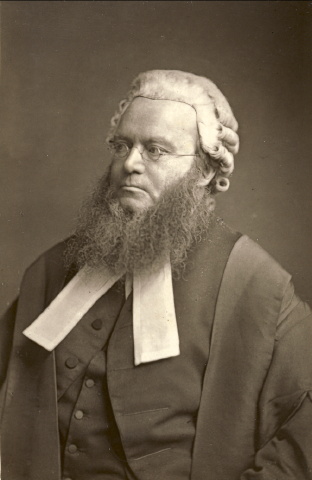
DR. KENEALY,
Q.C.
From a carte-de-visite by The
Stereoscopic Co. |
The next year,
1880, saw the death of his father, aged 84, from ‘senile decay and
diarrhoea’ on 6 October, at 5 King Street, Tring, where he had been
living alone attended by neighbours since the death of his wife six
years earlier.
|
A DUTIFUL SON.
— Gerald Massey was convicted of disobeying an order of
Justices, directing him to pay 3s. 6d. weekly towards
the support of his father and mother who had become
chargeable to the parish of Tring. Order made for
payment of 11s. 6d. expenses, the arrears having been
sent by post. |
At the time of that earlier newspaper report (Bucks Herald, 8
October 1864), Massey was in his usual state of financial distress,
and had temporarily been unable to make the payment.
Also in that year (1880),
probably as the result of his research prior to publication of his
Book of the Beginnings, Massey was elected Chosen Chief of the
Most Ancient Order of Druids, replacing Edward Vaughan Kenealy.[9]
Founded in 1781, this order claimed to have traditions extending
from Neolithic times. Its Celtic-Arthurian mystery teachings
and the mysteries of Ceridwen developed to a more modern emergence
in the eighteenth century. As the order was both practical and
philosophical in outlook, a number of prominent persons are said
either to have belonged to a Druid order, or to have been acquainted
with their teachings. These included Bulwer Lytton, Charles
Kingsley, Sir Edwin Arnold and Lewis Spence of the Rosicrucians.
Traces of Druidic teachings are said to be found in the works of
Boehme, William Blake and Swedenborg. The Three Intentions of
Druid Instruction, which must have appealed to Massey, were the
training of the mind; the cultivation of the heart, and the making
of true manliness. Massey remained Chosen Chief of the Order
until 1906 when ill health forced his resignation, and he handed
over to John Barry O'Callaghan. (See under 'Societies'
in Appendices.)
By 1881 he had completed his first two volumes of
research,
A Book
of the Beginnings, as ‘containing an attempt to recover and
reconstitute the lost origins of the myths and mysteries, types and
symbols, religion and language, with Egypt for the mouthpiece and
Africa as the birthplace’. Elaborately detailed in over a
thousand pages, he commenced with origins depicted in aspects of
Egyptian ritual, correlating them to their equivalent in British
mythology, either by type, sound or analogous meaning.
Proceeding in a similar manner to symbolical customs, Egyptian
deities and place names, he included a list of English and Egyptian
words to raise the question of an independent derivation of a common
source. The second volume dealing with Egyptian origins in
Hebrew, Akkado-Assyrian and Maori, commenced with a similarly
comparative vocabulary of Hebrew and Egyptian words. A section
notes parallelism between the Egyptian Book of the Dead and Hebrew
scriptures, continuing with the Egyptian origin of the Exodus, Moses
and Joshua, and Hebrew deities. Egyptian origins are also
noted in Assyria and, finally, he traces roots in Africa beyond
Egypt. Throughout his book he maintained a strong slant
towards astronomical mythology. In order to develop his
theories, he included an enormous amount of information from, among
other sources, ancient Egyptian texts, Biblical archaeology, Records
of the Past, the Old Testament, and the works of Max Müller.
But in an attempt to be as comprehensive as possible, his objectives
became obscured by providing the reader with large amounts of data
that were not supported by refined structuring.
Reviewers of the books were perplexed as how best
to deal with them. For their critical remarks most chose his
philological section, which appeared to conflict most clearly with
the opinions of that time. It was easier, also, to pick on the
occasional word derivation for sarcastic comment. The
Athenæum, more accustomed to reviewing his poetical works,
referred to the 'two large and sumptuous volumes' but it was unable
to perceive that he possessed the qualifications requiring a
thorough knowledge of anthropology, comparative philology and
mythology, or used caution in the use of materials in the
application of the inductive method. The reviewer ended with a
particularly caustic comment, 'The verses at the beginning will
probably be found by most readers the best part of the book.
The rest is the work of a man who has mistaken his métier.'[10]
The
Saturday Review, while noting some philological analogies,
somewhat tongue-in-cheek, skated over the bulk of his work, and
considered that Egypt had never before produced a jest so monumental
and colossal.[11] The Scotsman
adopted a similar tone[12], their reviewer
appearing supportive in considering that …
‘The aim of the work is to demonstrate, or, at the least, to
render credible, the hypothesis that at some far away time, and
somewhere in the interior of Africa, the negro, or primitive man,
was evolved from the ape—for the author is nothing if not an
evolutionist—and that, in process of time, the negro race descended
the valley of the Nile, peopled Egypt, became a civilised and
cultured people, sent out colonies all over the world, and spread
"mythology, religion, symbols, language," and all that civilisation
implies, to the uttermost ends of the earth.’
The Scotsman was, however, on firmer
ground in sharing the opinion of most philologists of the time when,
in referring to Massey's “Comparative Vocabulary of English and
Egyptian Words,” their reviewer asked “how many sensible people will
trust to the frail and fantastic structure” with which Massey
proposed to bridge the distance from Egypt to England? This,
the reviewer maintained, was by “the old-fashioned and exploded
etymological process in which the vowels count for nothing, and the
consonants for very little more; and in which, by juggling with
letters, any word in any language may be identified with any other
word in any other language of quite another organic structure.”
The reviewer complained that Massey's special object of abhorrence
was Grimm's law[13], and that Massey had, in
dealing with consonants, “made use of every possible form of
permutation without taking into consideration the phonetic laws and
tendencies of the languages to which the words operated upon
belong.” Nevertheless, modern research into the origin of
language suggests that Massey's theory of word classification by
sound and signification does have principles that are broadly
correct.
In contrast, the scientific journal Nature
was, in some ways, more kindly disposed to Massey's examples of
evolutionary ethnology, though also unable to accept much of his
philological arguments. However, the reviewer extended credit
to Massey for the ingenuity with which he had endeavoured to build
up his theory and, to his mind, discoveries. He considered the
work would be read with pleasure by some, with amazement by others,
and incredulity by specialists, though too warm and rosy for the
chill glance of science.[14] Equally, the
Journal of Science
regarded his book as deserving a calm and serious examination, and
regretted that other commentators had made it a mere peg upon which
to hang jests far from ‘sage born’. It considered that Massey
was operating in the right direction in taking man's origins further
back than Max Müller's roots of language, and saluted Mr Massey as a
fellow evolutionist.[15] [See the Epilogue,
Chapter 9, for notes on this theme.]
During the completion of his next work, The
Natural Genesis, five of his poems on Garibaldi, dating from
1851 to 1871, were gathered together and republished in 1882 as
Garibaldi. A Group of Reprinted Poems. Garibaldi had
died earlier that year. Written at the time of various crises
in the life of Italy's liberator, the poems were reprinted in
Garibaldi's memory at the publisher's request.[16]
Approaching the end of 1882, Massey was again
facing financial hardship. Due to his researches and writing
which occupied him for the whole of each day, there was no money
coming in. He had sold the copyright of his Book of the
Beginnings in 1872 in advance of publication, arranging for a
small annual stipend to be paid for ten years, and this had now
expired. His next two volumes were not due to be published
until the following summer. Fortunately he was able again to
obtain support from Lady Alford and Joseph Cowen, and was granted
£50 following an application to the Royal Literary Fund.[17]
Cowen wrote to him on 14 November confirming that
he had written to the Secretary of the Fund, saying that he had
received Massey's first volume, but due to eye trouble and his heavy
commitments as an MP, his reading was limited.
I feel as you do, that every year old friends disappear.
Curiously, however, this morning's post brought me letters from two
old political associates as well as you—Mr C. D. Collett and Mr
Thomas Cooper. I also now and then hear from Harney. He
has been in this country twice recently—once for several months.
He is about to write a history of Chartism.[18]
The Natural Genesis, a further two volumes of over a
thousand pages, was published in July, in which he continued his
researches into mythological and religious evolutionary themes.
While dealing principally with forms of typology originating
primarily in Africa, Massey divided his material to include customs,
numbers, myths and time. Religious myths were, he considered,
central to his thesis, and he included specific sections relating to
creation myths, the deluge and the ark, the fall in heaven and
earth, and equinoctial Christology. The relationships between
these, and the ancient Egyptian religious modes of thought as
written in their rituals, were compared in their development from
Gnosticism to the present Christian dogmas.
Reviews were more guardedly favourable this time,
the reviewers realising to some extent the importance of Massey's
conclusions. The
Athenæum, although again condemning his philology and
questioning the value of his result, did note that his work must
always have a value for the anthropologist.[19]
The New York Tribune praised his evolutionary researches and
acknowledged his sifting of the best authorities, but noted that the
mass of detail and accumulation of minute proofs would obscure the
significance of his argument.[20]
Additionally, the prestigious
Quarterly Journal of Science considered the work to have
importance, not hesitating to say, ‘if the substance of this work
could be presented in a condensed form … it would form a
valuable—almost necessary—companion to Darwin's Descent of Man,
the one work complementing and supporting the other.’ More
favourably inclined to Massey's philological derivations which were
based on things, objects, and gesture-signs—the actual ‘roots’ of
language, the journal stated that the conclusions reached would be
grievously unwelcome to many. But, ‘it seems that he is
turning the only position of importance still held by our opponents
[the non-Evolutionists], and that his movement, if properly followed
up, will be decisive.’[21] It was reported
that Alfred Russel Wallace, on receiving a copy, wrote, ‘Thanks for
your great and wonderful work. I see it contains many things
of profound interest.’[22]
During Massey's completion of his books, he had
been making arrangements for another American tour. This had
become a necessity for financial reasons, as the proceeds from any
of his publications were minimal. Before he left, he delivered
a series of four lectures out of the thirteen ‘archaic, evolutionary
and theosophic subjects’ proposed for America, at St George's Hall,
Langham Place. George Jacob Holyoake had recommended the
lectures as being a good sign for London if Mr Massey has a large
audience, as he has always something of point and weight to say.[23]
The first lecture, held on Sunday 9 September,
1883, ‘Man in search of his Soul during 50,000 years and how he
found it’, showed how his opinions had changed since his previous
lectures at that venue. In introducing his subject, Massey
offered an apology for his performance, to the effect that he had
‘held his tongue for ten long years, till he half lost the use of
it.’ Having become now more evolutionary in his principles, he
drew an analogy between man's physical form of evolution and the
corresponding enlargement of his consciousness. Particular
emphasis was given to his theories of Africa and Egypt as having
formed the cradle of civilisation. The ‘souls’ to which Massey
referred were, as he put it, the result of human awareness of
questioning ‘What am I?’ The first conception of soul was of
blood, which was life issuing from the mother in the form of a
child. The second was breath, which inspired life into the
child. Later developments attempting to define personality and
individuality by mythical legend or mystical representation,
indicated the degree of knowledge attained at that time. The
baptism of infants appeared to be an attempt to confer on them the
final ‘immortal soul’, and from hence may be derived the term
‘Christening’ and the doctrine of salvation.
His second lecture on the following Sunday had
the subject ‘The non-historic nature of the Fall of Man, and what it
meant as fable’. He traced the development of the earliest
non-human elemental powers (images of natural phenomena) and their
association with zootypes, which were later imaged in the circling
of the constellations. These were the timekeepers who, on
account of precession, were 'unfaithful', falling beneath the
horizon until being reinstated again at their next precessional
cycle. It was stellar, not human personages who ‘fell’.
For his third lecture on Sunday 23 September, he
chose ‘The
non-historic nature of the Canonical Gospels’. In his
introduction, he said that he regarded two things as constituting
the unpardonable sin of the parents against the helplessness and
innocence of infancy. The one in allowing a child to run the
risk of blood-contamination through the filthy fraud of vaccination,
the other in permitting the soul of a child to be inoculated with
the still more virulent poison of the theological vaccine.
Massey did have practical cause to revile against the first, as one
of his daughters had nearly died as the result of vaccination at an
early age. This was probably Cecilia, who was mentally
backward. The vaccine used at that time was of the ‘live’
variety, and had greater risk of side effects. ‘I,’ said
Massey, ‘in common with others was vaccinated body and soul, and
have to spend the rest of my life in trying to get rid of the evil
effects of the virus. When I lectured ten years ago, I had not
found out the fraud by which we have been unfathomably befouled.
I accepted the canonical gospels as containing a human history.’
Stating his belief that the Hebrew miracles developed from Egyptian
myths, he detailed many of the parallels between gospel history and
Egyptian ritual texts, to an appreciative audience.
His last lecture on Sunday 30 September, was his
favourite—‘Why does
not God kill the Devil?’ The ‘Devil’ in original ancient
mode of thought being night, or darkness, was a fact in nature.
The Hebrew Satan was the adversary, which swallowed up the light
incessantly. Hence the dualistic aspect of God and the Devil,
Cain and Abel, Esau and Jacob, Horus and Set, etc.[24]
This lecture had the best attendance, the speaker being in excellent
form, with a clear, powerful and sonorous voice.
During this time, an admirer had proposed the
formation of a guarantee fund to assist the independent Massey in
his research and travels.[25] No doubt
earnest and well meaning in his suggestion, this writer's proposal
was sharply rebuffed by Massey:
No doubt the writer meant well, so did Romeo when he stepped in
and caused the death-wound of his dear friend Mercutio, by an action
both futile and fatal. The letter was most injudicious, most
unwarranted, most unauthorised, to say the least of it … In coming
forth to lecture once more, I had no notion of being the personal
herald of a forthcoming subscription to myself. I had no
thought of holding my hat in my hand on the platform, and have no
intention of being posed in that position by any other person... The
writer speaks of my going forth to face the world with my 'tongue in
my hand', but better that, extraordinary as it may be, even though
torn out to realise the figure, than going forth with the tongue in
my cheek. Nor need the writer be distressed at my slender
personnel. I am thin on principle, and have never carried an
ounce of spare flesh. I live by system, and break no dietary
law. My heart is stout, a heart-and-a-half when the pull is
up-hill. It is true that I have suffered from bronchitis; nor
could I shake it off whilst sitting cramped over the desk and
working in the dusty atmosphere of books twelve hours a day seven
days a week as I have done for years … A thousand-fold more than
bronchitis would be the suspicion that in going to America or
Australia, I was facing the world with the begging-box slung
furtively at my back! … [26]
Just prior to leaving England for America, Massey
applied for a Visiting Order from the Home Office in order to visit
G.W. Foote, editor of The Freethinker, who was currently in
Holloway Gaol for blasphemy. His application was refused.
Foote had been charged in 1882 for publishing some comic Bible
sketches, and was undergoing 12 months imprisonment. Following
the Judge's (who was a Roman Catholic) sentence, Foote responded,
“Thank you, my Lord, the sentence is worthy of your creed.” In
Foote's book concerning the trial (Prisoner for Blasphemy.
Progressive Publishing Co. 1886 and online at Project Gutenberg), he
mentions Massey: “Mr. Gerald Massey, then on a visit to England [he
was actually leaving for America] was churlishly refused a visiting
order from the Home Office, but he sent me his two magnificent
volumes on ‘Natural Genesis,’ and a note to the interim editor of
the Freethinker, requesting him to tell me that I had his
sympathy. ‘I fight the same battle as himself,’ said Mr.
Massey, ‘although with a somewhat different weapon.’”
On 9 October 1883 he left England on the
400-berth s.s. City of Rome, his fellow-passengers including
Henry Irving's dramatic company and the women's rights campaigner
Emily Faithfull, who was making her third lecture tour of the U.S.A.
They arrived in New York on 21 October.
Massey's first lecture, advertised by the United
States Lyceum Bureau, was held at Chickering Hall on 16 November, on
‘Man in search of his soul … ’ the first of the series he had given
previously in London. In his introduction, he said:
I have been a fighter on the wrong side all my life … it is not
the way to fortune … I come here to sow the seed, not to reap the
harvest. I come to speak to the New America, the America of
the future, the Continental America … the America of freer thought
and fuller life, that includes Evolution, Spiritualism, Secularism,
Nationalisation of the Land, and other re-formative elements in the
New World's future mental life.
It was unfortunate that he had not explained
aspects of his thesis 'The Seven Souls' in greater detail during the
course of his lecture. A reporter from the New York Times
then briefly summarised the lecture:
Since the ascent of man, as unfolded in the doctrine of
evolution, had succeeded the falsehood of his fall, it became
necessary to go back to the beginning, and judge from the actions of
primitive man. The earliest mode of burial had its primary model in
the mother's womb, the idea being to preserve the body for future
birth. This is still represented in the navel mounds of India, the
nave of a church, the Scottish tumulus and other instances. The
certainty of a future after death possessed by primitive man did not
come to him by revelation, for he was neither a metaphysician nor a
victim of diseased subjectivity.
He said the Egyptians together with the Hebrew Rabbis, Druids and
present-day esoteric Buddhists believed in the existence of seven
souls. These souls were: the soul of blood, the soul of breath, the
soul of external perception, the soul of internal perception, the
pubescent soul, the intelligent soul and the immortal soul. This
belief was typified in the seven days of the Book of Genesis. The
Egyptians' struggle for immortality culminated in the mummy,
preservation being the first form of salvation. They believed that
man gained his fifth soul only at puberty, and his sixth at 20 years
of age. Children consequently had only elementary souls, and from
this was derived the false claim of the Church to save the soul of a
child by baptism.
They thought (together with Shamans and others) that they might be
able in a trance state to transform themselves temporarily into
spirits, and used forms of alcoholic beverage to produce that state.
This belief in a spiritual entity which could be separated
permanently from life, was the first conception of immortality.
The lecture was reported similarly by the New
York Tribune. The reporter wrote finally that, ‘… the
points made in the lecture will be found entertaining to those who
only take a casual interest in such subjects.’[27]
The Chicago Daily Tribune reported the same lecture on the 25
November, but with greater (and more necessary) explanatory detail,
and it was unfortunate that the lecture had not been treated
likewise by the New York Times.
The following day, an article appeared in the
New York Times under the heading ‘A New Philosophy’.
Written by a reporter who obviously intended to make the account of
the previous day's lecture an object of fun and derision, it nearly
became a disaster for Massey's lecture tour:
Being an exceptionally profound philosopher, Mr Massey of course
rejects the Christian religion and treats it with lofty contempt …
Through the magnificent vagueness and unequalled unintelligibility
of his lecture we find occasional glimpses of the grand system of
which Mr Massey is the prophet. It consists briefly in the
theory that man has seven souls, and that he obtains proof of the
existence of his seventh and only really valuable soul by getting
drunk. The state of drunkenness is a state of ‘spiritual
awakenment’; and in this state man may interrogate nature, become as
‘a spirit among spirits’, and indulge in various other useful and
entertaining games. The divine drunkenness of which Mr Massey
treats is not produced exclusively by alcohol or opium.
Mesmerism is a cheaper stimulant, and what is known as the trance
state is the variety of drunkenness best adapted for communion with
our seventh soul … In the enquiry what must a man do to be saved …
Mr Massey's answer virtually is: ‘Get drunk and commune with your
seventh soul.’ … Philosophers could have attained the summit of all
knowledge by the help of a few mesmeric passes or a few gills of
whisky … It could be wished that he had explained the connection
between the seven souls of man and the nine lives of cats.
There must be some connection, for both nine and seven are sacred
numbers … Mr Massey should investigate this great question, and
Colney Hatch would afford him the quiet and seclusion necessary for
this purpose.[28]
Although he usually ignored unfavourable comments
in newspapers, it would be an understatement to say that Massey was
annoyed by this particular report. After consulting
solicitors, he immediately issued a writ for defamatory, malicious
and injurious libel before the Supreme Court, King's County, against
George Jones as treasurer of the New York Times Publishing
Association, laying damages at $5,000. Having given
particulars of his previous reputation in the general field of
literature and his more recent research studies, he detailed the
untruths of statements made in the article. In his lecture he
had mentioned the opinions that various nations have held as to the
nature of the soul of man, and of those who have believed that man
had seven souls. Also, he had spoken of the evolution of those
opinions, an upward series of seven types, the culmination of which
was the fact of only one enduring soul. The references to
drunkenness were utterly false and untrue. He claimed that by
the false and defamatory libels set forth, he had suffered loss in
character as an author, writer; lecturer and as a man, and his
purposes as a lecturer had thereby been defeated, and his
prospective engagements thwarted to his great damage.[29]
Massey's comments (also in Natural Genesis I, vii,
388-393 and Lectures 'Man in Search...', 208-211)
regarding Shamans and their trance states induced by alcohol or –
more usually – by hallucinogens have received more academic research
since then. See
The Mind in the Cave. Consciousness and the Origins of Art,
by David Lewis-Williams, Thames & Hudson, 2002.
At an interview given to a reporter on the
Brooklyn Eagle on the 6 January 1884 in which he mentioned his
libel suit, he said all he demanded was vindication. He was
not after the money, but he felt it was his duty as a public man to
try and stop the system which he said was practiced with impunity by
certain papers in the country. He had supposed America to be a
free country where a man could utter his thoughts, however novel
they might appear, without being called a lunatic. For years,
he said, he had been at work on his new philosophy, encouraged with
the thought that he would be able to present the result of his
labours before American audiences, such as he had had when he was
here eight years ago. "It is rather hard," he said, "to be met
on the very threshold of my return to America with such a
reception."
Subsequent to the issuing of the writ, he was
advised against proceeding further.[30] It
appears likely that the time spent in an ensuing court case would
have seriously impeded or even necessitated the cancellation of the
remainder of his lecture tour. The damages claimed, if he had
been successful, may not have covered the financial expectations of
a full tour, and had he lost the case it would have been a financial
disaster.
Immediately following the lecture, Massey was
taken ill with bronchitis and a tonsil abscess brought about, he
thought, on account of the cold weather of that week. This
caused the cancellation of his remaining three booked lectures, and
some unforeseen expense. A Catholic paper, published in
Brooklyn, gave personal feelings of delight that Massey did not
appear to be meeting with much success on his second visit to the
United States.[31]
Following two months of recuperation, his
reputation apparently undamaged, he felt able to recommence his
tour. He began with a series of four lectures at the Old
Baptist Church, 133 Clinton Avenue, Brooklyn. Two of these
lectures were new, ‘The Non-historic nature of the Fall of Man’ and
‘Non-historic nature of the Canonical Gospels’.[32]
Judge A. H. Dailey presided for his first, the now infamous ‘Man in
search of his Soul …’ The reporter found Massey to be:
… at the grand climacteric of life; and is below the medium
stature. Grey whiskers, of English trim, half mask a face
which wears a look of intensity as he plows through the mystical
domains of Egyptology and the shadowlands of the ancient Orient.
Brown hair, with occasional streaks of grey, rolls forward in a
billow on his crown, and ripples off from the ears. He wears
spectacles when he reads from manuscript. He spoke for nearly
two hours with such rapid enunciation that his hearers were strained
to follow him.[33]
From Judge Dailey's residence at 252 Bushwick
Avenue where he was staying, not yet fully recovered from the trauma
of the aborted court action and subsequent ill-health, he wrote to
Harry Edwards on 25 February:
You put a little new life into me on Saturday. I was losing
heart and nerve. But, we must make this a success or I shall
feel worse than before. To your 25 or 10 or 5 Dollar friends
you may hint of my illness and that this is a sort of benefit
Lecture …
Leaving Brooklyn he went in early March to Gill's
Hall, Springfield, Mass.[34], where he wrote to
Edwards again:
Heartfelt thanks for your kindly note. All right.
What I make here will keep me going. I did not know that I was
to stay over the two Sundays here. I look in at Dailey's on
Tuesday and go to Philadelphia on Thursday, then back to Dailey's.
I have an offer from Cleveland for a course of Lectures, at a price,
early in April. So it begins to look as tho' with your
invaluable help the worst is over and I shall get along. The
improved prospect puts me in better spirits. Indeed, I am
fighting down my nervous dyspepsia fast … [35]
From Springfield he went then to Cleveland, at
the Church of the Unity, on 8 April, for a series of five lectures.
Prior to leaving Cleveland he gave a short talk to the Children's
Progressive Lyceum, on ‘The Origin of some of our everyday Habits
and Customs’.[36] On his way to San
Francisco he stayed to lecture in Power's Opera House, Grand Rapids,
Michigan, from 21 to 28 April which the Eagle
reported, and noted his delivery ‘as like the rushing storm’.[37]
Professor Marvin Vincent, a theologian, commented, ‘He is a splendid
lecturer. He went off like the eighty-one ton pounder. I
didn't agree with his opening remarks, but it was like a shell
bursting among us, and we had enough to do to look out during the
rest of the lecture.’[38]
Having arrived in San Francisco, he was met by a
reporter from The Call on 23 June 1884, who asked him for his
impressions of America before he continued his onward journey to
Australia. He used the opportunity to restate his beliefs
concerning capital, labour and co-operation, which had remained a
firm conviction since his Chartist days. (Appendix
D.)
Massey's first lecture in Australia was in
Freemasons' Hall, Sydney, on 12 August 1884. For his subject,
‘The Man Shakespeare with Something New’, he was introduced by His
Honour Mr Justice Windeyer as the first English poet that had
visited Australia. The hall was crowded to capacity.
Following the lecture the poet was cheered by the enthusiastic
audience. They again showed their appreciation when it was
mentioned that Massey was the critic who, in the Athenæum had first
introduced the Australian poet Henry Kendall to the rest of the
world.[39]
From Sydney he went on to Melbourne for a
conversazione of the Victorian Association of Spiritualists on 29
September, where he spoke in general terms on the subject.
Remarking on the divergences of opinion within their ranks, he
thought it was in many ways an advantage, making those people
independent in mind. He did consider, nevertheless, that a
loose confederation would assist them to agree on plans of action.[40]
With regard to Massey's visit to Melbourne, it is
interesting to speculate if John James Bezer, who had left England
under a cloud in 1852, and was living in Melbourne at this time, had
heard of the visit. If he had, he would certainly have avoided
Massey. See the author's John James Bezer, Chartist, and
John Arnott, National Charter Association (lulu.com
2008).
In Ballerat, New South Wales, he irritated the
religious dogmatists before returning to Sydney at the Theatre
Royal. After giving several lectures he was taken ill, which
lost him two months, but was able to continue with further lectures
at West's Academy in May, before sailing to Auckland, New Zealand,
in August.[41] The local
Rationalist reported large sections of his lectures, which
also received fair commenting from the national press. Towards
the completion of his tour in the colonies, he was frequently asked
for his opinions on their culture and social state:
I have been twelve months in the Colonies, and still feel that I
want to come back to see what I think. Roughly speaking, I see
a land of coarse plenty, which must be a paradise to myriads of
emigrants half starved at home … Douglas Jerrold said of the
soil out here, that if you tickled it with a hoe, it would laugh out
with a harvest. It strikes me there has been too much tickling
with a hoe—too much surface work. You want a lot of our small
farmers with some means of their own—the men who are being ousted
from the land at home every day … One thing I have been delighted
with, that is the universal use made of flowers as a daily beauty in
the homes of the people, wherever I have been. I have been
struck with the look of English solidity in buildings.
Asked if he considered free trade or protection
best for a young colony like New Zealand, in relation to local
industries, he replied:
I am a freetrader myself, and I consider that England has
absolutely demonstrated the benefits of free trade for the whole
people. I should be very chary of protecting anything,
although there may be necessary exceptions in a young colony... It
is not the duty alone that tells, but the profit on the duty. Thirty
per cent duty means another 30 per cent to the purchaser. A 1s
6d bottle of eau de cologne in London, is 2s in Sydney, and 3s in
Auckland and Dunedin. Nor is it necessary for all people to
produce all things, as if they were going to stand a siege against
all the rest of the world.[42]
In spite of the litigation concern and health
problems that caused delays to his tour, he appeared satisfied with
the result, and left for England in November.
During his travels, Massey must have read about
the Pall Mall Gazette's articles ‘The Maiden Tribute of
Modern Babylon’ which, in May 1885, had exposed large scale
prostitution and white slave traffic in London. William T.
Stead, editor of the journal and author of the articles had been
less than circumspect in obtaining evidence, and was imprisoned for
three months on charges of abducting a minor. J. O. Baylen in
the Victorian Periodicals Newsletter traced a copy of
Massey's poem ‘Greeting to W. T. Stead’ which Massey had sent to
Stead, presumably in January, the month of his release,
congratulating him on his crusade.[43] This
was not published in Stead's journal, but another copy, with some
minor variations and an extra verse, was published in the Medium
and Daybreak, 22 January 1886. Stead had been released
from prison on 18 January, and the additional penultimate verse
indicates that particular event:
… And so we greet him at the Prison-porch,
With bosoms beating music for his march,
And hearts uplifted like a Triumph-Arch.
Honour to him, we cry, who sought to save
The Girls dragged down our gutters to the grave!
For him our plaudits ring and welcomes wave. |
The poem was reprinted by Massey in 1889, as ‘At
the Prison-door’, again with an extra verse and some
amendments.[44]
On 28 March 1886 he was ready to recommence his
lecturing with a welcome at St George's Hall, for which the Reverend
Stainton Moses had urged a large attendance. Samuel Carter
Hall, then aged 86, who had supplied evidence to the Dialectical
Society and provided valuable assistance to D. D. Home during his
trial, expressed his regret at being unable to attend:
Dear Gerald Massey,
I wish to let you know that nothing but very severe illness would
have prevented my attending your Lectures, which I am very sure will
be of deep interest and value. I should like to write you a
long letter, but, in truth, I cannot. I am very near to death.
To borrow a saying of my old friend Thomas Hood, ‘I am so near
Death's door that I fancy I can hear the creaking of the hinges’ … I
shall long precede you out of this life, but I may be, I believe
that I shall be, one of your helpers in the next … [45]
Massey responded to the greeting:
I sometimes feel that the assurance of Spiritualism must almost
make me seem brutal in my acknowledgement of death … It is, however,
betwixt a smile and a tear that I think of you looking back here for
work to do, at a time when all good Christians are looking forward
to doing nothing whatever but lying down lazily in the oyster-beds
of everlasting repose …
Of the more worldly affairs during 1886, nothing
provided more attention than the general election. Fought
principally on the issue of Irish Home Rule, Gladstone's ‘Bill for
the Better Government of Ireland’ was defeated with the aid of
dissident Liberals. Randolph Churchill aided Salisbury's
Conservative Party with an onslaught against Gladstone, and the
Conservatives were returned to power in July. Massey, who
always had strong political interests, supported Gladstone,
particularly on the front of Home Rule. Prior to the election,
he wrote a pamphlet of six ‘Election
Lyrics’ which were published by Burns, and sold at 'Twopence
each; 7/6 per 100; 30/- per 1000'. The sales are not recorded.
Politically satirical as compared with his radical protests of the
1850s, the lyrics were cleverly constructed and topical. ‘The
Poet of the People uttered the voice of the People.’ He
exhorted them to ‘Vote for the Liberation Laws, The Grand Old Man,
and the Great New Cause!’ and criticised the Conservative Primrose
League. The League had been formed by Lord Randolph Churchill
and some of his friends in 1883 to promote the political opinions of
the Tory party in a more popular manner. From their base at 20
Essex Street, Strand, they aimed to maintain the union of the Crown,
the Constitution, and the Country. The name of the League was
suggested by the late Lord Beaconsfield's favourite flower.
Queen Victoria had acknowledged this by sending a wreath of
primroses to be placed on his tomb on 19 April, the anniversary of
Beaconsfield's death, thus commencing the annual Primrose Day.[46]
The league was very well organised, and became a powerful force in
obtaining votes. Advertisements for Primrose pocket handkerchiefs,
Primrose tooth powder, Beaconsfield sun shades and skirts were
widely placed in journals. The Grand Council had two Grand
Masters, the Marquess of Salisbury and the Earl of Iddesleigh,
followed by trustees, and a large Grand Council. Branches,
known as ‘habitations’ were formed countrywide under the old ‘orders
of knighthood’ basis, with members joining as knights or squires.
Habitations were subdivided into wards, each ward consisting of one
or more blocks of buildings, controlled by a ‘warden’, which
facilitated intensive canvassing. Early in its formation, the
league recognised the importance of women as a political force, and
a special branch for them, the ‘Dames’, was formed the following
year under the presidency of the Marchioness of Salisbury.
Lady Randolph Churchill was a vice-president. The dames
appreciated the primrose as being representative, as they considered
it possessed their own characteristics attributed by Burns to the
daisy, of being both ‘wee and modest’—although approval by a dame of
the league was to mean more than the favour of a gracious smile.
They assisted their knights very effectively in the canvassing
duties. In 1886 the league had a membership of half a million
people.[47]
|
The Primrose Dame is a likely lass,
To wile and wheedle the Working Class
Of their Votes - her end and aim.
A vision of beauty, in by-way or street,
Is the glance of her face, or a glimpse of her feet,
When a-foot is the Primrose Dame …
Soliciting votes, she is not shy,
Will let you light your pipe at her eye, -
Kindle your fire with her flame;
But look for the snare when you see the smile,
Under the Primrose she can beguile:
Beware of the Primrose Dame … |
In a later edition of the poems he added a further verse:
‘Refreshments at five, in the Primrose Bower!
You WILL come? You WILL wear it? MY favourite flower?
HIS flower who gave it HIS fame!'
And the touch is of velvet, the look is of love:
But beware of the claw that is sheathed in the glove
Of the Beaconsfield Primrose Dame.[48] |
Lecturing occupied most of Massey's time for the
next two years. Another series of ten at St George's Hall
commenced on 31 August, and included Shakespeare and Burns as a
lighter variation on his now more orthodoxy opposed subject matter.
As a result of his iconoclastic change of stance he found himself in
greater conflict with accepted authorities on biblical and
mythological exegesis, as well as with some of his Spiritualistic
advocates. Dr James Peebles, a Christian Spiritualist, had
been lecturing in Australia in 1874 on ‘Spiritualism defined and
defended’. There he had been referred to as ‘the American
devil-rapper’, ‘bold infidel’, ‘long-haired apostate’, and other
unflattering terms to which even Massey, with the occasional
exception, had not been subjected.[49]
Massey was now firmly against the literal
interpretation of biblical narrative. He declared that the
Christ of the Canonical Gospels was not to be resolved into the man
whose identity is acknowledged by the Jews; but could be traced by
trait, characteristic and character, to the several copies of the
Egyptian prototype, especially to the Horus-Christ of the Osirian
religion, who was continued as the Horus of the Gnostics, and who is
developed as the Christ in the Catacombs of Rome. Peebles had
complained of Massey's anti-Christian opinions, to which Massey had
responded by referring to Peebles as ‘one of those professed
Spiritualists who are the very worst cacklers on behalf of historic
Christianity, as if they were the Geese who are going to save Rome
for the second time’.[50] Massey was also
attacked by William Coleman in the Chicago Religio-Philosophical
Journal, on a lecture ‘The Historical Jesus and Mythical Christ’
which had been published in the Medium and Daybreak.
Coleman, in some detail, accused Massey's parallels between the New
Testament and Egyptian mythology as being far-fetched, incongruous,
absurd, and positively false in construction.[51]
As no copy was sent to him, Massey was unable to
reply until the following March. By that time Coleman had
written a letter in the same journal on 5 February, ‘Opinions of
eminent Egyptologists regarding Mr Massey's alleged Egypto-Christian
parallels’. Quoting a letter on the subject by Professor
Sayce, in which Sayce referred to Massey's books as ‘a mass of
ignorance and false quotation’, he mentioned a letter from an
Egyptologist connected with the British Museum, who did not want his
name published ‘owing to the rather personal character of some of
his remarks’. This person had written, with other assertions,
that Massey was ‘an ignoramus of the worst kind’. Massey was
quick to take up the challenge, and wrote to Mr Le Page Renouf at
the British Museum, as being the most likely person to have made the
statements, but Mr Renouf declined either to admit or deny having
been the author. Massey replied in a very abrasive manner to
the points made by Mr Coleman, whom he judged to be incompetent to
discuss matters of Egyptology. Strangely, Coleman had written
in his article ‘that there is no reasonable doubt in the light of
historico-critical biblical science, that while large portions of
the latter [John's Gospel] are genuinely historical, the Gospel of
John, as a whole, is unhistorical, mythical’, and Massey was quick
to take up that point. Welcoming honest criticism and genuine
correction, Massey said that he had spared no time to get at his
facts, and neglected no source of knowledge. He had learned
the Egyptian Book of the Dead nearly off by heart, and consulted
with Dr Samuel Birch regarding variant texts, who also had corrected
his proofs and gave him advice. And that, he added bitingly,
was a great disadvantage when being judged by Mr Coleman![52]
He had also received assistance from Claude Montefiore, a Hebrew
religious and biblical studies authority as well as from Goldridge
Pinches, Lecturer on Assyria at the British Museum. [Birch/Pinches
correspondence, British Library.] Massey's ‘Retort’
was appreciated by a pseudonymous ‘M.A. (Cantab.)’. He
mentioned that Le Page Renouf, who had succeeded Dr Samuel Birch as
Keeper of the Egyptian Antiquities at the British Museum, was a
Roman Catholic, and queried his judgement on religious philosophy.
Although the Egyptian origin of Christianity was an old theory,
Massey's discoveries built a firmer foundation for this thesis.
Even if several facts were found to be errors either of judgement or
other cause, the force of the array of the others is undiminished.[53]
On 11 November Massey was in Glasgow, when his
subject incurred the displeasure of the Christian Leader.
Under the heading of ‘A wasted life’ the journal stated its orthodox
indignation against that part of the audience who showed their
appreciation of some of Massey's comments:
Shame on the men who laughed outright, and deeper shame on the
few women who veiled their smiles at the wittily couched blasphemies
which interspersed Gerald Massey's lecture last week on the
historical (Jewish) Jesus, and the Mythical (Egyptian) Christ!
I saw a minister present. Why did he not speak out against the
man who had the effrontery to state that Christianity has for
eighteen hundred years presented a sorry spectacle trooping after
paganism! … Granted, as Massey asserts, that nearly all the passages
in our Lord's life had parallels in heathen mythology long before
Christ's advent, would not this alone be sufficient reason for the
Redeemer to gather up these dim threads of expectation, and weave
them into His own personality so as to present to the heathen mind
the completion of what the fable-links had indicated? … [54]
This attack was ignored by Massey, although
undoubtedly brought to his attention.
In Edinburgh he mentioned that in spite of the
wretched wet weather he had done fairly well, and had been reported
in a somewhat "brief but dynamitish" fashion by The
Scotsman. Massey may have been referring to the edition of
22 October 1886, which carried a report on his lecture in the Albert
Hall, Edinburgh on ‘Paul the
Gnostic—not a Witness for Historic Christianity.’[55]
Massey's next intended visit, to Newcastle, was
spoiled by a series of misunderstandings. When he suggested a
fee of £30 for four lectures, he received no reply from the
Newcastle Spiritualists. On then asking for an offer, they
said they could pay £3 3s plus the hall and advertisements for two
nights, but no expenses. Neither of these suggestions being
satisfactory to both parties, further proposals were made, which
then became confused, with the whole affair ending in publicised
acrimony. However, it appeared not to have damaged Massey's
lecture tour, the paper being less sympathetic to the Newcastle
Society when it stated that generosity in the form of a more
handsome offer for such services was desirable.[56]
A few years after he had received his Civil List
Pension in 1863, it was proposed by friends that an application
should be made for an extension of the sum that had been granted.
This course was urged also by Lord Lytton, who had written on 15
July 1866:
Dear Mr. Massey,
I was sorry to hear that you did not receive a more adequate
pension. I should be willing to sign a memorial with others;
and I advise you to get one prepared, stating the circumstances, and
asking for an increase of the amount now given. I think you
well worthy of whatever pension can be allowed from the fund set
apart for literary men.
Yours,
Lytton.[57]
But due to his involved personal affairs and
American tours, he had been unable to act on this advice at the
time. He now prepared the necessary Memorial and sent it to
the Rt. Hon. W. H. Smith, the First Lord of the Treasury.
Forty-two signatures were appended for:
Your Lordship's most considerate attention, and venture to hope
that your Lordship may see fit to recommend Mr Massey's name for an
extension of the amount now granted, that his lot may be made a
little lighter, and his chance increased for rendering fuller
justice to the literary talent which, according to the undersigned,
has already done good service.
The forty-two names appended included those of
Lady Marian Alford, Matthew Arnold, Robert Browning, Richard Burton,
William Crookes, David Masson, George Meredith, Henry Morley,
Herbert Spencer and John Tyndall. This application proved to
be successful, and on 1 April, 1887, ‘in consideration of his
literary merit, and of the smallness of his means of support’ he was
awarded an extra £30 per annum.[58]
Since 1883 Massey had realised the desirability
of providing short synopses of some of the principal areas in his
Book of the Beginnings and Natural Genesis as suggested
by the Quarterly Journal of Science (vide sup.).
Certain reviewers had commented on the complexity of the material,
and he had received enquiries from other persons, particularly
Freethinkers, Secularists and Spiritualists, concerning publication
of abstracts. As his current lecture courses were derived from
these large works, he prepared a series of ten for private
publication in 1887. These included several of the lectures
that he was currently presenting, together with some additional
titles. In these short published lectures (Gerald
Massey's Published Lectures) he demonstrated his research into
the African origin and development of myth, symbol, language and
religion by the use of a system of typologies that he developed as a
method of classification. These included totemic typology,
primitive customs, numbers, time, the mythical serpent, the cross,
the four quarters, mythical creations, etc. He stated that
mythology is a mode of representing certain elemental powers by
means of living types that were superhuman-like phenomena in nature,
i.e. representation on the ground of likeness. They were
representatives of certain natural forces, from which the earliest
gods evolved. How these were thought of and expressed
constitute the primary stratus of what is termed 'Mythology' today.
Early man made use of 'things' to express their thoughts, and these
'things' became symbols—outward and visible shapes of ideas—the
beginning of gesture sign-language by imitation being earlier than
words. As an example, Massey notes that the figure of an eye
directly represents sight and seeing, but the eye as reflector of
the image becomes a symbol. Myths were therefore founded on
natural phenomena and remain in the register of the earliest
scientific observation. Massey treats mythology as 'the mirror
of prehistoric sociology.' Throughout his works, when
examining racial mythology, Massey places particular emphasis on
ancient Egyptian myths (the most developed in African culture) and
general mystery religions. He maintains that these myths
developed as a necessary and fundamental central core of belief from
earliest times, and are the roots of modern cultural origins.
Intrinsic to these beliefs are world-wide convictions that support
the particular idea of the post-mortem persistence of the human
soul. In Egypt, for example, prayers and offerings were not
made to the person of the deceased (represented as a type of
transformation by the dead Mummy—a mortal likeness), but to the
ka-image, a likeness of the person's soul that lived on after death.
Elaine Pagel’s introduction to her
Adam, Eve, & the Serpent (Wiedenfeld & Nicolson 1988) p. xix
quotes the anthropologist Clifford Geertz' definition of culture as
"an historically transmitted pattern of meaning embodied in symbols;
a system of inherited conceptions expressed in symbolic form, by
means of which men communicate, perpetuate, and develop their
knowledge about and attitude to life." This would certainly
equate with Massey's concise concept of mythology as being "the
mirror of prehistoric sociology" and the Oxford definition of
culture as "ideas, customs and social behaviour of a particular
people or society."
It has to be noted that the lectures were
published in 1887, and due account must be taken of research and
archaeological discoveries made since then. Elements of these
must necessarily amend some of his details and conclusions.
Massey's theme in his
Paul as a Gnostic opponent, not the Apostle of Historic Christianity—and
comments of some later scholars regarding Gnosticism were reinforced
by the discovery in 1945 at Nag Hammadi, Egypt, of twelve 2nd/3rd
century Coptic Gnostic codices. Bart Ehrman in his Lost
Christianities. The Battles for Scripture and the Faiths we never
knew (OUP 2003) quotes from a section of 'The Apocalypse of
Peter' in which Peter witnessed the crucifixion. What was
crucified was not the divine Christ, but his physical shell.
Jesus replied to Peter's query as to whose hands and feet they were
hammering:
The Saviour said to me, "He whom you see above the cross, glad
and laughing, is the living Jesus. But he into whose hands and feet
they are driving the nails is his physical part, which is the
substitute … "
The Gnostics believed that salvation does not
come in the body, but by the divine spirit escaping the body, which
is the physical shell, and that the physical death of Jesus was not
therefore the key to salvation. It is not the dead Jesus that
saves, but the true self—the Divine Essence. Before the
publication of Massey's lectures in 1887, portions of gospel texts
associated with Paul were considered corrupt. Since then,
further biblical exegesis (such as the Nag Hammadi cache discovery)
has continued to cast doubt on the accuracy of a number of works
attributed to Paul and other writers. Bart Ehrman—vide
supra,—Barry Layton's
The Gnostic Scriptures (1987) and Elaine Pagels' The
Gnostic Paul (1975) confirm the multiplicity of groups with
diverse ideas in that period that gave rise to conflicting opinions
in their writings. Although known Gnostic writings have not
been dated before the early 2nd century, mythological elements may
probably have existed from an earlier date. It appears also
that the Gnostics had much in common with early non-Gnostic
Christians. But can Paul be termed a 'Gnostic' as a classic
term, as Massey asserted? A form of philosophical Jewish
mysticism comprised an integral part of Gnostic beliefs, and it is
likely that Paul understood some of those beliefs. Both Jesus
and Paul as cited in the gospel texts spoke often in parables that
were symbolic, and not to be taken literally. Pagels—supra—notes
two conflicting images of Paul. Traditionally in one image he
is viewed as a Christian literalist and anti-Gnostic, in the other
as a symbolic Gnostic—supporters of each both claiming to be
authentically Christian. Massey takes the latter, Gnostic
view, giving his thesis a marked bias in that direction.
To some extent also, is Massey's overstatement of
the importance of the phenomena of Spiritualism that runs
thematically throughout many of his works. His lecture
The coming religion
provides a good example. Whilst not necessarily doubting the
earliest forms of psychic phenomena and its important influence, or
some of the more modern exponents, it does appear that Massey at
times became less that critical when taking that particular
approach.
The Theosophists were also very interested in his
works, and held him in high regard except for a number of his
opinions on the relevance of secret forms of mysticism. Madame
H. P. Blavatsky quoted him twenty-four times in her Secret
Doctrine, and wrote to him on 2 November 1887:
… I have read and re-read your Lectures, and the more I read them
the more I rejoice, for whatever there is in them (except your
unjust pitching, semi-unjust at any rate, into esoteric Buddhist and
our septenary idea) is a corroboration of our esoteric teaching … I
quote you constantly, and, for me, you are the only man in Europe
and America who understands that symbolism correctly … You differ
from us in several important points, such as not accepting the
Avatars, or the spirit of Christos, Buddha, Krishna, (rather
Vishnu), &c., otherwise than as purely subjective manifestations. We
say that, with regard to the Gnostic Christ, you are absolutely
right … I say, Mr Massey, glory and honour to you … [59]
When Massey had this letter published in 1891, he
wrote an open reply referring to one of his lectures,
The Seven Souls. In this,
he had written of theosophy, or esoteric Buddhism as it was then
called, in terms that could hardly have brought a smile to the face
of the usually inscrutable ‘H.P.B.’
They are blind guides who seek to set up the past as superior to
the present, because they may have a little more than ordinary
knowledge of some special phase of it … I do not want to find out
that I am a god in my inner consciousness; I do not seek the eternal
soul of self. I want the ignorant to know; the benighted to
become enlightened; the abject and degraded to be raised and
humanised; and would have all means to that end proclaimed
world-wide, not patented for the individual few, and kept strictly
private from the many … I cannot join in the new masquerade and
simulation of ancient mysteries manufactured in our time by
Theosophists, Hermeneutists, pseudo-Esoterics, and Occultists of
various orders, howsoever profound their pretensions … The only
interest I take in the ancient mysteries is in ascertaining how they
originated, in verifying their alleged phenomena, in knowing what
they meant on purpose to publish the knowledge as soon and as widely
as possible … Mystery has been called the mother of abominations;
but the abominations themselves are the superstitions, the rites and
ceremonies, the dogmas, doctrines, delusive idealisms, and unjust
laws that have been falsely founded on the ancient mysteries by
ignorant literalisers and esoteric misinterpretation.
[Chapter 8]
NOTES
|