|
THE LONDON ILLUSTRATED
NEWS
FEB. 23, 1850.
LAW INTELLIGENCE.
__________
COURT OF EXCHEQUER.
THE NATIONAL LAND SCHEME.—O'CONNOR (M.P.) v. BRADSHAW.
On Thursday week the trial of an action for libel was begun in this case
before the Chief Baron and a special jury. The defendant (the proprietor
of the Nottingham Journal) pleaded a justification.
Mr. Serjeant Wilkins opened the plaintiff's case by reading
the alleged libel, which was in the following terms:—
"The subscribers to the National Land Company, and the
admirers of Feargus O'Connor, Esq., M.P. for Nottingham, who has
wheedled the people of England out of £100,000, with which he has bought
estates and conveyed them to his own use and benefit, and all who are
desirous to witness the overthrow of this great political impostor,
should order the
Nottingham Journal, in which his excessive honesty in connexion
with the Land Plan has been, and will continue to be, fearlessly
exposed. The Nottingham Journal is the largest newspaper
allowed by law; and is the best vehicle in this county or neighbourhood
for advertisements, business information, and general news.
Delivered everywhere early every Friday morning.—Price only 4½d: per
annum, in advance, 18s; credit, 20s."
The learned sergeant proceeded by observing, that, if ever
there was a libel rendered undignified by the mode in which it was
framed, and the object for which it was disseminated, it was that which
he had read. It was a specimen of patriotism wrapped up in dirty
paper. (A laugh.) All he should add, in conclusion, was, let
the defendant attempt to prove that libel if he dared.
Evidence was then given in the usual way, that the defendant,
Mr. Bradshaw, is the registered proprietor of the Nottingham Journal,
and that copies of the placard in question were obtained at defendant's
office in Nottingham.
Mr. Roebuck addressed the Jury for the defendant, supporting
the plea of justification.
The hearing of the case occupied the whole of Thursday,
Friday, and Saturday.
On the latter day, the Chief Baron, at the close of the
defence, summed up. He said that it was very possible that the
errors into which Mr. O'Connor had fallen were to be attributed to this
fact, that he was a sanguine, unthinking man, and that, eager in the
pursuit of an object no doubt delightful to contemplate, he had been
betrayed by his enthusiasm into errors and oversights which left his
proceedings open to suspicion. It was for the jury, however, to
consider what the defendant had meant by the word "dishonesty." If
he meant to say to Mr. O'Connor, "Your scheme is a political imposition,
and you have not fully and honestly stated as much as you were bound to
have stated with reference to it," why then there could be no doubt that
enough had come out on the trial to show that the defendant's plea had
been made out; but if the jury thought that he meant to impute personal
dishonesty to the plaintiff in his individual capacity, the case then
stood in a totally different position. A man might be as
philanthropic in his intentions as a Howard or a Cartwright; but he had
no right under heaven to collect such a sum as £112,000, and to place it
in such a position that not one of the subscribers would have any legal
right of control over it. If Mr. O'Connor had unhappily become a
bankrupt, every shilling of the money so collected might have been
divided amongst his creditors. No man had a right to impose such
implicit continence in his own integrity and honour—no man had a right
so to set at nought the vicissitudes of this ever-changing world as to
leave it to the chance of his remaining honest and solvent whether his
countrymen should be enabled to recover the enormous sums they had
confided to his guardianship. There was not the least necessity to
have run such a risk, for he might have placed the money in the hands of
three or four persons of undoubted respectability, who might have signed
a paper, stating that they held it in trust to be handed over to the
treasurer of a society which it was in contemplation to institute.
Mr. Sergeant Wilkins: As to the libel being a libel on Mr.
O'Connor's personal character, allow me to remind your Lordship that it
accuses him of conveying the property to his own use and interest.
The Chief Baron: And that is true; nobody else has a legal
right to it. Of course it would be for the jury to decide on his
bona fides, but it would be also for them to decide on the bona
fides of Mr. Bradshaw. As far as the evidence went, there was
no man under heaven who had the least legal right to one shilling of the
money collected, or to one acre purchased, excepting only Mr. O'Connor.
Every man in the community was responsible to society for the obvious
inferences which might be drawn from his conduct, and could not complain
if those who watched over it should censure him for that which, however
remote it might be from his intention, appeared to be the natural result
of what he had said or done.
The jury retired at five minutes after five o'clock, and in
eighteen minutes returned, and, amid the general hush of expectancy,
gave in the following verdict:—"We find a verdict for the defendant, but
beg to accompany it with the unanimous expression of our opinion that
the plaintiff's character stands unimpeached as regards his personal
honesty."
The finding appeared to give general satisfaction to those of
the public who were assembled in the court.
|
|
____________________________________
THE NORTHERN STAR
AND NATIONAL TRADES JOURNAL.
LONDON, SATURDAY, APRIL 27, 1850.
SOUTH LONDON CHARTIST HALL.
The first meeting convened under the superintendence of
the Provisional Committee of the National Association, in this hall, was
held on Monday evening, April 22nd, and was more numerously attended
than any meeting held on this side of the water for two years past.
Mr. PATTINSON was unanimously
called to the chair, and said, that night they would not be called upon
to support the Parliamentary Reformers, but to stand firmly by, and
agitate for the People's Charter. He could not understand, for the
life of him, if they expended "all their strength" in support of the
Parliamentary and Financial Reformers, what use would it be "holding the
Charter in view" when their energies were entirely exhausted. The
resolutions to be proposed partook both of a political and social
character—they were open to discussion; and should any one have
objections to or amendments to propose, let them come forward, and, as
far as he (the chairman) was concerned, he would do his duty in getting
them a full and fair hearing. (Hear, hear.) He had much
pleasure in calling upon Mr. G. W. M. Reynolds to move the first
resolution.
Mr. REYNOLDS, on rising, was
greeted with prolonged cheering, and moved the following
resolution:—That as the life, liberty, and property of every individual
is, or may be, affected by the laws of the land in which he lives; and
as every person is bound to pay obedience to the same; and as no man is,
or can be, actually represented who has not a vote in the election of a
representative, cannot be said to be fairly protected by the laws he is
bound to obey—this meeting is of opinion that every man in this realm
hath a natural and equal right to vote in the choice of a representative
to parliament; pledges itself not to give up agitating until the said
right is granted to every man (criminals, insane persons, and infants
only excepted), together with the remaining points of the People's
Charter. This meeting is also of opinion, that any agitation which
will not give to others the same rights they claim for themselves,
cannot be based on true and just principles—so that, while we refrain
from factious opposition to any such agitation, we are, nevertheless
determined not to combine nor unite with any such party, conscientiously
believing the same would end in disappointment and dissatisfaction to
the most needy and most deserving of the working classes." Mr.
Reynolds said, it gave him great pleasure to move that resolution, as he
was for the "whole Charter," and had but little sympathy for those who
advocated anything short of that measure. (Hear, hear.) Mr.
Reynolds here reiterated his determination to move an amendment in the
programme of the Parliamentary Reforms, at their Conference, which would
commence to-morrow—namely, for registration, in lieu of taxation—which
would, if adopted, bring them to Universal, or Manhood Suffrage.
(Cheers.) He intended, also, to add Payment of Members. He
should do so because he believed that any measure less than that
embracing the six points of the Charter would prove injurious to the
working classes. (Cheers.) [At this moment Messrs. J. J.
Bezer, Bryson, Martin, Snell, Young, and others of the liberated victims
came on the platform, and were welcomed by hearty and prolonged
cheering.] Mr. Reynolds said, if any justification was required
for the step he was about to take, they had it in the harsh treatment
and the severity of the verdicts passed on those men who had just been
liberated from prison—(loud cheers)—and he (Mr. Reynolds) believed that
if a less measure of Parliamentary Reform was obtained, the middle
classes would turn round upon the working classes and say—"This is a
final measure, and ,if you attempt any further agitation you will be
prosecuted; we shall be the jury, and will convict you." (Loud
cheers.) The working classes now toiled almost day and night for a
bare subsistence, and were scarcely thanked for their labour, and they
were not infrequently called "a mere mob" of "the canaille," beings
without either rights or privileges. ( Hear; hear.) At a
recent meeting at the National Hall, he had spoken of their social
rights; the
Times had seized upon his speech, evidently with a view to hold him
up to scorn as a spoliator; representing him as having a desire "to sell
the estates of the rich," when he knew right well that he had said all
change must be made by Act of Parliament, and that as first steps under
the Charter, he had recommended the Repeal of the Laws of Mortmain,
Primogeniture, and Entail; and that he had then said that parliament did
now interfere with private property in the matter of railroads, quays,
or wharves, granting compensation for the private lands and property it
took for the benefit of the public, and he hoped the time would come
when a government, elected by the people, would hold all the lands for
the benefit of the whole people. (Tremendous cheering.)
There could be nothing wrong in this, always providing that the present
holders were duty compensated; but if he or any one else were to
advocate spoliation, he verily believed that he or they would be hissed
from the platform. (Loud cheers.) He must confess that he
held it to be a wrong and a robbery for one to have superfluities,
whilst another lacked the positive necessaries of life, and more
especially so when the possessor happened to be a useless, indolent
aristocrat. (Loud cheers.) He maintained that preaching
Socialism, as well as Chartism, was only acting in accordance with the
dictates of Common Sense; it would be worse than useless to occupy time
and means in advocacy of the Charter, unless the Charter led to the
adoption of social rights. (Hear, hear.) Socialism meant
finding employment for the unemployed, food for the hungry, and raiment
for the naked. Socialism was horrified at the gross immorality and
the mass of prostitution that prevailed in our streets; and the numerous
suicides that took place amongst those unfortunates, was a proof that
such a mode of life was unnatural and most abhorrent to them.
Where was the wisdom or patriotism of Parliament, when they looked on
and saw gaunt famine prevail in Ireland—when they daily witnessed scenes
of wretchedness and misery which drove poor wretches to the poor-law
bastile, and separated husbands from wives, and parents from their
offspring? (Hear.) Yet did these rulers call themselves
Christians, whilst they violated the fundamental rules of Christianity.
(Hear, hear) And here the genius of Socialism stepped in to
perform its great mission of humanity; and be conceived that man could
be their friend, who would attempt to stay its progress. (Loud
cheers.) When they witnessed the enormous progress this principle
was making in France he was sure that they could come to no other
conclusion than that Socialism was a compound of sublime facts.
(Loud cheering.) Sure he was, did Socialism prevail, rags and
wretchedness would be chased out of existence. (Loud cheers.)
Mr. Reynolds next reviewed the origin and progress of aristocracy, and
asked was it wonderful that men so formed and trained, should be the
deadly enemies of Chartism and Socialism, seeing that those measures
would lay the axe to the root of their tyrannic and oppressive
privileges? Then, he said, let them discuss the social subject,
and when the Charter came—as come it would—(tremendous
cheering)—Socialism would be the legitimate question. (Hear,
hear.) The upper and middle classes appeared to dread increasing
intelligence of their working class brethren, and were apparently
throwing a small modicum of reform by way of a sop to stay their
progress. (Hear, hear.) The working classes had been deluded
in 1832, and again on the repeal of the Corn Laws. Hence, he said,
stand staunch to principles, join the ranks of the National Charter
Association, remember that every one of the members of its Provisional
Committee are the advocates of political and social rights. (Loud
cheers.) Support their efforts, and give vitality to the veritable
National Charter Association; be firm and true, and political rights and
social privileges must soon be theirs. Mr. Reynolds resumed his
seat amidst rapturous applause.
Mr. D. W. RUFFY, in seconding the
resolution, asked why he was there tonight, seeing that he had retired
from politics for some few years? It was because the cries of his
suffering fellow-men was more than he could bear. (Hear, hear.)
They owed those brave fellows who had just emerged from the bastile, and
now stood on the platform, a deep debt of gratitude—(loud cheers)—and
which he thought they would best repay by convincing them they were more
determined than ever to gain their rights and liberties. (Loud
cheers.) The resolution held in his hand contained the gems of
great and glorious principles, principles which proved that when they
came from their Creator they were free and that the earth and its fruits
belonged by right to all. (Great cheering.) He trusted that
the working classes would not be frightened at any bugbear their
opponents might put forward. (Hear, hear.) Socialism meant
co-operation, and when the working classes could appreciate its
blessings they would co-operative for themselves. (Applause.)
When the working man had his pittance doled out to him on Saturday
nights he had to count it over and over again before he could tell how
to spend it, so as to preserve an existence for the coming week for
himself, wife and family. As regarded the sympathy of the middle
classes, God help them! he had seen enough of that whilst performing the
duties of Inspector of Weights and measures, for his district.
(Hear, hear.) If they required veritable sympathy and support they
must look for it amongst their own order, and look neither to middle nor
upper class, but band themselves together, determinedly bent on
obtaining their full rights and privileges. In their agitation,
let them remember that the comparative failure in France had resulted
from the ignorance of her citizens of their social rights, which caused
the provinces to act against the capital. Then let them make
themselves acquainted with their social rights, and so long as they
could use hand, tongue, or pen, let them never cease agitating until
were in full possession of political rights and social privileges.
(Great cheering.)
Mr. J. J. BEZER was now
introduced by the chairman, and was greeted with great cheering.
He said he was a most grateful man, the Whigs had been very very kind to
him and he exhibited his gratitude by attending the very first Chartist
meeting after his liberation. (Laughter.) His eighty-six
weeks' confinement had not reformed him, except it had changed his mind
a little; when he went to prison he thought principles were right, but
now he was sure they were. (Cheers.) A brother radical had
met him coming to that meeting, and shook him cordially by the hand, and
asked him did he mean to cause the meeting to laugh? He hoped the
meeting would remember that, although eighty-six weeks' incarceration
had not broken his heart, yet he could not conceive that Newgate's
sombre walls were calculated to enliven his spirits or make him
gay—(hear, hear)—more especially when he remembered he had left their
honest uncompromising friend (John Shaw) immured within its walls.
He had heard, too, (what should he, as a loyal man, call them,) wicked
speeches. He was not a learned man, although he had been called to
the bar, (laughter)—and when there, his learned brother, her Majesty's
Attorney-General, had said, pointing to him (Mr. Bezer.) "The prisoner
has positively offered to sell Lord John Russell a pike—a pike, yes,
gentlemen, a pike." (Roars of laughter.) Ah, it was easy for
them to laugh, but allow him to say it put all the old ladies in court
into a state of "Terroris extremis." (Increased laughter.)
Well, he had told them that he was not a learned man, but he had
searched Johnson, Entick, and others, and had there found that a pike
was a fish, and of course, by a parity of reasoning, a fish was a pike.
(Laughter.) Well, as they all knew he was a City merchant, he
dealt in fish, and, of course, merchant-like, wished to have the
patronage of the first Minister of the Crown; but instead of giving him
(Mr. Bezer) an order for the pike, he had given him an order for the
"Stone Jug", (Laughter and applause.) When there, he had been
visited by the magistrates; one in particular said:—"Oh, you are
Bezer—you are a fool— I don't pity you—you not only get yourself into
trouble, but you endeavour to get others into trouble by your talk—ah,
'twas lucky for you that you did not attempt to march from Kennington
Common, for I so suppose you were there, or you would all have been
annihilated, for I had command of the bridges; one did come roaring out,
I am a Chartist—brandishing his stick—I took it from him and threw it
into the water; can I do any thing for you?" Yes, he wished to see
his wife—"for what reason?" Because he was a husband and father.
(Loud cheers.) "Oh! that's no reason." Four times had this
"Commander of Bridges" visited him and repeated the same tale; but he
hoped the meeting would not think the "Commander" was Mr. Alderman
Farebrother. (Loud laughter.) He trusted be was addressing
three parties met into one; viz., Chartists, Socialists, and
Republicans; and he conceived that any one who attempted to create
disunion was a rascal. He knew they were called queer names
sometimes, but somehow or other, they possessed natural affections
notwithstanding, but he trusted for the future to make amends. Mr.
Bezer then called for three cheers for John Shaw, which were heartily
given to and resumed his seat greatly applauded.
Mr. SIDE said he did not stand
there to oppose the resolution; he admired the Charter and had been a
member of the National Union of the Working Classes, from whom some of
them had sprung. The chairman had intimated that the Charter
League was going for the little Charter, leaving the People's Charter in
perspective; but no one had ever said so. He and the Charter
League contended, that Chartism would be facilitated by anything the
Parliamentary Reformers might gain (Oh! oh! and laughter.)
He believed, that if the Parliamentarians gained what they were seeking
that the Charter would follow in six months. (Oh! oh! Laughter,
and derisive cheers.) Why, those who were admitted to the
franchise now must be of the poorer classes, as every person paying four
shillings and sixpence per week rent now, could have the franchise if
they liked. (No, no.) Working men might even improve their
sanitary condition, by taking £50 houses conjointly—each apartment of
the clear value of £10—giving the vote. Again, that portion of the
middle classes called shopkeepers, were interested in the working men
getting better wages. (Shouts of derisive cheers and laughter.)
Why, would not they have more money to spend with them? (Derisive
cheers and laughter.)
Mr. ELLIOT said he had been
opposed to the Parliamentarians from the first, believing as he did that
the middle classes lived entirely on what they rung from the industrial
class. (Cheers.) Hence he called on all to join the National
Charter Association. Let those who produced all be firm, and stand
together; and, whilst they support tailors, shoemakers, printers, &c.,
in their associations, still keep pushing onwards, and, depend upon it,
home colonies would follow. (Cheers.)
The resolution was then put, and carried unanimously.
Mr. STALLWOOD rose to move the
second resolution as follows;—"That this meeting is of opinion that a
government fully possesses the means to carry out the organisation of
productive labour, not only so far as regards the production of
property, but also to guarantee to the producers a fair share of such
production; and this meeting pledges itself not to lose sight of so
important a question, but to agitate and discuss the same, so that in
the event of a government being elected on the principles of pure
democracy the question may be fully understood, and speedily put into
practice." Mr. Stallwood said he was most happy to propose that
resolution. The political one had preceded it, and was the
"means"; the one he now proposed was a social one, which was the "end."
His friend (if he would permit him to call him so) Mr. Side had said he
had belonged to the National Union of the Working Classes. He (Mr.
Stallwood) had also belonged to that body. This being so, Mr. Side
had been a political and social reformer, as the declaration of rights
embodied in the rules of that defunct association would show; and he
(Mr. Stallwood ) hoped Mr. Side would soon retrace his steps, and be
again a social as well as a political reformer. (Cheers.) It
seemed somewhat extraordinary to him how Mr. Side could have fallen into
so many errors. He had told them that "any occupier of a house of
the clear yearly value of £10, could have a vote if he liked."
Now, he (Mr. Stallwood) would like to possess a vote; yet, although he
rented a house of the clear yearly value of £10, he had not, or could
not, under present circumstances, obtain the vote,—(hear,)—and his was
by no means a singular case; no person who resided either in Fulham,
Hammersmith, Kensington, or Chelsea, could have a vote, unless possessed
of the county qualification. (Hear, hear.) Again Mr. Side
had said, houses of £50 a year rent, could be taken conjointly, and each
clear £10 would give a vote. Now it was known that with the
exception of places let out as chambers, landlords would not let houses
in the way described, but simply to individuals, and if the landlord
resided on the premises, why his residence, as has been decided over and
over again, damnified the rights of all the lodgers. (Hear, hear.)
Then Mr. Side had asserted that the middle class shopkeepers were
interested in getting better wages, when it was a well known fact that
the workmen got as much as he could for his labour, and the employer
gave as little as possible. (Hear.) Besides did not common
sense now say to the workman—you have worked long enough for others,
co-operate, and divide the whole profits arising from labour amongst the
producers? (Cheering.) Mr. Stallwood then gave a description
of the reception of the working classes at a recent Parliamentary and
Financial Reform dinner; showed the difference between the little and
great Charter; illustrated the progress of Socialism as evinced in the
progress of the tailors', shoemakers', printers', etc., etc.,
co-operative societies, and urged them onwards in the good work.
Mr. Stallwood resumed his seat amidst great applause.
Mr. MILNE in seconding the
resolution, said it contained the great and all-moving principle of
social reform—(hear, hear)— and he believed, if they once got a taste of
the blessings of co-operation, it would make them better Chartists, as
they would have the vote to protect it. (Hear, hear.) A
gentleman in that hall, in the preceding meeting had said "The Charter
and something more." What more? He apprehended by this time
the gentleman comprehended, that something more meant social rights.
(Loud cheers). Foreign politics had been deprecated, but foreign
politics had taught him much; he had seen how matters stood in France
from a want of a knowledge of social rights; and he had determined to do
his best to prevent such a catastrophe here. (Loud cheers).
The resolution was then put and carried unanimously.
Messrs. BISHOP, BENTLEY
and other friends from the City locality, came forward and sung the
"Marsellaise" amidst rapturous applause.
A vote of thanks was given by acclamation to the
chairman; three cheers were given for Ernest Jones, and the other
victims now incarcerated; three cheers for the Charter and our social
rights. £1.16s.10d was collected at the doors as the meeting broke
up, and we learn that a gentleman also presented 10s. on the platform.
Thus peaceably, though joyously, ended the first and most enthusiastic
meeting convened by the provisional Committee in South London. |
|
____________________________________
THE NORTHERN STAR
AND NATIONAL TRADES JOURNAL.
LONDON, SATURDAY, APRIL 27, 1850.
OVERFLOWING MEETING AT THE JOHN STREET INSTITUTION, ON BEHALF OF THE
INCARCERATED POLITICAL VICTIMS, CONVENED BY THE PROVISIONAL COMMITTEE OF
THE NATIONAL CHARTER ASSOCIATION.
_________________
Tuesday evening, April 23rd, having been set apart for the
victims, at an early hour the Hall was filled to overflowing.
Mr. J. ARNOTT
was unanimously called to the chair, and briefly opened the proceedings
by announcing that thirteen of their liberated brethren, who had passed
the fiery ordeal, were restored to them, and now stood on that platform.
(Immense, cheering.) He would call on Mr. Ruffy to move the
following resolution:—"That this meeting is of opinion that
imprisonment, or any other punishment, for the expression of political
sentiments is a gross violation of that freedom of speech, which is one
of the recognised rights of the people; and this meeting is further of
belief that it is the duty of the people to labour unceasingly for the
liberation of their friends, and the abrogation of those unjust
enactments under which they were imprisoned, with the view of preventing
future outrages upon the right of public discussion."
Mr. RUFFY said, they were there
to-night to protest against a government illegally constituted.
They were there to protect against the harshness with which their
brethren had been treated. They were there to protest against the
violation on of justice that had been committed; and they were there to
bear witness to the heroic virtues of their liberated brethren.
(Great cheering.) He believed there was not a friend to justice or
freedom but would agree to that resolution. They met in that Hall,
night after night, to discuss remedies, simply because they found their
fellow men oppressed, and nearly destitute of the requirements of life.
(Hear, hear.) Last night he was informed that a gentlemen was
lecturing in that Hall on arts and sciences connected with what was
termed the great exposition of industry for 1851. He thought the
greatest of all science, was the science of government. Now, could
he have his way, he would have a space in the building set apart, and
call it the Ark of Government: in the centre of which he would have
placed a certain little lady (of course he did not mean the Queen of
these realms,) surrounded by all the tinsel and gew-gaw of the Court,
and place over the head of the wax figure a large label, inscribed with
the cost per day, which, summed up, makes all per. annum the gross total
of £385,000. True, he should be at some loss to describe the
figure represented by the model. Perhaps it would not be
appropriate to designate it "chief creator of sinners."
Immediately opposite, he would have the model of a prince, (a foreign
one of course) with his cost £30,00 per annum, labelled conspicuously,
and his designation should be "second chief creator of sinners."
Facing these he would have placed a distressed needle woman, whose hard
toil was requited by 2½d. per day. In another corner he would have
the bench of Bishops, with their crosiers, mitres, and lawn, inscribed
with "cost ten millions per annum." (Hear, hear.) Facing
these he would have placed some of the unfortunate creatures driven to
prostitution, and over these he would, have placed a label, "effect of
state Christianity." (Loud cheers.) Again, facing these he
would have a picture of contented workmen following rational
employment—wives and child in back grounds—with school rooms, pleasure
ground, libraries, &c., and, as a companion picture, he would have men,
women and children, free from care, with pleasure and wisdom depicted in
their countenances, happiness reigning in their bosoms, revelling on the
green sward in leisure hours. Over these he would have inscribed,
"Socialism as it shall be under the glorious rule of the People's
Charter." (Immense and long continued applause.) It was now
something like twenty years since he commenced in the movement, and he
had seen little or no real progress, and it was time that they commenced
to do something practical: this could only be effected by the discussion
of their social rights. (Hear, hear.) Social rights would
bring the land back to those to whom is naturally belonged, viz., the
whole people. (Loud cheers.) How came it that those men, who
were just liberated, had been confined? Simply, because they
attempted to waken the feeling of the people to a sense of their just
rights. He had very great pleasure in submitting that resolution
to their consideration, (Loud cheers.)
Mr. T. BROWN, in seconding the
resolution said—The principal purpose of their meeting to night was to
memorialise the government for the release of those political prisoners
still in confinement, and whose treatment was most scandalous, and was a
clear indication that the Chartists had not done their duty.
(Hear.) Some of those men recently liberated, had, for the cause,
sacrificed home, friends, employment, etc., and one or two of them were
in that most unenviable position of having no home to go to,—
(hear)—whilst from the long absence of husbands and fathers, some of the
homes of others were reduced to be nearly as desolate as the gloomy
cells from which they had just emerged. (Hear, hear.) He
thought it their duty, not only to send one but many memorials.
(Hear, hear.) He had heard expressions fall from noble lords much
stronger than any for which Bezer and others had been convicted, which
clearly proved it to be a party affair. (Hear, hear.) The
men had been treated most harshly in prison, and it was high time that
they aroused themselves on behalf of their incarcerated suffering fellow
men. (Cheers.) Be it remembered, that those men not
virtually criminals, theirs were only political crimes, and in such
cases that were denominated as great crimes and misdemeanours to day,
were extolled as great and heroic virtues to morrow. (Loud cheers.)
The CHAIRMAN now introduced Mr. J. J.
Bezer, one of the liberated victims who was greeted with a most
rapturous welcome. He said: On the 28th July, 1848, he was on the
platform of the Milton-street Institution, but at the same date in 1849
he found himself in quite a different place. And why? because he
had spoken freely, and he meant what he then said. (Hear.) He
recollected one sentence he had uttered to the government reporters; it
was "They were there, not because he feared the government, but because
the government feared the uneducated costermonger,"—(great cheering)—and
his saying had been verified. When brother Shaw got out he should
have a tale to tell them. (Three cheers were called for, and
heartily given, for John Shaw.) On the occasion some of his
friends had advised him to go out of the way, and he had taken himself
to Highgate; only five persons knew were he was, and one of them had
proved a Judas by selling the secret for sixty pieces of copper—yes, for
five shillings. (Hear, hear.) Well, he was arrested, tried,
as it was called, and convicted, of course; and what was he convicted
with? Why, with conspiring against Her Majesty, her crown, and
dignity. (Laughter.) Now, really, he had never mentioned the
little lady's name; but he was told the people, they—the producers of
wealth—were respectable; of course, this was seditious—truth and
sedition being synonymous terms. (Loud cheers.) Well, he was
now out of prison, in mind and principle a wiser man than when he went,
(cheers)—and to use a lady's expression—"He was as well as could be
expected,"—(laughter)— and so he ought to be, considering that in
eighty-six weeks he had swallowed, upon a fair computation, three
hogsheads of skilly. (Laughter) Well, it appeared that Popes
ran away, Kings had their whiskers shaved off—(laughter)—and stand ye
firm, for the poet has written—
|
"Mitres and Thrones from this world shall be
hurled,
And Peace and Brotherhood through the universe
prevail."
|
(Great cheering.)
BRONTERRE O'BRIEN
was next introduced amidst applause, and said, the first thing he had to
do was to congratulate them on having a baker's dozen of the liberated
victims present—(loud cheers)—and it was a great pleasure to know that
they had come out better men than they went in. It was pleasing to
know that persecution and imprisonment had failed in damping their
energies for the People's Charter. (Cheers.) Their friend
Shaw, and their gallant young friend Ernest Jones, and the other
martyrs, were imprisoned for their excess of virtue. Free Traders
had attended meetings—made speeches—and murder had sense ensued: but
those men had not been treated as Ernest Jones was—why? because that
patriot had been tried by a Whig government, and middle class vampires.
(Cheers.) He (Mr. O'Brien) could see far into the future.
Their friend Bezer had told them that kings had had their whiskers
shaved off, and prophesied their heads would follow their whiskers.
(Loud cheers.) He thought that violent speeches (although he did
not anticipate any) would injure, not benefit, their cause. It was
was not only necessary that the twelve hundred persons present should be
up to the mark, but also the floating millions out of doors, and how to
get at these men was the subject worthy of consideration. He would
most respectfully and deferentially call the attention of Harney,
Vernon, and their other friends, to the matter, with a view of finding a
remedy. Oh! he wished be could show them a letter from their
friend Leyno in Paris, addressed to the Irishman, in which he asked his
countrymen not to confine themselves to Universal Suffrage, but to
direct their attention to their social rights. (Cheers.) And
he wished he could induce his and their friend Harney to say what no
meant by that "something more" than the Charter. The National
Reform League had endeavoured to explain what it meant by social rights.
Its members had issued seven resolutions, which resolutions would be
stereotyped in Manchester, Glasgow, and London. So much confidence
did the friends of the Reform League place in the principles contained
in those resolutions, that they had resolved, if possible, to get thirty
millions of them distributed in Europe—(loud cheers)—fifteen millions of
them on the continent. His wish was that those resolutions should
be discussed as a means to obtain social rights. He wished his and
their friend Harney would lend his assistance in inducing his
continental friends to translate and circulate the principles of those
resolutions, placing them in the hands of those who are now actively
engaged preparing the mighty future. (Great cheering.)
Anybody might make a profession of Chartism or Republicanism. Even
Louis Napoleon called himself a Republican; and well he might, seeing
that the Republic had given him six millions of votes—thereby making him
the first man in France, whereas nature had made him the last.
(Laughter, and cheers.) Mr. O'Brien concluded by making an
eloquent appeal to the meeting to give liberally to the Victim Fund,
seeing that the victims had sacrificed so largely for them, and resumed
his sent much applauded.
Mr. W. J. VERNON said, he felt
much pleasure in supporting that resolution, especially as he found
himself—right and left—surrounded by those who had recently been
liberated from prison. (Hear.) He contended that punishment
should never be inflicted unless it had a tend tendency to prevent a
recurrence of the crime for which it was inflicted. Well, just
suppose that in 1848 they had attempted to overthrow the government, the
only punishment justice and wisdom would have inflicted, would have been
an attempt to convince the insurgents of the error of their ways; but
nothing of the sort had ever been attempted, but recurrence to brute
force had been freely indulged in. (Hear, hear.) Mr. O'Brien
had said, all the men had come out better Chartists. Speaking from
his own experience he said, they had all come out much more than
Chartists, and this would ever be the case; where brutality was
practised it never could induce love, but must engender piece and deadly
hate. (Hear, hear.) As the only piece of advice he was
likely to offer Sir G. Grey, in a civil way, he said, try kindness, and
if that failed give up the point. (Loud cheers.) Mr. O'Brien
had asked, what was meant by something more than the Charter? and had
commended seven resolutions issued by the Reform League. He (Mr.
Vernon) had not seen the seven resolutions, but would make it a point to
do so, and consider them minutely, and if he found them to contain a
full measure of social rights, he would do all in his power to circulate
them and insure their adoption in practice. (Cheers.) What
he meant by something more was, in plain terms, "that the Producer of
wealth should enjoy the full measure of such produce." (Lead
cheers.)
The resolution was them put, and carried unanimously.
JULIAN HARNEY,
who, on coming forward was received with great applause, said: He should
consider it out of place to say much on any other subject than the one
pointedly before them, viz., that of the memorial he was about to
propose on behalf of their incarcerated brethren. (Hear.) But,
nevertheless, he would say in reply to the observations of Mr. O'Brien,
that his (Mr. Harney's) "something more" included the seven excellent
resolutions of Mr. O'Brien, and still something more. (Great
cheering.) He then read the following memorial—
To the Right Hon. Sir George Grey, her Majestey's Secretary of State, this
Memorial, adopted at a Public Meeting, held at the Literary and
Scientific Institution, John-street, Fitzroy-square,
SHEWETH
that the memorialists have experienced great satisfaction from the
exercise of the Government's clemency in liberating from prison some of
the persons who, in the year 1848, were convicted of sedition, and other
political offences.
They deplore, however, that the Government has not
extended the same humane consideration and mitigation of punishment to
others, who still remain in penal confinement, in consequence of
convictions on similar charges.
The memorialists, therefore, earnestly and respectfully
entreat the Government, to enlarge to sphere of their mercey, and to
restore to liberty Ernest Charles Jones, Joseph J. J. Fussel, John Shaw,
Peter Murray McDouall, Francis Looney, and the others now suffering
imprisonment in various goals in many parts of the Kingdom, for the
expression of their political opinions.
The memorialists beg leave to give the assurance that
by restoring these men to their homes, the Government will secure to
themselves the gratitude of their families and friends, the esteem of
the humane, and the approbation of the great body of the working
classes.
Signed on behalf of the meetings,
JOHN ARNOTT,
Chairman.
A gentleman in the body of the meeting asked why the
name of Mitchel was not included in the memorial?
JULIAN HARNEY
replied that the memorial was founded on the liberation of their friends
on the platform, but he begged to say that they had not forgotten the
glorious patriot Mitchel, and he and his colleagues would at any time
work with their Irish brethren to obtain the freedom of that heroic man,
and the other noble spirits who are suffering for their devotion to long
oppressed Ireland. (Much applause.) [Press of matter compels
the ommision of Mr. Harney's speech.]
Mr. WALTER COOPER, on being
announced, was greeted with a most cordial welcome. He said he
thought the best thing he could do at that late hour was, simply to
second the resolution and resume his seat. (Loud cries of "No,
no.") Well, then, he would say a few words. Their friend
Harney has alluded to their late and respected friend, Henry
Hetherington, who sometimes entertained them with an anecdote of a
farmer who called his poultry together, to ask them what sauce they
would like to be eaten with; at which they clapped their wings, and
cried "bravo," with the exception of a young cock, which Henry
Hetherington called the Chartist cock, and he declined to be eaten at
all. "Ah," said the farmer, "that's not the question."
"Yes," said the cock, "that's the vital question to me." (Loud
cheers.) It was too often the way with the people—that they often
cheered before they knew what they were cheering for. The people
sought justice, which all the privileged classes of tyranny could never
entirely eradicate from their minds. (Loud cheers.) He had
often been amused by the cries of the party of "Order and Religion," put
forward to excite and prejudice the minds of the people against
progression. First they had "The Church in Danger," but this had
become stale, and the people would no longer rally to it. The
second was, "The Throne in Danger," this had proved very powerful.
The judge who had tried Thomas Muir, had said—"The English Constitution
was the best that ever was or ever would be established." However,
they did not think so. Well, another cry was Family, Property and
Order; this was taken up in France, and was finding its way here.
Family was quite right, everybody felt affection for the human family;
but he maintained that none had a right to surround themselves by such
circumstances as would enable one family to swallow up the blood and
marrow of other families. Mr. Cooper here quoted paragraph from
one Mr. Jame's novels—showing that there was but little difference
between the kings of the earth and those of merry Sherwood, except that
the Robin Hoods were the best. This very apposite paragraph
elicited the most hearty applause. He did not think it right, in
order to keep up family, that the Duke of Bedford should hold lands,
give him for dubious services, by Henry VIII., which, by-the-by, Henry
had no right to—property in this case being robbery, and he no where
found history relating any great talents the original Bedfords ever
possessed. (Hear, hear.). This question of property might be
very well, but who could show God's handwriting for a single acre?
What was property? All besides land was the result of labour, and,
therefore, Proudhon was not far wrong, when he said property was theft.
He held that the Nazarene and his disciples were quite right in
declaring "That he who would not work neither should he eat."
(Great applause.) When he was asked what he meant by "the Charter
and something more," he distinctly said—he meant God's earth for God's
creatures—property for those who produced it! (Great cheering.)
It was cant and humbug to tell the people they were intelligent when
they are not. He gloried in Bronterre O'Brien telling them that
much required to be done in the way of instruction. A better
illustration of this could not be given than the knowledge, that a body
of boot and shoemakers had been on the strike, keeping their men out of
work for a long time, at a cost of £350, and now they were obliged to go
to their work worse men than when they left it. (Hear, hear.)
Another body of the same trade was about to follow their example.
Why waste capital and labour thus? Why not work for themselves,
and have all the profits? Why with the same amount of capital, the
tailors had rescued a number of their fellows from poverty and
wretchedness, and set an example to the world. Two branches of
shoemakers had done the same—the needle women had followed suit, and the
builders were meeting every night to see how they could effect a similar
object. (Loud cheers.)
Mr. GERALD MASSEY
said, 1,800 years ago the Christ of Nazareth preached Equality and
Fraternity, but the Pharisees at that day shouted out, "away with
him,—crucify him." Rienzi had found men ignorant enough to
persecute him; and even at this day Ernest Jones was being tortured out
of existence. This true poet of labour had thought, when Rome
threw off her Pope, that Englishmen—the descendants of Hampden and
Milton—would have been prepared. He had hoped that the spirit of
Leonidas still prevailed, but misery and degradation had done their
work; the people in by-lanes and back alleys had fallen a prey to
priests, who preached of gods of wrath, and of hells of torture as
though they were the devil's own salamanders; but the day would come
when thrones and aristocrats would no longer hang as millstone about
their necks. (Loud cheers.)
The memorial was then put, and adopted by acclamation.
Mr. HARNEY, in moving a vote of
thanks to the Chairman, passed a high eulogy to the memories of Williams
and Sharp, and made an eloquent appeal on behalf of the Williams and
Sharp Widow and Orphans' Fund. The vote of thanks was carried by
acclamation.
Three cheers were then given for "Ernest Jones," three
for the "Charter and Social Rights," three for the candidature of
"Eugene Sue," and the meeting then quietly dispersed.
Four pound ten shillings were collected at the door,
and several members, enrolled in the Association. |
|
____________________________________
LYON v. HOME.
____________
FROM
THE ILLUSTRATED POLICE NEWS.
Gerald Massey's Affidavit.
[1868]
Mr. Gerald
Massey, of Ward's Hurst, Herts, in his affidavit, said: On the 28th of
December, 1866, I met Mr. Home and Mrs. Lyon for the first time.
It was at the house of Mr. and Mrs. Samuel Carter Hall. Since that
time I have seen a great deal of Mr. Home, and have never had the
slightest reason to look upon him other than as a man of the most
honourable character and kindliest disposition; in fact a gentleman whom
I should judge to be quite incapable of any such business as had been
laid to his charge. In company with Mr. Home I called twice on
Mrs. Lyon, and once I called alone and breakfasted with her, at her
lodgings at Knightsbridge, and sat alone with her for several hours
afterwards, and on each occasion she went more or less over the story of
her meeting with Home, and told me her motives in adopting him as her
son and heir. She said that since the death of her husband she had
been alone in the world, nobody to care for her. She had adopted
Mr. Home as her child to have some one to love, some one to show her
affection to. She had given him £30,000 right off, she said to
make him independent of everybody—independent even of herself so that
there should be nothing ambiguous in their relationship in the eyes of
the world. I understood her also to say that she should make him
the inheritor of her wealth. She stated that she had sought out
Mr. Home, and not Mr. Home her. She had sought him out in the
first instance, she observed, because she was a believer in what is
called spiritualism. She had been a believer all her life, and
accustomed to have visions from her childhood upwards. Of these
she related several being very anxious to impress me with her great
natural gifts in this respect. Mr. Home had been shown to her in
one of her visions, and that she had recognised him immediately they
met. Indeed, she said that her husband, before his death, had
foretold her adopting a son. She stated the number of years she
was to be after her husband's death and told me the time was up.
She said she knew Mr. Home as the son of her adoption the moment she set
eyes upon him. She was very open in speaking of what she had done
for Mr. Home, and for what she intended yet to do. In regard to
her gift of so large a sum, instead of making him depend on her for an
allowance, she asked me if she had not done rightly. I replied
that I thought she had done an uncommonly handsome thing. I
inquired of Mrs. Lyon if she had acted from anything said or done at any
of Mr. Home's séances. She assured me most emphatically that she
had not, and that nothing of the sort had taken place at their early
interviews beyond her personal liking. She took constant delight
in hearing Mr. Home relate his astonishment at her proposals, her gifts
being so unsought and unexpected; and, from what I saw of Mrs. Lyon, I
should take her to be one of the last persons in the world to be
influenced by any will save her own. For example, she has taken a
dislike to something done by Mr. Home's son, and nothing could soften
her feeling against the child, or bend her resolute will, although this
was very painful to Mr. Home. Her mind was made up, and there was
nothing more to be said. From all that I saw of Mrs. Lyon's relationship
to Mr. Home, I should say that her will was the dominant one. She
made him do pretty much as she pleased, even to the going on errands for
her, and carrying home trivial articles for her. She called him
her child, and assuredly treated him as one. I saw him do very
humiliating things, and put up with very strong displays of Mrs. Lyon's
will. I once remarked to him, "I could not stand that for £30,000
a year." His reply was, "Oh, you do not know mother; she likes to
have her way, but she is kindness itself." I saw plainly enough
that she liked to have her way, and I saw that she had it. My
observation would lead me to assert that the charge of Mr. Home's power
and ascendancy over Mrs. Lyon is the grossest fiction, and impudently
absurd on the face of it. Why, in the charge of "undue influence"
by spirit means, the falsehood to my mind stands already manifest, for
Mrs. Lyon rated her own power of mediumship, far above everything shown
by Mr. Home. So far did she carry this, that I once told her I
thought she was jealous of his alleged powers; but she soon demonstrated
that she had no need to be after such remarkable things as had occurred
to her. She, indeed, even spoke with disapproval of Mr. Home's being
sometimes in trances, and having séances, because she said it weakened
his natural power. So far from being easily swayed, I found that
Mrs. Lyon would agree with nothing she did not like, or that did not
suit her view. On the other hand, so potent was Mrs. Lyon's power
and ascendancy over Mr. Home, that I foresaw it would in all likelihood
be fatal to one so frail in health as Mr. Home; and I was one of the
first, I think, to advise that he should make an effort to gain a little
more personal freedom. I saw that he had a great difficulty in
getting away from her, and that she was very jealous of him going
anywhere without her. I am aware of more than one engagement he
was not able to keep on this account. Mrs. Lyon was very ambitious
of meeting with and being recognised by the class of people amongst whom
cases like Mr. Home's excite the largest amount of curiosity. I
mean persons of title and members of the aristocracy. Mr. Home's
acquaintanceship with such is large; and I found that Mrs. Lyon was
irrepressibly anxious to meet with Lady —, or go to the house of Lord —.
She was greatly gratified with any notice shown to her by a titled lady.
I speak of what I saw. And she was proportionately disappointed if
it happened that Mr. Home was invited where she could not go. Mrs.
Lyon expressed herself as being made very happy by what she had done,
and she was very lavish in her marks of affection towards him. He
was once speaking of some hardship he had undergone in early life,
whereupon Mrs. Lyon embraced him, wept over him real tears, and said how
glad she was to be the means of preventing anything of that kind ever
again occurring. She was at times excessively affectionate.
A more cynical looker-on might have surmised a something too fond and
fervent. I only thought it rather an ostentation exhibition of late
motherhood.
______________________ |
|
THE MEDIUM AND DAYBREAK
Feb. 16, 1877
SOW IT BROADCAST!
A TRACT, BY GERALD MASSEY.
A few hours before going to press we received a copy of a new tract from
the vivid pen of the Poet-Friend of Progress, Gerald Massey. We
alter our arrangements somewhat to give it place. It is the
author's desire that it be presented to Spiritualists at the lowest
price, that its publication may not be a matter of profit, and that all
do their duty to place it in the hands of the people. As soon as
the author has revised it the tract will be issued, price 6d, per 100,
post free, or 4s. per 1,000, carriage extra. We hope to receive
orders for hundreds of thousands. What a grand idea to get the
people to sing Spiritualism into popularity, and the enemies of freedom
into oblivion! Thank God, those who make the "Songs of the People"
are essentially Spiritualists, and they exert that redemptive and
enlightening influence which reform the laws and adapts them to the
progressive needs of humanity.
A CARD.
This is seed for winds to sow,
Spirits guide it where to go!
Bread of Heaven may it grow
For the souls that hunger so. |
The old Spiritualism born of Myth and fed upon Tradition is
dying,—surely dying.
A new and living Spiritualism is as certainly taking its
place.
The old Spiritualism was based on Belief: the new is founded
on the facts of a common Experience.
Its truth is testified to by millions of witnesses and may be
verified by all.
The new Spiritualism offers evidence that spirits in the body
can communicate with disembodied spirits.
It affords proof palpable of the life hereafter.
The new Spiritualism is being Tried publicly in Courts of
Law, at the national expense.
But, as it does not depend upon Professional Mediumship,
there is no need to pay Public Mediums nor to be taxed for their
persecutions.
The truth of the matter can be tested and proved privately in
your own family circles by those who are intent enough to try it for
themselves.
Some persons can see spirits; others hear their voices;
others consciously commune with them, waking or sleeping.
For those who cannot, other means of communication are
possible.
The simplest plan is to form a circle, in the dark or
dimly-lighted room; sit round a table; be in earnest; set no traps, and
tolerate no tricks.
Singing assists; so does prayer—"uttered or unexpressed."
If raps be heard, some one should call over the letters of
the alphabet and put together those at which the raps occur.
If communication be established, do not expect "Revelations"
nor begin by imposing test conditions to prove the personal identity of
the communicating intelligence.
First, be sure of the raps as an abnormal fact, and register
mentally just what does take place! The Fact IS the Revelation;
make what you can of it.
Should more startling manifestations ensue, call in and
consult some one who may be familiar with the phenomena.
|
Gather round the Table,
When the day is done;
Lay the Electric Cable
That weds two Worlds in one.
We have found the passage
Past the frozen pole;
We have had the Message
Flashing, soul to soul.
Gather round the Table
In a fervent band:
Learn the Lost are able
To join us hand in hand.
With ties no longer riven:
Empty in the Past
We stretch'd our hands toward Heaven,
They are filled at last.
Gather round the Table:
The silent and the meek,
So long belied, are able
For themselves to speak.
Only ope a portal:
Every spirit saith,
Man is born immortal,
And there is no death.
Gather round the Table
By knowledge faith is fed
Ours the fact they fable;
The Presence is the Bread.
Come with cleanliest carriage,
Whitely-pure be dressed:
For this Heavenly Marriage,
Earth should wear its best.
GERALD MASSEY. |
|
|
__________________________
THE MEDIUM AND DAYBREAK
September 21, 1883.
THE PROPOSED GERALD MASSEY FUND.
To the Editor.—Sir,—The letter which appears in the MEDIUM
headed "a Gerald Massey fund proposed" necessitates a reply from me.
Possibly the light in which I look at it may be a revelation to the
writer. But, considering my position as a exponent of unpopular
thought and an announcer of the unwelcome results of original and
fundamental researches, such a letter might have been written by one of
"the enemy" with the intention of discrediting my sincerity, or of
melting down the metal of one's manhood, and turning the edge of one's
weapon, just when it is called upon for the sharpest cleanest cut.
No doubt the writer meant well, so did Romeo when he stepped in and
caused the death-wound of his dear friend Mercutio, by an action both
futile and fatal. The letter was most injudicious, most
unwarranted, most unauthorized, to say the least of it.
Fortunately my sense of the ridiculous is generally first. I was
instantly reminded of Andrew Jackson Davis who told me that when a
deputation once waited upon him (they DID consult
him) to inquire whether he had any objection to their raising a national
subscription, he replied:—"Not in the least, if you will only guarantee
that I shall not be saddled with the expenses. But, I was also
annoyed and chagrined past swearing. In coming forth to lecture
once more, I had no notion of being the personal herald of a forthcoming
subscription to myself. I had no thought of holding my hat in my
hand on the platform, and have no intention of being posed in that
position by any other person. The writer forces me to explain that
whilst inviting Evolutionists, Archæologists, Spiritualists, or others,
to listen to a course of lectures, I entertained no idea of making the
"men of wealth and generosity," by whom the writer of the letter found
himself "surrounded," conscious that they were being counted for a
Poll-Tax; and that calculations were being made as to how much the
fleece would fetch at the future shearing. I should have thought
that was the way to make them sheer off from my lectures altogether.
The writer speaks of my going forth to face the world with my "tongue in
my hand," but better that, extraordinary as it may be, even though torn
out to realize the figure, than going forth with the tongue in my cheek.
Nor need the writer be distressed at my slender
PERSONEL. I am thin on principle, and have
never carried and ounce of spare flesh. I live by system, and
break no dietary law. My heart is stout, a heart-and-a-half when
the pull is up-hill. It is true that I have suffered from
bronchitis; nor could I shake it off whilst sitting cramped over the
desk and working in the dusty atmosphere of books twelve hours a day
seven days a week as I have done for years. But my first lecture
showed we that the full free clean-sweeping vivifying kind of
insufflation which comes to one in lecturing, will probably clear out
the troublesome tubes in another climate. A thousand-fold more
than bronchitis would be the suspicion that in going to America or
Australia I was facing the world with the begging-box slung furtively at
my back! I may now have to publish "a card" for the purpose of
assuring people where-ever I go that such is not my mission. I am,
ever faithfully, GERALD MASSEY. |
|
__________________________
THE MEDIUM AND DAYBREAK
October 12, 1883.
GEMS FROM "THE NATURAL GENESIS."
THE DRAMA
OF THE MIDNIGHT
MYSTERIES.
The mythical nature of the Christ and his doings and sayings
recorded in the Gospels is not only shown in the psycho-theistic and
doctrinal phase of gnosticism, but can be traced to the natural history
of the phenomenal solar god. As the sun of day and night he was
depicted in the course of navigating nightly through the lower regions
during the twelve hours of darkness. Twelve gates inclose twelve
portions of space. Through these the god passes one by one,
generally having the blessèd on his right hand and the damned upon his
left. The twelve gates correspond to the twelve hours of night
assigned to the sun in the lower hemisphere. The drama of the
midnight mysteries contained the scenery of this passage of the sun
below the horizon.
Har-Khuti, the Lord of Light and of the spirits or glorified
elect ones, the Khu, is an especial form of the divinity who descends
and passes through the twelve doors of the twelve hours of the night,
and there is a formula found on at least six of the doors to this
effect:—
"The great god reaches and enters this porch; the great god
is worshipped by the gods who are there." They salute him.
"Let our doors be thrown aside; let our porches open for Pa-Har-Khuti.
He shall illuminate the darkness of the night, and he shall bring light
into the hidden dwelling. The door closes after the entrance of
this great god, and those who are in this porch cry out when they hear
this door shut! and the dwellers of the earth cry out when they hear the
door shut."
This is very suggestive of the parable of the ten virgins and
the bridegroom who comes by night. Har-Khutti is the lord of
lights and of the elect spirits. He too comes at midnight, and the
righteous were supposed to help him through the darkness by having their
lamps ready against his corning. The ten virgins with their ten
lamps are possibly reproduced from the ten uræi upright in the basin of
the uræi, as in one place it is said of each uruæs "Its flame is for Ra,
emitting globes of fire for Ra." The Uræus is a type of Renen,
whose name signifies the virgin, so that ten uræi emitting globes of
flame are equivalent to ten virgins with their lamps of light.
Thus we can see how certain scenes in the hades were, represented in
parables.
In the book of the solar passage and the scenes in the lower
hemisphere (Book of the Underworld, translated by M. Deveria) it is said
that "the myth of its mysteries of the lower heaven is so hidden and
profound it is not known to any human being." The transaction of
the sixth hour is expressly inexplicable. In the gospel we read:
"Now from the sixth hour there was darkness over all the land unto the
ninth hour." It is in the seventh hour the mortal struggle takes place
between Osiris and the deadly Apophis or the great serpent Haber 450
cubits long, that fills the whole heaven with its vast folds. The
name of this seventh hour is "that which wounds the serpent Haber."
In the conflict with the evil power thus portrayed the sun-god is
designated the "conqueror of the grave." In the gospel Christ is
like-wise set forth in the supreme struggle as "Conqueror of the grave,"
for "the graves were opened, and many bodies of the saints which slept
arose."
When the god has overcome the Apophis serpent, his old
nightly, diurnal and eternal enemy, he exclaims, "I come, I have made my
way! I am Horus, the defender of his father. My mother is
Isis. I come for the protection of Osiris. I am Horus, his
beloved son. I have come like the sun through the gate of the one
who likes to deceive and destroy. I have bruised and have passed
pure."
S. E. B. |
|
__________________________
From...
The Brooklyn Eagle
10 February, 1884.
SHAKESPEARE'S SONNETS IN A NEW LIGHT.
Innumerable and diverse as are the opinions and readings of
Shakespeare's dramas, they are far exceeded in the same kind by
Shakespeare's sonnets. Unable, naturally and properly, to frame
any notion of the man from his plays, we hasten with a month's mind to
his sonnets in hope to get at the wonder of his personality. We
think we have attained it at the first reading; but repeated readings
involve us in doubt, often compelling the admission that the more we
learn the less we know. The mistake of most of us is that we
accept the outward form as representative, as veritable even, and we are
led, therefore, into errors that baffle correction. The sonnets,
understood personally, as they usually are, contradict the little we
know of the poet's life, and increase instead of diminishing the mystery
of the individual. Understood dramatically in their entirety, or
symbolically as some commentators claim they should be, does not help
the matter. It should seem that they would be interpreted—so
Gerald Massey insists—both personally and dramatically; and whatever may
be thought of his view, elaborately set forth in "The Secret Drama of
Shakspeare's Sonnets Unfolded, with the Characters Identified," its
great ingenuity, its verisimilitude, can hardly be gainsaid. If a
single opinion of a simple lover of Shakespeare be worth anything, I may
frankly say that the sonnets were to me always more or less enigmatic in
respect to the author's identity with them, until I read Massey's book.
This is very rare, since the edition was limited to 100 copies, for
subscribers alone (there are, I think, but three or four copies in the
Republic). Consequently I have supposed that a synopsis might be
interesting to the many who could not gain access to the work itself.
I have forborne, in the main, to express any judgement of my own,
preferring to convey Massey's ideas, without his language, as clearly
and compactly as limited space will allow.
So many literary folk have taken turns at the sonnets,
especially in the last fifty or sixty years, illuminating them with
darkness rather than light, explaining them opaquely by far fetched
theories, that Massey's generally direct, lucid method appears
exceptional. The ordinary tendency has been, is still, to look
upon the sonnets as autobiographic, which, were they so, would show the
mastermind of the world in such a light that we might wish they had
never been written.
There is abundant internal evidence that the bulk of the
sonnets were the poet's early work; and they certainly have the
characteristics of his youthful composition. The greater portion
were not addressed to William Herbert, as has been declared, but to
Henry Wriothesley, Earl of Southampton, Shakspeare's intimate friend,
his generous patron. Sonnet XXVI. thus opens:
|
"Lord of my love, to whom in vassalage
Thy merit hath my duty strongly knit,
To thee I send this written embassage,
To witness duty, not to show my wit"— |
proving that this was before the singer had appeared in print. He is
too modest to address his patron in a public declaration. He is
willing to wait.
The Earl belonged to the flower of England's chivalry.
Though a gallant soldier, he was denied the scope he needed, by the
ill-will of Elizabeth, whom he more than offended by his impetuosity and
independence of spirit. At first he was a prime favourite of the
Queen, thereby exciting the jealousy of the Earl of Essex, who, like
most courtiers of the time, affected to be fond of Elizabeth in order to
flatter her egregious vanity, and so win her weak side.
Junius Henri Browne.
[Ed. — See Massey's later (1888) edition, 'The
Secret Drama of Shakspeare's Sonnets'. |
|
__________________________
From...
The Agnostic Journal
Oct. 3rd, 1891.
MADAME BLAVATSKY ON GERALD MASSEY'S "LECTURES" AND "NATURAL GENESIS."
The following letter explains itself:—
"Editorial Office, 17, Lansdowne Road,
"Holland Park, W., November 2nd, 1887.
"MY DEAR MR.
MASSEY,—My respected Guru in Egyptology, your
correspondent is, for once (?), and yourself too, at sea, in your
conjectures. Whatever the exoteric meaning of the editorial
footnote, its esoteric meaning will become clear in the third number of
Lucifer. I have read and reread your Lectures, and the more I
read them the more I rejoice, for whatever there is in them (except your
unjust pitching, semi-unjust at any rate, into esoteric Buddhist and our
septenary idea) is a corroboration of our esoteric teaching. No
man, not initiated into the 'Gupta Vidya' (secret knowledge) of the
Hindus and Buddhists could, or has, come to better understand the secret
of symbolism in Egypt than you. This I said [say] in so many words
in my forthcoming article, 'The Esoteric Character of the Gospels.'
I quote you constantly, and, for me, you are the only man in Europe and
America who understands that symbolism correctly. Not being much
of an Egyptologist myself, except in those cases where that symbolism is
identical with the Aryan (whether India had it from Egypt, or Egypt from
India, is the business of ethnology and anthropology and the priority of
races), I know, nevertheless, that yours is the correct rendering,
simply because I know the secret symbolism of the Hindu Buddhists.
The only object I have in view is to show this, and I can do so but by
glorifying your esoteric intuition, not by representing it as exoteric.
You differ from us in several important points, such as not accepting
the Avatars, or the spirit, of Christos, Buddha, Krishna, (rather
Vishnu), &c. otherwise than as purely subjective manifestations.
We say that, with regard to the Gnostic Christ, you are absolutely
right. There was no such 'Avatar' since the pre-Mahabharatu times;
but there is one at the close of every Kali-Yuga—every 4,320,000 years
(laugh, O Scientist!), the nine Avatars shown in the Puranas being only
semi, not full, 'Avatars.' And you are absolutely right as to the
Egyptian origin of Christianity, the carnalisation of purely
metaphysical dogmas of the Gnostics, &c. I take your Egyptian aspect
in toto, and only add to it the Aryan and what they would call the
Turanian aspects, thus mutually strengthening our positions.
We, too, claim that our interpretations are 'derived from the facts
themselves,' and are not the outcome of our 'own theoretic speculation.'
If you only 'flesh the skeleton of facts,' we do the same: plus,
we infuse into that skeleton the soul and spirit of ancient metaphysics,
which is, to say correctly, metaphysics only now, when the terrible
Materialism and physicality of our modern minds has made it meta, some
thing 'beyond' our physical senses. We say there was a day when
what is now meta-physical was as physical and as objective to the early
races as our own bodies are now. Your Lectures are thus only one
more chapter added, and a magnificent, invaluable contribution to, and a
corroboration of, the Secret Doctrine in the 'Books of Dzyan.'
"One thing may well make you proud, and I mean to point it
out. What we know we have learned it from readymade teachings for
us, from the said Books and the Sanscrit secret Books. We avail
ourselves of the ready-made Wisdom-religion of the far-away past.
We were taught, in short. You, all you know, you have laborously
acquired it by personal research and thought; you are self-initiate in
the Mysteries—of the British Museum; and [have] extracted the essence
and the marrow of Esotericism out of the dead letter of Egyptian papyri,
and under the conceited nose of Egyptologists, who see no deeper than
the surface. I say, Mr. Massey, glory and honour to you. I
say it for no compliment, out of no politeness, but from the bottom of
my heart. It is our good Karma that sent you to us at the right
moment, and the best—when Lucifer was born on earth. Never
mind that you differ from us and our views. What matters it that
your conclusions are opposed to ours, when all your fundamental
premisses are identical and the same; and when, moreover, they (these
conclusions) are only with regard to the aspect, or the version, of the
archaic Esoteric Wisdom of one nation, the Egyptian, now radiating in
so-called Christianity in a thousand broken rays. Let us, then,
work in peace, harmony, and alliance against our common foe—the modern
enemy and curse of humanity—Exoteric Christianity—though we may (in
appearance only) be working on two different lines. Forgive us our
mistakes, as we forgive you your exuberance of science and its strict
methods. And, lastly, forgive me my pigeon-English in favour of my
sincerity.— Yours in truth, H. P. B."
*
*
*
*
*
And yet in one of the "Lectures," that on "The Seven Souls,"
I had written of Theosophy, or "Esoteric Buddhism," as it was then
called, as follows:—
"They are blind guides who seek to set up the past as
superior to the present, because they may have a little more than
ordinary knowledge of some special phase of it! There were no
other facts or faculties in nature for the Hindu Mahatmas or Egyptian
Rekhi than there are for us, although they may have brooded for ages and
ages over those of a supra-normal kind. The faculties with which
the Adepts can—as Mr. Sinnett says—read the mysteries of other worlds,
and of other states of existence, and trace the current of life on our
globe, are identical with those of our clairvoyants and mediums, however
much more developed and disciplined they may be in the narrower grooves
of ancient knowledge. Much of the wisdom of the past depends on
its being held secret and esoteric—on being 'kept dark,' as we say.
It is like the corals, that live while they are covered over and
concealed in the waters, but die on reaching day!
"Moreover, it is a delusion to suppose there is anything in
the experience or wisdom of the past, the ascertained results of which
can only be communicated from beneath the cloak and mask of mystery, by
a teacher who personates the unknown, accompanied by rites and
ceremonies belonging to the pantomime and paraphernalia of the ancient
medicine men. They are the cultivators of the mystery in which
they seek to enshroud themselves, and live the other life as already
dead men in this; whereas, we are seeking to explore and pluck out the
heart of the mystery. Explanation is the soul of science.
They will tell you we cannot have their knowledge without living their
life. But we may not all retire into a solitude to live the the
existence of ecstatic dreamers. Personally, I do not want the
knowledge for myself. These treasures I am in search of I need for
others. I want to utilise both tongue and pen and printer's type;
and, if there are secrets of the purer and profounder life, we cannot
afford them to be kept secret; they ask to be made universally known.
I do not want to find out that I am a god in my inner consciousness.
I do not seek the eternal soul of self. I want the ignorant to
know, the benighted to become enlightened, the abject and degraded to be
raised and humanised; and would have all means to that end proclaimed
world-wide, not patented for the individual few, and kept strictly
private from the many. That is only a survival of priestcraft,
under whatsoever name. I cannot join in the new masquerade and
simulation of ancient mysteries manufactured in our time by
Theosophists, Hermeneutists, pseudo-Esoterics, and Occultists of various
orders, howsoever profound their pretensions. The very essence of
all such mysteries as are got up from the refuse leavings of the past is
pretence, imposition, and imposture. The only interest I take in
the ancient mysteries is in ascertaining how they originated, in
verifying their alleged phenomena, in knowing what they meant, on
purpose to publish the knowledge as soon and as widely as possible.
Public experimental research, the printing-press, and a Freethought
platform have abolished the need of mystery. It is no longer
necessary for Science to take the veil, as she was forced to do for
security in times past. Neither was the ancient gnosis kept
concealed at first on account of its profundity, so much as on account
of its primitive simplicity. That significance which the esoteric
misinterpreters try to read into it was not in the nature of it
originally. There is a regular manufacture of the old masters
carried on by impostors in Rome. The modern manufacture of ancient
mysteries is just as great an imposition, and equally sure to be found
out. Do not suppose I am saying this, or waging war, on behalf of
the mysteries called Christian, for I look upon them as the greatest
imposition of all. Rome was the manufactory of old masters 1800
years ago. I am opposed to all man-made mystery, and all kinds of
false belief. The battle of truth and error is not to be darkly
fought now-a-days behind the mask of secrecy. Darkness gives all
its advantage to error; daylight alone is in favour of truth.
Nature is full of mystery; and we are here to make out the mysteries of
Nature and draw them into daylight, not to cultivate and keep veiled the
mysteries made by man in the day of his need or the night of his past.
We want to have done with the mask of mystery and all the devious
devilries of its double-facednees, so that we may look fully and
squarely into the face of Nature for ourselves, whether in the past,
present, or future. Mystery has been called the mother of
abominations; but the abominations themselves are the superstitions, the
rites and ceremonies, the dogmas, doctrines, delusive idealisms, and
unjust laws that have been falsely founded on the ancient mysteries by
ignorant literalisation and esoteric misinterpretation."
*
*
*
*
*
These two citations may yield instruction if thoughtfully
compared.
GERALD MASSEY. |
――――♦――――
SAMPLES OF GERALD MASSEY'S
CORRESPONDENCE.
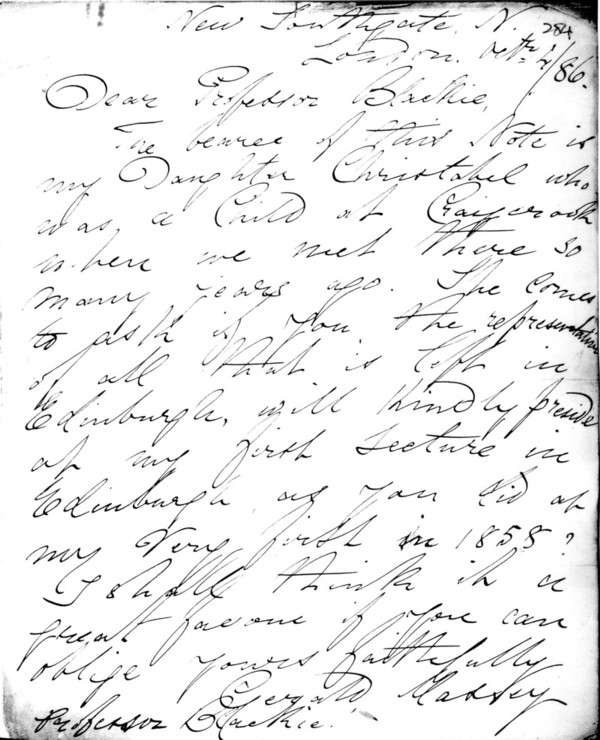
|
New
Southgate N.
London Oct.' 4/86.
Dear
Professor Blackie.
The bearer of this note is my
Daughter Christabel who was a child at Craigcrook when we met there
so many years ago. She comes to ask if you, the representative
of all that is left in Edinburgh, will kindly preside at my first
lecture in Edinburgh as you did at my Very first in 1858?
I shall think it an great favour if
you can oblige yours faithfully
Gerald Massey
Professor Blackie. |
――――♦――――
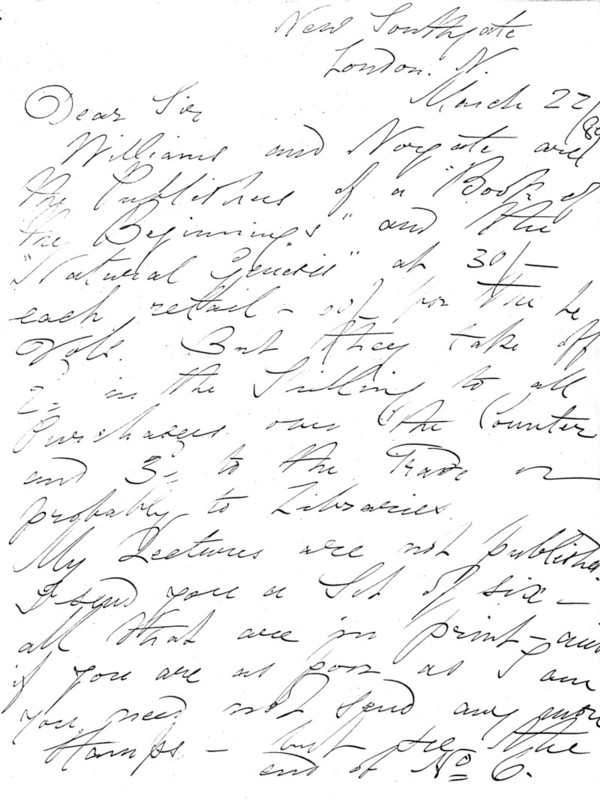

|
New
Southgate
London N.
March 22/89
Dear
Sir
Williams and Norgate are the Publishers of a
"Book of the Beginnings" and the "Natural Genesis" at 30/- each
retail—60/- for the 4 Vols. But they take off 2d in the
Shilling to all Purchasers over the Counter and 3d to the
Trade—probably to Libraries.
My Lectures are not published. I send you a Set of
six—all that are in print—and if you are as poor as I am you need
not send any more stamps — but see the end of No 6.
I made use of a Letter from you in Natural Genesis V. 1. 180
and refer to your Father's Book V. 2.P.258, and over.
Yours faithfully
Gerald Massey. |
――――♦――――
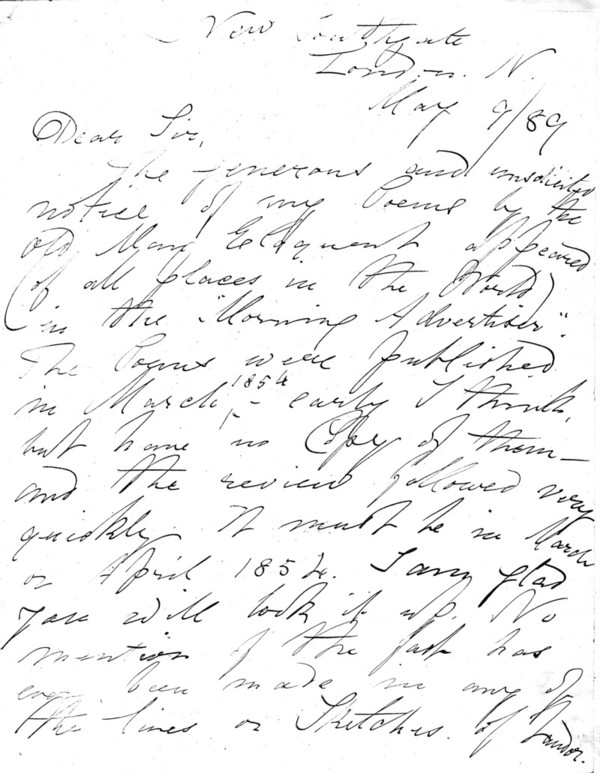

|
New Southgate
London N.
May 9/89
Dear
Sir,
The generous and unsolicited notice of my
poems by the Old Man Eloquent appeared (of all places in the World)
in the "Morning Advertiser". The Poems were published in March
1854—early I think, but have no Copy of them—and the review followed
very quickly. In must be in March or April 1854. I am
glad you will look it up. No mention of the fact has ever been
made in any of the lines or Sketches of Landor. You see, I am
not in with any of the Coteries. But, it was a most chivalrous
thing to do, and then to select the "?????" in his superb
Wilfulness—wasn't it like him? Cant something be done to make
our people more familiar with his magnificent writings?
I am dear Sir
Yours faithfully
Gerald Massey
I am sorry not to have a Copy of his Letters but have always been
negligent in such matters. Have you seen my re-written book on
Shakspeare? Kegan Paul & Co. |
――――♦――――
|
CHRISTABEL MASSEY
Nothing has been made obvious concerning Christabel Massey’s outside
interests. However, she was either a member of, or attached to
the Froebel Institute. Frederich Froebel (1872-1852) was a
German educationalist and a student of the Swiss Johan Pestalozzi
(1746-1827). Both were concerned with the methods of education
of young children in their formative years. They had three
main areas of concern. Play and activity that included toys
for sedentary and creative play, song and dance, observing and
growing plants for awareness of the natural world. These were
considered to develop individualism in the children. The
Froebel Society remains active today, together with the similar and
developed structuring of the Italian Maria Montessori (1870-1952)
teaching methods and schools.
The first indication of Christabel’s interest in and association
with Froebel comes in a Conference Report of the Froebel Society of
Great Britain and Ireland, 1895 where Christabel is Secretary of
that Society:
CONFERENCE REPORT OF THE FROEBEL
SOCIETY OF GREAT BRITAIN AND IRELAND.
CHRISTABEL MASSEY, SECRETARY FROEBEL SOCIETY.
|
A CONFERENCE was held by
the Frobel Society of Great Britain and Ireland at the
College of Preceptors, Bloomsbury Square, London,
England, on Thursday, September 12 [1895]. The subject
of the conference was: "The Kindergarten Gifts and
Occupations Considered in Themselves, and in Their
Relation to Manual Training and the Arts." This was
arranged...... |
(Kindergarten-Primary Magazine vol. 8, p.69 in the 1896
American edition, otherwise p.157).
The American Froebel Society had a large number of local branches
that arranged their own meetings and activities, and was noted for
having strong religious overtones. Christabel Massey noted this in
her article for The Reformer, 1897. Gerald Massey had Hebrew
translation assistance from Claude Montefiore (1858-1938), liberal
Hebrew scholar, who was Chairman of the Froebel Society at
Christabel’s time, then became President in 1904. Following Massey’s
death in 1907, H[enry] Keatley Moore (1846-1937) wrote a short
epitaph for the Norwood News (Biog..
Ch. 8). Moore was then Mayor of
Croydon Borough Council (1906-1908) and contributed to the Great
Britain and England Froebel Magazine in 1910 and was co-author
of a version of The Autobiography of Frederic Froebel, 1932.
It appears that there was for a time, a tripartite association
between the two Masseys, Moore and The Froebel Society.
FROEBEL and the KINDERGARTEN
by
Christabel Massey
The Reformer, Vol. I, June 1897, 109-11, (Bonner, London.)
There can be little doubt that the Kindergarten, in spite of its
foreign name and origin, is now firmly established in England. When
the Baroness von Marenholtz-Bülow came here in 1854-5, to carry out
her master’s wishes and spread a knowledge of his methods of
education in foreign lands, she could only hear of one Kindergarten
already at work. That one was at Hampstead. Today, there are
hundreds throughout the country. Though these certainly are not all
conducted on strictly Froebellian principles, their existence shows
the demand for them. Indeed, a great many of them are started and
carried on by individuals more or less incompetent, and are not
subject to any form of inspection. Although the Froebel Society
sends out inspectors when applied to, and registers all
Kindergartens examined and reported by them as efficient, and
although the number of trained and certificated Kindergarten
teachers increases each year (the number who went up for the N.F.U.
examinations last year was 557), it is purely optional whether a
principal appoints a trained Kindergarten mistress or whether, urged
perhaps by her own limited means and the fact that her Kindergarten
is a venture, and may be a failure, she secures, for a small salary,
the services of someone who understands little more than the mere
mechanised working out of some of the “Occupations”. Of course, this
kind of Kindergarten gives a wholly false idea of Froebel’s methods
of education, and stands seriously in the way of their wider
adoption. Froebel’s Kindergarten is not a place designed just to
“keep children out of mischief”, as I have more than once found
English mothers regarding those to which they were sending their
children.
Froebel’s great text that true education is achieved by means of
“self-activity”, that it must proceed from within and cannot be
imposed from without, was preached by Pestalozzi when he insisted on
the necessity of developing faculty instead of cramming with
information, and by Rousseau when he emphasised the need of
educating according to nature; but Froebel alone, through years
of patient observation and practice, made out the method and
supplied the means of doing this. He tells us that he set himself as
his life’s aim “to give man to himself”, and he demonstrates that
this can only be done by “exercising the whole human being”. “All of
us,” he says, “without exception feel – each in his own way, and
some more, some less – the consequences of deficient culture and
faulty education at every stage in our various relations of life and
spheres of work, and we have had to contend against these our whole
life long.”
Is not the restlessness and dissatisfaction with their lives, felt
by so many, the result of having so few outlets for the activity
that is in them? The directions that this would take are not perhaps
sufficiently defined by what we call “talents”, that declare
themselves in spite of all hindrances, but the need for the
expression is there, and is a fruitful source of unhappiness.
Beginning with the infant in the cradle, Froebel shows that directly
it wakes to consciousness its education begins, and he appeals
passionately to all mothers to meet and cultivate the earliest signs
of activity – mental and physical. The baby’s muscles are to be
strengthened, its desire for movement directed and satisfied, its
delight in bright colors and pleasing sounds gratified, and a
perception of their likenesses and differences awakened by means of
ball games and the games and songs of his “Mütter-und Kose-lieder”.
Of the book he says:
|
“I have here laid down
the fundamental ideas of my educational principles.
Whoever has grasped the pivot idea of the book
understands what I am aiming at .... This book is the
starting-point of a natural system of education for the
first years of life; for it teaches the way in which the
germs of human disposition should be nourished and
fostered, if they are to attain to complete and healthy
development.” |
Also the “connectedness of everything in life and nature – the fact
that everything stands related to something else – which Froebel so
strongly accentuates throughout his whole “system” of education, is,
as Mr. Courthope Bowen points out (“Froebel and Education in
Self-activity”), in this book “introduced on almost every occasion,
but is brought out most clearly in what relates to human
occupations”.
And stage by stage Froebel provides , through his wonderful series
of “Gifts” and “Occupations”, both the incentive to the exercise of
a particular “activity” and the channel in which it can be
pleasurably exercised.
In arranging his bricks, in tablet-laying, in bead-threading, mat
weaving, paper cutting, paper folding, etc., the child develops a
real sense of number and form – arithmetic and geometry. A just
appreciation of color and proportion are evolved. He learns to
create his own patterns, and thus a power of designing comes to him.
Some of his materials require careful handling and much precision;
this gives manual dexterity and delicacy of touch.
But the primary object of true education, Froebel holds, is to build
up character, develop faculty. Accumulation of knowledge is
secondary.
A child delights in making a thing himself – in creating. Froebel
would seize on this , would turn it to account, and through his
interest in the thing he is making, through his desire to see it
accomplished, the child shall develop perseverance, concentration,
and the habit of persisting in his work shall become so thoroughly a
part of his nature that it will be stronger later in life than the
sense of irksomeness in anything he has undertaken to do. Also
Froebel would have the thing the child is making – say a mat, for
instance – be for someone else. Let him feel that he is of use to
someone, that his work is helpful to them. This sense of service to
others is made so much of by Madame Schräder, in the
Pestalozzi-Froebel House in Berlin, that the children there take
part in all kinds of household duties. Let the child delight in its
work, for the work’s sake, and and also for the sake of making the
lives of others happier.
Froebel considers the study of Nature, in her world of plants,
animals, insects, one of the most important of all factors in a
child’s education. Let him watch the development of a plant from the
sown seed to the ripened fruit. Let him observe closely, and express
the results of his observations in his own way, in his own phrases,
and by means of his brushwork, drawing, clay-modelling. He is thus
trained to observe exactly and describe faithfully. His knowledge of
the plant, animal, insect, is attained by by his own mental
exertion. He does not learn by heart what someone else has seen, but
watches the results of causes for himself. To see truly and report
accurately become a part of his nature, and tend to make him a
reasoning being. Through Interest in their ways comes affection for
the animals he watches. He cares for their well being, and
recognises his own responsibility towards them, this making cruelty
in any form to them – or to his weaker fellows – an impossibility.
In the Kindergarten game, with its story and song, Froebel appeals
to the child’s imagination, and provides food for it. He gives him a
means of expressing himself in dramatic action, and cultivates
rhythmical and graceful movements. He forms and trains a sense of
music, and the habit of clear enunciation. He lays down the
foundation of a love of musical and dramatic art. And insensibly,
unobtrusively, he bears in on the child that he is one member in a
community. The little autocrat who orders his own games at home, and
always decrees a prominent part to himself, finds at the
Kindergarten that he is only a part of a whole. The other parts are
necessary to him and he to them.
Though it is now possible in most English towns for parents who can
pay the fees to send their children to a Kindergarten, we are a long
way from realising Froebel’s idea of what Kindergarten education
means for the race. And we shall not realise it until free
Kindergarten are general throughout the country. This may sound a
“large order”, but, when compared with our present prison,
workhouse, and asylum system, the cost would look small. And is not
humanity worth cultivating? Is not the neglect of it the cause of
all the problems which baffle reformers on all lines?
I am told that in Hungary nearly every parish has its free
Kindergarten for the children of the poor, as well as a paying
Kindergarten for those who can afford to pay. All are under
Government inspection and are regulated. The teachers have been
trained and certificated at Government training colleges, and after
a certain number of years (during which they receive a salary for
their work) they are entitled to a Government pension.
At present I do not know of a single free Kindergarten in England.
The Froebel Institute at West Kensington was designed to include a
free Kindergarten in one wing, a paying Kindergarten in the other,
and a training college for Kindergarten teachers in the centre. The
paying Kindergarten and the training college have been at work for
some time, but so far the subscriptions have not been sufficient to
open the free Kindergarten for the children of the poor.
In the above brief sketch I have purposely left out all allusion to
what Froebel’s disciples call “the intense religious element in his
pedagogy”. He holds that “in every child there exists a rational and
spiritual germ that may be developed into a right relation to the
three great living factors of all human environment – Man, Nature,
God.” This is amplified and applied continually throughout his
writings, but it appears to me to be the result of his Christianity
and his own individual mysticism, and in his way a necessary part of
his educational method. That the Kindergarten has been identified by
people of all creeds surely shows that it belongs to none. Indeed, a
system of education which is calculated more than any other to
awaken and strengthen a child’s powers of reasoning and induce the
habit of verifying facts for himself, is little likely to end in
making for Christianity or the passive acceptance of any traditional
belief.
Christabel Massey
|
FROM THE PEN OF CHRISTABEL
MASSEY.
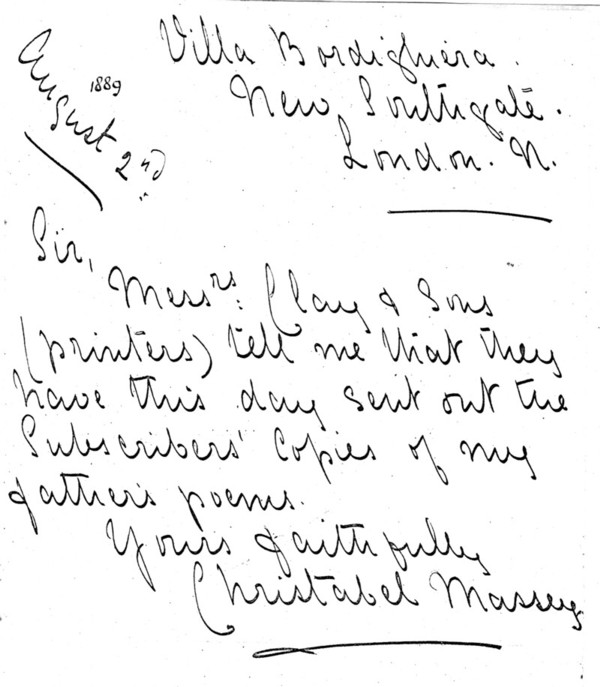
――――♦――――
|


