|
JOHN ARNOTT
(1799 – 1868)
GENERAL SECRETARY,
NATIONAL CHARTER ASSOCIATION
by David Shaw.
|
――――♦――――
JOHN JAMES BEZER, CHARTIST
AND JOHN ARNOTT,
NATIONAL CHARTER ASSOCIATION
BY
DAVID SHAW
now on sale at
LuLu.
――――♦――――
|
Little information is available concerning
the personal life of John Arnott, who was noted for being sometime
Secretary and General Secretary of the National Charter Association.
His name comes down to us principally in the reports of meetings of the
National Charter Association, and other associated organisations with
which he was involved during a period from the mid 1840’s to mid 1850’s.
Details of the particular events together with their background can
readily be traced in the relevant Chartist newspapers and books on
Chartist history.
It is probably safe to
infer that John Arnott joined the National Charter Association soon
after its inception in 1840. His progress within the organisation
was rapid, and he was highly regarded and respected for his efficiency.
However, there is no record of him undertaking lecturing or article
writing that would have brought his name to a more prominent position in
the Chartist press, although he did compose some poems that were
published in the Northern Star. From 1853 and the virtual
death of the Chartist movement, he is unrecorded. It appears that
he, together with many other official stalwarts gave up that particular
struggle, and supported associated organisations, or continued with
their own personal affairs.
John Arnott was born on
the 22 October 1799, at Chesham, Bucks, the son of William and Mary
Arnott. There were another three sons and two daughters in the
family, all born in Chesham, between 1802 and 1807. George, born
29 April 1802; Elizabeth, born 1 December 1804; Joseph and Benjamin
(twins) born September 1807.
On the 19 October 1819,
he married Sarah Allen at Chesham Bois. It appears that he resided
in Chesham until 1830 – 1835, when the family moved to London.
Census records for 1841
show him residing at Suters Buildings, St Pancras, with his wife and six
children – Alfred 15, b. Chesham; Ann 13, b. Chesham;
Benjamin 11, b. Chesham; Emma 4, Sarah 2, and Edwin 4 months b. St
Pancras. John Arnott is listed there as a ‘Cordwainer’
[Shoemaker]. Suters Buildings appear to have been situated in
Somers Town in an area between Ossulston Street, Middlesex Street,
Phoenix Street and Chapel Street. Today, now redeveloped, between
Ossulston Street and Brill Place, behind the British Library.
Arnott obviously made
steady progress within the National Charter Association. In 1844,
he was a member of the Somers Town Branch of the Metropolitan Delegate
Council. On the 8 June (Northern Star) at a meeting of the
Council he moved that a national petition be got up by each locality
praying for the deliveration of
Thomas Cooper, now confined in Stafford
Gaol. On the 3 August, he took the Chair at a Delegate Council
meeting, and on October 5 at a Council meeting, he was elected
Secretary. His address at that time was given as Middlesex Place,
Somers Town.
On December 10 1844, a
well attended soiree was held at the Literary Institute, John Street, in
honour of the removal of the Northern Star from Leeds to London.
Harney, O’Connor and other leaders were present, and gave many toasts
and strong addresses. John Arnott sang a patriotic song amidst
considerable applause. On January 18 1845, he was elected
Secretary of the Delegate Council with re-election on the 13 May for a
further three months.
On the 19 March his
eldest son, Alfred, at 8c Middlesex Place, Somers Town, married Eliza
Cavell of the same address. Eliza’s father listed as a labourer.
The next year, 1846,
was a year of great cheer for the Chartists. Feargus O’Connor had
been preparing his Co-operative Land Society for a launch that, he
anticipated, would place the Chartists at the forefront of land
co-operative for impoverished workers. Many of the prominent
Chartists supported the venture, including
Ernest Jones. John Arnott also gave
his support, and provided a poem that he composed especially for the
occasion.
This was an over
optimistic eulogy for the opening celebration of O’Connor’s ill-fated
Society (The National Land Company) to be held on the 17 August 1846.
The People’s First Estate (the first of six purchased and plots issued
by shares) was some 100 acres located at Heronsgate, near Rickmansworth,
and was known as ‘O’Connorville.’ It had 35 specially designed
properties for cheap rent, and a schoolhouse. (See The Chartist Land
Company, A.M. Hadfield, David & Charles 1970, p.101.) The poem
was printed and placed on sale at the site on opening day, priced 1d.
|
Northern Star, August 1
1846, p.3.
Songs for the People xxiv.
The People’s First Estate,
Or, Anticipation of the 17th
August.
Air,—“The days that we went gipsying.”
Come let us leave the murky gloom,
The narrow crowded
street;
The bustle, noise, the smoke and din;
To breathe the air
that’s sweet.
We’ll leave the gorgeous palaces,
To those miscalled great;
To spend a day of pleasure on
The People’s First
Estate!
CHORUS,—
On this estate the
sons of toil
Shall independent
be,
Enjoy the first fruits of the soil,
From tyranny set
free!
The banners waving in the breeze,
The bands shall
cheerfully play,
Let all be mirth and holiday
On this our holiday
Unto the farm—“O’Connorville,”
That late was “Herringsgate,”
We go to take possession of
The People’s First Estate!
On this estate, etc.
When on the farm! The People’s Farm!
This land of liberty!
We’ll join the dances and rural games,
With joy and sportive glee,
Our gambols play, throughout the day,
(To scoffers you may
prate,)
And leave at night this lovely scene,
The People’s First Estate!
On this estate, etc.
May nature shed her choicest stores,
On this delightful
spot;
Each occupant be blest indeed,
And peace attend each cot.
And may our brave Directors with
The funds that we’ll create,
Live long to purchase hundreds more
Like this our first estate!
On our estate the sons of toil
Shall independent be;
Enjoy the first fruits of the soil,
From tyranny set free!
John Arnott
Somers Town
July 27 1846. |
Arnott had
earlier composed a poem for the occasion of the First Annual Festival to
celebrate the anniversary of the French Republic. This was held at
the White Conduit Tavern on April 21 1846, but the poem was not printed
in the
Northern Star until some time later.
|
Northern Star,
19 September 1846, p. 5.
Songs for the People no. xxx
A SONG ADDRESSED TO THE
FRATERNAL DEMOCRATS.
Air—"Auld Lang Syne" |
|
All hail, Fraternal Democrats,
Ye friends of Freedom hail,
Whose noble object is—that base
Despotic power shall fail.
CHORUS
―
That mitres, thrones, misrule and wrong,
Shall from this earth be hurled,
And peace, goodwill, and brotherhood,
Extend throughout the world.
Associated to proclaim
The equal rights of man.
Progression's army! firm, resolved,
On! forward lead the van.
Till mitres, thrones, misrule and wrong,
Shall from this earth be hurled.
And peace, goodwill, and brotherhood,
Extend throughout the world.
To aid this cause we here behold,
British and French agree,
Spaniard and German, Swiss and Pole,
With joy the day would see.
When mitres, thrones, misrule, and wrong,
Will from this earth be hurled,
And peace, goodwill, and brotherhood,
Extend throughout the world.
We now are met to celebrate
The deeds of spirits brave,
Who struggled, fought, and bled, and died,
Their misrul'd land to save.
For mitres, thrones, misrule and wrong,
From France they nobly hurled,
And would have spread Democracy
Throughout this sea-girt world.
Though kings and priests might then combine
To crush sweet liberty,
We tell them now that they must bow,
That man shall yet be free.
That mitres, thrones, misrule and wrong,
Shall from this earth be hurled,
And peace, goodwill, and brotherhood,
Extend throughout the world.
Oh! may that period soon arrive,
When kings will cease to be,
And freedom and equality
Extend from sea to sea.
Then mitres, thrones, misrule and wrong,
Will from this earth be hurled,
And peace, goodwill, and brotherhood,
Shall reign throughout the world. |
John Arnott
Somers Town, September 1846 |
The poem was followed by a similar stirring piece by George Julian
Harney, titled ‘All Men are Brethren’. A song for the Fraternal
Democrats.
Appreciative, as many were, of the hard work and dedication showed by
Ernest Jones, Arnott then composed a poem in his honour, in the form of
an acrostic:
|
Northern Star
17 October 1846, p.3.
An Acrostic.
To Ernest Jones, Esq., Barrister-at-Law
Estranged Aristocrat! What leave the favoured few,
Regardless of fortune and prospects in view,
(Noble Democrat) to join the
Chartist band,
Eschewed, despised, and
scouted through the land.
Such conduct we esteem, nay
more, admire,
Thy spirit burns with
freedom’s sacred fire.
Just as the trav’ler
pursuing his lonely way,
On whose dark path meteors
bursting play,
Now changing gloom to bright
refulgent day;
Ernest we hail thee, from
thy genius bright
Shines in full power pure
Democratic light.
John Arnott
Somers Town.
Oct. 12th
1846.
|
[Note: The first letter of each
line forms the name ‘Ernest Jones’.]
The following year Arnott composed yet another poem to honour Thomas
Slingsby Duncombe (1796—1861) MP for Finsbury, who had petitioned for
the release of imprisoned Chartists in 1842. Duncombe was also
sympathetic towards Louis Kossuth and Guiseppe Mazzini. Mazzini,
exiled in England, had the aim of promoting Italian unity, republicanism
and democracy. He was suspected by the government of being a
participant in organising an attempt at an invasion of Italy, and Sir
James Graham, Home Secretary authorised the opening of Mazzini’s
letters.
|
Northern Star, March 13 1847,
p.3.
A SONG
(Air – with Helmet on his Brow)
In
honour of that indomitable friend and advocate of the
Rights
of Labour,
T.S. Duncombe, MP.
Let the base sycophant
Of wars and
heroes sing;
‘Laud the despot’ cringe and bow
To Emperor or King:
I scorn such fulsome themes,
I sing of the patriot brave,
Duncombe, the friend of Liberty,
And Labour’s worn-down slave.
CHORUS—
Let all as one smite,
And join in freedom’s cause,
Shouting for
“Duncombe and our Right;
Free, just, and equal laws!”
When the Whigs and Tories join’d
The
Labourer to enslave,
Duncombe crush’d their monster Bill,
And consigned it to its grave.
The Post-office espionage
Pursued in Graham’s plan,
Duncombe did nobly upset,
And exposed that hateful man.
Let all as one, etc.
The poor in Bastilles doomed
Their wretched lives to spend,—
The toiling slaves—the factory
child—
Duncombe has been their friend;
He has their wrongs denounced,
He will
their rights demand,
And labour would emancipate
From the grasping tyrant hand.
Let all as one, etc.
He will defend the oppressed,
The Irish or the Pole;
The deeds of despots are deplor’d
By his patriotic soul.
Duncombe they cannot bribe—
He’s honest firm and bold,
And, as the leader of our cause,
His worth cannot be told.
Let all as one, etc.
Let the Tories talk of Peel,
The Whigs of Russell boast,
Duncombe is our champion,
And this shall be our toast:—
“To Duncombe and the Trades,
Duncombe and Liberty;
To Duncombe and the Charter,
And may we soon be free!”
Let all as one smite,
And join in freedom’s cause,
Shouting for “Duncombe and our Right;
Free, just, and equal laws!”
|
|
John Arnott. Somers
Town. |
Until
the virtual demise of the National Charter Association, the ensuing
years were busy for John Arnott. In August 1846 he had taken the
Chair at the first Amalgamated Meeting of the chartist’s Veterans,
Orphans and Victim Relief Committee, and at a public meeting in
October at St Pancras on ‘The Charter and no surrender’, he read and
moved the adoption of the National Petition. In the same month he
was elected a member of the Fraternal Democrats, and referred to at that
time as the ‘Somers Town Chartist Rhymer.’ In October he was
appointed Assistant Secretary to the Veterans, Orphans and Victim
Committee, and in November at the South London Chartist Hall, he was
Sub-Secretary. In the following month his poetry was again noted,
and he was mentioned then as “our respected and indefatigable
sub-secretary, Rhyming John Arnott.” His address was given as 8
Middlesex Street, Somers Town.
Considerable prominence was being given in the following year to the
Chartist petition that was to be presented to Parliament in April 1847.
This publicity caused fears of violence, and a pseudonymous letter was
published in the Times of 1 April in which the writer quoted an
announcement by ‘Vernon’ made at a recent Chartist meeting. In
this, mention was made of an intended procession of between 100,000 to
300,000 persons. The writer of the letter queried protection of
the rights of shopkeepers against the ‘tumultuous proceedings,’ and that
suspension of their business appeared to be an infliction and a robbery.
This letter was brought to the attention of the Chartist Committee
appointed to deal with the arrangements of the demonstration on the 10
April. John Arnott, as Secretary, was requested to repudiate in
the strongest terms the language thus ascribed to have been uttered by
Mr Vernon, and to state most emphatically that it was the “firm
determination of the committee that the demonstration shall be
peaceable, orderly, and moral display of the unenfranchised toiling
masses.” (Times, 4 April 1848) Arnott’s address was given
as 11 Middlesex Place, Somers Town.

During January and February 1849 Arnott was
Secretary of the National Victims Fund, also on the Central Regulations
and Election Committee, as well as the Committee of the Fraternal
Democrats. On the 3 March, a Public Meeting was held at the John
Street Institute on ‘The Separation of Church and State.’ A
petition was drawn that the Industrial classes are impoverished due to
evil legislation, and have to contribute to the support of a National
Church—known only to petitioners as a tax-collector. Religion does
not need the assistance of the State. The petition, proposed by
Arnott and another member, was to be forwarded to the MP for Tower
Hamlets, but nothing positive came of it.
On the 24 March, Arnott, on behalf of he National Victim and Defence
Committee (assumed to be the Relief Committee as previously mentioned)
made a request for more financial contributions. He noted that the
law made widows and nearly 100 orphans plus the wives and families of
Ernest Jones, Peter McDouall and others dependent on support.
Giving 3 shillings each to the widows and one shilling for every child
under 12, left the Committee liabilities of £10 p.w. That week,
two shillings only could be afforded to a woman with 5, 6, or 7 children
for seven days.
In August, it was reported that the balance sheet over 17 weeks showed
receipts as £103, expenditure £102. This amount was divided
amongst 31 families (30 grown persons and 70 children), and Arnott made
a further appeal the following month.
London branches of the NCA met on a regular basis to discuss general and
local issues—and it appears that some of the proposals were destined
only to give verbal support to the overall cause. On the 31 March
1849 Arnott seconded a Resolution ‘that the present so-called
representation of the people is a monstrous injustice on the nation at
large, and a violation of the British Constitution.’ About this
time, it was realised that it would be an advantage if local groups
could cohese and provide general unity within the movement. At a
meeting of the General Registration and Election Committee, Arnott and
another member proposed that a Hand-Book and Guide to Regulations and
Elections be published at two pence a copy, and that the Chartist
Executive be requested to aid circulation. The Metropolitan
District Council to consist of two members from each locality within the
metropolis and suburbs, and to cause a fusion of all whom advocate
Chartist Suffrage, into one united phalanx.
July 1850 was the month that Ernest Jones was released from prison.
He was met by John Arnott and several others, and the next day the
Fraternal Democrats gave a supper in his honour. Arnott, G.W.M.
Reynolds, Bronterre O’Brien, George Julian Harney and others proposed
toasts in his honour. Testimonials were presented, together with a
pair of large portraits of Mr and Mrs Jones. The following day,
there was a public meeting at the John Institute in honour of Jones’
release. Harney took the Chair, with the Executive of the NCA on
the platform, and Walter Cooper, Reynolds and others gave addresses.
Later that month, the NCA Executive met with a view of reuniting the
NCA, Fraternal Democrats and National Reform League into one body.
The name suggested was the National Charter Association Federal
Union—later agreed to be National Charter and Social Reform Union.
This inevitably received a mixed reception, and caused ongoing dissent.
On the 27 November 1850, the NCA Executive Committee resigned, and votes
were taken for another Executive. The General Secretary was to be
paid, while the Executive were unpaid. Arnott was elected to the
Executive, and later was confirmed as General Secretary, thus replacing
Samuel Kydd who was receiving a salary of £2 per month.
The 1851 census return for 11 Middlesex Place, Somers Town, gives: John
Arnott, 51. Cordwainer, b. Chesham; Sarah Arnott, 51, b. Bovington,
Herts.; Benjamin, 21, Brush finisher; Emma, 14; Sarah, 12;
Edwin, 10.
Arnott’s son, Benjamin, was married on the 13 April 1851 at Trinity
Church, St Andrew to Eleanor Wilmott, of Middlesex Place. Her
father, like Arnott, was also a Shoemaker, and the couple went to live
at 9 Brill Place, Somers Town.
Differences of opinion concerning the best way to promote the Chartist
movement were becoming more acute in that period. At a meeting of
the NCA on the 19 March 1851, Arnott and Ernest Jones proposed a long
stirring address for unity, to be read at locality meetings. The
main drive of the address, similar to one given as at a meeting the
previous year, was to unite disparate organisations in one phalanx.
‘Henceforth let social co-operation go hand in hand with political
organisation . . . Unite! unite! unite! The convention must be the
PARLIAMENT OF LABOUR! The Executive, the MINISTRY OF THE
UNENFRANCHISED!’
Some of the Districts were also becoming opposed to the leaders of the
National Charter Association, with John Arnott also subject to
displeasure. In the
Northern Star of 22 March 1851, Arnott responded via the Editor to
criticisms made by the Radford locality in a postscript item in the
previous issue. He replied:
“. . . the postscript
runs thus—‘We have frequently seen notices from the Executive, stating
that correspondence had been received from Radford and other places
complaining of their inability to send delegates. So far as we are
concerned, we deny such a statement.’
Now, Sir,
being of opinion that the above is calculated to damage the Executive,
and to impress the idea on the public mind that I, as their secretary,
have published FALSE REPORTS, I, therefore, feel it to be my duty, in
reply thereto, to state that I have minutely examined the printed
reports for the last eight weeks, and I must say that Mr. Brown has
superior penetration to what I possess, as I cannot find Radford therein
mentioned, consequently, I request Mr. Brown to point to the reports to
which he alludes, and, failing doing so, I shall leave it for our
readers to decide which has published a false statement, Mr. Brown or
myself...’
In
another instance, it had been agreed earlier that the Metropolitan
Delegate Committee’s meetings would include representatives from the NCA
Executive. For some reason, these did not turn up a meeting held
in December. A report in the
Northern Star for 20 December 1851 concerning the election of a new
NCA Executive expressed the displeasure of one locality:
Finsbury
Locality. Report from the Metropolitan Delegate Committee: “That
this locality consider the absence of the whole of the Executive from
the Metropolitan Delegate Committee meeting as deserving of explanation;
and the General Secretary is deserving of censure, seeing that it was
his duty to have attended the aforesaid meeting. The locality
recommend the new Executive to elect as their General Secretary a man of
known ability and straightforward conduct and able to address Public
Meetings, and that we recommend Thomas Martin Wheeler— seeing that the
inefficiency of the late General Secretary is a matter of public
notoriety and regret.”
It appears
that Arnott, who had family responsibilities and relied for his living
as a shoemaker, acted principally as an administrator and could not
afford the time to lecture, even locally. Lecture tours demanded a
considerable amount of time away, with some expenses not always
reimbursed. Arnott was therefore considered a less active
participant than Thomas Wheeler. However, neither the NCA nor
Arnott appeared to have responded to the remarks made by the locality.
In early January 1852, the new Executive Committee had their first
meeting, during which dissentions became even more apparent.
Harney had declined to stand for election, believing that the NCA was
virtually finished. Arnott was present, with
John James Bezer in the Chair. Arnott read a letter from
W.J. Linton, in which he stated his
belief that it was impossible to resuscitate the Chartist movement, and
declined to sit on the Executive unless the movement joined the middle
class. Ernest Jones resigned. The NCA had for some time
developed a strong socialist stance, attempting to unite the Chartists,
the Co-operatives and the Trades into one movement. The Manchester
Chartist’s supporters opposed the NCA. Arnott then read the
accounts, revealing a debt of some £37. Unable to pay the
Secretary’s expenses, it was moved that J.M. Wheeler act as Secretary,
but this was not seconded and Wheeler resigned from the Committee.
John Arnott then agreed to serve for one month, but two members opposed
the nomination, and the Chairman’s vote caused his resignation as
Secretary, although he remained on the Committee. Other members
were nominated, but declined to stand. Finally, James Grassby
consented to act as Secretary for one month.
In one of a series of articles in the Northern Star, on January
17 1852, a pseudonymous ‘Censor’, complained that “... the charge of the
people’s cause has fallen into the hands of Messrs Arnott, Bezer,
Grassby, Shaw and
Holyoake...” and asked “if these are
the persons who should be entrusted with the conduct of so important a
movement ... knowing how limited were the powers which such persons
could bring to the duties they aspired to discharge...”
In broad terms the accusation was correct, as the Executive were ruled
by dissention, opposition, and decreasing support from the working
classes. Harney had wanted a merger between Chartists, trades
unions and co-operatives, whilst Ernest Jones continued to press for the
NCA as the sole Chartist organisation. This barely viable NCA
lasted until 1858 when it finally ceased to exist.
The apparent inefficiency of the Executive of the NCA was now blamed for
the miserable state of the Chartist movement, and Arnott and the
Executive complained that the Manchester Council was set up to supersede
the NCA. Another meeting referred to the Finsbury Locality having
objected to Messrs Le Blond and Thornton Hunt having seats (replacing
Linton and Jones). James Grassby in response stated that, “We
think it a pity that men seeking political power should have such a
vague knowledge of how to use it.”
On the 27 March 1852
The Star and National Trades’ Journal reported a meeting of the
Executive Committee, when the famous statement was made that it was “The
Executive of a society, almost without members, and without means –
members reduced by unwise antagonism without, and influence reduced by
repeated resignations within...”. Despite this, it was later
agreed that Arnott and Bezer and others were to continue in office
(probably only on a temporary basis for three months), and Arnott
remained on the Democratic Refugee Committee up to November 1852.
The situation was similar to that of William Lovett’s earlier Working
Men’s Association that had, in October 1836, proposed resolutions
towards a viable ‘People’s Charter’. Thomas Cooper, Feargus
O’Connor and George Julian Harney were members for a time, including a
number of well known later Chartist activists. In 1849 that
Association was in debt, and it was stated that “Cliqueism and
dissentions helped to kill that Association, as in other movements.”
(A History of the Working Men’s Association from 1836 to 1850, by
George Howell, 1900. Published Frank Graham, Newcastle, 1970).
In July 1853 the American and British public were stirred by the news
regarding the rescue of Martin Coszta, a Hungarian refugee from an
Austrian ship in the port of Smyrna. Coszta was residing in
America, and visiting in Smyrna on business. He had stated that he
wished to become an American citizen, but was taken by a party of armed
Greeks employed by the Austrian consul general, and held on their ship.
Captain Duncan Ingraham, commanding a 22 gun sloop-of-war, received
permission from the US charge d'affairs in Constantinople to request
Coszta's release, or use force to obtain it. This was despite
Hungarian ships in the harbour, with firepower greater than Ingraham’s.
It was then agreed that that Coszta be released to the French consul and
from there returned to the United States.
In England, an
Ingraham
Testimonial Fund Committee
was formed, with Arnott as Secretary. The Chairman was G.W.M.
Reynolds, with other members that included George Julian Harney, James
Grassby, Samuel Kydd, Walter Cooper and Robert Le Blond as Treasurer.
Ingraham was presented with a medal from the US president for
Vindicating American Honour, and following the subscription, an
inscribed chronometer from the working classes of England.
The 1861 census return for Arnott’s last stated address, 11 Middlesex
Place, shows it as unoccupied. At the same time, his second eldest
son, Benjamin, 30, was residing at 47 Middlesex Street as a ‘Licensed
Hawker’. His wife, Eleanor, 33, was a laundress, with children
Eleanor Diana, 9; Elizabeth Mary, 3; and Clara, 7 months.
John Hollingshead in his Ragged London 1861
(Smith, Elder), mentions Somers Town as being full of courts and alleys,
cheap china shops, cheap clothiers and cheap haberdashers.
Wherever there is a butcher’s shop, it contrives to look like a
cat’s-meat warehouse. Its side streets have a smoky, worn-out
appearance. Every street door is open, no house is without patched
windows and every passage teeming with children. It had a
population of some 35,000, and was more industrial than the adjoining
Agar Town, between Euston and Kings Cross stations, that was referred to
as a disgrace. The Midland Railway cleared Agar Town and part of
Somers Town in 1866.
Thomas Martin Wheeler (b. 1811), was a valued Chartist member, author
and lecturer. A strong supporter of Feargus O’Connor and his Land
Plan, he had purchased a plot at O’Connorville, where he resided for
some time. He was elected to the NCA Executive in 1841, and became
a popular General Secretary from 1842 to 1846. He died in 1862 and
was buried at Highgate Cemetery. Twenty-four horse-drawn carriages
followed the hearse to Highgate, accompanied by a large procession.
John Arnott, who had supported Wheeler’s aims, also attended the
funeral.
According to
W. E. Adams
in his Memoirs of a Social Atom,
chapter xvi, “Some time about 1865 I was standing at the shop door of a
Radical bookseller in the Strand. A poor half-starved old man came
to the bookseller, according to custom, to beg or borrow a few coppers.
It was John Arnott! Chartism was then, as it really had been
for a long time before, a matter of history.”
Some time after this, probably in 1866, Arnott suffered a stroke.
However, he was able to compose a poem that he sent to Edmund Beales
(1803-1881) Chairman of the Reform League, for their forthcoming meeting
at the Agricultural Hall, Islington, on 11 February 1867. As a
chartist Arnott had of course supported those activities promoting
manhood suffrage and the ballot, and he continued now by the only means
available to him - through a poem:
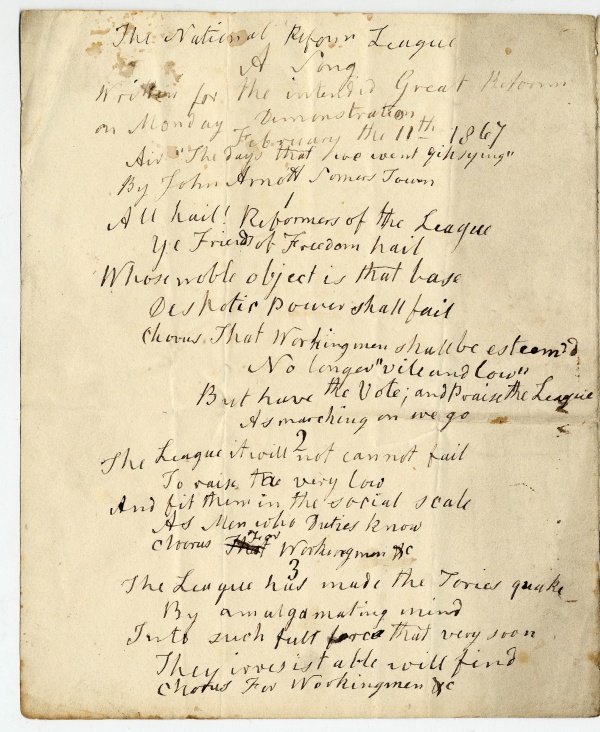

|
The National Reform League,
A Song.
Written for the intended Great Reform
on Monday Demonstration,
February the 11th 1867.
Air "The days that we went gipsying."
By John Arnott, Somers Town.
-1-
All hail! Reformers of the League,
Ye Friends of Freedom hail,
Whose noble object is that base
Despotic power shall fail
Chorus:
That Working men shall
be esteem'd,
No longer "vile and low,"
But have the Vote; and
Praise the League
As marching on we go.
-2-
The League it will not can not fail
To raise the very low,
And fit them in the social scale
As Men who duties know.
Chorus: For Working men etc.
-3-
The League has made the Tories quake
By amalgamating mind
Into such full force that very soon
They irresistable will find
Chorus: For Workingmen etc.
-4-
Ye "thousands of" The Reform League,
Concentrate all your Powers,
Your foes are strong your cause is just
(The front of battle cowers);
Be firm United one and all,
The Prize is Liberty,
Tell the Tories now that they must bow
That Men will soon be Free.
Chorus: For Working men etc.
-5-
So sure as winds the billows dash
Across the foaming Sea,
Orbs still roll on and Natures works
In harmony agree;
So shall this glorious cause Progress
It can not will not fail,
And with such Champions as Beale and Bright,
It must it shall prevail.
Chorus: For Working men etc.
John Arnott
(a Poor Paralysed old Chartist)
1 Equity
Buildings
Somers Town N.W.
Janry 16th 1867 *
|
* (Acknowledgements to
Bishopsgate Library, Bishopsgate Foundation and Institute. Ref:
Howell/11/2D/131).
The meeting in Islington commenced with a march from
Trafalgar Square, and was represented by a countrywide number of Trade
Union and Reform League Branches carrying banners and accompanied by
brass bands. The Times of February 12, p.12 reported that
there were no fewer than 30,000 - 60,000 persons in attendance.
During the meeting a group called 'The Reform League Minstrels' chanted
verses that had been printed, and were then distributed at a penny each,
but there is no record of Arnott's poem being made available at the
meeting.
On 28 April 1868, John Arnott was admitted to St
Pancras Workhouse probably from his and his wife’s residence, at Equity
Buildings, Somers Town. He died shortly afterwards on the 6 May of
‘Paralysis’ [a term for a stroke, at that time], aged 69. His
occupation was given as Shoemaker Journeyman.
St Pancras Workhouse held between 1,500 and 1,900 inmates, of which 200
occupied sick wards, 60–70 were lunatics and idiots, and about 1,000
were helpless infirm and aged. (Illustrated London News, 3
October, 1857).
John Arnott was buried on the 12 May in St Pancras Cemetery, High Road,
East Finchley, grave no 47, section 10J. The grave was a
‘communal’ (pauper’s) grave, and there is no headstone.
Reports of his activities from the Northern Star show that
throughout his ten years with the National Charter Association and
other associated organisations, he was well liked and respected for his
impartiality.
This was a sad ending for one of the Chartists’ relatively
undistinguished but ardent supporters who had reached the peak of
the Chartist Administration.
Two years after John Arnott’s death, his wife, Sarah Arnott, died on the
17 February 1870 age 71 of ‘Senile Decay’. She was still
living at 1, Equity Buildings, Somers Town. The informant—who made
her mark—was Eleanor Arnott, daughter-in-law, (wife of Arnott’s son,
Benjamin) of 41, Middlesex Street, Somers Town.
In his tour of the area, Charles Booth in 1898 wrote of Equity Buildings
as a queer little paved cul-de-sac; low one storey two-roomed cottages,
with a little wash house and yard behind; been done up during last year;
doors open straight into room; many of the houses appeared to be very
full of furniture; rents from 6/6 to 7/-.
Equity
Buildings are marked on large scale maps of the period. Now
redeveloped, it was between what is now Ossulston Street and Polygon
Road, with the entrance in Phoenix Road. See the 1863 map below:

Of interest to Genealogists, I append details of a few of John Arnott’s
children:
|
1871 census.
No Arnotts listed at 41
Middlesex Street. 21 Middlesex Street, Alfred Arnott, 47, Shoemaker.
Eliza Arnott (wife) 45. Charles, 21, Carman. Eliza, 15, Shop girl.
Willie, 4.
1, Phoenix
Street, St Pancras. Edwin Arnott, brother, 30, Upholsterer. Emma Arnott,
sister, 34, Shoe-binder. Emily A., neice, 10. Phoenix Street was
near Equity Buildings where Sarah Arnott died in 1870.
1881 census.
6, New Street,
Chelmsford (The King William the 4th Inn). Benjamin Arnott,
lodger, 51, Hawker. b. Chesham.
13 George
Street, St Pancras. Edwin Arnott, 40, Upholsterer. Sarah Arnott, wife,
41, b. Cleeve, Glos. Ben Etheridge, visitor, 7, b. Mitcheldene, Glos.
22 March 1890.
Eleanor Arnott, wife
of Benjamin Arnott, Roadsman, died age 62 of Acute Bronchitis at 29
Chalk Farm Road. Daughter, M. Arnott.
11 January 1908
Benjamin Arnott, 77,
formerly a Hawker, of 43 Little George Street, St Pancras, died of
Bronchitis on 11 January 1908, at St Anne’s House, Streatham Hill.
St Anne’s
House was a branch of St Pancras Workhouse for some 500 aged and infirm
men.
|
|
References:
A History of the
Working Men’s Association from 1836 to 1850. George Howell, 1900.
Frank Graham, Newcastle, 1970.
A Memoir
of Thomas Martin Wheeler, by William Stevens. John Bedford Leno,
1862.
Charles
Booth’s notes for his Life and Labour of the People of London, a
selection digitised – and online – by the London School of Economics.
Illustrated London News, as cited.
Ragged
London in 1861, by John Hollingshead. Smith, Elder. Dent, 1986.
St Pancras
Workhouse Admissions Register, London Metropolitan Archives,
ST/P/DG/160/001.
The
Chartist Land Company, by A.M. Hadfield. David & Charles, 1970.
The
National Charter Association and its role in the Chartist movement,
1840–1858, by John Richard Clinton. M.Phil. thesis, Univ.
Southampton, 1980. This is a useful work to use in conjunction with the
main works on Chartism.
The
Northern Star
for the dates cited.
The Times,
as cited.
Further
information of the period from Harney’s Red Republican and
Friend of the People. But for a wider range of opinion, it is
necessary to consult the main published works on Chartism and other
radical newspapers of the time.
|
Acknowledgements: Linda
Hull for document research.
――――♦――――
MR. JOHN
BEDFORD LENO.
An article appearing in
THE COMMONWEALTH,
October 6, 1866.

John Bedford Leno is the eldest son of John and Phœbe
Leno, and was born at Uxbridge, on June 29, 1826. His mother kept
a dame school and from her be acquired his earliest educational
training. His academical course finished at the borough free
school, at the early age of eleven. Up to this period the family
income had been regular, if not large, some 12s. per week, if we have
been correctly informed. For this munificent sum, John Leno the
elder, wore the badge of slavery alias
the livery of his master, displayed a pair of calves (that exhibited no
signs of the rinderpest) and powdered his hair, till that near the
crown, with a dignity in keeping with its position, walked off and never
returned.
The particular circumstances, though somewhat
comical, that caused Mr. Leno, senior, to let go the sheet anchor, are
barely worthy of record. Suffice it to say, they culminated in a
determination to quit service for ever, a determination which he
heroically kept. The heraldic trimmings were secretly removed by
the subject of this brief sketch, and for months young Leno was rich in
buttons.
From eleven to fourteen, he fought his way as best he
could as cow-boy, rural postman, &c. His early ambition is
proclaimed by the fact, that about this period, he climbed a greasy pole
for a new white hat, and was within an ace of reaching it, when the
angry voice of his father bade him descend — that he kicked and wore the
stockings at Hillingdon fair on the ensuing year, and fought and made a
draw with Paddy Hardy, the boy champion of the town, who was some years
his senior.
It so happened that the office of post master, was
held by Mr. William Lake, printer. While acting as post-boy, his
conduct won him the good opinions of his master, and this resulted in an
offer on his part to teach him the business without a premium, the first
and last ever so taught by the Caxton of his native town. This was
probably the turning point of young Leno's life, for he was thus placed
in contact with men of far more than averaged scholarship, and moreover,
became a great favourite of Mr. Henry Kingsley, a gentleman well known
as possessing an extraordinary fund of information and a mind rarely
equalled. Here, moreover, he could fairly revel in light
literature, Lake's library being known for its completeness in this
department, and by way of change, stow himself away in the old
warehouse, where cartloads of unsaleable books were rotting away.
Here he studied "fistiana," through the pages of the Gentleman's
Magazine, and song literature by the accumulation of centuries.
The elder Disraeli's curiosities of literature and Barnum's museums
would sink into insignificance could the contents of this strange
warehouse ever be made known. Residues of unsold pamphlets,
illuminated missals which had been discovered by the stripping of old
books, in which the still older materials had been used up, a model
barrel made by a convicted murderer, by trade a cooper. His salary
during the period of apprenticeship, ranged from 3s. 6d. to 10s. weekly.
He left home during the second year of his apprenticeship and managed to
live for two years unaided on 4s. during the first and 4s 6d. during the
second year. Within a few days of the close of his apprenticeship,
his master became bankrupt, and, after waiting vainly several weeks for
a settlement of his master's affairs, he was compelled to go abroad in
search of work. In consequence of the collapse of the railway
mania, hundreds of printers were thrown out of employment, and both town
and country may be fairly said to have been overrun by them. The
result was, that he tramped thousands of miles, with no other income
save that derived from gifts made by the trade and the halfpence
collected from those who thought his effort as a singer worthy of
encouragement. In 1848, he returned home disheartened and
penniless. His friends suggested the propriety of a benefit at the
Town Hall, and the result was that both rich and poor attended, and
nearly £50 were collected by the transaction. With this he bought
press and type and in conjunction with Gerald Massey, a brother poet,
Edward Farrah, a shoemaker, and Mr. George Redrup, started a political
journal under the title of The Uxbridge Spirit of Freedom.
This journal attracted the attention or Mr. William Howitt, Mr. J. W.
Linton, and received the highest and encomiums from the London press.
The town clergyman, however, held other notions respecting its contents,
and poured forth the vials of his wrath on its youthful conductors.
At length advances were made to both Massey and Leno,
which induced them to join the Christian Socialists in their endeavour
to foster co-operative action on the part of working men. Massey
joined the working tailors of Castle-street, and J. B. Leno, the working
printers, of Pemberton-row. Both took an active part in the
political movements of the day and in the columns of the Christian
Socialist, and the reports of the public journals may be found good
evidences of their efforts in behalf of the political enfranchisement of
their own order and the amelioration of their social condition. At
the breaking up of the co-operative societies, J. B. Leno once more
sought employment as a journeyman. This continued for some two
years, when he had an offer of employment at Boston, in the United
States. To get there he sold everything he possessed, but when
about starting he received a letter, which somewhat modified the
original agreement. Before any understanding could be arrived at,
a portion of the money he had realised had vanished, and it was evident
that the rest would soon follow, if something was not done. In
this extremity, he determined once more to start as a master printer.
By perseverance and the kind assistance of the late Thomas Martin
Wheeler, and his brother George William, he surmounted his difficulties.
Hitherto we have said little, respecting those
persuits which have entitled him to this biographical notice. We
will briefly state that for years, he has been a recognised prose
contributor to democratic journals — among which may be mentioned,
The Spirit of Freedom, The Future,
The Christian Socialist, The Workman's Advocate, The
Commonwealth, &c.
When Eliza Cooke retired from the Dispatch
newspaper, the editor availed himself of the contents of a small volume
he had issued under the title of Herne's Oak, to supply the
weekly instalments of poetry. His "Song of the Spade," first
published in the Dispatch, attracted the attention, and excited
the warmest praise of Capern, the Bideford postman, who, on a friendly
visit to the author, proclaimed it one of the best labour songs ever
written. His 100 Songs of Labour (of which a new edition will
speedily be forthcoming) sold extensively among the labouring portion of
his countrymen, and we are told that several of the songs have become
exceedingly popular in the Great American Republic.
The following independent criticism places his merits
as a song writer beyond all doubt. Ernest Jones, in reviewing
them, said that the "Song of the Spade was equal to the lyrics of
Mackay." In Lloyd's he was called "The Burns of Labour."
By Reynold's the "Poet of the People," while the
Athenæum,
devoted two of its pages to a highly favourable review of
a penny issue.
The words, with the music by Mr. John Lowry, of
several, may be obtained at 282, Strand, price 6d. His later and
more ambitious efforts have a never yet been presented to the public in
a collected form. Mr. Leno is also known as a the writer of essays
on the Nine Hours Movement, on Female Labour, &c.
His activity in all movements in which he has a been
engaged is invariably recognised, and the estimation in which he is held
by his colleagues, in the present agitation for Reform, may be guaged by
the position he occupied on the poll for the Executive Council, which
will be found in another portion of our paper. Mr. Leno, is now in
his fortieth year, and we trust he will live on to enjoy the high
opinion in which he is held.
This notice would be far from complete did we not
present our readers with a poem. Hence we conclude with the
following picture of a Crowded Court, the original of which may be found
within a few yards of his own dwelling.
|
THE CROWDED COURT BELOW.
|
|
As I gazed from out my window on the crowded court below,
Where the sunshine seldom enters and the winds but seldom blow,
I behold a flow'ret dying for the want of light and air,
And I said, "How fares it, brothers, with the human flow'rets
there'!"
By and bye I saw a little hand stretched through a broken pane,
"I have brought thee," cried a little voice, a "cupful of God's
rain;"
But rain alone would not suffice to raise its drooping stem,
And I thought of those who dwelt below and longed to succour
them.
On the morrow, ere the noontide, as I wandered down the court,
Through a brood of little children, flushed alone by ruddy
sport,
I drew a little girl aside and bade her tell to me
The name of those who dwelt within the cottage numbered three.
With little bright eyes sparkling through her flaxen, unkempt
hair,
She answerers "I will tell you; there are many living there!"
And saintly with her nimble tongue she ran the whole list
through,
I gave the child a penny, and she curtseyed and withdrew.
Let those on Mercy's errands bent be never turned away!
There was fever raging all round those children in their play;
And in the little stifling room, outstretched upon the bed,
The sister hands to that I saw were lying cold and dead.
I called the flow'rets friend to me, and kissed her pallid brow;
I longed to bear her far away, where healthful breezes blow;
She told her tale of heartfelt grief as innocence can tell;
I never heard a tale so sad in sorrow told so well.
Toll, toll the bell! another and another has been slain!
No more shall I behold that hand stretched through the shattered
pane
They bear her to a sunny spot, where myriad flowers bloom—
The spot that should have been her home is chosen for her tomb!
But what of those yet left behind within that sunless court?
Shall they be left till Death shall come and end their childish
sport?
And she with flaxen, unkempt hair, with bright eyes all a-glow—
Shall she, like others, perish in the crowded court below? |
―――♦――― |


