|
From
THE SCOTSMAN
14 May, 1845.
THE LATE THOMAS HOOD. |
|
—was the son of Mr Hood, the Bookseller, of the firm of Vernor and Hood.
He gave to the public an outline of his early life, in the "Literary
Reminiscences" published in
Hood's Own. He was, as he there states, early placed "upon
lofty stool, at lofty desk," in a merchant's counting-house; but his
commercial career was soon put an end to by his health, which began to
fail; and by the recommendation of the physicians he was "shipped, as
per advice, in a Scotch smack," to his father's relations in Dundee.
There he made his first literary venture in the local journals:
subsequently he sent a paper to the Dundee Magazine, the editor
of which was kind enough, as Winifred Jenkins says, "to wrap my bit of
nonsense under his Honour's kiver, without charging for its insertion."
Literature, however, was then only thought of as an amusement; for on
his return to London, he was, we believe apprenticed to an uncle as an
engraver, and subsequently transferred to one of the Le Keux. But
though he always retained his early love of art and had much facility in
drawing, as the numberless quaint illustrations to his works testify,
his tendencies were literary, and when, on the death of Mr John Scott,
the
London Magazine passed into the hands of Messrs Taylor & Hessey,
Mr Hood was installed in a sort of sub-editorship. From that time
his career has been open and known to the public.
The following is, we apprehend, something like a
catalogue of Mr Hood's works, dating from the period when his "Odes and
Addresses," written in conjunction with his brother-in-law, Mr J H.
Reynolds, brought him prominently before the public:—"Whims and
Oddities;" "National Tales;" "The Plea of the Midsummer Fairies" (a
volume full of rich, imaginative poetry); "The Comic Annuals,"
subsequently reproduced with the addition of new matter as "Hood's Own;"
"Tylney Hall; "Up the Rhine;" and "Whimsicalities; a Periodical
Gathering." Nor must we forget one year's editorship of "The Gem,"
since that included "Eugene Aram's Dream," a ballad which we imagine
will live as long as the language. Of later days Mr Hood was an
occasional contributor to Punch's casket at mirth and
benevolence; and, perhaps, his last offering, "The Song of the Shirt,"
was his best—a poem of which the imitations have been countless, and the
moral effect immeasurable.
[The above short memoir is extracted from a kindly
notice of Mr Hood in the
Athenæum, and gives a general idea of his multifarious labours.
Mr Hood's reputation is chiefly founded upon his unequalled talents as a
wit and humorist, but he had many higher claims upon the voice of fame.
He was possessed of poetical powers of no mean order, as many of his
descriptive sketches amply testify; and the ballad, "Eugene Aram's
Dream," mentioned in the preceding sketch, is one of the most powerful
pictures of the workings of remorse and guilty terror to be found in any
language. As a novelist, also, Mr Hood is worthy of a high place;
and though "Tylney Hall" is the only regular novel he has ever completed
(for a second was being published in "Hood's Magazine," under the title
of "Our Family," when the author's hand was arrested by his final
illness), yet it alone is amply sufficient to establish his excellence
in this department. We perceive that some regret has been
expressed that Mr Hood should have expended his genius upon the light
periodical literature of the day; but in our opinion such expressions
are less justifiable than they at first eight appear to be. His
writings in magazines and elsewhere have cheered the leisure hours of
many whom otherwise they might never have reached; he has diffused among
thousands of his countrymen much innocent and cheerful amusement, thus
contributing largely to the general fund of happiness. And not
only so, for the majority of his works were of such a nature as to
instruct as well as to amuse—to improve the heart and the feelings, as
well as to gratify the imagination. The moral tendency of Mr
Hood's writings was always of the highest and most unimpeachable kind,
his sympathies were strong and active, yet tender and sensitive, and
even in his most light-hearted moods, he would sometimes touch some of
the hidden springs of the heart, and delicately appeal to the most
tender and sacred feelings of our nature. There was often deep
thoughtfulness in his smiles, and tears would sometimes mingle with his
most joyous laughter. We quite concur in the opinion of the writer
in the Athenæum, that "the world will presently feel how much
poorer it is for Hood's withdrawal."]
|
|
____________________
Advertisement for
lecture engagements, 1852.....
LECTURES!!! |
|
GERALD MASSEY,
Author of "Voices of Freedom and Lyrics of Love," will deliver lectures
on the following subjects, to Working Men's Associations, Mechanics
Institutes, &c., &c., who may think fit to engage his services.
|
A course of Six Lectures on
our chief living Poets.
A course of Six Lectures on English Literature, from Chaucer to
the present time.
Cromwell and the Commonwealth.
The Poetry of Wordsworth, and its influence on the Age.
The Ideal of Democracy.
The Ballad Poetry of Ireland and Scotland.
Thomas Carlyle and his writings.
Russell Lowell, the American Poet, his Poems and
Bigelow Papers.
Shakespeare—his Genius, Age, and Contemporaries.
The Prose and Poetry of the Rev. Chas. Kingsly.
The Age of Shams and Era of Humbug.
The Sonz-literature of Germany and Hungary.
Phrenology, the Science of Human Nature.
Chatterton, a Literary Tragedy.
The Life, Genius and Poetry of Shelley.
On the necessity of Cultivating the Imagination.
American Literature, with pictures of transatlantic Authors.
Burns, and the Poets of the People.
The curse of Competition and the beauty of Brotherhood.
John Milton: his Character, Life and Genius.
Genius, Talent and Tact, with illustrations from among living
notables.
The Hero as the Worker, with illustrious instance of the Toiler
as the Teacher.
Mirabeau, a Life History.
On the effects of Physical and mental Impressions. |
For particulars and terms, apply to Gerald Massey, 56, Upper
Charlotte-street, Fitzroy Square, London
In answer to some communications which I have received from
good friends in provincial towns, &c., I may say that with the coming
spring, I intend making a lecturing tour through the Country, should I
succeed in making satisfactory arrangements.
GERALD MASSEY. |
|
____________________
MS. National Library
of Scotland.
FRESHWATER, I. OF WIGHT,
April 1, 1854
My dear Sir
In consequence of my change of residence I did not receive your
captivating volume till yesterday. I am no reader of papers and reviews;
I had not seen, nor even heard of any of your poems; my joy was all the
fresher and the greater in thus suddenly coming on a poet of such fine
lyrical impulse, and of so rich, half-oriental imagination. It must be
granted that you make our good old English tongue crack and sweat for it
occasionally; but Time will chasten all that. Go on and prosper and
believe me grateful for your gift and
Yours most truly
A. Tennyson.
|
|
____________________
MS. National Library
of Scotland.
FARRINGFORD, FRESHWATER, I.
OF WIGHT, July 11, 1855
Dear Mr. Massey.
Will you accept a little volume from me of my own poems? I have
ordered Moxon to forward one to you. My mother now between 70 and 80,
one who takes far more interest in the next world than in this, and not
generally given to the reading of literature, was quite delighted with
your paper in Hogg's Instructor. Believe me, dear Mr Massey,
Yours very Truly
A. Tennyson
|
|
____________________
MS. John Hopkins
11 August 1855
Dear Mr Massey
Many thanks for the Critique in the Edinburgh paper [Ed.―Edinburgh
News and Literary Chronicle, 28th July] which I suppose you sent me.
You have done wisely in not attempting, as most other of the periodical
writers have done, a full explanation of the poem. Men should read and
ponder over a work before they judge it: to prejudge it is ten to one to
misjudge it.
I trust you got a copy of Maud which I sent you, inscribed. I believe
you are quite right as to the conclusion of the Charge. I sent you a
copy of that version of it which I have just transmitted to the Crimea.
The Secretary of the Society for the Propagation of the Gospel out there
told a friend of mine that the ballad had in some strange way taken the
fancy of the soldiers: that half of them were singing it but that they
all knew it in fragments and that [all of them wanted it in black and
white. The chaplain of the Society wrote to the Society. 'You can do
no greater service] just now than to send out copies of the Charge
on slips for the army to sing.' Who could resist such an appeal? This is
the soldier's version and I dare say they are the best critics.
I trust my dear sir that you are by this time somewhat reconciled to the
loss of your child. Believe me,
Yours most truly
A. Tennyson
|
|
____________________
MS. Cornell
University
January 3, 1870
Dear Mr. Massey
I thank you for your Poems [Ed.—A Tale of Eternity and Other Poems
(1870)] and I send you an inscribed copy of The Holy Grail according to
your desire. I have been waiting for it or I should have answered
your note before.
I am by no means sure of being at home on 27th February but if you will
kindly give me an opportunity of communicating with you immediately
before I will let you know whether I am or not.
As to telling you what I think of your book, I am sorry that I cannot
promise to do much of that, having, as I think you know, been obliged to
decline all or nearly all criticism.
My wife begs to thank you for your inquiries. Believe me,
Faithfully yours
A. Tennyson
|
|
____________________
From
THE SCOTSMAN
24 March, 1858.
|
|
MR GERALD MASSEY’S
LECTURES. — A large audience assembled in the Queen Street
Hall on Monday evening to hear Mr Gerald Massey on "Thomas Hood, and Wit and
Humour." Professor Simpson presided.
Mr Massey introduced his lecture with a pleasing definition
of the varieties of wit and humour, and the healthy tendencies or genuine
merriment. As Jean-Paul Richter said, "The tear of holy sorrow is
beautiful, but it is the tear of joy that is the diamond of the first water."
Hood's verse drew such tears, although the sad and melancholy predominated in
his songs, and was rendered more effective by the force of sudden antithesis.
His humour was of the most ethereal kind....neither coarse, like Swift's, nor
sarcastic like Byron's.....his wit was anchored fast in humanity. That
Hood was irreligious in many of his poems Mr Massey denied. The poet
ridiculed pretence, hated humbug, exposed all' Pharasaical cant, stripped false
sanctimony of its disguise and consumed it to ashes in the fire of his scorn,
but with religion he played not.
Having drawn a graphic picture of the remarkable contrast
between light and shade which was everywhere to be met with in Hood's poetry—a
contrast influenced equally by his love of humanity as by his own personal
misfortunes. Mr Massey glanced at him in his grandest character, as the poet of
the poor, into whose sufferings he looked with a friendly and a sympathising
eye, and in whose cup of bitterness he had so often and deeply shared.
At the conclusion of the lecture, which was frequently
applauded, a hearty vote of thanks was passed to Mr Massey on the motion of the
chairman.
|
|
____________________
From
THE SCOTSMAN
27 March, 1858.
|
|
MR GERALD MASSEY'S
LECTURES.—On Thursday evening Mr Gerald Massey gave the
last of his series of lectures in Queen Street Hall, the subject being "The
Poetry of Alfred Tennyson." Lord Murray presided.
Mr Massey, by way of introduction, glanced at the two
division of Poetry—the objective and the subjective. Tennyson came under
the subjective class; beginning his poetry with minute and careful
particularising, and not like those who broadly handled the brush and produced
effects not to be desired, his reputation was slowly and securely built.
Many people pretended to view his poetry unfavourably—
thought it vague, involved, and meaningless; but Tennyson never " moved with
aimless feet"—his verse was pregnant with meaning, and though at times subtle
and obscure at first sight, this vagueness occurred only when the poet reached
one of those eternal truths which, like a cut diamond, might be six -sided, and
present as many meanings. The stream of his speech might be deep—perhaps
unfathomable to many—but it was never muddy, except through the splashings and
flounderings of the reader. The great function of the poet was to give
expression to the beautiful; and surely he did well who translated a page of
that language.
Tennyson's poetry was a world of beauty—not a world like
Wordsworth's with the look of eternity in its aspect; not like Shelley's, so
fantastic, so aspiring in its forms; not like Keats's, whose deity was Pan, who
revelled in a wilderness of sweets, where the very weeds were fragrant; nor like
Byron's, which was a volcano extinct. Tennyson's world was like that
fairer world of beauty of which they got glimpses only in the delectable views
of the imagination. It lay near heaven. It had a holy ground; it
might be an invisible world to some, but others could glance up at it; it was a
world where the mortal met with the immortal, and saw the spirits of the past
move by grandly and solemnly, with music, perfect and ineffable, dying away into
the faintest spirit-sweetness, seeming to be answered by an ethereal far-off
echo in the life that is to come.
The lecturer showed that it required a refined and educated
taste to appreciate the poetry of Tennyson, which was noble and moral and pure,
having a womanly sanctity pervading it; he contrasted it with the poetry of
Byron, noticing how the latter was sunk in self-consciousness, while the former
was patriotic, and representing humanity. He gave several readings from
the more prominent of Tennyson's poems, and especially quoted from his "In
Memoriam," which possessed so wide a range of thought and beauty in its
expression that he could not but consider it as the greatest poetic effort of
the last two hundred years—the climax and crown of Tennyson's poetic life, to be
equalled by nothing he had yet done or would hereafter perform.
|
|
____________________
A letter published in the
THE SCOTSMAN
21 December 1859
|
|
Tuesday, December 20, 1859.
SIR,—Will you permit me
to throw out a suggestion which may possibly be of some benefit to railway
travellers in these snowy days. Yesterday, I came from Darlington to
Edinburgh by the train which was due at 3.35. As you are aware the North
British line is blocked up between Dunbar and Cockburnspath, so that we had to
come round by Kelso. I had to lecture in Falkirk last night. This I
could not do unless we were in time for the six o'clock train. I made Mr
Maclaren, the gentleman sent by the North British Company to clear the trains
through, aware of the fact, and he did all that was possible to reach Edinburgh
by six. Indeed, in spite of the snow, we came from Kelso in twelve minutes
less time than the ordinary train should have done. We were in at the
place for ticket-taking as the clocks were striking six. I ran up, and the
next instant saw the Falkirk train in motion. One minute's grace would
have been sufficient; and that brings me to my point. At a time like the
present, it may happen again that a train going north when a train is coming
from the south may, by giving a minute or two, save a great deal of annoyance
and expense to passengers who may already had enough of both! There is such a
thing as telegraphic communication even where there may be no friendlier feeling
between railway companies. In this case, there were two or more trains
long due, and other passengers than me waiting to go on. Allow me, on the
part of these passengers and for myself, to thank Mr Maclaren, of the North
British Railway, for the energetic and unwearying efforts he made to ensure
safety and attain speed. We all pronounced him to be a "brick."—I
am, &c.
|
|
____________________
BRITISH PRESS and JERSEY TIMES
28th Nov., 1862.
MR. GERALD MASSEY'S
LECTURES.—Last evening Mr. G. Massey delivered his first
lecture in the Lyric Hall, his theme being "Sir Charles James Napier, the
Conqueror of Scinde." There were about 150 ladies and gentlemen present.
H. L. Manuel, Esq., took the chair, and, in introducing the lecturer to the
meeting, made a few remarks on the happy change which had of late years taken
place in the transmission of knowledge. Mr. Massey then apologized for his
non-appearance on Wednesday evening, and explained that the occurrence arose
from two circumstances—the late delivery of a letter, and losing the boat by
three quarters of a minute. The greater part of the lecture was an heroic
on one of England's most successful generals. In drawing the portrait of
Sir Chas. Jas. Napier, the Lecturer aims at accuracy of delineation,
truthfulness of detail, and beauty of execution. He succeeds; and,
although it cannot be said that Mr. Massey is a first-class lecturer, it may
safely be stated that he is a writer of eminence, many of his beautiful lyrics
having won for him a world-wide celebrity. He is a young man who has nobly
fought his way to the present position among the literati, by whom he is
regarded as being much more successful as a writer than as a lecturer. His
lecture last night was frequently interrupted by applause, and, at its close, he
had the additional gratification of receiving a vote of thanks from the
audience.
|
|
____________________
BRITISH PRESS and JERSEY TIMES
29th Nov., 1862.
MR. GERALD MASSEY'S
SECOND LECTURE—The author of "Babe
Christabel" delivered his second lecture in the Lyric-hall last night, when the
number of ladies and gentlemen present very considerably exceeded the small
attendance of Thursday night. His subject was, "England's old Sea Kings;
how they lived, fought, and died." The lecturer appeared to be much more
at home than when drawing a picture of the life and exploits of the Conqueror of
Scinde, for although the tale of Sir Charles James Napier is a good one when
well told, it did not afford such scope for a display of Mr. Massey's high
poetical powers as the theme of England's Sea Kings. Having traced the
origin and progross of our maritime life up to the time of Elizabeth, Mr. Massey
showed clearly that we are deeply indebted for our supremacy on the seas the
genuine courage of the great Queen and the bravery of her admirals, foremost
among whom was the indomitable Drake. Its tells an excellent story,
showing the animus of haughty Spain, who instructed her admirals not to fail in
accomplishing two objects viz., "Take the Queen prisoner, and kill the Drake."
Fortunately for us, they did neither. The lecturer's descriptions of our
naval exploits were heart-thrilling and brilliant, and were received
enthusiastically by the audience. In the absence of Colonel Nicolle, Mr,
Wellman presided, and, at the close of the lecture, proposed a vote of thanks to
Mr. Massey, which was carried by acclamation.
|
|
____________________
BRITISH PRESS and JERSEY TIMES
5th Dec., 1862.
MRS. GERALD MASSEY'S
POETIC READING.—The talented wife of
the author of "Babe Christabel" gave a poetic reading last evening in the Lyric
Hall, about three parts of which were occupied by an intelligent audience of
ladies and gentlemen, with a few children. If an exception be made to the
weakness of this lady's voice, it may be said, with truth, that she reads very
well; her expression is sweet and pleasing, and her enunciation distinct.
The poems which she read embraced several of her gifted husband's best
productions, interspersed with choice selection from the Poet Laureate, Russell
Lowell, and poor Hood. Massey's touching "Poor Little Willie" was
charmingly rendered, as was also the poem "Nelson" (by the same author) and
"Lady Clare," by Tennyson. To Russell Lowell's enticing piece "The
Courtin'," full justice was done. That most pathetic piece of Hood's, "The
Death Bed," brought tears to many eyes, which were again lighted up with the
treat of "Under the Mistletoe," Massey's "Nicholas and the Lion," had many
admirers, who received a decided accession to their numbers when "Our Wee White
Rose" was given. "Sir Richard Grenville's Last Fight," is a fine
production, rendering infinite credit to the noble heart of the author.
The interesting entertainment closed with "A National Anthem," by Massey—the
auditory being evidently much gratified with what they had heard. We may
add that Mrs. Massey made a few pertinent remarks on the eminent poetic
abilities of the truly great Victor Hugo.
|
|
____________________
BRITISH PRESS and JERSEY TIMES
8th Dec., 1862.
MR. AND MRS.
MASSEY IN GUERNSEY.—We condense the
following from the Guernsey Star:—
On Monday evening a highly respectable audience, composed of
about 600 persons, assembled in the hall, the chair being occupied by Peter
Stafford Carey, Esq., Bailiff. To aid in a just appreciation of Mr.
Massey's merits we would mention that he is entirely a self-educated and
self-made man. The child of honest labouring parents, he at a very early
age, became a worker in a silk mill, and from thence went to London as an errand
boy. But he had that within him which compensated for the want of worldly
advantages, and by indomitable perseverance in reading he so trained himself as
to become a correct and able writer, stored his mind with various knowledge, and
at length made for himself a name amongst the lyrists of the day, affording in
his own person an encouraging example of what may be achieved by perseverance
applied to the culture of natural talent.—The subject subject of Mr. Massey's
reading on Monday evening was "Old England's Sea-Kings,—how they lived, fought
and died." It is not our purpose to follow Mr. Massey through his lecture.
He propounded the theory that the fighting element of the Anglo-Saxon character
was derived chiefly from the old Norsemen who had mixed themselves so largely
with the Celtic and Saxon population of Britain, and he then proceeded to
establish this theory by relating, from the Saga records the warlike deeds of
the Sea-Kings and their hardy followers. There was much of thought,
expressed in powerful and poetical language, in Mr. Massey's lecture, and we
found much to admire in his composition—much to confirm the reputation to which
he has attained. We should observe that Mr. Massey is not an elocutionist,
and that, consequently, his reading did but imperfect justice to his matter.—On
Wednesday evening Mrs. Massey gave readings from her husband's poetry, and from
that of Tennyson, Hood, Russell, and Lowell, before a meeting presided by the
Rev. A. Crisp. Mrs. Massey read in what may be termed "a drawing room"
style, without any attempt at declamation. Her reading was intelligent and
touching and was much applauded.
|
|
____________________
From
THE LIVING AGE
Volume IV, 1867.
|
|
JEAN INGELOW, THE POETESS.
"WILL
you come and call on Jean Ingelow?” said my hostess, one fine day.
Of course I would. So away we went along a shady lane, with the
old oaks of Holland Park on the one side and the ivy-crowned walls of
Aubury House on the other; for, though a part of London, Notting Hill is
rich in gardens, lawns, and parks, such as one sees only in England.
Our way led us by Kensington Palace, the residences of Addison, the Duke
of Argyle, Macaulay, and, better than all the rest to me, the house of
Thackeray. A low, long brick house, covered with ivy to the
chimney top; a sunny bit of lawn in front, trees and flowers all about,
and, though no longer haunted by the genial presence of its former
master, this unpretending place is to many eyes more attractive than any
palace in the land. I looked long and lovingly at it, feeling a
strong desire to enter its hospitably open door, recalling with ever
fresh delight the evening spent in listening to the lecture on Swift
long ago in America, and experiencing again the heavy sense of loss
which came to me with the tidings that the novelist whom I most loved
and admired would never write again. Leaving my tribute of
affection and respect in a look, a smile, and a sigh, I gathered a leaf
of ivy as a relic, and went on my way. Coming at last to a quiet
street, where all the houses were gay with window boxes full of flowers,
we reached Miss Ingelow’s. In the drawing-room we found the mother
of the poetess, a truly beautiful old lady, in widow’s cap and gown,
with the sweetest, serenest face I ever saw. Two daughters sat
with her, both older than I had fancied them to be, but both very
attractive women. Eliza looked as if she wrote the poetry, Jean
the prose —the former wore curls, had a delicate face, fine eyes, and
that indescribable something which suggests genius; the latter was
plain, rather stout, hair touched with gray, shy, yet cordial manners,
and a clear, straightforward glance, which I liked so much that I
forgave her on the spot for writing these dull stories.
Gerald Massey was with them, a dapper little man, with a large,
tall head, and very un-English manner. Being oppressed with "the
mountainous me,” he rather bored the company with "my poems, my plans,
and my publishers,” till Miss Eliza politely devoted herself to him,
leaving my friend to chat with the lovely old lady, and myself with
Jean. Both being bashful, and both labouring under the delusion
that it was proper to allude to each other’s works, we tried to exchange
a few compliments, blushed, hesitated, laughed, and wisely took refuge
in a safer subject. Jean had been abroad, so we pleasantly
compared notes, and I enjoyed the sound of a peculiarly musical voice,
in which I seemed to hear the breezy rhythm of some of her charming
songs. The ice which surrounds every Englishman and woman was
beginning to melt, when
Massey disturbed me to ask what was thought of his books in
America. As I really had not the remotest idea, I said so; whereat
he looked blank, and fell upon Longfellow, who seems to be the only one
of our poets whom the English know or care about. The conversation
became general, and soon after it was necessary to leave, lest the
safety of the nation should be endangered by overstepping the fixed
limits of a morning call. Later I heard that Miss Ingelow was
extremely conservative, and was very indignant when a petition for
women's rights to vote was offered for her signature. A rampant
Radical told me this, and shook her handsome head pathetically over
Jean's narrowness; but when I heard that once a week several poor souls
dined comfortably in the pleasant home of the poetess, I forgave her
conservatism, and regretted that an unconquerable aversion to dinner
parties made me decline her invitation.
—M. L. Alcott
in the "Queen."
Massey reviews Jean
Ingelow's Poems for the Athenæum. |
|
____________________
From
THE SCOTSMAN
12 December, 1868.
|
|
PORTOBELLO LECTURE—On
Thursday evening, a lecture on the "The Sea Kings of England” was delivered at
the Town Hall, Portobello, by Mr Gerald Massey. The room was completely
filled by a fashionable and attentive audience.
In the first part of the lecture Mr Massey treated of the virtues
and the vices of the old Norse Vi-Kings, of their heroism, endurance of pain,
love of adventure, grim humour, and deep-seated tenderness, as well as of their
influence on our national life and character; in the second, he dwelt on the
revival of the sea-spirit in the Elizabethan Age, and did full justice to the
memory of Granville, Gilbert, Drake and many other worthy.
To show that there was life in the old land yet, he concluded a
most eloquent and animated narrative with graphic descriptions of the cavalry at
Balaclava, and the wreck of the Birkenhead.
|
|
____________________
From
THE MEDIUM AND DAYBREAK
17 February 1871
GERALD MASSEY ON SPIRITUALISM.
On Tuesday last, Gerald Massey the poet, lectured at Ulverston,
Lancashire, on "Pre-Raphaelitism, a Plea for Reality." The lecture
was an eloquent, advocacy of "Truth," whether in painting, literature,
sculpture, or religion. In the course, of his remarks Mr. Massey
referred to the supernaturalism of the age. He thought great harm
was done by regarding Spirituality as something to be reached only by an
act of faith. The fact was, life was but a portion of eternity,
and was quite as great a mystery as ever death could be. We wanted
more naturalism in our religion. He looked upon the spiritual
world as ever round about us. He pictured disembodied spirits as
ever carrying on God's work, and occasionally they gave us glimpses of
his glory and his love. That was his idea of the realism of the
supernatural. It had, however, he could assure his hearers, taken
long and deep inquiry to arrive at such a conclusion. Gerald
Massey is a thorough believer in Spiritualism, and his latest work, "A
Tale of Eternity, and other Poems," which appeared simultaneously with
Tennyson's "Holy Grail," is full of his personal experiences. In
an article on the "Self-made Men of Our Times," which appears in last
week's Chimney Corner (an illustrated periodical), the story of
Gerald Massey's life is told, and the writer describes him as "a true
poet," and a man of "the most exalted character." Nevertheless the
biographer finds it hard, as do most of his class, to accept the facts
of Spiritualism which Gerald Massey narrates. This is how be gets
over the difficulty:—
"We do not pretend to be very deeply versed in the doctrines
of Spiritualism, nor indeed do we believe much in the supernatural, but
we do not think that such testimony as Mr. Massey's is altogether to be
ignored, though to us it does not appear necessary to go out of the
world of reality to account for phenomena which Spiritualists themselves
admit are only exceptional, and which may be easily accounted for in
some peculiarity of the temperament of the so-called "medium."
Every imaginative mind has experienced its capacity for realising
visions which itself creates, and, by excessive indulgence in this
capacity, the mind may be strained to a state of tension that becomes
almost dangerous. Gerald Massey himself best illustrates this view
in the following passage of this remarkable poem:—
|
'One night as I lay musing on my bed,
The veil was rent that shows the dead not dead.
Upon a picture I had fixed mine eyes,
Till slowly it began to magnetise:
So the ecstatics on their symbol stare,
Until the Cross fades and the Christ is there!' |
But, whatever
the theory that forms the basis of this poem, the utterances that spring
out of it display a mind in the author capable of the deepest and
profoundest thoughts on subjects that affect humanity more nearly than
anything else, and we are very far from agreeing with some of his
critics that such subjects are not fit ones for poetry. What we
are, and whence, and whither we tend, are not questions of mere
theology; they are the questions that man has endeavoured to solve for
thousands of years. Who ever objected, on the score of theology,
to Wordsworth's 'Ode on the Intimations or Immortality,' or to Shelley's
'Hymn to Intellectual Beauty'? The 'Tale
of Eternity' has the same spiritual tendency, and exhibits a grasp
of intellect, in clearing away the films of matter, and contemplating
'the awful presence of that Unseen Power' which exists beyond, equal if
not superior to either." |
|
____________________
From
THE MEDIUM AND DAYBREAK
5 October 1883
WHY DOES NOT GOD KILL THE DEVIL?
(Man Friday's Crucial Question )
DELIVERED IN ST. GEORGE'S
HALL, LANGHAM PLACE,
LONDON, SUNDAY
AFTERNOON, SEP. 30TH,
1883.
___________
This lecture, the last of the series, was better attended
than any of those previous. The audience had come to know what to
expect, and they took their places with a feeling of familiar
confidence. The lecturer was equally at home, and performed his
task with great freedom. The voice was clear, powerful, and
sonorous, and could have been perfectly heard in any part of a hall
three times as large. There was a flow of humour, and feeling of
vivacity about the manner of delivery which gave a charm to the lecture.
It was the most practical of the series; the application of the whole
question. Though its lively sallies were received with
irrepressible laughter, yet it had an equal proportion of passages that
moved the deepest and most sacred feelings of the audience.
The Lecturer introduced his subject by observing that the
savage laughed at the statement that man could live after death without
a body. The human intellect began by recognising
things—thing-king. The metaphysicians, whom he had called
impostors, were literally so, for they imposed a system of words upon
the things that had been previously observed. Thus Plato bridged
over the chasm between the system of Egypt and the Christian Fathers,
leading to chaotic misrepresentation. Thus the doctrine of the
trinity was shown to originate in the phases of the moon, which, when
full, represented the mother, in the quarter it was the child, while the
sharp horn of the new moon was the reproducing male. These phases
represented the moon in totality, as man is represented by father,
mother, and child. The three are one.
The metaphysician uses words without any facts of his knowing
to represent them. Thus the Spiritualist calls certain
manifestations by the name of materializations, and yet knows nothing of
spirit any more than the materialist knows of matter, or the mentalists
of mind. Such people could not explain themselves: like Crusoe,
when Friday asked him if God could not kill the Devil, being so strong,
they pretend not to hear inconvenient questions.
The Lecturer traced the origines of the dualism known amongst
us as God and Devil. These were darkness and light; Cain and Abel,
one of which slew the other; Esau and Jacob, having a feud with each
other even before they were born, they were supplanters and destroyers
of one another. The myths of the Bible representing this dualism
were found amongst savages. Night, or darkness, was the measurer
of time, and observed in advance of light as a fact in nature. The
devil, or the dark brother, took the precedence of God, or the good
brother in the savage myths. The Hebrew Satan was the
Adversary—darkness—which swallowed up the light incessantly. The
Lecturer at full length showed that in early times no devil was
understood to be behind the darkness: the darkness itself was the devil.
To illustrate he showed that the animals after which constellations are
named were not animals, but images of natural phenomena. It was
pointed out that the duality of God and Devil existed in Egypt, and
another form, the twin Christ, had been discovered in the Catacombs of
Rome. The duality was then traced by the speaker into mental and
moral states: the enlightened and dark mind, the flesh and the spirit.
The misunderstandings were pointed out which result from the
transference of this primitive fetishism into modern theology, of which
the mind of the present day is the victim. Luther and Calvin did
much to set up the Satan of modern Churches, the Romish Church knowing
too much of his antecedents to make much of him.
Having repudiated the mythical Church devil and the hell
where he is supposed to dwell, the Lecturer gave a forcible illustration
of the "devil" revealed by Spiritualism. In powerful language, he
showed how the consequences of earth-life followed the spirit into the
future state, returning again as a tempter to man on earth. But in
some cases man was the tempter of those undeveloped spirits, by holding
out in his own undeveloped vicious state, conditions through which these
evil spirits can approach earth and gratify their passions. The
only devil is the Nemesis that follows broken laws, in heredity,
personal acts, &c. This was a hell more terrible than that of the
Church.
To illustrate how evil affects in various ways man's
condition, he read a poem relating a legend of a youth and an angel
passing a dead dog in a state of putrefaction. The youth was
almost suffocated by the bad smell, whereas the angel did not at all
perceive it. Further on they met a beautiful woman. The
youth was ravished by her attractions, whereas the angel could not
approach her, the influence of her surroundings were so disagreeable to
him. The decaying dog was too far down in the scale to affect the
angel, whereas the worldly passions of the woman which fascinated the
youth repelled the angel.
The passions, like a fever, had to burn themselves out; when
no trace of them were left in us, then their analogues in the spirit
world would be unable to influence us. When a natural appetite
became a lust, and led the attractions to a lower state, then it was
enthralling to man's spirit. The miser would have to haunt the
treasure left on earth till it was all distributed. By overlooking
these considerations man had failed to recognise the true devil, which
every man has within him, his worse self, which has to be overcome by
the better.
The Lecturer then reviewed the many abuses in society that
extend beyond the province of personal effort or responsibility, and
appealed to all to co-operate to destroy the causes of evil prevailing
amongst us. God is not the author of this evil; we shed it on his
creation. It is the consequence of evolution, and has to be
continually combatted with as man rises. Thus treated evils were
blessings in disguise. When a thing is seen to be evil, then it
must be abandoned and substituted by good: and thus the "devil" may be
converted.
The use of pain was shown as necessary to the perfection of
conditions inhuman life. Pain and suffering were not a curse, but
the result of ignorance and its conditions, and therefore an incentive
to improvement. Man is so much of one family that "own-hookism"
cannot be practiced. If the condition of the masses leads to
disease, the wealthy who are better placed may fall victims to the
infection. The condition of the poor was sketched with much
pathos; persons "who neither go to church nor chapel." The
sectarian, it was said sarcastically, would possibly attempt to remedy
the matter, by spending money on building more churches, and appointing
another bishop, instead of improved dwellings for the sufferers from
man's avarice. He held that we are all responsible for the welfare
of man as a whole. He ridiculed that selfish policy which strives
for an individual salvation and the "rights of property" utterly callous
as to the welfare of others. There was enough in the world for the
use of all, and man required a salvation by which everyone would be able
to live his best. He was not so concerned about another world as
this one. Here our duty for the present lay, and by attending to
it the best preparation could be made for what might follow.
But the considerations arising from the fact of a future life
were introduced in a most powerful manner. That there is a realm
beyond the visible introduced a new factor into man's life on earth.
The reign of law extended beyond the visible and the present.
There was no longer the idea of "blind force," but an eye and an
intelligence dominating all things. Spiritualism showed that man
is not alone in the universe, whether there be a God or not. But
thought opened up a vista of possibilities which turned the ground of
materialism into a Godwin's Sands. As to a personal God, he
considered it premature to speak decidedly: a true conception on this
point was coming in the future. He had great sympathy with the
atheist, who had no alternative but the fetish of the primitive man.
That kind of God was the cause of atheism; and it was better to be blind
than to see falsely. He seldom used the name of God; it had been
so long taken in vain by the orthodox blasphemers. With great
delicacy of statement the lecturer regarded the question of God as
private with each soul. "It is a consciousness working under
conditions like his own consciousness."
Man's relations to God in the matter of prayer was discussed.
He did not recognise a God that played fast loose with the laws of
nature: a weathercock placed on the top of creation, and which could be
turned in any direction if sufficient human lung power could be obtained
to blow it.
The land laws were examined, and the complicity of the Church
in all abuses that demanded legal reform. The bishops would not
even vote for the poor pigeons. The savage sport of the
landowners, and the monopoly it maintained was the inscrutable cause of
the origin of much evil that the Church professed to bewail. The
policy of the 30,000 thieves who invaded us as Hastings—the eaters up of
the land—was contrasted with that of the clansmen. The evil of
large farms and fancy farming was pointed out. The productive
powers of these islands had never been tested. The Church stands
in the way of any effort to remove these evils. The Church,
indeed, opposed all progress. Its cruel and unjust plan of
salvation was represented by the vivisection of animals on the plea that
such suffering is for the good of mankind.
The lecture closed with an eloquent appeal for action to be
immediately taken to promote the kingdom of heaven on earth.
Though the Church stood in the way, it was nearly "played out," to use
an American phrase. He called on the misdirected worshippers to
get up from their knees and work for the better kingdom, and do all that
might be required for its establishment. All the evils that exist
are of man's making, and by him alone can they be removed. So God
cannot kill the devil.
_____________
Having concluded his lecture amid great enthusiasm on the
part of the audience, Mr. Massey remarked that before he went on the
platform it had been suggested to him that a vote of thanks should be
proposed to the lecturer. He thought it would be better for the thanks
to proceed from the lecturer; he therefore very sincerely thanked his
audience for their attendance and attention.
_____________
Such are a few heads of a long lecture, which bristled with
gems of thought, poetical language, flashes of wit, deep pathos, and a
thorough and comprehensive treatment of all that is the concern alike of
theology, philanthropy, and reform. No report could give a true
idea of the performance, and there is a charm about Mr. Massey's
presence and manner which greatly enhances the value of his most
excellent matter, expressed only as a poet can phrase it.
The position assumed is a most independent one. All the
vested interests and abuses of society are openly and honestly assailed.
Mr. Massey makes a clean breast of it, and takes his audience freely
into his confidence, even to his most secret thoughts on the most sacred
themes. It is his earnestness and straightforward manner that
charm even those who do not agree with him on all points. His
fiercest thrusts are given with such good humour and pitying love for
human suffering, that no shade of coarse invective or harsh denunciation
can be perceived, Mr. Massey is an embodiment of a new concrete
progressive idea. While he boldly speaks as a Spiritualist, and
derives his strongest points from spiritual sources, yet he has a word
of criticism as he goes along. He curries favour with no class or
party, while he is a tower of strength to all true and sincere
reformers.
|
|
____________________
From the
SYDNEY DAILY TELEGRAPH
26 May, 1885.
[Re-published in The Medium and Daybreak, London, 24
July, 1885]
GERALD MASSEY'S EXPERIENCES IN SPIRITUALISM.
At West's Academy, on Sunday night, Mr. Gerald Massey
delivered a peculiarly interesting lecture on Spiritualism, which he
calls "A Leaf from the Book of my Life." The lecture was chiefly
interesting from being to a large extent a plain statement of
extraordinary facts in Mr. Massey's life, giving support to the belief
in a spirit-world which can and does communicate with this world of
ours. In his opening remarks Mr. Massey said:—
"We have a class of journalists in London who grin for the
public through the horse-collar of the Press. They laugh for their
living, and their duty is to make fun of all that is foreign—the more
the seriousness the greater the absurdity for them. Such jesters
are not wholly unknown to the colonial papers. Their duty is to
play the fool. They have no comprehension and can have no respect
for the love of truth, which alone could compel a man to tender his own
testimony in a case so painfully personal as this. In the course
of my life, I have been a fighter in the forlorn hope of more than
unpopular cause. But these grinning, drivelling fools of the
present time need not think that I am therefore, the champion of an
unparalleled imposture. Some of my hearers would possibly have
preferred a short and easy lesson upon Modern Spiritualism, in which I
should tell and teach them the whole that I have learned, and they could
go away, knowing all about it, in 70 or 80 minutes. But what I
have to offer to-night is a story of personal experiences, and I will
answer for my facts with as much certitude as Mr. Cocker has done for
his. I speak in all sincerity, and mean exactly what I say, never
doubting that the truth, truly spoken, will ring truthfully on the
touchstone of all true souls. But in relating an experience so
personal and peculiar, it is only fair to myself and my subject that I
should ask your attention to one or two facts which with the
unprejudiced, if there are any such, may count in my favour as an
observer. In the first place, then, I am no visionary, and have no
predisposition to superstition—no predilection for wonder-mongering in
any department. I have had to earn my own living by hard work of
various kinds ever since I was eight years old. During that time I
have had to form the habit of looking facts in the face as fully and
squarely as possible, with the view of getting a good grip-hold of
reality. Nor did I start with any original tendency to
'mooning'—all my abnormal experiences came unsought. I had no wish
to try the spirits—they tried me too much. My testimony may be
questioned on the ground that I am sometimes called a poet, and poets
are supposed by some people to be born liars. But even in poetry
it has always been my desire and endeavour to get at the truth. I
never could derive any inspiration from unreality, and I have spent some
years of my literary life conscientiously trying to tell the truth.
The facts now presented are those that I recorded just as they
occurred."
Mr. Massey then proceeded to explain how he, some 33 years
ago, was invited to see a young clairvoyant, who afterwards became his
wife, and he then narrated some remarkable phenomena which he
experienced through the mediumship of that lady. Many things, for
example, were communicated to him by her while in the trance condition,
which could not be accounted for but by the working of some intelligence
external to this life. Events were recorded by her on the date of
their occurrence, at great distances from them at the time, with perfect
accuracy, as subsequent inquiry proved. Some of these events were
trivial, others were of importance, and one touching instance of this
abnormal power may be related in Mr. Massey's own words:—Washing up one
night, my wife said "Mother is dead!" "Why do you think so?" I
asked. "She told me so, and showed me the letter pushed under the
bedroom door with the black seal upwards. At 8 o'clock the same
morning* I saw the letter pushed under the door by the servant
with the black seal upwards, and which letter verified my wife's vision
by announcing the fact. "For many years," continued Mr. Massey, "I
used to look on the trance conditions as only showing an exalted form of
the same personality. But by degrees I was forced to the
conclusion that there was more in it than one individuality manifesting
under some duality of obscure brain conditions—that, in fact, other
persons, individuals, or intelligences had the power to make use of
these conditions, as if they, also, could magnetise and put their
patient into a trance, take possession of the human machine, and run it
on their own account; that these conditions were those of mediumship
betwixt two worlds, the unseen and the seen; and that the kind of
manifestations on the character of the operators were in keeping with
the nature of the conditions. That is, to put it roughly, health,
mental or moral, is conducive to the manifestations of good or pure
spirits; whilst disease, whether mental or moral, lets in the lower,
darker, earth-bound kind of natures to make use of the victim for their
gratification. I know whereof I speak, and if need were I dare
stand here to say what some of you would not dare to sit there and
listen to. Some of us could present facts so hard that they would
strike the blatant sceptic and shut him up dumb, as with a back-handed
blow on the open mouth."
Mr. Massey then gave further facts in proof of spirit
communication, relating one instance where it seemed the spirit of his
wife's mother and of his little daughter absolutely conveyed certain
intelligence by means of rapping, which was the means of preventing his
wife being consigned for a time to an asylum for the insane. He
also referred to a number of manifestations he had obtained, and
phenomena experienced, as for example when he received a direct
communication from Müller, who was hanged on a charge of murder, and in
whom he (Massey) had interested himself in consequence of a
communication made through the medium that Müller did not actually
commit the murder, laid to his door. "As soon as executed he
(Müller) purported to come and thank me in trying to save his poor
neck." Other experiences in the same direction, which the lecturer
told his audience were of a weird and gruesome character, as for example
when a certain house** occupied by his family was haunted for a term by
the restless spirit of a departed murderer, the scene of whose crime was
that same house, his victim being an illegitimate child, whose body he
buried in the cellar. In this instance it was the medium who
suffered most, the supposed spirit of the murderer taking complete
possession of her, and in the most horrible language demanding
possession of the discovered bones of the murdered child. "If we
had never touched the other world before, it looked as if we had broken
into it now, and that it responded in a frightful manner. When the
supposed spirit was in possession of her organism, the medium would
become to all intents and purposes a male, consumed with a craze for rum
and clamorous for tobacco. Other and even more peculiar
manifestations were apparent when the seizure was on her and the
transformation took place. It is not my purpose merely to tell you
a thrilling story, or I might repeat some of the details that may be
found in 'Tale of Eternity,' but I would rather set people's brains at
work within the skull than see their hair standing on end outside of it.
For myself, I wonder I did not come out of that awful experience
white-haired."
Mr. Massey then quoted a portion of his "Tale of Eternity,"
in verse, giving an account of this particular experience.
Continuing, he said—"Before passing away, the medium promised to come
back and prove her presence with the children by rapping a clock, and
those raps were of common occurrence for years, and at my first sitting
with the medium Home my wife purported to speak to me, giving her
experience of the time when she parted this life. The contact of
the spirit-world is to me as real, as active, as that of the natural
world. I have touched it at various points, and joined hands with
it for the doing of better work in this world. I have proved that
spirits can be evoked whether good or bad, Heaven-soaring or
earth-bound, in strict accordance with the nature of our longings and
desires. I have had my own hand compelled to write without any
volition of mind hundreds of times. I declare when I come to think
of it, that these miserable, despised, and repulsive facts in their
mental transformation have been such a lighting of the earthly horizon,
and such a letting in of the Heavens, that I can only compare life
without Spiritualism founded on fact to sailing on board ship with the
hatches battened down, and being kept below, 'cribbed, cabined, and
confined,' living by the light of a candle, and then being allowed upon
some splendid starry night to go up on deck to see the glory of the
starry heavens overhead, and drink in new life with every breath of the
wondrous liberty." The lecturer proceeded at considerable length
with an analysis of the Spiritualist's belief, but was careful to say
that for him the belief was based solely on facts. A Positivist
critic and opponent of his had admitted that he (Mr, Massey) had
accumulated and presented such a mass of facts that it would take half a
dozen philosophers to deal with them. Spiritualism was at once the
oldest and the newest light in the world.
In bringing his lecture to a conclusion, Mr. Massey said he
had to confess that the Spiritualists as a body were possibly the most
curious agglomerate of human plum-pudding-stone in the world, an
aggregate of the most crooky and kinky individualities ever massed
together. They were drawn, but by no means bound together by the
facts to which they testified in common. They were an inchoate and
an incoherent cloud of witnesses. Of one thing only did they speak
with one voice. That was the reality of their facts; the
actualities of the phenomena, to which he bore true witness that night.
But mark this. It was not Spiritualism that created, or was
accountable for this bustling crowd of crooks. They were the
diverse outcome of other systems of thought. They were the warts
on the stricken and stunted tree—the thistles and thorns of uncultivated
fields—the wanderers during forty years in the theological
wilderness—the rebels against usurped authority. They stood with
all their divergencies distinct, but massed together like a chevaux
de frise of serried spears around their central truth whoever might
advance against them, or touch it. Spiritualism meant a new light
of revelation in the world from the old eternal source. The old
grounds of belief were breaking up rapidly. The foundations of the
orthodox faith were all afloat. They had built as the Russians
rear their winter palaces on the frozen river Neva, and the great thaw
had come suddenly upon them. The ominous sounds of a final
breaking-up were in their ears. Their anchorage and place of trust
was crumbling underfoot before their eyes. They had built on many
things that had sealed up the living springs and stopped the stream of
prayers. They arrested for the purpose of resting. And here
was the hint of the Almighty that they must move on or be moved off.
Spiritualism, as he interpreted it, meant a new life in the world, and
new life was not brought forth without pain and partings and sheddings
of old decay. New ideas were not born in the mind without the
pains and pangs of parturition, and to get rid of old ingrained errors
of false teaching was like having to tear up by the root the snags of
one's own teeth by one's own hand; but by one's own hand this had to be
done, for nothing else could do it. Light and life, however, did
not come to impoverish, they came to enrich, and no harm could befall
the nature of that which was eternally true. It was only falsehood
that feared the purifying touch of light, that must need shrink until it
shivered away. Spiritualism would prove a mighty iconoclast, but
the fetishes and idols it destroyed would yield up their concealed
treasures, as did the statue which was destroyed by Mahmoud, the
image-breaker. The priestly defenders offered him an enormous sum
to spare their god, but he resisted the bribe, and smote mightily with
his iron mace, and as it broke there rolled out of it a river of pent-up
wealth which had been hoarded and hidden within. "It will take a
long time," said a learned professor the other night, "before this sort
of thing—Spiritualism—saves the world." And this expression of an
obsolete system of thought was no doubt considered to be a "modern
instance" of wisdom. But the world had never been lost, and
consequently never could be saved in the sense intended. Such
language had lost its meaning for others. It had become one of the
dead languages of the past. Spiritualism would have done its work
if it only abolished the fear of death, and enabled them to live as free
men and women, who would do their own thinking in that domain where they
had so long suffered from the pretensions of the sacerdotalists, who
ignorantly peddle the name of God—a system of thought, the sole
foundations of which, as it was his special work to show, were to be
found at last in misinterpreted mythology.
* This must mean next morning, unless the
conversation reported took place after midnight. In other places
we have found errors in reporting.—ED.
M.
** Ed.—'Ward's Hurst', at Ringshall near Tring — the
current tenants (2005) still believe the house (in particular, its
cellar) to be haunted.
|
|
____________________
From
THE MEDIUM AND DAYBREAK
4 December 1885
Reprinted from the New York Tribune.
MASSEY AS AN EVOLUTIONIST.
_______
THE NATURAL GENESIS. By GERALD MASSEY
2 vols. imp. octavo, pp. 552, 555. London: Williams & Norgate.
Price £1.10s.
This is the second part of a voluminous work undertaken by
Mr. Massey for the purpose of establishing a theory which certainly
should have sober examination. He holds that the origins of the
"myths and mysteries, types and symbols, religions and languages," are
to be found in Africa alone, and that Egypt is the "mouth-piece."
Proceeding on the evolutionary hypothesis he seeks to demonstrate, to
quote his own words, "the Kamite origin of the pre-Aryan matter extant
in language and mythology found in the British Isles—the origin of the
Hebrew and Christian theology in the mythology of Egypt,—the unity of
origin for all mythology, and the Kamite origin of that unity,—the
common origin of the mythical Genitrix and her brood of seven elementary
forces, found in Egypt, Akkad, India, Britain and New Zealand, who
became kronotypes in their secondary and spirits or gods in their final
psychotheistic phase,—the Egyptian genesis of the chief celestial signs,
zodiacal and extra-zodiacal,—the origin of all mythology in the Kamite
typology,—the origin of typology in gesturesigns,—and the origin of
language in African onomatopoeia."
It is clear that if on the one hand this is a sufficiently
audacious and ambitious conception, on the other hand it is a perfectly
legitimate enterprise, and one the implications of which may be most
important. The author deliberately undertakes to prove all
Christendom the dupes of sweeping and long-sustained delusions. He
challenges scientists, theologians, philologists, anthropologists,
sociologists. But he proceeds upon methods the soundness of which
no evolutionist, at least, can question; and since he presents to his
readers all the testimony upon which his conclusions rest, it is not
difficult to check him as he goes on, and to ascertain how far, if at
all, he is making unwarrantable deductions. The volumes represent
an immense amount of labour and research. Mr. Massey has evidently
sought conscientiously to exhaust the field in regard to justification
for his views. The abundance of his evidence, indeed, will have
the effect of delaying the comprehension of his purpose, inasmuch as the
ordinary reader will soon become lost in the mass of detail, and,
bewildered by this accumulation of minute proofs, will fail to perceive
the tendency, the sequence, and the significance of the argument.
To the non-evolutionist the work will probably appear either
unintelligible or wantonly wicked, since its involves, among other
results, the relegation of the whole system of Christianity to the realm
of mythology, the very historical existence of its Founder being denied,
and the not altogether novel theory of the sun-myth being put forward as
the origin of the alleged delusion upon which the religion was based.
Necessarily, however, this conclusion is only reached after a long and
elaborate study of the typology and primitive language of early mankind.
In these researches it must be conceded that the author has sifted the
best authorities; that he shows familiarity with a wide range of
scholarship; that he has not undertaken to thrust upon the world an
altogether crude theory, by straining, distorting or mutilating the
evidence used on its behalf. In fact he has succeeded in bringing
together a great number of illustrations whose peculiarity is that they
appear quite naturally, and because of inherent accord, to fortify his
conclusions. The worst that can be said of any controversial work
is that the theory was first invented, and that the facts have been
selected to fit the theory. Such a description ought to be fatal
to any work of the kind, if true. But Mr. Massey is not open to
that accusation, so far as we can perceive. He has questioned
facts to find out what they meant, and he has endeavoured to put that
meaning, as it appeared to him, plainly before his readers. And
certainly some of his suggestions are well calculated to approve
themselves to intelligent minds. The old notion that primitive man
began with monotheism and gradually declined into polytheism, is now
exploded. But there still survives a tendency to believe that
primitive man was a good deal of a philosopher, capable of somewhat
subtle reasoning upon physical phenomena, and possessing an imagination
potent enough to create for himself a complete mythology. Upon
this subject Mr. Massey argues forcibly. He says: "The world of
sense was not a world of symbol to the primitive or primeval man.
He did not begin as a Platonist. He was not the realizer of
abstractions, a personifier of ideas, a perceiver of the Infinite.
In our gropings after the beginnings we shall find the roots of
religious doctrines and dogmas with the common earth, or dirt
even, still clinging to them, and showing the ground in which they
grew."
He deals boldly with the theory that the ancient mysteries
concealed subtle and mystic teachings and occult secrets. That
theory has of late been revised by some who desire to find new support
for belief in a modern adaptation of those mysteries. Mr. Massey,
however, does not hesitate to express the opinion that the reason why
the mysteries were so carefully concealed from the masses in later times
was "the simple physical nature of the beginnings out of which the more
abstract ideas had been gradually evolved." He holds, in fact,
that the Gnosis, the Kabalah, the esoteric evidence of all the so-called
mysteries, owe their origin to very simple and transparent physical
allegories. That, as he puts it, "the knowledge was concealed
because of its primitiveness, and not on account of its profundity."
Certainly some of the partial explanations which have come down to us of
the mysteries of Eleusis, seem to bear out this theory. The extent
to which symbolism has been employed, the natural progress made by it
from its beginnings in the crudity of gesture language to its tyrannical
sovereignty over partially civilized minds during long periods of time,
is exhibited in a suggestive way, and with the usual wealth of
illustration. Indeed, so far as the argument is concerned, Mr.
Massey would, in our judgment, have done better had he curtailed the
illustrative portion of his book considerably; and even now he may find
it worth while to popularize the work by making a condensed revision of
it, in which only a bare sufficiency of evidence need be given, and so
as not to interrupt the free and steady progress of the argument.
Patience and determination are required for the perusal of
such voluminous works, and the author evidently does not expect that his
book will achieve a large circulation. If, however, it is read by
the small minority of thinkers who, after all, give tone and tendency to
the intellectual progress of the age, his aim will have been attained;
and this limited range the work assuredly deserves. For it is an
honest, intelligent, painstaking effort to apply the evolutionary
principle to the beginnings of things, and to get at the real meaning of
many mysteries by ascertaining how the beliefs which men have held have
grown naturally. No doubt modern ethnology is very useful in this
connection, for there is no lack of examples of savage, barbarous,
half-civilized, and peoples of arrested development, to investigate.
By the psychological growth of the modern savage we can tell with almost
certainty what was the psychological growth of our ancestors, and of the
ancestors of those ancient peoples; the evidences of whose high culture
have been preserved so wonderfully in the Nile Valley. And
inquiries from the beginnings are becoming recognised as the only
profitable ones. The school of which Mr. Herbert Spencer is the
acknowledged chief and guide has proceeded mainly upon this method,
though it has not always been true to itself, because perhaps it could
not at once liberate itself from the influence of inherited and
instilled fallacies. Mr. Massey has gone further in this research
than any of his predecessors. He is justly entitled to claim, as
he does in his preface, that his book is written "by an Evolutionist for
Evolutionists." Unhampered by educational bias of any kind, he was
enabled to start from a more advanced point than any who preceded him,
and as a result he has produced a work which must be characterized as
the boldest and most uncompromising outcome of the evolutionary
principle, carried out with an intrepid determination to arrive at the
truth concerning all the subjects of the inquiry. The volumes are well
printed, and are furnished with an index, which, however, might well be
enlarged for the better convenience of those to whom the work is likely
to become one of reference.—New York Tribune.
|
|
____________________
From
THE BUCKS ADVERTISER AND AYLESBURY NEWS.
MAY 22ND,
1886.
GERALD MASSEY'S LECTURES.
_______
The eighth of Mr. Massey's ten lectures was given in St. George's Hall on
Sunday, and was on the "Logia or Sayings and Teachings assigned to Jesus."
The lecturer said the popular ignorance of the various origins of "History
Christianity" must be well-nigh invincible when a man like Professor Jowett
could say, as if with the voice of superstition in its dotage, "to us the
preaching of the Gospel is a new beginning, from which we date all things,
beyond which we neither desire, nor are able to inquire." Whereas we who
commence with our canonical Gospels—the latest of a hundred scriptures—are three
or four centuries too late for the beginnings. From the time of Irenaeus to that
of Mansell it had been taught that Gnosticism was a heresy and an apostacy from
the true faith originating in the second century, whereas the earliest
Christians known were Gnostics, although they did not accept Historic
Christianity. Essenes, Mandaites, Sethites, Elkesites, Nazarenes,
Docetæ, Simonians of Antioch, and others, were Gnostic Christians; some of whom
preceded, and all of whom opposed, the belief in a carnalised Christ. The
Gnostics, who were muzzled, and whose evidences were masked, constituted the
true connecting link betwixt Egypt end Rome. The Horus-Christ of Egypt was
continued as the Gnostic Christ called Horus. Other Gnostic types, probably
Egyptian, survived as Christian. It was Gnostic art that brought on the
types and symbols and portraits of the Horus-Christ, which are to be seen in the
Gnostic stories and in the catacombs of Rome. The Gnostic rituals repeat
the matter, names, and symbols found in some late chapters of the Egyptian Book
of the Dead. It was the Gnostic ante-Christ that became the haunting
anti-Christ of historic Christianity. According to the unquestioned
testimony of Papias, the primary nucleus of the canonical Gospels was not
biographical but a collection of sayings of the Lord (the Logia Kuriaka)
written down in Hebrew by one Matthew. The lecturer proposed to show that the
sayings referred to by Papias, together with the sayer and the scribe, were
originally Egyptian. The Ritual is partly composed of the sayings of
Horus, whose names signifies the Lord. One of these saying is "I have given food
to the hungry, drink to the thirsty, clothes to the naked, and a boat to the
shipwrecked," and as the speaker has done these things the judges say to him,
"Come, come, in peace," and he is welcomed to the great festival called "Come
thou to me." These sayings of Horus (literally, the Logia of the Lord) are
written down by Tehuti (Thoth or Hermes) the scribes of the Divine Words, who is
said to have the power of granting the Makheru to the solar god—that is
the gift of "speaking the truth" by means of the word, because he is the writer
of the sayings—the scribe of the wisdom uttered orally by the Lord; the means
therefore by which the word became truth to men. Now the special title of
this divine scribe in the character of registrar when he writes down the sayings
in the judgement hall (chapter 125) is Matin, which the lecturer claimed
to be the Egyptian original of "Matthew." Mr. Massey's next lecture will
be on the " Mystic Christology of Paul." |
|
____________________
From
THE BUCKS ADVERTISER AND AYLESBURY NEWS.
MAY 29TH,
1886.
GERALD MASSEY'S LECTURES.
_______
The subject of Mr. Massey's ninth lecture in St. George's Hall on Sunday
was "The Mystery of the Apostle Paul, and the nature of his Christ."' It
was well known that there was an original and fundamental difference between
Paul and the three apostles, or "pillars," whom he saw in Jerusalem. But
the depth of that doctrinal difference had never yet been fathomed, in
consequence of false assumptions concerning the origin of historic Christianity.
Paul found that Peter, James, and John were preaching another gospel than his,
and setting forth another Jesus, which he denounced and anathematised. We
know what their gospel was, because it has come down to us in the doctrines and
dogmas of historic Christianity. It was the gospel of the literalisers of
mythology, and the Christ made flesh to save mankind from an impossible Fall;
the gospel of a physical resurrection, and the immediate ending of the world.
These doctrines of delusion were repudiated and opposed by Paul. The
lecturer entered into immense detail in his analysis of the Epistles to identify
the Gnostic doctrines found there. Upon any theory of interpretation two
voices were to be heard contending for supremacy in Paul's writing. They
utter different doctrines; and this duplicity of doctrine makes Paul, the one
distinct and single-minded personality of the New Testament, look like the most
double-faced of men. These two doctrine are those of the Gnostic Christ
and the historic Jesus. The lecturer contended that the true solution of
this profound problem was to be found in the fact that Paul did not set forth or
celebrate any historical Christ. He was a Gnostic, or, in Hebrew, a
Kabalist. He was an adept in the mysteries, a master of the gnosis, and
one who spoke wisdom amongst the perfected. According to Clement Alexander, when
Paul was going to Rome he stated that he would bring to the brethren, not the
true "Gospel history," but the gnosis or gnostic communication—the tradition of
the hidden mysteries "as the fullness of the blessing of Christ," which, Clement
says, were revealed by the Son of God—"the teacher who trains the Gnostic by
mysteries"—that is the mysteries of the gnosis and of abnormal experience, such
as that whereby Paul at first received his personal revelation. A
knowledge of the Gnostic doctrines, which had been continued from Egypt, will
alone explain the true position of Paul. No Gnostic could admit that the
Christ became flesh, and Paul was a Gnostic. No Gnostic ever called the
Christ "Jesus of Nazareth;" neither does Paul. The Gnostic Christ had no
human genealogy and Paul likewise repudiates the genealogies amongst other
Jewish fables. Paul was the only apostle of the true Logos who was
recognised by Marcion, the rejector of historic Christianity. The double
dealing with us in the Epistles may be set down to the interpolators of the
writings after the death of Paul—the forgers whom be had warned the
Thessalonians against in his life-time. The supreme feat performed by the
secret managers in Rome was the conversion of Paul's epistles into the chief
support of historic Christianity by the restoration of that "other Jesus," whom
he had all along repudiated. But there wait a great gulf for ever fixed
between the Gnostic-Christology and the historic Christianity, which has not yet
been plumbed, or bottomed, or filled in. It was bridged over, with Paul
and Peter for supports on either side—they who from the first had stood on two
sides of the chasm that could not be closed. The "Prædicatio Petri"
declare that Paul and Peter remained unreconciled till death. But the
Roman Church was erected as a bridge across the gulf which it concealed, and the
Pope appointed and aptly designated Pontifex Maximum. It was reared above
the chasm lurking like an open grave below; and to-day, as ever, the orthodox
are horribly haunted with the fear lest a breath of larger intellectual life, a
too audible expression of freer thought, a dose of mental dynamite should bring
down the edifice to fill that gulf at last, on which it was so perilously
founded from the first. |
|
____________________
From
THE MEDIUM AND DAYBREAK
10 September, 1886.
MASSEY ON SHAKESPEARE AND BURNS.
_______
Mr. Gerald Massey gave the first two of a course of ten
Lectures, in St. George's Hall, Langham Place, London, on Tuesday and Friday
evenings of last week, on Shakespeare and Burns.
THE MAN SHAKESPEARE
HIMSELF.
Mr. Massey said that his object was to present the human
personality of the great poet. How few of all who ever read his
works or made use of his name, had any adequate or even shapeable
conception of the man Shakespeare. He who of all poets came the
nearest home to us with his myriad touches of nature, seemed the most
remote from men in his own personality. Yet we know that somewhere
at the centre of the glory radiating from his works, there dwells the
spirit of all the brightness, however lost in light Shakespeare's own
life, Shakespeare himself, not Bacon, nor another, is at the heart of it
all. He was a man, and one of the most intensely human that ever
walked our world, although as a dramatist the most elusive Protean
spirit that ever played bo-peep with us from behind the mask of matter.
But the known facts of his life were few. The lecturer gave a
brief and interesting sketch of the England into which Shakespeare was
born; and the new spirit of national adventure which was just then
beginning to get daringly afloat. When our Shakespeare was sixteen
years of age there was a William Shakespeare drowned at Stratford, in
the river Avon. This fact offered a rare chance for those purblind
followers of poor Delia Bacon, who were suffering from the delusion that
her namesake was the author of Shakespeare's works. They should
complete their case by boldly swearing that that was our William
Shakespeare who was drowned, and there was an end of him once for all;
nothing short of proving some such
alibi could ever establish their theory. Possibly his early
life in London was a time of trial for Shakespeare; but, unlike Byron,
who wrote most eloquently about himself, largeness of sympathy with
others, rather than intensity of sympathy with self, was Shakespeare's
nobler poetic motive. This was provable by means of his poems and
plays, and was not to be gainsaid by any false reading of the sonnets.
We should know still less than we do of the man Shakespeare, but for his
evident ambition to make the best of this world. He had seen quite
enough of poverty in his father's home. So he set about gaining
what money he could for himself, and gripped it firmly too when he had
got it. Mr. Massey thought it was to Gabriel Harvey that we owe
the first recognition of Shakespeare's genius, in the letters
"especially touching parties abused by Robert Greene." Harvey
expostulates with the Greene clique on behalf of this new poet, whom he
proclaims to be "the sweetest and divinest muse that ever sang in
English or other language." Mr. Massey adduced various instances
of Shakespeare's retorts to the attacks make on him by his
contemporaries, the most amusing of which were in reply to old John
Davies, of Hereford, who wrote the epigram on "Drusus the deer-stealer."
The lecturer suggested that the character of Malvolio was intended for
John Davies. We might depend upon it, whether we accepted the
particular illustrations or not, that Shakespeare was a great mimic by
nature, and the mimicry was not limited to the player when on the stage.
He was a merry mocker beneath the dramatic mask. See how he
quizzed the euphuistic affectations, and other non-national and
non-natural fashions; how he burlesqued the bombast of Tamburlane, and
made fun of the mythical heroes of Homer, who he knew were not men of
nature's making. Mr. Massey said he dwelt on these aspects because
it had been too commonly the habit to look at Shakespeare with the
faculty of wonder alone. Of all great poets he drew most from real
life, and his men and women are so life-like and genuine for us to-day,
because he held the mirror up to nature, and so faithfully rendered
those of his own day. It is not the subjective kind of mind, which
goes ballooning aloft out of sight of the earth below, that can ever
apprehend the robust reality and matter-of-fact details, political or
personal, to be found in the work of Shakespeare, which is the essence
of the national character made concrete. No true representation or
Shakespeare could be given with a false interpretation of the sonnets.
If we read them as wholly personal to himself we have to reverse all
that we know of him—the happy soul delighting in his wealth of work and
"well contented day" becomes a moody, disappointed, discontented man,
envious of this one's art and that one's scope, disgusted with his work,
which brought him friends and made his fortune; disgraced by writing for
the stage or hearing the name of "player" as a brand; miserable in his
lot; an outcast in his life; blotted and stained in his character;
meanly immoral in his friendship; a hypocrite, a knave, and a fool. And
all because a sort of one-eyed folk cannot see that the greatest
dramatic poet in the world could also write dramatically, or
vicariously, when composing "sonnets for his private friends." The
autobiographic theory was false. The sonnets were also dramatic.
In his life we know that he left the impress of a cheery, healthful
nature, a catholic and jocund soul, on all who carne near him.
Only twenty-four years after the poet's death the publisher Benson says
the sonnets are of the "same purity that the author himself avouched
when living." They would find in Shakespeare an active sense of
the supernatural, and the reality and nearness of the spirit-world, but
he never took sides with any religious sect or system. He was a world
too wide for any or all of the theologies, and when these had passed
away, said Mr. Massey, like a mist dispersed, there will be but little
superseded in the work of Shakespeare. Ben Jonson, in his tribute
to Shakespeare, his "book and his fame," uttered the very one word once
for all, when he said, "Thou wert not of an age but for all time."
He had nothing merely Elizabethan or Archaic in his work; his language
never gets obsolete; in spirit he is modern up to the latest minute;
other writers may be outgrown by their readers as they ripen with age,
or lose the glory of their youth, but not Shakespeare. At every
age he is still mature, still ahead of his readers, just as he always
overtops his actors.
The lecturer was frequently applauded, and many valuable
hints were given and suggestions offered, to Shakespearean students.
ROBERT BURNS, POET
AND FREE-THINKER.
In his essay on Burns, Carlyle remarks that if the boy Robert
had been sent to school, and had struggled forward to the university, he
might have come forth, not a rustic wonder, but as a well-trained,
intellectual workman, and changed the whole course of British
literature. This dictum, the lecturer ventured to dispute; he
could not regret that books had no more to do with the intellectual
making of Robert Burns. We had altogether overrated the power of
making mind out of books; we need more rapport with, and
relationship to, the living source of mind in nature itself; a closer
study of records, a nearer, subtler communion with her works and ways.
What could they have done with Burns at college beyond making out of him
one more misleading parson or professor, or possibly have turned out
another mis-trained literary man—the more literary, the less a man?
What had been and still is the great cause of mental sterility but the
casting of new minds in obsolete moulds of thought? Burns got the
very best education that was not to be had for money, whereas the
collegian sometimes got the very worst that money could purchase,
because it was misleading. Mr. Ruskin once wrote to him (Mr.
Massey) "Your education was a terrible one, but mine was a thousand-fold
worse." "Yet," said the lecturer, "he had all that wealth could
buy, and I had all that poverty could bring, and was forced to do my own
thinking for myself." The world had been suffering for centuries
from a religion of anti-naturalism, and a poet like Chaucer,
Shakespeare, Wordsworth, or Burns exerted a most beneficent influence in
rescuing men from the pious pretenders who taught that all things
natural are wrong. The people must produce their own poetry, and
Robert Burns possessed the very soul of the people. Perhaps no
poet ever existed who was so intensely national; his generous heart
flowed with sympathy for the poor, who were so often compelled to creep
through ways too low for the lofty spirit to walk in at full height.
His tear of pity for the wee dying daisy hangs on it an immortal
dew-drop. And how his feeling heart ached to see the little field
mouse turned out of its "cosie, wee bit housie" just as it was built for
shelter from the coming winter. But in all these outgoings of the
poet's sympathy there was never a taint of the sentimental. The
most cynical Saturday Reviewer even dare not snigger nor sneer when
Burns sheds tears. Burns' sympathy was large enough to include the
devil in its embrace. It was often a great difficulty for the
self-educated man to fling aside the fustian in his writing long after
he had ceased to wear it in his work, but Burns seemed to have begun
where other writers had ended, with reliance on simplicity and perfect
trust in truth. He was Wordsworth's immediate predecessor and
teacher. The revolution in poetry completed by Wordsworth was
begun by Burns. Wordsworth had said of him—
|
He showed my youth
How verse may build a princely throne
On humble truth. |
But Burns was
the more essentially and inevitably human in his love of nature.
His brother man was more to Burns than his mother earth, and he struck
his deepest root in human soil. Speaking of the drinking songs and
customs, Mr. Massey said it did seem at times as if Scotch whisky were
the sole relief from the dreary drizzle that had soaked and sodden the
souls of men with the Calvinistic mist of misery—as if Scotch whisky
were the natural and necessary antidote to Scotch theology. (Laughter.)
No subject tickled the Scottish sense of humour more irresistibly than
that which brought out in a broad light the droll aspects of character
under the influence of drink, especially if illustrated by the lapse of
some godly man who had been spirituously overcome in his unequal
conflict with the tempter, the delightful incongruity of the douce*,
canny man becoming devil-may-care, the straight-laced letting out tuck
after tack till Nature asserted herself, large as life—the over-cautions
permitting the mask of prudence to fall, or dashing it off like an old
wig and going in for it neck or nothing, barefaced and bald beaded.
This, too, Burns said and celebrated. We could not possibly
estimate the genius of Burns apart from the surroundings of his life.
It was, in fact, by the eclipse which his life suffered that, like
astronomers dealing with the sun, we could best measure the corona of
his glory and see how far it soars beyond eclipse. It was such a strong,
clear spring of life, welling fresh from the Infinite and working its
way outward from the stiff soil of poverty, through all obstacles, to
water and give life to many waste places of the world. At times
the poor fellow was, as he described himself, "half-mad, half-fed, and
half-sarkit.*" All he asked of his native land when he made his
little venture of publishing his first poems (the final folly he
intended to commit) was just £20 to enable him to leave it for ever.
And when he was dying he was threatened with the horrors of a gaol on
account of a debt (the only debt we hear of him owing) for his
regimental suit, in which he had sought to serve a grateful country;
whilst his petition that his full salary might be continued to his wife
and children during the time he was dying was not granted; add to these
things the fact that he suffered fearfully from low spirits, and had a
constitutional melancholy. That dark cloud of Calvinism, under
which he was begotten and born and bred, was never quite lifted from the
soul of Burns; he suffered horribly from that creed which sets men all
at cross purposes with themselves, and with nature within and without so
soon as they begin to think. On behalf of his fellows his whole
nature rose in revolt against this theology. His own recklessness
was at times in sheerest defiance of its damnatory doctrines.
Think of these things, said Mr. Massey, and then remember that Burns in
his poetry is one of the blithe powers of nature, and his art is
dedicated to joy. Personal suffering or discontent do not set him
singing. He was not one of the half-poets who are cradled into
poetry by wrong, but one of those who mirror the round of human life in
the range of their own experience. He did not apotheosize sorrow
as an image of the Eternal. He was heartily opposed to the gospel
of gloom, and his poems supplied an antidote to Auld Scotland's
lugubrious curse of Calvinism. The poet Goethe had characterised
the history of a nation as a mighty fugue, in which the voice of the
people is heard last. In our national development we, the people,
got adequate expression for the first time by the voice of Robert Burns.
In him the soul of the common people, the toilers, the peasantry,
straightened the bent back, and rose up to manhood full-statured to wipe
the sweat off the brow proudly, look out of his eyes, dare to be poor,
and feel enfranchised through him. As a poet he was the first, and
remained the foremost, great representative of labour. He asserted
our right to join in the onward march of humanity, and share audibly in
the national life. The flag of the workers, which waved out only
the other day in our House of Commons, and will soon have manhood
suffrage emblazoned on it, was first unfurled on its way there by our
banner-bearer, Robert Burns. He had the "glorious insufficiencies"
which are often more admirable than the "narrower perfectness"; and we
are drawn more directly to a nature like this, with all it flaws and
failings, than to the man whose only fault might be that from lack of
force he had no fault at all. As we are humanly constituted, a far
more perfect man might have called forth a lesser love than that which
we feel for Robert Burns.
The numerous eloquent passages and the humorous and satirical touches in
Mr. Massey's address, elicited frequent bursts of applause.
* Ed. 'douce' [archaic] - sober; prudent;
sedate; modest.
'sarkit' [dialect] - clothed. |
|
____________________
From
THE MEDIUM AND DAYBREAK
10 September, 1886.
MR. MASSEY'S NOTES ON DR. PEEBLES.
_______
We have had placed in our hands certain notes made by Mr.
Massey on reading our article commenting on the correspondence of Dr.
Peebles with Rabbi Wise. Our language implied that the
falsification of Josephus had gone on to the fourth century. Mr.
Massey corrects that view of the matter :—
NOTE 1.—You have got Josephus wrong.
The passages about Christ did not appear until the fourth century,
being entirely unknown to the early Christian fathers. The
forgery proves the need of it! It is feasibly conjectured to have
been the work of the forger Eusebius, who boasted to Constantine that he
had made things square, or all right for the Christians!
It has been the culminating aim of Mr. Massey's work to show
that the Christ of the Canonical Gospels is not to be resolved into the
man whose identity is acknowledged by the Jews; but can be traced, trait
by trait, characteristic by characteristic, and character by character
to the several copies of the Egyptian prototype, especially to the
Horus-Christ of the Osirian religion, who was continued as the Horus of
the Gnostics, and who is the Christ in the Catacombs of Rome.
NOTE 2.—Dr. Peebles will have to go a
good deal further than Rabbi Wise, or any other Hebraist who is
unacquainted with the Egyptian origines of the doctrines of Christology.
I do not deny that such a person as Jesus Ben-Pandira ever lived, or
that he may have been mixed up with the Mythical Christ of the Gospels
by his ignorant followers. But he was not Jesus the Nazarene; as
is shown by the legend of the water Boleth being poured upon his crown,
to make it bald for ever, and destroy his pretensions to being a
Nazarene. But "Jesus" could not have been named "of Nazareth" in
consequence of being a Nazarene, nor could he become a Nazarene, or a
Natzar, by being born or taken to dwell at a place called Nazareth.
His reputed father's name was Pandira, not Joseph; his mother's name was
Stada, not Mary, and a long way the opposite to a virgin. He was
put to death and hung on a tree in the city of Lydda, or Lud, not at
Jerusalem. These contradictory statements can never be reconciled,
hence certain ancient Rabbis rightly contended that Jehoshua Ben-Pandira
could not be the Jesus of our Canonical Gospels. Rabbi Salman Zevi
put forth ten reasons why the Jehoshua of the Talmud was not the
personage who was afterwards known as Jesus of Nazareth. Others
maintained that the Man of the Jewish history and legends could not be
one with him who was honoured by the Christians as their God.
NOTE 3.—You are right. Dr. Peebles is
incapable of asking a question correctly; much less could he be expected
to answer one. He is also incompetent to repeat what he has
"carefully" read. I do not purpose replying to him, you have done
that very well. He is one of those professed Spiritualists who are
the very worst cacklers on behalf of historic Christianity, as if they
were the Geese who are going to save Rome for the second time!
|
|
____________________
From
THE SCOTSMAN
22 October, 1886.
|
|
PAUL THE GNOSTIC NOT A WITNESS FOR HISTORIC
CHRISTIANITY.—Mr
Gerald Massey delivered a lecture last night in the Albert Hall, Edinburgh, on
the above subject. There were about sixty ladies and gentlemen present.
The object of Mr Massey’s lecture was to show
that the Apostle Paul did not preach the Christ made flesh, and was not a
supporter of historic Christianity. Two voices, he said, were to be heard
contending in Paul's Epistles, to the confounding of the writer's sense and the
confusion of the reader's. They utter different doctrines, so
fundamentally opposed as to be for ever irreconcilable—the
doctrines of the Gnostic or Spiritual Christ and of the historic Jesus. He
held that the profoundest feat performed in secret by the mangers of the
mysteries was this conversion of the Epistles of Paul into the chief support of
historic Christianity. It was the very pivot on which the total imposition
turned. In his lifetime Paul had fought with tongue and pen, tooth and
nail, against the men who forged the faith of the Christ made flesh, and damned
eternally all disbelievers.
After showing that, according to the date and
data of the Acts, the conversion of St Paul was wrongly recorded, Mr Massey said
that the account of his conversion recorded in the Acts was entirely opposed to
that which is given by Paul himself in his Epistle to the Galatians; and nothing
can be more instructive than a comparative study of these two versions for
showing how the matter has been manipulated, and the facts perverted, for the
purpose of establishing an orthodox history.
Jesus of Nazareth was unknown to Paul.
The compilers of the Acts had falsified when they thought fit, and told the
truth when it suited their own notions. Here they found Paul in agreement
with the Gnostic rejector of the Jesus of Nazareth and of historic Christianity.
In the same way Paul repudiates the
genealogies. He tells Titus to "avoid foolish questionings and
genealogies." He counsels Timothy to warn his followers against giving
"heed to fables and endless genealogies," such as they now found in the
canonical Gospels of Matthew and Luke; these could have no application to the
Christ of the Gnosis. The Christ of the Gnosis was not connected with
place any more than personality and, therefore, could not be Jesus of Nazareth.
The Gnostics were Christians in an esoteric sense, but not because they
explained a human history exoterically. It was as a Gnostic, a wise
master-builder, that Paul laid the foundations which others built upon; and we
know the superstructure they reared was that of historic Christianity. His
Gospel; his mystery; his Christ, are not those of Peter and James, and so he
warns his followers against the preaching of that "other Gospel" and other Jesus
which are opposed to his own truer teaching. Here the lecturer entered
into very elaborate details to identify the Gnostic nature of Paul's doctrines,
and to show how the doctrines involved the Christ of the Gnosis and not of any
human history. Paul's doctrine of the resurrection was Gnostic, and
therefore totally opposed to the cardinal doctrine of the Christian creed, the
resurrection of the body. Such doctrines being impossible to the Gnostic,
the lecturer said he held that the texts on which they were founded had been
falsely fathered upon Paul. The Gnostic Christ was the immortal spirit in
man, which first demonstrated its existence by means of abnormal or
spiritualistic phenomena; it did not, and could not, depend on any single
manifestation in historic personality; and when Paul said, "I knew a man in
Christ,” he showed that to be "in Christ," or "in the spirit" as he otherwise
calls it, was to be in the condition of trance—-that condition in which he first
received the revelation of his mystery. This Christ of the Gnosis of Philo and
of Paul, preceded Christianity and was sure to supersede it, because it is based
upon facts known in nature, and verifiable to-day as ever; and because Paul
demonstrated these facts the Galatians received him as the Christ. Peter, in
questioning the claims of Paul as an apostle, was obviously aiming at his
abnormal spiritualism when he asks:—"Can anyone be instituted to the office of a
teacher through visions?" Hence those who were the followers of Peter and James
anathematised Paul as the great apostate, and rejected his epistles.
The work of the forgers who laid the
foundations of the Roman Church, was to successfully blend the Christ-Jesus of
the Gnostics, of the pre-Christian Apocrypha, of Philo and of Paul, with that
corporeal Christ and impossible personality in whom they ignorantly believed,
through a blind literalisation of mythology, so as to make the historic look
like the true starting point and the Gnostic interpretation of a later heresy.
This was finally effected when the teaching of John, that the "Word was made
flesh, and dwelt among us," had been accepted as the genuine Gospel.
|
|
____________________
From
THE MEDIUM AND DAYBREAK
1 April, 1887.
EGYPTOLOGISTS AND GERALD MASSEY.
By "M A. (CANTAB.)."
The readers of the MEDIUM are really
indebted to Mr. Coleman for his being, however unwittingly, the occasion
of the spirited "Retort" from Gerald
Massey, contained in the issue of March 18. Most of them will be
content with the knowledge of Mr. Coleman which may be gathered from the
said "Retort." But the apparent endorsement of his criticism by an
Egyptologist of so high a reputation as Mr. Peter Le Page Renouf,
challenges further notice.
No one, I think, of ordinary perspicacity, could doubt after
reading Mr. Renouf a unmanly, skulking sort of note to Mr. Massey, that
he was the author of the letter to Mr. Coleman referred to, approving
that person's strictures on "The Natural Genesis." Who then is Mr.
Le Page Renouf, who lately succeeded Dr. Birch as Keeper of the Egyptian
Antiquities at the British Museum? and what ground have we for
distrusting any judgment he may form on subjects bearing on religious
philosophy? It is not perhaps generally known that Mr. Renouf,
when an Oxford undergraduate, eighteen years of age—in 1842—became a
member of the Roman Catholic Church. In 1855 he was appointed by
Dr. Henry Newman, Professor of History and Eastern Languages in the
Catholic University of Ireland. I am not aware that Mr. Renouf has
ever renounced his faith in the dogmas of the Catholic Church, and if he
has not done so, what reliance can be placed on his decision as to any
religious question, directly or indirectly relating to or impugning the
authority of the Catholic Creed? On the peril of his soul's
salvation he cannot search for Truth, except through the distorting
medium of Catholic spectacles, and if he accidentally meet with her, he
dare not look her in the face.
On à priori grounds then, we are obliged to distrust
the judgment of Mr. Renouf, but not on these alone. In his
"Hibbert Lectures," delivered in 1880, on "The Origin and Growth of
Religion, as illustrated by the Religion of Ancient Egypt," Mr. Renouf
expressly says that "neither the Hebrews nor Greeks borrowed any of
their ideas from Egypt"; that the interest attaching to the Egyptian
Religion is that of an isolated phenomenon;—we quote from memory. These
"Hibbert Lectures" are, I see, referred to by Professor Max Müller in an
article lately published, as being of remarkable worth.
But if the interest attaching to the Mythology of Egypt be of
the isolated character that Mr. Renouf supposes, why should scholars
spend their lives over it in a work-a-day world like ours ? How can Mr.
Renouf above all, with his religious notions, be content to pass his
days in deciphering Egyptian hieroglyphics, when Hell and Purgatory are
yawning for erring souls ? Why does he not leave his mummies to the
repose they have enjoyed for 4000 years, let the dead bury their dead,
and join himself the popish Salvation Army of the ignorant learned ?
I venture to say a word also with regard to Professor Max
Müller. If his praise of Mr. Renouf's Lectures only implies an
admiration of his scholarship, regardless of his theory as to the
isolated character of the religious belief of Egypt, how misleading is
such approbation! Of what real importance to us is a knowledge of
the exact religious ideas of the inhabitants of the Valley of the Nile
6,000 years ago, if they stood alone. The real point of
importance is their after influence. If Mr. Renouf is wrong there,
his capital error more than outweighs all his erudition. If, on the
other hand, Max Müller agrees with him on this main point, what a
reproach does he cast on the authority of orthodox Egyptian scholars!
And what confidence can we, poor laymen have in the assertions of these
interpreters of the Sacred Books of the East ?
For if Mr. Renouf is right, then such erudite Egyptologists
as Gardner Wilkinson, Samuel Sharpe, Stuart Glennie, and the author of
"The Origin and Destiny of Man," with a host of other reliable scholars,
must have been under the strangest possible delusion: inasmuch as they
assert that almost every distinctive article in the Christian Creed was
held in Egypt 5,000 years ago. This much was known before Gerald
Massey wrote a line on the subject. What he has done is to give us
the Natural Genesis and Evolution of the Ideas, and to work out the
details, so (as it seems to me) to leave no possibility of doubt on the
matter.
The Egyptian origin of Christianity is in itself an old
theory. But an age of science like ours is impatient of mere
theories. Theories are useful and necessary, but they must be
interpreters of, and interpreted and checked by, facts. Unless they will
bear this test, they must be rejected, however gratifying they may be to
the imagination, or whatever logical ingenuity may have been employed in
their construction. Mr. Massey's discoveries do not consist of
theories of this nature. They form a vast pyramidal structure,
raised on a concrete foundation of unquestionable facts, derived from
every conceivable region and authority. And a critic who would
endeavour to weaken the force of Gerald Massey's conclusions, as a
whole, by exposing a hundred petty etymological or other errors,
would show that he had not the power of understanding the author's aim
and method, or the bearings of the work. Not that Messrs. Sayce
and Renouf have done that; they have avoided giving evidence which could
be tested! "The Natural Genesis" is a museum of facts—facts
zoological, ethnological, mythological, astronomical, philological,
physiological, theological, and philosophical. These facts are
shown to be related, according to certain laws and principles, which are
clearly enunciated. If, then, twenty facts—zoological,
mythological, or what not—otherwise inexplicable, are interpreted by
some law, it does not matter if three other facts, from error of
judgment, lack of knowledge, or other cause, should be improperly ranged
under that same law: the force of the array of the other twenty
remains undiminished.
I have been reading and re-reading "The Natural Genesis" ever
since it was published. To master it in its present form is no
light task, and I for one do not regret this. One feels doubtful
if it would be well to popularise such a book. It is a terribly
revolutionary affair, for which the world is scarcely ripe, perhaps, as
yet. Reverend Professors and Catholic Curators are certainly not
so. An earthquake is a serious matter, productive of results very
painful to contemplate. But this is something worse : this is a
heaven-quake!
|
|
____________________
From
THE MEDIUM AND DAYBREAK
3 August, 1888.
GERALD MASSEY PROPOSES TO VISIT AMERICA.
The lecturing tour in the United States now proposed
will be Mr. Massey's third visit of the kind. His first tour was a
great success. On the second occasion his health broke down, and
that was, of course, an end of everything. After leaving the
American Continent his success in the Australian Colonies was
phenomenal.
Mr. Massey is just the teacher which this progressive age
requires. No lecturer, nor all the lecturers, in the world could
cover the ground which he has made his own. He stands far ahead of
all expositors, and his unique position will suit the American mind to a
tee. We have heard nearly all of his lectures, and have witnessed
the most intellectual and refined audiences drink in his words with
ecstasy. There is not a poor or "middling" lecture in the list.
They are all good!
But how will Mr. Massey's health stand the cold weather and
the incessant platform work and travelling? With the larger
demonstrations, a course of chamber lectures should be worked.
Twelve or twenty is not too large a dose of these lectures. Select
subscription courses in a moderately sized apartment would just suit
picked minds on special subjects. Some lectures are "popular,"
others are a hundred years ahead, and therefore just level with the
requirements of certain advanced minds.
If the right men will work the right way in the right places,
a successful work may be done through Mr. Massey's visit such as the
Cause of Progress stands greatly in need of at the present moment.
A LIST OF EVOLUTIONARY, ANTHROPOLOGICAL, GNOSTIC, NEO-NATURALISTIC
LECTURES.
BY GERALD MASSEY.
WOMAN, as the Victim of Ancient Symbolism.
MYTHICAL MARES'-NESTS:
Donnelly's Lost Atlantis, and Warren's Paradise Found at the North Pole.
THE DEVIL OF DARKNESS
in the Light of Evolution.
MAN IN SEARCH OF HIS SOUL
for 50,000 Years, and how he Found it.
THE COMING RELIGION.
A LEAF FROM THE BOOK of my
Life.
THE HISTORICAL JESUS
of the Jews and the Mythical Egyptian Christ.
PAUL THE GNOSTIC Opponent of
Historic Christianity, called by Tertullian the "Apostle of the
Heretics."
THE "LOGIA OF THE LORD,"
or Pre-Christian Sayings assigned to Jesus in the Gospels.
THE HEBREW CREATIONS
fundamentally Explained.
THE FALL OF MAN
as an Astronomical Allegory and a Physiological Fable.
GNOSTIC AND HISTORIC
Christianity.
CHRISTIANITY IN THE ROMAN CATACOMBS,
or the Testimony of Gnostic Art.
LUNIOLATRY: Ancient and Modern.
THE "SEVEN SOULS,"
and their Culmination in the Christ.
NATURAL ORIGIN OF SPIRITS:
Elemental, Celestial, and Human.
ZOOTYPOLOGY as a Primitive Mode of Representation.
MYTHOLOGY as a Primitive Mode of Representation.
TOTEMISM as Primitive Mode of Representation.
FETISHISM as a Primitive Mode of Representation.
SIGN-LANGUAGE: From Gestures
to the Alphabet.
LANGUAGE in the Human Likeness.
THOUGHT without Words.
THE ANTI-SHAKSPEARE
CRAZE; or, Shakspeare and Bacon.
THE MAN SHAKSPEARE:
His Life and Work.
THE SECRET DRAMA
of Shakspeare's Sonnets.
REALITY AND SHAMS in Art and
Literature.
CHARLES LAMB: The Most Unique
of Humorists.
ROBERT BURNS.
THOMAS HOOD: Poet and Punster.
OLD ENGLAND'S SEA-KINGS:
How they Lived, Fought, and Died.
Delivered Singly or in Courses, according to the Subjects.
Mr. Massey uses the term "Neo-Naturalistic" in place of
"Spiritualistic," as he claims that Spiritualism is a newer, larger
Naturalism. Mr. Massey's lectures promote the Cause of
Spiritualism with a class of minds inaccessible to other kinds of
advocacy.
|
|
____________________
From . . . .
LUCIFER
Vol. 3, September 1888, pp 74-5.
GERALD MASSEY IN AMERICA.
THE intelligent American public will shortly have
another opportunity to hear that brilliant orator, poet, Egyptologist
and philosopher, Mr. Gerald Massey, Egyptologist, about to visit America
for the third time on a lecturing tour. Our transatlantic brethren
of the T. S. will give him, we feel sure, a hearty welcome, for his own
sake, and for that of the help he has given LUCIFER,
notwithstanding the dissimilarity of his views to that of the
Theosophists in some respects. All our theosophists and readers
remember the charming poetry and excellent articles on symbology that
have graced the pages of our magazine over Mr. Gerald Massey's
signature. His is a richly stocked mind; full of learning, where
there is no room for narrow-minded prejudice. His noble endeavours
to raise the British working-man to higher aspirations and ideals have
made his title clear to ennoblement in the list of benefactors of
humanity and won the respect of the greatest thinkers of our age.
The last time he was in the States, his health broke down in
the midst of a course of lectures in some Chickering Hall, New York, and
he was laid up for some months. He is probably better known or
appreciated in America than in England. At least we know of an
occurrence in a London drawing-room which points that way. Two
American ladies claimed that Mr. Massey was an American poet, and there
was no one present who could disprove it. This is a story that Mr.
Massey tells with great glee. There are, however, some reasons for
this. Mr. Massey's poems have been published in a collected
edition in Boston, U. S., but never in England [Ed. ― collected
editions of his poetry appeared in 1888 and in 1896 ― see
My Lyrical Life]. He is
perhaps the least published of any living author. At the present
time the whole of his writings in prose and verse, with the exception of
his "Natural Genesis" and "Book of the Beginnings," are out of print.
He is preparing to make a re-appearance with his work in the "Secret
Drama of Shakspeare's Sonnets," which has lately been re-written by
him in the light of later knowledge, with a
reply to the anti-Shakspeareans.
It is to be issued immediately from the press of Messrs. Clay and Sons
in two editions, one for subscribers only, the other for the public.
A foolish notice, full of errors, recently appeared in Mr. Redway's
circular attached to the June number of LUCIFER. Amongst other
mis-statements it was alleged that Mr. Massey was "a ghost-seer" as well
as a poet. This is simply untrue. Nor was Mr. Massey's work
on Shakspeare based on any abnormal experience of his own. A
"psychic origin for anything professedly outside the consciousness of
the author" in that relationship has to be referred to the mediumship of
Mr. Massey's first wife and not to his own, as explained by him in one
of his lectures. Mr. Massey's later studies and researches bring
him nearer to the Theosophists. He has never lectured better than
he did in delivering his recent course of lectures in London. What
he has to say is the result of profound research and wide experience,
and is sure to be uttered in that masculine English of which he is a
master. His list of lectures contain subjects that are
Evolutionary, Anthropological, Gnostic, Neo-Naturalistic and Literary .
. . .
|
|
____________________
|
 |
|
Sir Arthur Conan Doyle
ca 1905 |
|
|
Extract from Sir Arthur Conan Doyle's
'The New Revelation'
(Ca. 1918) |
|
|
|
I cannot end this little book better than
by using words more eloquent than any which I could write, a splendid sample of
English style as well as of English thought. They are from the pen of that
considerable thinker and poet, Mr. Gerald Massey, and were written many years
ago.
"Spiritualism has been for me, in common with many others, such a
lifting of the mental horizon and letting-in of the heavens — such a
formation of faith into facts, that I can only compare life without it
to sailing on board ship with hatches battened down and being kept a
prisoner, living by the light of a candle, and then suddenly, on some
splendid starry night, allowed to go on deck for the first time to see
the stupendous mechanism of the heavens all aglow with the glory of
God."
|
|
____________________
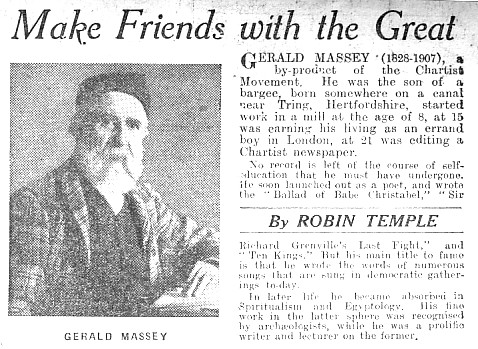
|
|
"Gerald Massey (1828-1907), a by-product of
the Chartist Movement. He was the son of a bargee, born somewhere on a canal
near Tring, Hertfordshire, started work in a mill at the age of 8, at 15 was
earning his living as an errand boy in London, at 21 was editing a Chartist
newspaper.
No record is left of the course of self-education that he
must have undergone. He soon launched out as a poet, and wrote the
Ballad of Babe Christabel, Sir
Richard Grenville's Last Fight, and Ten Kings. But his main title to fame is
that he wrote the words of numerous songs that are sung in democratic gatherings
to-day.
In later life he became absorbed in Spiritualism and
Egyptology. His fine work in the latter sphere was recognised by archeologists,
while he was a prolific writer and lecturer on the former."
Note: the journalist's reference to 'Ten Kings', which cannot be
traced, might have been to 'Sea Kings'.
|
|
____________________
GERALD MASSEY'S DEATH
|
|
This cutting from an unidentified Australian Newspaper, was found pasted inside
an 1854 edition of 'The Ballad of Babe Christabel with Other Lyrical Poems'.
"An interesting personality has passed away.
He may even be remembered in Australia, which he visited some 30 years ago [in
fact in 1884]. I refer to Gerald Massey, the Chartist poet, a
friend of F. D. Maurice, of Charles Kingsley, and the original of George
Elliott's "Felix Holt", and a writer applauded by Tennyson, by Landor, and by
Ruskin. He was the son of a canal boatman; he had practically no
education, and all through his wretched childhood starvation pursued him.
Yet he rose superior to his surroundings, and by the age of 30 had impressed the
world with his poetic powers. His ambition was to become the poet of
the masses. "I yearn to raise them into loveable beings. I would
kindle in their hearts a sense of the beauty and grandeur of the universe, call
forth the lineaments of Divinity in their poor worn faces, give them glimpses of
the grace and glory of love, and of the marvellous significance of life."
Massey was true to the mission he planned for himself in those noble words.
It has been said of Massey's poetry that it is "thickly strewn with beauties";
and so it is. Landor quoted, with glowing admiration, the lines:
|
"The
starry soul that shines when all is dark,
Endurance that can suffer and grow strong
Walk through the world with bleeding feet and smile." |
Many of his metaphors and similes are extremely beautiful:
|
"We climb like corals, grave by grave,
That have a pathway sunward."
"Hope builds up
Her rainbow over memory's tears." |
Nearly 40 years ago Massey practically gave up poetry, and
devoted himself to literary research, spiritualism, psychology, and
egyptology. His latest book, not long out, was "Ancient Egypt: the Light of the
World."
|
|
____________________
THE TWO WORLDS
May 8, 1908.
Gerald Massey: An Appeal.
WE have received a
copy (which we gladly publish) of the circular letter recently issued by
Mr. James Robertson, of 5, Granby-terrace, Hillhead, Glasgow, regarding
the raising of a "Subscription Fund" for the "widow and daughters" of
Gerald Massey. We are pleased to notice that "by the
kindness of Sir Henry Campbell-Bannerman" the fund is headed by £200
from the Royal Bounty Fund, followed by £100 from the Committee of the
Royal Literary Fund. Other sums follow, but much more is required
to meet the cases of the ladies. Mr. Massey was a royal-souled man
and a deep thinker. As a poet he sang the songs of freedom and
progress, as a Spiritualist he was stalwart. He literally laid all
he had upon the altar of truth, and we most earnestly hope that now he
has left us, those whom he loved may not be allowed by his friends to
feel the cold winds of adversity now that he can no longer help to
succour them. Some £360 has already been raised, but at least
£1,000 is necessary. Will all who can assist send at once to Mr.
Jas. Robertson, as above. He is a donor of £10. Who will
follow his example? |
[Next Page]
|



