|
[Back
to Chapter 1.]
CHAPTER TWO
CO-OPERATION AND REPUBLICANISM
1850—1853 |
|
Men of all countries are
brothers, and the people of each ought to yield one another mutual aid,
according to their ability, like citizens of the same state.
(Robespierre) |
|
|
THE principles of the
first Working Tailors' Association were founded on a resolution which
stated that 'individual selfishness, as embodied in the competitive
system, lies at the root of the evils under which English industry now
suffers: the remedy for the evils of competition lies in the brotherly
and Christian principle of Co-operation — that is, of joint work, with
shared or common profits.[1] At the commencement
of the venture everything went smoothly. Workrooms on the top
floor, with offices and a shop on the lower floors were fitted out, and
the building opened for business with twelve employees on 11 February
1850. Wages for the workers soon compared favourably with those of
other trades, averaging 24s per week. That month, Maurice
published the first of a series of eight Tracts on Christian
Socialism which announced the term 'Christian Socialism' to the
public in which he presented, so he thought, his own clear convictions
on the subject. But his aims as interpreted by the working class
were misunderstood. In general, Christian Socialism was taken to
mean a restructuring of labour based on co-operation, joint ownership
and with increased power to the working class. Maurice's ultimate
intention, however, was through using these means, to Christianise
socialism by opposing the unsocial Christians and the unchristian
socialists.[2]
The early success of the Working Tailors' Association
quickly prompted workers in other trades to make application for
membership. In the following month Massey wrote to Leno suggesting
that he should, at his recommendation, move to London to take charge of
a Working Printers' Association, soon to be formed. Leno,
following an interview with the proposers, agreed, but preferred to
remain as an operative rather than be taken on as manager. His
printing press was moved from Uxbridge and, during the three years he
was with this Association, Leno found that he was able to provide them
with much valuable service, as well as maintain his active Chartist
interests.[3]
|
 |
|
John Bedford Leno 1826—1894. (The
Commonwealth, 6 October 1866)
Leno had supported George Julian Harney and his
Internationalism during the last stage of the Chartist
movement. He then involved himself with the Reform
League, becoming a member of the Executive Council. He
wrote prose and poetry, his published poems with social and
labour themes being highly regarded. Although
emotionally descriptive, he was not subject to over emotive
idealism that featured in many of Gerald Massey's poems.
See for example, his Herne's Oak (1853), Drury
Lane Lyrics (1868) and The Aftermath (1892). |
Despite much general approval for their venture from
working class journals, the Christian Socialists received a sharp attack
from the
Daily News. Maurice and the new movement were criticised:
The case of the working tailors ... is ... to some extent, a remedial
one; provided, however, the sufferers do not allow themselves to fall
into the hands of persons who seek to turn their case into an
illustration that humanity and political economy are irreconcilable, and
to erect on their unfortunate workshops of Christian Socialism, as Mr
Maurice, of King's College, in the Strand, is pleased to term his
hostility to the principle of commercial competition, about which he
seems to know as much as it is to be presumed he does of single stitch.
Already there are attempts to connect the working tailors' case with the
teaching of the Communist doctrine . . .[4]
The promoters of the Christian Socialists with their
high clerical connections received visits from many upper class persons
of distinction who were desirous of seeing at first hand the practical
work being achieved by the associations. One day a messenger
hastily entered the Castle Street workshop informing the workers that
the Bishop of Oxford was downstairs, and intended to visit the
operatives before he left.[5] This caused a
great deal of excitement. Hasty preparations were made and a guard
was placed on the landing to inform the men of his lordship's arrival.
As the bishop started to climb the stairs to the workshops, the warning
was given. Walter Cooper entered the room followed by the bishop,
with Gerald Massey close behind. The workers heralded the bishop's
entrance with a hymn to the tune of 'Old Hundredth', although the words,
which differed considerably, fortunately escaped the Bishop's notice:
|
Old Grimes, he's dead, the good old man,
We ne'er shall see him more;
He used to wear an old grey coat,
All buttoned down before. |
The Bishop beamed jovially at the earnest workers and
said to Walter Cooper, 'Well, now, Mr Cooper, this is really delightful,
to see a number of men while engaged at their work singing praises to
the glory of God. I am delighted at this spectacle!'[6]
 |
|
Samuel Wilberforce, Bishop of Oxford. From a
Carte de Visite. |
From the time Massey left Uxbridge he had not ceased
writing poetry, some pieces continuing to be accepted by the Northern
Star. That had come to the
attention of Maurice who wrote to Charles Kingsley in February, 'Has
Ludlow told you of our Chartist poet on Castle Street? He is not
quite a Locke, but he has I think some real stuff in him. I hope
he will not be spoiled.'[7] It is probably this
remark which suggested to commentators of Alton Locke that Massey
was one of the main prototypes that formed Kingsley's model for this
character.[8] Although similarities have been
noted (see the letter from Massey to Samuel Smiles, Chapter 3), other
proposals for this role were made for Thomas Cooper, the most likely
candidate, or Walter Cooper, both of whom share early experiences
similar to Alton Locke. Although Alton Locke was not
published until August 1850, the book had been completed the previous
spring, and there is no evidence that Massey had made personal
acquaintance with Kingsley prior to commencing at Castle Street.
In the London radical literary sector, Massey and his
paper had gained a favourable reputation. The last issue of The
Uxbridge Spirit of Freedom
contained an article by Massey in which he stated his views on the
middle class reformers. He considered that it was time to question
the Chartist leaders as to the direction they were heading, as he
doubted there were more than two of these who knew how they would apply
political reform to aid the poor:
It was the middle class reformers who obtained the Reform Bill, who
then became respectable monopolists and enemies of the unenfranchised.
Had there been no Reform Bill, the workers might have had a government
built on Universal Suffrage, and it should be realised that a middle
class despotism is worse than the tyranny of feudalism. Whilst the
middle classes will precede us to power, they will not solve the problem
of labour. Even if we were on political equality, our interests
would be at issue immediately, for while they seek a political change in
order that they may prevent the coming social revolution, we work for a
political revolution, thereby to consummate the social one, which must
follow. If leaders stand in the way, they must be sacrificed at
the shrine of principles.[9]
Editors of more powerful radical papers were taking
stock of Massey's developing literary talent, in particular George
Julian Harney of the
Northern Star and the Democratic Review. Harney was
an excellent journalist and a passionate supporter of internationalism.
His
Democratic Review welcomed the opinions of, and articles by,
foreign revolutionaries such as Louis Blanc, Giuseppe Mazzini and Ledru
Rollin.
Thomas Cooper, imprisoned in Stafford for two years
in 1843 for sedition and conspiracy, during which time he composed his
epic poem The Purgatory of Suicides, had commenced in January
1850 his most noted contribution to radical journalism. Cooper's
Journal: or, Unfettered Thinker and Plain Speaker for Truth, Freedom,
and Progress was published weekly with a short break, until the
following October. As well as being a focus for Cooper's own
series on a critical exegesis of Gospel history following the Strauss
mythical system, the journal included articles by Thomas Shorter on
education and association, and Samuel Kydd, a prominent Chartist who
dealt with industrial matters. In common with journals of the
time, space was given for original working-class poetry. Massey's
first poem to be published in London following his arrival, appeared in
the second issue. ‘'Twas Christmas Eve!' contrasted the day
celebrated at a palace with that at a poor man's hovel, and was
characteristic of his socio-political stance:
|
'Twas Christmas Eve! In the palace, where Knavery
Crowns all the treasures the fair world can render;
Where spirits grow rusted in silkenest slavery,
And life is out—panted in golden—garbed splendour ...
Love—kisses sobbed out 'twixt the rollick and rout,
And Hope went forth reaping her long-promised treasure:
What matter, tho' hearts may be breaking without?
Their groans are unheard in the palace of Pleasure! ...
'Twas Christmas Eve; but the poor ones heard
No neighbourly welcome — no kind voice of kin!
They looked at each other, but spoke not a word,
While through cranny and crevice the sleet drifted in.
In a desolate corner, one, hunger-killed, lies!
And a mother's hot tears are the bosom-babe's food! ...
False Priests, dare ye say 'tis the will of your God,
(And veil Jesu's message in dark sophistry),
That these millions of paupers should bow to the sod! … |
Cooper's Journal published fourteen of
Massey's social protest but less overtly martial poems during its run, a
notable exception being the 'Song of the Red Republican':
|
Ay, tyrants, build your bulwarks! forge your fetters!
link your chains!
As brims your guilt-cup fuller, ours of grief runs to the
drains:
Still, as on Christ's brow, crowns of thorns for Freedom's
martyrs twine,
Still batten on live hearts, and madden o'er the hot
blood-wine!
Murder men sleeping; or awake — torture them dumb with pain,
And tear with hands all bloody-red Mind's jewels from the
brain!
Your feet are on us, tyrants: strike, and hush Earth's wail
of sorrow!
Your sword of power, so red today, shall kiss the dust
to-morrow ... [10] |
'The Cry of the Unemployed' demonstrates another
typically more socially directed example:
|
There's honeyed fruit for bee and bird, with bloom laughs
out the tree:
There's food for all God's happy things; but none gives food
to me!
Earth decked with Plenty's garland-crown, smiles on my
aching eye:
The purse-proud, swathed in luxury, disdainful pass me by:
I've eager hands — I've earnest heart — but may not work for
bread:
God of the wretched, hear my prayer! I would that I were
dead! ... [11] |
Massey contributed only one article to Cooper's
Journal. ‘Signs of Progress' exhibited a style that he had
developed during this early period and illustrated so often in his
poetry; a proselytising optimism directed at the working class. At
that time there were strong hopes of a Chartist revival, and the radical
papers kept up relentless pressure on their readers to prepare them for
that advent, as Massey demonstrated:
For it is in the dense ignorance which covers the people like a sea
of darkness, that Tyranny lets drop its anchors. Remove this, and
its mainstay is gone; and the King-craft, the Priest-craft, and the
State-craft shall be swept away by the rushing waves of Progress ... It
needs a high heart and never-tiring faith to bear up; but, let not your
hearts die within you, ye who toil on thro' nights of suffering and days
of pain, watering the bread of penury with the tears of misery … For
even as God said, ‘Let there be light'' and there was light; so let the
people say, ‘Let there be Freedom!' and there shall be Freedom. [12]
Prior to and following the 1848 revolutions in
Europe, Harney had supported the Hungarian, French, Italian and German
refugees, and had provided space for their opinions in his Democratic
Review. In January 1850, to give further assistance to the
cause of foreign democratic and social progress, he enlarged the scope
of his Society of Fraternal Democrats that he had founded in 1845.
The objects of this new association were for the fraternity of nations,
the abolition of stamp duty on newspapers and the political emancipation
of the working classes through the Charter. The ‘diffusion of
political and social knowledge for the purpose of deliverance from the
oppression of irresponsible Capital and usurping Feudalism', would be
promoted by meetings and continued through Harney's Democratic Review.[13]
This produced an immediate response from Massey's idealism, and he
joined with Harney, who was secretary to the association, to serve on
the committee for twelve months.
Soon after the association had been formed, the
committee decided to celebrate the ninety-second anniversary of the
birth of Maximilian Robespierre, the ‘Incorruptible'. A democratic
social reformist and revolutionary leader of the Jacobins in the French
National Convention, he had been guillotined in 1794. A special
supper was arranged at the John Street Institute on the 6 April 1850, to
which members and friends of the Fraternal Democrats were invited to
attend. Many organisations held that pattern of social event that
provided the advantage of a large meal with convivial companionship,
during which they solidified their members by declarations of future
intent. Some seventy persons attended the commemoration with
Harney presiding, and many toasts and speeches were given following the
meal. Harney proposed ‘To the Sovereignty of the People, and the
Fraternity of all Nations', responded to by Citizen G. W. M. Reynolds.
Citizen Gerald Massey sang the English version of the ‘Marseillaise
Hymn', and Citizens Reed and Massey responded to a speech by a German
exile. Massey concluded this with ‘To persecution and martyrdom in
the glorious cause of freedom'. Other toasts and responses were
made by Chartists Bronterre O'Brien (the health and prosperity of the
chairman, George Julian Harney), J. B. Leno (the memories of Paine and
Washington), and John Arnott,
general secretary of the National Charter Association (Prosperity to the
Society of Fraternal Democrats, and the Democratic Press).[14]
Very early that year in 1850, following his move to
London, Massey had been invited to a demonstration of clairvoyance
which, together with mesmerism and more physical phenomena, were
attracting quite wide interest since the publicity of the Fox sisters in
America in 1848. This young clairvoyant had the apparent ability
to read while blindfolded, and was able also to perceive the cause of
some persons' illnesses, the body appearing to her as translucent during
that time. She visited hospitals and, using her powers, assisted
some doctors in their diagnoses.[15] It was
reported that she had manifested this ability from the age of nine,
following a head injury, and had given demonstrations to the Earl of
Carlyle, the Duke of Argyle, Sir David Brewster and Charles Sumner, then
Bishop of Winchester.[16]
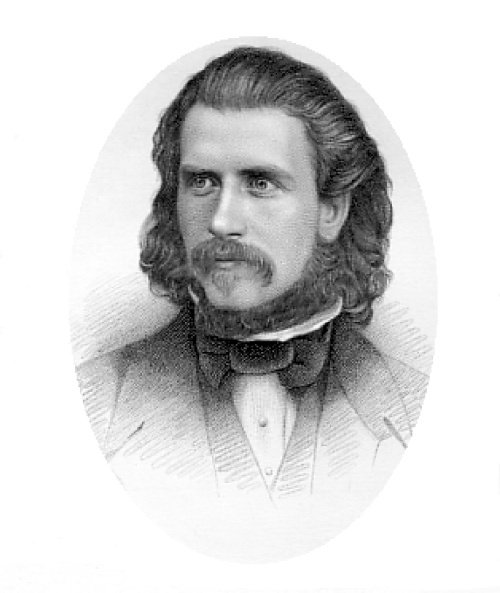 |
|
Gerald Massey, Chartist, mid 1850's.
From Samuel Smiles' Brief Biographies, 1876. (Library
of Congress)
A faded carte de visite shows
a similar picture, probably from the same original source. |
|
 |
|
Thomas Hughes (1822-96), English lawyer and
author. |
Massey at that time was handsome and eligible. Although short in
stature at five feet four inches, his brown hair worn long and brushed
back, with beard and moustache, a Grecian nose and blue eyes gave him a
very distinguished appearance. This chance acquaintance blossomed
into love, and on the 8 July, 1850, Rosina Jane Knowles, aged nineteen,
was married to Gerald Massey at All Souls' Church, St Marylebone,
witnessed by Walter Cooper and Thomas Hughes. Hughes was a valued
member of the Christian Socialists, and later the author of Tom Brown's
Schooldays. Rosina came originally from Bolton, Lancashire, where
her father was a boot and shoe maker in Independent Street, and the
family had moved some years earlier to 21 New Church Street, Marylebone.
Although short-lived, Rosina transformed the whole of Massey's
philosophical conceptions which he expressed so often in his lyric verse
and, less fortunately, re-orientated his mundane lifestyle for the next
fifteen years. There is no description of her physical appearance,
but from indirect references it may be assumed she was rather taller
than her husband, of firm build, with dark brown hair, brown eyes and a
pale complexion.
Immediately following her marriage, Rosina moved in
with her husband at 55 Wells Street, off Oxford Street, where he shared
lodgings with Jeremire Jerome, a master tailor and his family.
Jerome may have been employed at the Castle Street workshops, or have
been connected with Thomas Jerome who kept a tailor's shop in Oxford
Market, sited at that time in a small area between Castle Street, Castle
Street East, and Great Titchfield Street.
The 1851 census return for 34 Castle Street (the
headquarters and workshops of the Working Tailors' Association) shows
that Walter Cooper, then aged 38, born in Aberdeen, was residing there
with his wife, Ann, aged 43 years. He is listed as ‘Manager of
Tailors' Association.' They had two sons and three daughters.
Also residing there was Massey's brother, Frederick, listed as a
‘Porter.' It is likely that he left home to find work in London,
and was staying temporarily at Castle Street prior to finding his later
occupation as a ladies hatter. He married in 1854.
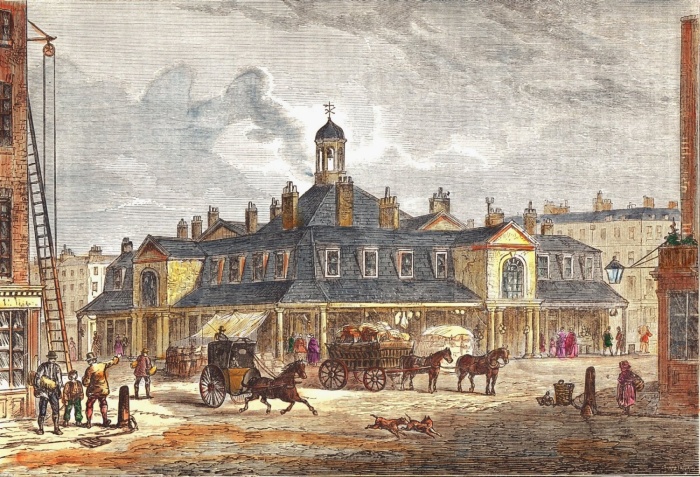
Oxford Market c. 1870.
Marriage did not decrease Massey's political
activity, nor his idealistic enthusiasm for co-operation. Indeed,
he became more involved with the events that were shaping themselves as
the last breaths of active Chartist protest. His first advertised
but unreported public lecture had been delivered on 21 April 1850 at the
Institution, Golden Lane, Barbican, on ‘The Poetry of Freedom and
Progress'.[17] At the same time he was forming
a closer association with Harney whose developing socio-political plans
most nearly approached his own ideals. Since 1848 there had been
increasing ideological disharmony between Harney and O'Connor.
O'Connor was attempting to unite the Chartists with the middle-class
radicals to form a new National Charter League, to which Harney became
increasingly opposed. In order to force a decision, Harney
resigned from the provisional executive of the National Charter
Association and, following elections, won the day. Members of
Harney's Fraternal Democrats now dominated the executive, which decided
to reconstitute the Metropolitan District Council. At a meeting of
the provisional committee on the 19 March, following a speech by Harney,
Massey confirmed Harney's objectives concisely:
The Charter was very good, but we wanted something
with it — our social rights. The capitalists were the great bane
and curse of the nation. In 1848, kings and priests were kicking
about, but the capitalist could buy up both kings and priests. The
remedy was co-operation, Chartism and Socialism united. (Loud cheers.)
They had already established a tailors, a printers, a shoemakers, and a
provision store. (Loud cheers.)
Mr Massey concluded a highly poetical speech which elicited
hearty applause.[18]
Harney had only recently expanded his ideas that
would, he hoped, provide a new impetus in revitalising a flagging
interest in active Chartism. His call for ‘The Charter, and
Something More' was first announced in the Democratic Review in
rather vague terms as meaning ‘The Charter, the Land, and the
organisation of Labour', the Land belonging to all the people which,
being the natural right of all, should be made national property.[19]
This call for ‘Something more' was echoed continuously at subsequent
Chartist meetings.
At the French elections of March and April 1850, six
Red Republicans had been returned at the Saône et Loire district with a
great majority. To celebrate their victory, the National Charter
Association relinquished their usual meeting at the John Street
Institution in order to hold a special gathering. To a large
assembly Harney, Bronterre O'Brien, Walter Cooper and others spoke in
praise of the democrats of France. Massey moved the first
resolution that appealed to the French people to defend their natural
and constitutional rights by any and every means, and continued:
The first French revolution had been a glorious work; it broke up the
feudal power of the aristocracy, and it had brought the people upon the
stage, to play, for the first time, an important part in the area of
history; they mounted the platform, and crowns fell down before them
like old Dagon before the ark. (Cheers.) ... There was suffering
enough in this country to make ten revolutions. Might made the
right to liberty, if they would but struggle and contend for it.
(Prolonged cheering.)[20] |
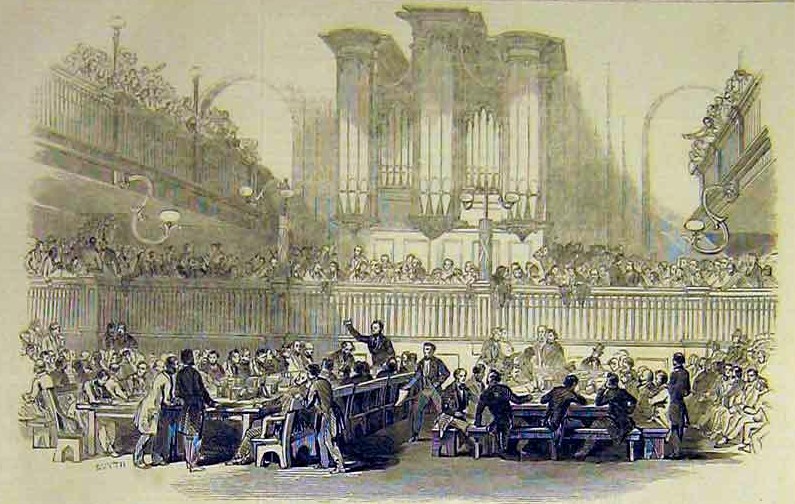 |
|
The Literary and Scientific Institution, 23 John
St., Fitzroy Square
(Illustrated London News 15 April 1848). |
|
The release
of a number of Chartists from prison that year was another
occasion used profitably to promote the Chartist cause. A
meeting was immediately convened by the provisional committee of
the National Charter Association, and was held at the John
Street Institution on 23 April 1850. Thirteen of the
released Chartists mounted the platform, and spirited addresses
were made by committee members, including Bronterre O'Brien and
Harney. John James Bezer, one of the late prisoners was
introduced, and addressed the packed hall amid loud cheering.
Massey responded to an address by Walter Cooper, and said in
conclusion that:
Ernest Jones, a true poet of labour, had thought that
Englishmen would have been prepared for the revolution, but
misery and degradation had done their work. The people had
fallen a prey to priests, who preached of gods of wrath, and of
hells of torture as though they were the devil's own
salamanders. But the day would come when thrones and
aristocracies would no longer hang as millstones round their
necks. (Loud cheers.)[21]
John Arnott, general
secretary, then moved a resolution that punishment for the
expression of political sentiment was a gross violation of one
of the rights of the people, and that the people should labour
unceasingly for the liberation of their friends and for the
abrogation of those laws which denied the right of free public
discussion. Harney followed by reading a memorial
addressed to Sir George Grey, Queen Victoria's Home Secretary,
appealing for the release of the other Chartists imprisoned for
expressing their political beliefs. It was probably
fortunate for the future release of those Chartists that Queen
Victoria's ministers were unlikely to be reading Harney's
Democratic Review. In the July issue Harney referred
to the birth of Prince Arthur on 1 May, as ‘a royal burden' from
which the Queen ‘had condescendingly allowed herself, in her
magnanimous deference to a natural law, to be relieved.'
The prince's christening on the 22 June, for which Prince Albert
had composed a 'chorale', suggested a new five verse rendering
to Harney:
|
… O! who would grudge to squander gold
On such a glorious babe as this?
What though our babes are starved and cold,
They
have no claims to earthly bliss.
Ours are no mongrel German breed,
But English born and English bred;
Then let them live and die in need,
While the plump Coburg thing is fed …[22] |
The Christian Socialists at that time did not
rely solely on workshops to promote their ideas. Lectures
were given by members, particularly by Walter Cooper, and public
meetings were held to ensure that their principles became known
to the majority of the working-class. One such meeting was
held at the National Hall, Holborn, under the auspices of the
Working Men's Association, on 31 July 1850, when there was a
large attendance composed mainly of operative tailors.[23]
Vansittart Neale, a resolute supporter of co-operation took the
chair and, with Ernest Jones released from prison on 9 July,
together with Samuel Kydd, Walter Cooper and Gerald Massey as
speakers, it was shown the evils that were resulting from the
competitive system of society, and how these could be remedied
by association. Ernest Jones pointed out that despite
increasing mechanisation over the last eighty years and
extending markets, pauperism, crime and emigration had
increased. Poor rates had risen from one to eight millions
and labour was shifting from the shoulders of male adults to the
shoulders of women and children. This state of things, he
said, resulted from the mechanical power of the country being in
the hands of capitalists, who employed it for their own profit.
The effort of the people should be directed to the formation of
associative-working societies. He moved that competition
be one of the principal causes of the existing distress, and
recommended association to be the best remedy. Massey
seconded, and said that:
If the working classes of England had helped themselves
before, instead of trusting to the legislation of hereditary
imbeciles, they would not now occupy their wretched position.
(Hear, hear.) ... they ought no longer to be content to weave
splendid robes for titled lords and garb their own hearts in the
shrouds of misery. (Hear, hear.)
Walter Cooper called upon the working-classes
to assist the associations by becoming their customers, since
co-operation tended to increase the security and value of
capital. As manager of the Working Tailors' Association,
Cooper was particularly well suited to debate, lecture and write
upon the conditions of working tailors. Poverty stricken
in childhood, he had experienced the slop and sweating systems
during his trade as a tailor. When his first child was
born, he had no bed, bedclothes, food or fire in the room, and
was working on a pair of trousers for which he would receive
seven-pence.[24] The condition of the
journeyman tailors, male and female, had received attention also
at a meeting of master tailors at the Freemasons' Tavern on 4
March when extreme cases of poverty and social degradation were
cited. A woman who worked in a slop shop stated that she
received sometimes only 4d for making a waistcoat; a married man
with three children was making a coat which would take him
twenty-six hours to complete and earn him two shillings.
Although he had another coat in hand to make, this would take
him two days, for which he would receive 3s 6d. Yet
another worker and his daughter had a room nine feet by eleven
which had also to accommodate two young men and one young woman,
and serve as workroom and bedroom for them all.[25]
An up to date statement of the Working Tailors' Association was
provided by Massey for the Leader, in October, when he
announced also that the terms of ‘master' and ‘employed' had
been abolished, and the workman was no longer a hireling.
He applauded the Daily News for working against them, as
by doing so they had helped by advertising their existence,
thereby increasing custom.[26]
On 22 June Harney, finally breaking with
O'Connor over policy, and having completed his notice of
resignation from the Northern Star, commenced his most
famous radical unstamped paper, the
Red Republican.
Through this new journal he aimed to provide a strong political
perspective and revive support for Chartism by elaborating on
his earlier ambition to obtain ‘The Charter and Something More'.
Due to falling sales he discontinued his
Democratic Review the following September, but sustained
publicity and aid for the European Democrats in the Red
Republican. The appropriately named title of Harney's
new paper, together with its contents and the fact that it was
sold unstamped, caused misgivings on the part of newsvendors.
So much that at the weekly meeting of the National Charter
Association on 6 August, it was commented that a ‘contemptible
conspiracy' existed among the newsvendors for the purpose of
‘burking' the
Red Republican. Also they opposed it because it was
calculated to bring royalty into contempt (hear, hear, and
laughter.) Bronterre O'Brien informed the meeting that he
was about to visit Manchester in order to agitate the doctrines
of the National Reform League in connection with Chartism.
Playing down the precept that kings and queens were denounced as
being the cause of the people's suffering, he asserted that the
upper and middle classes were the real cause, through their
monopoly of land and profits. (Hear, hear.)
Referring to a recent election at Lambeth where a Chartist was
returned, he pointed out that this person was returned by the
middle class, as he was a financial reformer and upholder of the
rights of capital. What was required was extensive
organisation to endeavour to secure a large number of Chartist
representatives at the next general election. Massey
responded and said that, as he had passed along the streets, he
had heard the drunken song of ‘Britons never will be slaves!'
Why, the working-class of this country were bought and sold
like slaves in the market, and yet seemed inclined to worship
and bow down to those who trampled them underfoot. (Hear, hear.)
Britons were the veriest slaves in existence; they were the
slaves of a royalty which spent annually as much as would keep
10,000 families in comfort (hear, hear.); the slaves of a church
which took from them £12,000,000 a year; the slaves of everyone
who had nine-pence to buy them with — and, worse than all, the
slaves of drunkenness . . . I long to see a real and effective
union of all classes of democracy, that the power of those
oppressors might be broken. He was no true friend of the
people who would oppose such a union, when, without it, no
successful effort could be made for the redemption of the
people.
After dwelling upon the advantages to be
derived from associated labour, Massey resumed his seat amid the
applause of the gathering.[27]
Massey had been attracted to, and aligned
himself increasingly with, Harney's more fully developed ideas
of ‘something more', i.e. to make the Charter more attractive to
the working class by defining their societal rights as an
impetus to political reform. Harney elaborated on this
theme of social regeneration in a series of articles throughout
most issues of the Red Republican under his well known
pen-name ‘L'Ami du Peuple.' Massey supported Harney and
solidified their friendship by writing poems and articles for
Harney throughout the days of the
Red Republican, continuing when it was renamed the Friend
of the People. He also acted initially as secretary to the
Red Republican's committee, and made two stirring contributions
to their first issue on 22 June, 1850; an article 'Cossack or
Republican' and a poem 'The Red Banner':
Let us then fling ourselves into the glorious work; let
Chartists, Communists, and Republicans unite in one common bond
— forget all our idle feuds; and come what may — let us be found
ever in the front rank, ever at the outposts, in fighting the
battles of Freedom ...
|
Fling out the Red Banner! o'er mountain and
valley,
Let earth feel the tread of the Free, once again;
Now, Soldiers of Freedom, for love of God, rally —
Old earth yearns to know that her children are men;
We are served by a million wrongs; burning and
bleeding,
Bold thoughts leap to birth, but the bold deeds must come,
And wherever humanity's yearning and pleading,
One battle for liberty strike ye heart home! ... |
Although the Christian Socialists were
actively sympathetic with the sufferings of the working class,
they were far from happy with the extreme radical activities of
some of the Chartist leaders. Harney, O'Connor and some
others were referred to as 'that smoke of the pit', and it was
thought that the workmen were tired of idols, and were just
waiting and yearning for the Church and the Gospel which the
Christian Socialists were willing and able to provide.[28]
Kingsley told the Chartists that instead of pinning their faith
on the Chartist leaders, they should turn to the Bible as the
true Radical Reformer's Guide.[29]
It was understandable therefore, that Gerald
Massey, a member of the Christian Socialists working for the
Red Republican, annoyed Ludlow, who denounced anything of an
extreme radical or irreligious nature. He had regularly to
'blow up' Massey:
for having publicly connected himself with a thing called the
Red Republican, patently treasonable. He was
bullied out of it, by my offering him the choice between
association and the ‘Red' and in the note in which he consented
to withdraw, he had told me that if I for instance had set up an
organ of Christian Socialism he should have been quite willing
to write in it.[30]
It was due in part to this episode and the
fact that Ludlow recognised other literary talent among the
co-operative workmen ‘either lying idle, or forcing its way
through wrong channels', that induced him to commence the
Christian Socialist the following November, 1850.
Appearing outwardly penitent following
Ludlow's reprimand, Massey was not so easily discouraged and had
no intention of severing his literary relationship with the
Red Republican. As soon as the second issue was
published, Massey ran into the Castle Street workshop with a
copy of the paper, which he placed in front of fellow worker
Robert Crowe saying, ‘Crowe, we have a new poet in the field!'
Crowe immediately recognised the style of Massey in ‘A Call to
the People', signed with the name ‘Bandiera'.[31]
Massey had taken this name from the brothers Attilio and Emilio
Bandiera, Italian officers in the Austro-Italian navy who, in
1844 had planned an unsuccessful Italian insurrection. The
poem had been published previously in Cooper's Journal,
but Massey had extended and revised it to a more republican
stance. Some weeks later, with the ninth issue of the
Red Republican in his hand, Massey again informed Crowe that
yet another new poetic star had appeared in the literary
firmament, this time in the name of 'Armand Carrel', introducing
himself with ‘A Red Republican Lyric'.[32]
This was a name that Massey had used originally in the
Uxbridge Spirit of Freedom, for a letter to the ‘editor'
headed ‘Struggles for Freedom'. Whether he thought it was
too strongly worded to sign with his own name, or he felt that
had already provided sufficient signed material for that issue
is not known:
Peoples of Europe, you have looked on and calmly seen a noble
nation [Hungary] murdered — its blood be upon your heads!
Englishmen, you are slaves, blind, plague-stricken slaves! you
see the brave struggling for life and liberty, and will not lend
the helping hand; no, you dare not help yourselves to right and
freedom! all the world know this! they know that the heart of
England hath become the prey of vipers! ...
To end the letter, Massey had quoted some
lines from ‘The Jacobin of Paris', a poem by the Hon. George
Sidney Smythe MP in praise of Jean Paul Marat, a leader in the
French Revolution:
|
Ho! St Antoine! ho! St Antoine! thou quarter of
the poor,
Arise! with all thy households, and pour them from
their door —
Rouse thy attics, and thy garrets, — rouse cellar,
cell, and cave,
Rouse over-taxed, and over-worked — the starving and
the slave ...
Justice shall sheathe her sword heart-home; thrones,
crowns
be swept away
And brothers, gallant brothers, We'll be with you on
that day... |
Massey used to recite this dramatically at
Chartist meetings with an effect on the audience which was
described as ‘magical', and it was probably he who suggested
that Harney print the poem
in extenso in the fourth issue of the Red Republican,
and again in the twenty-fifth issue of the Friend of the
People.[33] The pseudonym ‘Armand
Carrel' caused some puzzlement to one ‘Nameless' reader of the
Red Republican, who wrote to Harney asking if an article
under that name was really written by the French patriot.
If not, why was a forgery foisted upon the readers?
Although the writer found no fault with the name ‘Bandiera', he
wondered why it was used. Harney had to explain that
‘Armand Carrel' died fifteen years previously, and that writers
with good reason to withhold their own names selected their
favourites. But he hoped that correspondents would
exercise discretion, having received that week letters signed
‘Marat' and ‘Robespierre'![34]
During that time at the Castle Street
Tailors' Association, steady progress had being maintained until
in September Walter Cooper went on a lecturing tour to the north
of England. While he was away, the accounts of the
association were found to be in some confusion and were examined
by the Council of Administration. Called to return on a
suspicion of embezzlement, Cooper was investigated by the
Council of the Society, and was found to have been careless and
too trusting, having had no previous accounting experience.
There was no evidence of dishonesty. The association was
dissolved, and a new association elected by ballot.
Some eleven of the original workers were not
readmitted and formed themselves into a rival association, The
London Association of Working Tailors. Although that
organisation lasted only until the following summer, it caused a
considerable amount of acrimony while it existed. The
affair was not helped by Ernest Jones, who denounced the entire
system of local co-operation in his Notes to the People
in 1851, and entered into some sharp correspondence with Gerald
Massey in 1852.[35] Jones complained of
‘a tissue of virulent abuse or most fulsome adoration. The
abuse is my share, who exposes profit-mongering; the adulation
is for the wealthy gentlemen, who have advanced money for the
Castle-street shop, and enabled it to profit—monger.'
Massey retorted, referring to Jones' ‘strange, unwarranted, and
artificial opposition to the co-operative Movement', and of his
‘vile, contemptible and infamous statements'. Although
initially supportive of associative-working societies as a
primary step to the relief of distress at that time, Jones
considered that social co-operation should be applied on a
national basis, which could not be achieved without first having
obtained political power through the Charter. Small
individual co-operative associations would only divert attention
from, and weaken efforts towards full democratic political
achievement. That unfortunate episode of the Working
Tailors' Association was related by Massey in a trenchant series
of articles for the Star of Freedom, in 1852.[36]
There was, however, one fortunate outcome as
a result of that affair. Had any legal action been
attempted against the association through Walter Cooper as
manager, there would have been even more difficulties, as no Act
then in force gave the association full protection. At the
instigation of Ludlow, Robert Slaney M.P. was persuaded to
establish a Commission of Enquiry to look into the position of
liability in the Working Tailors' and other associative
branches. Ludlow, Walter Cooper, Vansittart Neale and the
economist John Stuart Mill were among those who gave evidence.
In June 1852, Slaney's Act was passed as the Industrial and
Provident Societies Act, thereby giving legal recognition to the
co-operative movement.[37]
As a result of Massey's comment to Ludlow,
the first issue of the Christian Socialist appeared on
the 2 November 1850, and Massey's first poetical contribution,
in rather fulsome praise of F.D. Maurice, was published in the
second issue as ‘To a Worker and Sufferer for Humanity':
God bless you, Brave One, in our dearth,
Your life shall leave a trailing glory;
And round the poor Man's homely hearth
We'll proudly tell your suffering story... |
During 1851, J. M. Ludlow had been
undertaking a ‘co-operative tour' through Lancashire and
Yorkshire, and in an open letter to F. J. Furnivall (Christian
Socialist II, 49, 4 Oct. 1851) made reference to the Salford
Working Hatter's Association. Furnivall considered that
the current eleven members making some two dozen hats per week
were successful due chiefly to ideas promoted in the
Christian Socialist. Part of their trade was, of
course, competitive. Ludlow however decried the fact that
they were mean enough to charge £10 per cent commission to all
other co-operatives who chose to sell their hats when a small
compensation of £1 per cent might be reasonable. With the
exception of the Manchester Working Tailors who refused to
accept commission, all the co-operative bodies have very quickly
pocketed this enormous bonus in their dealings with the Working
Hatters.
Ludlow then continued with a reference to the
Oxford Street Tailors saying, "Even a certain flourishing
establishment near Oxford Street, — and which shall be nameless,
in the hope that it will mend its manners, and also because its
manager, who is now in the north, professes to know nothing
about the matter, — is stated to have given way to the
money-grubbing spirit so far as to accept it."
Massey quickly responded with a letter in the
following issue to the Christian Socialist:
The Manchester Hatters and the Working Tailors' Association.
Dear Sir, In your last number, Mr. Ludlow assumes that our
Association, among other co-operative bodies, has been selling
the hats of the above Company with enormous profit, — permit me
to explain. The Manchester Hatters sent us specimens of
their admirable workmanship, with the (wholesale prices)
attached, giving 10 per cent discount for ready money. We
entered upon no stipulation — made no conditions of sale, — but
simply took the hats, and exerted ourselves to sell them; and
not only did we not add any profit to the wholesale price, which
the manufacturers assured us would bear 25 per cent — but we
gave each customer the advantage of that 10 per cent discount to
the utmost farthing, and in our own unsophisticated method of
doing business — so far from having nurtured the spirit of
money-grubbing, we have entirely forgotten to charge the
customers for the hat-box, for which, upon referring to the
invoice, I find we are charged at the rate of 3s. per dozen.
So you see our profit has been of the same species as that of
two Yankees, who swapped two jack-knives till each had gained
5s. by the transaction. In conclusion, allow me to add,
that with our peculiar mode of dealing, I think that the portion
of the community so frequently appealed to as "Smart Young Men
who want a Cheap Hat," cannot do better than apply to us for the
same at 34 Castle-street East.
Gerald
Massey, Oct. 2nd. 1851. Secretary.
Two extended articles on Tennyson's poetry
("Tennyson's Princess" and "Tennyson and his Poetry") completed
Massey's contribution to the second volume of the Christian
Socialist, which ceased publication at the end of 1851 due
to high production costs. Both Massey's articles were over
aesthetically appreciative rather than critical, and he fell
into the trap of the time by quoting large passages of the poems
concerned in order to illustrate facets of his commentary.
Nevertheless, he demonstrated a growing feeling for descriptive
romanticism, often to excess, in marked contrast to his
realistic socio-political verse. In an article ‘Tennyson's
Princess', he embraces the theme of women's rights, inherent in
the poem, and made more self-evident since his marriage:
...We do not want Women to be crammed with dead language and
mummified learning ... but let them be educated up to the
noblest offices and holiest duties of life, which they are not
now . . . the hallowing wretchedness of this inequality is often
a very hell in its torments, — the clasping ring remains, a
mocking symbol!
Despite his plea for the education of women
‘as far as possible in accordance with her nature', the added
proviso that ‘all attempts to train her into manhood are ...
false and unnatural', deny total emancipation and equate more
with the current Victorian mode of thought and unthinkable rule
of society by matriarchy. Later he was to mellow even his
liberal statement and press for full equality. However,
even at that time women's rights campaigners were pressing those
issues. The Woman's Elevation League, together with
individuals such as Mary Howitt, was actively campaigning for
their recognition in social, moral and professional status.
This included pecuniary and political elevation, together with
full franchise.
Within the broader aspects of Chartism,
Harney was attempting by means of a Democratic Conference to
unite various democratic associations into one solid body, into
the principles of which would be incorporated his proposals for
greater social reform. These associates, in addition to the
National Charter Association, would include the Fraternal
Democrats, the National Reform League, and the Social Reform
League, and be united under the title of the ‘National Charter
and Social Reform Union'. The proposition received considerable
opposition, and Harney was forced to concede that Feargus
O'Connor, Bronterre O'Brien and Ernest Jones were against them,
and that the Trades' Associations could not be relied upon for
support. On account of this, it was decided to draw up an
address to the people of the country, and the executive
committee resigned for re-elections.[38]
Nominations from localities for the new committee included most
of the old members, represented by Reynolds, Harney, Jones,
O'Connor, Thornton Hunt (editor of the Leader), Holyoake,
O'Brien and Gerald Massey. But just prior to the elections
because of differences over policy, Massey, Walter Cooper,
Thomas Cooper and some others declined to stand. Appropriately,
Massey's articles and poetry in the Red Republican during this
period were appeals for unity, in which he complained that:
We, the democracy of England, are disunited and fragmentary;
we are broken up into sects and parties ... we are even at war
amongst ourselves, and well may the tyrants and oppressors laugh
us to scorn ... they know there is little cause for disquiet so
long as we are disunited. . . We can accomplish little or
nothing, going on as we are—at present. What will the new
organisation of the Chartists effect — singly? ... or any other
body of reformers by themselves? ... Some unity policy must be
adopted, or I am bound to say, that we shall be no nearer the
realisation of our hopes in 1860 than we are in 1850... We are
all democrats! ... Let us then unite Red Republicans,
Communists, Socialists, Chartists, and Reformers. . . It is
unity which is the great want of the time; and if the egotism of
men, calling themselves ‘Leaders' should stand in the way of
this federation, let the party behind each leader push on...
At a Conference of Delegates for effecting a
union between different classes of reformers, at the John Street
Institute, in October, Massey spoke again — as he had cause to,
on many occasions — on the need for greater unity:
‘The Chartist agitation had hitherto proved a
failure; it had never been at so low an ebb as at the present
time; even the Chartists themselves had acknowledged that the
bulk of their body were not Chartists in time of plenty, but sat
as easy and contented as even the middle classes. Seeing
this apathy among their own body, their leaders wished to extend
their basis, and asked other bodies to join them; but they could
not expect their co-operation, unless they admitted the claim of
those parties which the committee had inserted in the programme;
he believed that no party could singly obtain their objects, and
that no programme could satisfy the claims of every party, but
they could agree on some leading principles. He belonged to the
Tailors' Association. They were aware that they would not
struggle successfully with competition without some governmental
change; if they did not agree to adopt the law of Partnership,
or some of their principles, they would lose aid from Christian
Socialism and the young Republican party.'[39]
At a further meeting of the Democratic
Conference, it was realised that its break-up would lead to the
Manchester Council middle-class supporters taking greater hold.
Accordingly, Holyoake with Arnott, Reynolds, Massey and others
were appointed as a Committee of Observation to deal with
business and correspondence regarding possible amalgamation with
other democratic associations.
Nevertheless, despite much effort, it became
increasingly obvious that individual antagonisms together with
policy differences would negate all hope of a universal union.
A Manchester conference held in January 1851 had little positive
outcome, but was notable for O'Connor slandering Harney, which
was refuted at a meeting of the National Charter Association on
the 25 February. At this meeting, Harney was received with
a rapturous welcome and Massey, in an eloquent speech which
excited enthusiastic applause, contrasted the consistency and
manly conduct of Harney with the baseness and villainy of his
slanderers.[40] Despite the negative
conference, a Chartist convention held in London the following
March and April 1852 made more firm agreement on future Chartist
and social agitation. During these activities, there was
found time to organise the annual anniversary social evening in
memory of the birth of Robespierre, held as usual at the John
Street Institution, on 8 April. Harney presided, and a
number of speeches were given by Samuel Kydd, Gerald Massey,
Bronterre O'Brien and others to ‘the sovereignty of the people,
the fraternity of nations, and the social regeneration of
society'.
Since joining the Red Republican which
Harney had renamed the
Friend of the People in December 1850 to make it sound
more appealing to the working class and acceptable to
newsvendors, Massey had been compiling his published poems with
a view to producing them in book format. Finally completed
with some new material, Voices of
Freedom and Lyrics of Love by T. Gerald Massey, Working
Man, was published on the 21 March 1851 priced one shilling,
dedicated to his friend Walter Cooper:
As the toiler-teacher you have won your diploma in the school
of our suffering, and can well appreciate the difficulties which
the self-educated working man has to encounter ... Who can see
the masses ruthlessly robbed of all the fruits of their industry
... and not strive to arouse them to a sense of their
degradation, and urge them to end the bitter bondage and the
murderous martyrdom of Toil? ... But do not think me a mere
railer against the classes which oppress our own, I know too
well the evils that are self-inflicted, I know that our greatest
curse is in being our own Tyrants...
Reviews that appeared in the radical press
and smaller journals were distinctly appreciative of his gentler
love lyrics and, surprisingly, more critical of his political
poems. The Friend of the People confirmed the force
and fire of his partisan political poems which were, it
considered, lessened by ‘ruggedness', and compared them with the
elegance of his love lyrics.[41] A very
valid comment was made when the reviewer complained of a
‘painful striving for effect by means of big words and monstrous
fantasies. "God", "Christ", "Hell", etc. are terms used
far, far too often'. But these particular words among
others, together with excessive capitalisation remained an
expressive feature of Massey's poetry. Despite these
obvious faults the Pioneer appreciated the 'rich
fullness' in the lyrics.[42] The
Northern Star referred to ‘great force of perception,
accompanied by an equal power of delineation . . .' admiring the
‘force, fervour and nervous diction', but preferred also his
Lyrics of Love.[43] Eliza Cooke's Journal
published a biographical sketch and appreciation of Massey
written by Dr Samuel Smiles, the self-help advocate, which has
since formed the basis for most early biographical details.[44]
The Leader, quoting from this sketch and referring to his
martial poems, stated that Vehemence is not Force, while his
lyrics would benefit from the laborious study of versification.[45]
Once all the reviews were published, Massey was able to edit
them, and quote the most favourable extracts in an advertisement
printed in the 21st June issue of the Friend of the People.
Both preceding and following the review of
Massey's book, Ernest Jones' journal Notes to the People,
which contained Jones' own poems written while he was in prison,
received an equally honourable mention. It may have been
due to these reviews that at a casual meeting between Jones and
Massey in Fleet Street, Jones grasped Massey's arm, and was
reported to have exclaimed, ‘Massey, you and I are the two
greatest poets in England!'[46] Despite
Harney having changed the name of his paper it was steadily
losing circulation, and to save it he was trying to persuade
Ernest Jones to join with him in producing a new Friend of
the People. But his advertisements of the proposed
format for the paper were premature; Harney's paper was
unstamped, and fear of prosecution together with greater concern
for his own Notes to the People made Jones decide against
the proposition. Harney therefore was forced to
discontinue the Friend of the People at the end of July
1851. Having now no effective mouthpiece, he was obliged
to rely on accounts of his meetings being reported principally
in O'Connor's Northern Star and Reynolds's Weekly
Newspaper which, despite policy differences particularly in
the former, were by comparison, accurately reported.
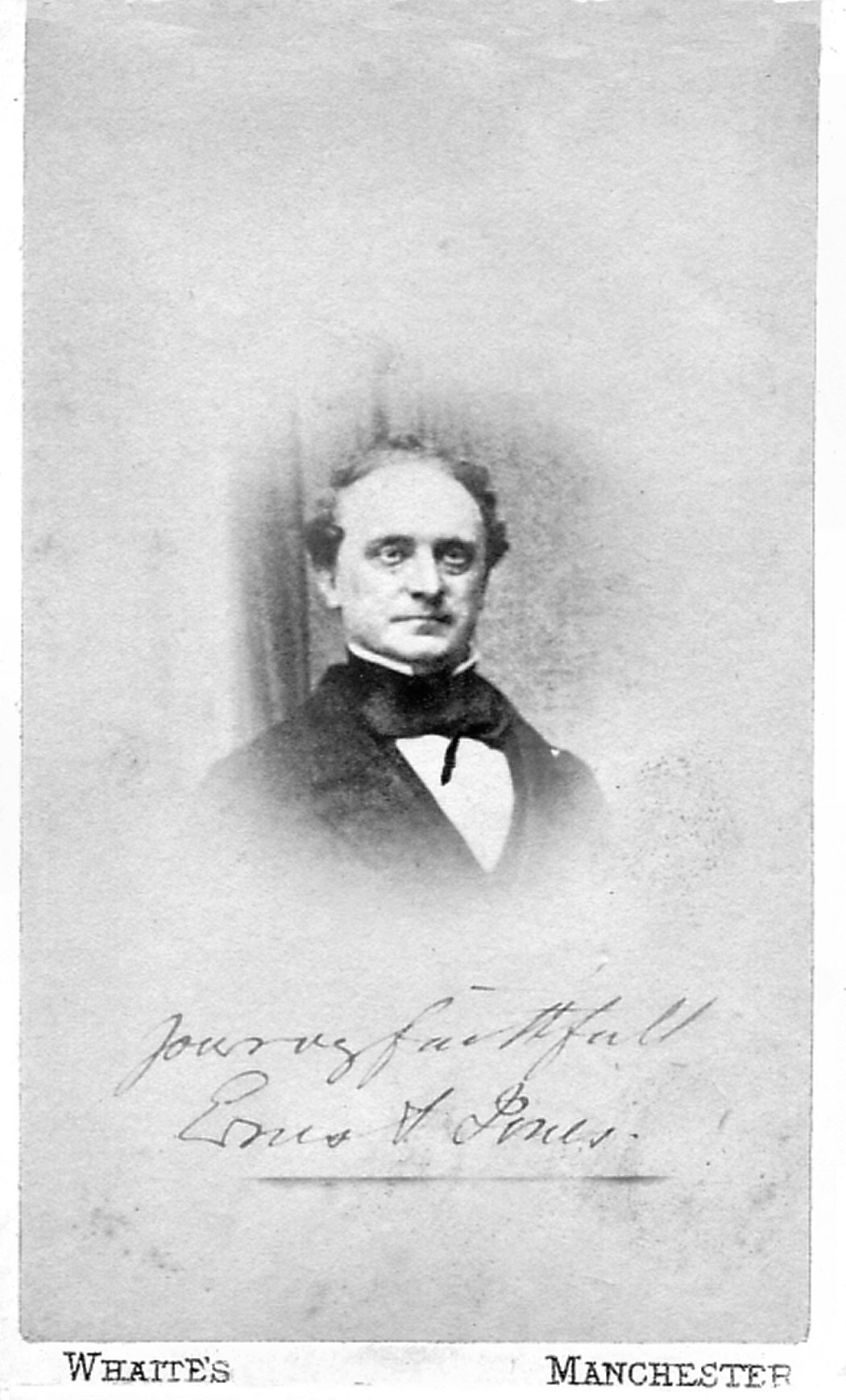
Ernest Jones: a
carte de visite.
The Fraternal Democrats and foreign refugees
during this period continued to receive Harney's attention,
which culminated in the arrival in England of the Hungarian
leader and patriot Louis Kossuth on 20 October 1851.
Massey wrote a special poem for the occasion, ‘A Song of Welcome
to Kossuth':
|
... Ring out, exult, and clap your hands
Free Men and Women brave—
Shout Britain! shake the startled lands
With ‘Freedom for the Slave!'
Come forth, make merry in the sun
And give him welcome due;
Heroic hearts have crown'd him one
Of Earth's Immortal few! ... |
Published first as a broadsheet, it was seen
by the deaf John Plummer in a Chartist bookshop near the corner
of Fleet Street and Fetter Lane.[47]
This would have been John Bezer's shop, at 183 Fleet Street, the
headquarters of The Society for Promoting Working Men's
Associations. Plummer was living then in Whitechapel,
working as an errand boy for his mother, a needlewoman, and had
taught himself the rudiments of reading by studying the London
street names and advertising placards. It was principally
Massey's poem that induced him to continue with self-education.
He eventually became a writer and earned the praise of John
Stuart Mill and Lord Brougham. Later, he said that he had
‘passed through the same fiery ordeal of poverty, neglect and
suffering ... as Gerald Massey', and that he deemed ‘the poetry
of Gerald Massey to be the most in accord with the general tone
of opinion entertained by the majority of working men of the
present day'.[48]
Massey's first child, Christabel, was born
the following day, on the 22 October 1851 at 50 College Place,
Camden Town, where the family had moved earlier that year.
At that time Massey was obtaining material in order to extend
his range of lectures, and had been writing to Charles Kingsley,
asking for some suggestions. In a letter dated Christmas
Day 1851, Kingsley replied:
My dear Mr. Massey,
Being in your debt three or four moderate letters, I condense
them all into one enormously long one. You must not think,
however, that want of interest in you has kept me silent; not
that, but business, daily & hourly & unwillingness to write to
you at all, without writing carefully & at length. Now
this Xmas night I seem to have time to put on paper the many
thoughts about you, which your letter etc. this morning, re-woke
in my mind; and I begin by wishing you & your wife & child all
the blessings of this most blessed of seasons, for the sake of
the Baby of Bethlehem.
Next, the reviews which I promised you.
I have (to my shame) not yet sent. Nevertheless next week
you shall have a parcel containing 1 or 2 nos. of Frazer,
and one no. of the North British. The Review of
Poetry in each of them being mine ... Also, in the same parcel,
the only 2 books about the commonwealth which I have which can
help you, Milton's Prose works, and Carlyle's letters & speeches
of Cromwell ... & lastly, a sermon which I preached today, which
I wish you would read, as a sample of the way in which to my
mind, the great doctrines of Xtianity have to do with these poor
country clods of mine ... The man to ask about books is Ludlow.
I am very ill read in original authorities of that period.
Mr. Maurice also would give you information ... [49]
The ensuing twelve months were to be
virtually the last of any form of Chartist organisation and
Massey's involvement with its media propaganda came to an end.
At a meeting of the National Charter Association Massey was one
of thirty — later reduced to twenty two — persons proposed to
act on the executive committee. The South Lancashire
delegate meeting referred to Massey and some others as those ‘in
whom the greatest amount of confidence can be placed ... '[50]
It was decided also at that time to reconstitute the
Metropolitan Delegate Council, two persons from each locality to
be nominated to serve. More schisms developed within the
executive when the Northern Star
was purchased from O'Connor by its editor and printer, and the
tone of the paper became more allied to the middle-class
reformers. Massey, together with Bronterre O'Brien and
another member, then declined to serve on the committee.
Additionally, Harney was away in Scotland, and Ernest Jones
resigned when Holyoake, a supporter of the middle-class
reformers was elected. W. J. Linton also declined to serve
unless the movement joined the middle class, believing that it
was impossible to resuscitate the Chartist movement.
Furthermore, the association was in debt, and had to relinquish
its offices at 14, Southampton Street, Strand, and John Arnott,
their general secretary, refused to continue voluntarily,
without payment. The association complained that it, and
Chartism, had been abandoned by Harney and Jones, who had
represented that body in public estimation.
Harney, away in Scotland and aware of the
censure he was receiving, could exert little influence without
his own paper. Immediately following his return from
Scotland in January, he started a new Friend of the People
on 7 February 1852. Massey had been waiting for an
opportunity of leaving the Tailors' Association for some time
since the Christian Socialist had changed its name to the
Journal of Association, and had ceased publication in June
1852. Additionally, there was no outlet for his writing
when the first Friend of the People ended in the
following July through lack of support, so he was anxious to
obtain a position which would provide him with greater
opportunity. Since his marriage, Massey had been
experimenting with mesmerism. To supplement his finances
he and his wife started to demonstrate the phenomenon, but
initially only on a private basis. Now that Harney was
back in London, Massey wrote to him, regarding his new venture:
It's now a settled thing that I leave the Tailors'
Association. They intend advertising at once for a Cutter
who will also keep the books. Therefore, I am at liberty
to make further arrangements with you if agreeable, with regard
to the Friend of the People ... do not think I have any
utopian idea of living out of it! ... I can make as much money
in 2 hours by Mesmerism as I get here in a week. What I
have to propose is that I become Conductor and that name,
influence and writing be all directed to extend the circulation
of the Friend with this object in view ... With regard to
remuneration for the present I waive that till you get something
for yourself. My object is if possible to be building
something up for the future ...[51]
Although not referred to as ‘co-conductor',
Massey did assist Harney by writing a considerable number of
articles and reviews.
At a meeting of the Chartist Executive
Committee on 24 March, it was obvious that Massey's earlier
pleas for unity had been disregarded. They were forced to
admit officially, that it was ‘The Executive of a society almost
without members, and without means — members reduced by unwise
antagonism without, and influence reduced by repeated
resignations within … '[52]
The Northern Star had been equally
affected by the Chartist movement's decline, its weekly sales
decreasing to less than two thousand. The owner therefore
decided to put it up for sale. Harney immediately
commenced negotiations to purchase it, the finance being
provided by Robert Le Blond, a Chartist supporter and head of
Benetfink, ironmongers of 81 Cheapside. It was first
renamed the Star, then the Star of Freedom from 24
April 1852. That caused Ernest Jones a considerable amount
of annoyance, as he had also wished to acquire it. In an
article in the Star of Freedom Massey commented on
reports by Jones regarding the purchase of the Northern Star:
It has been stated — and the statement has been assiduously
circulated to our prejudice and injury — that this Paper was
purchased by Mr Le Blond, with Middle Class gold, for the
purpose of advocating the Middle Class interest as opposed to
that of the Working Classes. Now, Mr Le Blond has
distinctly denied this in a communication to Mr Ernest Jones
(the author of the said statement), at the same time reminding
him, that he has been the recipient of Middle Class gold!
This was forwarded to him for publication, but Mr Ernest Jones
has burked it in accordance with his usual policy regarding
truth …[53]
Massey left the Working Tailors' Association
about May 1852, when the family moved from Camden Town and took
up rooms at 56 Upper Charlotte Street, Brunswick Square.
There he continued writing for both Harney's Friend of the
People, and the
Star of Freedom. A preliminary notice by Harney in
the Friend of the People had informed its readers that
for the Star of Freedom ‘my able and enthusiastic friend,
Gerald Massey, is engaged as literary editor, and will, in
addition to the Review department, superintend that portion of
the paper devoted to subjects coming under the general
denomination of Social Reform.' Ernest Jones, determined
not to deviate from his principle of priority for the Charter,
and to publicise his programme of reform without joining the
middle class reformers, commenced his new People's Paper
in May. |

|
Massey's prose writing in the later editions
of the
Friend of the People showed
continuing development. Articles on John Milton and
Tennyson's poems, reviews of Wordsworth's and Poe's poems
demonstrated, among others, a greater positive critical
appraisal of his subject matter. A portrait of Béranger,
in which he compared unfavourably the poems of Thomas Moore with
those of his subject received a sharp response from Austin
Holyoake, and a corresponding retort from Massey.[54]
Writing to Harney at that time, he suggested writing portraits
of Kingsley, Howitt and Carlyle — which was not taken up — and
he complained that ‘ … you don't use what I do send …'[55]
In an article on co-operation to which he had become firmly
aligned, he emphasised his stance regarding Chartist policy, and
the solution to social inequities. These views owed no
little affinity to the cause of the Christian Socialists, and
the ultimate higher aim of Ludlow—but lacked the orthodoxy of
organised religion:
[the parsons] have gone on preaching and teaching, announcing
the redeemer not yet come, and the redemption that is scarcely
yet begun ... yet we have little more of true and practical
Christianity welded into our life ... this it appears to me
because they have merely gone on preaching and teaching, praying
and talking, and have not set about any practical realisation of
the redemption they prophesied. They have always sought to
inculcate Christianity instead of so arranging the social
machinery and so moulding humanity, that Christianity should
have been developed as the outcome of a natural growth ... the
advocates of the Charter have pursued the same course of talking
everlastingly, talk, talk, nothing but talk these past twenty
years, save countless martyrdoms and endless sufferings; and
never was Chartism at so low an ebb as at present; never did we
appear farther from obtaining the Charter than now … We have to
reconstitute society on such principles as shall render the
fruit of a man's labour the natural reward for his toil; and
this I maintain, can only be done on the principle of
co-operation …[56]
Harney's support for the democratic refugees
continued despite his being relegated from the National Charter
Executive. A meeting of leading democrats was convened on
the 9 May 1852 at the John Street Institution to discuss the
possibility of giving aid to a large number of the refugees who
were living in squalor, unable to obtain employment.
Harney, Thornton Hunt and Massey were appointed to act as a
sub-committee to draw up a public address to the people.
They decided to make a direct public appeal for funds, and to
hold a soirée at the John Street Institution on 8 June in honour
of the Star of Freedom. Among those present were
Louis Blanc and Colonel Karl Stolzman, and speeches were given
by Harney, Walter Cooper, Louis Blanc and others, amid general
approval. Massey gave an eloquent and lengthy address
which called forth the enthusiastic applause of the assembly.
The Star of Freedom, meanwhile, was
receiving opposition from some members of the Metropolitan
Delegate Council who considered that Jones' new People's
Paper should receive the support of the council. The
dissension continued throughout subsequent council meetings.
At a reorganisation of the John Street locality on 25 May, James
Grassby, formerly on the executive committee, and Massey were
elected as representatives to the Metropolitan Delegate Council.
An address was then moved condemning some despotic members of
the executive. The following week's meeting resulted in a
‘disgraceful uproar', with policies being attacked and Jones'
People's Paper accused of gross misrepresentation.
These schisms were partly responsible for Massey ending his
active association with the Chartist movement. But he
continued to write for the Star of Freedom until it
ceased publication in November, due to Ernest Jones' more
successful People's Paper. Unsigned items
recognised as Massey's include reviews of Longfellow's
Poetical Works, William Whitmore's Firstlings,
Elizabeth Barrett Browning's Casa Guidi Windows
and an article ‘A Visit to the Royal Academy'. This latter
show an effect that is demonstrated in much of his poetry; a
colourful chiaroscuro of aesthetic description, in some parts
extremely effusive:
Frith's ‘Pope makes love to Lady Mary Wortley Montague' is a
most masterly composition. The colouring is very white,
but it is of the complexion of the eighteenth century. And
what an antithesis is made out! God and the devil—hell and
heaven—were scarcely greater. Pope has had the temerity to
declare his love for that brilliant beautiful woman, and she has
burst into a fit of laughter. And such laughter—rich,
ringing, spontaneous laughter, it swims like glory in her
sweetly-drunken eyes, dimples and bickers on her cheek, flashes
from her pearly teeth, so real and genuine you forget its tragic
cruelty, until you see the writhing victim sit there crushed
into ghastly, livid despondency, bitter mortification, and
implacable hatred of himself, her— everything! …[57]
About August of that year, John James Bezer,
active Chartist and publisher, had been given money by Lord
Goderich, the Christian Socialist supporter, in aid of the
Star of Freedom. Harney, not having received the
money, made enquiries via Goderich, who found that Bezer had
fled to Australia in an emigration ship, leaving his family in
England.[58] It was stated also, by
Ludlow, that he had run off with another man's wife! In
further research I have shown that Bezer, an interesting minor
Chartist activist (1816—1888) made a bigamous marriage in
Australia. There he raised a large family and continued
with some literary and political activities.[59]
Emigration to Australia had received a sharp impetus following
the discovery of gold in that country in 1851. Massey was
disgusted at this behaviour from a previously valued upholder of
Chartist and co-operative principles, and sent a five verse poem
with his opinions on the subject to Harney for publication in
the Star of Freedom:
|
Another gone back, when our battle went sorest!
Another soul sunk, like a star from the night!
Another hope quencht, when our progress was poorest!
Another barque wreckt, with the haven in sight!
Our Brother once — Traitor now: nay, we'll not curse
him,
O Freedom forgive him, he knew not the cost! ... |
Titled ‘The Deserter from Democracy' it was
not published by Harney, but was included much amended as ‘The
Deserter from the Cause' in Massey's later poetical works.[60]
Probably due to the knowledge that all was
not well with the
Star of Freedom and that he could soon become jobless,
Massey decided to increase the scope of his lecture subjects.
He therefore arranged to give a special series of three at the
John Street Institution commencing on 1 October 1852, during
which he would be assisted by his wife. On the occasion
that he had first witnessed Rosina hypnotised, prior to his
marriage, he was indignant at the treatment to which she was
subjected in order to satisfy people's curiosity. They
then restricted such demonstrations to small private gatherings.
Unfortunately their financial state now determined the contrary,
so under the broad heading of ‘Mesmerism and Clairvoyance'
Massey advertised the subject matter to include:
The truth of Phrenology illustrated by Phreno—Mesmerism . . .
Catalepsy induced by means of Mesmeric passes and Readings of
Books, Papers, etc., by means of Inner Vision, the ordinary
visual means being suspended by way of the audience, closing and
holding the eyes of the Clairvoyante with their own hands.
The Clairvoyante, Mrs. Gerald Massey, long known as the
‘Somnambule Jane', has manifested the peculiar power of
Clairvoyance or Second Sight, for a period of eleven years,
during which time she has been satisfactorily tested by numerous
persons ... Admission to the Hall, 3d.; gallery, 4d.; Reserved
seats on the Platform, 6d.[61]
A Star of Freedom reporter recorded
that there were good attendances, the last lecture being very
well received as Mrs Massey was in better health than
previously, and the demonstrations therefore more successful.
At the last lecture her husband:
... attempted to explain the phenomenon of Clairvoyance, and
show how it was produced, which was very startling and
interesting, and to judge from the audience, received with
satisfaction. There were some medical sceptics, well known
in the scientific world, present, who came to doubt and expose
the ‘humbug', and it was very interesting to watch their change
from doubt to wonder, from wonder to belief, and as the
experiments went on, to hear them assert their full and perfect
conviction to the audience.[62]
The success
of these demonstrations encouraged Massey to give repeat
lectures on 18 October, 25 October and again on 22 November
(just to give the sceptics another chance), with an intervening
lecture on ‘Rienzi and Mazzini — an historical parallel' on the
14 November. He also announced his availability to deliver
a programme of forty-four lectures on tour the following spring.
A wide range of subjects included Cromwell and the Commonwealth,
six lectures on English Literature, six lectures on living
poets, the poetry of Wordsworth and its influence on the age,
Thomas Carlyle and his writings, the song literature of Hungary
and Germany, as well as lectures on Shakespeare, Chaucer,
Tennyson, and American literature. Also on offer were his
lectures on Mesmerism and Clairvoyance. Massey had been
wise in making his plans at that time as, due to decreasing
circulation, Harney was forced to discontinue the
Star of Freedom from 27 November. One month prior
to this, Harney had reasserted his previous declaration, now so
obviously apparent, ‘… that the Chartist organisation is
literally dead. Yes, dead; and no galvanised efforts can
revive it. [But] its principles are immortal. They
can never die …'[64] |
[Chapter
3.]
NOTES
|
1. |
Motion quoted in Raven, C.E., Christian Socialism 1848-1854
(London, Macmillan 1920, Cass 1968), 151. |
|
2. |
Christensen, T., Origin and History of Christian Socialism
1848-54. p. 135, in Acta Theologica Danica, 3, (Aarhus,
1962). |
|
3. |
Leno's activities can be noted in reports of the National Charter
Association and other association meetings in which he was involved,
which were published in the Northern Star. |
|
4. |
Daily News, 1 Apr. 1850, 4. Reynolds's Political
Instructor, 1, (27 Apr. 1850), gives extracts from this article,
together with generally supportive comments towards the Christian
Socialist experiment of the Working Tailors. |
|
5. |
Samuel Wilberforce (1805-1873) was appointed as Bishop of Oxford in
1845. |
|
6. |
Crowe, R., The Reminiscences of Robert Crowe the Octogenarian
Tailor (New York, n.p., n.d. [1902]), 15. Chapters 12 and 13,
dealing with his experiences at the Westminster House of Correction
following his arrest at the Chartist meeting on Kennington Common in
1848, were published separately as 'The Reminiscences of a Chartist
Tailor' in the Outlook, (New York) 71, (9 Aug. 1902), 915-20. |
|
7. |
Maurice, F., Life of Frederick Denison Maurice 2 vols.
(London, Macmillan, 1884), 2, 36. |
|
8. |
Introduction to Alton Locke (Oxford, OUP, 1983 ed.), ix, by
Elizabeth Cripps. |
|
9. |
'The Middle-Class Expediency', quoted in the Northern Star, 9
Feb. 1850, 3. |
|
10. |
Cooper's Journal, 15 Jun. 1850, 376. |
|
11. |
Ibid. 16 Feb. 1850, 104. |
|
12. |
Ibid. 23 Feb. 1850, 113-15. |
|
13. |
Democratic Review, 1, (Nov. 1849), 240. |
|
14. |
Ibid. 1, (May 1850), 463-4. The Literary and Scientific
Institution, 23 John Street, Fitzroy Square, (thought originally by
W.E. Adams to have been a chapel, see also illustration p. 55) had
been used as a venue by the delegates to the Chartist Convention in
1848 to prepare for the Kennington Common demonstration. John
Street—since renamed Whitfield Street—was sited parallel to the west
side of Tottenham Court Road, extending approximately from Goodge
Street to Warren Street. |
|
15. |
Medium and Daybreak, 17 Mar. 1872, 177. Although no names are
given, it is possible that there was an involvement with Dr John
Elliotson (1791-1868), Professor of Medicine from 1832-1838 at
King's College Hospital, and Founder of the Phrenological Society.
Using treatment by mesmerism, lecturing and demonstrating the
subject, he founded his own London Mesmeric Infirmary in Weymouth
Street, Portland Place, in 1849, also publishing a journal, the
Zoist, a Journal of Cerebral Physiology and Mesmerism. Due to
his earlier activities he had to resign his professorship, but his
clinical abilities were always highly regarded. J. M. Ludlow, the
main founder of Christian Socialism mentions some mesmeric
experiences in his autobiography, including a visit that he made to
Elliotson's Infirmary. See John Ludlow. The Autobiography of a
Christian Socialist ed. Murray, A. D., (London, Cass, 1981),
319-22. Captain Richard Burton also frequently mesmerised his wife,
Isabel, and consulted her whilst she was in trance. See: Lovell, M.
A Rage to Live. A biography of Richard Burton (London, Little,
Brown, 1998, 460-461). |
|
16. |
Banner of Light, 10 Jan. 1874, 1. |
|
17. |
Cooper's Journal, 20 Apr. 1850, 246. |
|
18. |
Northern Star, 23 Mar. 1850, 1. |
|
19. |
Democratic Review, 1, (Feb. 1850), 349-52. |
|
20. |
Reynolds's Weekly Newspaper, 12 May 1850, 7. For an account
of the background of the French elections, see Harney's
Democratic Review, June 1850. |
|
21. |
Northern Star, 27 Apr. 1850, 1. |
|
22. |
Democratic Review, 2, (July 1850), 48-50. |
|
23. |
Reynolds's Weekly Newspaper, 4 Aug. 1850, 7. |
|
24. |
Reynolds's Political Instructor, 1, (16 Mar. 1850), 1. |
|
25. |
Northern Star, 9 Mar. 1850, 3. |
|
26. |
Reynolds's Weekly Newspaper, 6 Oct. 1850, 4. |
|
27. |
Ibid. 11 Aug. 1850, 7. |
|
28. |
From a letter dated 13 January 1851, quoted in the 'Prefatory
Memoir' to Kingsley's Alton Locke, by Thomas Hughes (London,
Macmillan, 1876). |
|
29. |
Christensen, op. cit., 76. |
|
30. |
Ludlow, J. M., The Christian Socialist Movement, 1850-4.
Lecturing and Literary work. Chap. 25, 7-8. Cambridge Univ. Library,
Add. 7450/5. Reprinted in John Ludlow. The autobiography of a
Christian Socialist, op. cit., 189. |
|
31. |
Crowe, Robert, op. cit. 14. |
|
32. |
Jean Armand Carrel (1800—1836). Often misspelled 'Carrell'. Army
officer and republican, later a political journalist editing the
Nation. Was praised by John Stuart Mill in his Dissertations
and Discussions. Fought several duels of honour from the last of
which he received a fatal wound. |
|
33. |
Adams, W. E., Memoirs of a Social Atom 2 vols. (London,
Hutchinson, 1903. New York, Kelley, 1968), l, 232. |
|
34. |
Red Republican, 21 Sep. 1850, 109. |
|
35. |
Notes to the People, 1, (1851), 27, and 2, (1852), 731-2,
745-6, 883-4. |
|
36. |
Star of Freedom, 24 Apr. 1852, 5. 8 May 1852, 5. 22 May 1852,
5. 5 Jun. 1852, 6. For an abridgement of Massey's articles, see
Appendix 'A'. C. E. Raven's
Christian Socialism 1848-1854 gives further details and later
outcome of this and co-existent working associations at that time.
Note also Christensen, op. cit. 231, and passim. |
|
37. |
Raven, op. cit. 289-300, and commentaries in the Christian
Socialist. |
|
38. |
Reynolds's Weekly Newspaper, 12 Oct. 1850 to 24 Nov. 1850,
also Gammage for a general account. |
|
39. |
Red Republican, 31 Aug. 1850, 82-3; Northern Star, 26
Oct. 1850. |
|
40. |
Friend of the People, 6 Mar. 1851, 101. |
|
41. |
Ibid. 26 Apr. 1851, 171-2. 3 May 1851, 185-87. |
|
42. |
Pioneer, 26 Apr. 1851, 27-8. |
|
43. |
Northern Star, 12 Apr. 1851, 3. |
|
44. |
Eliza Cooke's Journal, no. 102 (12 Apr. 1851), 372-74.
Although Samuel Smiles' Self Help (1859) does not mention
Massey, his early life was the theme of a lecture given by Smiles in
Leeds prior to his article in
Eliza Cooke's Journal,
while a revised edition of the latter appears in his Brief
Biographies. Cited in Medium and Daybreak, 10 Oct. 1873,
450. |
|
45. |
Leader, 3 May 1851, 417-8. |
|
46. |
Medium and Daybreak, 10 Oct. 1873, 450. |
|
47. |
Newcastle City Libraries. |
|
48. |
Plummer, J., Songs of Labour, Northamptonshire Rambles and Other
Poems. (Edinburgh, Tweedie, 1860), preface. See also the
Chimney Corner, 28 Jan. 1871, 122. |
|
49. |
National Library of Scotland, Ms. 3218.f.141-2. |
|
50. |
Northern Star, 27 Dec. 1851, 1. |
|
51. |
Black, F., Black, R., The Harney Papers (Assen, van Gorcum,
1969), letter 54. Massey letters held in the private Métivier
collection, Jersey. |
|
52. |
Reynolds's Weekly Newspaper, 28 Mar. 1852, 5. |
|
53. |
Star of Freedom, 5 Jun. 1852, 4. |
|
54. |
Friend of the People, 6 Mar., 27 Mar., and 3 Apr. 1852. [see
Index] |
|
55. |
The Harney Papers, op. cit. letters 55 and 56. |
|
56. |
Friend of the People, 29 Feb. 1852, 27. |
|
57. |
Star of Freedom, 29 May 1852, 2. |
|
58. |
Wolf, Julien, Life of the First Marquess of Ripon 2 vols.
(London, Murray, 1921), 1, 51. |
|
59. |
John Ludlow. The Autobiography of a Christian Socialist op. cit.
190. See also the section on Bezer
on the website gerald—massey.org.uk and in John James Bezer,
Chartist and John Arnott, National Charter Association by David
Shaw (lulu.com 2008)
for a full account of this interesting Chartist. |
|
60. |
Massey had written on it 'That blasted Bezer'. The Harney Papers,
op. cit. letter 57. |
|
61. |
Star of Freedom, 25 Sep. 1852, 104. Phreno-mesmerism was used
for purposes of demonstration. The operator pointed to
phrenologically defined areas of the skull on a mesmerised person,
and responses appropriate to each defined area were elicited from
that mesmerised person. See Alfred Russel Wallace's account in My
Life, 2 vols. (London, Chapman & Hall, 1905), 2, 234-36. |
|
62. |
Ibid. 23 Oct. 1852, 172. See also "Clairvoyance at
Tring", Bucks Advertiser and Aylesbury
News, 21 Jan., 1853. |
|
63. |
Facade of the
Scientific & Literary Institute, Whitfield St., 1940's. Previously
John Street. (Survey of London, vol 21, 1949) |
|
64. |
Ibid. 16 Oct. 1852, 171. |
|


