|
INDEX |
|
GERALD MASSEY AND THE ‘RED’
- an introduction by David Shaw |
|
COSSACK OR REPUBLICAN? |
|
TO THE READERS AND FRIENDS OF THE RED REPUBLICAN. |
|
PERSECUTION AND MARTYRDOM. |
|
POETRY TO BE LIVED. |
|
THE GREAT WANT OF THE TIME.
|
|
GERMAN STUDENTS: GOTTFRIED KINKEL, AND THE MAYTRS OF 1848-49. |
|
COMING OUT OF EGYPT. |
|
PETöFY, THE PEOPLE'S POET OF HUNGARY. |
|
______________________________
GERALD MASSEY AND THE ‘RED’
by David Shaw |
|
Undoubtedly the
most influential person for whom Massey worked in his early years was
George Julian Harney (1817-1897).
Harney was guided into Chartism by Henry Hetherington, editor of
The Poor Man's Guardian for whom he had worked and had been
imprisoned three times for selling that unstamped paper. The
experience aligned him towards the more radical Chartist elements, and
Feargus O'Connor recruited him in 1843 as a journalist for his paper,
The Northern Star. Harney's ability led to him becoming
editor in 1845. Massey's early poetry and radical articles
came to Harney's attention via
The Uxbridge Spirit of Freedom in 1849, and Harney gave this
paper and Massey's 'first-rate poetry' favourable reviews in
The Northern Star.
Towards the end of 1849, Massey had met two
Chartist lecturers - Walter Cooper, a tailor, and Thomas Shorter, a
watch-finisher. They informed him of a proposal by J.M.
Ludlow, lawyer and socialist, to commence Working Associations that,
they hoped, would end capitalist owners' exploitation. Ludlow had
been joint editor for the Rev. Charles Kingsley's Politics for
the People. On the 8 January 1850 at a meeting in London
that included Frederick Dennison Maurice, Thomas Hughes and Kingsley, it
was decided to appoint Walter Cooper as manager of their first
association, The Working Tailor's Association. Cooper then invited
Massey to take up the appointment of Secretary. Working premises
were obtained in Castle Street, off Oxford Street, London. Around
this time, Massey's poems in The Northern Star came to the
attention of F.D. Maurice, who wrote to Charles Kingsley in
February...."Has Ludlow told you of our Chartist poet on Castle
Street? He is not quite a Locke, but he has I think some real
stuff in him. I hope he will not be spoiled."
With Massey now in London, two editors of powerful radical papers
were taking stock of his developing literary talent. In
particular, George Julian Harney of The Northern Star and
internationalist Democratic Review, and Thomas Cooper of
Cooper's Journal: or, Unfettered Thinker and Plain Speaker for Truth,
Freedom, and Progress.
Massey's first poem published after his arrival
in London (from Uxbridge) when he was twenty-one, appeared on the 12
January 1850 in the second issue of Cooper's Journal. 'Twas
Christmas Eve!' contrasted the day celebrated at a palace with that
at a poor man's hovel. Cooper published fourteen of Massey's
socio-political poems during the Journal's run, as well as the
particularly martial 'Song of the Red
Republican'.
Both before and following the 1848 revolutions in
Europe, George Julian Harney had supported the refugees, and in January
1850 he enlarged the scope of his organisation 'The Society of Fraternal
Democrats' that he had founded in 1845. The objectives included the
diffusion of political and social knowledge and deliverance from the
oppression of irresponsible Capital and usurping Feudalism, and would be
promoted via meetings and Harney's
Democratic Review. Massey immediately joined with Harney,
who was Secretary to the Association.
In June, Harney finally broke with Feargus
O'Connor following political differences, discontinued his
Democratic Review, and commenced his most famous paper, The
Red Republican. Massey supported Harney by acting initially as
secretary to the paper's committee, and immediately contributed an
article, 'Cossack or Republican' and a stirring poem,
'The Red Banner'.
During this period, the Christian Socialists
whilst actively sympathetic with the sufferings of the working class,
were made very unhappy by the extreme radicalism of Harney, O'Connor and
others to whom they referred as 'that smoke of the pit'. Being a
member of the Christian Socialists at the same time as contributing to
The Red Republican, Gerald Massey also came under their
scrutiny. J. M. Ludlow was particularly annoyed, and had to
reprimand Massey, finally giving him the choice between their
Association and the 'Red'. Massey responded by saying that if
Ludlow had set up a paper for Christian Socialism he would have been
willing to write for it. Although appearing penitent
following Ludlow's reprimand, Massey had no intention of breaking with
Harney, and continued to write his more radical items under the
pen-names of 'Bandiera' and 'Armand Carrel'.
In November 1850, the first issue of the
Christian Socialist was published, the journal lasting a year.
Massey contributed two extended articles on Tennyson's poetry during
that period ("Tennyson's Princess" and
"Tennyson and his Poetry"). In December
1850 Harney changed the name of The Red Republican to
The Friend of the People to make it sound more acceptable to the
working class and booksellers, the paper continuing until the end of
1851. Harney gave Massey's Voices
of Freedom and Lyrics of Love a favourable review during this
time. The obvious decline of the Chartist movement then was made
more apparent by the sale of the
Northern Star in 1852, and Harney risked much in purchasing the
paper, renaming it
The Star of Freedom. A preliminary notice by Harney in The
Friend of the People stated that '...my able and
enthusiastic friend, Gerald Massey, is engaged as literary editor, and
will, in addition to the Review department, superintend that portion of
the paper devoted to subjects coming under the general denomination of
Social Reform'. Harney also continued his reporting of
Chartist meetings, and lectures, where Massey is mentioned and quoted
often as an active Chartist member and lecturer.
Massey wrote for the paper until it was forced to
close at the end of 1852 due to decreased circulation. Harney had
now finally to admit that '...the Chartist organisation is literally
dead. Yes, dead; and no galvanised efforts can revive it. [But]
its principles are immortal. They can never die...' This final
statement ended Massey's working involvement with Harney.
Nevertheless, Massey sent Harney copies of his poetical works over the
years, and Harney was able also to assist Massey in obtaining a short
course of lectures in Jersey in 1862. Neither did Massey forget
Harney on his eightieth birthday in 1897, for which a subscription fund
had been raised, and the sum of £200 was to be presented. Harney,
ill and confined to bed, confirmed to those present that he was the sole
survivor of the delegates who constituted the first Chartist Convention
that met on the 4 February, 1839. As Massey was unable to attend
due to ill health, his daughter Christabel represented him.
Massey had one other reason to be grateful to
Harney. Massey's
Ballad of Babe Christabel
was published in February 1854, and copies sent for review.
Hepworth Dixon, chief editor of the
Athenaeum, casually picked it up from a number of items on his
desk, and noticed one poem that seemed familiar. He remembered
that two years earlier he had been browsing in a London bookshop where
he had looked through a bound edition of Harney's
Red Republican. Inside the dust-wrap cover had been a
poem, 'The Song of the Red Republican'
by G.M., published originally in Cooper's Journal. The
authors were certainly the same. Dixon took the book to show
Douglas Jerrold, former editor of the
Shilling Magazine and contributor to Punch. Dixon
reviewed the book in the Athenaeum, and Jerrold in Lloyd's
Weekly. These gave an impetus to the sales, despite some
negative comments from other magazines and resulted eventually through
Dixon's influence, in Massey becoming a reviewer for the
Athenaeum and being introduced to society figures. Recognition
had thus been achieved - but Fate had some cruel blows waiting for him.
(For further information on Harney, see A.R. Schoyen's The
Chartist Challenge, London 1958, and John Saville's introduction to
the Merlin Press reprint of
The Red Republican and Friend of the People, London 1966.) |
|
___________________________________
No.1.—VOL.
I] SATURDAY, JUNE 22, 1850
[PRICE
ONE PENNY. |
|
COSSACK OR REPUBLICAN? |
|
"IN fifty
years," said Napoleon, "Europe will be either Cossack or Republican."
That prophecy is hastening to a swift fulfilment; day by day, and hour
by hour, are the Peoples of Europe forming into two grand armies,
Cossack and Republican. Day by day are they gathering strength for
the combat which must be fought on the battle ground of the Future.
Between these antagonistic powers there is war, "war to the knife!"
There can be no compromise; it is the fat and the lean kine; it is
Aaron's rod swallowing all the others. Cossack or Republican? There is a
gulf between, which will be filled with blood and bridged with corpses.
The question for us is whose blood? whose corpses? Hitherto it has
been the blood of the best and the bravest of men. Hitherto it has
been such workers for holy Liberty as Christ and Robespierre, the
brothers Bandiera and Robert Blum. Hitherto it has been my order,
the poor, the "Canaille," who have always suffered, bled, and died.
But the sea saw of power ascends at our end now. We begin to
obtain a fairer vantage-ground for the combat. The Cossacks of
Statecraft, the Cossacks of Priest-craft, and of the Bourgeoisie,
comprehend their position well since 1848, and accordingly, have leagued
together in a mutual bond of Ruffianhood, to crush and exterminate
Republicanism and Socialism. Oh, that we understood our position
as well, and were but as united. The correspondent of the
Times is not merely fulminating, blustering, bullying, bravado, when
he utters his cold-blooded and infernal provocations to massacre the
masses; it is the language of the Cossack, of the Court, the Quirinal,
and the Bourse. M. Montalembert advocates a crusade of murder against
our republican brothers; he urges that they should be shot down like mad
, beasts—he raves for a political St. Bartholomew. Well, the
language is quite natural to them, it is the language of the Cossack,
and I do not bewail that they should speak openly. I say let us
respond to it. Let us take up the gauntlet, they fling at our
feet. Let us accept their challenge, with the battle-burst of
defiance. Surely we should not shrink from the contest, we, who
are the exponents of a million burning wrongs and injuries, the
remembrance of which should nerve us to dare death, if need be, while
our enemies are but as cowards who already quake at the shadow of coming
retribution. Brothers, let us not blench at the howl which will be
raised against us of "bloody Democrats," "vengeful and sanguinary mob,"
&c. Who are they that shall apply these epithets to us? Who
are they that shall accuse us of blood-thirstiness? Shall the
hell-hounds of the red monarchy taunt us with cruelty? Or they who
for centuries have murdered in old religion's name, making God their
accomplice? Is it the traffickers in blood who shot down the brave
Ouvriers in the streets of Paris because they demanded the "droit du
travail?" Is it the authors of the massacres in Posen,
Gallicia, and Hungary? Are these the wretches who shall taunt us
with being "bloody?" Why, in all history the crimes against
humanity, perpetrated by the most outraged slaves, ground down to the
dust of degradation, and tortured to madness, can never equal the,
premeditated butcheries and merciless atrocities that are chronicled in
the record of tyranny's dark and bloody deeds. We are not to be
daunted by any such canting cry. We stand face to face with the
mighty future. We hear its earnest and solemn questioning,
"Cossack or Republican?" And we answer Republican, with war to the
Cossack aristocracy. War to the Cossacks who have fastened their
fangs in our hearts with the grip of blood-bounds. War to the
Cossack of competition—this spirit of trade, of mammnonism, of
profit-mongering,—which in the shape of an exchange-ocracy is killing
us—man, woman, and child—with a tyranny more atrocious than the deadly,
blind, and opaque oppression of feudalism. Cossack or Republican?
All minor questions for us workingmen must be merged in this grand one
which awaits our solution. It is not whether free-trade is good,
or protection better—we, have no power of ensuring to ourselves the
fruits of either. "Parliamentary" and "financial" reforms are all
very well to be discussed by the philosophers of plenty, but they are
too expensive of time for poor hungry devils like us. A seven
years' agitation for free trade! ten more to effect a reduction of ten
millions in the expenditure!! Did you ever hear of the Chinese discovery
of roast pork? Some of the celestials found in the ruins of a house
which had been burnt down, the remains of a roasted pig, and it was so
delicious to their taste that they resolved to have some more roast pig,
and in order to effect this these sublime philosophers of Cathay were
wont to shut a pig up in a house, and burn the house down to roast the
pig. In like manner the free-traders having spent seven years to win
free-trade, are resolved to have some more roast pig. Well, let the
timid and the time-serving haggle on for pennyworths of that reform
which must cost more than a crown—a grander and a sterner work is
missioned for us to perform; it is the abolition of the proletariat, or
speculation in man by man;—the extinction of servitude, and of the terms
"employer" and "employed." This is the grand idea labouring into
birth, and which causes all the commotion of the age; it is the motive
impulse of all the mighty workings of the present. |
|
"Democracy," says Carlyle, "is the demand of the age we live in."
Yes, but not the Democracy of ancient Athens, with its hereditary
helotage for the masses; nor of old Rome with her slaves and gladiators;
but the Democracy of Socialism, which shall make as a law unto all men,
the words of the Old Book, "he that will not work neither shall he eat;"
which shall eternalize the doctrine of Christ's equality, and recognize
one common landlord—God; the earth one common inheritance for the family
of men. This is the Democracy which is coming, which shall come,
in spite of all Cossacks, for it is tyrant-proof. It was but dimly
comprehended in the first revolution of France;—its manifestations were
but as the blind gropings of the Cyclops, mad with agony in the cave.
There was but one man who wielded the destinies of that revolution who
saw clearly its manifold, mighty, and terrible meaning—it was Maximilian
Robespierre, the truest champion of the Working Classes and the most
self-sacrificing man of policy and action the world ever saw.
Alas! he fell all too soon, for the abolition of property in man, and
the inauguration of Socialism, Again it burst forth in June, 1848, that
was the real revolution, not the revolution of February; and if you will
but read and heed the signs of the times, you shall see that this
industrial revolution is even now at hand, and that wild Work will soon
be made with the present "order" or disorder of things. The
trumpet of the time gives no uncertain, sound. It calls us to the
conflict for progress, freedom, and the rights of men. And let the
hypocrite, the coward, and the mammonite, slink to their graves, the
true of heart will leap up at the sound of the coming battle, don the
armour that is stronger than steel, and join the Peoples in their holy
warfare against universal tyranny. The old powers of Wrong and
Evil will wrestle with the tide of destruction for a time, but it will
be but as the faint efforts of the bubble striving on the edge of the
cataract to resist the tremendous torrent their fall is inevitable.
Take heart my brothers, still hope on, trust on, work on, and fail not;
let it be our every day incentive and our life-long thought to do
something to hasten the coming of the glorious time of which we dream,
to crown long years of blood, and wrongs, and tears, and dark
degradation, when the poor man's heart shall leap for gladness, and the
desert of his life shall blossom as the rose. Many a hard battle
has to be fought; many a wrong must be crumbled into the dust. Let
us then fling ourselves into the glorious work; let Chartists,
Communists, and Republicans unite in one common bond—forget all our idle
feuds; and come what may—let us be found ever in the front rank, ever at
the outposts, in fighting the battles of Freedom, and in our mutuality
of faith, and the solidarité of an united will, may we cry in the words
of the "Jacobin of Paris," to the powers that oppose us:—
|
"Come then with every hireling Sclave, Croat, and Cossack,
We dare your war, beware of ours, we fling your freedom
back!" |
|
|
GERALD MASSEY. |
|
____________________________________
TO THE READERS AND FRIENDS OF THE RED REPUBLICAN. |
|
BROTHER
DEMOCRATS,—The first fruit of our exertions is now
before you; and but that our cause is a common one, we would thank you
for the aid so generously yielded to our efforts. Let it suffice for us
to state, that the generous sentiments which accompanied the larger
subscriptions, and the touching expressions of sympathy received with
the mites of our suffering brethren, have proved to us the spread of
pure democratic principles, and the existence of a self-denying heroism,
worthy of a better age—worthy of the cause in which we are united.
Our work is but commenced, and foreseeing that further
assistance will be required, we have resolved to continue our exertions
as a committee for sustaining and promoting the success of the "RED
REPUBLICAN."
We have received from provincial towns many
applications for bills and posters, with offers to placard the same at
the personal cost of the parties applying. No better method could
be adopted to give publicity to the "RED REPUBLICAN;" and as soon as we
are financially in a position to respond to these applications we will
do so—with pleasure. For that and other purposes necessary to the
success of the publication; we call for further aid. For the
greater part we are "men of toil," and we make this appeal with the more
confidence inasmuch as we have given, and shall continue to give
pecuniary and other aid to the extent of our ability.
Trusting that each man who feels the wrongs and
indignities to which the Proletarians are subjected, will make the
success of this publication a personal matter.
We are, brother Democrats,
yours, &c.,
JAMES GRASSBY, Treasurer.
T. GERALD MASSEY, Secretary. |
|
____________________________________
No.2.—VOL. I]
SATURDAY, JUNE 29, 1850 [PRICE
ONE PENNY. |
|
PERSECUTION AND MARTYRDOM.
|
|
THEY always
fall on evil days who come into the world as the vicegerents of freedom;
and the high God mission flaming on their noble foreheads is as fatal as
the brand of Cain. It has ever been and still is martyrdom to
those who devote themselves to the service of mankind. They mist
toil on through the dark nights of suffering and the dreary days of
pain, ever labouring for the redemption of a world that repays them with
the spurn and the sneer, the mouldy crust and the bitter misery; they
must toil and battle on with danger and difficulty for the success of a
cherished principle—the high reward and fruition of which may not be
reaped for ages, in the day of fearfullest pain and the night of keenest
trial—still keeping bright and burning the spirit that kindles within
them, that it may be a beacon pillar of fire to those who are wandering
in file wilderness of Slavery, holding on to prison, to exile, and to
death. Their very heart's blood shall be shed into the red-hot
crucible of martyrdom to be coined into the words of flame that stir the
souls of men, and make the veins run living fire; their lives of heroic
temper shall be wrought out on the forge of suffering by tile blows of
Persecution. And then, ah! me, how many a noble heart has given
out its life of life—been severed from the dearest joy of its being, for
the cause of the People—sending forth from the blind obscurity in which
it lived the Thoughts that champion the men of this nineteenth century
to daring deeds for holy liberty—holding fast on with the terrible
tenacity of him of old, who clung to the side of the enemy's vessel till
his hands were lopped off, and then held on with his teeth till he died.
There is not a beam of the light of Knowledge which now illumines the
world but is part made up of souls gone down in darkness! There is not a
liberty we now enjoy, but for which thousands of noble hearts have let
out their lives. Again and again have the World's proud Redeemers
been crucified and slain at cross and stake and bloody scaffold; again
and again have they been murdered in the dungeons of infernal,
inquisitions, and mounted the scaffold to strain their weary eyes, on
the future and through the mists of ages, yearned to catch one grey
glimpse of that morning which is now so gloriously bursting on the
World? Far back in the ages arose the large-hearted Christ, to
preach his divine doctrine to wear the crown of the Kings of Sorrow and
Salvation, and to die on the cross; he the glorious, God-like,
child-like Gallilean, whose dying smile has lamped the gloom of eighteen
centuries, and whose life is coeval with the round of time. Six
centuries ago, and that splendid spirit Rienzi burst on the astonished
World to redeem Rome and Italy, from ages of shame and degradation.
He expunged from her dark and bloody archives, much of her crime and
guilt, humbled the haughty and rapacious nobles, tamed the brigand
barons, re-adjusted the bandage which had slipped the eyes of the olden
Justice, and bade fair to reinstate her in all her ancient glory as the
peerless mistress of the world, and he too, fell a victim to popular
ignorance, sacrificed at the shrine of Tyranny. Fifty years ago
Church and State mobs of English workingmen could be hounded on by the
money-lords and priests and State-savages to burn in effigy the
celebrated Dr. Priestly and the immortal Thomas Paine; and in our own
day we see the glorious Mazzini, the Rienzi of our time, Louis Blanc,
Kossuth, Ledru Rollin, John Mitchell, and Meagher, in exile, suffering
for the land of their love. While Barbés, Blauqui, Ernest Jones, and
many another true patriot is being crushed out of existence in a prison
cell. A word, working-men, about our brother Ernest Jones, who is
one of the noblest champions of our Cause; no finer spirit stands in the
advanced guard of Progress. He has known how sublime a thing it is
to suffer and be strong, and the lines of a noble endurance are written
in his face; and after all it is only they who have suffered "with
single hearts and free," who have won by battling with adversity—the
wrestling thews and iron sinews which serve to throw the world, who have
come forth from the fiery ordeal as conquerers going forth to
conquer,—who can be the true and real teachers of the People in their
upward struggle and mighty march to the fulfilment of their glorious
destiny! They who have known what the poor endure, and they alone, can
speak the unspoken language of the poor mail's heart that bleeds and
suffers dumbly.
From the hour that Ernest Jones became a hand-to-hand
combatant in the ranks of the poor, a hand-and-heart helper in our
every-day strife, he has fought our battle bravely, manfully. He
saw how the poor were robbed and trampled mercilessly,—he saw how the
soulless wretchess were eating our souls-how the tearless were draining
our tears—broke our hearts to yield them bread, and drank our blood for
wine. His chivalrous soul was madly stung, and when France arose
like a giant roused from strengthening slumber and dashed the
monarchical incubus from her indignant bosom,—when Milan responded so
gloriously to the trumpet-cry of Liberty—and Rome, even
priest-ridden-besotted old Rome, asserted amid the mingling voices of
the awakened nations that the flower of Freedom still grew amid all her
ruins and desolation—that she the Capital of the Caesars, the proud City
of the Seven Hills, and mother of Immortals, was still the nurse of
children whose hearts were beating grand accompaniment to those of the
Heroes and the Gods of old, —Ernest Jones, daring and self-sacrificing,
thought that the time had come to appeal to the down-trodden,
misery-cursed men of England, to bid them rise and win their claim to
manhood. He spake to them in burning words, he thought
that—crushed and degraded, coward slaves, though Englishmen were—they
had not forgotten they were the sons of the men who taught the world the
glorious lesson, that the divine Right of Kings was a lie when they
rolled the royal head of Charles from the scaffold. He thought
that the spirit of liberty still smouldered on, not quite extinct in the
hearts of Englishmen, and that the breath of a free man might kindle it
flame-wise. That Spirit which burned in the heroic hearts of Leonidas
and his Spartan three hundred in the red pass—the gory gap of
Thermopylae; the spirit which nerved and fired the immortal old Patriot
of Sempach, Arnold Von Winkelreed, who in fighting his last battle for
his country, when his comrades could not break the fiery front of their
enemies ranks, flung himself on their naked spears, and gathering a
sheaf of their points in his arms, plunged them into his noble heart,
that his countrymen might pass on to victory and to freedom, through the
gap he had made with his devoted corpse. Ernest Jones thought this
Spirit was not dead; in its high and holy name he made loud and eloquent
appeal—he bade Englishmen to cringe no more that miscreants might lord
it in palaces—he bade them cease to die of slowest torture with decay,
disease and death, in filthy huts and plague-smitten hovels, but to,
come forth while the bow of, hope was spanning the bread blue heaven of
Humanity and stand erect in the glorious sunlight of God, in the dignity
of men, determined to dare death, so they might live free. But
want and misery had done their damning work—(day by day, hour by hour,
is the clay rotting out the souls of Englishmen)—they responded but
faintly, and Ernest Jones has suffered two years of intense torture in a
dungeon. Honour to thee, my Brother, all honour to thee, that in
this age of shams thou wert an earnest man. With the weakness of
my spirit I would fain uphold the strength of thine. Thou hast
sacrificed and suffered in the proud cause in which I long to prove me a
valiant soldier, and I love thee.
But courage, my Brothers, persecution and martyrdom are
the natural inheritance of those who do battle for the deliverance of
humanity. It has ever been so—it is so even now, and let
thorn persecute:—
|
"Keep Galileo to thy thought
And nerve thy soul to bear,
They may gloat o'er the senseless words they wring
From the pangs of thy despair;
But they cannot blot thy spoken words
From the memory of man,
By all the poison ever was brewed
Since time its course began;
To-day abhorred, to-morrow adored,
Thus round and round we run;
And ever the Right comes uppermost,
And ever is justice done." |
|
|
They were wont to
gloat over the agony made manifest by the uplifted and quivering arms of
the faithful martyrs, thrust upward from the fires of martyrdom at the
auto da fe; but it was not alone those upraised arms that were
thrust forth from the fires of their suffering, but
Thoughts,—Thoughts mighty as the pangs of their torment, and ninny
as the sparks of their torture-furnace, Thoughts that rushed through all
the world as on the wings of mighty winds, ploughing as with a fiery
plough-share the seed-furrows in the hearts of men. Let them persecute;
where the plough drives the deepest the best fruits will spring; the
field of Waterloo is one of the most fertile in Europe. Many more
martyrs must fall. Our pathway is strewn with the bleached bones
of those who in other days have striven to pass, yet we halt not—looking
on them will wrench a tear from the brain, but it inspires a firmer grip
of "the Banner with the strange device," and the mounting god leaps at
the heart of us, as we shout the Battle anthem, "Excelsior." |
|
BANDIERA. |
|
[A pen name of Gerald Massey |
|
____________________________________
No.3.—VOL. I]
SATURDAY, JULY 6, 1850 [PRICE
ONE PENNY. |
|
POETRY TO BE LIVED. |
|
"A THING
of beauty is a joy for ever," sang the sweet poet John Keats, and poetry
is a thing of beauty, and a joy for ever. The world is full, of
poetry—the poetry that never dies, written by the finger of the
everlasting on the mountains and clouds, the woods and the ripe waving
corn, the faces of brave men and beautiful women; and the world is as
full of this poetry, now as it was in the old time of love. The
sun shines as gloriously in heaven to-day its it did a thousand years
ago; the birds sing as sweetly on the blossomed boughs at this hour as
they sang in fabled Eden, when the young world unfolded to life and
loveliness in the budding Creation's morning mirth; and the flowers the
dear innocent flowers that we love so much, brimful of God's own poetry
for the human heart; the flowers that smile up in our faces as though
they knew we ought to have happy hearts and cheerful countenances,—the
glorious flowers that start up at the voice of Spring wherever we tread;
many, and wonderful, as though the awakened earth had opened a million
gamesome starry eyes, and march , over the meadows and the hills, the
green roadside, and the lone groves, waving to every wind of heaven
their banner of conquering beauty, they bloom as beautiful on the
earth's green bosom now, as when the world's grey fathers offered up
sacrifice on the verdant sod! Poetry' lives everywhere, in the
budding, bright, melodious hour of the balmy morning; in the starry
tenderness of midnight; in the glorious greenery of the grand old woods,
musical with myraids of merry singers, that call us forth with the voice
of ten thousand welcomes; in the sublime old mountain peak that lifts
its hoary front up against the sky, and through the eternal ages,
worships in the religion of silence. It lives in the magnificent
ocean, and the little laughing steamlet, the thunder of the tempest, and
the song of the bird,—all of these are full of poetry, the poetry that
never dies, the thing of beauty and the joy for ever! And the highest
poetry that we can embody in our works and lives is akin to this,—the
poetry of the eternal; the highest poetry is above the schisms of sect
and the pinnacle of party zeal; we ascend by its influence up the mount
of Transfiguration, the splendour of God is upon us, and we feel it is
good to be there! The commonest nature has some divine touch of ,
poetry in it—crushed and degraded as we are, worn , down by suffering
and sorrow, blighted by the dry rot of slavery, and the branding stamp
of tyranny, there are times when we walk on the angel-side of life, and
feel that our lives do not all turn in darkness—and the generous
aspiration will be stirring at the heart, the sweet tears will be
starting to the eyes, and we know we might have been something better,
and lived a nobler life, if the world had done justice by us.
Those tears are as a telescope to the soul, through which it catches big
glimpses of the infinite: and those aspirations realize unto us the
highest kind of poetry—the poetry to be lived. All honour
to the noble hearts who have given out their lives in proud and glorious
poetry, and with their trumpet-strains of freedom, championed the
peoples till the walls of Tyranny have fallen flat like the walls of
Jericho before the Israelites of old.—God's blessing, and the blessing
of our humanity, on the brave spirits who have sought to trim the divine
lamp of poetry in the poor man's heart and home—to add a blessed beauty
to his daily life, who, with a seraphic purpose of good, have permeated
the poor man's cottage with divine influences, stolen, like the waters
of life into the desert nooks of the world, and made the arid waste
fruitful! But it was in the absence of the reality that the poets
have sought to win us with their ideal fancies; the actual world was
cold and desolate, and they have kept Eden alive, fresh, and green, in
their hearts, and from thence created a world of glorious imagination to
live in. But the delight they give, is but as bringing a green sod
of earth to the poor caged sky-lark, in its smoky city prison—outside
still lies the boundless land of loveliness, the tender green fields,
the summer-blue heaven, the waving woods with their tides of green-leaf
seas rippling up the wind! the streams in the leafy dells prattling of
their whereabouts with sweet and endless laughter, the songs of birds,
and all the glad and glorious world—bright and beautiful, as though
there were neither a grave or sorrow in it! And all this is meant for
us, with its beauty and its plenty, its freedom and its happiness, else
is the poet's song a lure of the syren, and the boundless good with
which his heart gushes, mere beggary and utter starvation. There is more
poetry to be
lived than to be written! There is no poetry like to that of a
noble life, wrought out amidst suffering and martyrdom; there is no
poetry like to that of playing a proud part in the byeways and the nooks
of the world—and, after all, the unknown heroism, the unchronicled
greatness, and the unwritten poetry of the world, are its most glorious
graces—there is no poetry like that of living a noble life, and there be
many of God's own lion-hearted heroes who have lived, and others who are
now living, in the foodless garret and the fireless cellar, with a moral
glory gilding their martyr lives, which would eclipse any amount of
written poetry. Take the life of Christ, which in itself is a
perfect poem; it is written of him that he went about doing good.
And when he had preached his glorious equality and brotherhood, he bade
defiance to all tyrants, and died in defence of his principles! He dared
to
live his poetry—it was welded in the iron of his life! And it is
not written poetry that speaks to us from the thorn-crowned martyr of
Calvary—it is the poetry of noble actions and deathless deeds! It is not
written poetry that speaks to us from the gallant land of the Magyar,
when immortal Kossuth, like one of the old Hebrew bards, filled with
divinest inspiration, roused the hero-hearted Hungarians to battle for
their fatherland, and roll back the tide of war from its shores with a
crash that shattered the Austrian empire to its rotten core; or when the
brothers, Bandiera, Mazzini, and other patriot souls, threw themselves
into the gap to stay their country's destruction—the one, to fall by the
bloody weapons of their enemies, and to be consecrated evermore in the
hearts of all the sons of progress—the other to live on, and rise from
the waters of sorrow, and the tides of affliction, like the lands of
Egypt from the overflowing of the Nile, more flourishing and
fruitful—for Mazzini is like Massena on the field of combat, who was
never so much himself as when the battle went sorest against him—when he
arose in all the pride arid strength of conquest, put on the robes of
triumph, and went forth victorious! That was the poetry of noble
actions and deathless deeds. Witness also the life of the poet
Milton; grandly magnificent as is the poetry of "Paradise Lost,"—there
was a nobler, a truer poetry, in the life of the stern old republican.
Of all the poets upon record, the life of Milton was the proudest, the
completest, the manfullest. The life of Shakspere was a chequered youth,
a green old age. Coleridge's was dreaming and weird-like. Byron's was
the storm, the grandeur, and the gloom of the tempest, his poetry was
like fruit on the side of Etna! Shelley's was like a drama,
wherein Christ, Rousseau, and Ophelia should play their parts! and
Keats—dear Keats!—his life was like the song of the nightingale, heard
in the rich, still summer night, pouring her soul out on the balmy air,
in passionate cadences, singing you into tears; as though the old fable
were true that she sang with the thorn in her bleeding bosom. But
Milton's life was a colossal epic, ponderous but complete in all its
parts; in his youth he was a model of beauty and purity, in his manhood
astern and valiant warrior in the Republican camp—the compatriot and
coadjutor of Cromwell and Hampden, and the other mighty men of the
Commonwealth: and then, in his old age, when he had battled and wrestled
for the cause of liberty—till he was blind—when the martyrs were
sleeping in their bloody graves, when the second Charles had made the
court of England once more a beastly brothel—when his compeers, Ireton
and Bradshaw, were dragged from their tombs, and hung up to rot on the
gibbet—still we find the immortal old man, battling on in the good old
cause, "bating no jot of heart or hope," true as ever to his
principles—firm as ever in the Republican cause, and bidding defiance to
despot, death, and devil!
Brother Working-men, let us endeavour to live this
poetry in our lives! I know how the untoward circumstances will hem
round, and, like hounds of hell, bay at the aspiring soul; but still
struggle on. It may be ye are born where light never comes, and
where birth is the very sepulchre of the soul—still hold on, for the day
is breaking, and a light is coming whereby the poor man may read the
many beautiful meanings that are so rudely inscribed on the
chamber-walls of his life! Never give up; there are lions in the
way to the gate which is called "Beautiful," but, if you will but dare
to go closer, you shall see they are chained; only dare to look a lie in
the face, and you have already half conquered!
|
"Never give up! 'tis the secret of glory,
Nothing more wise can philosophy preach;
Think of the men who are famous in story,
Never give up! is the lesson they teach.
"How have they compassed immortal achievements?
How have they moulded the world to their will?
'Tis that thro' dangers, and woes, and bereavements,
Never give up! was their principle still." |
|
|
They have borne the cross of suffering—they have endured and conquered,
and even as they have done, so may we—
|
"Lives of great men all remind us,
We can make our lives sublime,
And departing leave behind us,
Footprints on the sands of time.
Footprints which perhaps another,
Sailing o'er life's solemn main,
Some forlorn and shipwrecked brother,
Seeing shall take heart again." |
|
|
Let us live noble
lives, and they shall be as footprints in the sands of time to those who
follow after us. It is of little use that we proclaim ourselves to
be Democrats unless we live our principles in our lives, which should be
living epistles of our truthfulness to all men. The man who is a
slave to his own vices, his own passions, would be a slave still, even
through all the Political and Social tyranny which we war with, were
abolished to-morrow; and a man who is a tyrant in his own household
would be a tyrant in a Cabinet or a Crown. Slaves are progenitors
of Tyrants, and tyrants the poison-spawn of slaves. Slaves are
tyrants in the grub, and tyrants are only slaves mounting on the wings
of power. Believe, me brothers, these divine ideas of Liberty,
Equality, and Fraternity, will need another birth-place than the
barricade, another baptism than that of blood, they demand a birth and
baptism in the souls of pure and earnest men. They who cherish our
principles should keep them as unsullied as their heart's first love,
and in all circumstances keep some corner of the heart as a temple of
the beautiful for them to dwell in. The exponents of Democracy
cannot render their lives too God-like. Think of the glorious
aspiration bodied forth in Longfellow's noble poem "Excelsior."
Excelsior, up higher—higher, evermore higher; that same Excelsior has
been the very life-pulse beating in the hearts of all who have
endeavoured to write their names in starry glory, side by side the suns
of immortality. The old man warns him that the path is
dangerous—he can see the light of happy homes welcoming him in; the
lovely maiden bids him stay and rest his weary head on the soft pillow
of her budding bosom; but stern in the work he has to perform, filled
with the might of his proud mission, he answers warning, welcome, and
lure, with the clarion-cry of "Excelsior." And "Excelsior" up
higher, still higher, even though those we love should bid us stay;
though friends should fail and the night gather darkly around; though
the scaffold frown, the axe gleam, and the grave gape, still let us lift
the shout "Excelsior." Let us bear the banner of our cause
heavenward, and let the winds and the glorious sunshine of heaven play
upon it so that all the world may read what is written thereon, and not
trail it in the mire and dust at our feet. And even though we may
never reach the political and social Canaan for which we are suffering
and struggling; even though we may never reach the mount Pisgah of the
Future and look on the land of promise; nevertheless, let us do
something to render the journey easier to those who follow after; let us
plant our footsteps firmly the mountain ascent of our up-hill battle—so
that others who follow in our track shall see where our foot-print have
beaten out the rugged road, and with tears of joy, bless those who have
gone before; and if, when we have toiled and struggled, we shall still
fall by the wayside and perish—if when we come to the last dark hour of
the soul's dumb agony that leap in the dark, Death—and there should be
nothing beyond, if it be merely a long and welcome sleep which we have
been rehearsing every night for years, and nothing more, why then,
conscious of the integrity of our own being—that we have ever combatted
for the Right and warred with Wrong—endeavouring to leave a better and
happier world for our having lived in it—we shall lie down like a tired
child to rest, and welcome annihilation as a very joy. On the
other hand, if there be a conscious Future, if the Spirit should burst
the cold clutch of death and the cerements of the grave—crack into
glorious wings of splendour, and soar, and soar for evermore into the
boundless realm of being—if we should meet with the mighty men of old,
with whose spirits we have held sweet converse here, the prophets,
apostles, and martyrs who once on earth struggled hard as we do now,
with sufferings, tribulations, and tear—if we should meet with the gods
among immortals, Socrates, "the sans-culotte Christ," Shakspeare,
Shelley, Rienzi,
|
"See Milton's eyes no longer dim,
See seraphs walk with slander'd Pym," |
|
|
why then: we, may rest assured that even as we have sown on earth, so
shall we reap on the fields of destiny. I say it is of no use for
the sham, the slave, the sensualist, and the coward, to proclaim
themselves to be Democrats. Red Republicans, the hour is coming
that will put them to the proof, and it will need a faith that will
never tire—a courage that will blench not! |
|
BANDIERA. |
|
____________________________________
No. 11.—Vol. I]
SATURDAY, AUGUST 31, 1850 [PRICE
ONE PENNY. |
|
THE GREAT WANT OF THE TIME. |
|
Is union, unbounded union? It is by union, and union alone, that we
can accomplish the emancipation of humanity, and the consummation of the
people's proud destiny. With all the preaching of the priests—with
all the effect wrought on the people—by their infernal dogmas and
damnable "be content" doctrine—with all the power for soul crushing of
their Governmental-machine religion—with all the power of the
aristocracy, and the middle classes to boot, against us—we, the workers,
could bid defiance to them all—were we but united!—were we but bound up
together, hand to hand, and heart to heart, as with hooks of steel in a
phalanx of might. It is as great a truism to-day as it ever was, that
for a people to become free, it is sufficient that they will it.
Even as God said, let there be light, and there was light, so let the
united people say, let there be freedom, and there shall be freedom!
But we, the democracy of England, are disunited and fragmentary; we are
broken up into sects and parties; we have no Moses to lead us out of
bondage; we have no David to number the host; we have no Mazzini
preaching and inspiring us with the grand idea of unity, a people "one
and indivisible;" we have no Louis Blanc permeating the minds of the
masses with the element of' "Solidarité"; we are even at war
among ourselves, and well may the tyrants and oppressors laugh us to
scorn. They can afford to mock our puny efforts to free ourselves from
their clutches; they know there is little cause for disquiet so long as
we are disunited. Is the tramp of democracy's million feet, and
the thunder-music of its million voices heard resounding through the
nations—what fear they? The People (of this land) are
disunited. Is it bruited abroad that France—that beating-heart of the
world, which sends the pulse of liberty burning along the veins of the
nations—will ere long awake the world with the trumpet-voice of freedom.
What matter?
The People are disunited. Are the many heart-broken by reason of
their long, hopeless toil and travail, wearing the harness of life which
cuts into their very life-strings, and weeping the agony-sweat and,
bloody tears which are wrung out in poverty's hell of torture and grim
combat with daily death—that eternal Gethsemane! And do the few
noble hearts who mourn over their sufferings, cry out in the anguish of
their tortured hearts? They must wear out their lives in exile or
the felon's cell, there is no help— the People are disunited.
Have these divine ideas of right and eternal justice which are stirring
the world to its uttermost bounds, and beating and breathing in the
bounding heart of universal humanity; have they permeated the barracks
and the guard-room as well as the hut and the hovel; and does the
soldier feel that he is one of the people, and that their cause is his;
does he yearn to grasp them by the hand and tell them all his heart? It
avails nothing. The
People are disunited. We are isolated, divided, antagonistic; while
those who oppose us and our demands have the very best organization and
discipline in the world. We can accomplish little or nothing,
going on as we are at present. What will the new organization of
the Chartists effect—singly? Or what can the fraternal democrats
do—isolated? or the "national" or "social" reformers? or any other body
of reformers by themselves? Absolutely nothing toward arousing the mind
of the country and combining it for action. It is not that the
English people, are cowards—that they bear on and still bear on though
the furnace of their torture be heated seven times hotter! there
is more courage, there is more heroism in one year's suffering, than
would suffice to make ten revolutions; but it is the courage and the
heroism of endurance, instead of the courage and heroism of action.
It is courage and heroism employed in prolonging their misery, instead
of being directed, to end it: and there is none to direct this wasted
bravery in the right, direction; there is no party which the country
recognizes as a national one. There is no combination of men at
the summit of affairs in which the masses will put their trust.
They see the leaders are at variance among themselves, and they hold
aloof. There is in this country a young mind, a growing
intelligence, created and surged onward by the startling events of the
last two years, of which no present party is the whole exponent.
It is more advanced and further-reaching than all the parties, save the
"Reds," and it only needs a movement to be moulded and given the right
direction, to embrace all this young mind, all this glorious
intelligence, all this effervescent spirit of freedom, to make the next
struggle the crowning effort of long years of agitation. Some
unitary policy must be adopted, or I am bound to say, that we shall be
no nearer the realization of our hopes in 1860 than we are in 1850.
I would advocate that the leaders of the people and the
champions of their cause should come together willing to sacrifice
something of prejudices and to suppress all bickering and
cantankerousness, of spirit; wisely and brotherly to attain the grand
object we all have in view. Let it be understood, that each man
and party should be at perfect liberty to advance and work out their own
particular views independently. But let there be some common
ground of understanding, on which all might agree, as a basis for mutual
notion, and on the strength of that unity let a manifesto be issued to
the country, and there would be a most glorious response; for there is
an universal desire for the union of all the veritable democrats.
We are all democrats; we are not all "reds," we are not all socialists,
we are not all communists—we are not all chartists—but we are all
democrats! There is not a member of any one of the
above-mentioned, but would subscribe to that. We are all,
democrats! Let the grand principles of democracy be the basis of
our union. Let as not quarrel about how we shall work them out in
detail.
We are agreed upon democracy's wide and fundamental
truth. We all entertain the same faith in progress. We all
know that he who will not work should not eat. That all men are
brothers (tyrants and slaves having given up their manhood, are not men,
therefore should have no place in the family of men or in the world);
that no one has a right to monopolize the fruits of the earth, while any
lack the common things of life, nor afterward! That wherever there
is not equality of right, liberty is impossible. That all laws are void
which do not emanate from the people. That it is necessary for
mankind to recognize an identity of interest. That all have an
equal right to room and opportunity for the growth and development is of
their own unequal faculties. That association is the necessary
form of equality. That the terms '"employee" and "employed" must
be abolished, and the workman be no longer an hireling. That land,
railways, fisheries, mines, gas and water works, should not be held for
individual aggrandizement, but for the benefit of the whole community.
That no taxation should be delegated, but direct, and only what may be
necessary for conducting the affairs of the state. We might also
subscribe to the declaration, that in the present existing anarchy, it
is the duty of every man who loves his country and his kind to become a
revolutionist. Surely these and other general truths constitute ample
room and verge enough for an amalgamation of all true democrats.
We are all agreed that it is time to end this horrible state of things,
which is killing us, man, woman, and child, by slow torture, which tears
friends, brothers, sisters, wives, and little ones from our side to-day,
and returns as hungry as ever to devour us to-morrow. We are all
agreed, that as the present legislators and statesmen of the world's
governments do not know how to meet the crying misery, except with the
persuasive reasoning of bullets and bayonets, as they are shrinking
terribly aghast at the iron logic of the nineteenth century, it is the
people themselves who must give impulse and direction to their upward
and onward march in the fulfilment of their destined redemption.
We are all agreed, that as this mighty problem of labour demands another
solution than that of sabres and bayonets, it must be solved by the
thinking brains and the hard hands of the workers. Let us then
unite Red Republicans, Communists, Socialists, Chartists, and Reformers!
Let us unite and be as one; nay, give the tyrants and oppressors a grand
proof that their death-struggle is at hand. Let us no longer allow
them to plunder us of the fruits of our industry. Let us no longer
build wealth and establish power for others. Let us no longer till
the fields, which yield us no harvest. Let us no longer weave
robes of lordly splendour, and queenly silks and costliest merchandize,
yet enshroud our own hearts darkly in the pall of misery. Let us
no longer allow them to pauperize the people and curse the land; to rob
us of all the pleasures of living, of all the wealth of intellect, and
the sweet treasures of love. Let us no longer allow them to
prosecute and imprison our noblest advocates, trample us into the mire
of misery, and make us the living records of their, cruel and bloody
fame. Let us unite and get power. It is unity which is the
great want of the time; and if the egotism of men, calling themselves
"Leaders" should stand in the way of this federation, let the party
behind each leader push on. He is no true man, no friend of the
people, who will oppose this union. Of course, there will be some;
because they may not be the great "I AM" of the
movement. But it is the duty of the people, it is the urgent duty
of the hour to release ourselves from the tyranny of leadership, as well
as all other tyranny. The cause of the people must not be
sacrificed at the shrine of any man. If there be any fearful—if
there be any halting by the way—who dare not face the dark uncertain
future—let them make way for younger and more daring spirits, who,
inspired with a higher trust, and a more iron perseverance, will march
on hopefully and gallantly in face of despot, death , or devil. We
must not be frightened at the sound of mere names. Men become used
up, and movements require more vigorous life; and with regard to
leaders, he is the greatest among us who, working most, is
large-heartedly willing to be accounted least. And not alone
should the democrats of England be united in a federal bond, but we
ought to be linked with all the men of progress and the champions of
progression wherever they are found.
Our cause and our sympathies should be universal.
Wherever humanity is yearning to cast off the execrable tyranny which
crushes it—wherever there is a misery crying for redress—wherever there
is a people groaning beneath the scorpion-lash of despotism—there is our
cause; and if we cannot wield the strong arm of power, our hearts do
battle for them, and all our sympathies fight for them. But if we
were united, we should be able to wield the strong arm in that cause; we
should not stand by and see a noble nation, like Poland, tortured and
killed piecemeal by that grim giant of the north—the miscreant Nicholas.
We should not permit a gallant-hearted people like the Hungarians to
pour out their, best and bravest blood in vain. We should not let
the millions and millions of murdered martyrs that have gone down to
death feed the fiery Jaws of war without a triumph in the present as
well as in the future. All this we have done; all this has passed
before our eyes; and we have helplessly looked on the bloody tragedy—
because we were disunited.
Shall such scenes be re-enacted in the next grand
struggle as in the last? Shall it be in the great day of the
future as it was in 1848 and 1849? Shall we countenance the
massacre of noble nations struggling for life and liberty as we did
then? Shall our government be allowed in the dark to weave the
same web as the spiders' of Vienna, Berlin, Rome, St: Petersburgh, and
the Elysee, for the purpose of murdering all who love liberty?
Shall it it be said that this land of ours, the country of Alfred,
Sydney, Hampden, Milton, Cromwell, and the mighty men of the
Commonwealth, the birthplace of Shakespeare, and the home of Shelley—the
nursing mother of heroic sons—shall it be said that this land, glorious
in its thrilling associations; this land which once in history stood up
amid the surrounding nations like Saul among his warriors, a head and
shoulders above the rest, and foremost in the van of the world struck
that battle-blow for freedom which abbreviated Charles the First by a
head. Is it this land which shall be a stumbling-block in the way
of the nations who are stirring in the cause of right with a seraphic
purpose of good? No, no, by my soul, we richly merit the fiery
hell which the bigot preaches, with its red jaws agape to grapple souls
in the clutch of eternal horrors, if we do. It is wonderful what a
few may accomplish with unity of purpose and will. Three hundred
Spartans fought two million Persians in the gap of Thermopylæ; and not
more than three thousand formed the nucleus of the French Revolution of
1843. We must have unity; we must have organization; so that when
France shall again call the people to do battle once more, and trumpet
them on in the holy warfare against universal tyranny; when Kossuth
shall return from exile, and awaken ,heroic Hungary; when Mazzini's
battle burst of defiance shall be heard once more in Rome; then we may
say we have measured our strength. We may be slaves, but each
slave will unite with the weapon of a freeman's thought. Beside,
we have truth, justice, and right on our side, and they who oppose us,
do but fight against the Lord; and we, will march with the fraternized
peoples against the oppressors, determined to work out our mutual
redemption manfully, or die together; for better were it we were rolled
together in the darkness and the dust of death, than that we should bend
God's living image longer at the shrine of tyranny.
Another Continental revolution will come; it is
inevitable. The breathing-space between revolutions grows shorter
cash time. From 1793 to 1830 was 37 years; from 1830 to 1843 only
13 years. The next pause will be shorter still. And then,
you murderers of the people—you liars and hypocrites—you Molochs and
drinkers of human blood—the numberless agonies of the people will
outweigh your lying, promises, the cries of hunger, will drown the
pleadings of the plague stricken Mammonites who have crushed out of
existence millions of the poor toilers. Not for nothing have you
wrought us all this bloody hurting; not for nothing have we toiled and
suffered without hope or interest in life; not for nothing have you
scorned, our petitions, and mocked all our pleadings. It is a bitter
seed ye have sown. The harvest cometh.
|
|
ARMAND CARREL. |
|
____________________________________
No. 1.]
SATURDAY, DECEMBER 14, 1850 [PRICE
ONE PENNY. |
|
GERMAN STUDENTS: GOTTFRIED KINKEL, AND THE MARTYRS OF 1848-49. |
|
THROUGH all
their history the spirit of liberty has burned brightly in the hearts of
the famous students of Germany.
Upon all occasions when there was an opportunity of
aiming a blow at tyranny, they have stood in the foremost ranks.
They stood by old John Huss and Luther; and the long bloody thirty
years' war can well attest to their love of fatherland, their
devotedness and their bravery! The field of Gmunden, where fell
the fiery Unknown, drank a deep rich draught of effervescing
student blood. The Battle of Leipsic bears bloody testimony to
their lion-hearted valour; they did deeds worthy of Thermopylæ, and the
inspired boys—the gallant band of Jahn—were
literally cut to pieces. And then how dastardly were they deceived
by the false German princes. The traitors, who, in their hour of
need, cried to the brave young beating hearts to help them to liberate
their country from the fetters of Napoleon—and had
no sooner achieved their victory over the invader, than they turned and
trampled on the very hearts of their gallant rescuers. He was a
wise man who said, "put not your trust in princes!"
But warned by the past, the students of Germany will
not again pour out their best and bravest blood at the beck and bidding
of traitors and hypocrites. The lesson has been burned and branded
into the heart of them, and henceforth their arms, as well as their
sympathies, are with the people. In tile great day of the Future
they will be found side by side with the proletarians, resolved to work
out their country's salvation, or fall together.
Gottfried Kinkel, whose recent escape from the dungeons
of Spandau, has excited so much interest, was, in his youth, one of the
glorious student-band. Having distinguished himself in various
branches of learning, he was appointed professor of Theology, in the
University of Bonn. His marriage with a lady who had renounced the
Catholic religion to be come his wife, subjected him to such serious
annoyances that he was induced to change the theological chair for that
of German Antiquity. With a family of four children his happiness was
complete.
But the revolution of 1843 came, with its uprisings of
the long-oppressed—its wreck of thrones and
dynasties. France awoke the trumpet-voice of freedom, and Milan
gloriously responded. Berlin brought the bloody-minded and
perjured Prussian king on his knees before the injured People—and
a republic was enthroned in the capital of the Cæsars.
Kinkel joined the democratic party, was elected a
member of the Prussian National Assembly, and took his seat on the
extreme left. The revolution progressed. The Prussian king
and the German princes proved themselves traitors. Baden became
the theatre of a sanguinary struggle. In one of the conflicts,
Kinkel—who had joined the revolutionary army as a
volunteer—was wounded in the head and taken
prisoner by the Prussians.
Nearly all the leading revolutionists who fell into the
hands of the Prussians, were put through the mockery of a trial by
court-martial, and mercilessly shot. Kinkel was condemned to
death, but escaped the fate of so many of his comrades, his sentence
being commuted to imprisonment with hard labour for life.
They clothed him in the dress of the vilest criminal, shaved his head,
and gave him the worst prison food. They deprived him of all books
except the Bible, and made him wind wool from half-past four in the
morning until five in the evening—until his right
arm was lamed and well nigh useless. In one year his intense
sufferings had wrought such a change in him that his own daughter did
not recognise him. This continued for twelve months, when he was
tried with others for taking part in storming an arsenal. His
defence overpowered every heart. Even the soldiers guarding him
were affected to tears. All the accused were acquitted; but Kinkel
remained under sentence of imprisonment for life. His wife
attempted to speak to him, but was brutally driven back by her husband's
gaolers. She was about to retire in despair, when Kinkel cried
cried out in a loud voice, "Jane, come to me: it is thy husband who
calls thee!" Thereupon the soldiers lowered their arms, permitted
her to approach, and she shed bitter tears on the bosom of her husband.
He was then transported to the jail of Spandau near Berlin, where he
remained until his recent escape.
The Leader tells the story in a few words:—"An
officer's uniform was secretly conveyed to him, the password given him,
and by the aid of a duplicate key of his cell be walked out , was
mistaken by the sentinel for an officer, and passed without question.
What a moment must that have been as he gave the password! What a
rolling of the stone from his breast as be fairly stepped beyond the
shadow of Spandau!' Escaping his pursuers, Kinkel passed through France,
and is now safe in England.
Kinkel is free: and our hearts beat higher, and our
eyes grow brighter as we read that at least one of freedom's apostles
has escaped the hellish fangs of his blood-thirsty enemies. Yet is
our joy dashed with grief at the thought of the thousands of political
prisoners who are pining in the dungeons of France, Belgium, Germany,
Austria, Italy, Poland, Hungary, and Siberia? Men of England! let
the thought burn into your souls, that, not merely for their own
countrymen, but for us also these martyrs have suffered and are
suffering. For us, they have sacrificed heart love, and fond
affection; home, friends, every thing! to live and die for freedom.
Then, think of the numbers that have gone down in their blood—who
have laid down their bodies as barricades for freedom, and can no more
answer when the trump of liberty shall sound its next summons,—
|
They are gone.
When hope's blossoms many-numbered—
Stirred as if to burst—
When on earthquake-edge all slumbered—
Who have man accurst—
When our hearts like throbbing drums,
Beat for Freedom, ha! it comes,
God! they stumbled among tombs.
They are gone.
Freedom's strong ones young and hoary,
Beautiful of faith;
And her first dawn-blush of glory—
Gilds their camp of death.—
There they lie in shrouds of blood,
Murdered where for Right they stood!
Murdered, Christ-like, doing good.
They are gone,
And 'tis good to die, up-giving
Valour's vengeful breath—
To nurse heroes of the living
Thus divine is death!
One by one, dear hearts! they left us,
Yet Hope hath not all bereft us,
Triumph lamps the gap they cleft us.
They are here!
Here! where life run bloody rain—
When power from God seem'd wrencht—
Here! where tears fall molten brain,
And hands are agony-clencht!
See them! count their wounds! ha! now
There's a glory where the plough
Of Pain's fire-crown seam' d each brow.
They are here!
In the Etna of each heart,
Where Vengeance laughs hell-mirth!
In the torture-tears that start
O'er their glorious worth!
Tears? aye, tears of fire! proud weepers!
T'avenge these soul-sepultured sleepers!
Fire! to smith Death's blood-seed reapers.
They are here!
In the starry march of Time,
Beating at our side!
Let us live their lives sublime,
Die as they have died!
God shall wake! these martyrs come
Myriad-fold, from their heart tomb!
In the Despot's day of doom.
GERALD MASSEY. |
|
|
____________________________________
No. 2]
SATURDAY, DECEMBER 21, 1850 [PRICE
ONE PENNY. |
|
COMING, OUT OF EGYPT. |
|
FULL
of grand and glorious meaning is that old tradition of the Israelites coming
out of the land of bondage. The people are crushed and ground into the
mire of misery—they must cry aloud in their desolation
when there is none to answer, and suffer in their sorrow when there is none
to save; they must plod on, in the night time of sore affliction and the
dark days of adversity—bear the stripes of the cruel
taskmaster's lash, even make bricks without straw, before the deliverance
comes. Then arises the Moses, and smites the bonds that bind them to
the chariot-wheels of despotism, and champions them in the noble march to
freedom. They go up out of Egypt, and pass the Red Sea of fierce
tribulation. Forty long years of toil and travail, must be wrought out
with tears and agony-sweat in the wilderness. Then comes the ascent of
the Mount Pisgah, and behold the boundless beauty of the promised land!
Brothers, the peoples of the world are now about to go
up out of Egypt, the land of slavery and the shadow of death! They
have suffered horrors unknown to the denizens in the land of the Pharoahs.
Mothers and Fathers torn asunder in their old age and thrust out of
existence in the parish bastille. Sons driven to choose between
starvation and the hulks, daughters thrust beneath the feet of the trampling
town, and little children torn in their early infancy from the arms of their
mothers, to earn their own dear bread by eternally taxing their tender
strength and cheapening their flesh and blood—thousands
of these are born annually even as the silkworms are, for the young life to
be wrung out of them, and fashioned into aristocratic raiment and splendid
attire. Having borne and suffered all the misery which is chronicled
in the lives of the poor, they will now go forth toward the land of promise.
The deliverer, the Moses, has arisen, and the land is already ripe with
preparations for the coming journey. We may not live to see the day
when the people shall burst the last manacles of tyranny—for
it is written that of all the multitudinous host which went up out of Egypt,
there were but few lived to look on the Canaan of their aspirations; even so
may we fall by the way and perish. Yet, O! my Brothers, while the day
of our being is yet at the full—ere the night cometh
when no man shall work, let us work in earnest to hasten the time, let each
of us resolve to live a life which shall break at least one link of Error's
mighty chain, and the people shall soon go free! Let each of us
resolve to pluck up one weed, and humanity shall speedily become a garden of
flowers. Hold on, and let not the heart die within you, my Brother,—though
you are toiling and toiling with no other interest in life then to
toil and to suffer—though you have run the gauntlet of
misery—and in this glorious God's world with its rich
over-brimmings of plenteousness and its boundless wealth of blessings and
beauty—seem to have no part nor lot save to toil in
darkling despair. You were not fashioned thus divinely to slink and
skulk about the world as though you were a helot and interloper; your place
is here! your work is here! and you were not meant to droop and suffer,
believe that. Even now I see a light burning in your eves which
is the light of knowledge, knowledge which shall enable you to conquer
the evil circumstances which surround you with such untoward influences.
All this toil and suffering and martyrdom for faith in progress has not been
in vain. Not in vain have the armies of death-devoted lived martyr
lives and died the martyr's death. Not in vain has their heroic
thought been spoken, or their daring deeds been done. Not in
vain is the earth watered by your sweat and tears. Not in vain do
these groans and lamentations go up to God. For martyrdom and victory
are twins. Still hope, still work on, my suffering brother, though you
may never become great as the world goes, though your life may not stand as'
a glorious pillar of strength in the new temple of humanity, yet there needs
lath and plaster as well as pillars to build with, and better is it to be as
lath and plaster in the Temple of Freedom than to stand as strong pillars of
great strength in the tabernacles of Tyranny.
Brave spirits are abroad, they are starting from our
midst, I mark them in the hidden ways of life doing the work of God's own
lion-hearted heroes! laying their lives on the altar of their faith.
The world may little need their proud daring, their majestic struggling, and
their silent sufferings now, but ere long shall the up-thundering sound of
their mighty workings dash down barrier and mound and put the world to
shame. The trumpet of the time gives no uncertain sound, it calls upon
all the truth and manliness which is in men, and bids them prepare for the
on coming battle. Let the hypocrite and the mammonite, war's crimson
worshipper, and the worn hack of expediency slink to their hiding-holes and
blind their eyes like the ostrich in the sand, all true hearts will leap up
at the sound of the battle, with war to all shams and hypocrisies; and
strike heart-home at all cowardice and slavery: sloth and oppression have
yet to be started by such utterances from poverty's nether hell of torture,
as all their silken pillows will not drown; only rip up the surface of this
silken seeming, there lies a weltering hell of misery and wretchedness from
which the smoke of torment ascends, ever ascends. Toil was not
meant to be a curse, nor the destiny of the toiler hopeless want and endless
drudgery; nor because we refuse allegiance of kingcraft, priestcraft, and
aristocraft are we about to bow the divinity within us at the shrine of the
mammonites, the golden calves! No chivalry have they, no altar of love
in their, hearts, with their gilded hypocrisy, yelept respectability; and
their hearts a yearn for nothing nobler than breeches-pocket music; we shall
not prostrate ourselves before the Juggernaut of any such tyranny—which
is the sediment filtered from all past tyrannies. The people are
coming out of the land of bond-age—they will pass
through the long wilderness of this competitive strife—and
the tyrants will yet pass through the. Red Sea of the people's hatred;
and though we who are now sowing the grain of our being for the future food
of humanity—though we may not reap the fruit of our
own toil—yet shall the harvest come in its own good
time, even though it be garnered above our tombs. |
|
GERALD
MASSEY. |
|
____________________________________
The Friend of the People.
February 7, 1852. |
|
PETöFY, THE PEOPLE'S POET OF HUNGARY. |
|
AT
the call of Kossuth in 1848, the great heart of Hungary leapt up as at the
sound of a trumpet, and all classes of the people gathered to his standard.
They needed neither conscription or press-gang to whip them to the defence
of their country. The noble left his mansion and estates, and the
peasant left his cottage and bit of land, and went together to the field of
battle. The farmer took the horse that had ploughed his fields, and
the merchant converted his stock in trade into outfit and ammunition. From
city and from hamlet—from mountain and valley they hurried, at the sound of
the fatherland in danger—burning with noble enthusiasm, and attended by the
blessings land exhortations of the mothers, wives, and sweethearts, left
behind. The student and the lawyer came, and among the rest, the poet
PETöFY, only twenty-five years of age, but a hero in heart, and recognised
as the chief of Hungary's poets,—the Korner of the Madyars. Already
were his stirring lyrics circulating like fire among his countrymen—he had
wielded the pen nobly, and now the man of thought was called upon to become
the man of action—and he took his place in the ranks of those ardent
volunteers, eager to strike a blow for the country of his love.
Petöfy, like Burns, Beranger, and other national poets,
sprang from the mass, the "mob." Very provoking for young
gargon-crammed aristocrat, and mummied scholar, but poetry, the flower of
the world, will continually spring up amid the thorns and bushes, in the
wilderness—by the way-side, and from the crevices of the city pavement!
Petöfy was the son of a humble tavern-keeper. Born in 1823, he became
a soldier very early in life but steadfastly followed his literary pursuits.
At length, as his mind expanded, and he began to reflect on the condition of
his country, he left the Austrian service, of which he was thoroughly
disgusted. He went to Pesth, where he published his first volume of
Poems,— these were the honest utterances of his heart, and as such went
these straight to the heart of the people. They were something rude and
rugged; nevertheless, they were passionately truthful, and terribly in
earnest. Of course he got severely handled by the critics, who could
not tolerate the self-taught genius and son of the people. Petöfy was
a Republican, and was at the head of the inhabitants of Pesth, who abolished
the Censorship in that city, and printed one of the poet's own songs, as the
first offering to their new freedom. This song was a noble and
patriotic appeal to the people of Hungary.
Petöfy was one of the furthest seeing of the Hungarian
republicans; they were then in the minority, and out-voted. With
others he mounted the red feather, and went forth an apostle of the
Republic; but, seeing that the time was not ripe, and that weightier matters
than party questions pressed upon them, he quietly retired, rather than call
forth dissension. A worthy lesson! The Austrians were about to swoop
down upon them—the Fatherland was in danger—and so he joined the army of
Bem, who loved him as though he had been his son. He accompanied the
Polish hero in numerous expeditions against the Wallachs, against Puchner
and the Russians. In several combats Petöfy highly distinguished
himself: on one occasion, side by side with Bern, in a crisis of the battle,
actually charging the Russian infantry with nothing but their artillery, of
which Bern was, perhahaps, the greatest general on record. When the
poet was not fighting with his good sword in his hand, he fought with his
pen—and bravely did his songs, breathing of freedom, and radiant with
victory, ring out in the pauses of battle—cheering his comrades under
defeat, exalting their patriotism, increasing their courage, and elevating
them in soul and action to dare and do the deeds of "demigods."
Petöfy has not been heard of since the last campaign of
Bem, through which he fought. It is not known whether he fell
fighting, or shared the horrible fate of those Honveds, who, remaining
wounded in the defiles of Transylvania, were thrown by the Wallachs into the
salt mines; or still wanders about in disguise 'awaiting better times, and
happier circumstances to avow himself.
Be this as it may, Hungary cherishes his name and his
poetry in the warmest corner of her heart, and she will not forget her
poet-soldier in the day of her coming glory. We shall not be able to
give any of his lyrics in this short paper—a great many which were written
during the late war, and are not yet collected; but they are not lost.
The people will not let them die and their hearts are a safer record than
paper. At some future time we will invite our readers to a Hungarian
Banquet, at which Petöfy shall be Lord of the Feast. |
|
GERALD
MASSEY. |
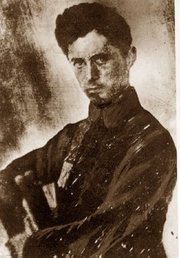 |
|
Sándor Petőfi
(January 1, 1823 – July 31, 1849) |
Ed. — Petőfi joined Polish revolutionary general
Bem's Transsylvanian army. That army fought a successful campaign against
Habsburg troops, Romanian and Transsylvanian German militias, but was
defeated repeatedly when the Russians intervened to aid the Austrians.
He was seen last time in the battle of Segesvár (Sighişoara), July 31, 1849.
The circumstances of his death are mysterious and debated. Mainstream
opinion is that he died in the battle, but some believe he was captured and
brought to Russia where he was killed, or died naturally. After the
Revolution was crushed, Petőfi's memory again began to shine, his poems were
popular, and his rebelliousness served as role model for Hungarian
revolutionaries and would-be revolutionaries of every political colour ever
since.
Today hundreds of streets are named after him throughout
Hungary (perhaps one in every village), beside a national radio station and
a bridge in Budapest.
The first complete edition of Petofi's poems appeared in
1874. The best critical edition is that of Haras, 1894. There are numerous
indifferent German translations.
Source: http://en.wikipedia.org/ |
|



