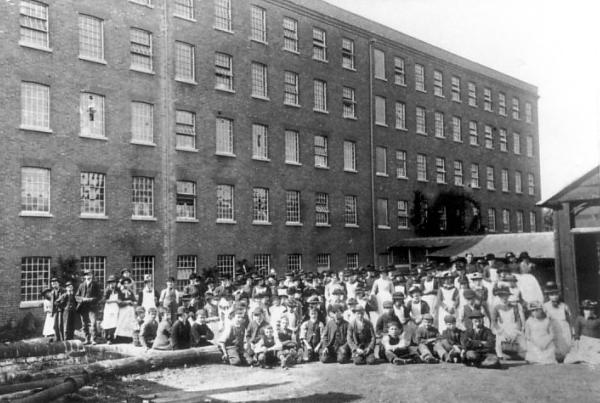
|
Although this would cause much distress to those who relied
on the mill for their sole employment, the fire was regarded as
a saviour from weary toil by many children and adolescents who
worked there as operatives. Indeed, at another fire at the
mill in January 1842, it was reported that it was:
Very discouraging ... to see the poorer class of persons of
Tring standing by and viewing the progress of the enemy with
apparent satisfaction ... which was scarcely to be wondered at
when the system was known to be productive of the subversion and
destruction of all that is moral and useful in the female part
of the labourers therein ... labour is so inadequately paid for
that young women from 16 to 20 years old do not obtain for a
long day's work more than from 4d to 6d per day.[2]
This did not please David Evans, the owner, who wrote at once
to reply that young women who understood the trade could and did
earn from 5s to 7s 6d per week. He added, sharply, that it
would be admitted by those most conversant with the estate of
Tring itself that its morals were better now than they were
before the establishment of the mills.[3]
A few local residents supported his remark, commenting that,
whatever might be the individual opinions as to the working of
the factory system in general, it would not be easy to find a
factory in the country that was not better run, or where the
employees were altogether more satisfied.[4]
The 'progress of the enemy' at the first conflagration was
viewed with special delight by the child operatives.
Ragged and shivering in the cold and sleet, they watched as the
destruction of their hated workplace promised a release from the
deafening noise of machinery, the heat, and the all pervasive
smell of oil. At that exciting time there was no immediate
thought given to the effect the loss of their meagre wages would
have on their families.
Ten years before this, on the 19 December 1826, William
Massey was married to Mary Rooker, in the Church of St Peter and
St Paul, Tring.[5] Tring was then a
small country market town having a population of some three
thousand, with mechanical industry limited to silk throwing,
brewing, and flour milling. William was an illiterate
labourer and boatman, relying constantly for his sometimes
uncertain periods of work on the wharfingers and Tring Wharf
flour mill, situated by the side of the Wendover Arm of the
Grand Junction Canal. Mary had a determined nature, a more
refined mind, and could even read and write a little, to a low
average attained then by most of the poor. The home they
set up together on Gamnel Wharf was rented from William's
employers, probably William Grover & Sons, Millers and
Wharfingers, for a shilling per week.
For this money they were given a
flint cottage in a row of four flint cottages and four houses,
that included good gardens. Their cottage was next
to a house rented by Elizabeth ('Mam') Rowe that was used also
as a small dame school. [5a] Having
paid the rent, nine shillings remained from William's weekly
wage to provide a minimum subsistence. This was tolerable
until the family started to increase, and William's idea of
bliss was to indulge in the occasional gallon of beer.
Thomas Gerald was their first child, born on Thursday, 29 May
1828, and was followed by Edwin, Frederick and Henry at
approximately three yearly intervals. Because of his
parents' increasing responsibilities and living costs Gerald was
sent when he was eight, in common with many other local
youngsters of a similar age, to wage earn as a throwster at the
silk mill. Filament silk was prepared for weaving by
'throwing' or twisting the thread in varying degrees to the left
or right. Each twist was called a turn, with more turns
per inch tightening the thread. The four main stages in
throwing were winding, doubling two or more threads, twisting to
increase the number of turns, and skeining. The skeins
were then soaked to make them more pliable, dried, and reeled on
to bobbins. Tram, organzine and crepe were the most used
types of thrown yarns.
By Act of Parliament in 1833 the employment of children less
than nine years old was prohibited, and from nine to thirteen
years restricted to forty—eight hours per week. Although
civil registration of births and deaths became operative from
1837, it was not until 1875 and a fine of £2 for
non—registration that this could be enforced. Until then
many parents had of necessity to lie about the ages of their
children. Gerald therefore was up at five in the morning
for six days a week, reminded by the mill bell at half—past—five
in case he had overslept, returning home at six—thirty in the
evening. Half—an—hour was allowed for dinner, that the
operatives brought with them from home, and two short breaks
permitted for 'drinking time'. For his first week's work,
Gerald received 9d, or 4p in today's coin, but in attempting to
increase his wages by the easier method of pitch—and—toss, he
lost it all before he arrived home that day. In recounting
the incident to a reporter many years later, he admitted to
having been an inveterate gambler in his young days, but did not
record any comments that his parents must have made.[6]
|
Pleasantly rings the Chime that calls to
Bridal—hall or Kirk;
But Hell might gloatingly pull for the peal that
wakes the babes
to work!
'Come, little Children,' the Mill—bell rings and
drowsily they run,
Little old Men and Women, and human worms who have
spun
The Life of Infancy into silk; and fed, Child,
Mother and Wife,
The Factory's smoke of torment, with the fuel of
human life.
O weird white face, and weary bones, and whether
they hurry
or crawl,
You know them all by the Factory—stamp, they wear it
one and all.
(Massey) |
A short account of work in Tring silk mill in 1858
experienced by an eight year old girl, confirms the bell's
imperious call of 'Come to the mill' at half—past—five.
But at that time, being under the age of eleven, she had only to
work half days; during the remainder of those days she was
supposed to be attending school. After the age of eleven
she was of necessity working a twelve—hour day for wages of 2s
6d per week.[7]
Compared with Gerald's counterparts in the heavily
industrialised areas of Britain, the workers at Tring mill were
well treated. From contemporary accounts by workers and
from official reports of the time, many factory operatives,
particularly in the Midlands, were subjected to degradation,
brutality and grossly excessive hours. The Sadler
Committee, appointed to collect first hand evidence on
conditions in factories, discovered extraordinary cases of such
maltreatment combined with social privation. A tailor's
three daughters aged 12, 11 and 6 years worked in a worsted mill
near Leeds. During the busy time, six weeks in the year,
they were at the mill from 3 a.m. until 10 p.m. with a quarter
of an hour for breakfast, half an hour for dinner, and a quarter
of an hour for 'drinking'.[8] Overseers
with a cruel disposition would make the children's life a
misery, beating and flogging them for the slightest inattention
to their work. One young girl of nine was beaten for going
to the toilet.[9] It was not until 1847
that legislation was able to be enforced, albeit slowly, to end
the exploitation of child labour.
Mary tried her best, despite the family's poverty, to
inculcate the decencies in her children. Being religiously
Calvinistic, Sunday School was an essential part of their
upbringing. Devotional pamphlets were brought to homes by
local preachers, and old copies of the Bible, the
Pilgrim's Progress and the religious Penny Post were
distributed. Gerald was sent first to a 'penny school'
that may have been held in the Baptist Chapel, New Mill (known
as the New Mill Sabbath School in 1833), located near the wharf,
and later to the National School in the town. Although he
learned to read well, he achieved little else. In common
with most youngsters he was made to memorise chapters of the
Bible; he also assumed as true the allegories of John Bunyan,
and accepted as fact the statements set out in Wesleyan tracts.
At that early age he showed an appreciation for music and had a
good singing voice. His parents were proud to take him to
chapel to show his ability in the choir, although to be seen and
heard properly, being of short stature, he was made to stand on
the pew.[10]
While the silk mill was being repaired following the fire, it
was necessary that Gerald's earning power that had reached 1s 3d
per week, be redirected. Next to silk manufacturing, the
main occupation in Tring was straw plaiting. This also was
a children's employment, taught often to those as young as three
years. By early school age, youngsters who could not plait
the minimum three straws were regarded as being very dense.
Parents commonly taught plaiting at home, or the children were
sent to plaiting schools, that were sometimes no more than a
large cottage room. A good, usually adult worker could
make thirty yards of plait a day, although it took about twelve
hours work each day to earn between three and four shillings a
week. The plait was then sold to local dealers to be made
up into hats, bonnets, or dress ornamentation.[11]
Gerald found this new labour to be equally as oppressive and
financially unrewarding as silk throwing. During the few
years he worked at plaiting, he suffered several attacks of
fever, which was common to the inhabitants of that low—lying
area. At one time the whole family lay prostrate, too weak
even to obtain a drink or get help from neighbours. When
William was out of work, the family income could be as low as 5s
9d per week, the cost of one course of a meal on a rich man's
table.[12]
Those harsh conditions which were testified in press and
official reports between the 1830s and 1850s, gave many literate
working men the impetus to make an initial step towards active
social radicalism. Of his own environment, Massey
commented:
Having had to earn my own dear bread by the cheapening of
flesh and blood thus early, I never knew what childhood was.
I had no childhood. Ever since I can remember, I have had
the aching fear of want, throbbing in heart and brow. The
currents of my life were early poisoned ... I look back now in
wonder, not that so few escape, but that any escape at all ...
so blighting are the influences which surround thousands in
early life, to which I can bear such bitter testimony.[13]
By 1841 the family had moved temporarily to Fleet Street,
West End, off the present day Chapel Street, near the centre of
Tring. Their wharf home may by then have become
uninhabitable. After three years working at straw
plaiting, Gerald obtained a domestic post at a local boarding
school in Market Street.[14] But he had
not worked there long before he was sacked because, as he
recounted later, the girls used to hug and kiss him![15]
It was about that time, approaching the age of fifteen, when
he realised that none of his strongly progressive but yet
ill—defined hopes would be achieved by staying in Tring.
Being uneducated, he had no prospect of obtaining employment
other than returning to the silk mill, or continuing in inferior
and uncertain positions. Hence, during late 1843 or early
1844 he decided to chance his fortune in London.
|
O mighty mystery London, there be Children still,
who hold
Her Palaces are silver—roofed, her pavements are of
gold;
And blindly in that dark of fate, they grope for the
golden prize
For somewhere hidden in her heart the charmèd
treasure lies.
(Massey) |
It was in 1843, when he was depressed and probably thinking
about leaving for London, that he said his first poem on 'Hope'
had been accepted by the Aylesbury News.[16]
Provincial papers received poems submitted by local writers and
published them either with signature, or anonymously.
These were included with poems by better known names such as
Ebenezer Elliott and Eliza
Cook that often indicated the political stance of the paper.
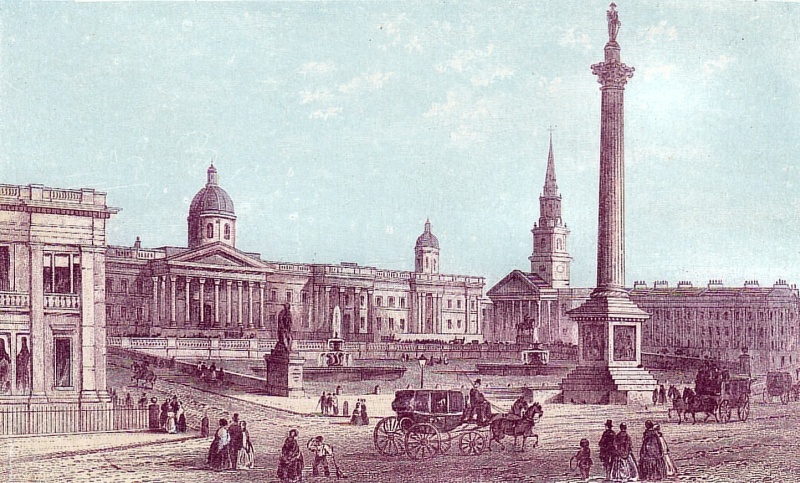
The Nelson Column, c. 1860 (Print by
T. Nelson & Sons.)
|
 |
|
Cloth
Fair , near the Barbican. |
If he had saved his wages for a few weeks
Massey could have made his move to London probably by one of
several horse coach services that passed through or commenced at
Tring. On entering London via the Edgware Road, these
travelled along Oxford Street, 'the road to Oxford', and on to
one of the several coaching inn termini in the City area.
'The Old Bell', Warwick Lane, 'Clemet's Inn', Old Bailey, and
the 'King's Arms', Holborn Bridge were used on the Tring run.
Alternatively, and more likely, he could have secured a lift on
a Carrier's cart, travelling along the same route. From
old prints of the period, the London streets were as busy then
as they are today. Pedestrians had to be agile when
crossing main roads to avoid being knocked down by one of many
horse carriages and carts. Hawkers, street vendors,
crossing sweepers and prostitutes were continually occupied.
Years of division between rich and poor was immediately
noticeable, and formed one of the long—standing basic causes of
radical discontent. Oxford Street, although shabby,
separated the more wealthy class to the north from the slums of
St Giles and Spitalfields to the south and east. Trafalgar
Square, a haven for vagrants, was soon to have its Nelson
Column, to be followed later by the lions. Smart Regent
Street was proud of its covered colonnade, though the
shopkeepers had to keep an eye open for thieves and pickpockets
for whom it was a profitable attraction. Away from the
more select areas, the pervasive evidence of inadequate sewerage
systems was made clear to all, particularly in the densely
populated labouring districts. A civil engineer,
commenting on the parish of St Giles, referred to houses whose
yards were covered with sewage from the overflowing of privies.
In Westminster, cellars were flooded by sewage water.[17]
Before the construction of New Oxford Street and Endall Street,
the area around St Giles known as the 'Rookery' was one mass of
garbage and stagnant gutters, bordered closely by dilapidated
and overcrowded dwellings.[18]
|
 |
|
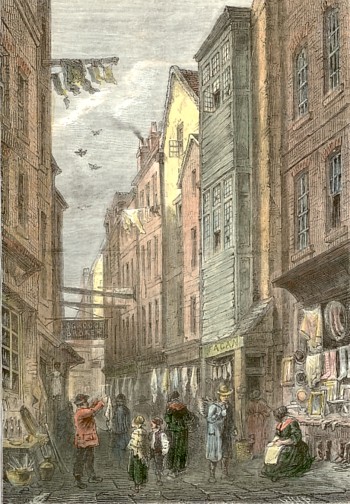
Field Lane, c. 1840. (Old and New
London) This (now part of Shoe Lane) ran
from Holborn to Saffron Hill, and was an area
favoured by thieves for the sale of their stolen
goods, particularly handkerchiefs. Some of
these can be seen in the picture, hanging outside
shop windows. Charles Dickens had recorded the
street in his Oliver Twist (1837). |
|
 |
|
Near
Field Lane c. 1844
Houses with the open part of the Fleet Ditch before
rebuilding
(Print: D. Bogue, Fleet Street) |
|
 |
|
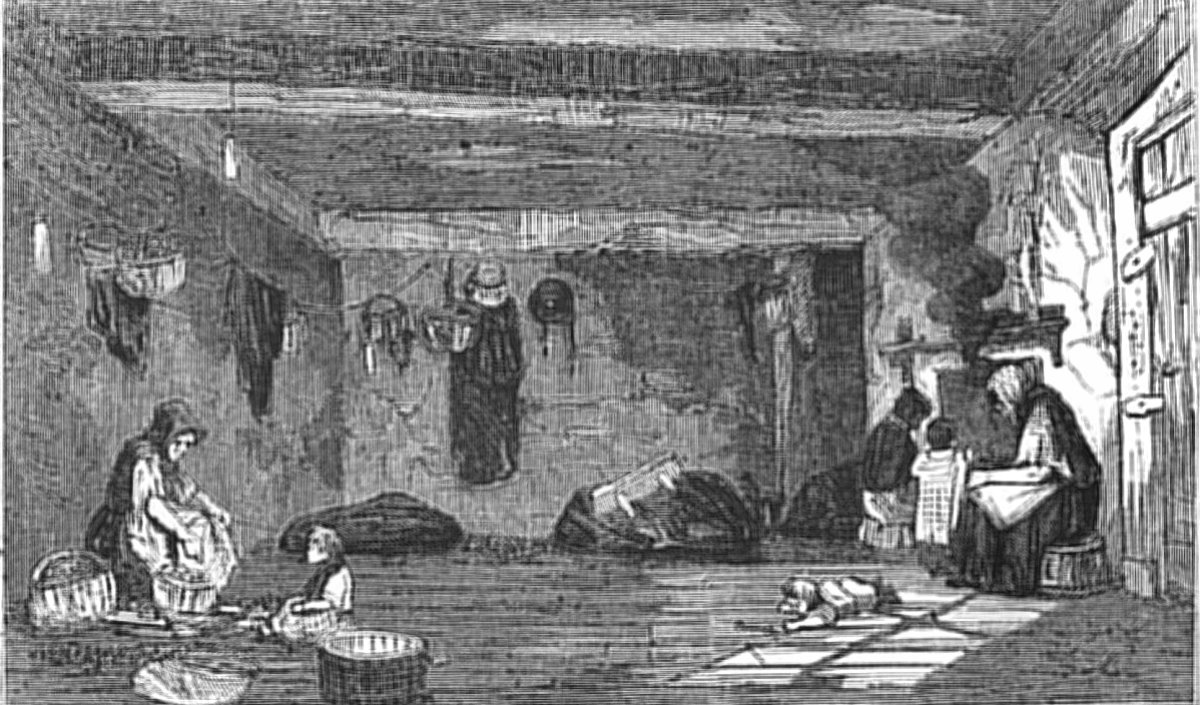
A Clerkenwell interior.
(London Shadows, 1854) |
The cause of cholera outbreaks had not then been medically
determined. Some thought it was connected in some way to
vapours emanating from those areas, and a doctor considered
that:
". . . . It is strictly an epidemic . . . prevailing most in
those localities of a town where the drainage is most defective,
and where, at the same time, the population is most destitute
... it is not infectious, nor admitting of being controlled by
any of the means that are reputed to exercise a power over
infectious diseases . . ."[19]
Similar to St Giles were the areas 'Jacob's Island', in
Bermondsey, and Saffron Hill, between Leather Lane and
Farringdon Road. These were also brought to life in
Dickens' Oliver Twist, and the original film of that
name. Jacob's Island was described by Dickens in the 1830s
as being full of 'Crazy wooden galleries ... with holes from
whence to look on the slime beneath ... rooms so small, so
filthy, so confined, that the air would seem too tainted even
for the dirt and squalor which they shelter'.
Clerkenwell's water supply was thought to contain water draining
from Highgate cemetery and other burial grounds and cess pits in
the area. In an account of two cholera cases:
...it was afterwards found that the cellar of the house in
which the patient resided had been burst into by a cesspool;
whilst in the other, a fine, stout, healthy man, lived at the
back of a graveyard, the mouldering remains of the dead were
level with the window—sill in the parlour in which he was
constantly living . . .[20]
Even the Thames was so fouled that the stench on one hot
summer's day forced the adjournment of the House of Commons.
Poverty, squalor and cruelty; each was co—existent on the other.
The cruelty was apparent in the markets, especially Smithfield,
and in Spitalfields, the home of the silk weavers. They
were noted bird catchers and suppliers of singing birds, which
they often blinded with hot wires, as it was considered to make
them sing better. In his later years, Massey wrote a poem
for his granddaughter, after telling her of that cruel custom:
|
Listen, my little one, it is the lark,
Captured and blinded, singing in the dark.
His nest—mate and his younglings are all dead:
Their feathers flutter on some foolish head.
Of some lost Paradise, poor bird, he sings
Which for a moment back his vision brings: ...
He sings his fervid life out day by day;
Imprisoned in an area underground ...
As if with floods of music he would drown
The dire, discordant roar of London Town.[21] |
Massey's previous connection with the manufacturing of yarn
may have helped him to obtain his first post as a draper's
errand boy. Because of a rise in the amount of
manufactured cotton at that time, retail outlets had increased,
giving rise to greater competition between these shops.
Drapers, tailors and haberdashers in the main thoroughfares had
therefore to be smart in appearance. Many of the shop
assistants, sharing a cramped and often unsanitary room over the
premises, were up early in the morning, cleaning, polishing and
arranging displays. Gas lighting flared brilliantly
through plate glass windows, displaying carefully arranged bolts
of cloth, yarn and made up materials. Brass fittings on
the counters shone to perfection. Errand boys, in whatever
type of shop they were employed, were kept very busy, often
working a fourteen—hour day. The majority of customers
required their goods to be delivered, some to quite a distance,
and within that same day. The errand boy had therefore to
carry a large number of parcels to varying addresses, which
could cover a wide area. He then returned to the shop for
further deliveries, or to clean until further items were ready.[22]
As Massey's arrival point in London was near to High Holborn,
which had a number of woollen and other drapery shops, it is
possible that this was the area in which he found his first of
several jobs. He made no mention of the name of the shop,
although he indicated that it was not small, having several
staff and a supervisor. In spite of the long hours, that
was the opportunity for which he had been longing for several
years. 'Now I began to think that the crown of all desire,
and the sum of all existence, was to read and get knowledge.
Read, read, read! I used to read at all possible times,
and in all possible places; up in bed till two or three in the
morning — nothing daunted by once setting the bed on fire.'[23]
Being continually short of money, he used to read from books in
the numerous street bookstalls, probably even using his
employer's time while travelling on errands. When he was
out of work, he often went without a meal to purchase a book,
and self—education became a constant obsession. English,
Roman and Greek history, French tuition books and the
instructive Lloyds' Penny Times built on the foundation
of his earlier meagre schooling. Everyday encounters with
people, and observations of the stratified social setting
initiated critical reasoning concerning fundamental social
anomalies. In particular, the oppressive injustice between
the position of master and servant that he viewed and endured,
focused and sharpened his investigations to that area. In
common with most forthcoming young radicals of the time, he
found the causes of iniquity, political, social and religious,
defined in the writings of Thomas Paine, William Howitt, and the
French Republicans Constantin de Volney and Louis Blanc.
Publication of Paine's
Rights of Man and Richard Carlile's The Age of Reason
in the early 1800s had resulted in Carlile's imprisonment for
sedition and blasphemy. The Chartist leaders used Paine's
works as a theory of reference in the formulation of their
principles. Volney's Ruins: or a Survey of the
Revolutions of Empires, and New Researches into Ancient
History, stressed Republican ideas and Biblical questioning,
as did Howitt's
A Popular History of Priestcraft. Louis Blanc
emphasised the division between capital and labour in The
Organisation of Labour in and his periodical the Monthly
Review, in the late 1840s. Those and similar works
were read by working class radicals against a background of
social privation, injustice and unrest. Under those
circumstances it is understandable that the political system
that caused such inequality should result in a powerful call for
democratic reform. Thomas Carlyle had written, 'Chartism
is one of the most natural phenomena in England,' and this
statement remained evident until the early 1850s and the
movement's rapid decline.
Massey entered a turbulent political scene
dominated by Sir Robert Peel's Conservatives who were facing
trade recession, the Anti—Corn Law League, and
Chartism. There were two main causes of unrest at that
time. First was the outcome of the Reform Act of 1832.
Although this allowed more people to vote, it introduced minimum
property and rental restrictions, thus effectively disqualifying
many working men who were previously entitled to vote. The
second was the Poor Law Reform Act of 1834 that increased the
number of workhouses to end the cost of parish relief given to
needy individuals. It was hoped that policy would make the
poor more thrifty, and encourage them to seek work in industry.
But the segregation of men, women and children, together with
strict discipline in harsh conditions caused much opposition.
This was particularly evident in the early 1800s when young
workhouse inmates were transported from cities as 'apprentices'
to even worse conditions as cheap labour in country factories.[24]
The Anti—Corn Law League was founded in 1839 from the
Association's Manchester headquarters. The Corn Laws of
1815 had prohibited the import of wheat until the home price
reached 80s per quarter. Despite a sliding scale
introduced by the government in 1828, the League blamed the laws
for raising the price of food.
The Chartist movement with which Massey came
into particular contact was a force that had a long history due
to social unrest. Its roots lay in the radical London
Corresponding Society, founded in 1791 for working men, and
gathered strength through successive organisations, the most
powerful of which was the London Working Men's Association.
This organisation was founded in 1836 by William Lovett who,
with John Roebuck MP, was responsible for drafting the 'People's
Charter' published in 1838, giving recognition to the term
'Chartist'. The Charter consisted of a programme of
political reform that had six main points: a vote for every man
over twenty—one; vote by ballot; no property qualifications for
MPs; equal electoral districts; payment of members of Parliament
and annual election of Parliament. By these points it was
hoped that power would be given to the working classes that had
been denied to them by the Reform Act.
During his first years in London, Massey had
not forgotten the success of having his first poem printed
which, he said, had been due to him falling in youthful love.
Prior to that he never had any fondness for poetry, and skipped
over verse when he came across it in books. From that
first experience his emotions developed with particular
sensitivity to form and colour; he delighted in the countryside
with its flowers and wildlife; was entranced by golden tints of
sunlight shimmering through the trees. The contrasting
streets of London induced feelings of nostalgia for the
countryside he had left and, to compensate, between work and
study he found time to compose more poems that he compiled and
published by subscription in Tring. The private printing
by Garlick of Tring in 1847 of Original Poems and Chansons
by Thomas Massey was priced at one shilling and, surprisingly,
was reported to have sold 250 copies locally, but no copy has
been traced (Appendix A).
The title was suggested to him by the French Republican, Pierre
de Béranger, who had been imprisoned twice for his political
verse. His Chansons de P. J. Béranger was published in
English in 1837.
After some time served as an errand boy in
various shops, Massey was promoted to attend behind a shop
counter that brought him into closer contact with a particularly
arrogant and strongly disliked supervisor. Having a lively
sense of humour, Massey could not help making jokes to the other
staff, impersonating this person's self—importance.
Unfortunately, following a particularly pungent jest, this came
to the ears of the supervisor who immediately bundled an
unrepentant Massey, together with his belongings, into the
street. The shop may have been Swan & Edgar, the large
draper's store that was sited at the corner of Regent Street and
Piccadilly.[25]
London in the 1840s was a centre for
meetings, lectures and oratory, particularly in the broad sphere
covered by the term 'radicalism'. There were protests
against the Corn Laws, support for Robert Owen's socialism with
its anti—Christian overtones, and publicity for advocates of
temperance. Of greatest importance were the Chartist
meetings. These were held in local halls, such as the
National Hall, High Holborn. The Metropolitan Delegate Council
of the National Charter Association met weekly at the City
Chartists' Hall in the Barbican, and smaller meetings were held
in coffee houses. The Charter Coffee House, High Holborn,
Denny's Coffee House, Seven Dials, and the London Coffee House,
Ludgate Hill, were popular. The Arundel Coffee House in
the Strand was hired by the Chartist National Convention.[26]
Educational and political lectures were held at the Hall of
Science, 58 City Road, which moved, following termination of
lease in 1866, to 142 Old Street, and became the headquarters of
the National Secular Society. The equally prestigious
Social, Literary and Scientific Institution, at 23 John Street,
Fitzroy Square, was used also by many radicals. This
building had opened as such in 1840 — thought originally, and
from an engraving, to have been a chapel — and was replaced a
short distance away by the Cleveland Street Hall in 1861.
Many of the Chartist leaders lectured in these and similar halls
in the suburbs, particularly Feargus O'Connor, editor of the
Northern Star, and Thomas Cooper, following his two years'
imprisonment for sedition in 1843. From reading Massey's
earliest works, it is obvious that
he attended many of those meetings and lectures, which
influenced the idiom of his written and oral styles. The
radical press had an equally great effect on him, particularly
the Northern Star that had the young, ultra—radical
George Julian Harney as sub—editor.
It was the year of 1848 and the final stand of Chartism that
had the most profound effect on Massey, and which was to
determine the direction of his life for the following five
years. The repeal of the Corn laws the previous year had
diverted more attention to Chartism. Increasing
unemployment gained it more supporters, as did the general
election when O'Connor was elected for Nottingham and Harney
opposed Palmerston for Tiverton. In February it was heard
that King Louis Philippe of France had been deposed, and that
France had become a republic. Two national petitions for
the Charter had been made previously to Parliament, in 1839 and
1842, but without success. With events now appearing to
favour workers' rights, the Chartists hurriedly organised a
third, and plans were made for a national convention to meet in
April, and present the petition to Parliament. Protests by
the Trades' Meeting against unemployment, and by G. W. M.
Reynolds, a later Chartist leader, against income tax added even
more to working class unrest. Simultaneously there was an
increase of violence in several northern cities, with sporadic
outbreaks in London sufficient to cause extended police activity
and governmental concern. Queen Victoria was advised to
stay at the Isle of Wight until stability had been restored.
The meeting, during which the petition would be presented, was
held on the 10 April at Kennington Common, near the site of the
present Oval cricket ground, and was attended by about 100,000
people. Massey was present, and was nearly run down by the
police. Despite the failure of the petition, he said later
that it had a greater effect on him than anything previous in
his life. 'It scarred and blood—burnt into the very core
of my being.'[27] For his support of
the Chartists at that meeting, he was again sacked from his job.
There is no record when Massey became a member of the National
Charter Association, which was formed in 1840, but due to his
involvement in Chartist interests it probably dated to around
1848 or 1849 when he was twenty. Lecturers of radical
organisations travelled widely throughout the provinces, and
Massey undoubtedly met with a number of these speakers in
informal discussions when the merits of particular groups and
radical centres of activity were compared. Consequently,
he moved to Uxbridge where John Bedford Leno, a printer and
later branch secretary of the local Chartists, together with
some other local helpers had in 1845, started a Young Men's
Improvement Society. In 1846, then aged twenty, Leno was
promoter and joint editor of a manuscript newspaper the
Attempt, of which seven issues were produced up to 1849.
Massey immediately joined the Society, which had then a
membership of a hundred, and gave it considerable support.
Books and newspapers were bought from members' weekly
subscriptions, and gifts of reading matter readily accepted.
Massey donated seven books for their library, and wrote one
rigidly structured article for the Attempt. 'Shelley
and his Poetry', although unsigned, can be recognised by his
early, more copybook style handwriting.
Early in 1849 the Society decided to start a monthly printed
journal of literature and general information, the Uxbridge
Pioneer, to open 'a medium of communication between the
learned and ignorant' for the benefit of the working classes.
Massey, Leno and some other elected members of the Society were
appointed as editors, and the first issue, price 3d, was
published in February. A substantial amount of the
material was written by Massey, who signed himself as 'T.G.M.'
or 'Gerald', and some unsigned items can be identified also as
by him. 'A Few Words
on Poetry' shows lack of depth and maturity, but has a
colourful, metaphorical style. It is possible that he
regarded poetry as a form of escapism at that time when he wrote
that 'Poets seek a world of thought to live in, because the
world of reality is harsh and cold.' 'A
Romaunt of Ancient Woxbrigge' has a particularly jocular
form. A rich patriarch was extremely jealous of attention
given to his two daughters who, despite his care, became
pregnant. Intending to obtain his revenge on the man
responsible, he pretended to go away on a journey, but hid near
the house until evening. On noticing a length of knotted
scarves coming from his daughters' bedroom window, he held on to
the end, and found himself pulled rapidly upwards. The
daughters, in shock at meeting this unexpected face, released
the scarves, which resulted in the demise of their tyrannical
father. In 'May
Dawson' Massey wrote on the perils of London prostitution.
That was probably a mainly fictional item, taking the form of a
personal encounter in London with a young Tring girl who had
been seduced, and who later committed suicide. An unsigned
editorial 'To Our Readers'
has Massey's style, and contains some lines from later published
poems.

Uxbridge High Street.
Shortly after publication, political differences alienated
the more radical Massey and Leno from the other editors. A
letter received, and published in the second issue, mentioned
'T.G.M.' in particular, and referred quite obviously to his
'Woxbrigge' and 'May Dawson' articles:
I will not quote the passages from the Pioneer, which to my
mind are highly objectionable ... I find they occur in papers
bearing the same initials; and I cannot but regret that the
alternate blush of the reader should suffuse his cheek, the
moment after his mind has been charmed with the germs of
elegance and vigour which characterize the style of their author
... a little more moral precision, and he will 'write to
profit'. I trust ... a second number ... may be with
safety and profit placed in the hands of the younger members of
our families.[28]
Massey and Leno, together with colleagues Edward Farrah and
George Redrup became increasingly opposed to the policies
advocated by other active members of the Society.
Accordingly they decided to commence in April a paper to counter
the Pioneer. With the assistance of some political
sympathisers they raised fifteen shillings with the promise of
one shilling per month from each, to finance continuing issues.
A thousand copies of the first issue of the Uxbridge Spirit
of Freedom and Working Man's Vindicator conducted by Working Men,
price one penny, was offered for sale on Thursday market day.[29]
To promote their paper with the minimum of cost, some
pretentious publicity was devised by Massey for the occasion.
Having obtained an imitation uniform of the republican Paris
civil corps, he persuaded Leno's brother to dress in this
uniform, march around the town, and help to sell the paper.
This proved to be sound advertising, and the paper's many
treasonable contents were certainly noted by its readers.
There was a predictable mixture of agreement from the workers,
dissent from the more affluent Tory townspeople and condemnation
from the vicar's pulpit (in the name of God) the following
Sunday.[30] In their introductory
editorial Massey and Leno had stated clearly their intent to
'Call a man a man, and a spade a spade'. An ironmonger
responded by placing a shovel outside his door with 'This is a
spade' written on it, and a baker changed the title of the paper
to the 'Spirit of Mischief: or Working Man's Window Breaker.'
That publicity ensured the sale of 900 copies, sufficient for
the young#editors to judge the venture a moderate success. After
seven issues Massey reported that the sales had doubled.[31]

The Uxbridge Spirit of Freedom
(Columbia University Library, Seligman Collection)
The majority of radical papers published notices of similar
publications, and it was the Northern Star that gave the
most comprehensive reviews of the Uxbridge Spirit of Freedom
throughout its nine monthly issues.
The following review of the first edition of the Uxbridge
Spirit of Freedom appeared in the Northern Star, 4th
April 1849:
"Uxbridge Spirit of Freedom, and Working Men's Vindicator.
Conducted by Working Men. No. 1. April.
Published by J. Redrup, Uxbridge, Middlesex. London: J.
Watson Queen’s Head—passage, Paternoster Row.
A NEW monthly publication, of thoroughly democratic character
conducted by Working Men. We shall let our friends speak
for themselves :—
We shall be accused of class—feeling, and party
spirit; well, be it so. We would fain clasp the whole
world in the arms of love: but ye will not, ye who spit upon us
and flout us with being the “swinish multitude.” What can
be the nature of that union where the subjection of the one
party is maintained by the force of the other? This is
treason to the sovereignty of the people, and treason to God, by
destroying that moral beauty of unity which the creator intended
for mankind. We are slaves socially and helots
politically: and if to work out our own redemption be called
“party feeling,” we accept it. We call upon true democrats
of all ranks to support us: but especially on the working class:
we invite them to contribute to our pages, for we want the
sledge hammer strokes which working—men who do think can give,
and, if we cannot reach the head of the present system of
things, why we’ll let drive at the feet! Keep at work, and
the mighty Triune which crushes us now, shall, ere long, make
way for an educated and enfranchised people, who shall yet make
Old England a land worth living and worth dying for.
Such a publication appearing in Manchester or Leeds would be
nothing wonderful: but we must say we are agreeably surprised to
find a small town like Uxbridge containing men who not only dare
think for themselves, but who also, are determined to give their
free thoughts utterance, with the view of hastening the
political and social emancipation of their order. Such men
claim our respect and good wishes: and most earnestly we wish
them success. The whole of the article in the number are
well written: their titles are significant – “The Labour
Question”, “Letter of a Labourer,” “Emigration and the
Aristocracy,” “Where is Religion to be found?” &c., &c. We
must make another extract from this boldly—written “Vindicator”
of the rights of the proletarians:–
We have to play a grand part in the history of
the future. Our gallant brothers of Paris, Vienna and
Berlin, must not bleed on the barricades for Labour’s rights in
vain. The problem will again and again force itself on the
world, and, if our rulers dare not grapple with it, we must do
the work ourselves. Working men, we must understand each
other – let us learn what wrongs have been perpetrated, for that
is the first step towards redress. We must, ourselves,
assert our rights or we shall never win them. We have been
listeners in the political arena – now let us mount the
platform.
The Schoolmaster is abroad. Let the enemies of Justice
look to it. Work on ye 'MEN OF THE FUTURE' .
The local Bucks Advertiser, commenting later on the
paper, referred to it as juvenile but daring, adding that 'We
take the liberty of suggesting that a good deal of what they
write does not look as if it came from men of temperance and
peace. The principles are sound and true, but we don't
think it worth while to commit sedition in order to expound
them. . . '[32]
The Northern Star, reviewing the second issue, noted
an increase of four pages, and favoured Massey's 'first—rate
poetry.' It gave also, in issues through to December, the
titles of a number of articles in each issue. These
indicated strongly the paper's political stance: 'To the Thieves
and Robbers of both Houses of Parliament', 'The Poor and the
Rich', 'Why has the cause of the People not triumphed?' and
'What have the Clergy been doing?' The Northern Star
emphasised these and other progressively heretical titles by
quoting part of an article by John Rymill of Nottingham, who had
pronounced scathingly:
Is it not monstrous that an age which permits a handful of
antiquated lords to eat up the soil, and a swarm of red and
black coated thieves to swallow up the taxes; an age in which
England's true nobility have to starve in the midst of plenty,
in order that certain useless things called lords, dukes,
esquires, and reverends, may be fed on dainties, and be clothed
in crimson; an age in which poor paupers are worse clad, and
more scantily fed than criminals . . . is it not monstrous,
I say, that such an age should be sanctified with the name of
civilization![33]
The majority of Chartists held those opinions of the clergy,
nobility and royalty. The established church, politically
conservative and against any further extension of the suffrage,
had an annual income of some nine million pounds, which was
termed 'pious robbery' by the Chartists. Bishops and other
leading church ministers had Tory connections that indicated
that they worked solely for money, while the working clergy had
little interest in working class social conditions.[34]
Nobility and royalty were condemned for living in idle
dissipation, while the working classes starved. The
Court Journal recorded detailed descriptions of grand state
balls and banquets held in Buckingham Palace, in some depth:
The range of tables displayed a gorgeous assemblage of gold
plate ... massive centre pieces, candelabra, vases, wine coolers
... flowering plants in golden vases... On the buffet
surrounding the centre shield were ranged vases, cups, chalices,
tankards, and salvers in profusion, some of them glittering with
precious stones, others enriched with exquisite carvings ...
A bill of fare in French, included turbot, turtle, prawns,
fillets of sole, peacock, pigeons in aspic, smoked salmon,
braised beef, ham, haunches of venison and other luxuries. In a
bitter but well meant contrast, the chef of the Reform Club
suggested improvements for the soup that was provided for the
inmates in charitable institutions. This could be made in
thousand gallon quantities, distributed to the poor once or
twice a day, and cost no more than two or three farthings a
quart.[35] These and similar items were
reported over the years with scorn and condemnation by the
Chartist press, and noted with resentment by readers. G.
W. M. Reynolds commented on the building in Hyde Park that had
been put up in preparation for the 1851 Great Exhibition.
He had reason to refer to an 1844 file of the Weekly Dispatch
that gave an almost Christian account of the interment in 1840
of Queen Victoria's favourite spaniel, Dash. An expensive
marble monument ordered by Prince Albert had been erected over
its resting place. Reynolds asked what readers thought of
that, when a poor working man's widow reflects upon the pauper
funeral of her husband. The coffin knocked up with a few
thin boards and old nails; the hurried ceremony; the heartless
apathy exhibited by the undertaker who contracts for the parish;
and the turfless grave on the 'poor side' of the churchyard.
He concluded, 'But a foreign Prince, for whom British industry
is taxed to raise him from a state of German pauperism to a
condition of English aristocratic opulence, can do all this with
impunity.'[36] The Uxbridge Spirit
of Freedom received support from W. J. Linton, engraver,
Chartist sympathiser and editor in 1839 of the National: a
Library for the People, and Thomas Cooper was pleased with
the first number he received. Throughout his time at
Uxbridge Massey submitted during twelve months from December
1848, a selection of his more roughly lyrical and less radically
contentious poems to the Bucks Advertiser, some of which
were published also in the
Uxbridge Spirit of Freedom.
Towards the end of 1849 Massey had come into particular
contact with two Chartist lecturers, Walter Cooper, a tailor by
trade, and Thomas Shorter, watch finisher.
Mr. Walter Cooper was born in Aberdeenshire in
1814, being brought up as a Wesleyan Methodist, and was employed
very early as a herd boy. His parents were very poor, and
he stated, "Many a time have we all been ill in bed together,
racked and parched with fever, each crying for water, and each
too weak to help the other; no medical aid was available, and no
friend or neighbour nigh to assist us. Hey, man! I shall
never forget the death of my old grandmother who loved me so
dearly; we had no fire in the house, and I had to nestle close
to her to give her some warmth while she shivered in the cold
clutch of death."
Whilst searching for employment in London in 1834, he got
married. He discovered before long that there was one
religion for the rich and another for the poor; that the same
distinction existed in a chapel as in a court of justice; that a
wide and impassable gulf separated the richly clad idler from
the hard—working labourer clothed in fustian. He found
that he had been religiously duped, deceived and misled.
Discovering the social and political wrongs endured by the
humbler classes, he became an eloquent and ardent debater at the
Sunday gatherings held in Smithfield Market.
A tailor by trade, he was thoroughly experienced in the miseries
attendant upon the slop and sweating system. When a child
was born to him, and he was willing but unable to obtain work,
he had no bed, no bedclothes, no food, and no fire. At the
same time he was toiling long and painfully over a pair of
trousers, for the making of which he was to receive seven—pence.
That caused him to become a stubborn denouncer of tyranny.
At the present time he is engaged in the management of the new
co-operative Association of Working Tailors, recently
established in Castle Street East, Oxford Street, London,
practically, and we trust successfully, illustrating the
principle he has long enunciated on the grand and all—important
question of labour. (Abridged from Reynolds's Political
Instructor, 16 March, 1850.)
In December, Cooper and Shorter informed Massey of a proposal
made by J. M. Ludlow to commence Working Associations that, they
hoped, would end capitalist owners' exploitation. Ludlow,
a lawyer and socialist, had been joint editor for the Rev.
Charles Kingsley's Politics for the People, and was
instrumental in starting meetings with workers in which social
views could be discussed. These received greater impetus
following reports by Henry Mayhew in the Morning Chronicle
of the conditions and poverty of, among others, the journeyman
tailors.[37] Kingsley's pamphlet
Cheap Clothes and Nasty, written under the name of 'Parson
Lot' just after Mayhew's exposure, owed much to Mayhew's report.
On 8 January 1850 at a meeting in London that included F. D.
Maurice, Thomas Hughes and Kingsley, it was decided to appoint
Walter Cooper as manager of their first association, the Working
Tailors' Association. A three-year lease was signed on the
18 January on a spacious building at 34 East Castle Street,
Oxford Street. This property was sited in a line opposite
the Pantheon, the main entrance of which was on the south side
of Oxford Street, next to Poland Street, the main entrance of
which was at 359 Oxford Street. The Pantheon, previously a
theatre, was being used at that time as a bazaar and picture
gallery.
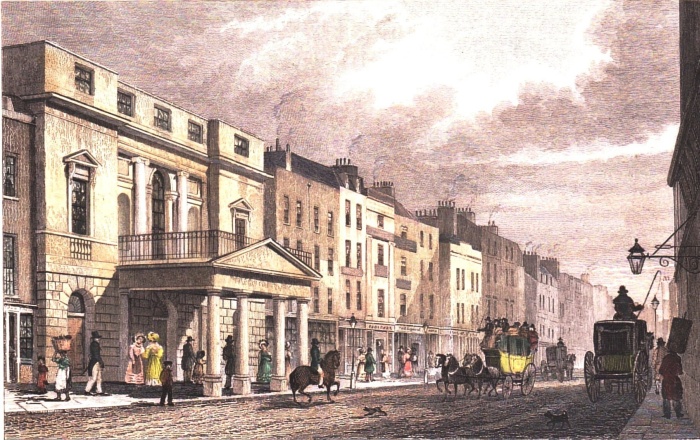
Pantheon, Oxford Street, c. 1830.
Demolished in 1937 for a Marks &
Spencer store.
Walter Cooper then invited Massey to take up the appointment
of secretary. During his editorship at Uxbridge, Massey
had been sacked twice from his job for using a candle late at
night preparing copy for the paper, and three times for the
radical opinions that the paper contained. This no doubt
influenced his decision to accept Cooper's offer and return
again to London where, he expected, there would now be a greater
opportunity for the expression of his radical idealism. |