|
CHAPTER III.
HOW A WINDMILL WORKS
INTRODUCTION
Little change occurred in windmill design from their first use in
Britain until the Industrial Revolution, when a number of
significant advances were made in the design of sails and machinery.
But important though they were, these advances were slow to gain
acceptance and too late to make a significant impact, for by then
James Watt’s condensing steam engine was in the ascendant.
From about the mid-19th century, steam-powered milling began rapidly
to supplant wind and water power. This was followed by the
introduction of industrial-scale flour mills in which steel rollers
replaced grindstones to produce, in greater quantity, finer and more
consistent quality products. Mead’s (later Heygates) Flour
Mill at Tring (Chapter VII) is an
early example of an industrial-scale flour mill.
This chapter describes the general operation of a windmill and some
of the advances in design that were made towards the end of the
windmill era. A brief description of the modern roller mill is
given in the Appendix.
WHAT A WINDMILL DOES

Fig. 3.1:
the fantail (where one is fitted) rotates the cap
automatically to keep the sails facing the wind.
The mill was the first engine invented by man. For centuries,
mills driven by water or wind were the only machines that could
convert the power of nature into useful work. In the case of
the windmill, wind striking its sails exerts a force upon them that
causes the shaft to which the sails are attached to rotate.
What then follows depends on what task the windmill is to perform.
Windmills have been used for many purposes, such as pumping water,
sawing wood and as crushing machines in the preparation of oil,
paper, spices, chalk and pottery. Today, wind turbines are
used increasingly to generate electricity. But in Britain, the
windmill’s most common use over the centuries was to grind grain.
In a grain mill, the wind’s energy, harnessed by the windmill’s
sails, is transferred via a system of shafts, cogs and belts to
drive one or more pairs of millstones. Grain, fed between the
rotating millstones is ground into meal.
The remainder of this chapter describes the main steps in the
windmilling process; also the sails and the machinery that is
usually found within a windmill.
THE FLOORS OF A WINDMILL

Fig. 3.2:
schematic drawing of a tower mill.
Windmills do not follow a common design but they do share common
features, not least of which is that windmilling is a gravity-driven
process. Milling begins at the top of the mill and each
succeeding stage of the process is performed on the next floor down
(in following this process, the need for a mechanically powered
hoist to lift sacks of grain and meal up several floors of a
windmill soon becomes clear!)
Windmills were built with different numbers of floors, [3]
hence, the windmilling process is not always exactly as described
below. However, in general the following applies . . . .
i. The cap, uppermost part of a windmill (fig. 3.1), houses the
windshaft, bearings, cogs and the top of the upright shaft, which
transmits the windshaft’s rotary motion down through the mill to
drive the machinery.
ii. The dust floor (fig.3.2), positioned under the cap, serves to
keep dirt from above from falling into the storage bins and to keep
dust rising up from below.
iii. The bin floor houses bins in which are stored grain for
cleaning; cleaned grain for milling; and meal to be sifted.
iv. The stone floor houses grain-cleaning machinery, the millstones
used to grind the grain, and machinery to sift the ground meal into
various grades of fineness.
v. The meal floor houses chutes from the stone floor above, down
which flows cleaned grain for milling, meal for sifting, and milled
products, each of which is collected in sacks.
THE WIND MILLING PROCESS
The first step in the milling process is to hoist the grain to be
milled up to the bin floor where it is loaded into a storage bin
ready to be cleaned. When required, the uncleaned grain is
discharged down a chute to the stone floor, where it is mechanically
cleaned, then discharged down a chute for collection on the meal
floor.
Sacks of cleaned grain are hoisted up the mill to the bin floor,
where they are stored in a bin ready for milling. When
required, the cleaned grain is discharged down a chute into a hopper
on the stone floor, from where it is trickled into the millstones,
ground and discharged down chutes for collection on the meal floor.
The sacks are then hoisted up the mill to the bin floor, from where
the meal travels downwards, this time through a flour dresser, which
sorts and distributes it according to its fineness, white flour
being the finest and bran the coarsest. All this machinery is
powered by the thrust of the wind as harnessed by the windmill’s
sails.
THE SAILS
|
 |
|
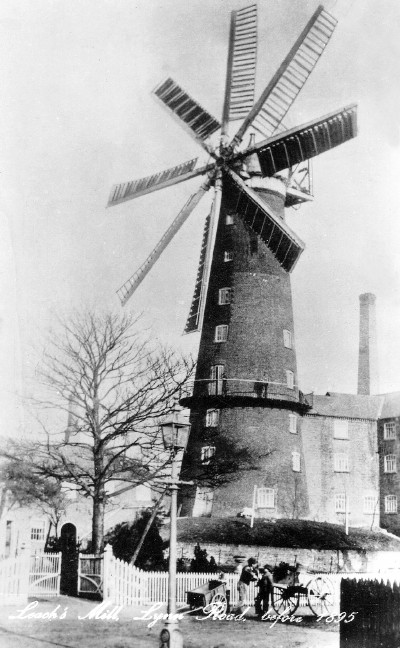
Fig. 3.3: Leach’s Mill, Wisbech. Ceased milling ca.
1895. |
A windmill’s sails are usually four in
number, but five, six and eight-sailed windmills (fig 3.3) were also
built. More sails generate more power with a smoother torque,
but at greater cost, weight and maintenance.
A windmill’s sails do not rotate in the vertical plane, but are
slightly inclined to it, for it was discovered that a slight
inclination of about 15° increases the wind’s effect (fig. 3.4).
This is due to wind currents near to the ground meeting more
frictional resistance than higher up, to the extent that at a level
of 43 ft above ground-level, wind velocity is some 10 per cent
greater than at 20 ft. To accommodate the tilt of the sails,
the windshaft has also to be inclined at the same angle below the
horizontal, with its rear end held in place by a firmly-embedded
bearing to enable it to rotate while preventing it from sliding
backwards (plate 17;
plate 25).
A further discovery was that sails worked more efficiently if,
rather than being set flat across the sail stock, a slight twist is
applied, this being more accentuated nearest the windshaft (about
18°) lessening towards the tip (about 7°); this twist can be seen in
the sails of Quainton mill (plate 26).
A major problem for the miller was to regulate the speed of rotation
of the sails and thus of the millstones. The optimum sail
speed for a grain mill generally lies in the range 11 to 15
revolutions per minute; speeds much above that run the risk of
over-driving the stones and burning the grain, while even higher
speeds — sometimes referred to as the mill ‘running away’ — could
damage the machinery and, indeed, the mill itself.
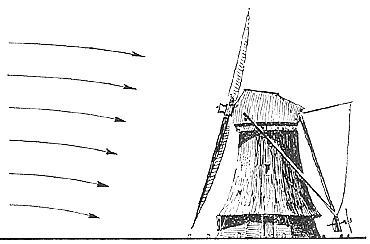
Fig. 3.4:
flow of air currents near the ground.
Small differences in sail speed can be adjusted by changing the
amount of grain fed to the millstones or changing the gap between
them, both of which affect the load placed on the sails. But a
large change in wind speed has to be dealt with by altering the sail
area exposed to the wind, either by increasing or reducing it, a
process called reefing (fig. 3.5).

Fig. 3.5:
different degrees of reefing a simple cloth covered sail.
For centuries before the development of more advanced and better
controlled sail systems, sails comprised a lattice framework over
which the sailcloth was spread (plate 10).
Such common sails required two men for reefing, one to climb on the
sweeps to carry out the task and one to control the brake; should
the brake fail during the operation, the man on the sweep was in for
a spectacular ride.
Towards the end of the 18th century, developments in sail design
eased the reefing process. Roller reefing employed banks of
cloth blinds mounted on rollers (comparable to a household roller
blind) that could be adjusted with a manual chain from the ground
without stopping the mill. Other systems replaced the
sailcloth with sets of wooden shutters (comparable to Venetian
blinds) mounted along each sweep. These systems employed some
form of tensioning that caused the shutters to spill the wind
automatically if its force exceeded a set limit. A later
invention, the air brake (fig. 3.6), comprised shutters placed
longitudinally at the tip of each sweep that turned automatically if
the wind exceeded a set strength, thereby disturbing the sail’s
profile and slowing it.
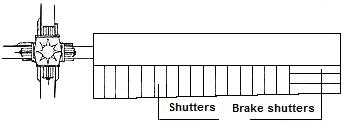
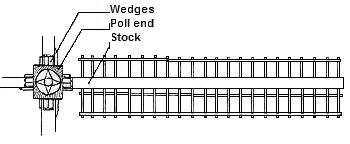
Fig. 3.6:
top, a sail fitted with shutters and air brake.
Bottom, a sail for simple cloth covering.
The development of hollow windshafts permitted control rods to be
inserted through their centre (fig. 3.7). This enabled sail
settings to be adjusted from within the mill automatically under the
action of counter-weights.
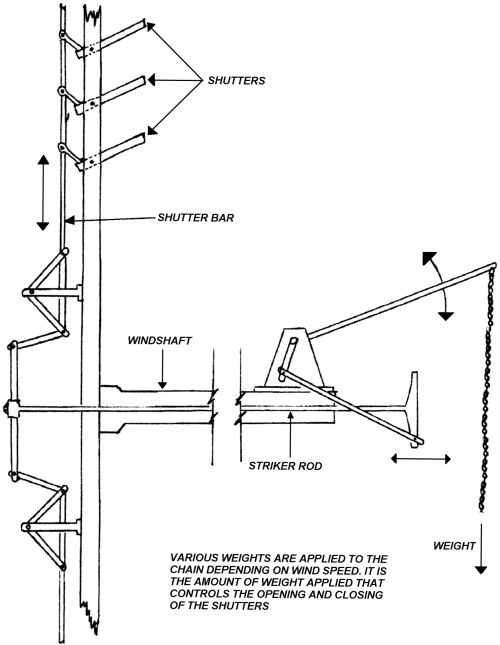
|
Fig. 3.7: towards
the end of the windmill era, shuttered sails were introduced that
enabled a degree of automatic reefing by applying tension weights to
balance the wind pressure falling on the shutters. The two
forces were balanced through the striker rod (which passes through
the centre of the windshaft), the shutters bars and moveable
linkages/levers. |
While these developments were not without their complexities when
compared to common sails, they reduced manual effort while improving
the windmill’s efficiency as a motive force.
THE MACHINERY
Different hardwoods were used in the construction of milling
machinery. Cogs were often of applewood, hornbeam or beech,
wheels and shafts of oak, whilst the dowels used to join together
wooden parts were of holly. However, from the middle of the
18th century cast-iron parts were used increasingly, although
iron-to-iron gearing was avoided, for it was found that iron-to-wood
gearing ran more quietly and was easier and cheaper to maintain and,
most important, it avoided the risks of sparks causing a dust
explosion. [4] Problems associated
with manufacturing and handling large iron castings were avoided by
the use of small sections bolted together, an example being the
dozen or so sections that make up the 18ft diameter iron rack in the
cap of Wendover mill (plate 24).
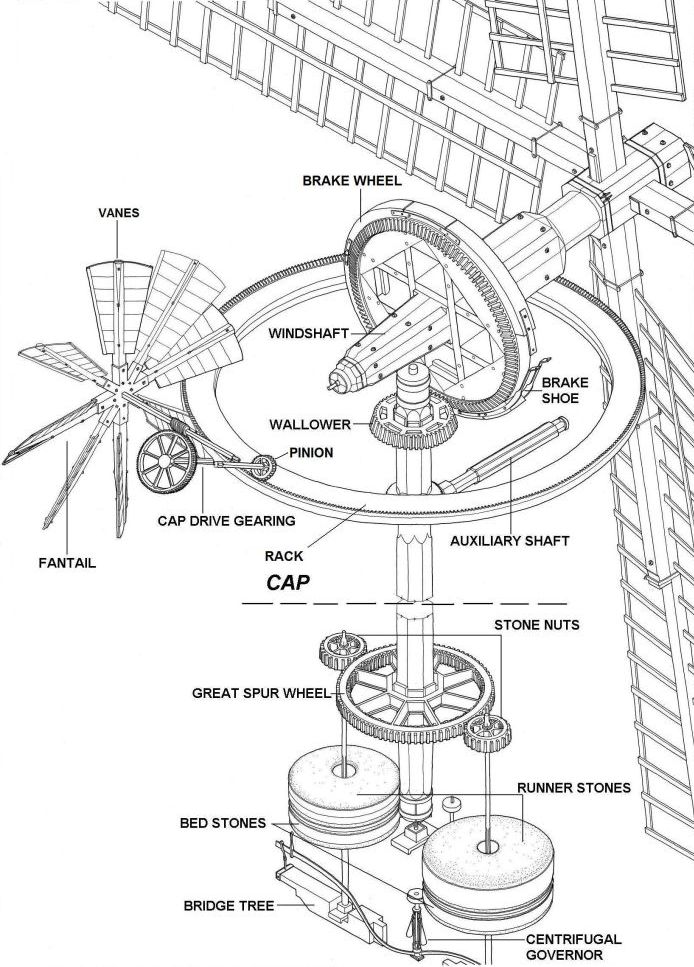
Fig. 3.8:
general arrangement of a windmill fitted with a cap and fantail, and
two sets of stones.
In order to rotate the millstones, the (near) horizontal rotation of
the windshaft must first be converted into a vertical rotation.
This is achieved using a form of bevel gearing. The inner end
of the windshaft is fitted with a large toothed wheel, the brake
wheel, the teeth of which mesh with a cog, the wallower, which is
set at an upright angle to it. The brake wheel, when rotated
by the windmill’s sails in the horizontal, causes the wallower to
rotate in the vertical (fig. 3.8).
The wallower is mounted on the upright (or main) shaft, which
transmits its rotary motion downwards through the mill.
Mounted on the base of the upright shaft is another large toothed
wheel, the great spur wheel. This in turn meshes with the cogs
— called stone nuts — that drive the millstones. In this way
the wind’s energy is captured and then put to work to grind grain
and drive other machinery for cleaning, sifting and hoisting grain.
As its name implies, the brake wheel’s other function is to stop the
mill. In fig. 3.8, the brake is the circular shoes that
surround the brake wheel. To stop the mill, a lever is pulled
to tighten the brake-shoes causing them to grip the periphery of the
brake wheel and thus slow the rotating windshaft or clamp it in
place.
THE MILLSTONES
Windmills are generally equipped with several sets of millstones (plate
14). Each set comprises a rotating runner stone and a
stationary bed stone which, depending on their diameter, weigh in
the region of two tons. Different types of stone are used to
grind different types of grain. Stones of grey millstone grit
from Derbyshire are used to grind coarse meal for stock feeding.
The millstones employed to grind wheat for flour are made of French
Burr, a hard silicate found in the Seine valley. Burr stones
are constructed in segments, cemented together and bound with heavy
iron bands.
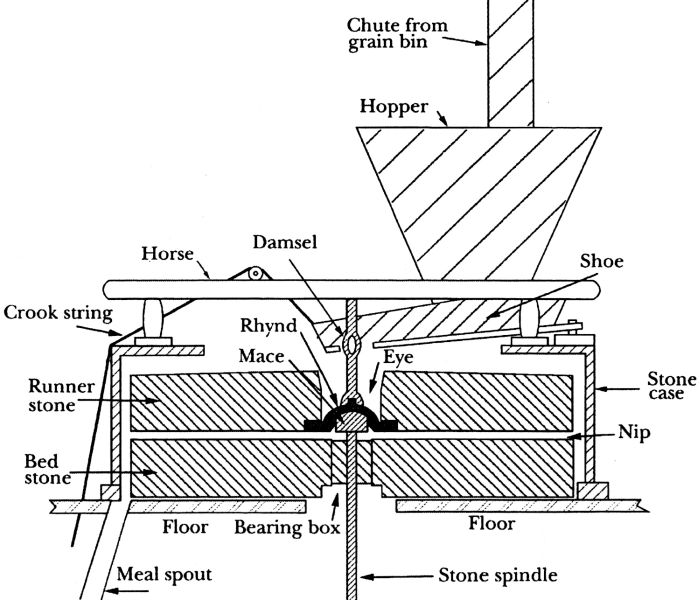
Fig. 3.9:
millstones and their associated equipment.
In operation, the millstones (fig. 3.9) are fed from a hopper, which
trickles grain along a wooden trough — the shoe — into the eye (a
hole through the centre of the runner stone) where it is ground
between runner and bed stones. The shoe is kept in a continual
state of agitation by a rotating crank. Called the damsel, due
to its chattering sound when in operation, it serves to keep the
grain flowing steadily down the shoe into the eye.
Each stone has a pattern of grooves cut into its surface (fig.
3.10). The grooves act like scissors, cutting the grain as
well as moving it outwards from the centre to the periphery of the
millstones. As the meal emerges from between the stones, it is
swept inside the circular wooden container that encases them — the
tun or stone case — into the top of a chute, or meal-spout, which
funnels it down to the meal floor below where it is bagged.
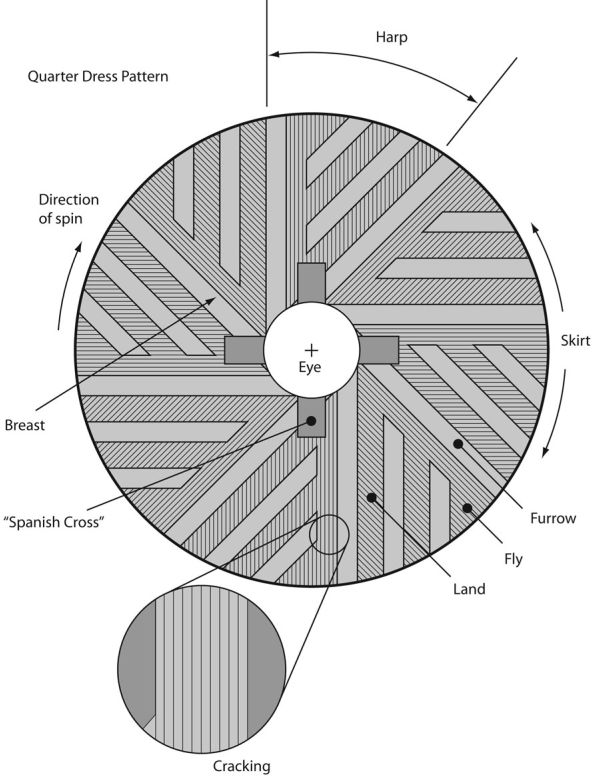
|
Fig. 3.10:
plan view of a millstone. This is a runner stone;
a bedstone would not have the "Spanish Cross" into which
the supporting millrynd fits. |
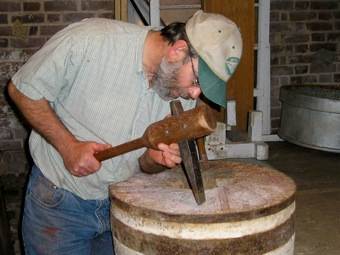
In regular use, the grooves in a millstone wear down and need to be
dressed periodically; that is, re-cut to keep their cutting surfaces
sharp. This is a tedious and exacting task, sometimes
performed by the miller but often by an itinerant stone dresser
(fig. 3.11). The work was executed using various tools
including a mill bill, a tempered steel blade clamped in a wooden
handle, rather like a small pickaxe, and used as a chipping tool.
Today, power tools are often used.
|
 |
|
Fig. 3.11: a stone dresser using a mill bill. |
Adjusting the gap between the stones — a process called tentering —
is carried out using a system of screws or levers that move the
runner stone up or down. This gap, or nip as millers call it,
helps to determine the fineness of the meal; the smaller the nip,
the finer the meal. Only slight adjustments are required, for
the stones, when grinding, are only about the thickness of a
postcard apart.

Fig. 3.12:
the centrifugal governor.
Tentering can be performed manually, but the centrifugal governor
(fig. 3.12 & plate 2) can perform the
task more efficiently. This ingenious device is driven from
the rotating upright shaft. As the speed of rotation of the
sails — and thus of the shaft and the millstones — increases, a pair
of heavy metal balls linked to the governor’s spindle begin to fly
outwards under the increasing centrifugal force. This causes
their collar to rise up the spindle, and in so doing to move the
levers that adjust the gap between the millstones. An
increased gap results in more grain being fed into the eye of the
millstones, which increases the load on the sails, slowing their
speed of rotation and that of the millstones.
The optimum speed of rotation of a runner stone depends on its
diameter and on the quality of the output required. A rule of
thumb followed by millers was to divide the diameter of the stone
(in inches) into 5,000 for flour and 6,000 for coarser meal.
Thus the optimum speed for a 48 inch runner stone, set to produce
meal, would be 125 rpm — assuming, of course, there was sufficient
wind to drive it at that speed.
THE FANTAIL
Even a small change in wind direction can result in a significant
reduction in the torque the sails generate if they are not
repositioned. In older windmills, ‘winding the mill’ involved
hard manual effort. In the case of a post mill, the entire
superstructure needed to be turned by pushing on a large beam (the
tail post) that protruded from the rear of the mill. In later
smock and tower mills, only the top floor (fig. 3.1) needs to
revolve, but this still required manual effort. The fantail
automates the process by using the wind itself to wind the sails.
Later windmills usually adopted this feature, which could also be
built onto the tail posts of old post mills (plate
31).
A fantail comprises gearing driven by a small set of sails (vanes),
which are aligned at right angles to the main sails and positioned
at the rear of the mill. Its purpose is to rotate the cap
automatically when a change of wind direction occurs, which it
achieves via a system of gears that mesh with a toothed rack around
the inside of the cap (fig. 3.8). When the sails are properly
winded, the vanes of the fantail are at right angles to the wind, so
they derive no thrust from it and do not rotate. But should
the wind change direction, its force then falls on one side or the
other of the fantail, causing its vanes to rotate and drive the
gearing that rotates the cap and winds the sails, a clever feat of
automation.
However, while very useful in normal working conditions, the fantail
provided no guarantee against a mill being tail-winded by a sudden
change in wind direction, as sometimes accompanies a thunderstorm;
thus fantails might be supplemented by a hand crank, an example
being in the cap of Wendover mill (fig.
10.3). And unless the fantail drive could be
disconnected, a further problem for the miller was how to turn the
windmill’s sails off the wind in a sudden squall in order to stop
them. Things were rarely straight-forward in windmilling.
ANCILLARY EQUIPMENT
|
 |
|
Fig. 3.13:
principle of the flour dresser. The cylinder is tilted
at an angle. The wholemeal is fed into the upper
end and passes through the machine under gravity, the
bran being ejected at the lower end. |
Because windmills use gravity feed to
clean and grind grain, filter the meal produced and bag the end
product, a sack hoist is an essential piece of equipment if the
drudgery of lifting sacks manually up the mill, on numerous
occasions, is to be avoided. The sack hoist takes the form a
simple rotating chain, driven by an auxiliary shaft which is in turn
geared to the upright shaft (plate 3).
As it rotates, the sack hoist is used to lift the sacks of grain or
meal up through a succession of trapdoors to the bin floor of the
mill.
The auxiliary shaft also powers other windmill machinery. That
used prior to the grain being milled might include a smutter, which
removes the black spots of smut caused by a fungus disease that can
grow on grain if its gets damp; a separator, used to separate grain
from other foreign matter, such as stones, weeds, and sticks; a
scourer, used to separate usable grain from debris such as dirt,
dust, and chaff.
Following milling, a flour dresser (fig. 3.13) is used to sift the
meal into its various grades of fineness. The dresser consists
of a cylindrical drum, covered in wire mesh of increasing grades of
fineness, and set at an angle. Inside the drum revolves a set
of brushes. Meal, fed into the upper end of the cylinder is
rubbed against the mesh screens by the brushes as it falls through
the cylinder under gravity. The finest meal, white flour, can
pass through the finest mesh screen; next comes semolina flour,
which passes through the next grade of mesh, leaving the coarsest
product, bran. Each grade is ejected into canvas chutes which
feed sacks on the meal floor below.
The mill might also drive an oat crusher, used to crush oats for
animal feed.
――――♦――――
APPENDIX
THE ROLLER MILL
Although the subject of this book is windmills, some mention should
be made of the technology that in the latter part of the 19th
century was to sweep away both wind and water mills so rapidly.
The steam engine was the first major advance. The first
steam-powered mill, Albion Mill, was established in 1786 by Matthew
Boulton and James Watt. It employed a Watt steam engine of 150
hp to drive 20 pairs of millstones, and was capable of grinding 10
bushels of wheat per hour, all day and regardless of wind strength.
Albion Mill was the industrial wonder of the age, but in 1791 it
burned down. The cause was never discovered, but it was widely
believed to be an act of arson by local millers and millworkers who
believed their livelihood was threatened by the new technology.
Rotating millstones, sometimes steam-driven, continued to be used
for grain milling until the late 19th century, when roller mills — a
Swiss invention — appeared, the first being built in Hungary in
1874. Edward Mead (Chapter VII.)
is believed to have installed the U.K.’s first roller mill at
Chelsea in 1881. The combination of steam power and the roller
milling process led directly to the flour mills of today.
|
 |
|
Fig. 3.14:
the principle of the roller mill. In practice, the
meal passes through several stages of roller milling to
produce fine white flour. |
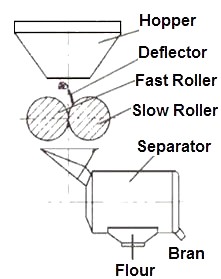
Roller milling (fig. 3.14) crushes the
grain, not between revolving millstones, but between a series of
fluted steel rollers of about 12 inches in diameter. The
rollers are set with a specified gap between them and spin towards
each other at high, but at different, speeds; the surface of each
roller is also grooved with a different pattern.
In a modern flour mill, before milling commences, the grain is
cleaned of any extraneous matter using a variety of techniques
including sifters and magnets (to remove metallic particles).
It is then conditioned to ensure uniform moisture content and
blended with other wheats to provide a mix capable of producing
flour of the required character. Then, using a reduction
process, the grain is crushed by a succession of rollers, the fine
flour particles being sifted out at each pass of the rollers while
the residue (bran) is sent on to the next set of rollers in a
repetitive manner. Thus, roller milling is a series of
crushing and sifting operations, ideally suited for making clean
white flour.
Roller mills offer several other advantages over traditional milling
methods. They eliminate the cost of dressing millstones and
enable the production of a larger amount of better-grade flour from
a given amount of wheat, quicker and to a consistent standard.
Rollers are also superior for milling the harder wheats used for
bread by reducing the wheat kernel slowly into flour fragments to
separate out the bran.
Roller milling made possible the construction of larger, more
efficient grain mills, hastening the abandonment of the small
country wind and water mills, and of stone grinding. Indeed,
so successful were the roller mills that within 30 years of their
introduction into Britain in 1881, more than three-quarters of the
wind and water mills that had served for centuries so faithfully, if
erratically, had been demolished or abandoned. This is what
Edward Bradfield, an old miller who was writing in 1920, had to say
about this milling revolution . . . .
“Then came the changes. ‘High grinding,’ ‘gradual reduction’ and
the ‘roller system’, one after the other, came to revolutionize the
trade. The flour was greatly improved by the new methods and
the trade of the stone millers was decimated. The new methods
allowed the brittle stony wheats then coming into fame to be made
into excellent flour which the stone millers could not equal.
Yet many of them, who clung to the traditional system which had
brought them fame, wealth and honour, made heroic efforts to stay
the onslaught, but failed.”
However, the roller mill revolution brought with it a drawback.
The friction of the rollers caused the meal to become hot, which led
to some nutrients in the flour being damaged. This was not
realized at a time when essential dietary needs were little
understood.
Today, the
‘Bread and Flour Regulations’ govern the use of
additives as well as requiring the addition of certain nutrients to
ensure that a wholesome product emerges from the flour mill.
This from the Federation of Bakers . . . . .
“The Bread and Flour Regulations require that flour should
contain not less than 0.24mg. thiamin (vitamin B1), 1.60mg.
nicotinic acid and 1.65mg. of iron per 100g. of flour. These
amounts are found naturally in wholemeal flour. White and
brown flours must be fortified to restore their nutritional value to
the required level. In addition calcium carbonate, at a level
of not less than 235mg. and not more than 390mg. per 100g. of flour,
is added to all flours except wholemeal and certain self-raising
varieties. This ensures the high nutritional value of all
bread, whether it is white, brown or wholemeal.” |



