|
Although the fan-stage and fantail are long gone, the worm-gear that
the fantail drove remains in place together with cross-bars to
permit hand-winding (fig. 10.3), necessary when there was a very
sudden change in wind direction. This gearing connects via a
vertical spindle with an iron rack of some 300 iron teeth. Set
into the cill, the rack extends around the circumference of the cap
(plate 24). The 30 iron rollers
upon which the cap revolved also remain in place, some being just
visible above the rack.
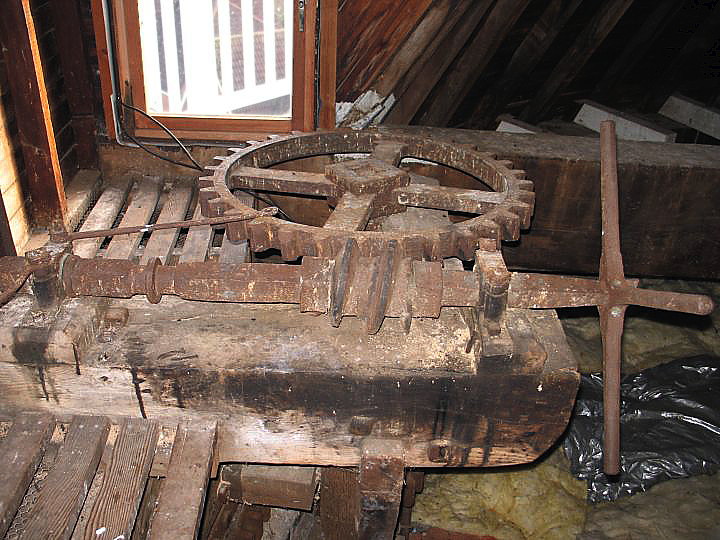
Fig. 10.3:
hand winding gear in the cap.
The cap is of wood and much larger than those at Quainton, Goldfield
and Hawridge tower mills. Its base consists of four cross
members that are mortised at each end into two massive beams that
extend across the mill. Above this, 24 substantial rafters
arch upwards to a pinnacle, forming the frame that supports the roof
— quite spectacular as one looks up at its apex (plate
23). The roof’s interior is clad with wooden boarding, its
exterior with zinc sheeting.
Notable among the mill’s former machinery were its upright shaft —
reported to have been a ship’s mast — and its 4-ton, 18ft iron
windshaft, which remains in place and which the millwright Derek
Ogden, who worked on the mill in the 1960s, claimed to be the
biggest that he had ever seen (plate 25).
Also remaining and clearly visible from behind the mill, is the iron
centre cross on which the stocks that carried the sails were
mounted. Originally, the sails were of the ‘simple’ variety
but these were later replaced; when the mill was sold in 1875, the
auctioneer’s catalogue described them as being . . . .
“of modern construction, with all the
latest improvements, two of which are recently new, and the Fan
[fantail] will be found good and
efficient.”
Although long gone in Freese’s time, he describes the sails as
having been “double-shuttered anti-clock patents”, which can
be seen at fig. 10.2.
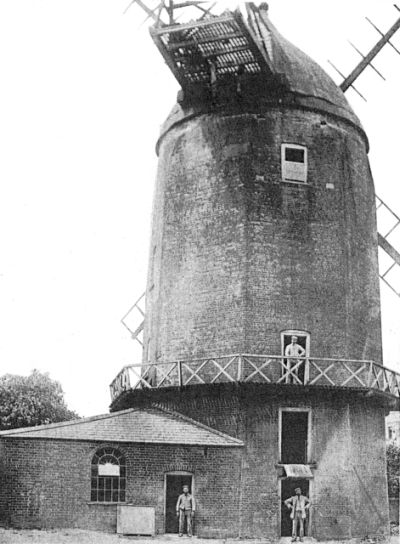
The mill originally had a gallery at second floor level (fig. 10.4)
but this was removed in 1947 when extensive repairs were carried
out. The present gallery at cap level (plate
22) is a recent addition, constructed to ease roof maintenance,
for leakage has been a recurring and expensive problem to deal with.
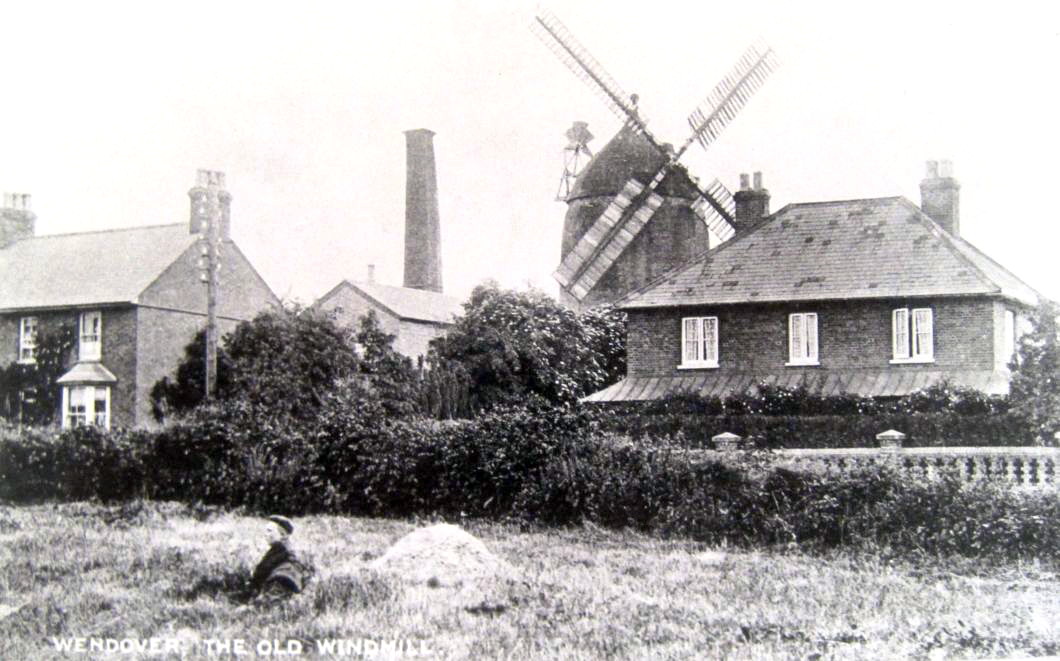
A tall chimney stack was also built onto the south side of the mill
at some time after windmilling ceased, for it would otherwise have
impeded the fan-stage as it revolved.
STEAM MILLING
|
 |
|
Fig. 10.4:
Wendover mill showing the engine house. |
At some point in its life wind power was
supplemented with a 12 hp steam engine installed in an engine-house
built onto the south side of the mill . . . .
|
“. . . the former windmill at Wendover was
converted to steam power because the building of houses near to it
affected the currents of air. The late Mr. F. Purssell, the miller,
said there was great difficulty when the wind shifted suddenly into
the opposite quarter, and the sails started to revolve backwards.
The sails had to be wound round by hand to bring them into the wind
again.”
In
Buckinghamshire, G. Elland, 1923.
|
Stanley Freese describes the machinery as . . . .
|
“. . . . an exceptionally fine expansion
engine, no doubt the best ever used in a Buckinghamshire windmill .
. . . starting from cold at 7.30 a.m., she would soon grind corn
with about 40 lbs. of steam, but would not operate the sack hoist
until about 11.30 . . . . sometimes the sack hoist was driven all
day in order to replenish the exceptionally capacious bins.” |
A flue from the engine’s boiler passed underground to a tall
brick-built chimney in the centre of the mill yard. Although
it is not known when the steam engine was installed, it is recorded
that it was by Hillsdons of Tring (Chapter
V).
Milling is believed to have continued using both wind and steam, but
having been damaged severely by a storm the sails were removed in
1904.
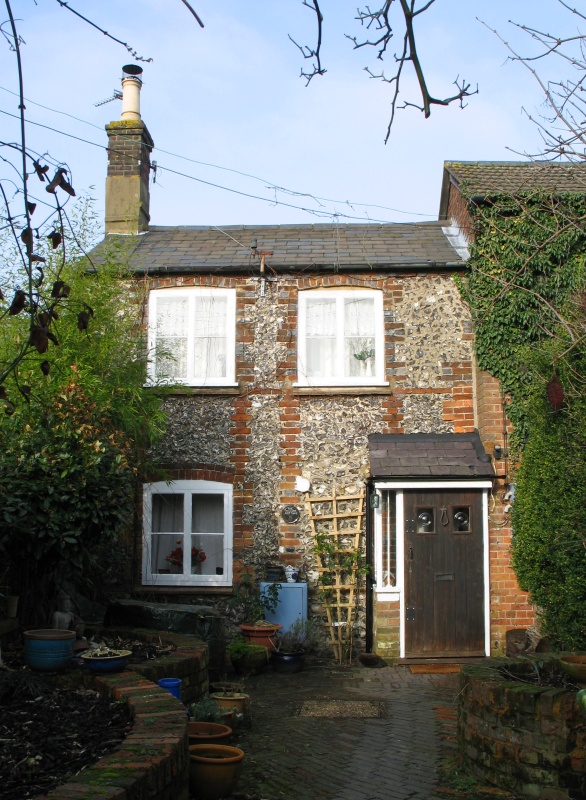
Fig. 10.5:
the miller’s house.
THE MILLERS
|
 |
|
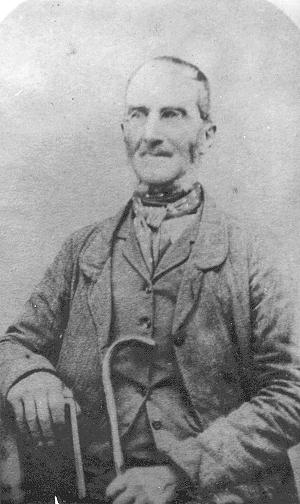
Fig. 10.6: Charles Burton. |
Wendover Mill had a number of occupiers up
to 1875. Local trade directories list Thomas Horwood and Thomas
Andrews as millers in 1842 and 1850 respectively; the 1851 Census
lists Charles Burton. In 1861 the diary of Thomas Grace of Tring
records that he accompanied his brother-in-law, Edward Mead, to look
over the mill and that Edward agreed to pay £100 a year in rent.
Mead operated the mill until 1869 when Thomas Edward Biggs took
over.
In 1875, due to the expiry of the lease, the mill was offered for
sale by auction. The name Zachariah Phillips appears on the
auctioneer’s ground plan, which suggests that the freehold remained
in the possession of the original owners, the Phillips family.
The sale was conducted by Reader & Son at the Bell Hotel, Aylesbury.
Their catalogue describes the property as a . . . .
“Brick-built, octagon-shaped, roomy
FREEHOLD WINDMILL
of five stories, driving three pairs of stones,
with the whole of the gearing complete
also, attached thereto, a
12-HORSE-POWER STEAM
ENGINE
and boiler, with high Shaft, driving two pairs of Stones . . . .”
In addition to the windmill were granary, store houses, cart sheds,
stables, the miller’s house, out-houses, yard and garden. The
catalogue goes on to describe in detail the mill’s structure and
equipment (see Appendix I).
The mill was bought by William Purssell for £1,000, but others ran
it for the names of Francis Beesley (1877) and George Butterfield
(1883) appear in the records. On William Purssell’s death in
1887, his son Frank took over from Butterfield and continued to
operate the mill until his death in 1922.
In his account, Freese suggests that in its early life the windmill
was unsuccessful commercially and it was not until Frank Purssell’s
time that business began to look up . . . .
“. . . . he took her over from a Mr
Butterfield. Steadily the business improved under his management,
and he confounded the pessimists by building up a very flourishing
and successful trade, which was still very good when he passed away
in 1922 . . . . mostly English wheat was ground in the old days,
some of it coming by canal to Wendover Wharf, but with the steam
engine they latterly ground much Russian barley and American maize,
etc. and flour was made until about 1912; generally speaking there
was a loss of about 7 lbs. per bushel.”
Following Frank’s death in 1922 his son Basil carried on, but by
then business was beginning to decline, probably due to competition
from larger and more efficient roller mills. By 1925 the mill
was only working two days a week due to “difficulties of the
trade”. In the following year, the General Strike and its
coal shortage led to the mill’s closure. The machinery was
removed in 1929 and the engine house and chimney were demolished two
years later.
THE WINDMILL IN DOMESTIC LIFE
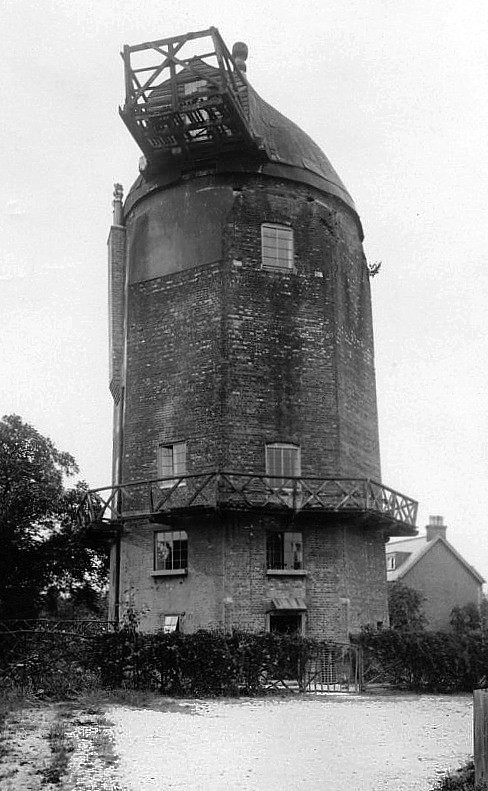
Fig. 10.7:
the mill following conversion to a dwelling c.1930.
By the time of its closure, the mill’s floors were in poor
structural condition with rot affecting some of the joists, probably
due to damp seeping through flaws in the bonding of the brickwork.
The mill’s cap was also perishing and there was talk of demolishing
the top two floors. This drastic action was avoided, and in
1931 the mill was converted to a private house. Freese,
writing during the 1930s, reports that . . . .
“. . . . some big long irons or bolts were
inserted by which the weak fourth floor is now practically suspended
from the curb of the mill, whilst the fifth floor has two iron
girders set into the wall just below, giving support to the rotten
ends of the two main joists. New staircases have been
installed . . . . and the ground floor has been converted to a cosy
living room by Miss Marion Fawcett, the actress and playwright, who
is now the tenant, whilst the second floor contains two comfortable
bedrooms and a bathroom, the upper floors being vacant .”
Miss Fawcett, who leased the mill for 15s. a week, continued the
tenant until 1946 when the mill again fell into disuse. Basil
Purssell, writing to the
Bucks Herald in October 1954, stated that . . . .
“In October 1948, when a gale blew in part
of the back cap, Mr Freese was a great help. Together with a
London workman, Mr. Carew, who had been working therein that summer,
he repaired the roof temporarily for £50 and it was a courageous
job. . . . the late Mrs. Frank Purssell planned the preservation of
the mill back in 1931, the idea being to convert it into a
comfortable home . . . after that considerable sums of money were
spent on maintenance both by the owners and the leaseholder, London
actress Marion Fawcett.”
By 1953 the mill was again in a poor state of repair and at risk of
demolition. It was offered for sale and an advertisement in
the
New Statesman caught the eye of Kenneth and Margaret
Roberton, who bought the mill and moved in on Coronation Day, 1953.
Again, the
Bucks Herald . . . .
“The new owner, who is the well-known
musician Kenneth Roberton, spent a further £600 this summer on
renovation.”
The domed roof was rebuilt in the mid 1960s making the top two
floors habitable and from the 1970s until his death in 2003, Kenneth
Roberton used them as the base for his music publishing business,
Roberton Publications. His obituary in the Bucks Herald
stated that he was a tireless campaigner for the town’s interests,
helped to found the Wendover Society, as well as fighting for the
rights of residents and battling against developments that he felt
would adversely affect the town.
A further piece of structural work on the cap is recorded in an
article on the mill in the Bucks Advertiser in June, 1971 . .
. .
“in the summer of 1969, the familiar black
cap was replaced with a shining white aluminium one . . . .”
. . . . that the present occupier had to replace when the aluminium
was discovered to be leaking through its joints. The cap is
now clad with zinc sheeting, the fastenings of which are sheltered
from the rain by fold-over joints.
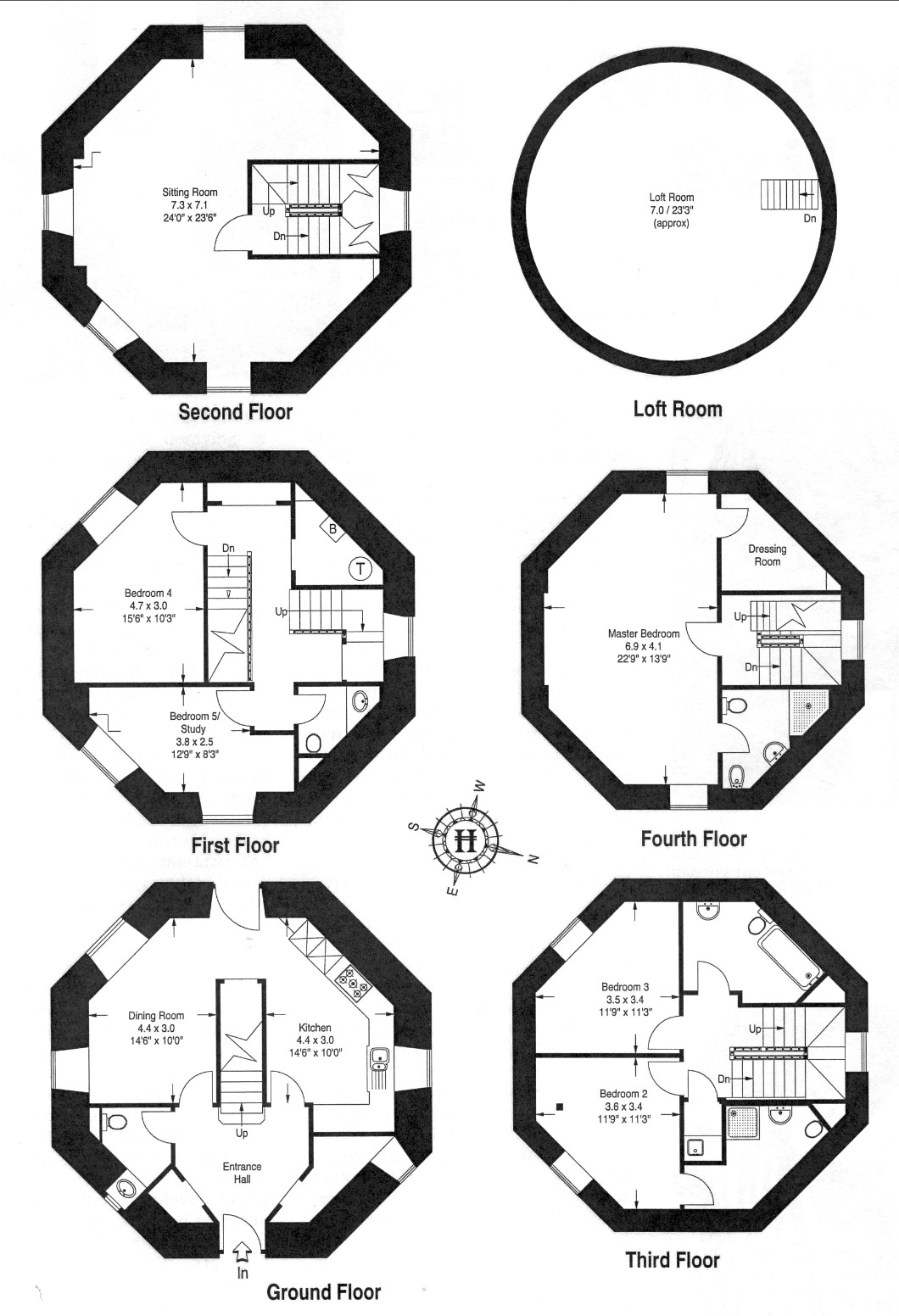
Today the windmill, which is Grade II listed, is a very comfortable
family home. Its five levels contain five bedrooms, three
reception rooms, three bathrooms and a kitchen (Appendix
II) — but looking back at some of the old repair bills, one
cannot help forming the impression that those who would live in an
old windmill need a deep pocket!
――――♦――――
APPENDIX I.
AUCTIONEER’S PARTICULARS (1875)
ENGINE HOUSE
A superior 12-horse-power horizontal Steam Engine by Hillsdon,
Tring, working expansively with 11-inch cylinders, 2ft. 4ins stroke,
large fly wheel (11-feet diameter), steam and exhaust pipes, with
governors, pump, &c., bed plate, and brick foundation. An
excellent Cornish boiler (only recently put in), 18ft. by 4ft. 6ins,
with flue 2ft. 3ins diameter, dome, safety valve, pressure gauge,
water gauge, and the brick setting thereof. Hand-force pump
for feeding boiler.
THE MILL
GROUND FLOOR. —
Crank shaft from steam engine, 5½-inch diameter, and 14ft. long,
driving two pairs of wheat stones on first floor, on cast-iron
upright frames, with plummer blocks and brasses, carrying two bevel
wheels, driving pinions, on stone spindle, with iron bridge-trees
and brass steps, iron rising screws one drum on end of shaft, for
driving dressing tackle on 1st Floor two meal bins and shoots,
jogging screen for offals, sack jumper, and step ladder.
FIRST FLOOR. —
Two pairs of 4ft. wheat stones (driven by steam power), with
damsels, wood hoppers and casing, stone spindles, bevel wheels and
pinions, iron shaft, driving pulley, cast-iron housings, housings,
and wood shoot. One 21-inch lay shaft, 9ft. 6ins long, with
plummer blocks and three pulleys, driving the 3ft. 6ins dressing
machine, with 16-inch cylinder, pulleys, plummer blocks and shaft,
complete in deal case flour bin, offal bin.
SECOND FLOOR. ―
Spur wheel and three stone nuts and spindles, bridge trees, rising
screws, and governors, three jogging screens to part the offals,
three meal bins, three spouts, apparatus and chain for hoisting by
steam power.
THIRD OR STONE FLOOR.
— Two pairs of wheat and one pair of barley stones, 4ft. and
4ft. 6 in diameter, with damsels, wood hoppers, and casings, stone
spindles, spur wheels and pinions, iron shaft, driving pulley, cast
iron housings, and wood shoots one lay shaft, about 10ft. long, with
hanger and plummer blocks, bevel pinions for driving smutter,
dressing machine, and bolting mill one crown wheel, on wallow shaft
and iron pinion one dressing machine, 4ft. 6ins long, with 16-inch
cylinder, and apparatus feed, &c. one horizontal smutting machine,
2ft. 2ins long, 16 inches diameter, with shaft, pulleys, &c. bolting
machine, 6ft. long, with spindle, pulley, plummer blocks, &c.
FOURTH FLOOR.
— Hoppers to smut machine two others six large bins.
FIFTH STORY. —
Iron wind shaft, with large iron boss and break wheel cast iron
wallow wheel, working into break wheel, with oak upright shaft,
circular rack, and hand-gear to fan-tail self-acting hoisting
tackle, with wood barrel break and lever, and about 84 feet of
quarter-inch chain.
YARD. — 53 feet of smoke flue, brick
smoke shaft, base 6ft. square, height about 55 feet. |