|
CHAPTER II.
TYPES OF WINDMILL
Setting aside prairie wind pumps, wind turbines and other recent
developments, traditional windmills fall into three broad
categories, the ‘post mill’, the ‘smock mill’ and the ‘tower mill’.
POST MILLS
|
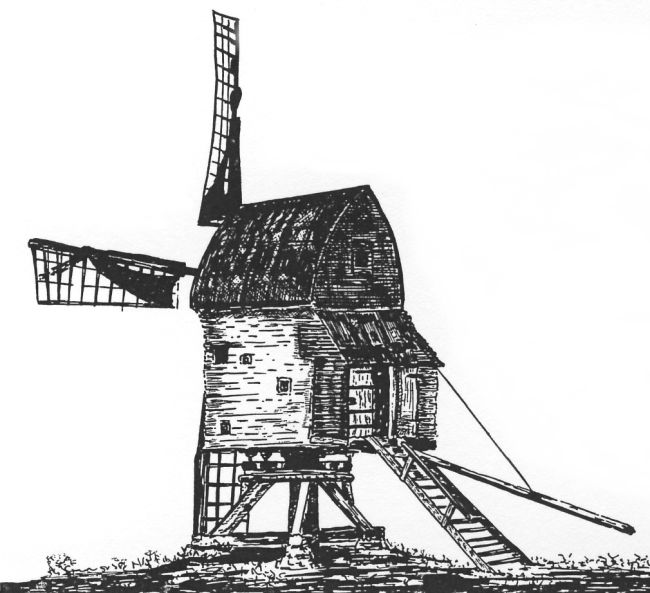
Fig. 2.1: A post mill could be revolved around its
central trestle to face the sails into the wind using
the tail pole (protruding at the rear), an action called
“winding”. This open trestle post mill stood on
Bledlow Ridge near Chinnor. It was damaged
and ceased working in 1913, and was pulled down in 1933. |
Post mills were the earliest type of windmill to reach Britain,
probably late in the 12th century. They are so named because the
body of the mill is supported on and revolves around an upright
post. This enables the mill to be turned to face into the wind ― a
task called winding or luffing ― where its sails can generate the
most torque. [2] Many examples
remain throughout Western Europe, those at Pitstone (plate
1), at Brill (plate 4) and at
Chinnor (plate 7) being nearest to
Tring.

Fig. 2.2:
the parts of an open trestle post mill.
The mill’s supporting post needs to be a substantial piece of timber
to carry the weight of the mill’s superstructure and machinery.
That which supports Pitstone mill was cut from a single tree, some
17 feet long by 33 inches diameter at its base, comparable in girth
to a sailing ship’s mast. The post is capped with a bearing,
which permits rotation and, via a massive wooden cross-beam called
the ‘crown tree’, supports the full weight of the mill.
In fig. 2.2, the post appears to rest upon the cross-trees beneath
it, but this is not so. Were it to be, the entire weight of
the mill would bear down on their centre, which would eventually
fracture under the pressure. Thus, the post is suspended
slightly above the cross-trees by four ‘quarter bars’, which are
mortised into it and which also maintain its vertical position.
By this means the mill’s weight is transferred downwards evenly
through each of the quarter bars and onto the four brick piers.
The cross-trees, which are held in a permanent state of tension by
the outward thrust of the mill’s weight, prevent the quarter bars
from spreading, a clever resolution of forces.

Fig 2.3: main post,
Pitstone Mill, Buckinghamshire.

Fig. 2.4: base of main post
and cross trees, Pitstone post mill, Buckinghamshire.
Many post mills eventually had a brick roundhouse built about their
base (plate 4) to protect their timber
supports from the weather and to provide a covered loading bay.
Those without a roundhouse are usually described as ‘open trestle’.

Fig. 2.5: open trestle post
mill at Brill.
It later acquired a
roundhouse.
SMOCK MILLS
Due to its distinctive sloping sides, usually six or eight in
number, this type of windmill came to be named after the canvas and
cotton smocks worn by farm labourers of the time. As with the
earlier post mill, the sides of a smock mill are clad with
horizontal weatherboarding, although there are some examples of
vertical cladding. The mill’s wooden body sits on a brick base
to protect it against rot and to provide support for its upright
posts. The base can be a substantial structure, that
supporting Union Mill (fig. 2.6) being a four-storey building.

Fig. 2.6:
Union Mill, Cranbrook, Kent, Britain’s tallest smock mill.
Built in 1814, it is now open to the public.
The main internal structure of a smock mill consists of its cant or
corner posts (plate 11), which extend
to its full height, converging as they go up. The cant posts
are secured at the bottom to a wooden sill, which is fixed firmly to
the brick base. This joint between post and sill poses a
problem; because the cant posts lean inwards they throw the mill’s
weight outwards at the sill, where a weak joint can result in posts
slipping away and toppling the mill.
Unlike the post mill, in which the whole body of the mill needs to
be turned to wind its sails, only the top, or cap, of a smock mill
needs to rotate. The small cap also allows better airflow
around the sails, which contributes to a more efficient and stable
source of power, especially when winding is performed automatically
by a small windmill at the rear of the cap known as a fantail (see
fig. 2.6). Because the body of the mill doesn’t have to be
rotated, it can be larger than a post mill, thus allowing more space
for machinery.
Smock mills are found throughout Western Europe; in the U.K. they
were particularly common in Kent. The nearest smock mill to
Tring is at Lacey Green near Princes Risborough (Chapter
XII.).
TOWER MILLS
|
 |
|
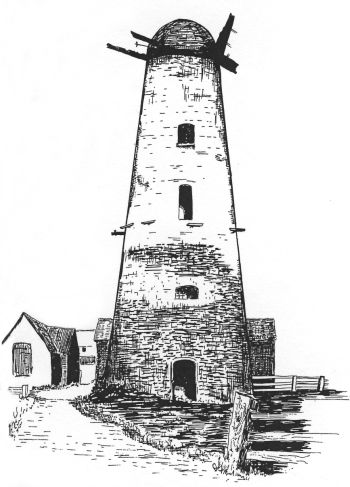
Fig. 2.7: Quainton tower mill prior to restoration. |
The earliest record of a tower mill in
Britain dates from the late 13th century and refers to a mill at
Dover, possibly at the Castle. In that age, windmills were
sometimes built on the sides of castles and of towers in fortified
towns to protect them from attack.
A tower mill differs from a smock mill in that it is of brick or
stone construction and usually round in shape, although there is a
fine example of an octagonal tower mill at Wendover (plate
22). Because of its masonry construction, a tower mill
requires increasingly massive walls towards its base to support the
weight of the upper storeys; those at Wendover mill are three feet
thick at the base. It is therefore unsurprising that
tower mills were much more expensive to construct than wooden post
and smock mills, and probably for this reason they did not become
prevalent until the 18th and 19th centuries. However, this
type of construction offers the advantage of a more robust frame
that can support larger sails and resist harsher weather.
In common with the smock mill, the tower mill is topped by a
moveable cap, that at Stembridge Tower Mill at High Ham, Somerset,
being the last example of a thatched cap.
The nearest tower mill to Tring is Goldfield Mill (Chapter
VIII) on Icknield Way, near to the junction with Miswell Lane.
Slightly further afield are examples of tower mills at Hawridge (Chapter
IX) and at Wendover (Chapter X).
These three mills have been converted into private dwellings, but
the tower mill at Quainton (Chapter XI)
has been restored to working order and is open to the public. |



