

|
|
Road coaches.
|
|
|
|
A coach of the
Elizabethan era. Note the absence of brakes and suspension
on the chassis. |
The Tudor period saw the development of the road coach, the wheels of
which imposed far greater wear on the unmade road surfaces of the time.
These coaches had solid wheel rims and primitive leather strap
suspension, which, in conjunction with the deep ruts and potholes of the
road surfaces over which they travelled, must have made any journey for
their occupants uncomfortable.
Although they first appeared during the 16th century, it was not until
the 18th century that coaches came into more common use, the main
drawback to coach travel being the poor condition of the roads.
Following the General Highway Act of 1555, road surfaces improved, but
to a very limited extent. Parish surveyors were pressed men, often
illiterate and with no training in road engineering, while those
performing their six days unpaid statute labour were hardly likely to be
enthusiastic about the task. Stories abound of roads being
impassable in wet weather, thus journeys were best made during the
summer months.
By the late 18th century, many main roads had come under the control of
turnpike trusts and road conditions had begun to improve. This
period of road transport history ― from the first royal mail coaches in
the 1780s to the 1840s and the coming of the railways ― is now known as
the ‘Golden Age of Coaching’, familiar to us today through sentimental
Christmas card scenes of snow-covered stagecoaches arriving to a hearty
welcome at a coaching inn.
Stagecoaches.
The stagecoach developed to convey fare-paying passengers, rather than
act as the personal conveyance of the gentry and nobility. The
first stagecoach route, from Edinburgh to Leith, commenced in 1610.
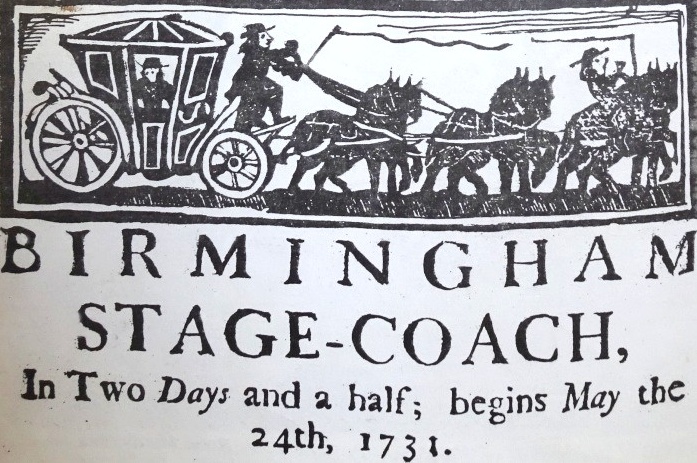
An early stagecoach advertisement, from the Birmingham Mail.
The name ‘stagecoach’ is derived from the term ‘stage’, which referred
to the distance between stops along a stagecoach route. During the
first decades of the 19th century, when more emphasis was placed on
speed, stages were usually between 8 and 10 miles apart and the coach
travelled the entire route in stages, changing horses (which took a few
minutes) at each. Coaching inns sprang up along the coaching
routes to provide teams of fresh horses and sustenance for coach
passengers, including overnight stops on long journeys.
During this period significant developments in road construction were
made by Thomas Telford and, to
a more widespread extent, by the Scottish road engineer
John Loudon McAdam. Road surfaces improved, and turnpike roads
were often straightened, widened, and given gentler curves and
gradients. Stagecoach construction also evolved with the fitting
of better brakes and the introduction of steel leaf spring suspension.
These improvements resulted in coach speeds increasing from around 6 to
8 miles per hour, inclusive of stops, which greatly increased the level
of mobility of travellers and the speed of mail delivery. The
number of passengers increased, as did the volume of wheeled road
traffic.
Stagecoaches were not the only wheeled transport to make good use of the
turnpike road through Tring. By the time of the Sparrows Herne
Turnpike Act 1823, which extended the trustees’ powers for a further 21
years and authorised repairs and improvements to the road, it was noted
in the press that “a great variety of vehicles now use the road –
coach, berlin, landau, chariot, calosh, chaise, hearse, wagon, cart,
wain or other carriage”.
“This was the hottest
day of the Summer. Several coach horses dropped dead on the roads from
the excessive heat.”
Tring Vestry Minutes, 1st September 1824.
Coach travel was by no means straightforward and various hazards had to be contended with. The earliest coaches had no brakes, careful handling of the horses being the only way to keep the coach at a steady pace and control progress over inclines. On very steep hills passengers were required to step down and walk. Other obstacles such as deep ruts, potholes and flooding of the road, together with loose animals, could also cause accidents. Overall, early coach travel was a most uncomfortable experience and one that did not improve greatly over the years:
“What advantage is it to
men’s health to be called out of their beds into these coaches an hour
before day in the morning, to be hurried in them from place to place
till one hour, two, or three within night, in so much that, after
sitting all day in the summertime stifled with heat and choked with the
dust, or the wintertime starving and freezing with cold or choked with
filthy fogs, they are often brought into their inns by torchlight, when
it is too late to sit up to get a supper; and next morning they are
forced into the coach so early that they can get no breakfast?
What addition is this to men’s health or business, to ride all day with
strangers, oftentimes sick, ancient, diseased persons, or young children
crying . . . . and many times . . . . crippled by the crowd of the boxes
and bundles? Is it for a man’s health to travel with tired jades,
to be laid fast in the foul ways and forced to wade up to the knees in
mire; afterwards sit in the cold till teams of horses can be sent to
pull the coach out? Is it for their health to travel in rotten
coaches and to have their tackle or perch or axletree broken, and then
to wait three or four hours, (sometimes half a day) to have them mended
again, and then to travel all night to make good their stage? Is
it for a man’s pleasure . . . . to be affronted by the rudeness of a
surly, doggèd, cursing, ill-natured coachman; necessitated to lodge or
bait at the worst inns on the road, where there is no accommodation fit
for gentlemen, and this merely because the owners of the inns and the
coachmen are agreed together to cheat the guests?”
From a contemporary letter quoted in Travel in England in the Seventeenth Century, Joan Parkes (London, 1925).
In the earliest days of coach travel, it was too precarious for
passengers to sit on top, but later designs included two seats behind
the driver and two over the luggage box at the rear; outside travellers
needed to be aware that it was prudent to stay awake to prevent toppling
over the side. Inside, and at double the cost of outside seating,
were two seats facing each other, taking from four to six passengers at
a squeeze, with knees touching. Neither was coach travel
comfortable; straw was laid on the floor to absorb the wet and mud;
windows had no glass, and in bad weather a leather curtain was rolled
down. Early suspension was by leather straps, which caused an
unpleasant swaying motion, but straps were later superseded by steel
springs, which enabled the coach body to be lowered; a lower centre of
gravity meant the coach was less likely to overturn.

|
Strap suspension. Suspension of the state coach built for the Duke of Cleveland by Rigby & Robinson of Park Lane, London. Dating to around 1810-1820, the thick leather straps shown were employed to support the coach body and serve as shock absorbing springs. |
Coach driving was recognised as a skilled profession, with drivers
earning the respect of both colleagues and passengers alike.
Coachmen drove on average some 50 miles a day for a weekly wage of
approximately a guinea, but the driver also expected a generous tip from
each passenger and harassed those who did not pay the expected amount ―
some coaching advertisements listed the number of drivers for a given
journey, which gave passengers some idea of the tips they would have to
pay in addition to the fare. Other perks for the driver were the
delivery of parcels and pocketing the fares collected from passengers
picked up between stages. Most coaches carried a guard, and
he too expected a tip. The guard usually stayed with the coach for
the entire distance, thus, on long routes, he may not have been that
alert at journey’s end.
The working life of a coach horse was some three to four years.
They needed to be fit and strong to haul a coach at around 10 miles an
hour between stages. Horses for coaching use were generally
supplied by local land-owners and farmers, quite often sold due to
unsuitability for any other sort of work, but they usually settled down
in harness. Some were bred specially for coaching [1]
and were used for the fast mail services; these animals fetched a very
high price, as much as £25 each in 1834.
Stagecoach fares were expensive in comparison to the wage of an average
individual, and only the well off could afford this form of transport.
For example, in January 1836 the coach operator Joseph Hearn & Co.
advertised ‘The Despatch’, an “elegant and light four inside coach”
operating on the London to Aylesbury route. This coach departed
from the King’s Head Aylesbury at 7am, then travelled down the
turnpike road through Watford to arrive at the King’s Arms, Snow
Hill (Holborn), London, shortly after midday. Fares were 12
shillings inside and 7 outside. By October, fares had fallen
significantly, perhaps an indication of impending competition from the
London & Birmingham Railway. Travellers could then expect to pay 8
shillings inside and 4 outside, but even this reduced fare was expensive
when judged against a farm labourer’s weekly wage of around 15s. a week.
But those who could afford it expected the best. Coach and horses
were smartly turned out in the livery colours of their owners, or in the
case of the Royal Mail coaches, in red, although this was changed to
blue in 1833, supposedly as a compliment to King William IV.
In the context of stagecoach fares, we meet the terms ‘booking’,
‘booked’ and ‘booking office’, all of which come down to us today from
the days of stagecoach travel.
In those days of uncertain departures and strictly limited
accommodation, it was essential for the intending traveller to secure
his place in the stage coach at least twenty-four hours ahead. It
was at the coaching inns that the stage coach proprietors established
booking-offices where intending travellers could make arrangements for
their journeys. Here, one of the staff would be engaged to serve
as the coach proprietor’s representative and booking-clerk.
But the intending traveller could not merely place his money on the
counter and ask for “single to so-and-so, please”; on the
contrary, securing a ticket was a more complicated business. The
clerk was required to enter in his book such details as the
passenger’s name, the coach in which accommodation was desired, and
whether he preferred to travel inside or outside the coach. The
entries were made in triplicate. One copy of the paper ticket was
handed to the passenger, another was retained in the issuing office, and
a third was for the guard of the coach. It was not usual for the
traveller to be called upon to pay his fare when booking; this was paid
to the guard at the end of the journey.
For the most part the pioneer railways followed this complicated system
of booking inaugurated by the road carriers, the railway booking-offices
taking the place of the old coaching inns. In time the ‘book’
disappeared and railway tickets, similar to what we have today, took
over.
From time immemorial, the King’s despatches were carried by King’s
Messengers. [2] To speed the progress of royal
correspondence, fast relays of horsemen were used under a system first
set up by Edward IV. By Tudor times, when a comprehensive spy
network was in place, an important minster known as the ‘Master of the
Posts in England’ maintained a regular line of Posts along the roads to
Scotland and Dover.
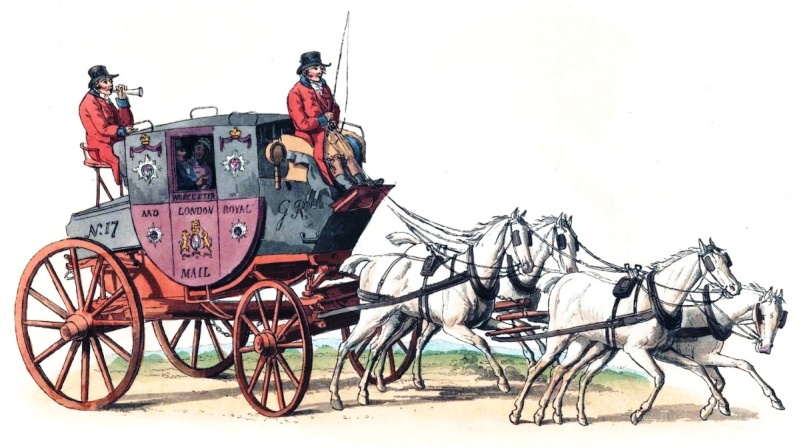
The Royal Mail service was first made available to the public in the
reign of Charles II at a time when most of the country’s mail was
carried by mounted post boys, whose solitary progress left them a
vulnerable prey to highway robbers. In 1784 when the Post Office
adopted the use of Stage Coaches, which became the most important
vehicles on the road. By the 1830s and 1840s, the nightly
departure of the mail coaches from the General Post Office in St
Martins-le-Grand was one of the sights of London, but by 1846 it was
over, replaced by the new, faster railway services.

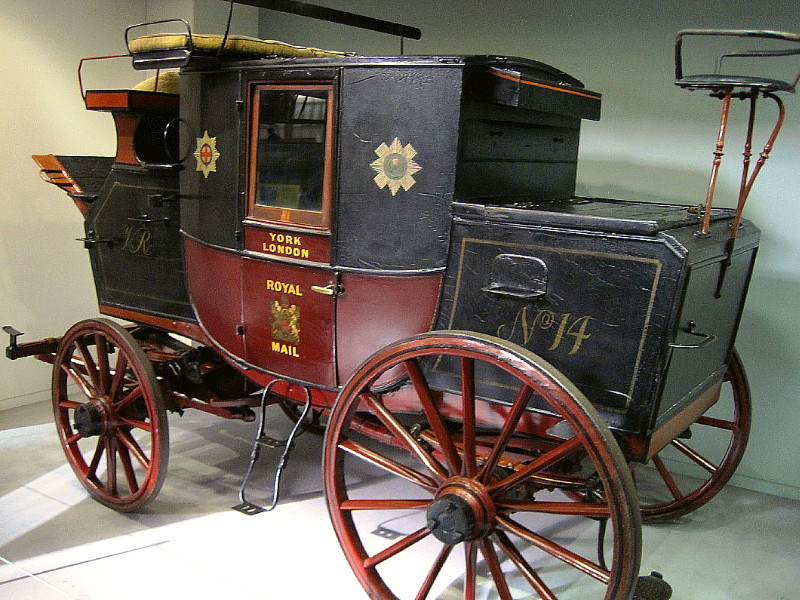
Royal Mail coach ― Science Museum, London.
This vehicle employs steel leaf spring
suspension.
Mail coaches were not owned by the Post Office but by contractors, the
only Post Office employee being the Guard, who was armed with a horse
pistol and a blunderbuss; he also carried a clock, kept in a leather
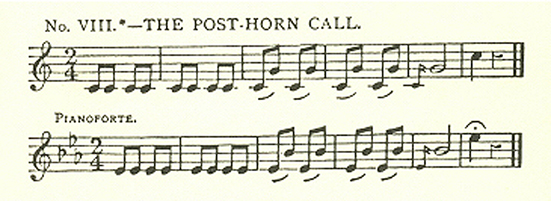
pouch, and was equipped with a post horn to give advance warning of the
coach’s arrival. Many guards prided themselves on their post-horn
blowing skills. The three-foot long instrument, made of tin,
produced four deep and bell-like notes to sound the instantly
recognisable message of ‘Clear the Road’. This was a warning to
inn landlords of the imminent arrival of the coach in order that ostlers
could have ready the change of horses. It also alerted toll-gate
keepers to open their gates, for the law demanded that vehicles carrying
the Royal Mail should encounter no obstructions to impede their
progress.
This from the Buckinghamshire, Bedfordshire & Hertfordshire Chronicle,
9th June 1821:
|
NEW ROYAL MAIL COACH to Birmingham, Warwick and Leamington Spa. The Nobility, Gentry and the Public are most respectfully informed the above Royal Mail coach leaves the Kings Arms Inn, Snow-Hill, London, every evening through Watford, Berkhamsted, Tring, Aylesbury, Winslow, Brackley, Banbury, Southam, Leamington and Warwick to Birmingham. Messrs. Hearn, Griffin, Mash, Vyse & Co.
Performed by T. Dale, T Landon, C Wyatt, Abraham Godfrey & Co. |
|
|
|
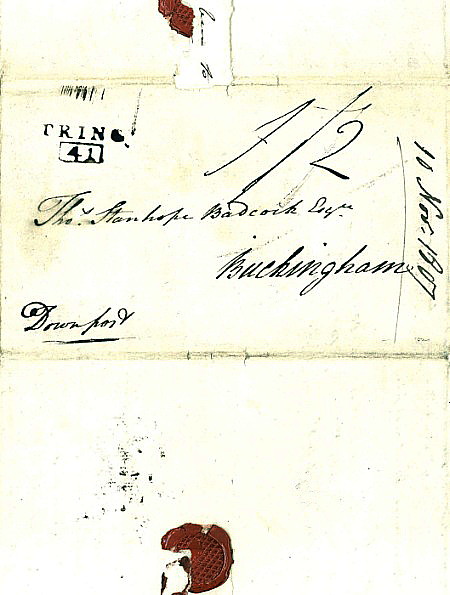
A letter sent before the advent of the penny post. |
Writing in the 1890s, Tring historian Arthur MacDonald had this to say about the local mail coaches:
“There were two Royal Mail coaches passing through Tring, the down
mail about midnight, and the up coach about three in the morning,
rousing the town by a lively tootling from Parsonage Bottom [3]
to the corner of Frogmore Street, where the little Post Office stood
[4]
apprising the indefatigable Post Mistress, Miss Betsy Montague,
of its approach. . . . . these coaches changed horses at the Cow Roast,
halfway between Tring and Berkhamsted, then a wayside inn of importance,
its stables being filled with the numerous horses then used on the
canal, as well as the changing teams for coaches.”
An intricate postal charging scale was based on distances from London,
the distances shown being the same as those on milestones by the side of
the road. When a letter was despatched on a cross country route,
it was usually carried by a Post Boy on horseback to a Post Office at a
mid point, where it was franked with a Mileage Mark showing its distance
from London, there to be collected by the mail coach if necessary.
The example shown is a letter sent in 1807 from Bledlow to Buckingham
(the addressee of the missive, Thomas Stanhope Badcock, was the father
of Vice-Admiral Stanhope who lived for a while at Drayton Manor,
south-west of Tring). The postal charge on this letter, 1s.
2d., is written on the front and is payable at the receiving end.
The mileage mark, ‘41’, is Tring’s distance from London. [5]
|
“Stamps have been invented for sticking on letters. This will save going into the Post Office and paying the fee for a letter.” Tring Vestry Minutes, 25th April 1840. |
Tring’s Post Office once stood on the corner of the High Street and
Frogmore Street. Following the introduction of the Uniform Penny
Post in 1840, letters could be sent throughout the U.K. for a penny,
payment being made with the first prepaid postage stamp, the ‘Penny
Black’. The volume of mail increased and it became apparent that
the small cramped office with its inconvenient street corner position
was unsuitable. Tring needed something better-suited to the modern
age; the poem in the
Appendix explains what happened then, and since.
Some looked forward to travel on the new public railways with fear and
apprehension, but these feelings were quickly dispelled when its
comparative speed, safety and comfort became apparent:
|
I left the realm of silence by the Rail. THOMAS COOPER |
Mail was first carried by train on the Liverpool and Manchester Railway
in 1830, and in 1838 (the year in which the London & Birmingham Railway
opened throughout) legislation was introduced to regulate the conveyance
of the mail by railways. As the railway system spread, the
horse-drawn mail coaches disappeared from our roads. But despite
the speed of mail in transit increasing dramatically, this was not
reflected in the time it took to distribute it to its recipients.
Mail bags still had to be conveyed between railway stations and sorting
offices by conventional means, not always a smooth operation as one
disgruntled commentator pointed out:
|
“THE RAILWAYS, THE PUBLIC, AND OURSELVES. The following time-table of the ‘Trains, as they were and as they ought to be’ will give our friends some idea of the annoyance to which the present disarrangements on the Great North Western line subject the public. The arrival of the trains in London is far worse ― seldom less than an hour behind the proper time. The absurd system pursued by the Post Office, in ordering the mail cart to wait at Tring the arrival of the northern as well as southern mails, was fully shown on Thursday morning, when the London letters might have been sent on five hours earlier than those from the north, which were detained by an accident.” Bucks Herald, 19th August 1848. |
There was fierce competition between rival coach proprietors, which
increased following the opening of the London & Birmingham Railway to
Tring in October 1837. Of the many coaches passing through Tring
the best known were:
|
The Expedition ― An advertisement of 1789 stated “the Original London, Banbury, Buckingham, Winslow and Aylesbury elegant Post Coach. To Tring, Berkhamsted and Watford and setting out every morning from the Red Lion, Banbury, at 5 a.m. The coach carries four inside passengers.” Performed by Pratt, Stamp & Son, Graves. |
A passenger luggage and parcel carrying service was also offered, with
no responsibility for anything above the value of £5.
The King William from Kidderminster and Leamington passed through
the Town on alternate days, changing horses at the Rose & Crown.
The guard, probably for the sake of distinction, performed on the key
bugle:
|
“Tring. The new guard on the King William coach from Kidderminister, is an excellent performer on the key bugle. It is a very pleasing sound, as the coach enters the town in the early morning.” Tring Vestry Minutes, 1830. |
The Dispatch was better known as ‘Wyatt’s Coach’ after its
regular driver, James Wyatt. The Dispatch was the favourite of
the road and its punctuality was such that people were said to have set
their clocks by it ― but not all agreed that Wyatt was a good
timekeeper. According to the recollections of William Toovey,
writing in the King’s Langley Parish Magazine in 1895, “. . .
. the driver, Wyatt by name, used to stop very frequently for
refreshment, and was known occasionally to stop at the Windmill Inn,
Bushey, and join in a rubber of whist, whilst the coach and its
passengers waited outside . . . .” Other than that, his
affability to his passengers made it quite the thing to go up by Wyatt’s
Coach, and his habit of blowing kisses to a lady fare was too delicately
polite to give offence:
|
Tring Vestry Minutes. |
Wyatt drove The Dispatch for 40 years. On his retirement,
he was presented with a handsome testimonial by some of his many friends
and passengers and it was said that he was only absent from his seat on
one day, when he went to give evidence at the murder trial of the keeper
of the Aylesbury toll-gate [Chapter
7]. By 1838,
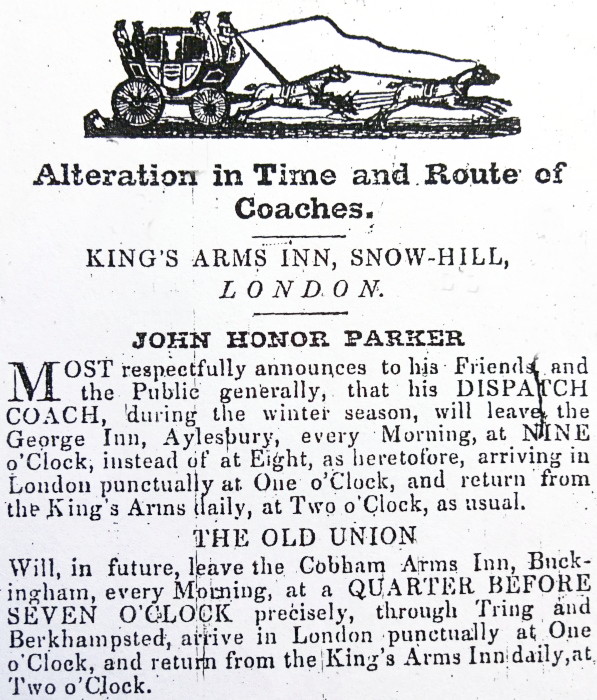
The Despatch was operated by warehouseman John Honor Parker, and
ran daily from The George at Aylesbury to the Kings Arms,
Snow Hill, London.
The Old Union, another Parker coach ran from Buckingham, through
Tring and Berkhamsted to Snow Hill, London. After 1839, Parker
began advertising his vehicle as ‘The Union Dispatch’, presumably
because he had either rationalised or expanded his business. His
later advertisements show that he was making use of new technology in
offering a carrying service by rail in addition to his existing road
transport.
|
|
|
Aylesbury News coach advert, 1839. |
The Good Intent ran from The Bell or The Plough at
Tring to
The George, Holborn, starting early at 7 a.m. Jack Hale,
one of the guards on The Good Intent, took over as driver of
Tring’s first bus service, which ran between the town and the railway
station.
The Young Pilot, rival to The Good Intent, ran from either
Aylesbury or Tring (also at 7 a.m.) to London. The fares were kept
very low by the keen competition, which created some excitement along
the road, the partisans of the one cheering their favourite as it drove
up with “Good Intent forever” and being answered the opposition “Throw
him in the river”.
After the London & Birmingham Railway opened, a particularly dashing
coach was driven from Watlington and Thame to Tring Station by a Major
Fane, with a team of thoroughbred horses which were changed at The
Bell on Tring High Street. Major Fane’s gallantry on the road
left Wyatt in the shade, and the bravura performance of his horses
resulted, not infrequently, in his coming in with a missing horseshoe,
or even short of one of his team through some mishap.
Among the wealthy sections of society, all of whom would own private
coaches, was one illustrious user of the road. It was not an
unusual sight in Tring to see the exiled King of France and his retinue
rumbling their way from Hartwell House in Aylesbury and on to London.
Bored by country life, King Louis VIII often sought pleasures in the
capital, stopping at various coaching inns along the way, particularly
The King’s Arms in Berkhamsted where he was said to have a ‘close
friend’.
Stage Wagons were a prominent feature on the road, conveying the heavy
goods and the poorer travellers. They were huge cumbrous affairs
with eight or nine horses, and would carry as much as 10 tons.
Joseph Hearn of Aylesbury, referred to above, ran wagons as well as
passenger coaches.
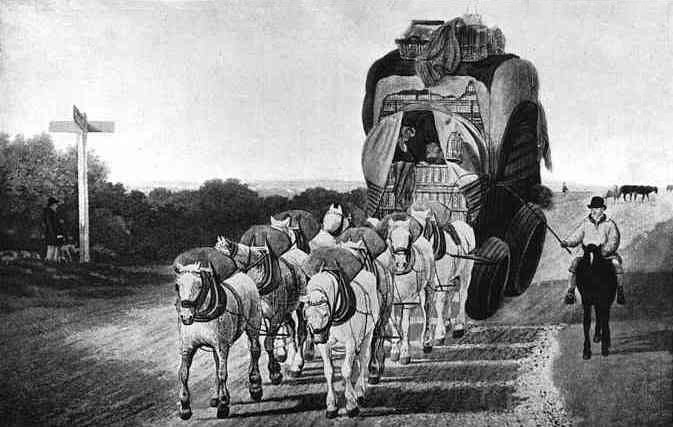
A stage wagon.
From every town and village in the locality, smaller conveyances,
sometimes owned and driven by one individual, provided carrying services
to London and to all towns and villages within a wide radius of Tring.
For example, Kelly’s Post Office Directory of 1848 listed 69 such
services operating from Aylesbury, with three of these specifically
mentioned as serving Tring. From Tring itself, wagon operators
included William Stevens from his house in Dunsley hamlet; Joseph Hedges
from The Plough; Thomas Rodwell from The Green Man; Crook
and Slade from The Bell; and Elliott, Horwood, and Parker & Co.
from the Rose & Crown.
Coachbuilders.
Many skilled trades served the needs of the era of horse-drawn
transport, including those of the blacksmith, the wheelwright and, of
course, the coach builder. Such was the volume of traffic that
even in small market towns, crafts and businesses of this type could be
found. An 1839 trade directory for Tring lists William Griffin as
‘a wheelwright and gig maker’. Thirty years later, coachbuilder
George Parrott set up premises in Western Road. At the end of the
century he took A S Wright, his apprentice, into partnership and in 1910
the firm became known as Wright & Wright when a cousin joined the
business. Robert Wright, who had served his apprenticeship at
coachbuilders E. King & Sons of Berkhamsted, remembered:
|
“I was apprenticed to this firm in the body-building department in June 1895. In those days we built not only trade carts and dog carts, but ‘Ralli’ carts, [6] governess carts, phaetons, broughams, landaus, and even a bus for Mr Williams of Pendley”. |
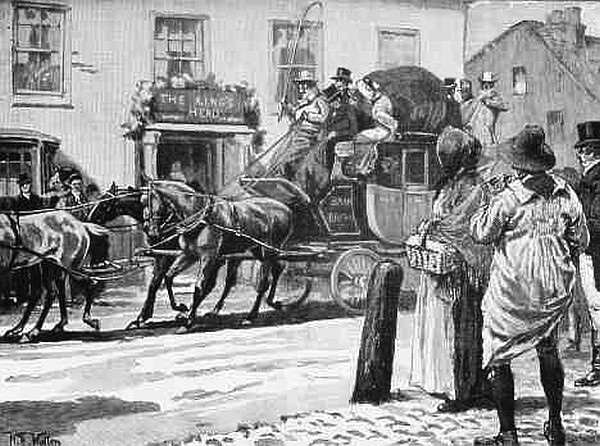
Most towns along main roads boasted one or more coaching inns, often
located in a prominent position and serving as the centre for the town’s
main activities. Usually, an imposing entrance doorway led
to the interior of the inn, whilst sited to one side was the high
archway leading to an inner courtyard of sufficient width to allow a
coach to turn round. Surrounding this, or in the driveway leading
to it, were rows of stabling with accommodation above for ostlers and
drivers of stage wagons and carriers’ carts, and sometimes an inn owned
its own meadows to provide an ample supply of fodder. Being on one
of the chief routes to London, Tring supported several inns that served
coaching needs.

Tring High Street
looking south. The old Rose & Crown Inn, demolished in 1905,
is on the
immediate right.
The Rose & Crown, located on Tring High Street, was the
town’s largest coaching inn. It was first recorded in Tudor times,
but is probably older. Three storeys high and with a central
archway, a Georgian frontage was added later thatstood flush with the
line of shops facing the public footway. Built to the general
pattern of the times, the rear area enclosed a large yard with stabling
facilities and tack rooms. The Inn was so busy during the heyday
of the coaching era that extra stabling was provided at The Plough
opposite (now Anusia’s Café); above the stables was a billiards room for
recreational use by ostlers and coachmen. One coach, The Good
Intent, owned by The Rose & Crown ran either from The
Plough or The Bell. The advent of the railways
adversely affected the coaching trade, and in 1852 the landlord opened a
booking office for the London and North-Western Railway Company, and a
horse-drawn omnibus provided a service between the inn and Tring
Station.
The advent of the railways badly affected the coaching trade, but in
1852 the landlord of the Rose & Crown opened a booking office for
the London and North-Western Railway Company and provided a horse-drawn
omnibus service between the Inn and Tring Station.
The later Rose & Crown Hotel, with the station horse omnibus in the foreground.
In 1904, the townsfolk of Tring suggested to the then owner, Lord
Rothschild, that he might enhance the town with a first-class hotel.
This he agreed to build, his action being reminiscent of a landed
medieval lord who erected additional accommodation to house the influx
of travellers whom, by custom, were his guests.
|
|
|
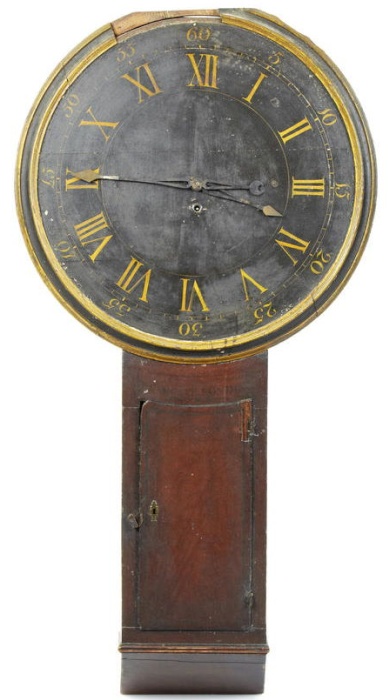
An Act of Parliament Clock. |
The new inn was set back from the High Street and built in lavish style,
with sports facilities at the rear. When complete, the new inn was
leased by Lord Rothschild to the Hertfordshire Public House Trust,
forerunner of Trust House Forte. The hotel finally closed for
business on 29th February 2012, and is now converted to private
apartments.
The Bell ― the earliest written reference to this
ancient inn is 1611, when Henry Geary was brought before the Justices
for keeping The Bell without a licence, and a few years later for
being drunk. Over the years the inn has been heavily restored,
including the loss of its fine carved hood over the entrance door, and
during demolition of some outbuildings in 1937 timbers were discovered
dating to the 13th century. One theory is that the inn acquired
its name from a bell foundry sited at the rear, but there is no evidence
to support this. According to local historian, Arthur Macdonald,
during the time of the construction of the London & Birmingham Railway,
when hundreds of navvies were employed on digging the Tring cutting, the
Parish Constables sometimes had to be called to the premises to sort out
various affrays.
Some of the through coaches changed horses at The Bell, and the
archway leading to the stable yard still can be seen. Folklore has
it that flitches of bacon and cooked game were hung from the beams under
the arch. But if true, and considering this used to be a Right of Way,
in those times of serious hunger one wonders how safe a storage space it
might have been. Over the gateway extended a long room that was
used for a variety of entertainments ― it was expected that coaching
inns could provide an assembly room, such as this, for a various
entertainments and meetings.
In 1797 an Act of Parliament was introduced which imposed a five
shilling tax on every clock. The Act was most unpopular and was
soon repealed, but during it was in force the response was to hang
clocks on the walls of public places, especially in taverns as landlords
of larger establishments welcomed the additional trade this could
generate. Ever after, these clocks become known as ‘Act of
Parliament’ clocks. They had weight-driven movements and plain
dials of two to five feet in diameter, and one such is known to have
hung in The Bell and another is still in place in The King’s
Head in Aylesbury.

The King’s Arms ― it is not known exactly when this public
house opened, but circumstantial evidence suggests some time during the
mid 1830s. It was built with adjoining stabling to house six or
more horses, with a hayloft above. The pub was named after the
‘Sailor King’ William IV who reigned from 1830 to 1837. Erected by
Tring brewer John Brown, his pub presented a more imposing appearance
than the cottage-style beer houses prevalent in the area, and has not
changed structurally in any significant way in the intervening years.
Brown chose the sites of the 11 pubs that he built or acquired in the
locality with care; his eye to maximising profits of The King’s Arms
gained from passing equestrian trade; both The King’s Arms and
The Britannia (another of John Brown’s pubs), faced west to welcome
travellers approaching the town from the Aylesbury direction.
Also, it is likely that he was aware that the western side of the town
would see considerable development, as proved the case in the
mid-Victorian period when new side streets, workshops and businesses
sprang up within the
Tring Triangle.

The Britannia stood at
the junction of Western Road and Park Road (a.k.a.
“Bottle
Cross”).
It is now a private
house.
As time went by, the stable block became a corn merchant’s warehouse,
the hayloft was converted for use as a meeting room, and the garden was
sold for development. After near-terminal neglect in the 1970s,
the Grade II-listed Kings Arms again flourishes, with a
reputation for good ale and home cooking, while its distinctive dark
pink-colour scheme is a local landmark.
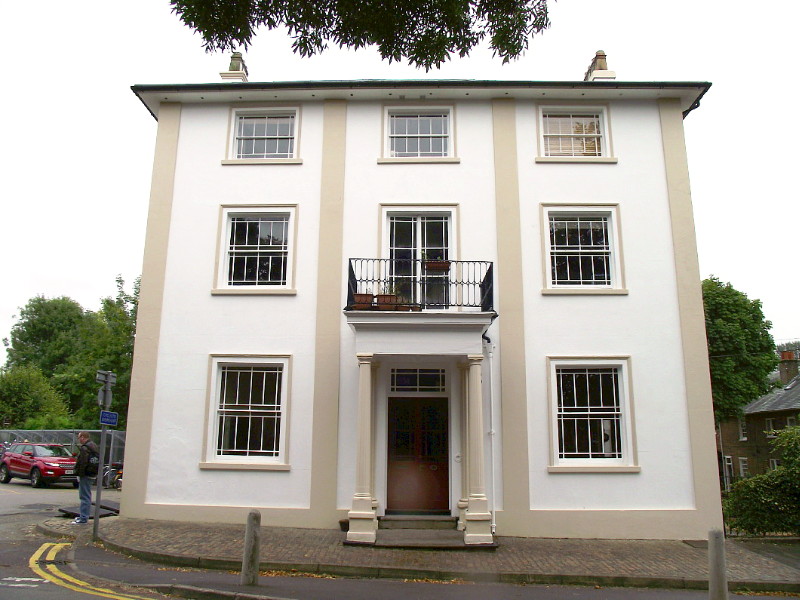
The former Royal Hotel, Tring Station.
The Royal Hotel (formerly The Harcourt Arms), Tring
Station ― Although built in 1838 to serve the needs of passengers using
the new railway station, the hotel was also a Posting House, that is an
establishment where horses, a carriage, and a coachman could be hired,
as were The Rose & Crown and The Plough in the centre of
Tring. A large yard at the side of the premises surrounded by
ample stabling for horses, kennelling for hounds, and provision for
animals at livery, resulted in the hotel rapidly acquiring an excellent
name as a centre for local hunting activity. Fierce was the
competition between coach proprietors to provide transport to the new
railway stations, and local papers of the time carried many
advertisements proclaiming what excellent services they could offer.
A spacious ballroom at the rear supplied a suitable venue for gatherings
of the well-to-do of the district. The hotel and outbuildings
remain, but now all are converted to houses and apartments.
The Cow Roast Inn ― the present Cow Roast, a Grade
II-listed 17th century inn, was probably built on the site of a more
ancient establishment that stood by the roadside between Berkhamsted and
Tring. The name supposedly is a corruption of the original ‘Cow
Rest’ or ‘Cow Roost’, an area where cattle drovers and their beasts
could break their journey and rest overnight on their way to Smithfield
Market in London. [7] The travel writer John Hassell observed that
the spot was . . . .
|
“. . . most erroneously named [Cowroast] . . . Here we saw herds of cows grazing, and observed a fresh drove of sucklers with their calves coming up to remain for the night, and we found, upon enquiry, that this inn was one of the regular stations for the drovers halting their cattle for refreshment; hence I should suppose, the proper name is the Cow Rest, or resting place of those animals, for along the road, and all the way through the breeding and grazing parts of Bucks, Bedfordshire, and Northamptonshire, there is a perpetual supply of cows passing to the capital . . . .” A Tour of the Grand Junction Canal in 1819, John Hassell |

Driving cattle long distances continued even into the age of the
railway, and drovers were required to have a licence and pay road tolls
― where they could not be avoided. Bones of a variety of animals
have been excavated around The Cow Roast, mostly of the cows
penned for the night in the surrounding fields. In 1806 these
fields were owned by Thomas Landon, the owner of The Cow Roast
and the wharf on the nearby Grand Junction Canal, and the stables of the
inn sheltered not only the horses used on Royal Mail coaches, but also
the heavier type that hauled narrow boats along the towpath.
The period 1885 to 1910 showed a rise in popularity of the light railway
or tramway. All cities and most large towns were by then connected
by standard gauge railways, and the desire for rail communication
between villages was natural. The line planned for Tring was to
start a few yards to the east of the London & North-Western Railway
station, and would have turned west using the road bridges across the
railway and Grand Junction Canal. Its route was then to have
followed Station Road to the High Street, with planned stopping points
at Beechgrove House, Brook Street, Frogmore Street, The Britannia Inn,
before going onwards to the outskirts of Aylesbury. But the scheme
never materialised due to lack of investment and, some believe,
objections raised by Lord Rothschild.
――――♦――――
――――♦――――
FOOTNOTES.
1. During the 19th century, some Cleveland Bays were bred with
thoroughbreds to produce the ‘Yorkshire Coach Horse’, a now extinct
breed once native to England. It was a large, strong, bay or brown
horse with dark legs, mane and tail. It was said to be
“a longer-legged carriage horse with unmatched ability for a
combination of speed, style, and power” and “a tall, elegant
carriage horse”.
2. The King’s Messengers are generally accepted to be the origin of the
postal service. The first recorded King’s Messenger was John
Norman, who was appointed in 1485 by King Richard III to hand-deliver
the monarch’s secret documents. Today, the Corps of Queen’s
Messengers are couriers employed by the Foreign and Commonwealth Office
to carry secret and important documents to British embassies and
consulates around the world.
3. Sited in the dip in Christchurch Road.
4. Now ‘The Motorists’ Centre’.
5. Before the invention of the envelope, letters were folded and sealed
with sealing wax.
6. Small, two-wheeled vehicle similar to a gig.
7. There are numerous paths and lanes in the Chilterns that are enclosed
with ancient hedgebanks and steep sided ditches. These sunken
tracks are known as ‘hollow-ways’, and the depth of many that run down
the Chiltern escarpment reflect their origins as drove roads, in use
over hundreds of years to move livestock from local villages to their
common lands. This activity, called ‘droving’, also took place
along main roads, with livestock being driven to market.
――――♦――――
[Next
Page]
|
|