|
THE MEDIUM AND DAYBREAK
LONDON, MARCH 29, 1872.
_______________
MR. GERALD MASSEY ON SPIRITUALISM.
Most of us have friends who mean well, but have an
unfortunate way of allowing it. They damn us with faint praise,
without intending to do so! We may know their little peculiarities
and allow for them, but outsiders may not. All illustration of
what we mean occurs in the last number of the Spiritualist.
Here it is: "Mr. Gerald Massey will shortly give a series of four
lectures at St. George's Hall, on Spiritualism, in which he will answer
the objections recently advanced by Dr. Carpenter and others.
Although he is not the man to do battle with scientific weapons, he will
bring to bear that common sense of which Dr. Carpenter speaks so highly,
and as he is a lively and talented essayist, his lectures will doubtless
be of considerable interest. He is supported by a committee of
some of the leading friends of Spiritualism." No doubt the writer
of this meant well, but if he had been patronising a youthful writer for
Punch he would have been much nearer the mark. Mr. Massey has
no doubt written "lively" and" talented" essays, seeing that he was for
many years a contributor to the Quarterly Review, the
Athenaeum,
North British Review, and various other periodicals, but his only
essay before the public is the one "Concerning Spiritualism." Our
contemporary does not seem to know that Mr. Massey has been heard of as
a poet here and there, now and again, all round the world. Sixteen
years before our contemporary was born, Mr. Massey was universally
hailed as a new and genuine poet when he published his" Babe Christabel,
and other Poems," of which five editions were called for in one year.
As a poet, and "the first of all who in our time have sprung from the
people," he was placed on the Civil List for a literary pension, by Lord
Palmerston, many years ago. For the benefit of our contemporary
and others, we will subjoin a few more facts, selected from a memoir of
Mr. Massey which was printed some time since. Twenty years ago he
was lecturing on Spiritualism amongst the Secularists, &c., at John
Street and the Hall of Science, City Road. He started and edited
the Spirit of Freedom in 1849; was engaged working on behalf of
Co-operation with the "Christian Socialists" in 1850-1-2; was London
correspondent of the
New York Tribune in 1854-5; contributed a large number of sketches to
the "Men of the Time" (second edition, 1856); edited an Edinburgh paper
in 1855; published "Craigcrook Castle" in 1856; "Havelock's March, and
other Poems," 1861; "Shakspeare's Sonnets and his Private Friends,"
1866—a labour of love and of three years' research, aided most potently
by spiritual revelation. "A Tale of Eternity, and other Poems,"
was published in 1870. For ten years Mr. Massey reviewed for the
Athenaeum; during four or five for the Quarterly Review; and
for ten years he wrote for Good Words. He has been a
lecturer during some fourteen years—one of the highliest prized—and has
delivered more than five hundred lectures in the three kingdoms. Here
are two or three opinions of him as a lecturer:—
"Never have lectures given more delight and satisfaction than those of
Gerald Massey."—Newcastle Chronicle.
"They are full of beautiful gems exquisitely set."—Hertford Mercury.
"For two hours he kept the large audience—comprising the noblest minds in
Newcastle—entranced, as he grandly pleaded the Pre-Raphaelite cause. * *
* * At the close of the lecture, which was throughout a poem, the
audience broke up with praises of the poet-lecturer on their lips.
Never was lecturer more successful—Gateshead Observer.
"The Bishop of Derry (Dr. Alexander) expressed the peculiar satisfaction
he felt in being there to welcome to the good old city of Londonderry a
man of real genius, and a genuine poet. Mr. Massey was there to
discharge a duty for which, himself a poet of a high order, and a subtle
critic, he was eminently qualified."—Londonderry Paper.
"All who were there thoroughly enjoyed the hour and a half with a wit and
poet. The opening of his lecture was marked by such an incessant
play and sparkle of puns and other witticisms as to suggest that the
spirit of Hood was present in person. A lecture more humorous,
more pathetic, more exhaustive, more interesting or delightful, was
perhaps never delivered."—Gloucester Journal.
"There was all the humour—all the wit—all the pathos—written as it were in
Lamb's own style. None but a poet could have brought out the quiet
pathetic touches of Lamb's life as Mr. Massey brought them out.
There was all the light and all the shade of the charming picture."—Northern
Whig.
As a poet, Mr. Massey began as the advocate of unpopular
opinions, for he was, and is, essentially the poet of the people—of the
poor. And yet he succeeded at once in conquering the recognition
of the rich man's press, as the following brief extracts will show:—
"Here is another poet, and one whose story and position as
a teacher and a preacher clothe him with unusual interest."—Athenæum.
"A man who has fought his way to the temple-gate of fame, sword in hand.
May his Summer day be fair as the spring dawn is bright!"—Times.
"There is a real glow about all Mr. Massey writes."—Edinburgh Review.
"Heartily do we congratulate the age that sees the advent of the poet of
'Babe Christabel.'"—Church and State Gazette.
"In whatever part of the field of literature we meet him, he deserves
recognition as u writer of earnestness and ability, who has achieved
success under circumstances which, in the case of the vast majority of
men, would have involved total failure."—Guardian.
Many years ago the London Review said: "The career of
Gerald Massey marks an era of progress in the history of his country.
It shows how the people are advancing, and prefigures their coming
possession of political power. Brave, honest, free-spoken Gerald
Massey! He has won his own independence, and his now recognised
title. From his mind emanates the flower of poetry, that is
destined to live and give forth sweet odours, over fresh and ever new,
as long as our English language is a living tongue in this world."
"It is in some respects unfortunate for Mr. Massey that,
where he is at his very best, his poems do not challenge criticism at
all. We receive them; rest in them; and occasional lines dwell
with us with a lingering tenderness that oftenest imposes reticence.
Like some of Uhland's they are charged with the Heimwch, the
longing look-back, or rather let us say the longing look-up, which
supervenes on great and crushing experiences. Their sensuous
beauty is one thing, their suggestion for the crushed soul is quite
another thing, and it is impossible their whole beauty should be seen
save through the latter; and then the human heart is scarce in a mood
for speech, even to utter its gratitude for words of cheer and
helping."—Nonconformist.
We are privileged to quote a letter lately received by Mr.
Massey after one of his lectures into which he had skilfully inserted a
good deal of Spiritualism:—
"Nov. 27, 1871.
"MY DEAR
SIR,—I thank God that He has
permitted me to see your face in the flesh, and I hope that I may one
day have the privilege of clasping the hand that penned the "Wee White
Rose." Eight years ago we laid our darling firstborn in the grave, and
many a time, in the weary days that followed, your sweet words made
music in our lonely hearts, and my husband and I have cried together
over them, and loved you for writing them. Now he too has gone, and
another precious child since, and I have less left on earth than in
heaven.
"I have no right to trouble you, but, I must thank you out of the
abundance of my heart for the sweet comfort that mingled with your words
to-night. I feel sure you will be glad to know that you made one
desolate heart to sing for joy—yet you taught no new doctrine, but just
what Jesus Christ Himself teaches in his word concerning those that
"sleep in Him." God bless you for the way in which you unfolded such a
blessed truth! I think I shall meet you in the "upper sanctuary," if I
do not down here, and I shall thank you again then. With loving and
grateful thanks, I am, my dear Sir, most sincerely yours."
Of his later works, we are pleased to know that Spiritualists
are making themselves more or less acquainted with them.
So that, on the whole, we do not think Mr. Massey deserves to
be made known in our ranks as a "lively essayist." He does not
come amongst us either to win his spurs or to have them hacked off.
He is no dilletante Spiritualist, but one who has lived face to face
with the phenomena in his own house during fifteen years. Our
contemporary suggests that Mr. Massey is not the man to answer Carpenter
"with scientific weapons." What are they? The Quarterly
Reviewer's weapons—those that cut deepest were malevolent
misrepresentations, falsifications of fact, and miserable decryings of
men who had done some work in the world. It will be a sufficient
answer to Dr. Carpenter for anyone who is manly and knows his subject,
to be manly and speak the truth. Spiritualism is so many years
ahead of Dr. Carpenter that he will never overtake it in this world.
As for the next, we trust his doom may not be to have to come back after
death and try to convince others of the truth which he denied in life,
and move his wordless lips in vain across the grave to a world that will
not heed him. He shot an arrow or two which happened to reach our
"Psychic Force" friends far in the rear of our movement. And it
turned out that the arrows were poisoned. This caused their
outcry. But for this circumstance, can any Spiritualist find any
real argument in the article to answer? Dr. Carpenter has not been
nearer to Spiritualism than Burns's poet "Willie" was to Pegasus.
Of what avail would it be to demonstrate to him that the universe is not
to be measured by a Carpenter's rule, or that it is far easier to get
solid bodies passed through walls and ceilings than a new idea through
certain big-wigged skulls? Let Dr. Carpenter go on objecting.
He can't do better for us, and will certainly do for himself. And
let Mr. Massey give us his facts; tell us the story of his particular
personal experience; and throw what light he can on the subject
generally for the benefit of others.
_______________
MR. GERALD MASSEY'S LECTURES ON SPIRITUALISM.
In accordance with the promise given last week, we are now
enabled to present some particulars respecting the forthcoming course of
lectures by Mr. Massey, at St. George's Hall. The secretary, Mr.
Daw, has handed for publication the following list of names constituting
the
COMMITTEE OF INVITATION:—
Rev. Sir William Dunbar, Bart.
Sir Charles Isham, Bart.
Cromwell F. Varley, Esq., F.R.S.
William Crookes, Esq., F.R.S.
George Harris, Esq., F.S.A., Vice-President Anthropological Institute,
&c., &c.
Rev. S. E. Bengough, M.A.
H. D. Jencken, Esq., M.R.I., Barrister-at-Law.
Mrs. Makdougall Gregory.
Mrs. Berry.
Mrs. Hamilton.
N. F. Daw, Esq.
James Wason, Esq., Liverpool.
Andrew Leighton, Esq., Liverpool.
Nicholas Kilburn, Jun., Esq., Bishop Auckland.
William Tebb, Esq.
Benjamin Coleman, Esq.
A. C. Swinton, Esq.
Thomas Shorter, Esq.
T. Traill Taylor, Esq.
William White, Esq.
It also gives us pleasure to report that the invitation, thus
influentially presented, has been as cordially responded to by Mr.
Massey, who has forwarded to Mr. Daw the following list as the subjects
of his lectures:—
FIRST LECTURE.
Sunday, May 12.
Facts of my own personal experience narrated and discussed, together
with various Theories of the Phenomena.
SECOND LECTURE.
Sunday, May 19.
Concerning a Spiritual World in relation to the Natural World.
THIRD LECTURE.
Sunday, May 26.
The Birth, Life, Character, and Teachings of Jesus Christ, delineated
from a fresh point of view.
FOURTH LECTURE.
Sunday, June 2.
Christianity and (what is called) " Spiritualism."
By another week the arrangements will have been perfected for
the issue of tickets and means for obtaining the necessary publicity,
and in promoting the success of this very desirable course, we have no
doubt every Spiritualist in or near London will actively and heartily do
his part.
___________________ |
|
THE MEDIUM AND DAYBREAK
LONDON, MAY 17, 1872.
No. 111.—VOL. III.
_______________
GERALD MASSEY AT ST. GEORGE'S HALL.
On Sunday last, Mr. Massey gave the first of his course of
four lectures on Spiritualism in the above place. The hall was
well filled by an intelligent and appreciative audience, who, although
the lecture lasted for nearly two hours, manifested the utmost attention
throughout. It speaks highly in favour of the ability of a
lecturer when he can so hold his readers entranced, as it were, for two
long hours on a Sunday afternoon, listening to a prelection on that most
tabooed of all tabooed topics, "Spiritualism." But we need to make
no gratulatory remarks on Mr. Massey in introducing him to our readers
as a lecturer on Spiritualism; he has already made his name known and
his works admired in nearly all departments of literature, and, as he
himself puts it, has "established his sanity with the world by work done
in other departments," before coming out as an advocate of Spiritualism.
The subject of the discourse on Sunday was: "Facts of my own
Personal Experience narrated and discussed, with various theories of the
alleged Phenomena." The lecturer commenced by stating that he was
no visionary, and that he had no predisposition to superstition; he had
from an early age been obliged to earn his living, commencing with the
pitchfork and ending with the pen, and so from youth upwards had been
compelled to look hard facts in the face. His abnormal experience
came unsought, by the visitation of God, as it was called. He had
had no wish to "try the spirits;" they had tried him too much; but once
being assured of a fact, he dared stand by it before the world even in
the minority of one. It was popularly supposed that poets were
born liars; be that as it might, he had spent twenty years of his life
trying to tell the truth; but the world was so constituted that it was
hard work getting a living by telling the truth. He had come of a
race no individuals of which had ever been known to go mad; nor had he
induced an acquaintance with one kind of spirits by too free a
familiarity with another kind. He mentioned these things because
they were looked upon by many as the "natural causes of the
supernatural." Like Horatio, he began by doubting everything, and
ended by doubting his very doubts. He considered the fact of
Shakspeare's describing Hamlet as doubting the possibility of the
continuation of existence, after having confronted his father's ghost
only the night before, as one of the poet's profoundest insights, it was
well known how hard it is to believe, even though one came from the
dead.
The lecturer went on to say that the only facts he should
make use of had come under his own notice, knowing, as he did, "how
glory grows out of the haze of distance." Some two-and-twenty
years ago he was invited to see a clairvoyante read without the use of
her eyes. He was asked to place his finger over her eyes so as to
prevent her from being able to see. He knew so little of what was
expected of him that be placed his fingers so wide apart that she could
see between them. This lady afterwards became his wife, and he
found that this reading by abnormal vision was a fact. He had
never properly understood it before. Since then, however, he had
seen her read so hundreds of times and convince hundreds of people.
Many persons had been prepared for the acceptance of Spiritualism by
what they saw of her clairvoyance. Not only did she read books in
this manner, but the human body itself appeared to be diaphanous to her.
She had been made use of in the hospitals to diagnose diseases and
prescribe for them. Her power was just the same whether her eyes
were bandaged or not; in fact, if the eyes of the flesh were open she
could not read at all. In elucidation of this wonderful faculty he
adduced the following instances. A young man once asked her if she
could see the pain he had. She said that he must have suffered a
fracture of the rib, as one bone was overlapping another. The
young man replied that he had suffered such a fracture, and that he had
always feared the bones had not been properly set. On another
occasion an officer came with a friend. He was dressed as a
private gentleman. He had lost a carpet bag, and wanted to know if
it could be found by means of clairvoyance. She described the bag
and its contents, amongst other things a brace of curious silver-mounted
pistols of Indian workmanship, then a something which she could not
identify. Turning to the officer, she uttered a scream. He
wore an artificial arm; his own, which be had lost in action, was in the
bag, and that was what she had described. Mr. Massey and the
officer ,went to Liverpool in search of the missing carpet bag, but they
could not convince the police that they had any clue or evidence to go
by. One morning, on waking up, at seven o'clock, she informed her
husband that his mother was dead. On being questioned as to how
she knew, she said that she had seen the black-edged letter put under
the bedroom door. At eight o'clock Mr. Massey himself saw the
letter containing the sad announcement put under the door.
The lecturer here introduced a number of other remarkable
instances of the clairvoyant faculty as possessed by his wife, and
therefore coming under his own personal experience; but the facts of
clairvoyance are sufficiently well known and acknowledged amongst
Spiritualists to hardly need any corroborative evidence; although to the
world at large, to whom all abnormal or spiritual gifts are a delusion,
they are gigantic obstacles in the way of the so-called scientific
explanation of things.
He then entered into some details as to the unfortunate
malady of his wife, who through grief at the loss of a beloved child was
afflicted with mental derangement, so that at times her mind was quite
wavering. He felt certain that some forms of insanity are nothing
but diseased somnambulism, that in reality there is no such thing as
insanity of the soul; there was serenity and clearness in the depth of
the spirit-life, while all was chaotic in the troubled life of the
brain.
In 1863 this mental ailment took a peculiar turn.
Hitherto he had been able to control it by Mesmerism. Now,
however, he could not get her mesmerised in order to console her.
One Sunday night the doctors insisted on her removal. He had held
out against this alternative for a long time, but now his resolution
began to waver. They had retired to bed, but she was still very
violent. Suddenly he heard a strange noise. It was like a
scratching and scraping and knocking on the footboard of the bed.
At length the noise arrested her attention. He at first thought it
was she who was making the noise with her foot against the hot-water
bottle. She also thought it was he. The sounds increasing,
he procured a light and removed the water bottle. The noise went
on. It appeared as though a rat were in the room gnawing at the
foot of the bed. Then he thought a dog was in the room, and was
scratching on the boards. His wife insisted that there was a dog
in the room. He turned up the bed and mattress, but without
finding any explanation of the mystery. The scratching and
scraping, occasionally culminating in a rap, somewhat like the brushing
of a dog's tail against the footboard, still continued. His wife
screamed that she could not stand it. He bore it for some twenty
minutes. Once he wondered if it were possible that there could be
burglars in the room below, and that they were giving them the benefit
of an electric battery to distract their attention. But there was
no one there. At length he called the servant, without, however,
telling her the reason why. She sat down on one side of the bed.
She now passed through similar stages of wonderment to what they had
done. At first she seemed inclined to run away, but finding that
he could stand it, she fancied she could too, and so did not bolt as she
had intended. Next the mother of the servant went and sat on the
other side of the bed, so that there were now four of them in the
room—Mr. Massey and his wife sitting up in the bed, and the servant and
her mother on either side—and still the sounds on the footboard
continued, if anything, in a more energetic manner. He thought of
spirits, but the sounds were so grovelling and dog like that he was
disgusted at the idea. He made use of some expression adjuring the
sounds to cease. Whatever it was, however, it would not be gone.
At last he called out, "Is there a spirit here? If so, give three
raps." There were three distinct raps. "We looked at one
another" continued the lecturer, "and I dare say looked strange. I
was not frightened, but felt white."
Communications having thus been opened, Mr. Massey put other
questions, and learned by raps that his wife's mother and his little
daughter were there. Then he asked, "Have you come on Jane's
account?" Three raps. "Can you do her good?" Three
raps. "To-night?" Three raps. The sounds continued,
and the bed and bedstead throbbed. Then his wife sat straight up
in bed, her face lighted up, and in an intense whisper she said,
"Mother—Mary!" [Ed - probably misreported; other accounts give
'Marian', Rosina's third daughter, who died in 1855 at 11 months]
That night they held a long conversation with the spirits,
and he was told not to put his wife away on the morrow, though she would
be worse, but that she would be better on the following Sunday night;
and, true enough, on the said Sunday night she was nearly quite well.
The lecturer here very aptly remarked that there could not be much of
"epidemic delusion" about these experiences, seeing that they occurred
unexpectedly and to a solitary group of individuals.
Such, said the lecturer, was his first initiation into
spirit-rapping, although at first, he confessed, he could not make much
of it. He had never in subsequent experiences had anything so
clear as on that first night. It may be that the object was more
important. On other occasions answers had as often been wrong as
right, and the spirits seemed to glory in the fact. About this
time a clergyman, a friend, who said he was a writing medium, informed
him that he had invented a stool something like a planchette, only it
was for reading, instead of writing. He brought it, tied a pencil
to its foot, and he and the medium placed their bands on it, and the
stool wrote, "Muller not guilty; robbery, not murder," followed by a
tolerably good facsimile of Shakspeare's signature. This was
repeated in total darkness.
Space will not permit us to go over the whole ground of these
wonderful revelations. Surprised by the above communication, which
purported to come from Briggs, who, it will be remembered, was the man
for whose murder Muller was subsequently executed, Mr. Massey examined
into the evidence against the culprit, and finding that there was no
conclusive testimony against him, he drew up a letter, which he
considered the best piece of logical reasoning he had ever performed,
had eight copies made of it, and sent them to the London papers.
He never saw it in any of the dailies, and therefore concluded that it
had never been published. This was before Muller's execution.
After that cruel finale, the spirit came and thanked Mr. Massey for
"trying to save my poor neck." Some months later he learned,
through a lady who was interested in Muller, that his letter had
appeared in the Daily News.
To turn to the subject of Shakspeare; Mr. Massey had just
written an article on Shakspeare's Sonnets for the Quarterly.
Here was what purported to be a spirit who ought to know something about
this vexed question. He thought, "If this is true, now is my
time." He put his questions accordingly, and was astounded at the
intelligent replies he received. His wife knew nothing whatever
about the question at issue, and had even not been able to help him in
the least in his researches by her clairvoyant power. He had
rejected the 138th sonnet, which came into print when Shakspeare was in
his thirty-fifth year, and Herbert in his nineteenth. It purported
to be "On Age in Love." Now, a man of thirty-five did not
personify age in love. The answer he got to this difficulty was:
"Carefully compare the two copies of the sonnets, and you will find that
a line has been suppressed; it is ironical."
On comparing the two versions (sonnet 138 and the sonnet in
the "Passionate Pilgrim)" he found that the ninth line had been
suppressed, and the entire sonnet was ironical with reference to the
lady's age, and would naturally mean quite the contrary to what it says.
"There was evidence," said Mr. Massey, "as direct as I am
giving to you. Of course, I could only make use of what I was able
to correlate and find evidence for. The other day I printed a
supplement to my work on Shakspeare's Sonnets, in which I dared to use
the information I had received years before."
There must have been some person present who knew things that
were not in his mind and could not have been in the medium's, unless
there be a universal consciousness from whence we are able to draw
supplies of knowledge. The lecturer here also remarked on the
peculiar and varied types of individuals communicating. He
considered that Shakspeare himself did not represent character more
accurately than was done through this medium. Each spirit was
distinctly characterised.
In 1866 his experience took another form. He had
removed into a house which had been presented to him to live in rent
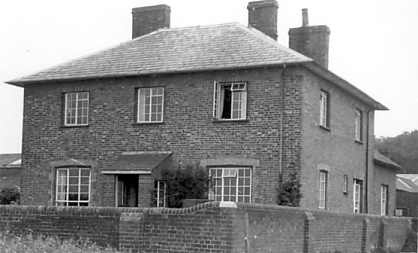
free [Ed. — Ward's Hurst Farm,
near Tring]; but the noises in it were so fearful that their
servant, a Scotchwoman, said she could not sleep in the night.
The noises seemed as if made by the ring of the kitchen range being
continually thrown down. She knew of the power he possessed
through his wife, and asked him to use it to fathom this mystery.
He rather fought against it, as he did not want to be turned out of his
house by evil spirits. Ultimately he had the room doors left open,
and he was awakened by a sound like the falling of a key. At
length he questioned the spirits, and learned that there was an unhappy
spirit connected with the place. There had been a child murdered
there, and it seems that the murderer in going to bury the remains of
the little innocent one had dropped his key in the dark, and night after
night, in rehearsing the fearful drama as a penance, he had to go
through the performance of losing and searching for his key, which
accounted for the noises heard. Mr. Massey had subsequently found
sticking out of a crack in the earth a couple of bones, which to him
appeared to bear a strong resemblance to the bones of a child. He
said nothing about this circumstance to his wife, but hid them away in
the cleft of a tree.
Until this time he had known nothing of the spirit thus
manifesting. Now, however, the spirit of the supposed murderer
frequently came and communicated, often swearing in a most blasphemous
manner. The lecturer here gave a number of illustrations of these
manifestations, in which the supposed murderer communicated many of the
details of his crime. But we may inform our readers that the story
of this fearful drama will be found in Mr. Massey's poem, "A
Tale of Eternity," of which it forms the plot and groundwork; and we
may add that to anyone wishing to read a tale of dramatic interest,
vivid and weird description, pathos, and an insight that seems to
dissolve the veil that divides the seen from the unseen, we can highly
recommend this latest work of the poet. With this terrible
expiator of his crimes done in the flesh Mr. Massey made a compact,
agreeing to pray for him if he would promise not to frighten his
children, which promise was given and faithfully kept. One time
when searching the cellars he found an old rusty key. He thought
to himself that it must be B.'s key, and, wishing to test the affair, he
put it into a particular place called B.'s cellar. The next time
the medium was entranced, she said:—"B. thinks he has found his key."
On leaving the medium the spirit was in the habit of frightening her, to
avoid which Mr. Massey was instructed to throw a handkerchief over her
face at the moment when he relinquished control.
Another curious experience was connected with the death of
Mrs. Massey, who died of heart disease. She turned on her, side
and passed quietly away; meanwhile her husband, who was by her side, not
perceiving any change, continued talking to her. Subsequently, on
his first sitting with Mr. Home, his wife informed him through the
latter that, on the night of her decease, she kept on talking with him,
but he did not answer, thus showing, he remarked, that the change is so
gradual and imperceptible at first that we are hardly aware of it—that
there is, in fact, no death. It is like, to use his simile, the
spinning top when we say it sleeps; the soul seems to have attained the
perfect motion.
The lecturer here made the remark that it was not his wish to
tell a wonderful story. He would sooner set their brains at work
inside the skull than make their hair stand on end outside. With
reference to the spirit-lights, Mr. Massey considered that they were
composed of the emanations from our bodies, with which also the spirits
clothed themselves when they wished to render themselves visible.
He had himself had glimpses of the glory seen round the heads of mediums
in the past. He had seen halos about the heads of persons, and
lights proceeding from the feet of some individuals walking in the dark.
Some remarks followed on the relationship between matter and spirit,
which we have no space to reproduce. Suffice it to say that he
considered this world was continually being fed from the spiritual
state, that bread and beef could not produce mind, and that, indeed, we
do not "live by bread alone."
The latter part of the lecture was taken up with a
consideration of the theories and arguments of Mr.
Serjeant Cox and Dr. Carpenter, a few
passages from which we give in extenso:—
If psychic force be soul force, then psychical children have
larger souls or more potent soul forces then psychical men, whereas
non-psychical people, twenty-nine out of thirty, ought to have no souls
at all, and we have arrived at that period of creation when the soul is
just coming into being, with Serjeant Cox as obstetrist.
Naturally, enough it would be born in the child! But, again, he
argues that it is not a spiritual force, because it proceeds from the
human organism. If so, he cannot include the spiritual in the
human organism, so that the manifestations may not be at fault in
demonstrating their origin as spiritual; only the Serjeant's previous
conclusions, or present dubiousness on the subject of the spirit's
existence. Given a non-belief in the spiritual absolutely, what
amount of evidence will it take to prove its existence relatively?
And if there be nothing spiritual in it, what then does Serjeant Cox
mean by calling it Psychic Force? At page 37, first edition of his
pamphlet, he informs us that the psychic is an unconscious agent—one who
can neither command nor control the force of which he is the medium.
It operates not only independently of his will, but does not even demand
his attention. At page 44 he states that the force is controlled
and directed by the intelligence of the medium—that is, by psychical
consciousness acting unconsciously. The psychic does not know
this, but Serjeant Cox does. In like manner the two German
philosophers may not have been so far out. They sat watching the
shower out of a window, in presence of a stranger; one said, nodding
towards the falling rain, "Perhaps that is I making it rain;" "Or I,"
replied the other. The stranger sat and stared at the two singular
aquarian specimens. At page 51 the Serjeant naively asks of his
readers, "By what process is it that the unconscious action of the
brain, asserted by Dr. Carpenter, who found out long ago how it was
done, directs the psychic force to intelligent purposes?" Ay,
there's the rub! If Serjeant Cox had asked that question of
himself or his phenomena earlier, it might possibly have prevented his
putting forth a theory that will be laughed at by men of science, and
must be repudiated by Spiritualists.
When his psychical phenomena have been connected with
"unconscious cerebration," and both harnessed on to
Dr. Richardson's nerve atmosphere, we shall then be better able to
show that the cause of all is spiritual. Not that we suppose there
is an unknown force, more powerful in the child than the man, proceeding
solely from the spirit or body of a psychic, capable of lifting a heavy
table and knocking down a woman without the psychic's will, but that the
spirit of the medium may be en rapport with vast and conscious
spiritual forces which can make of it a centre of force for the purpose
of effecting that which is performed. With them resides the
intelligence to apprehend and the will that responds. Serjeant Cox
supposes the psychic to be a centre to certain magnetic forces of the
living bodies present. So it may be. But there is the
obverse—that is, the spiritual—side to such fact. There would be
no magnetic emanations of the body if it were not the seat of spiritual
being. The origin of force is not in the human body.
We do not originate the force we manifest. Everywhere and always
there is that Beyond from which force is derived.
And we suppose the medium, by reason of the spiritual body
acting more or less abnormally, to be the centre of operations for
spiritual intelligences. Hence the force, as Serjeant Cox admits,
is more like an influence, and the motions are unlike any known to
matter. It is an influence from a power that is invisible—a will
that is not embodied for us until the moment and in the act of
manifesting the responding intelligence. Serjeant Cox says the
conditions of the phenomena are wholly inconsistent with the spiritual
theory. He does not point out one. He only assumes that if
spirits be the cause, then no conditions that affect the psychic ought
to hinder their operating at any time. But if spirits could act
independently of mediumistic conditions, they would not need a medium,
which we say is a sine quâ non [Ed. - essential, crucial, or
indispensable ingredient without which something would be impossible]
of these manifestations. Clearly, then, the conditions are the
mediumship! On these the spiritual operators have to depend for
certain manifestations. The phenomena demand an intelligent,
conscious agency, which the Spiritualist theory supplies and the psychic
theory cannot! The Spiritualists proclaim a force as old as
humanity; they correlate their facts with the manifestations made in all
times, amongst all peoples, and they account for them on a theory that
has been extant for ages. Serjeant Cox proclaims a new force in
Nature which cannot be correlated with any known force, mental or
physical, by affinity or analogy, and one that is more powerful in a
child than in a man!
I have only just glanced at Serjeant Cox's second edition,
but I find that at p. 47 he says the Spiritualist theory "explains all
the phenomena of Spiritualism"—I quote his own words; while at p. 60 he
says, "All the ascertained conditions are inconsistent with the
Spiritualist theory that these are the doings of the disembodied spirits
of the dead." Again I quote his own words. Which of the two
convey his meaning I do not know.
Let me not be misunderstood. I am discussing Serjeant
Cox's explanations, not making fun of Mr. Crooke's
experiments. They are real and right enough; and Spiritualists owe
him a debt of gratitude for the patience he bas shown in pursuing them,
and his pluck in announcing the results. He has our sympathy under
the foul play and malevolent or stupid misrepresentations from which he
has suffered, although our alliance would be of no service to him in the
scientific world.
That which our psychic-force friends have taken in hand will
assuredly bear them off their feet, if they stick to it. Our
psychic-force friends do but touch physically the veriest fringe of the
phenomena. They have but made a study of one ripple registered on
the sand by the great ocean that is out of sight. I fancy Mr.
Crookes has seen a thousand-fold more than he can scientifically
demonstrate to others. If the force be spiritual, as we contend,
it follows that physical science can only deal with that registered
record in the sand of the ripple passed away.
I tremble lest some unfortunate psychic should be brought
before Serjeant Cox, charged with killing a woman by throwing a table at
her. He may plead irresponsibility—say he had no intention to do
it, no control over the force, but that psychic force is the real
criminal, instigated by Dr. Carpenter's "unconscious cerebration," aided
and abetted by Dr. Richardson's "nerve-atmosphere." The plea would
be perfect; the argument unanswerable, according to the Serjeant's
overruling. How could he commit the man, when he has so committed
himself?
Passing on to a review of Dr. Carpenter's statements and
assumptions, the lecturer said:—
Dr. Carpenter repents a story of a gentleman who had been
thinking of writing the life of Young, the author of "Night Thoughts."
He was sitting with his sister-in-law, who was a medium, when Young
announced himself as present.
"Are you Young, the poet?" "Yes." "The author of the 'Night Thoughts?"'
"Yes." "If you are, repeat a line of his poetry." And the table
spelt out, according to the system of telegraphy which had been agreed
upon, this line:—
"Man is not formed to question, but adore."
He said, "Is this in the 'Night Thoughts?"' "No." "Where is it?" "J
O B." He could not tell what this meant. He went home, bought a
copy of Young's works, and found that in the volume containing Youngs's
poems there was a poetical commentary on Job which ended with that line.
He was extremely puzzled at this; but two or three weeks afterwards he
found he had a copy of Young's works in his own library, and was
satisfied from marks in it that he had read that poem before. I
have no doubt whatever that that line had remained in his mind—that is,
in the lower stratum of it.
Well, supposing it did, what then? Does "unconscious
cerebration" include tables as well as brains? Is it possible to
have our own latent ideas unconsciously cerebrated for us through other
people's brains and tables, on the way back to their natural owners who
fumble within for them in vain; but receive them from without? You
see, I hope, what the theory implies that the questioner's unconscious
knowledge caused the unconscious cerebration of the medium's brain,
i.e., his own unconsciousness unconsciously produced the consciousness
of the fact unknown to him and to her, and the gentleman's memory acted
through the medium's brain two or three weeks before it could make use
of his own, and so the medium unconsciously rapped out the right words.
When Daniel not only interpreted but recalled the dream which the king
had forgotten, how little he knew of the process whereby it was
accomplished! He, simple man, thought it was revealed to him in
vision, he being merely the medium he never dreamed, I suppose, that the
king's absent consciousness came to him and made him a present of the
secret hidden away from the king himself, and so he returned the lost
article to the king's memory. The starting-point for this theory
also is the assumption that the mind must one way or another engrave
every line we ever read deep enough for others to remember when we
forget. And the author of this asserts that these communications
represent nothing more than the ordinary workings of the minds and
bodies of the mediums under conditions well understood by physiologists
and psychologists. I must not call the writer a liar, though he
does assume that we are all liars. But an article is an indefinite
thing! And I assert that the article in the
Quarterly Review was a lie from the beginning to end—a lie 52 pages
long—and a lie was printed on every page. It was called
"Spiritualism and its Recent Converts," when the very men who were meant
to be injured had publicly, and in the pamphlet reviewed, guarded all
readers against considering them as converts to Spiritualism.
Serjeant Cox and Dr. Carpenter remind me of the two Wise Men of the
East. They were very wise, but also happened to be blind. So
blind blind were they that they could not see they were blind.
They insisted on judging all things by the sense of touch alone, and
would set up their opinion against that of anyone who could see, and
preferred it too. One day they had wondered into a wood where they
had never been before, and after knocking about for some time trying to
span the girth of the trees, they stumbled on an elephant, or vice
versâ. Now, they had not only not seen such a thing, but they
had never handled one before—or behind. The elephant was very
large, and they were very small, of stature. So small were they
that they could hardly span one of the elephant's legs without both
joining hands and so getting round it. And the elephant was so
tall, that when one of them knelt on the other's back and felt his way
upward he could not reach the elephant's body; he found it was all leg
so far. But by going in and out they discovered it was not all one
leg. They had counted as many as four, and were going on counting,
when the beast, no doubt being tickled, began to walk off with them.
This motion, of course, multiplied the legs to an unaccountable extent,
for as they tried to get out of the way the legs kept catching them, and
in and out they tumbled till there seemed to be a living, moving forest
of legs. At last they got clear of it and sat down to cogitate.
Now there was a blind man of old who, with his first glimmerings of
restored sight, saw men as trees walking. So it can be no marvel
if one of these blind men with no glimmer saw an elephant as a wood
walking. To him the trees were living, moving, and for the rest of
his life be continued to assert that he had been in a walking wood.
The other concluded the whole thing to be imposture, which he had
practised on himself by means of "unconscious cerebration!"
Subjective woodenness, he explained, had become an objective wood!
It was a well-known phenomenon—quite common to the learned, caused by
unconscious ideo-motor power. "Add a letter," says the other
pundit, "and make it idiot-motor power; that will suit it to a "T.'"
"Don't you halloo," says the first, "till you're out of the 'wood."'
When the mesmeric phenomena were announced in England, even the power of
thought-reading was denied, in common with other facts which were
ignored and derided. Now it is admitted to explain away the other
facts of Spiritualism; but it is too late. Our scientific opponents,
|
"Like the hindmost chariot wheels are curst
Still to be near, but never to be first!" |
______________________
WHO'S WHO:
Judge ("Serjeant-at-Law") E. W. Cox (1809-79) was
was an ardent Spiritualist and well-known psychical investigator. He
assisted Sir William Crookes (see below) in his first experiments with
the medium Daniel Dunglas Home, from which arose Cox's suggestion of a
"psychic force." He published a booklet 'Spiritualism Scientifically
Examined with Proofs of the Existence of a Psychic Force' in 1872, and
an elaborate work in 1874 under the title 'What Am I? A Popular
Introduction to Mental Physiology and Psychology.' In 1875 he
established, and was the president of, the Psychological Society of
Great Britain, but his collapsed on his death and was dissolved in 1879.
Some of its members were among those who, in 1882, founded the Society
for Psychical Research.
William Benjamin Carpenter
(1813–1885) explained hypnotism and spiritualist experiences in terms of
'unconscious cerebration' or 'ideo-motor' action making familiar the
role of unconscious activity in ordinary life. He concluded that
'thought' operates largely outside awareness and that unconscious
prejudices can be stronger than conscious thought, making them more
dangerous because they occur outside of the conscious until attention is
drawn to them. "Our feelings towards persons and objects may undergo
most important changes, without our being in the least degree aware,
until we have our attention directed to our own mental state, of the
alteration which has taken place in them." He systematically expounded
this work in
'The Principles of Mental Physiology' (1874). Carpenter's religious
concerns ran through all his commitments. During the 1860s and 1870s he
was a notable contributor to debates about science and religion.
Dr. Sir Benjamin Ward Richardson
(1828-1896) was a much honoured 19th century English physician,
best-known for his research into anaesthetics and for his involvement in
public health and the sanitary movement. He was knighted in June 1893.
The speculation of the existence of the 'nerve atmosphere' referred to
by Serjeant Cox was expounded by Richardson, in the Medical Times, on
May 6, 1871. Inquirers into spiritualism discovered that the human
organism is in some mysterious way bound up with the séance room
phenomena. A force was observed beyond the periphery of the body, with
no physical contact. As Cox put it "I noticed that the force was
exhibited in tremulous pulsations, and not in the form of steady,
continuous pressure, the indicator rising and falling incessantly
throughout the experiment. The fact seems to me of great significance as
tending to conform the opinion that assigns its source to the nerve
organization, and it goes far to establish Dr. Richardson's important
discovery of a nerve atmosphere of various intensity enveloping the
human structure..."
Sir William Crookes (1832-1919), English chemist, physicist
and scientific journalist, elected FRS in 1863, knighted in 1897 and in
1910 appointed to the Order of Merit. The most controversial aspect of
Crookes's career was his investigation of mediums. In 1870 Crookes began
to study the preternatural phenomena associated with Spiritualism,
conducting his experiments on strict scientific grounds. He described
the conditions he imposed on the mediums - including Kate Fox, Florence
Cook, and Daniel Dunglas Home - in each experiment thus: "It must be at
my own house, and my own selection of friends and spectators, under my
own conditions, and I may do whatever I like as regards apparatus." The
phenomena he witnessed included movement of bodies at a distance,
rappings, changes in the weights of bodies, levitation, appearance of
luminous objects, appearance of phantom figures, appearance of writing
without human agency, and circumstances which "point to the agency of an
outside intelligence." Crookes' concluded that these phenomena could not
be explained as conjuring, and he was not alone in this view. Scientists
who came to believe in Spiritualism included Alfred Russel Wallace,
Oliver Joseph Lodge, Lord Rayleigh, and William James, but most men of
science remained convinced that Spiritualism was a fraud. Crookes' final
report so outraged the scientific establishment "that there was talk of
depriving him of his Fellowship of the Royal Society". He didn't discuss
his views publicly until 1898, when he felt his position secure, and the
records from then until his death show that Crookes had become a
Spiritualist. There can be no doubt of Crookes's sincerity or that he
staked his very considerable scientific reputation on the validity of
the extraordinary phenomena he described. He genuinely believed that a
scientific investigation of psychic phenomena held out the promise of
data and theories that were unseen and unknown in contemporary natural
philosophy. |