|
THERE are persons so
destitute of a sense of humour, that they cannot make merry, have no ear
for a jest, no eye for the 'gayest, happiest attitude of things,' no
heart to rejoice in it. And the puritanical spirit would fain have
human nature reformed and re-stamped according to this dull and dismal
pattern; would, in truth, make this life a preparatory process to fit us
for a smileless eternity, and begin by trying to paralyse the risible
muscle of the human face. But the greatest and the wisest men have
not been of this type; they could laugh as well as weep, and they lived
in fuller perfection of spiritual health. The deepest seers have
frequently been the men who not only felt the seriousness of life, but
who also saw the province of humour as a pleasant reconciler of
opposites, and who bore their lot and wrought their work in a brave
spirit. The most earnest, we do not mean the grimmest, of men,
have had the keenest sense of fun.
We will not propose to define the nature of
humour, nor to discuss, metaphysically or philosophically, the
difference betwixt wit and humour; but as we shall have to use the terms
with some distinction of meaning, we may indicate by a few examples the
sense in which we understand and use them. When Curran was asked
by a brother lawyer, 'Do you see anything ridiculous in this wig?' and
he replied, 'Nothing but the head!' that was wit. And when Scott
describes the inmates of Cleikum Inn, in 'St. Ronan's Well,' who thought
they had seen the ghost of a murdered man, we get humour, the root of
which lies far deeper in human nature. He says the two maidens
took refuge in their bedroom, whilst the hump-backed postillion fled
like wind into the stable, and with professional instinct began in
his terror to saddle a horse. This was his most natural refuge
from the supernatural; a touch of humour at which we smile gravely, if
at all. When Hood describes a fool whose height of folly
constitutes his own monument, he calls him
|
'a column of fop,
A lighthouse without any light a-top.' |
That is wit. But when Chaucer
describes the fox as desirous of capturing the cock, and trying to
flatter him into singing by telling him how his respected father used to
sing, and put his heart so much into his song that he was obliged to
shut his eyes, and by this means gets poor chanticleer to imitate his
father and sing and shut his eyes also, whereupon the fox pounces on him
and bears him off; — that is humour; a sort of shut-eyed
humour quite irresistible. Again, we have wit when Jerrold defines
dogmatism as 'puppyism come to maturity.' But we get at humour when
Panurge, in his mortal fear of shipwreck, cries, 'Would to heaven that I
was safe on dry land with (we presume, to make quite sure of his
footing) somebody kicking me!'
The strokes of wit that are most
delightfully surprising are often the most evanescent. A flash and
all is over. You must be very much on the qui vive to see
by its lightning, or you may find yourself in a similar predicament to
that of the poor fly which turned about after his head was off, to
find it out. Not so with humour. It does not cut you
short. It is for 'keeping it up.' Wit gives you a nod in
passing, but with humour you are at home. Wit is a later societary
birth. Humour was from the beginning. There are persons who
have a sense of humour to whom the pranks of wit are an impertinence.
The true account of Sidney Smith's joke respecting the necessity of
trepanning a Scotsman is that the Scotch have the pawkiest
appreciation of humour, but do not so plentifully produce or care so
much for mere wit.
In its lowest range humour can produce its
effects with means most slight and simple. Indeed it is here as it
is in art, we sometimes admire all the more, and are apt to overrate
results, on account of the insignificance of the means employed. A
good deal of what is called American humour has been produced in this
lower mental range. It is not much beyond that which is uttered
nightly by the gallery 'gods' of our theatres, or daily by some village
humourist, who is noted locally for his ludicrous perceptions and
unctuous sayings. Artemus Ward's 'How goes it old Sweetness,
said I?' is precisely on a par with the humour of English canal boatmen.
Like the Scotch, the Americans have more humour than wit.
Their writers would not shine brilliantly in company with such men as
Hood, Lamb, Sydney Smith, or Jerrold. But the humour is
many-sided, quaint, and characteristic, ranging from the dryly demure to
the uproariously extravagant.
The Yankee character is in itself an
exceedingly humorous compound. 'A strange hybrid, indeed, did
circumstances beget here in the new world upon the old Puritan stock,
and the earth never before saw such mystic practicalism, such niggard
geniality, such calculating fanaticism, such cast-iron enthusiasm, such
sour-faced humour, such close-fisted generosity.' The Yankee will
make a living out of anything, and anywhere. His ingenuity is just
the most certain lever for removing difficulties and obstacles from his
path. It has been remarked that if a Yankee were shipwrecked
overnight on an unknown island, he would be going round the first thing
in the morning trying to sell maps to the inhabitants. 'Put him,'
says Lowell, 'on Juan Fernandez, and he would make a spelling-book first
and a salt-pan afterwards.' A long, hard warfare with necessity
has made him one of the handiest, shiftiest, thriftiest, of mortals.
In trading, he is the very incarnation of the keenest shrewdness.
He will be sure to do business under the most adverse circumstances, and
secure a profit also. This propensity is portrayed in the story of
Sam Jones: that worthy, we are told, called at the store of a Mr. Brown,
with an egg in his hand, and wanted to 'dicker' it for a darning-needle.
This done, he asks Mr. Brown if he isn't 'going to treat?' 'What,
on that trade?' 'Certainly; a trade is a trade, big or little.'
'Well, what will you have?' 'A glass of wine,' said Jones.
The wine was poured out, and Jones remarked that he preferred his wine
with an egg in it. The storekeeper handed to him the identical egg
which he had just changed for the darning-needle. On breaking it,
Jones discovered that the egg had two yolks. Says
he, 'Look here, — you must give me another darning-needle!' Or to
relate one other veracious history —
'"Reckon I couldn't drive a trade with you to-day, Square," said a
genuine specimen of the Yankee pedlar, as he stood at the door of a
merchant in St. Louis.
"I reckon you calculate about right, for you can't
noways."
"Wall, I guess you need'nt git huffy 'beout it. Now,
here's a dozen ginooine razor-strops—wuth two dollars and a half: you
may hey 'em for two dollars."
"I tell you I don't want any of your traps, so you may as well
he going along."
"Wall, now, look here, Square. I'll bet you five dollars
that if you make me an offer for them 'ore strops, we'll hey a trade
yet."
"Done," said the merchant, and he staked the money. "Now," says
he, chaffingly, "I'll give you sixpence for the strops."
"They're your'n!" said the Yankee, as he quietly pocketed the
stakes! "But," continued he, after a little reflection, and with a burst
of frankness, "I calculate a joke's a joke; and if you don't want
them strops, I'll trade back." The merchant looked brighter.
"You're not so bad a chap, after all," said he. "Here are your
strops — give me the money." "There it is," said the Yankee, as he
took the strops and handed back the sixpence. "A trade is a
trade, and a bet is a bet. Next time you trade with that ere
sixpence, don't you buy razorstrops."'
The Yankee,
however, unlike the Jew or the Greek, has a soft place in this hard
business nature; there is a blind side to this wide-awake character; he
may be 'bamboozled' through his better feelings. And, strangest
thing of all, this acutest of creatures, is just the first to be taken
in by words. We might have fancied that a people so full of
shrewdest mother-wit, and so matter-of-fact, would easily see through
pretence, and sham, and snuffle.
' 'Tis odd,' says Emerson, 'that our people should have, not
water on the brain, but a little gas there. Can it be that the
American forest has refreshed some weeds of old Pictish barbarism just
ready to die out—the love of the scarlet feather, of beads and tinsel?
The English have a plain taste. Pretension is the foible especially of
American youth.' But surely the boasting and buffoonery that is
tolerated on American platforms, and in American papers, cannot all be
seriously swallowed by the masses that pretend to believe in it.
Surely it must be to a great extent another form taken by the national
humour. Naturally enough, human nature likes to see itself look
grand, and next to seeing this, we should suppose the greatest pleasure
is hearing it. And the Americans 'must be cracked up,' and
patriotically and institutionally tickled; so it looks as if speakers
and listeners had tacitly leagued to keep the thing going, and that
whilst the speaker or writer distributed 'buncombe' and balderdash, the
listeners accepted it with the proper twinkle of the eye and the nod of
understanding. What but a suppressed sense of humour in both
speaker and auditors could possibly have carried off such a speech as
that attributed to Webster:—
'Men of Rochester, I am glad to see you; and I am glad to see your noble
city. Gentlemen, I saw your falls, which I am told are one hundred
and fifty feet high. That is a very interesting fact. Gentlemen,
Rome had her Cæsar, her Scipio, her Brutus, but Rome in her proudest
days had never a waterfall a hundred and fifty feet high!
Gentlemen, Greece had her Pericles, her Demosthenes, and her Socrates,
but Greece in her palmiest days NEVER had a waterfall a hundred and
fifty feet high! Men of Rochester, go on. No people
ever lost their liberties who had a waterfall one hundred and fifty feet
high!
The kind of
humour (such as it is) to which this belongs has been named by the
Americans themselves as high falutin.
We are told that there was a paper in
Cincinnati which was very much given to 'high falutin' on the subject of
'this great country,' until a rival paper somewhat modified its
continual bounce with the following burlesque:—
'This is a glorious country! It has longer rivers and more of
them, and they are muddier and deeper, and run faster, and rise higher,
and make more noise, and fall lower, and do more damage than anybody
else's rivers. It has more lakes, and they are bigger and deeper
and clearer, and wetter than those of any other country. Our
rail-cars are bigger, and run faster, and pitch off the track oftener,
and kill more people than all other rail-cars in this and every other
country. Our steamboats carry bigger loads, are longer and
broader, burst their boilers oftener and send up their passengers
higher, and the captains swear harder than steamboat captains in any
other country. Our men are bigger, and longer, and thicker;
can fight harder and faster, drink more mean whisky, chew more bad
tobacco, and spit more, and spit further than in any other country.
Our ladies are richer, prettier, dress finer, spend more money, break
more hearts, wear bigger hoops, shorter dresses, and kick up the devil
generally to a greater extent than all other ladies in all other
countries. Our children squall louder, grow faster, get too
expansive for their pantaloons, and become twenty years old sooner by
some months than any other children of any other country on the earth.'
This, however,
which is meant to be a satire, can be equalled in expression and
excelled in sentiment from the ordinary literature of America written
with a seriousness not meant to be absurd.
An article, entitled 'Are we a Good-looking
People?' appeared in 'Putman's Monthly Magazine,' March, 1853, the
writer of which maintains that John Bull won't do; he 'must be done over
again' on the Yankee model of humanity. 'Jonathan may be described
as the finishing model of the Anglo-Saxon, of which John Bull is the
rough cast.' He goes on to say that American ladies surpass all
other women. American 'notabilities are better looking than most
notabilities elsewhere.' American 'crowds, and public gatherings,
and thronged streets, show the best-looking aggregate of humanity, male
and female, in the world.' To show how much superior in stature
the Americans are, he says: 'Put Lord John Russell and Daniel Webster
back to back, and mark how the Americans overtop their English
relatives.' The American 'features are more sharply chiselled
than in any other people,' and their 'foreheads are higher and wider.'
In expression (he does not mean language) 'the Americans surpass every
other people. The expression of the common face of America
is without doubt the finest in the world.' He concludes that 'man
has never had so fair a chance as in America '- not only of living in
the world or of diversifying his way of going out of it, but he
emphatically asserts that, until the American woman was formed, or
reformed, man had never had but half a chance of coming into the world.
'It is easier, say the midwives, to come into this world of America
than any other world extant.'
As a matter of choice we prefer the humour
of the serious writing to that of the intentional parody. It is
ever the most provocative of mirth when the humour produces its effects
with unconsciousness of manner. Many writers assume this look and
attitude, and thus render their drollery all the drier. But
they cannot possibly compete with the man who does not know that he is
making fun all the while he is so much in earnest, and whose jokes are
too subtle for his own perception. This is one of the most
laughable aspects of American humour.
Again, the Yankee character has presented to
the world a fresh complexity of the great human problem. Hitherto
we have been in the habit of thinking that boasting and doing were
almost incompatible. And here is a nation of boasters who can act
as vigorously as they can brag; who can keep up a lusty crow under the
most discouraging circumstances, go on telling the world what they mean
to do and be as good as their word in the end. The Yankees can
both brag and hold fast. Of course it was not, even with them, the
great boasters that did the real work. Their fighting-men were
comparatively silent; they did not spend their breath in words, but put
it into blows. The burden was borne, the success attained by those
who knew how to put the
|
'silent rhyme,
Twixt upright Will and downright Action; |
men who had come to the conclusion
that
|
'Words, if you keep them, pay their keep,
But gabble's the short cut to ruin;
It's gratis (gals half-price), but cheap
At no rate, if it hinders doin'.' |
Still, the
national character includes these two extremes; thus creating that
congruity out of the incongruous which is so great and effective an
element in the production of humour.
One of the earliest, most obvious, and most
easily illustrated characteristics of Yankee humour is its lusty
hyperbole and power of boundless exaggeration. It is great in
'throwing the hatchet,' and 'pitching it strong;' mighty in drawing the
'long-bow' for a flight unparalleled. In this respect it shows
some traits of kinship to the old Norse humour, with its immeasurable
broad grins and huge uncontrollable laughters. We catch a far-off
echo from the back woods of the new world of that Brobdingnagian humour
which once delighted the Norsemen in the old. The story-tellers
are not the simple men of the Sagas; they have acquired a few more
'wrinkles' of knowledge; the laugh has lost somewhat of the old hearty
ring; the imagination is seldom sublime; still we recognize the instinct
of race working on and asserting itself; and in defiance of time, and
change, and shape, we find an affinity here to the broad humour of the
blithe Norsemen.
We can trace certain types of Norse humour
in some of the Yankee stories. Also in expression there is yet a
speaking likeness. At the gate of Urgard, says the Norseman, you
found it so high that 'you had to strain your neck bending back to
see to the top!' In the Norse tales we have a character who
listens and listens until 'his ears are fit to fall off!'
Another is in such a passion he 'does not know which leg to stand
upon.' Another has such a bush of beard that the birds come
and build their nests in it. Speaking of a very long distance, the
North Wind attempts to indicate it by saying that 'once in his
life he blew an aspen leaf thither, but it made him so tired he
could not blow a puff for ever so many days after.' And
surely the American Eagle, of which we hear such astounding things, must
be one with that great Giant of the Edda who sits at the end
of the world in eagle's shape, and when he flaps his wings all the winds
come that blow upon man.'
This tendency to humorous exaggeration has
run to riot in the Yankee mind, especially in that which is a dweller
somewhere 'down East' or 'out West.' In comparison with its
faculty for 'stretching it' when 'spinning a yarn,' the 'going in for
it,' the 'piling of it up,' the Norse originals are left far behind.
In no domain does it 'go-a-head' more rapidly than in 'running a rig'
with that species of humour which depends on enormous lying for its
success. Something vast in this way might have been anticipated
from a people born and bound to 'whip all creation;' the children of
Nature and of Freedom,' half horse and half alligator, with a dash of
earthquake, whose country is bounded 'on the East by the Atlantic ocean,
on the North by the Aurora Borealis, on the West by the setting Sun, and
on the South by the Day of Judgment.'
The Geography has been too much for the brain. Thus we meet
with a Yankee in England who is afraid of taking his usual morning walk
lest he should step off the edge of the country. Another, who had
been to Europe, when asked if he had crossed the Alps, said he guessed
they did come over so me risin greound.
It is related of one of this class which
nothing astonishes, nothing upsets, that he wanted to send a message by
telegraph, something like a thousand miles, and on being informed that
it would take ten minutes said he couldn't wait.
|
 |
|
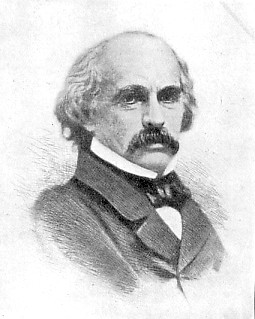
Nathaniel Hawthorne
(1804-64) |
Akin to which is the story told by Mr. Howells, in his recent work on
Venetian Life, of a 'sharp, bustling, go-a-head Yankee,' who rushed into
the Armenian convent one morning rubbing his hands, and demanded that
they should show him all they could in five minutes. The
Yankees pride themselves on this trait of their character. They
consider themselves much quicker and 'cuter' than the slow unwieldy
English. Mr. Hawthorne found one of his consolations in this fact.
We have never heard, however, what become of that particularly acute
child (Yankee of course) who left his home and native parish at the age
of fifteen months, because he was given to understand that his
parents intended to call him 'Caleb.' There can be no doubt
that so precociously sensitive an advanced intellect was soon snuffed
out.
Here is a bit of Yankee humour really worthy
of the Norse imagination. It is so ridiculous as to be within one
step of the sublime. A traveller called at an hotel in Albany, and
asked the waiter for a bootjack. 'What for?' said the astonished
waiter. 'To take off my boots.' 'Jabers what a fut!' the waiter
remarked, as he surveyed the monstrosity, for the man had an enormous
foot. At length, we may say at full-length, he gave it as his opinion
that there wasn't a bootjack in all creation of any use for a 'fut' like
that, and if the traveller wanted 'them are' boots off he would have to
go back to the fork in the roads to get them off.'
The Yankee also too keenly follows out the
consequence of any embarrassment in which he finds himself. To
take a recent illustration of this tendency, a Pittsburgh paper states
that a melancholy case of self-murder occurred on Sunday, near
Titusvile, Pennsylvania. The following schedule of misfortunes was
found in the victim's left boot:—
'I married a widow who had a grown-up daughter. My father visited
our house very often, fell in love with my step-daughter and married
her. So my father became my son-in-law, and my step-daughter my
mother, because she was my father's wife. Some time afterwards my
wife had a son—he was my father's brother-in-law and my uncle, for he
was the brother of my step-mother. My father's wife—i.e. my
step-daughter, had also a son; he was, of course, my brother, and in the
meantime my grandchild, for he was the son of my daughter. My wife
was my grandmother, because she was my mother's mother. I was my wife's
husband and grandchild at the same time. And as the husband of a
person's grandmother is his grandfather, I was my own grandfather.'
It may have been
'out West' that the thieves were so 'smart' they stole a felled
walnut-tree in the night-time; drew the log right slick out of the bark,
and left the five watchers sitting fast asleep astride the rind!
Kentucky must have the credit for that wonderful curative ointment,
which was so effective that when a dog's tail had been cut off, they had
only to apply the ointment whereupon a new tail instantly sprouted, and
a youngster, with a genuine Yankee turn of thought, picked up the old
tail, and tried the ointment upon it, when it grew into a second dog, so
like the other that no one could tell which was which.
There is just a smile of this kind of
humour in a story told of two Yankees on meeting; the one said, 'How are
you, old Ben Russell?' 'Come now,' says the other, 'I'll bet you I aint
any older than you! Tell us, what is the earliest reccollection
that you have?' 'Well,' says he, looking back intently through the
mists of memory, 'the very first thing that I can remember is hearing
people say, as you went by, 'There goes old Ben Russell!' Holmes
has neatly bottled a flash of this lightning, and put it into verse.
|
'Rudolph, professor of the headsman's trade,
Alike was famous for his arm and blade.
One day a prisoner Justice had to kill,
Knelt at the block to test the artist's skill.
Bare-armed, swart-visaged, gaunt, and shaggy-browed,
Rudolph the headsman rose above the crowd,
His falchion lighten'd with a sudden gleam,
As the pike's armour flashes in the stream.
He sheathed his blade; he turned as if to go;
The victim knelt, still waiting for the blow.
"Why strikest not? Perform thy murderous act,"
The prisoner said. (His voice was slightly
crack'd.)
"Friend, I have struck," the artist straight
replied;
"Wait but one moment, and yourself decide."
He held his snuff-box—"Now then, if you
please!"
The prisoner sniffed, and with a crashing
sneeze,
Off his head tumbled—bowled along the floor—
Bounced down the steps; the prisoner said no
more.' |
The Americans
are rich in specimens of what we may call the humours of character,
though, we should imagine, these are much droller in life than the dried
samples we have gathered up in books.
A complicated case was rather nicely met by
an American preacher, who owned half of a negro slave, and who used in
his prayers to supplicate the blessings of heaven on his house, his
family, his land, and his half of Pompey.
The late President Lincoln was very
fond of one particular form of Yankee humour, which consists of telling
a little allegorical story pat to the purpose, and pointedly
illustrative of some present difficulty. He had a large fund of
personal humour, by the aid of which his other self often took refuge
behind the mask that has a broad grin on it. In this way he was
enabled to parry many obstinate questionings which pressed inopportunely
upon him. No one ever had a quicker eye for the humours of the
national character, but it is evident that his grim jests and strange
mirth were only deep sadness in other shapes; bubbles from the troubled
depths. He was by no means author of all the sayings attributed to
him. Some of these are older than he himself was. Many were
well known before he made use of them and re-stamped them for a quicker
and wider circulation. Of this class was his story of the man who
would not change horses when crossing a stream, applied by him as an
argument against changing his Cabinet at a peculiar time. His
favourite illustration of a round peg in a square hole, by which he
indicated a man who did not fit his place, is one of Sydney Smith's
happy markings-off. It occurs at least twice in the course of his
'Letters.' And this reminds us that various stories collected in
'American Wit and Humour' have already seen much service in the old
world before they were transplanted. One of these belongs
originally to Partridge, the Almanack Maker, and it has been applied to
David Ditson.
Curiously enough, we find cited as a sample
of American humour a description of a man who had fallen in love and
been wrecked on the coral reefs, namely, of a woman's red lips.
And in a quaint old English love-poem, probably of the seventeenth
century, we find the idea in these lines—
|
'Tell me not of your starrie eyes,
Your lips that seem on roses fed,
Your breasts, where Cupid trembling lies,
Nor sleeps for kissing of his bed;
These are but gauds: nay, what are lips?
Coral beneath the ocean-stream,
Whose brink when your adventurer slips,
Full of the perisheth on them.' |
It is difficult
to discover anything under the sun that is perfectly new. What the
Americans are and do is often so much more ludicrous than what they
write. The first specimen of American humour which attracted much
attention among us was 'Major Downing's Letters,' a keen political
satire, which presented us with the first authentic specimen of the
wonderful tongue which forms the actual colloquial dialect of the United
states.* Major Downing represented very cleverly
the bluntness and shrewdness of a country Yankee. He was the
parent of Sam Slick, who was the great illustrator of the style of
humorous exaggeration; but as Sam was not a Yankee, and as enormous
lying is not the most valuable feature of Yankee humour, we do not
include him in the present article, which is devoted to the humour of
the Yankee writers themselves. And we must avow that in our
opinion the Yankee humour has not the ruddy health, the abounding animal
spirits, the glow and glory of healthful and hearty life of our greatest
English. As the Yankee has a leaner look, a thinner humanity, than
the typical Englishman who gives such a fleshy and burly embodiment to
his love of beef and beer, so the humour is less plump and rubicund.
It does not revel in the same richness, nor enjoy its wealth in the same
happy unconscious way, nor attain to the like fulness and play of power.
We cannot imagine Yankee humour, with its dry drollery, its shrewd
keeking, shut-eyed way of looking at things, ever embodying such a
mountain of mirth as we have in Falstaff.
|
 |
|
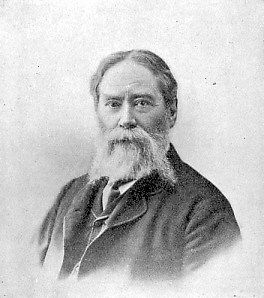
James Russell Lowell
(1819-91) |
But, as Lowell
reminds us, the men who peopled the New England States were not the
traditionary full-fed, rotund, and rosy-gilled Englishmen, but a
hard-faced, atrabilious, earnest-eyed race, somewhat 'stiff with long
wrestling with the Lord in prayer, and who had taught Satan to dread the
new Puritan hug.' Then their sense of freedom scarcely included
the liberty of the lungs in full crow with merriment. And if they
felt internal ticklings now and again they were sure to suspect it was
the devil's work. It was necessary, they fancied, to keep the face
rigidly set in order that they might preserve their spiritual balance.
So they kept watch and ward against all such wanton wiles of the wicked
one. Thus humour lived a more silent and stunted life it grew
slyer in character and more covert in expression; it learned to say the
drollest things with the old family face and with a sense of the stern
Puritan eye still upon it. Such, we think, was the early formation
of its most characteristic manner. And this manner has been very
recently illustrated by the 'Sayings' of Josh Billings. Josh never
laughs downright. There may be a knowing light in his eye, an
oafish pucker at the corners of the mouth, otherwise he is prim as a
Puritan; his hearing is formed on the early model. The
Yankee has a knack of splitting his sides silently and making no outward
sign. He does not laugh, he only chuckles internally. We
have heard of an English actor who went to New York, and on the first
night of his playing performed an exceedingly comic part, in which he
was accustomed to produce roars of laughter. But here there was
scarcely a grin. He thought he must have failed altogether.
On leaving the theatre he heard two of the audience conversing on the
subject of his acting. 'Never saw such a funny fellow in all my
life,' said one; and the other replied, 'Thought I should have busted
twenty times over.' But they had kept it to themselves whilst
inside the theatre. So is it with 'Josh Billings' personally: a
few of whose sayings we quote:—
'Some people are fond of bragging about their ancestors, and their
great descent, when in fact their great descent is just what is
the matter of them.'
'If I was asked, "What is the chief end of man now-a-days," I
should immediately reply, "10 per cent."
'It is dreadful easy to be a fool. A man can be a fool and
not know it.'
'God save the fools, and don't let them run out! for if it
wasn't for them, wise men couldn't get a living.'
'It is true that wealth won't make a man virtuous, but I notice
there ain't anybody who wants to be poor just for the purpose of being
good.'
'There are some dogs' tails which can't be got to curl no-ways,
and some which will, and you can stop 'em. If you bathe a curly
dog's tail in oil and bind it in splints, you can't get the crook out of
it. Now a man's ways of thinking is the crook in the dog's tail, and
can't be got out; and every one should be allowed to wag his own
peculiarity in peace.'
'When a fellow gets to going down hill, it does seem as though
everything had been greased for the occasion.'
Josh Billings'
notions respecting the animal kingdom are very amusing at times.
This of the mule for instance:—
'The mule is half horse and half Jackass, and then comes to a full stop,
Nature discovering her mistake. The only way to keep a mule in a
pasture is to turn it into a meadow adjoining, and let it jump out.
They are like some men, very corrupt at heart. I've known them to
be good mules for six months, just to get a good chance to kick somebody.
The only reason why they are patient is because they are ashamed of
themselves.'
His puritanical
manner and dry caustic cynicism notwithstanding, 'Josh Billings' can
tell 'whoppers' on occasion after the 'down East' fashion, the
uproarious breakings out of nature long repressed. He has likewise
a touch of a kind of humour that in itself is inexpressible, in its
character indescribable, in its appeal helplessly ludicrous. An
example of what we mean occurs in Dickens's 'American Notes.' We
think it is the writer himself who was standing on the deck of the
vessel in a storm, up to his knees in water; and when some one suggested
that he would take cold, he pointed down towards his feet and murmured 'cork
soles.'
It must be merely from imitation that Josh
Billings has adopted his mode of spelling. It does not in the
least enrich his humour, has no affinities to it. In the case of Artemus
Ward, we may imagine it to be a part of the speaker's character.
With him it looks like an element in that species of drollery which is
his forte; it helps to elongate and drawl out the humour.
But many of Josh Billings' sayings are keen enough for the short, sharp,
direct utterance of Douglas Jerrold, and the spelling is an annoying
obstruction; this we have removed in our quotations.
Again, in relation to the old world, there
is a spice of the Gamin nature in American humour, a dash of
impudence in the way it will 'take a sight' at the venerable author of
its being, or, as it may consider, the 'onnatural old parent.' It
can he as amusingly pert in its patronage of England as Mr. Bailey was
when his impudent eyes detected in Sairey Gamp the remains of a fine
woman. Its assumption is astoundingly vast; it takes such a range
of conditions for granted, each of which we should dispute at the
outset, and every one of which we might consider totally inadmissible.
But, whilst we may be pointing out the impossible premises, it has
reached its equally impossible conclusions. Sometimes this is done
with the consciousness made visible. At other times it attains its
triumph in apparent unconsciousness of the existence of the societary or
personal distinctions which it so coolly and so utterly ignores.
Not that we believe in the unconsciousness of Yankee humour. If
unconscious, it would be more self-enjoying, and experience more 'the
delight of happy laughter.' The utmost that it can reach is a sort
of knowing unconsciousness. Artemus Ward will help to make
our meaning understood. He has given to it the broadest
illustration in his well-known 'Interview with the Prince of Wales in
Canada.'
Artemus Ward, however, is not so good in his sayings as in his
scenes; but the most racy of these, such as his Interview with the
Prince of Wales in Canada, and his Courtship of Betsey Jane, are too
long for quotation in full. The position of the lovers in the
courting scene must have been rather a perilous one:—
We sot thar on
the fense, a swingin our feet two and fro, blushin as red as the
Baldinsville skool house when it was fast painted, and lookin very
simple, I make no doubt. My left arm was ockepied in ballunsin
myself on the fense, while my rite was woundid luvinly round her waste.'
The natural reasons why the two
were drawn together are amusingly simple:—
'Thare was many affectin ties which made me hanker arter Betsey Jane.
Her father's farm jined our'n; their cows and our'n squencbt their
thirst at the same spring; our old mares both had stars in their
forrerds; the measles broke out in both famerlies at nearly the same
period; our parients (Betsey's and mine) slept reglarly every Sunday in
the same meetin house, and the nabers used to obsarve, "Wow thick the
Wards and Peasley's air!" It was a surblime site, in the Spring of
the year, to see our sevral mothers (Betsey's and mine) with their gowns
pin'd up so thay could'nt sile 'em, affeeshunitly Biling sope together &
aboozing the nabers.'
The humour of
Artemas Ward hardly attains the dignity of literature. If
Republicans kept their fools, we might class him with the court jesters
of old. He is a species of the practical joker who wears a cap and
bells. To us it seems that the drollery would be better spoken
than written. It wants the appropriate facial and nasal expression
to make it complete. Now and then, however, he says
something perfect in itself, as where he announces that 'the world
continues to revolve round on her own axeltree onct in every twenty-four
hours, subjeck to the Constitution of the United States.' 'If you
ask me,' he says, 'how pious Brigham Young is? I treat it as a
conundrum, and give it up.'
After all, we do not see that he gains much
by his mis-spelling. Mr. Ward makes no humourous use of this
device. The spelling here, as with Josh Billings and others, is
neither genuinely Yankee nor really witty. Indeed, this habit of
trying to make letters do the grinning, looks like an African
perception of the ludicrous: a trick caught from the negro.
The faculty which the negro has for making
fun by the distortion of language is well known. The sound that
words make when tortured appears to please his fancy, and constitute a
sort of humour; and America is now producing as many imitators of this
grotesquerie
which is natural to the negro, as it has sent forth followers of the
negro minstrel in the swarms of sham Ethiopian and other serenaders.
It is quite true that iteration, if
not an element of humour, is at least a potent instrument for tickling
the ears of the multitude, as we may learn from the inextinguishable
laughter produced in our own country by so very moderate a piece of
pleasantry as 'How's your poor feet?' or the Parisian 'Where's Lambert?'
or any other vulgar catchword. By constant repetition, together
with the absurd appeal to the gravity of the person addressed, a sort of
fun is generated, and thousands can repeat and repeat it, and enjoy the
jest as much as if it contained the best wit in the world.
In the 'Biglow Papers' the spelling is
perfectly legitimate. It carefully reproduces a dialect, and we
have real nature contributing to the purpose of art.
In this description of Hosea Biglow by his
father, the spelling is an essential part of the representation.
It not only helps to set before us the rustic poet under inspiration, in
life-like colours, but it also served to give bucolic character and
national twang to the speaker's self.
'Hosea he com home considerabal riled, and arter I'd gone
to bed I heern Him a thrashin round like a short-tailed Bull in fli
time. The old Wotnan ses she to me, ses she, Zekle, ses she, our
Hosee's gut the chollery or suthin another ses she, don't you Bee
skeered, ses I, he's ony amaking pottery ses i, he's ollers on hand at
that cre busynes like Da & martin, and shure enuf, cum mornin, Hosy, he
cum down stares full chizzle, hare on eend and cote tales flyin, and sot
rite of to go reed his varses to Parson Wilbur hem he haint aney grate
shows o' book larnin himself, bimeby he cum back and sed the parson wuz
dreffle tickled with 'em as I hoop you will Be, and said they wuz True
grit.'
'Hosy ses he sed suthin' a nuther about
Simplex Mundishes or sum sech feller, but I guess Hosea kind o' didn't
hear him, for I never hearn o' nobody o' that name in this villadge, and
I've lived here man and boy 76 year cum next tatur digging, and thar
aint nowheres a kitting spryer'n I be.
But the work of
which we are now speaking is the lustiest product of the national
humour; it is Yankee through and through; indigenous as the flowers of
the soil, native as the note of the bob-a-link. The author is a
poet of considerable repute, who has written much beautiful verse.
But he has never fulfilled his early promise in serious poetry. In
this book alone has he reached his full stature, and written with the
utmost pith and power. Doubtless because in this he relies more on
the national life, his work is more en rapport with the national
character, and thus the book is one of those that could only be written
in one country, and at one period of history. The enduring
elements of art, of poetry, of humour, must be found at home or nowhere.
And the crowning quality of Lowell's humour is, that it was found at
home, his book is a national birth.
The 'Biglow Papers' include most of the
aspects of American humour upon which we have touched, the racy and
hilarious yet matter-of-fact hyperbole, that is, 'audible and
full of vent;' the boundless exaggeration uttered most demurely, the
knowing
unconsciousness, and other characteristic clues. They have also
that infusion of poetry which is necessary to humour at its best.
The two great characters of the book are the
'Rev. Homer Wilbur,' to whom Hosea Biglow, the young poet, takes his
verses, and 'Birdofredum Sawin.' But there are various smaller
sketches of character admirably drawn with the fewest strokes. We
have not room for the Newspaper Editor, one of the base 'mutton-loving
shepherds,' of which says the Rev. Homer Wilbur, there are two thousand
in the United States.
The life and glory of the Biglow Papers is
Mr. 'Birdofredum Sawin.' His experiences are as delightful as his
character is disreputable and true to nature. He has been through
the Mexican war, and this is his description of his losses. Among
other things he has lost a leg; however, he has gained a new wooden one.
This was what he got, instead of making his
fortune as he had anticipated. Dilapidated and maimed as he is,
useless for anything else, he proposes to canvas for the Presidency, and
his instructions for agents show genuine insight, a fine sagacity—
|
'Ef, wile you're 'lectioneerin' round, some cur
us chaps should beg
To know my views o' state affairs, jest answer
WOODEN LEG?
Ef they aint settisfied with thet, an' kin' O'
pry an' doubt,
An'ax fer sutthin' deffynit, jest say ONE
EYE PUT OUT!
Then you can call me "Timbertoes,"- thet's wut the people
likes;
Sutthin' combinin' morril truth with phrases
sech ez strikes;
"Old Timbertoes," you see, 's a creed it's safe
to be quite bold on,
There's nothin' in't the other side can any
ways git hold on;
It's a good tangible idee, a sutthin' to embody
Thet valooable class o' men who look thin
brandy-toddy;
It gives a Party Platform, tu, jest level with
the mind
Of all right-thinkin', honest folks thet mean
to go it blind;
Then there air other good hooraws to dror on
ez you need 'em,
Sech ez the ONE-EYED
SLARTEREE, the
BLOODY BIRDOFREDUM;
Them's wut takes hold o' folks thet think, ez well ez o' the
masses,
An' makes you sartin o' the aid o' good men
of all classes.' |
Lowell tried
during the late war to continue his 'Biglow Papers.' It is
proverbially difficult to continue a work like this, as difficult, we
should say, as it is to continue a first child in the person and
character of a second. But he succeeded in writing one or two
papers worthy of being included in the design. It is interesting,
on looking hack now, to observe how much national character there is in
the book. The theme on which he wrote is obsolete, but the human
nature remains the same. 'Birdofredum Sawin' is vital and superior
to circumstance, and impudent as ever.
Neither Lowell nor any other American
poet has ever before painted the coming of the New England spring with
the native beauty and new-world truth of these lines—
|
'Fust come the blackbirds clatt'rin' in tall trees,
An' settlin' things in windy Congresses,—
'Fore long the trees begin to show belief,—
The maple crimsons to a coral-reef,
Then saffern swarms swing off from all the
willers
So plump they look like yaller caterpillars,
Then grey hossches'nuts leetle hands unfold
Softer'n a baby's be at three days old:
This is the robin's almanick; he knows
Thet arter this ther' 's only' blossom-snows;
So, choosin' out a handy crotch an' spouse,
He goes to plast'riu' his adobe house.
Then seems to come a hitch, - things lag behind,
Till some fine mornin' Spring makes up her
mind,
An' ez, when snow-swelled rivers cresh their
dams
Heaped-up with ice thet dovetails in an' jams,
A leak comes spirtin' thru some pin-hole cleft,
Grows s'ronger, fercer, tears out right an' left,
Then all the waters bow themselves an' come,
Suddin, in one gret slope o' shedderin' foam.
Jes' so our Spring gits everythin' in tune
An' gives one leap from April into June:
Then all comes crowdin' in; afore you think,
The oak-buds mist the side-hill woods with
pink,
The catbird in the laylock-bush is loud,
The orchards turn to heaps o' rosy cloud,
In ellum-shrowds the flashin' hangbird clings
An' for the summer vy'ge his hammock slings,
All down the loose-walled lanes in archin' bowers
The barb'ry droops its strings o' golden flowers
Whose shrinkin' hearts the school-gals love to
try
With pins,—they'll worry yourn so, boys,
bimeby!
Nuff sed, June's bridesman, poet o' the year,
Gladness on wings, the bobolink, is here;
Half-hid in tip-top apple-blooms he swings,
Or climbs aginst the breeze with quiverin'
wings,
Or, givin' way to't in a mock despair,
Runs down, a brook o' laughter, thru the air.' |
Lowell has
fought long and strenuously against negro slavery, and lashed the vices
of American politics. But his ballad of 'The Courtin' is on quite
a different theme, and causes a regret that he has not written more
rustic poetry:—
|
'Zekle crep' up, quite unbeknown,
An' peeked in thru the winder,
An' there sot Huldy all alone,
'ith no one nigh to hender.
Agin' the chimbly, crooknecks hung,
An' in amongst 'em rusted
The ole Queen's arm thet gran'ther Young
Fetehed back from Concord busted.
The wannut logs shot sparkles out
Towards the pootiest, bless her!
An' leetle fires danced all about
The chiny on the dresser.
The very room, coz she wur in,
Looked warm frum floor to ceilin',
An' she looked full ez rosy agin
Ez th' apples she wuz peelin'.
She heerd a foot an' knowed it, tu,
Araspin' on the scraper,—
All ways to once her feelins flew
Like sparks in burnt-up paper.
He kin' o' l'itered on the mat,
Some doubtfle o' the seekle;
His heart kep' goin' pitypat,
But hern went pity Zekle.
An' yet she gin her cheer a jerk
Ez though she wished him furder,
An' on her apples kep' to work
Ez ef a wager spurred her.
"You want to see my Pa, I spose?"
"Wal, no; I come designin—"
"To see my Ma? She's sprinklin' clo'es
Agin tomorrow's i'nin'."
He stood a spell on one foot fust,
Then stood a spell on tother,
An' on which one he felt the wust
He couldn't ha' told ye, nuther.
He was six foot o' man A 1,
Clean grit an' human natur;
None couldn't quicker pitch a ton
Nor dror a furrer straighter.
He'd sparked it with full twenty gals,
He'd squired 'em, danced 'em, druv 'em,
Fust this one and then thet by spells,—
All is, he couldn't love 'em.
But long o' her his veins 'ould run,
All crinkly like curled maple.
The side she breshed felt full o' sun
Ez a South slope in Ap'il.
She thought no v'ice hed such a swing
Ez hisn in the choir,
My! when he made Ole Hundred ring,
She know'd the Lord was nigher.
Sez he, "I'd better call agin;"
Sez she, "Think likely, Mister;"
The last word pricked him like a pin,
An'— wal, he up and kist her.
When Ma bimeby upon 'em slips,
Huldy sot pale ez ashes,
All kind o' smily round the lips,
An' teary round the lashes.
Her blood riz quick, though, like the tide
Down to the Bay o' Fundy,
Au' all I know is they wuz cried
In meetin', cum nex Sunday.' |
In this we see
humour at play with sentiment, and should like to have had more such
interiors
pictured with the same vividness and delightful ease. In the other
poems we meet with humour—Yankee humour—in a working mood. Hosea
Biglow means 'business' when he enters the arena, and he strikes his
blows with the most sinewy strength; they go right home with the utmost
directness. The scorn that is concentrated in a local phrase, the
satire that is conveyed in the homeliest imagery, are hurled with double
force; the irony often reaches a Swift-like intensity. The amount
of hard truth here flung in a humorous guise at humbugs political and
literary is positively overwhelming. And to enhance the effect
there is that Yankee dialect, with its aggravating
drawl. Therefore we look upon the 'Biglow Papers' as the most
characteristic and complete expression of American humour.
We do not purpose including the humour of
Irving in this sketch. It does not smack strongly of the American
soil; its characteristics are old English rather than modern Yankee.
In its own mild way it is akin to the best humour, that which gives
forth the fragrance of feeling, and is a pervasive influence, elusive
and ethereal, sweet and shy; the loving effluence of a kindly nature
whose still smiles are often more significant, and come from a deeper
source, than the loudest laughter. This is the quality likewise of
Hawthorne's humour. But his has more piquancy and new-world
flavour. To do it justice, however, would demand a close
psychological study, so curious and complex were the nature and genius
of the man; the nature was a singular growth for such a soil, the genius
out of keeping with the environment, or, as the Americans would say, the
'fixings,' —a new-world man who shrank like a sensitive plant from the
heat, and haste, and loudness of his countrymen, and whose brooding mind
was haunted by shadows from the past. There was a sombre
background to his mind or temperament, against which the humour plays
more brightly. In the piece entitled the 'Celestial Railroad,' a
modern version of the 'Pilgrim's Progress,' which shows how easy it is
to do the journey now-a-days by the new and improved passage to the
Celestial City, where stood the wicket-gate of old we now find a
station. Here you take your ticket, and there is no need of
carrying your burthen on your back, as did poor Christian; that goes in
the luggage-van. A bridge has been thrown across the Slough of
Despond. There is no longer any feud betwixt Beelzebub and the
wicket-gate keeper. They are now partners in the same concern,
with all the ancient difficulties amicably arranged. A tunnel
passes through the hill Difficulty, with the debris
of which they have filled up the Valley of Humiliation; and instead of
meeting pilgrims and compelling them to mortal combat, Apollyon is the
engine-driver. The passage is safe, the journey is short, but
somehow, when the end is near, the doubts thicken, and the smile of the
humourist is of a kind to awaken grave troubled thoughts.
Hitherto slavery and politics have been the
chief subjects of the best American humour. The great social
satirist has to come. And should he arise there will be ample
scope for the play of his saturnine humour. 'The leading defect of
the Yankee,' says an American writer, E. P. Whipple, 'consists in the
gulf which separates his moral opinions from his moral principles!
His talk about virtue in the abstract would pass as sound in a nation of
saints, but he still contrives that his interests shall not suffer by
the rigidity of his maxims. Your true Yankee, indeed, has a
spruce, clean, Pecksniffian way of doing a wrong, which is inimitable.
Believing, after a certain fashion, in justice and retribution, he still
thinks that a sly, shrewd, keen, supple gentleman, like himself, can
dodge in a quiet way the moral laws of the universe, without any
particular bother being made about it.' This affords a fine
opening for the great humourist with genuine insight and a sure touch; a
nature that can 'coin the heart for jests,' use the scalpel smilingly,
apply the caustic genially, and give the bitter drink blandly.
Would the Americans welcome such a writer? There was a time when
they would not: we think there are signs that they now would. They
are beginning to laugh, and to laugh at their own expense. This is
finding out the true remedy for that over-sensitiveness at the laugh of
others which has tyrannized over them so long.
|
 |
|
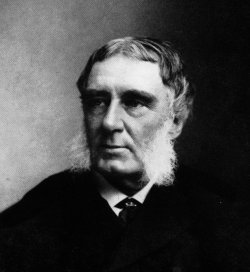
George William Curtis
(1824-92) |
The author of
the 'Potiphar Papers 'has attempted to satirize the vices and foibles of
the 'upper ten thousand,' the ruinous extravagance and vulgar display,
the insane ambition to blow the loudest trumpet and beat the biggest
drum, the crushing and trampling to get a front seat in the universe of
fashion, i.e. a palatial residence with thirty feet of frontage;
the coarse worship of wealth, the pompous profusion, and the vain
endeavours of a shoddy aristocracy to outshine all foreign splendours;
the houses which are 'like a woman dressed in Ninon de l'Enclos' bodice,
with Queen Anne's hooped skirt, who limps in Chinese shoes, and wears an
Elizabethan ruff round her neck and a Druse's horn on her head;' the
vast mirrors that only serve to magnify the carnival of incongruity; the
want of taste everywhere, or rather the prevalence of the taste that
estimates all things as beautiful and precious which cost a great deal
of money. One of the best characters in these papers is 'Thurz
Pasha,' ambassador from the 'King of Sennaar.' He writes home to
his royal master the results of his experience. 'I have found them
(the Americans) totally free from the petty ambitions, the bitter
resolves, and the hollow pretences, that characterize the society of
older States. The people of the first fashion unite the greatest
simplicity of character with the utmost variety of intelligence, and the
most graceful elegance of manner.
'The universal courtesy and consideration—the gentle charity, which does
not consider the appearance but the substance—the republican
independence, which teaches foreign lords and ladies the worthlessness
of mere rank, by obviously respecting the character and not the
title—the eagerness with which foreign habits are subdued, by the
positive nature of American manners—the readiness to assist—the total
want of coarse social emulation—the absence of ignorance, prejudice, and
vulgarity in the selecter circles - the broad, sweet, catholic welcome
to all that is essentially national and characteristic, which sends the
young American abroad only that he may return eschewing European habits,
and with a confidence in man and his country chastened by
experience—these have most interested and charmed me in the observation
of this pleasing people. They are never ashamed to confess that
they are poor. They acknowledge the equal dignity of all kinds of
labour, and do not presume on any social difference between their baker
and themselves. Knowing that luxury enervates a nation, they
aim to show in their lives, as in their persons, that simplicity is the
finest ornament. We, who are reputed savages, might well be
astonished and fascinated with the results of civilization, as they are
here displayed.'
|
 |
|
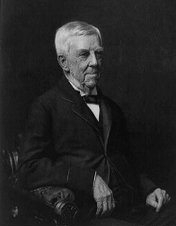
Oliver Wendell Holmes
(1809-1894) |
Oliver Wendell
Holmes is likewise doing his best to tell his countrymen a few truths it
was well they should learn, especially from their own writers. He
can say the most unpalatable things in the pleasantest possible way.
He does not appeal to the pride and pugnacity of his countrymen, or tell
them that America is the only place in which a man can stand upright and
draw free breath. He thinks there is 'no sufficient flavour of
humanity in the soil' out of which they grow, and that it makes a man
humane to 'live on the old humanized soil' of Europe. He will not
deny the past for the sake of gloryfying the present. 'They say a
dead man's hand cures swellings if laid on them; nothing like the dead
cold hand of the past to take down our tumid egotism.' He is
equally the enemy of high-falutin,' and spread-eagleism, and social
slang. 'First-rate,' 'prime,' 'a prime article,' 'a superior piece
of goods,' 'a gent in a flowered vest;' all such expressions are final.
They blast the lineage of him or her who utters them, for generations up
and down. He tells them that 'good-breeding is surface
Christianity.' He slyly consoles them with the thought that 'good
Americans when they die go to Paris.' He is thoroughly national
himself, and would have American patriotism large and liberal, not a
narrow provincial conceit. The 'autocrat' is assuredly one of the
pleasantest specimens of the American gentleman, and one of the most
charming of all chatty companions; genial, witty, and wise; never
wearisome. We fancy the 'Autocrat of the Breakfast Table' is not
so well known or widely read in this country as it deserves to be.
A more delightful book has not come over the Atlantic.
We have reserved Holmes to the last, not
that he is least amongst American humourists, but because he brings
American humour to its finest point, and is, in fact, the first of
American Wits.
Perhaps the following verses will best
illustrate a speciality of Holmes's wit, the kind of badinage
with which he quizzes common sense so successfully, by his happy paradox
of serious straightforward statement, and quiet qualifying afterwards by
which he tapers his point.
|
CONTENTMENT.
'Man wants but little here below.'
'Little I ask; my wants are few;
I only wish a hut of stone
(A very plain brown stone will do),
That I may call my own;—
And close at hand is such a one,
In yonder street that fronts the sun.
Plain food is quite enough for me;
Three courses are as good as ten;
If Nature can subsist on three,
Thank Heaven for three. Amen!
I always thought cold victuals nice,—
My choice would be vanilla-ice.
I care not much for gold or land—
Give me a mortgage here and there,
Some good bank-stock, some note of hand,
Or trifling railroad share,—
I only ask that Fortune send
A little more than I shall spend.
Honours are silly toys, I know,
And titles are but empty names;
I would, perhaps, be Plenipo—
But only near St. James;
I'm very sure I should not care
To fill our Gubernator's chair.
Jewels are baubles; 'tis a sin
To care for such unfruitful things;—
One good-sized diamond in a pin,
Some, not so large
in rings,
A ruby, and a pearl, or so,
Will do for me;— I laugh at show.
My dame should dress in cheap attire
(Good heavy silks are never dear);
I own perhaps I might desire
Some shawls of true Cashmere,—
Some marrowy crapes of China silk,
Like wrinkled skins on scalded milk.
Wealth's wasteful tricks I will not learn,
Nor ape the glittering upstart fool;
Shall not carved tables serve my turn,
But all must be of buhl?
Give grasping pomp its double care,—
I ask but one recumbent chair.
Thus humble let me live and die,
Nor long for Midas' golden touch;
If heaven more generous gifts deny,
I shalt not miss them much,—
Too grateful for the blessing lent
Of simple tastes and mind content!'
|
Having had our
laugh at Yankee humour, let us glance at what it tells us seriously.
In the first place it is morally healthy and sound. It has its
coarsenesses, though these lie more in the using of a word profanely
than in profanity of purpose. It has no ribaldry of Silenus, nor
is there any leer of the satyr from among the leaves. We perceive
no tendency to uncleanness. Fashionable ladies of the New York
'upper ten thousand' may be French at heart in the matter of dress and
novel-reading, but the national humour does not follow the French
fashion; has no dalliance with the devil by playing with forbidden
things, no art of insidious suggestion. In this respect it is hale
and honest as nature herself and it is just as sound on the subject of
politics. Disgust more profound, scorn more scathing, than Lowell
expresses for the scum of the national intellect thrown up to the
political surface by the tumult and fierce whirl of the national life,
could not be uttered in English. He tells the people they cannot
make any great advance; cannot ascend the heights of a noble humanity
cannot reach the promise of their new land and new life; cannot win
respect for self nor applause from others,
|
'Long'z you elect for Congressmen poor shotes
thet want to go
Coz they can't seem to git their grub no otherways than so,
An' let your bes' men stay to home coz they
wun't show ez talkers,
Nor can't be hired to fool ye an' sof'-soap ye
at a caucus,—
Long 'z ye set by Rotashun more'n ye do by
folks's merits,
Ez though experunce thriv by change o' sile,
like corn an' kerrits,—
Long 'z you allow a critter's "claims" coz,
spite o' shoves an' tippins,
He's kep' his private pan jest where 't would
ketch mos' public drippies—
Long 'z you suppose your votes can turn biled kebbage into
brain,
An' ary man thet 's pop'lar 's fit to drive a
lightnin'-train,
Long 'z you believe democracy means I'm ez good ez ,you be,
An' thet a felier from the ranks can't be a
knave or booby,—
Long 'z Congress seems purvided, like yer street cars an' yer
'busses,
With ollers room for jes' one more o' your
spiled-in-bakin' cusses,
Dough 'thout the emptins of a soul, an' yit with means about
'em
(Like essence-pedlers**) thet'll make folks
long
to be without 'em,
Jest heavy 'nough to turn a scale thet 's
doubtfle the wrong way,
An' make their nat'ral arsenal o' hem' nasty
pay.' |
The war has
taught the Americans many lessons, but it was only driving home, and
clenching in some places, what their writers had been telling them
beforehand. For example, that it is man, manhood, not multitude,
which leads the nations and makes them great. They were made to
learn, through a long and painful struggle, the helplessness of hands
without head.
But this was what their best instructors had
already insisted on. And, in the midst of the fight, Lowell cries
to his countrymen,—
|
'It ain't your twenty millions that 'll ever block
Jeff s
game,
But one man thet wun't let 'em jog jest ez
he's takin'
aim.' |
And again, in answer to the
continual call for more men, he says,—
|
'More men? More Man! It's there we fail;
Weak plans grow weaker yit by lengthenin':
Wut use in addin' to the tail,
When it's the head 's in need of
strengthenin'?
We wanted one thet felt all Chief,
From roots o' hair to sole o' stockin',
Square-sot with thousan'-ton belief
In him an' us, ef earth went rockin'!' |
We have always
believed that there were better things at the centre of American life
than were made conspicuous on the surface. We knew there were
Americans who had not the popular belief in 'buncombe,' who had the
deepest contempt for the 'tall talk' of their newspapers, and on whom
the sayings and doings of their countrymen inflicted torments.
Human nature in America is somewhat like the articles in a great
exhibition, where the largest and loudest things first catch the eye and
usurp the attention. Also, their system of representation gives
the largest and loudest expression to the, grosser human interests in
the political sphere; it aggregates a huge mass of ignorant selfishness,
such as is not swiftly or easily touched with the fine thought or noble
feeling of the few. For instance, the writers of America who
represent its moral conscience, are in favour of an international
copyright; they are on the side of right and justice, in opposition to
those who represent, only the political conscience of the country.
But their difficulty is in bringing their momentum
to bear upon the political machine, seeing that they cannot work
directly through it. With us the apparatus is far more delicate
and sensitive, and the chances of representation for the truer feeling
and higher wisdom are infinitely greater. Nevertheless it is
satisfactory to find—and the finger-pointings and the smile of Yankee
humour help greatly to show it—that there is among the Americans a
stronger backing of sound sense, of clear seeing, and of right
feeling, than we could have gathered any idea of from their political
mouthpieces.
GERALD MASSEY. |



