|
|
|
 |
|
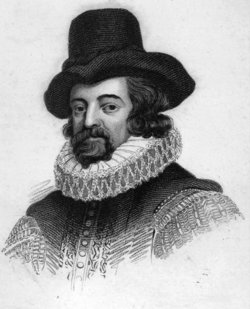
Francis Bacon
(1561-1626) |
|
|
IT was, and still is, the custom in some countries
for the benighted natives to rush forth from their dwellings at the
approach of a lunar eclipse, and howl lustily, with the intention of
scaring away the demon of darkness that is supposed to be devouring the
moon. But if I, in common with a few others, do raise my voice and
put on literary war-paint to face the Donnellian phantom, it is not from
any presentiment that the bogey Bacon is going to swallow Shakspeare,
nor from any fear that our luminary is about to suffer its eclipse.
Mr. Donnelly may talk of "hurling Shakspeare down
front his pedestal;" according to my calculation, there would be
less disparity between modern engineering appliances and the hoisting of
the Alps bodily from their base, than there is betwixt his proposed
means of removal and the
dethronement of Shakspeare. I think he might just as well decree
a new volcano, or propose a motion for a general earthquake.
Therefore I do not turn aside from the more immediate purpose of the
present work to say one word in defence of Shakspeare's authorship,
because of any anticipation that this revolt against common sense is
going to effect his dethronement. I should not even like it to be
thought that I take au sérieux the proposition that Francis Bacon
wrote the Plays and other poetry of Shakspeare; indeed, I am willing to
confess that the joke of attributing the works of Shakspeare to Bacon is
huge enough to be enjoyable. Only to think of the maddening effect
on serious Shakspeareans who will not see the joke! I look upon
Mr. Donnelly's information that Bacon was the real author of
Shakspeare's and Marlowe's Plays, not to include Montaigne's Essays,
and Burton's Anatomy of Melancholy, as a "very great secret"
indeed; far exceeding the one confided to George Dyer by Charles Lamb
when he told the guileless gobemouche that Lord Castlereigh was the
author of the Waverley Novels. To me it is what Shakspeare himself
terms a "fanatical phantasm." Nevertheless, for the truth's sake,
I shall treat the matter seriously in my own way. For it is the
same here as everywhere else, there is no sure protection, now or at any
time, against fraud and fallacy except in our mastering the fundamental
data for ourselves. It is only by taking full possession of the
genuine facts that we can prevent the phantoms of unreality from
taking possession, of us, and haunting us with their delusions!
We are continually learning and having to relearn the lesson that there
is no defence against impostures, no freedom from fallacies, past,
present, or future, save in ascertaining the facts, truly estimating
their force, and holding on hard and fast to their evidence.
I have no intention of calling names as a substitute for
argument. Mr. Donnelly complains that a deluge of opprobrium has
been let loose upon him; but the people who have pursued Shakspeare with
a blizzard of abuse should not cry out or squirm and squeal when the
pitch is made hot for their own behoof.
The Donnellians have been studiously offensive in speaking of
Shakspeare. They have done their dirtiest to defame and degrade
the life, the character, the relations, and outward circumstances of the
man whom Mr. Donnelly calls "Caliban," and to defile his image in the
innermost sanctuary of our affection. Mr. Donnelly has raked in
sterquinariæ to have his fling of filth at Shakspeare. He writes
as if he were obsessed with a spirit of hatred and uncleanness against
Shakspeare; his personal enmity looks like an unmistakable symptom of
confirmed mania. It is only the snob in soul that would speak
ignobly of any man, even a Shakspeare, on account of his poverty in
early life, or seek for a writer's nobility in his surroundings.
Mr. Donnelly's vulgarly virulent treatment of our great Poet, his
parents, his bringing-up, his early occupations, his wife, his children,
his character, is a thing to be held in derision so long as it may be
had in remembrance. Moreover, he who has said "the proposition
that Shakspeare, the man of the documents, and the writer of the Plays
were one and the same person
cannot be accepted by any sane man" (p. 46), has no right to complain
if he or his co-mates should happen to be called crazed.
Personally I do not see how anything but a great mental delusion could
account for the hypothesis that Francis Bacon WAS
the author of Shakspeare's Plays, Poems, and Sonnets! But one
would not therefore say that the Donnellians are ordinarily insane.
Nevertheless, it does seem in accordance with the fitness of things that
this delusion should have been engendered in the brain of poor Delia
Bacon. I feel that hers was amongst the saddest of all human
tragedies—those in which the martyr falls ineffectually on behalf of an
error that was sincerely mistaken for the truth. Her sufferings
make one gentle for her sake—
|
The Delian diver wrecked her life to grasp
A pearl she saw by visionary gleams,
And died with empty hand that could not clasp
The treasure only real in her dreams! |
But facts must
be faced, and whether as a birth of physical disease or only of mental
perversion, whether as the cause of disease or the result of it, this
fabric of false vision was first dreamed into existence by Delia Bacon
in the year 1845; her belief being announced in Putnam's Magazine
for January, 1856. The delusion was primarily conceived through falsely
assuming that Shakspeare had neither the natural qualifications nor the
education befitting the writer of the plays; and all the efforts
following her desperate venture have been directed to the support of
that fundamental fallacy.
First, it was hastily assumed that Shakspeare could
not, and it was then inferred that he did not, write his own works.
They tell us that his handwriting and the nose of his bust at Stratford
are dead against his being the real author of the Plays and Poems!
But to suppose that a college education and a profound
acquaintance with the classics are necessary to the bringing forth of a
Shakspeare is to miss the lesson of his life, the supreme lesson
of all literature, because in him it was triumphantly demonstrated once
for all, that these are not necessities of the most real self-developing
education; that nature grows her geniuses like her game-birds and
finer-flavoured wildfowl, by letting them forage for their own living,
to find what they most need. It was learning in the school of life
that was the best education for him, and in that school, as he says of
Cardinal Wolsey,
|
"From his cradle
He was a scholar, and a ripe and good one." |
Probably he had
not many books to read; but he was not made out of books. When
Nature wants a new man, it is not her way to make him out of old books.
Books are too often used as the means of getting our thinking done for
us. Shakspeare did his own. He could transmute from books,
but his genius preferred to work on nature, and draw his drama directly
from the life. It is with too many people as Butler says—
|
"Yet he that is but able to express
No sense at all in several languages,
Will pass for learneder than he that's known
To speak the strongest reason in his own!" |
That delusion
has been very common, and it is a delusion still, although one that is
being exploded.
Mr. Ruskin once wrote to me—"Your education was a terrible
one, but mine was far worse!" The one having had all that wealth
could buy, the other all that poverty could bring.
"Fair seed-time had my soul," says Wordsworth in referring to
the influences of nature that helped to educate him as a boy, when he
too was a bit of a poacher, and indifferent to the study of books.
The great point here is, that nature did not produce
Shakspeare as the result of a scholastic education, nor by refining an
ancient type that had been long manipulated by men, but threw back for a
fresh start to produce a new type altogether from her own font.
She did just what she taught Shakspeare himself to do! Instead of
adopting and polishing or further effacing the old literary types, it
was his wont to go back to nature on numerous lines of character to find
the fresh soil in which he could secure the life and strength and
hoarded riches of an original rootage. The secret of this matter
is to be found in nature, and not in the cram of mere acquirement.
It was by nature Shakspeare had that relationship with Source itself,
that rootage in the spiritual which taps the well-springs of the
universal life, and directly draws its strength and succour from the
Infinite!
No approximately correct estimate of Shakspeare in relation
to those few bare facts of his life to be found in the documents can be
formed unless we take them plus the personality of the Man, as he
was known to his "fellows," to Chettle, to Marston, to Henry
Wriothesley, to Ben Jonson, to the stage, and as we see him in the
mirror of his works. "The older one grows," says Goëthe, "the more
one prizes natural gifts, because by no possibility can they be procured
and stuck on." And in "natural gifts," as we know, our Shakspeare
was pre-eminent, was supreme. Ben Jonson saw this when he told the
world how little Shakspeare was indebted to Latin and still less to
Greek. Nor did he need it, says Jonson, who was the nearest of
them all in taking the measure of the man!
|
"Leave thee alone for the comparison
Of all that insolent Greece or haughty Rome
Sent forth, or since did from their ashes come.
I confess thy writings to be such
As neither Man nor Muse can praise too much." |
He recognized
the well-spring of ebullient life that rose and overran with its
irrepressible force of abundance. He portrays him as a very
Mercutio of a man, flowing with that facility which made it necessary
that he should at times be stopped to prevent a deluge. Such an
inexhaustible fount of life rose in him, springing fresh and free from
the world of life beyond all literature!
In the minds of Delia Bacon, Mrs. Pott, and Mr. Donnelly, the
genesis of the delusion may be traced to the beginning at first with
false ideas concerning Shakspeare, and next to fallacious inferences
resulting in a false Ideal of Bacon. It is not a fact that
Shakspeare was a low-born, illiterate fellow, or that his father was a
"Poor Peasant," but a falsehood to begin with. His father was a
Yeoman. As to his classical acquirements; in accordance with the
education of the time, he would learn sufficient Latin at the Grammar
school to read and draw from Ovid as he does some years afterwards in
his Venus and Adonis, to which he prefixes the Latin motto, and
says proudly and defiantly to those who had decried him and his
scholarship, "Let the mob marvel at things base, to me also
golden-locked Apollo shall supply cups filled with water of Castaly."
Mr. Donnelly soon demonstrates the fact that he is not to be
trusted either in his statements or quotations without verification.
He writes again and again, "he was not for an age, but for all
time." Twice over the "mightiest Julius" is quoted as the "mighty
Julius." These are small matters, but significant when credit is
at stake. He falsely asserts, that in Shakspeare's time the
very name of Shakspeare was considered to be the quintessence of
vulgarity! He falsely asserts that Shakspeare's pursuits and his
associates (who included Lord Southampton) were not favourable to his
acquiring knowledge in London. He falsely asserts that there is no
evidence whatever to show that Shakspeare was a diligent student of
books! The satirist Marston has emphatically assured us that he
was. Also we learn that Shakspeare was a buyer of books at sales
by some memoranda that were found at Stratford on the back of the panel
of a jury dated Nov. 1596, beginning, "Mr. Shaxpere, one book. Mr.
Barber, a coverlet." There had been a suit between Margaret Younge
and Jane Perat, and a sale, at which Shakspeare was present on the
look-out for books. At least we infer that it was he, and not his
father, who could not write.
The Great Cryptogram abounds in errors concerning
well-known matters of fact, in oversights and contradictions.
Shakspeare was not "an obscure actor" in 1601 (p. 633). We are
NOT told that Bacon dashed off a play in a fortnight
(as Mr. Donnelly says), but that Shakspeare did so! It is not, as
he asserts, wholly different with Shakspeare from other men of the time.
We know far more about him, for instance, than we do of Beaumont and
Fletcher.
The Dedications of Shakspeare's two Poems to the Earl of
Southampton are not merely "supposed to imply" a close "social
relationship," as Mr. Donnelly phrases it: they prove it!
Judith Shakspeare signs her initials in a very straggling
manner, whereupon Mr. Donnelly gets up a long and futile tirade against
Shakspeare for not teaching his daughter to read and write;
ergo he could not have written the plays! and yet the cipher
proclaims that Susannah Shakspeare was "WELL-TAUGHT"
(p. 747). In short, it is difficult to believe one word the
gentleman says who has a waistcoat on of THAT
colour. His reasoning constantly reminds one of the man who
prognosticated that people would soon cross the Atlantic in three days,
and who "did not see how it could be otherwise." He has no
diffidence on account of ignorance. He quotes—
"But I con him no thanks."
and
"Yet, thanks, I must you con."
and denounces
both as "sheer nonsense." But to "con thanks" is good provincial
English still current in the North. Sidney uses it in the
Arcadia
(p. 224)—
"I con thee thank to whom thy dogs be dear." (1590.)
It means to
express an obligation. The same ignorance, ludicrous errors, and
absurdities of assertion are apparent in the cipher-narratives, which of
themselves suffice to prove the ciphers cannot have been the work of
Bacon. There is no need to "rack the style" of Mr. Donnelly to
make it confess that the language is not Bacon's. It is thrice
impossible for this to be Bacon's English—"My lord struck his spur up to
the rowel against the panting sides of his horse" (p. 737). Struck
his spur
up to the rowel has no meaning, because the rowel includes the
spur-points that revolve with it. Neither is one spur
enough to be struck against both sides of the horse. What
Shakspeare himself wrote on the subject was this—
|
"And bending forward (he) struck his armèd heels
Against the panting sides of his poor jade
Up to the rowel-head." |
That is
English. But in picking out the cipher-narrative the English has been
completely destroyed.
Again, the narrative says—"Bardolfe is now almost as good
as dead; slain, killed outright by the hand of the old jade."
Now a man who was not quite dead could not be said to have been killed
outright. Moreover, the act could not be attributed to the hand
of the Queen, who had only ordered the pursuit (p. 682).
Stratford is called "one of the Peasant Towns of the West"
(p. 730). A double impossibility, as the town was not in the West,
but exactly in the middle of England, and townspeople are not identical
with but opposed to the Peasantry or Pagani. They were not 15,000
peasants who lived in Stratford-on-Avon in the time of Shakspeare.
The number is Mr. Donnelly's.
The cipher story tells of a desperate attempt on the part of
the Queen (in 1601) to find out who was the author of the play of
Richard II., which was certainly well known to be Shakspeare's, as it
had been published in 1597 and again in 1598, with his name on the
title-page; of that fact there never was a doubt.
One of Mr. Donnelly's many "reasonable probabilities" is that
Robert Cecil, "Says Ill," or "Seas-Ill," being Bacon's most bitter and
inveterate enemy, was well aware that he was the real author of the
Plays; knew that he had shared in the Essex conspiracy, and wrought on
behalf of rebellion in writing the Play of King Richard II., but
that he concealed the fact and kept the secret to himself, only having
his revenge by compelling Bacon to take a dastardly part against Essex
at his trial!
And here is a pretty story told of Shakspeare by the
cipher-narrative. "His health is very poor. It was my
presurmise that he is blasted with that dreaded disease, a most
incurable malady. His looks prove it. One day I did chance
to meet him, and although I am well acquainted with him I would not have
known him, the transformation was so great. . . He is not more
than thirty-three, in his youth, written down old with all the
characters of age. His cheek is white, his voice hollow, his hand
dry, his hair grey, his step feeble, and his head
WAGS as he
WALKED. There is a beastly wound new healed
on the side of his neck, and a great wen or gall, something like the
king's evil, which every day grows greater." In another
statement assigned to Bacon, Shakspeare is said to be "not yet thirty
three," but he is a stooping, decrepid, WHITE-haired
old man. He is being eaten away with several diseases. He
has the gout, the French pox, horrible breakings out, doubtless meant
for buboes, and he "hath fallen into a consumption." Now,
Shakspeare was thirty-three in 1597, and at this time, in 1596-7, the
character of Falstaff was created for the dramas of First King Henry
IV., and the following Merry Wives of Windsor. The
cipher-narrative also volunteers the information that Bacon and his
brother Anthony drew the fat man Falstaff and his "great round belly"
from Shakspeare as their "original model" (p. 815), who is also
described as a great over-greedy glutton, or greedy-guts, "weighing two
hundred pound" (p. 814). And the narrative relates how the
play-house was crowded to see this decrepid, diseased, consumptive,
pox-rotted, strumous, white-faced, white-haired, worn, wizened, and
bowed-down old man (in 1597) "caper" in his grossness with his "great
round belly."
Thus we have it all on the same authority that Shakspeare was
physically decayed or rotten and sick unto death in the year 1597; his
life was being eaten out of him daily by at least two incurable
diseases, not to mention the "venerean speculation," or latest novelty
from France; and that he was then tottering and trembling on the
crumbling edge of the grave. At the same time, or immediately
afterwards, in 1597, we find him not only as the original model for
Falstaff, but capering on the stage in the performance of that
character; still later, we are told by the same authority, that the
Queen calls Shakspeare "the fat creature," and Cecil refers to
him as "the fat fellow." And, it may be added, when
Shakspeare signed his will in March, 1616, we find he did so "in perfect
health and memory." If these revelations are considered
astounding, it must be confessed that the language in which they are put
forth is altogether in keeping. Here are a few samples of the new
Baconian English conveyed by the mediumship of figures.
"I derived these news." "Almost half dead."
"I asked him what he is doing here." "The
much-admired plays we all rate so high!" "The subjects
are beyond his ability." "He is subject to the gout in
his great toe." "Enough brain-power." "A bold,
forward, and most vulgar boy." This was done—"So that not
only their bodies but their souls might be damned." The
question is, how did the figures got infected so that Bacon's English
should be converted into the vulgarest nineteenth century newspaperese?
The cipher goes with the language of it—the one cannot be
Elizabethan and not the other. If the language be not Bacon's,
then he is not the author of the cipher, nor responsible for the
narratives evolved by Mr. Donnelly. In one place the
cipher-narrative says that Shakspeare "is a poor, dull, ill spirited,
greedy creature." Here we can at once convict it of lying
grossly and maliciously by the personal testimony of the men who knew
him, such as Chettle, John Davies, and Ben Jonson. Their evidence
is sufficient to destroy all credence in the narrative, and consequently
all truth in the cipher. But independently of these eye-witnesses,
the cipher goes on to convict itself once more, for, on another page
(815), the narrative affirms that the same man "hath a quick wit."
Mr. Donnelly plainly shows us how his theory was falsely founded from
the first. He lets us see the unfolding of his drama of
self-delusion. How the false vision was externalized, and the eyes
were brought to see that which was subjectively supplied. He that
hides may find; and he has consequently found the ciphers that none but
himself had hidden and none but himself could find. For example,
he discovered that the words "disease" and "diseases" occurred more
frequently than usual in the Play of 2 Henry IV. He says,
"They are found twelve times; this, with the cipher-system of
using the same word over many times, probably implies thirty-six
different references, nearly all, I take it, to Shakspeare's diseases"
(p. 80). Such a fanatical faith would furnish the writer's mind
with germs of Shakspeare's manifold diseases which are afterwards
unfolded by aid of the cipher. Mr. Donnelly declares that such
compounds as "Seas Ill" for Cecil, "Jack spur" for
Shakspeare, "And It" for Aunt, and "Ba and Can" for Bacon, were
necessitated and adopted in order that the secret cipher might not be
detected. At the same time, the whole inscrutable scheme was
revealed to him because the name of Bacon is openly used in the Play of
1 King Henry IV., and the name of Francis appears twelve times
over; the writer having gone out of his way to emphasize the name of
Francis by reading Tom, Dick, and
Francis, instead of Tom, Dick, and Harry. Thus the directions for
finding the veritable author of the plays were given plainly and
publicly as those on a sign-post; Francis Bacon, Nicholas Bacon's son,
St. Albans (1 Henry IV., IV. ii.).
Mr. Donnelly could not understand why Falstaff should say
"On, Bacons, on," unless Francis Bacon wrote that and the other
plays. If they had been called "Hogs" he might have comprehended.
But Bacons! Here was a mystery indeed. He did not know that
"Bacons" was good provincial English for country clowns, as we have it
still in "Chaw-Bacons," with no particular reference to Francis or Delia
Bacon, or the "Bacons" that do follow them. With a simplicity
almost touching he says, "When I read that phrase, 'On, Bacons, on,'
I said to myself, 'Beyond question there is a cipher in this play.'"
And he did not see how it could be otherwise. Beginning with the
"Francis Bacon" and "St. Albans" in 1 Henry IV., we can see how
the picking out of certain words suggested his narratives. For
example, the word "Bacon" had been looked up by Mr. Donnelly in the
Plays, and found in the Merry Wives of Windsor, IV. i., where it
is said that "Hang hog is Latin for Bacon." This also is
supposed to furnish evidence that Lord Bacon wrote the Plays! The
story was that Sir Nicholas Bacon, father of Francis, being on the
Northern Circuit, a criminal once pleaded with him for his life on
account of their kinship, for, as he urged, his name was Hog and the
Judge's was Bacon. Whereupon Sir Nicholas replied that Hog was not
Bacon until it had been well-hanged. We may suppose the "Hang hog
is Latin for Bacon" in the play to have been based on the story.
But what then? The story would not be alluded to without a moral
or a purpose. What would that intention be in the year 1599?
At that time Bacon had got all he could out of Essex or by his mean, and
was working against him more than was visible above board. Bacon
wits an avid, not to say a greedy man. As Mr. Donnelly might say,
he was somewhat "hoggish," and a hog that is hanged being Bacon, the
humour in reversion would consist in Bacon being a hog, well-hanged.
That I offer as the likelier version of the interpolated passage or
shifting scene in this Play.
If, as now to be inferred, there was an intended gird at the
living Bacon, considered as a hog only, then another of Mr. Donnelly's
mysteries may be cleared up, as this would account for the name of
Francis occurring twenty times in one column, when the special object
was to conceal the writer's own name! In thus repeating the
Christian name the writer is rubbing in the salt, as it were, to make
the Bacon. Moreover, he has added a sign-post in his reference to
the St. Alban's road, so that none of the initiated could mistake the
way.
But imagine Bacon as the author making fun of that kind at
his own expense, or giving any such a chance for people to point the
moral in this way—Hang-hog = Bacon, Bacon = Hog to be hanged! What
an enjoyable jest for him! No wonder the young lords of the Essex
faction were spending their time in 1599, as Rowland White records,
"doing nothing but seeing Plays."
Mr. Donnelly has not understood the humour of Shakspeare, but
has taken his "Gammon of Bacon" much too seriously. The man who
caricatured King James on the stage in 1606 would never have hesitated
at making fun of Bacon or any one else who offered the occasion.
There is, however, a far more important thing to be considered in the
Windsor Play—that is, the deer-stealing and the venison of which game—or
game-pie—is made in this drama. Was Bacon the deer-stealer, and
all the rest of Shakspeare the Stratford youth? Assuredly the man
who did steal the deer also wrote the Merry Wives of Windsor, in
which the deer-stealing is acknowledged, and the Lucys' coat of arms is
punned upon by name, and Sir Thomas Lucy is converted into Justice
Shallow, and served up with the venison, for the amusement of all the
world for all time. The Luces, fish, are turned into Louses by Sir
Hugh Evans! Page says, "I thank you for my venison, Mr. Shallow,"
and Shallow says, "It was ill-killed." But Page hopes to "drink
down all unkindness" over the venison pasty. The writer of that
was most certainly Will Shakspeare, the native of Stratford, not the
Londoner, Francis Bacon. Moreover, this Play was composed by
command of Queen Elizabeth, and, as we are credibly assured, was written
in a fortnight by the man who stole the deer! That command would
cause a flutter at the theatre, and a fitting of parts by Shakspeare
himself, with copy in his own handwriting. Do you think that his
playfellows Burbage and Kempe, Lowine and Arnim, were not sharp enough
to know their man, of whom they were so proud as a "shrewd fellow," who
beat all the University men? Do you imagine they did not know
whether he wrote his own work, or only kept a ghost that came up
through the trap-door when called for, as Bacon? Such a quick
response in fulfilment of the royal command would be the crowning feat
of that fertility of invention, that facility and incredible celerity in
execution, which gave him his unapproachable supremacy amongst the
playwrights of his or any other time.
It is strange for me, who have spent many years with
Shakspeare, to recount facts and reformulate the evidence that shows he
was really the writer of his own works! But as I happen to be
responsible for this elaborate elucidation of the Sonnets, I am able to
bring forward witnesses with testimony that seems to have been but
little suspected by the Baconians. Also I see that Mr. Donnelly
quotes me as having said something which appeared to favour his view.
There is some advantage in a writer being well-read in his
own subject, but I have seen no instance of the anti-Shakspeareans
knowing anything like enough of the evidence that bristles against them
impenetrably in the Sonnets. Either from ignorance or from
wariness they appear to be very shy of the Sonnets, and I can assure
them there are sound reasons for their being so. The Sonnets have
something decisive to say on this part of the subject. They will
furnish a reply against which there will be no possible appeal.
The Sonnets are full of data the most definite, criteria the most
conclusive, and facts the most fatal to their great fallacy. But
these facts will not be ignored by any sticking of one's head in the
sand not to see them; they remain visible to others, however the
Baconians may be blinded by the miopœia of a false theory!
To recapitulate. Briefly, the facts are these. In
the year 1590 Shakspeare had begun to be known as the writer of Songs
and Sonnets. As already shown, he began to write them in 1590 for
the young Earl of Southampton, then a youth of seventeen. The
early ones were written with his "Pupil Pen," before he had
printed his first poem of Venus and Adonis. Afterwards he
writes some of them in a book that has been provided for the purpose by
the Earl. In writing such Sonnets in Southampton's own table-book
or album, his friend is to supply the subject-matter, is to furnish his
own arguments, is to become the Tenth Muse, is to inspire and give light
to the invention or imagination needed for the purpose of writing.
So much is to be read in Sonnet 38. In Sonnet 77 we see him
writing in this very Book, which he calls "Thy Book," when he invites
his friend also to write in it! In that Book certain of the
Sonnets were written by Shakspeare himself. There they were to
stand in the sight of his friend, and his friends, to be read, as he
says, by those "curious days." There they were read by the
"Private Friends" (as known to Meres) in the Poet's own handwriting,
which certainly could not be mistaken by Southampton and Essex for
Francis Bacon's.
Thus the Sonnets were known to be Shakspeare's when they were
circulating in MS. among his "Private Friends" before 1598. They
were known to Francis Meres as Shakspeare's in 1598. Two of them
were printed as Shakspeare's in the Passionate Pilgrim (1599).
They circulated amongst the Private Friends during many years in
Shakspeare's own hand-writing. Chief of his "Private Friends" was
the Earl of Southampton, to whom he publicly dedicates his two poems;
when he tells his friend that he has future work then in hand that is
pre-dedicated to him! He offers the Sonnets as this promised work,
hence he describes them as the "Barren tender of a Poet's debt"—that is,
the debt already contracted and acknowledged in the inscription to
Lucrece. In 1609 the Sonnets were printed by Thorpe as
Shakspeare's, and dedicated to William Herbert, who was one of the later
Private Friends of the Poet; and who, as the editors of the first folio
tell us, had pursued Shakspeare with very great favour. Although
Shakspeare did not publish them himself they were known to be his, and,
as we learn from Benson, the editor of the second edition (1640),
Shakspeare not only identified them as his own, he likewise defended
them against some charge of impurity. Now, they tell us that
Shakspeare was one of those unlearned people who are not educated at
college, and therefore he was not qualified to write the Plays, Poems,
and Sonnets; whereas Bacon was one of the Learned. He was educated
at Cambridge. This same charge of not being one of the Learned, as
Marlowe, Nash, and Bacon were, was made against Shakspeare by his
earliest opponents and rivals. He was pointed to as the man of
a little country grammar knowledge,
i.e. he was educated at a country grammar school, and never was
"gowned in the University." But they identified him as the
unlearned man who DID write the Plays, not as the
unqualified man who did not! They charged him with stealing from
them—not from Bacon. Now, the writer of the Sonnets is confessedly
this man who did not receive a College education! He personally
recognizes the charges brought against him by the Nash and Greene clique
that he was one of the unlearned, not a University man, not a Master of
Arts, but a self-educated man, and, in short, an ignoramus! Nash
personified him as "Ignorance," and Shakspeare, as writer of the
Sonnets, accepts that designation. He tells Southampton—
|
"So oft have I invoked thee for my Muse,
And found such fair assistance in my verse,
As every alien pen hath got my use,
And under thee their poesy disperse:
Thine eyes, that TAUGHT THE DUMB ON HIGH TO SING,
And HEAVY IGNORANCE
ALOFT TO FLEE,
Have added feathers to the Learned's wing,
And given Grace a double Majesty:
Yet be most proud of that which I compile,
Whose influence is thine, and born of thee :
In others' works thou dost but mend the style,
And ARTS with thy sweet
graces gracèd be;
But thou art all my art, and dost advance
As high as Learning my rude ignorance." (78) |
Whereas Francis
Bacon WAS one of the Learned,
WAS a College man, educated at Cambridge, was "gowned in the
University;" and he was a man whose rude ignorance could not
be lifted to the side of Learning by the patronage of Southampton, or
anybody else, as Shakspeare's had been! That is the reply of the
Poet who wrote the Sonnets, to the people who say he did not write them
because he was an unlearned man!
We also gather from the Sonnets, not only that Shakspeare
-wrote Plays, but that he looked upon the writing of Plays as his own
proper "work," for he speaks of his Poems and Sonnets, devoted to
Southampton, as being the product of his "idle hours," distinguished
from his working hours. Next, we have the disparaging estimate made by
Shakspeare himself of his own work as a play wright. This occurs in the
100th Sonnet, about the year 1598. He had not written to his friend for
some time past, and he chides his Muse for playing truant and neglecting
her one supreme subject—
|
"Where art thou, Muse, that thou forgett'st so long
To speak of that which gives thee all thy might?
Spend'st thou thy fury on some worthless song,
Dark'ning thy power to lend base subjects light?
Return, forgetful Muse, and straight redeem
In gentle numbers time so idly spent;
Sing to the ear that doth thy lays esteem,
And gives thy pen both skill and argument." |
His labours for
the theatre were spent on subjects considered to be inferior when
compared with the work he had to do for his noble friend!
The Baconians do not explain whether Southampton, Essex,
Herbert and other of the "Private Friends," amongst whom the Sonnets
circulated as Shakspeare's, were impostors also as parties to the
stupendous fraud, or whether they were humbugged into thinking that the
Sonnets, with their promises of immortality, and the dedications, with
their offering of eternal love, were Shakspeare's, whereas he was only a
mask, and the man behind it all the while was Francis Bacon, who
pretended to be the non-academic and unlearned Shakspeare whom
Southampton had exalted to a seat beside the University men. Are
we to suppose that Southampton never knew which was Shakspeare and which
was Bacon; that Shakspeare himself was only the friend of Southampton by
proxy, and that both he and Bacon were co-partners in practising a huge,
an unfathomable, an impossible imposture,—fooling Southampton, Essex,
and the other "Private Friends" with the Sonnets, even as they were
fooling all the clever actors and keen rival dramatists, the public, and
the world in general for three hundred years in the matter of the Plays?
Do they mean to say that Bacon pretended to be a poor, despised player
in the Sonnets? Did he assert that he had gone "here and there" to
play the part of the fool on the stage, and that Fortune was guilty of
these disreputable deeds which branded his brow with indelible disgrace,
because she had made him an actor on purpose to delude them into the
belief that he was Shakspeare?
The Sonnets present evidence for Shakspeare's authorship like
the links of chain-mail in an armour of proof. And the man who
wrote the Sonnets must also have written the Poems and Plays. This
can be established by those principles of scientific demonstration that
have been applied to both in the present work. The same
unlearned man wrote both! Thus the secret history in the
Sonnets is in agreement with the public history of the time, and both
are in antipodal antagonism to the Great Cryptogram.
A most important witness is Henry Chettle, who was both a
writer and a printer or publisher of the time. Greene's Pamphlet
had been issued to the public by Chettle, and upon learning that it had
given offence to Shakspeare, he offered an apology in an epistle to the
Gentlemen Readers, which he prefixed to his Kind-Hart's Dream.
In this he tells the public that he himself has observed Shakspeare's
personal demeanour as being no less civil than he was excellent in the
quality he professed, i.e. as a player and a playwright.
Besides which, he says "divers of worship have reported his uprightness
of dealing, which argues his honesty, and his facetious grace in writing
that approves his art."
This testimony to Shakspeare as a known and proved writer was
given in 1592, the year before he printed the poem of Venus and
Adonis, therefore it was as the writer of Plays that he was known to
Chettle, who was himself a dramatist, and to those "divers of worship"
who had come forward in defence of Shakspeare personally, and testified
to his uprightness of character, and to the facetious grace or graceful
felicity of his writing. As he was then known to be the author of
the
Comedy of Errors, the Two Gentlemen of Verona, and Love's
Labour's Lost, no apter epithet than that of "facetious grace" could
have been applied to such of his early dramas as were entirely original.
Then we have the public and personal dedication of Shakspeare's two
poems to the Earl of Southampton in 1593-4. In the next year
Jervais Markham salutes Southampton as the man "whose eyes do crown the
most victorious pen;" obviously in allusion to his patronage of
Shakspeare, and not of Bacon.
In 1594 Robert Southwell grudgingly refers to Shakspeare as
one of the "finest wits" who are distilling love-sweets from "Venus'
Rose!" In his epigrams Richard Weever salutes him in 1595, and
says—
|
"Honey-tongued Shakspeare, when I saw thine issue,
I swore Apollo got them and no other." |
Then there is the description of the man as the author of Romeo and
Juliet, written by the satirist Marston, who shows us what a
diligent student and collector our Shakspeare must have been with
his "huge long-scrapèd stock of Plays;" the "worthy poet" who
"put on the pumps" when the "orbs celestial" danced Kempe's jig at
Shakspeare's theatre.
In 1598 he was proclaimed by the competent critic, Francis
Meres, to be the supreme genius of his time, the most all-round man in
tragedy, comedy, and lyrical love-poetry. If the Muses would speak
English, he says, it would be with Shakspeare's tongue.
Next we can cite the appreciation of his fellow-players, who,
like Kempe, knew that their "fellow Shakspeare" could "put
down all the University pens" as recorded in the "Return from,
Parnassus," where Kempe says—"Few of the University pen plays
well. Why, here's our fellow Shakspeare puts them all down, ay!
and Ben Jonson too!" "It's a shrewd fellow indeed!" responds
Burbage. (1601-2.) Something of this same pride looks out from
Shakspeare's representations of country mother-wit in the plays.
He is noted by Camden in his
Remains (1603) as one of the "most pregnant wits of these our times,
whom succeeding ages may justly admire." He is appealed to by
Chettle in 1603 as the Poet who ought to write the National Elegy on the
death of Elizabeth. John Davies of Hereford addresses Shakspeare
as our English Terence about 1611, and says—
|
"Thou hast no railing, but a reigning wit.
And honesty thou sowest which they do reap,
So to increase their stock which they do keep." |
That is, the
Players reaped the benefit of what Shakspeare honestly sowed in writing
the Dramas, and, as Davies knew, they held and kept the copyright!
Here, by the bye, is an answer to the Baconians who urge that
Shakspeare made no claim to the Plays and no disposition of them in his
will. He could not! They were left the property of the
theatre.
This is followed by the evidence of Heminge and Condell, who
collected and edited the Plays, and who declare from personal knowledge
that the author was known to them as Shakspeare, "and that as he was a
happy imitator of nature, he was a most gentle expresser of it.
His mind and hand went together; and what he thought, he uttered with
that easiness that we scarce received from him a blot in his papers."
These men were eye-witnesses for many years to what they
testify! And lastly we have the long, loud, and lasting blazon of
Ben Jonson, who knew and loved the man, and sounded his praise as with
the trumpet of eternal truth, when he wrote his IN
MEMORIAM
in remembrance of "MY BELOVED, THE
AUTHOR, MR. WILLIAM SHAKSPEARE,
AND WHAT HE HATH LEFT US," which would be recognition enough of
the man, his genius and his works, even if it stood by itself alone in
literature. Jonson testifies that Shakspeare's "mind and manners,"
as known to him in personal intercourse, ARE
reflected in his works, just as the father's face "lives in his issue."
He, the classical scholar, the learned rival and less popular writer,
had no misgiving as to whether Shakspeare was personally qualified to
write the Plays.
Mr. Donnelly comments on the remarkable fact that Shakspeare
left no manuscripts behind him. But we see that he did leave
manuscripts behind. How else should the Folio have been printed?
Shakspeare's manuscripts were preserved at least for seven years after
his death. Per contra, the Baconians have not one jot or
tittle, shred or vestige of contemporary evidence, to rebut or
invalidate the testimony of all these and other witnesses for
Shakspeare's authorship. Not one word was ever uttered on behalf
of Bacon; no claim was ever set up by him or his friends even for having
had a hand in a single one of the thirty-six Plays! What they are
forced to do is to falsify the facts. Thus when Ban Jonson says
the writer of the Plays "had small Latin and less Greek," this charge
Mr. Donnelly holds to have been aimed satirically at Bacon in verses
written by his own request as an intentional blind. And he thinks
that Ben must have vastly enjoyed the whacking of his good friend Bacon
over Shakspeare's shoulders. He likewise misunderstands or
perverts the lines—
|
"Sweet Swan of Avon, what a sight it were
To see thee in our waters yet appear," |
where "yet"
means still.
He tells his readers that the writer here expresses the hope
that the Poet will reappear. And as he had also said, "Thou art alive
still," and "Shine forth, thou star of Poets," here is good evidence
that he was not addressing the spirit of any dead Shakspeare, but was
really aiming at the living Bacon. In short, everybody did
everything to prove that Bacon did not write the Plays, but you've only
got to stand on your head or go off it altogether to reverse all that,
and see that Bacon was the real author.
There is no doubt of Bacon being greedy for enduring fame.
He HAD the last infirmity of noble minds most
profoundly. He made every preparation for the perpetuation of his
works, and did his utmost to insure their transmission to future times.
He not only wrought at them himself, he paid others to render his
writings from English into Latin, for the express purpose of insuring
their descent to posterity on the double line of two languages. He
showed the greatest care for their being preserved in the most accurate,
elegant, and perfect form. He was the most fastidious of writers
himself; one who could never finish his work to satisfy his acute
critical sense. With him the file was even more than the pen.
He transcribed and amended his Advancement of Learning seven
times over, his NOVUM
ORGANUM twelve times over, his ESSAYS
thirty times over. And yet the collected Plays came into print with
some 10,000 errors on their head. Also, any number of these errors
were repeated without question from the earlier quartos.
Not only did Bacon NOT correct a single
play, nor make sure that one was corrected, or turned into Latin, he did
not take the trouble to identify which of the thirty-six Plays were
genuine, or what part of the whole was spurious work, where the mixture
is such that the author only could have discriminated. Moreover,
the folio edition was collected and published in the very beginning of
the time when Bacon set about collecting, revising, and translating his
own works, on purpose to secure their survival after his death. He
stamped them as his by name with his own living hand. In his last
will and testament Bacon wrote—"As to that durable part of my memory,
which consisteth in my works and writings, I desire my executors, and
especially Sir John Constable and my very good friend Mr. Bosville, to
take care that of ALL MY WRITINGS, both of
English and of Latin, there may be books fair bound and placed in the
King's library, and in the library of the University of Cambridge, and
in the library of Trinity College, where myself was bred, and in the
library of the University of Oxonford, and in tile library of my Lord of
Canterbury, and in the library of Eaton." [156]
Not a sign is there in the Will, or the Works, of
the Plays, Poems, or Sonnets. Yet Shakspeare had been gone nine
years, and the first folio was printed, and left with none to look after
it, two years before Bacon made his Will. And in spite of all this
nervous anxiety on the subject of his writings, all the fastidiousness
in correction and finish, all his precaution against misrepresentation
or mistake, all this manifest intention for his own works to live on as
his own under his own name, he never deposited at Cambridge or
elsewhere, never translated into Latin or corrected in English, never
claimed a single one of the Plays in folio, or quarto, or MS., on the
stage or off it, in conversation, in his Will, or anywhere else.
Nor did he breathe a whisper of the great Cryptogram that he had
concealed in the folio edition of the Plays, nor leave any hint or clue
for its discovery.
Bacon actually wrote a chapter on ciphers in his "De
Augmentis," published in the same year as the folio edition of
Shakspeare's Plays, and did not include Mr. Donnelly's, nor mention that
he had employed it, nor offer any clue either to the discovery or the
reading of it. And we are asked to believe that this cipher was
invented by Bacon a score of years before it was wanted, and woven bit
by bit as a kind of birth-mark into the warp of his work, so secretly,
so inscrutably, that it could only be discovered by the man who has
shown his inability to make out a very simple cipher that is found in
Bacon's own works!
We now come to the second of the two factors in the genesis
of this delusion, which has to be identified in the likeness of thought
and expression to be found in the works of Shakspeare and Bacon.
The process of attaining a false conclusion may be followed in this way.
Mr. Donnelly holds that Bacon not only wrote the Plays of
Shakspeare and Marlowe, but that he is likewise the veritable author of
Montaigne's Essays. Doubtless the cipher might be devised
that would show him to have been the author of the Bible. But this
inference with regard to Moutaigne is not derived as one of the
cipher-revelations! It is founded on internal evidence, viz. the
identities and likenesses of thought and expression which are more or
less apparent in the writings of both Bacon and Montaigne. The
evidence for Bacon being the writer of Montaigne's Essays, then,
is just as good and entirely of the same nature as is that for his being
the author of the Plays, and in each case the false conclusion was
attained independently of any cipher. The comparative faculty of
the Baconian advocates is preternaturally alive to the least likeness
that seems to tell in their favour. The vast mass of their
comparisons are of non-effect. Not more than one in ten would
stand close scrutiny. In many cases it is enough to remember that
both Shakspeare and Bacon wrote Elizabethan English, or drew from a
common source. Indeed there are close upon 200 parallels in Mr.
Donnelly's first volume, which only show that both writers
USED THE SAME WORD IN EACH PARTICULAR QUOTATION—and these words
were first used by Shakspeare, as our great National Dictionary will
show. But when all deductions are made there does remain a
considerable residuum of likeness, not only distinguishable in separate
ideas, for the philosophical writings of Bacon are suffused and
saturated with Shakspeare's Thought! Such is the fact, although
their explanation of it is false.
There is sufficient likeness between the writings of Bacon
and Shakspeare to arrest attention and call for remark. Also these
likenesses in thought and expression are mainly limited to those two
contemporaries. It may also be admitted that one must have copied
from the other. This fact is reasonably certain, and deserves to
be treated reasonably. But I am about to show how the true
explanation of the fact does not depend upon the assumption that Bacon's
and Shakspeare's works were both written by one author. I quote
from the identical evidence the anti-Shakspeareans trust to for
demonstrating that Bacon wrote the Plays. |
|
SHAKSPEARE.
Gloster's show
Beguiles him, as the mournful crocodile
With sorrow snares relenting passengers.
Pt. II. Henry VI., III. i.
And well such losers may have leave to speak.
Pt. II, Henry VI., III. i.
This pretty lad will prove our country's bliss, . . .
Likely, in time, to bless a regal throne.
Pt. III. Henry VI., IV. vi.
Small have continual plodders ever won
Save base authority.
Love's Labour's Lost.
This is the ape of form, Monsieur the nice.
Love's Labour's Lost, V. ii.
You know that love
Must creep in service where it cannot go.
The Two Gentlemen of Verona, IV. ii.
On thee, the troubler of the poor world's peace.
Richard III., I. iii.
Snail-paced beggary.
Richard III., IV. iii.
That is not moved with concord of sweet sounds.
Merchant of Venice, V. i.
There's not the smallest orb which thou
beholdest
But in his motion like an angel sings,
Still quiring to the young-eyed cherubims.
Merchant of Venice, V. i.
In the base court? Base court, where kings
grow base,
To come at Traitors' calls and do them grace.
In the base court, come down.
Richard II., III. ii.
The tongues of dying men
Enforce attention like deep harmony.
Richard II, II i.
Then if he lose, he makes a swan-like end,
Fading in music.
Merchant of Venice, III. ii.
'Tis strange that death should sing.
I am the cygnet to this pale, faint swan,
Who chants a doleful hymn to his own death.
King John, V. vii.
|
BACON.
It is the wisdom of crocodiles that shed tears
when they would devour.
Essay, Of Wisdom for a man's self.
Always let losers have their words.
Promus, 972.
This is the lad shall enjoy the crown for which
we strive.
Essay, Of Prophecies.
Neither let him embrace the license of contra-
dicting or the servitude of authority.
Interpretation of Nature.
Custom . . .an ape of nature.
Advancement of Learning, Book II.
I pray your pardon if I send it for your recreation,
considering that love must creep where it cannot go.
Letter to King James.
. . .which possesseth the troublers of the world.
Advancement of Learning.
Whose leisurely and snail-like pace.
History of Henry VII.
To fall from a discord, or harsh accord upon a
concord of sweet accord.— Advancement of Learning.
The heavens turn about in a most rapid motion,
without noise to us perceived; though in some
dreams they have been said to make an excellent
music.
Natural History, cent. II.
This base court of adversity, where scarce any will
be seen stirring.
The last words of those that suffer death for
religion, like the songs of dying swans, do wonder-
fully work upon the minds of men, and strike and
remain a long time in their senses and memories.
Wisdom of the Ancients—Diomedes.
|
|
The miserable have no other medicine
But only hope.
Measure for Measure, III. i.
Malevolent to you in all aspects.
Pt. I. Henry IV., I. ii.
The brain of this foolish compounded clay,
man.
Pt. II. Henry IV., I. ii.
Turning the accomplishment of many years
Into an hour-glass.
Henry V. (Prologue).
There is some soul of goodness in things evil,
Would men observingly distil it out.
Henry V., IV. i.
One woman is fair; yet I am well: another is wise;
yet I am well: another virtuous; yet I am well: but
till all graces be in one woman, one woman shall
not come in my grace.
Much Ado About Nothing, II. ii.
Only in the world I fill up a place, which may be
better supplied when I have made it empty.
As You Like It, I. ii.
I will follow thee to the last gasp.
As You Like It, II iii.
O Heaven ! a beast, that wants discourse of
reason.
Hamlet, I. ii.
To thine own self be true,
And it must follow, as the night the day,
Thou canst not then be false to any man.
Hamlet, I. iii.
The dram of leaven
Doth all the noble substance of 'em sour.
Hamlet, I. iv.
How infinite in faculties.—Hamlet, II. ii.
The paragon of animals; the beauty of the world.
Hamlet, II ii.
What read you, my lord?
Words, words, words.
Hamlet, II. ii.
This majestical roof fretted with golden fire.
Hamlet, II. ii.
For in the very torrent, tempest, and, as I may
say, the whirlwind of your passion.
Hamlet, III. ii.
Nor do not saw the air too much—your hand
thus; but use all gently.
Hamlet, III. ii. |
To make hope the antidote of human diseases.
Med. Sacræ.
A malign aspect and influence.
Advancement of Learning, Book II.
Man's body is the most extremely compounded.
Wisdom of the Ancients—Prometheus.
The hour-glass of one man's life.
Advancement of Learning.
There is formed in everything a double, nature
of good.
Advancement of Learning, Book II .
For the affections themselves carry ever an
appetite to good, as reason doth.
Advancement of Learning, Book II.
To report as to her "complexion, favour, feature,
stature, health, age, customs, behaviour,
condition, and estate," as if he meant to find all
things in one woman.
History of Henry VII.
For we die daily; and as others have given place
to us, so we must in the end give way to others.
Essay, Of Death.
I will pray for you to the last gasp.
Letter to King James,
1621.
Martin Luther but in discourse of reason,
finding, &c.
Advancement of Learning, Book I.
Be so true to thyself as thou be not false
to others.
Essay, Of Wisdom.
As a little leaven of new distaste doth commonly
sour the whole lump of former merits.
History of Henry VII.
. . . infinite variations . . . the faculties of
the soul.
Advancement of Learning, Book II
The souls of the living are the beauty of the world.
Essay, Pan.
Here, therefore, is the first distemper of learning,
when men study words, and not matter.
Advancement, of Learning, Book I.
For if that great Work-master had been of a human
disposition, he would have cast the stars into some
pleasant and beautiful works and orders, like the
frets in the roofs of houses.
Advancement of Learning, Book II.
But men . . , if they be not carried away with a
whirlwind or
tempest of ambition.
Advancement of Learning, Book II.
It is necessary to use a steadfast countenance, not
wavering with action, as in moving the head or
hand too much, which showeth a fantastical light
and fickle spirit.
Civil Conversations. |
|
Assume a virtue if you have it not.
Hamlet, III iv.
Consider, he's an enemy to mankind.
Twelfth Night, III. iv.
I charge thee fling away ambition:
By that sin fell the angels.
Henry VIII., III. ii.
As flies to wanton boys are we to the gods:
They kill us for their sport.
Lear, IV. i.
Ripeness is all.
Lear, V. ii.
Upon such sacrifices, my Cordelia,
The gods themselves throw incense.
Lear, V. iii.
And I have bought
Golden opinions from all sorts of people.
Macbeth, I. vii.
Infirm of purpose. Give me the daggers.
Macbeth, II. ii.
Oh, these flaws and starts
(Impostors to true fear) would well become
A woman's story by a winter's fire,
Authorized by her grandam.
Macbeth, III. iv.
Canst thou not minister to a mind diseased?
Macbeth, V. iii.
'Tis a tale
Told by an idiot, full of sound and fury,
Signifying nothing.
Macbeth, V. v.
Life's but a walking shadow.
Macbeth, V. v.
The mortal moon hath her eclipse endured.
Sonnet 107, on the death of Elizabeth.
That Art
Which, you say, adds to nature
Winter's Tale. |
All wise men, to decline the envy of their own
virtues, use to ascribe them to Providence and
Fortune; for so they may the better assume them.
Essay, Of Fortune.
And therefore whatsoever want a man hath, he
must see that he pretend the virtue that shadoweth
it.
Advancement of Learning, Book II.
Pirates and impostors . . . are the common
enemies of mankind.
History of Henry VII.
The desire of power in excess caused the angels
to' fall.
Essay, Of Goodness.
As if it were a custom that no mortal man should
be admitted to the table of the gods, but for sport.
Wisdom of the Ancients—Nemesis.
The ripeness or unripeness of the occasion must
ever be well weighed.
Essay, Of Delays.
Upon the first grain of incense that was sacrificed
upon the altar of peace at Boloign, Perkin was
smoked away.
History of Henry VII.
I do extremely desire there may be a full cry from
all sorts of people.
Letter to Villiers,
June 12, 1616.
Seeing they were infirm of purpose, &c.
The Interpretation of Nature.
My judgment is that they ought all to be despised,
and ought but to servo for winter talk by the fireside.
Essay, Of Prophecies.
The particular remedies which learning doth
minister to all the diseases of the mind.
It is nothing else but words, which rather sound
than signify anything.
Let me live to serve you, else life is but the shadow
of death to your Majesty's most devoted servant.
Bacon to King James.
The Queen hath endured a strange eclipse.
History of Henry VII.
We make them also by their art greater than their
nature.
New Atlantis. |
|
In all these
instances of likeness, as well as in a hundred others, the chronology
will show that the thought or expression is Shakspeare's originally, and
that it was repeated by Bacon in a later writing. Shakspeare's
work being first, he could not be the borrower; and, as Bacon could, we
need no remoter explanation of the fact.
So far from these vaunted parallelisms proving the Plays of
Shakspeare and the writings of Bacon to be the work of one mind, all
they do tend to establish is the priority of Shakspeare. No matter
whether it may be as the natural philosopher, the philologist, the
politician, the legist, or any other character, it is Shakspeare who is
everywhere first, and it is Bacon who follows him, as demonstrated by
the dates. In his Advancement of Learning, Bacon recommends
the taking of Notes and making collections of these, or keeping a
Common-place book as a "provision or preparatory store for the
furniture of speech and readiness of invention." This, as the
Promus proves, had been his own custom. It was likewise the
practice of Shakspeare, who, as Marston says, had made a Common-place
book out of his huge, long-scrapèd stock of plays. Bacon compiled
his notes from various sources, plays being one of them. But not
only PRINTED plays. He appears also to have
Jotted down numerous things that he heard in the spoken drama!
Mrs. Pott and others have assumed the impossibility of Bacon having made
notes from Shakspeare's Plays on the stage! But this is not only a
possible explanation, it is a PROVABLE
one according to demonstrable fact. And this is the conclusion that
is destined to be final.
A study of the Promus folios will show us something of
Bacon's method, and allow us to overlook him at work either with his
tablets in hand at the theatre, or else filling his folios afterwards
from memory when imperfect recollection may be held to account for some
of his inaccurate quotations. At one time he quotes, at another he
comments; sometimes he moralizes the meaning, or generalizes the
particular thought that is to be found expressed over and over again by
Shakspeare. Sometimes his reflection takes the form of paralleling
or finding an equivalent in Latin or some other language. He
paraphrases to utilize, and possibly to disguise. Shakspeare's
favourite phrases may often be seen in transition. Some of the
notes contain repartees or snatches of dramatic dialogue in the form of
a saying and a retort which can be paralleled in the Plays. Note
198 (fol. 87) reads "Hear me out." Answer: "You never were in!"
which sounds like an echo of "If my hand is out, then belike your
hand is in" (L. L. L., IV. i.). The mode is essentially
Shakspearean, and the thought, the quip, the turn of expression, are
often identifiably Shakspeare's.
Bacon has thus recorded various words characteristic of
Shakspeare, which were but little used by his contemporaries, and
some of which were first used by Shakspeare as his own coinage.
Numerous expressions were copied by Bacon from the early plays, which
are Shakspeare's from the first and several times over afterwards!
Evidence can be adduced and multiplied indefinitely by those who have
the time, and think it worth while to show that making notes at or from
the Play was one of Bacon's modes of "setting down the knowledge of
scattered occasions." For instance, he listens to a complex
passage in the Two Noble Kinsmen, I. i. 75, and condenses it in
his note—"The soldier like a Corselet; bellaria et
appetina." "He had rather have his will than his wish"
is Bacon's note (113, fol. 85). Who would? Why, Proteus in
the Two Gentlemen of Verona, IV. ii. Silvia. "What
is your will?" roteus.
"That I may compass yours." Silvia. "You have your
wish; my will is even this," &c. Comment by Bacon—"He had
rather have his will than his wish!" This play is one of the
earliest—about 1591. "Black will take no other hue" (38,
fol. 83 b) looks like Bacon's reflection on Biron's praise of Rosaline's
black beauty.
|
"Your mistresses dare never come in rain,
For fear their colours should be washed away." |
Whereas black would not change its hue.
Here are a few parallels drawn from the Promus Notes
and the Plays— |
|
SHAKSPEARE.
Wealth the burden of wooing.
Taming of the Shrew, I. ii.
Is supper ready, the house trimmed, rushes
strewed — every officer with his weddinggarment
on?
Taming of the Shrew, IV. i.
Go, go, begone to save your ship from wreck,
Which cannot perish having thee aboard,
Being destined to a drier death ashore.
Two Gentlemen of Verona, I. ii.
Be patient, gentle Nell ; forget this grief . . . Ah,
Nell, forbear.
Pt. II. Henry IV., II. iv.
Prin. Hold, Rosaline, this favour thou
shalt wear ;
And then the king will court thee for his dear:
Hold, take thou this, my sweet, and give me thine;
So shall Biron take me for Rosaline.
And change your favours too: so shall your loves
Woo contrary, deceived by these removes. . .
Bir. The ladies did change favours; and then
we,
Following the signs, woo'd but the sign of she.
Love's Labour's Lost, V. ii.
Sir, you say well, and well do you conceive.
Taming of the Shrew, I. ii.
I do fear colourable colours.
Love's Labour's Lost, IV. iii.
However you colour it . . . Come, tell me true.
Measure for Measure, II. i.
I'll warrant you.
Two Gentlemen of Verona, II. ii.
I think the boy hath grace in him.
I warrant you, my lord, more grace than boy.
Two Gentlemen of Verona, V. iv. |
BACON'S 'PROMUS.'
Divitiæ impedimenta virtutis.—67, fol. 84.
Ceremonies and green rushes for strangers.
118, fol. 85.
He may go by water, for he is sure to be well
landed.—135, folio 85 b.
It is vain to forbear to renew that grief by speech
which the want of so great a comfort must ever
renew.—143, fol. 86.
You draw for colours, but it proveth contrary.
185, fol. 86 b.
Now you begin to conceive—I begin to say.
194, fol. 87.
You speak colourably; you may not say truly.
205, fol. 87 b.
It is so, I will warrant you. You may warrant me,
but I think I shall not vouch you.—207, fol. 87 b.
|
|
Now the dog all this while sheds not a tear.
Two Gentlemen of Verona, II. iii.
Pauca verba.—Love's Labour's Lost, IV. ii.
Few words suffice.—All's Well, I. i.
This Counsellor
Is now most still, most secret, and most grave.
Hamlet.
Seldom cometh the better.—
Richard III., II. iii.
She hath in that sparing made huge waste.
Romeo and Juliet, II. vi.
The world upon wheels.—
Two Gentlemen of Verona, III. i.
Signor Romeo, bonjour.— Romeo and Juliet,
II, iii.
There golden sleep doth reign.
Romeo and Juliet, II. iii. |
All this while.—283, fol. 89.
Few words need.—292, fol. 89.
Optimi consiliari mortui. (The dead are the best
counsellors.)—364, fol. 90.
Seldom cometh the better.—472, fol. 92.
Ever spare and ever bare.—488, fol. 92 b.
The world runs on wheels.—669, fol. 96 b.
Bon iouyr Bon iour bridegroome!—1194, fol. 111.
Golden sleep.—1207, fol. 111.
|
|
In the opening scene of this last play Romeo had said of Rosaline, "O
teach me how I should forget to think;—Thou canst not teach me to forget."
Afterwards he tells Friar Laurence, when he mentions Rosaline, "I have
forgot that name." In another scene Juliet says she has forgotten
why she called her lover back; and Romeo would stay and have her still
forget. Bacon's comment on all this forgetting is, "Well to
forget" (1232, fol. 111). Now, a crucial test of Bacon's
practice is afforded by his Promus and Shakspeare's play of
Romeo and Juliet, and therefore we must look a little closer at these.
First we see that "ROMEO" is quoted by name—the
sign over the 'e' showing that the vowel 'o' has suffered
elision; next the salutation Bon iouyr, Bon iozcr Bridegroome,
represents the Bon jour Romeo in the play. Then we find the
following "heads" of the play are all noted in this ONE
folio, No. 111, the previous folio being headed "Play." Good
morrow (1189). Bon iouyr, Bon iour Bridegroome (1194).
Good day to me and good morrow to you (1195). I have not said
all my prayers till I have bid you Good morrow (1196).
Late-rising—finding a-bed. Early-rising—summons to rise
(1197). Rome
(1200). Falsa quid est somnus Gelidæ nisi mortis imago
(1204). Golden sleep (1207). The cock (1211).
The lark (1212). Abed—rose you out bed (1214). Uprouse,
you are up (1215). Amen (1221). Well to forget
(1232). Various other "heads" found in, or characteristic of,
Romeo and Juliet might be quoted, but here is enough to show the
method of Bacon. It renders a bird's-eye view of the play, or a
sketch of it in a thumb-nail etching, for his own use. He notes
the salutations especially, and applies them and manipulates them
mentally. A compliment is suggested (1196) which he will probably
pay to the Queen, as he is in search of "FORMULARIES AND
ELEGANCIES" of expression—SUCH
BEING THE TITLE FOUND ON THE BACK OF THIS FOLIO. He
realizes the Poet's description of Juliet in the "borrowed likeness
of shrunk death," by turning it into Latin. He is greatly
struck with the notes and signs of early rising, being a regular
slug-a-bed himself, and one who enjoys the antithesis; hence the "cock,"
the "lark," the "golden sleep," and the "uprouse." His own mother
had been an early riser who had great trouble o' mornings with her boys.
In a letter dated May 24, 1592, Lady Bacon had written to
Anthony, "I verily think your brother's weak stomach to digest hath
been much caused and confirmed by untimely going to bed, and then musing
I know not what (nescio quid) when he should sleep; and then in
consequence, by late rising and long lying in bed, whereby his men are
made slothful and himself continually sickly. But my sons haste
not to hearken to their mother's good counsel in time to prevent."
In making these jottings he probably mused upon his mother.
We also gather from Lady Bacon's letters that her sons were confirmed
play-goers about the year 1594. The Promus then affords
sufficient proof of his practice and method of noting anything curious,
proverbial, rarely old or newly rare, as he does the provincial modes of
morning and evening salutation which Shakspeare had brought to town with
so many other things that were familiar enough to the country folk if
not to courtiers.
No writer ever made such a use of antithesis and analogy as
Shakspeare, more particularly in his earlier writings. No one like
him for moralizing two meanings in one word. No one like him for
showing his wit in wisdom and wisdom in his wit. No one whose
thought was so pregnant in suggestion, or flowered double so
determinedly, as if everything with him must needs be born twin from the
lusty fertility of so liberal a nature. These indigenous qualities
are specially noted and illustrated by Bacon's quotations from the
Plays, in which he must have found provender in plenty. Now when
we have once traced Francis Bacon at the playhouse making his notes and
storing his mind from Shakspeare's treasury, as we can and do where the
drama is Romeo and Juliet, we are at the beginning of a discovery
of which we cannot see the end. How many more of the plays had he
listened to with the express object of gathering gems of thought and
ingots of intellectual gold? The practice and the purpose can be
proved, but the extent of his direct borrowing and indirect assimilation
are not to be gauged; his indebtedness cannot now be measured.
Mrs. Pott asserts that there are several hundred notes in
Bacon's Promus of which no trace has been discovered in his
acknowledged writings nor in those of any other contemporary writer
except Shakspeare, and that these appear in the Plays and Sonnets.
"Several hundreds" and "no trace" are exaggerations, but the Promus
DOES contain a vast deal that was taken from Shakspeare's dramas,
and we can now see how it was derived orally, and how the notes of Bacon
were made, his memory stored, his pockets replenished from the
Shakspearean mint of source. In fact, we are witnessing the
building up of Bacon instead of the demolishing of Shakspeare.
Bacon would be one of the first to perceive the value of Shakspeare's
work, especially in its wealth of proverbial wisdom and folk-lore.
He would there find in profusion that which comes most home to the
business and the bosoms of men. Shakspeare, who portrayed the
country clowns, provincial mother-wits, and queer kinky characters among
the peasantry, was also in possession of their humours, their oral
wisdom, their homely sayings, pithy apophthegms, wise saws and quaint
expressions; much of which matter
HE BROUGHT INTO LITERATURE FOR THE FIRST TIME.
All this would be richly appreciated by the town-born, book-learned
Bacon, then striving more and more for the realities of nature.
Shakspeare had brought his proverbial philosophy directly from the
people, and fresh from the country, having gathered it as the Ancient
Wisdom used to be imparted, orally, from that source which underlies the
literature of different lands, and often obliterates the claims of any
one special nationality, because the Sayings are common to all.
Bacon must have known that the mind of Shakspeare was a richer
storehouse even than Heywood's Book of Epigrams, or Erasmus's
Adagia.
The Promus jottings PROVE that
he did not go to Shakspeare on the stage for FORMULARIES
AND ELEGANCIES OF EXPRESSION
only, but that he also took note of many things, ranging from the lightest
foam and flash of fancy on the surface down to the plumbing of his
profoundest depths of thought. Still, the Promus jottings
do not betray the Poet, or the lover of poets, in search of the sweets
of poetry, nor yet of humour in its glory. What he most
appreciated was
analogy, antithesis, and double meaning, felicities
of expression, the wisdom of thought in the wit of words, which
furnished matter that was portable in prose. And nowhere else
could he have discovered such an EL DORADO
of this wealth as in the works of Shakspeare.
Bacon in search of antithetic thoughts and expressions would
delight in a passage like this, from Romeo and, Juliet (I. ii.)—
|
"O brawling love! O loving hate!
O anything of nothing first created!
O heavy lightness! serious vanity!
Mis-shapen Chaos of well-seeming forms!" |
And Bacon in his far later Wisdom of the Ancients, writes
of Cupid as an Atom. "They say that Love was the most ancient
of all the Gods and existed before everything else, except Chaos, which
is held coeval therewith. Love is represented absolutely without
progenitor"—this being the later version of the two, and
Shakspeare's indubitably first.
The tables are suddenly and satisfactorily turned on the
Baconians if it can be demonstrated that the ownership of the
observations, the subtleties of thought, the imagery, the antithesis,
the metaphors, the peculiar turns of expression, the newly-coined words,
belongs to Shakspeare primarily and pre-eminently; and that can be
proved once for all by the chronology!
The only time that Bacon is known to have had a hand in the
production of a play was when he helped in devising the "dumb show" for
The Misfortunes of Arthur. He was also engaged on a masque or
two, and he asserts that he did ONCE WRITE A SONNET—much
as Beau Brummel once ate a pea—but even that one Sonnet has never
been found. Shakspeare was a well-known writer for some years
before Bacon had begun to make these preliminary PROMUS
notes. The earliest date found on the top of the first page of
Promus is Dec. 5, 1594. At that time Shakspeare had
published his two poems and written at least one-half of the Sonnets.
Some ten of the Plays were then extant, including Henry VI. in
three parts, Two Gentlemen of Verona, the Comedy of Errors,
Love's Labour's Lost, Midsummer Night's Dream, and Taming
of the Shrew. Further, the notes were continued for some two
years according to date, and so they cover the ground for including
Romeo and Juliet, Richard III., King John, and The
Merchant of Venice. Thus nearly one-half of Shakspeare's
harvest was reaped, and he had stored the seed-corn for producing the
rest before he could possibly have derived anything whatever from Bacon,
who first printed ten of his Essays, and also the Colours and
Meditations, in the year 1597. It is the idlest folly to point
to the later plays as evidence that the wise or witty antithetic
thoughts, the special imagery or peculiar turns of expression are
Bacon's because they may come later than the Promus, i.e. after
1594-6. For it was Shakspeare's constant habit to reproduce a
character, a fundamental figure, a description, or an image in later
dramas far more perfectly than in the early ones. He would often
give his gems of thought a different setting, or cut them with a fresh
facet, to catch the ray of another relationship, and show them in a
newer light. For example—
|
"Who now hangeth like a jewel in the ear of Cœlo,—the
sky.
Love's Labour's Lost, IV. i. (1591.)
"Presents thy shadow to my sightless view,
Which like a jewel hung in ghastly night,
Makes black night beauteous, and her old face new."—Sonnet 27.
(1593.)
"It seems she hangs upon the cheek of Night
Like a rich jewel in an Ethiop's ear."—Romeo and Juliet, I. v.
(1595.) |
Their first
appearance in the early plays, however, stamps and warrants the property
to be Shakspeare's own when it reappears in the later works. Thus,
a number of thoughts, images, wise sayings, and proverbial expressions
found in Bacon's notes and essays can be identified first of all in the
early plays of Shakspeare. Some of these appear afterwards in the
Promus. They reappear in plays that are later than
Promus, and then have been short-sightedly attributed to Bacon as the
author; whereas they are Shakspeare's from the first; Shakspeare's
several times over; his in the seed, his in the germ, his in the final
flower, no matter how or where or by whom they are made use of
intermediately.
When Bacon sent a portion of his History to James I. he
wrote— "This being but a leaf or two, I pray your pardon if I send it
for your recreation, considering that love must creep where it cannot go."
Of this Mrs. Pott remarks—"The same pretty sentiment reappears in the
'Two Gentlemen of Verona,' IV. ii., in this manner, 'You know that love
will creep in service where it cannot go.'" "REAPPEARS"
! ! Why the play was written as early as the year 1592, and James
did not come to England until 1603, eleven years later.
"You shall not be your own carver" is found in The
Advancement of Learning, which was not printed until 1605. "This,"
says the same writer, "is the model which is adopted in 'Richard
II.,' 'Let him be his own carver and cut out his way;'"
whereas the Play was published in 1597, that is, eight years earlier.
Now you cannot
reverse things in that way without your head being turned.
Amongst other antithetic apophthegms assigned to Polonius is
the wise saying—
|
"To thine own self be true,
Thou canst not then be false to any man." |
This is
adopted, altered, and reapplied by Bacon in his Essay Of Wisdom for a
Man's Self, where it furnishes the sage Baconian reflection, made in
the attitude of offering advice—"Be so true to thyself as thou be not
false to any man"! Here we have the proof of Shakspeare's
priority and of Bacon's deliberate adoption or borrowing from the great
original whom he so thoroughly ignored! The Play of Hamlet
was entered on the Stationers' Register July 26th, 1602. We know not
how much earlier it was acted, but it was printed in 1603, in 1604, and
again in 1605; therefore it must have been much sought after by readers.
The Essay was NOT amongst the Earliest Ten, and
therefore could not have been borrowed from by Shakspeare! In this
same Play Hamlet tells his mother to
|
"Refrain to-night;
And that shall lend a kind of easiness
To the next abstinence; the next more easy;
For use can almost change the stamp of nature,
And master the Devil."—IV. iv. |
This
IS the Essay Of Nature in Man visible in the
embryo, "He that seeketh victory over his nature, let him not set
himself too great nor too small tasks," etc. "There is no means
to help this, but by reasonable intermission," etc. The merest
hints of Bacon's way of working must suffice, as others can complete the
full comparison. My point is that these two Essays were not
amongst the first ten (1597), and did not appear until 1612,
consequently Shakspeare could not have been the borrower. Here, as
elsewhere,
HIS is the germ which Bacon developed into the
Essay. Here we can see the philosopher at work from the printed
book, just as we previously traced him making his notes from the acted
Play.
Various other Essays show the same elaboration
in stately prose of that which Shakspeare had already said more pithily
and compressly in his poetry, which contains a thousand such Essays in
embryo, together with a thousand other things beside! A closer
study on the right track will make this more and more manifest, and the
setting up of false claims on behalf of Bacon will make the true claims
of Shakspeare all the more apparent.
It is this borrowing from Shakspeare BY
Bacon that has given so much trouble and labour in vain to the Baconians.
It is this adopting, developing, assimilating, and transforming the
thought of Shakspeare that has so bewildered, disturbed, and unsettled
their wits, and set them off in pursuit of their false lights and
ignis fatui of the likenesses. The simple solution is that
Bacon was the unsuspected thief, who has been accredited with the
original ownership of the property purloined from Shakspeare. As
Bacon himself reminds us, "The nature of everything is best
considered in the seed" (Promus, 1451, fol. 128), or, as
Shakspeare had previously said it of "Things as yet not come to life,
which in their seeds and weak beginnings lie intreasured!" (2
King Henry IV., III, ii.).
By taking this cue we shall find that Shakspeare's early
plays and poems provided the seed for all the rest; and they were
produced before the Promus and the Essays of Bacon! But, as
Shakspeare was writing so long prior to the publication of Bacon's first
Essays, it has been assumed that there is no other way of accounting for
his mind being mirrored in Bacon's works except by concluding that Bacon
was the author of Shakspeare's Plays and Poems! This leap has been
logically taken by the leaders in the Baconian aberration who have thus
gone the whole hog; but they are wrong from the first, wrong all
through, and wrong for ever. It is true the ways of working in
poetry and in prose may be diametrically different. When
Shakspeare adopted matter of thought as the ore for his mintage, he
stamped his own ineffaceable features on the coin that he made current
for all time; whereas Bacon melted the coins down again, and mixed the
gold into an amalgam that was remoulded by him in his prose. In
this way much of the original likeness was lost.
The likeness looks doubly definite in the original poetry.
Hence it is not so easy to identify the good things that Bacon borrowed
from Shakspeare! A vast deal of Shakspeare's thought must have
gone into Bacon's sweating-bag or melting-pot, which is
not to be recovered or recognized now by any familiar features or
quotation marks. But, as we have seen, it was his practice to make
notes at the theatre, or to jot down from memory the remarkable things
that arrested his attention there. His Promus is the record
of much that he took directly from Shakspeare. For eight or ten
years he had free play and full pasturage in Shakspeare's field before
he published his first ten Essays! Moreover, as Spedding points
out, Bacon
had a regular system of taking notes, and of intentionally altering the
things that he quoted. This was a Baconian
PROCESS of making the borrowed matter his own, or
chewing the food to digest it, by so far disguising the original
or giving to it the turn and trend of his own thought. Such a
method of manipulation being left visible in his notes and other
writings, this opens a vast vista of possibility in his covert mode of
assimilating the thought, purloining the gold, or clipping the
coinage of Shakspeare. Also, the first folio of Promus
is numbered eighty-three, so that eighty-two preceding folios of Bacon's
notes are missing! But doubtless they were made and used.
A large number of Wise Sayings and Adages are quoted by Bacon
in his Promus which are not directly used in his known writings,
ergo it was thought they must be used in his unacknowledged ones.
And as large numbers of these same Sayings, or something like them,
appear in the Plays, it seemed to follow of course that Shakspeare's
acknowledged writings must be the unacknowledged work of Bacon!
Such reasoning is as logical as that of the Quaker who tried to palm off
his dog as a wolf-hound. He had found the animal was totally unfit
for anything else, and so he inferred that it MUST
be a wolf-hound, faute de mieux! No cloud appears too
unsubstantial for a castle in the air. No mental mist is too thin
to sustain a delusion.
Bacon quotes a Latin Saying from the Adagio of
Erasmus—"Ijsdem e' literis efficitur Tragedia et Comedia"—Tragedies
and Comedies are made of one alphabet. Which merely means that
both are composed from the same letters. But the word "alphabet"
has an underlined significance, because Bacon alludes to his Works of
the Alphabet, of which he sends a copy to his friend Tobie Matthew.
These works of the "Alphabet" are in all likelihood, as Mr. Spedding
guesses, communications written in Bacon's cipher. The language
denotes a cipher composed of letters, instead of a numerical one, such
as was used by Rowland White. It was something for
USE between the two friends, and it was EMPLOYED FOR
THE PURPOSE OF SECRECY. Hence Bacon's remark—"These
works of the alphabet are in my opinion of less use to you where you are
now than at Paris;" meaning that where he is now there is less need
of secrecy than there was in the French capital; still he sends the
communication in cipher for the use of friends, but says
cautiously—"For my part, I value your own reading more than your
publishing them to others." Now as the word "alphabet" is used
by Bacon in writing of his letter-cipher, and as both Tragedies and
Comedies are composed of the same letters or alphabet, it ought to
follow as another matter of course that Bacon is alluding in this letter
to those tragedies and comedies which he had written, and which have
been so falsely ascribed to Shakspeare!
When James I. was on his way to England, Master John Davis
went to meet him, and Bacon sent after him a letter in which he begs for
Davis to use his influence and good offices with the King in his favour,
and concludes with desiring him "to be good to all concealed Poets."
This, says Mr. Donnelly, half proves my case, and he quotes it for us to
infer that Bacon was the concealed Author of the Plays. What the
letter does point to is, that Bacon was practising a bit of his covert
and underhand work; just as he did when he wrote of himself to Essex
as if from his brother Anthony, saying of himself that he was
"too wise to be abused and too honest to abuse" in a letter
intended for the eyes of the Queen. He had a natural instinct for
underhand methods and the low politique. In the present
instance he had evidently written some adulatory lines of greeting to
the King, these were sent unsigned, and the suggestion is that Davis
will make known, "quite promiscuous like," who the concealed
and diffident poet is. The tone is identical with that of his
other "Apology," in which he alludes to the Sonnet he had once written,
"although I profess not to be a poet!" According to Mr.
Donnelly, "Francis Bacon seems to have had these Plays in his mind's
eye when he said—'If the Sow with her snout should happen to imprint the
letter A upon the ground, wouldst thou therefore imagine that she
could write out a whole tragedy as one letter?'" No doubt he
had the Plays in view. It is strictly in keeping with Mr.
Donnelly's system that as the sow makes bacon we should read the sow =
Bacon. But what a rebuke is administered in this passage to the
Baconians, when the august Shade itself appears to say with a grave look
and a modest majesty—
"If Bacon did write a Sonnet or a few lines of poetry (not
the A B C, mark, but only the A of the alphabet), wouldst thou therefore
imagine that he could write (not the whole of the tragedies and
comedies, but) a whole tragedy?" The spirit of Bacon evidently
stands aghast at such temerity in going the whole Hog, or, as he phrases
it, "the Sow!" [157]
Ben Jonson describes Bacon at a celebration of his own
birthday as looking self-absorbed and rapt away from the persons around
him; he says—
|
"In the midst
Thou stand'st as though a mystery thou didst." |
Here, again, is good evidence for Mr. Donnelly that Jonson knew the great
secret, and that Bacon was looking conscious of writing the Plays!
Baconians like Mr. Smith will pretend to quote from Bacon's
Will, and claim that he hinted at some great secret which was intended
to be made known "after some time be passed over." But
there are no such words in the "Will." And still they continue to
quote this mis-quotation in proof of the forthcoming revelation.
What Bacon did say was this, "For my name and memory I leave it to
men's charitable speeches, and to foreign nations and the next ages."
This was a reference to his trial and his other troubles,
NOT
to his authorship of Shakspeare's Plays!
My contention now is, in reply to the Anti Shakspeareans,
that the writer of the Promus notes was not the Author of the
Plays, but he was the plagiarist from them; and in such wise that
the EXTRACT of Shakspeare became
ESSENCE OF BACON. As early as 1592 Shakspeare had written in the
Two Gentlemen of Verona, II. iv.—
|
"Even as one heat another heat expels,
Or as one nail by strength, drives out another;" |
and one of Bacon's notes in the Promus contains the adage "Clavum
clavo pellere." Shakspeare's lines really contain an erroneous
scientific theory of heat which Bacon seems to have adopted as a result
of utilizing the proverbial wisdom that he found in Shakspeare or in
earlier writers.
The inevitable inference is that Bacon was enormously
indebted to the man whose name and works he never mentioned, for
felicitous expressions and words, old sayings, profound reflections,
antitheta, and the ripe results of wisdom found ready to hand.
Personally I have sometimes thought there was something conscious, not
to say sinister, in the silence of Bacon respecting Shakspeare, whom he
must have known as the friend of Southampton, the friend of Essex, the
friend of Bacon. Bacon as a frequenter of the theatre with Essex
and Southampton, and other of the "Private Friends," who are described
as "spending their time in seeing Plays," must have apprehended
the presence of that genius which had arisen to enrich the stage with
Love's Labour's Lost, the Two Gentlemen of Verona, the
Taming of the Shrew, the Midsummer Night's Dream, and the
early historic plays; they presented such a fund of noteworthy matter.
He must have perceived how lavishly this new writer scattered his wit
and Wisdom round with such a bounty of abundance that harvests might be
had for the gleaning by those who listened intently and gathered
industriously. It has often been a matter of much surprise that
Bacon should not have recognized Shakspeare or his work. But we now
know that he did. He has shown this in his own way, and left
us the means of convicting him of the fact. He has amply proved
his appreciation by his system of conveying the wisdom into his own
works, and by his mode of drawing directly from the fountain head of
living speech at the theatre, as well as from Shakspeare's published
Poems and Plays. The truth of the matter then is,
NOT that Bacon was the author of Shakspeare's plays,
but that he took so many notes of them, and derived so much mental
sustenance from them, beginning as a listener to them on the stage,
that much of the wisdom attributed to him is really and originally
the personal property of Shakspeare. It is enough to know that
he noted, adopted, absorbed, and assimilated so much from Shakspeare's
works as to give 'a colourable pretext to the inference that the writer
of Bacon's books and his Promus was also the author of
Shakspeare's dramas. And such is the ACTUAL
state of the case when we can get the horse once more in its proper
place before the cart! Such is the true explanation of his Notes!
Such is the
solution of the problem which has been so foolishly apprehended and
so falsely presented to the world.
Moreover, we have ample means of differentiating the two men,
Shakspeare and Bacon, and various ways of distinguishing their
completely diverse minds one from the other. For example,
Bacon had been the right-hand man of the Earl of Essex. But, as
early as the year 1596 he had begun to fall away from him, and to speak
unwelcome words of warning with regard to his wild courses and ambitious
designs. It is certain that after 1596 Bacon was
NOT
heartily WITH his early friend. In 1597 it was seen
by him that Essex was on the road that led to his fatal end on the
scaffold. He reasoned with him, he tried to serve him, but was
totally opposed to him in polity. In 1599 the two men stood on the
opposite sides of a separating gulf that widened between them day by
day.
As Mr. Donnelly points out, "When the fortunes of Bacon and
Southampton afterwards separated, because of Southampton's connection
with the Essex treason, the Poem of
Venus and Adonis
was reprinted (in 1599) without the dedication to Southampton, because
Bacon was then opposed to Essex." At last, as some people would
say, Bacon deserted Essex altogether. In a letter written by Essex
to Bacon in 1600, he says scornfully, "I can neither expound nor censure
(judge of) your late actions."
It is enough for me to maintain that Bacon did not abet him,
but was opposed to his secret plans and rash public acts, and that they
took directly opposite sides. But the Writer of the Plays and
Sonnets continued to be a devoted and a fettered friend of the Essex
faction. He continued to fight on their side and in their behalf.
The absence of the dedication of Venus and Adonis to
Southampton in the edition of 1599 [158] may be
attributed to the caution of the publishers. In King Henry V.
the writer goes out of his way to compliment the Earl, and make a
popular appeal in his favour. This was in 1599; and it is provably
impossible for Bacon to have done this, as it was diametrically opposed
to his view of affairs with regard to Essex and Ireland.
It can be shown that Shakspeare wrought most covertly in
Hamlet on behalf of the Essex faction, in one of the Players'
Shifting Scenes, and in a way that can only be explained by the personal
friendship of Shakspeare for Southampton, the most intimate friend of
Essex. It is also shown by the playing of King Richard II.,
and the adding of the deposition scene for the purpose. Now the
man who had opposed the pretensions of Essex to his face, and opposed
his policy publicly in parliament, and privately before the Queen, would
not have given him his secret support at the same time in plays
performed on the stage or in the streets.
The Queen declared to Lambard that Richard II. had
been played forty times for the conspirators in "open streets and
houses."
If it were a fact that Queen Elizabeth is called an old jade
and a termagant in the Plays, that would make for Shakspeare's
authorship and NOT for Bacon's, as he was on the
Queen's side against Essex, and Shakspeare was not. If Bacon was
practising covertly at that time, it would not have been in that way nor
in favour of Essex, but in his own behalf. For he was then playing
a somewhat double part, and one that bordered on treachery. Being
prescient of the coming danger, he was prepared to rat and leave the
vessel that he foresaw was doomed to wreck. But if he had been the
writer of Richard II. and Hamlet he would not have dared
to turn on Essex during his trial and compare him with Cain.
The man who wrote the Plays stuck to his friends, although he
did not always approve of their course. It was he who had said in
King Richard II.—
|
"I count myself in nothing else so happy
As in a soul remembering my good friends." |
It was he also who wrote about this time in Twelfth Night—
|
"I hate ingratitude more in a man
Than lying, vainness, babbling, drunkenness,
Or any taint of vice whose strong corruption
Inhabits our frail blood." |
Whether intentionally aimed or not, the friends of Essex could not but see
how that applied to Bacon. Not, however, as the writer of the
Play.
The Sonnets present further proof that their author was not
Bacon, but that he was on the other side of the gaping gulf which
divided Essex politically from Bacon. Here is another way of
distinguishing the two men. Bacon was a VIVISECTOR,
Shakspeare was
NOT. Bacon writes—"Though the inhumanity of
ANATOMIA VIVORUM was by Celsus justly
reproved, yet in regard of the great use of this observation, the
inquiry needed not by him so slightly to have been relinquished
altogether, or referred to the casual practices of surgery; but mought
have been well diverted upon the dissection of beasts alive, which
notwithstanding the dissimilarity of their parts, may sufficiently
satisfy this enquiry."—Advancement of Learning.
Shakspeare writes in Cymbeline—
|
"Queen.
I will try the forces
Of those thy compounds on such creatures as
We count not worth the hanging, (but none human,)
To try the vigour of them, and apply
Allayments to their act; and by them gather
Their several virtues and effects.
Doctor.
Your highness
Shall from this practice but make hard your heart:
Besides, the seeing these effects will be
Both noisome and infectious." |
In these two passages the two men again stand face to face with each
other, and are seen to be directly opposed. Bacon condemns Celsus
because he had not only reproved the cruelties of Anatomia vivorum,
but had protested against the practice of vivisection itself as inhuman.
He distinctly advocates the "dissection of beasts alive."
Cymbeline was produced later than Bacon's book, which Shakspeare
may have read. He makes the vile queen a vivisectionist or
torturer of animals, on purpose to point out the heart-hardening effect
on human nature, and therefore he is protesting against such practices.
Shakspeare's writings, more particularly the Sonnets and
Love's Labour's Lost, prove that he was a devout student of
Sidney's poetry; whereas the writings of Bacon show no obvious or
necessary acquaintanceship with Sidney's verse. Indeed it may be
said that the direct indebtedness in the one case is so great, and the
non-indebtedness in the other so apparent, that these of themselves
would suffice to differentiate two distinct literary workers.
In truth Bacon was not a poet himself. He has
left us quite evidence enough in the verse which he did write to show
and determine very definitely what he did not write, and could not have
written. He never possessed the temperament, the ear, the eye, the
inner soul, the voice, or outer vesture of the poet; he never was
possessed by the essential passion for poetry.
The intellect of Bacon was as typically scientific as
Shakspeare's was poetic. He had not that emotional transcendency
or afflatus of inspiration which mounts and demands the highest
expression in poetry as its natural language. The lyric rapture,
the winged motion, the golden cadences, the communicative kindly heat of
heart, the glow of animal spirits, the vision and the faculty
divine,—these are NOT the characteristics of
Francis Bacon. He never mistook himself, and never can be mistaken
for Shakspeare. He disowns any claim to the title of poet.
He says of his own mental moods and tendencies—"The contemplative planet
carrieth me away wholly." When, in the same letter to Burleigh, he
speaks of taking all knowledge for his province, it is for the purpose
of analysis and scientific discovery, which were the works of his
recreation, NOT for the dramatic representation of
human life. That was no more his aim than it was within his scope.
Bacon was amongst the least dramatic-minded of men; whereas Shakspeare
was the world's one supreme dramatist, the hive of whose thoughts
swarmed year by year with ever-issuing crowds of human personalities. |
|
[Next page]
______________________
|
|
Footnotes. |
|
[156.](page
380) Spedding's Life and Letters of Bacon, vol. vii. p.
539.
[157.](page 392) Interpretation, of Nature.
[158.](page 394) Isham Reprints.
Edited by Charles Edmonds.
_________________
|
|
|
|
Ed. Ignatius Donelly (1831-1901), a US
congressman, science fiction author and Atlantis theorist, wrote
The Great Cryptogram: Francis Bacon's Cipher in Shakespeare's Plays
(1888), in which he found encoded messages in the plays
attributing authorship to Francis Bacon — encoded messages that
Donelly alone could discern, however. |
|
|