|
|
 |
|
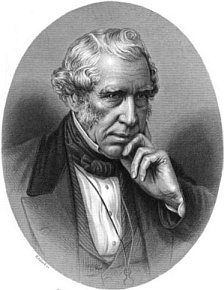
Fig. 5.2: Sir
William Fairburn,
civil engineer. |
The 19th century civil engineer, Sir
William Fairbairn (1789-1874) [5]
began his working life as an apprentice millwright at
Newcastle-upon-Tyne. In his Treatise on Mills and Millwork
(1865), Fairbairn provides an interesting insight into the
millwright’s work during the 18th century:
|
“. . . . the millwright of the last century
was an itinerant engineer and mechanic of high reputation. He
could handle the axe, the hammer, and the plane with equal skill and
precision; he could turn, bore and forge with the ease and despatch
of one brought up to these trades, and he could set out and cut in
the furrows of a millstone with an accuracy equal or superior to
that of the miller himself. These duties he was called upon to
exercise, and seldom in vain, as in the practice of his profession
had he mainly to depend upon his own resources.” |
Thus, the millwright’s trade combined elements of those of the
carpenter, blacksmith and stone mason, while he needed to be of a
practical and resourceful turn of mind. His occupation also
demanded the ability to design mills and milling machinery, which
required the application of arithmetic and geometry to the
manufacture of all the components of a working mill. Fairbairn
tells us that . . . .
“. . . . he could calculate the velocities,
strength, and power of machines, could draw in plan, and section,
and could construct buildings, conduits, or watercourses, in all the
forms and under all the conditions required in his professional
practice. . . ."
During the windmill era, the millwright performed much of the work
of today’s civil engineer and it is not difficult to see why some of
the more gifted among their ranks became our first great civil
engineers. Expertise also flowed in the opposite direction.
John Smeaton, famous for the Eddystone Lighthouse (and the first to
proclaim himself a “civil engineer”), while not a millwright
by trade, performed valuable research into the design of milling
equipment. He investigated sail design and was the first to
employ cast iron in place of wooden parts in the construction of
milling machinery.
Fairbairn also tells us something about the millwright’s standing in
society . . . .
“. . . . living in a more primitive state
of society than ourselves, there probably never existed a more
useful and independent class of men than the country millwrights.
The whole mechanical knowledge of the country was centred amongst
them, and, where sobriety was maintained and self-improvement aimed
at, they were generally looked upon as men of superior attainments
and of considerable intellectual power.”
Perhaps Fairbairn’s opinion was rose-tinted, for the two local
millwrights for whom we have been able to obtain information, while
offering the range of skills that he describes, do not appear to
have matched them with a high degree of business acumen.
THE DECLINE OF THE MILLWRIGHT’S TRADE
As the Industrial Revolution progressed, millwrights were pressed
into service to build the first powered textile mills. James
Watt’s condensing steam engine developed into an economical and
reliable driving force and, unlike wind and water power, one that
offered a stable source of motive power. Gradually, wind and
water mills were replaced, first by steam-driven machinery and
eventually by electric power, while small local grain mills gave way
to large factory units catering for entire regions of the country.
As for the millwright, his work was mostly lost in the evolution of
other trades, such as turners, fitters, machine makers and
mechanical engineers.
LOCAL MILLWRIGHTS
THE HILLSDONS OF TRING
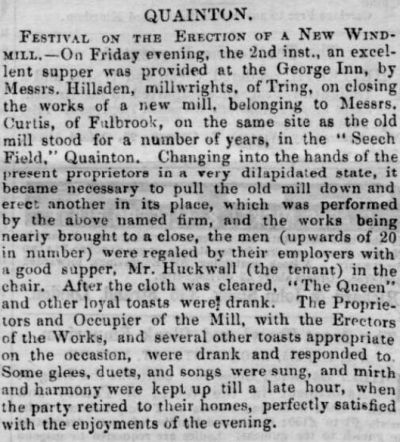
Fig. 5.3:
Bucks Herald, 10th November 1855.
Waddesdon-born John Hillsdon came to Tring in about 1825. The
1841 Census records him living at Tring Wharf with his wife and five
children, where he worked as a miller at Gamnel Wharf mill (Chapter
VII) together with his 16-year old son, John.
By 1850 John had left Gamnel to trade on his own account, describing
himself as a ‘Millwright’ and occupying premises on the corner of
Chapel Street and King Street in Tring. Ten years later the
Hillsdon’s venture into the world of business had proved unwise, for
their financial affairs were in a parlous condition. On 15th
December 1860 an announcement appeared on the front page of The
Bucks Advertiser & Aylesbury News:
|
 |
|
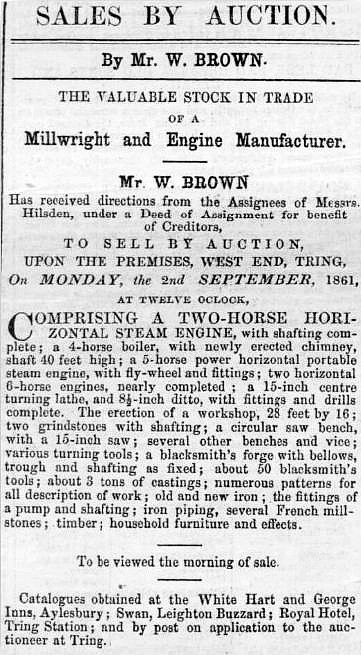
Fig. 5.4: Bucks Herald, 24th August 1861.
Bankruptcy sale of Hillsdon’s assets. |
|
“Notice is hereby given that by indenture
dated the 7th day of December 1860, John Hillsdon the elder and John
Hillsdon the younger of Tring, in the County of Hertford, Engineers,
assigned all their personal estate and effects whatsoever and
wheresoever to William Smith Simkin of No 6 Leadenhall Street,
London, Ironmonger, and John Nevins of Nos 1 & 2 Great Guildford
Street, London, Ironmonger, upon Trust for the benefit of
themselves, and all the creditors of the said John Hillsdon the
elder and John Hillsdon the younger . . . . In the presence of John
Merritt Shugar of Tring, Solicitor.” |
In spite of this drastic measure, in the following year Johns senior
and junior — now described as agricultural machine makers — are
found in the records of the Hertford Union Gaol & House of
Correction, imprisoned for debt. By no means an uncommon
offence at that time, the Hillsdon’s fellow inmates were other
assorted traders, including a china dealer, a market gardener and a
straw hat maker.
In May, 1861, John Jnr. petitioned for his discharge, his debts
amounting to £587. 14s, offering to pay 10s in the pound. All
his creditors concurred, save one, a solicitor, to whom Hilsdon owed
£21, but the objection was set aside and John was discharged.
What happened to his father is unrecorded, but they weathered the
storm and returned to carry on business in the same premises as
before. In 1869 John junior placed an ambitious advertisement
for Tring Iron Works in Kelly’s Trade Directory, where he is
described as “engineer; millwright; manufacturer of portable and
fixed steam engines, water wheels; corn, bone, bark and colour
miller; and iron and brass founder”. No more is heard of John
junior in Tring, but it is believed that he and his wife emigrated
to New Zealand, leaving there seven years later for the USA.
George Hilsdon, a younger son, also followed the family tradition
and remained with his father at the King Street business.
The firm of Hillsdon was undoubtedly involved in a wide range of
mill-related business, but all that is now known is that they
erected the tower mill at Hawridge Common (Chapter
IX), installed the steam engine at Wendover windmill (Chapter
X) and were possibly involved in the construction of Goldfields
and Waddesdon mills. [6] John
senior is last recorded in 1871, a widower of 76 living in lodgings
in Frogmore Street, Tring. It is believed that the Hillsdon’s
firm, Tring Ironworks, closed around 1905.
WILLIAM COOPER OF AYLESBURY
Almost all that is known of William Cooper and his business are
contained in two account books now held in the Buckinghamshire
Archives.
On October 11th, 1831, an announcement in the London Gazette
stated that the partnership between William and Joseph Cooper,
Millwrights and Smiths of Aylesbury, Bucks, had been dissolved by
mutual consent. The following year William Cooper was declared
bankrupt, his two account books passing into the custody of the
court. One is a general ledger in which are recorded his
business transactions between May 1827 and September 1832, the other
records expenses incurred between April 1830 and January 1831 in
connection with fitting out Champness windmill at Fulmer.
In common with the Hillsdons, the ledger shows that Cooper performed
a surprising range of work. This extended from simple repairs
to stoves and locks, to more complex work on agricultural machinery,
through to the installation of all the equipment at Fulmer and
Quainton windmills. The ledger also shows that Cooper worked
on some thirty wind and water mills in and around Aylesbury,
including a windmill at Tring (but unclear which) and those at
Waddesdon (Chapter XIV),
Wingrave (Chapter XIV), and
Wendover. He also undertook work on the treadmill in Aylesbury
Gaol and on an unspecified type of mill at Winslow Workhouse.
The cost of fitting out Champness mill was £445 8s.10d., of which
almost half was for labour, the balance being for canvas (121
yards), tacks (22,000), screws (13 gross), nails, chisels, ironwork,
timber, and “Different things”. Wages paid to the
skilled men were four shillings a day, while the daily rate for the
two labourers was two shillings.
Among Cooper’s smaller jobs are recorded the repair of butter
churns; roughing of horse shoes; mending wagons; repairing a kitchen
range; mending a rat trap; ringing pigs; mending plough shears; and
to a Mr. Collins he supplied “12 stoves different sizes”.
If nothing else it seems that the millwright of the age was
versatile.
What led to Cooper’s bankruptcy is unknown, although in the Fulmer
book there are references to expenses of a legal nature: “Copy of
a Rit” (writ), expenses for “Sherrfs officer”, and “Lawyer
Charge”, which suggest that he might have been owed money for
work on the mill. There are also several entries that refer to
the purchase of pints and quarts of gin and rum.
Apart from these account books, the Aylesbury Poor Rate Book for
1831-2 records that Cooper’s premises were in Walton Street on a
site now occupied by the White Swan, but by 1835 the foundry had
gone. |



