|
INTRODUCTION
Ever since man ceased being a hunter gatherer and settled down to a
predominantly agrarian existence, the grinding of grain has been a
central feature of rural life. From the simple quern stones of
the Neolithic Age through the age of water-, wind- and steam-driven
mills, to the electrically-powered, computer-controlled, roller
mills of the present day, the production of flour has remained
essential to the preparation of our most basic food, the loaf of
bread.
The Romans are believed to have first brought watermills to our
country. A thousand years later, many places recorded in the
Domesday Book had one or more mills, most probably run by water
power. Tring’s Domesday Book entry records two mills, both
valued at 9s. 0d. Within the Tring Hundred, several more are
listed: one at Tiscott (now a deserted medieval village), value
10s.0d.; two at Puttenham, value 10s. 8d.; one at Gubblecote, value
12s. 4d.; and one at Wigginton, value 5s. 0d. Given the
latter’s hilltop position and low valuation, this was probably a
mill driven by a single or a pair of yoked oxen. And for
hundreds of years, small hand-operated grinding stones were used in
many rural homes.
Although there is a reference to a windmill in Persia as far back as
AD 644, the first known practical windmills in that country date
from the 10th century. Such early examples took the form of a
roofless tower supporting a vertical pole to which lightweight sails
were attached to horizontal struts. This type of windmill was
known as a ‘panemone’ and was fixed in one position. The
concept is thought to have been brought to Northern Europe by
knights returning from the Crusades in the Middle East; the first
mention of a windmill in Europe is in a Papal Bull of 1105.
The idea then spread throughout the Low Countries, Denmark, and
Bohemia, in fact to any location lacking water to drive a mill but
where there was plenty of wind energy. [1]
The great Mongol conqueror, Ghengis Khan, also realized the wind’s
potential as a source of power, and following his invasion of Persia
he took local millers back to China to build identical mills.
|
 |
|
Fig.
0.1 - an illuminated letter depicting a 4-sail sunken
post mill (c.1260) |
The first references to windmills in Britain date from the last
quarter of the 12th century, but surviving pictorial evidence is
much later. One of the earliest illustrations appears in an
illuminated letter in Aristotle’s Meteoroligica (fig. 0.1).
It depicts a 4-sail ‘sunken’ post mill, a type in which the
superstructure of the mill (the ‘buck’) was supported on, and
revolved around a substantial upright post — the stability of this
type of mill derived from its central post having being sunk into
the ground, hence the description ‘sunken’. Supporting the
buck on a central post enabled the mill to be turned to face into
the wind (‘winding the mill’). Here, the miller is shown
applying his back to the tail poll to wind the mill, and a sack of
grain lies awaiting his attention in the doorway. The sails
are shown covered in cloth and the wind power thus captured would
have driven a single pair of grinding stones.
 |
|
Fig.
0.2 - detail from the ‘Walsokne Brass’ plaque (1349) |
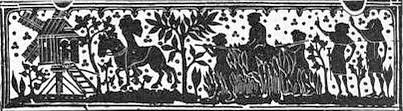
Another early image appears on the ‘Walsokne Brass’ plaque in St.
Margaret’s Church, King’s Lynn (fig. 0.2). Dating from
1349, a panel at the foot of the brass depicts a horseman carrying
grain to be ground at a post mill, followed by two men who are
bearing their lord on a litter. The type of windmill shown is
of a later type known as a ‘tripod post mill’, in which the sunken
upright post (fig. 0.1) is replaced by a post braced by supporting
beams that form a tripod arrangement. This construction
provided better stability and kept the upright post more free from
damp; it also permitted the windmill to be moved more easily.
This type of windmill continued with minor modifications and
improvements until the 17th/18th centuries, (plate
4) by which time windmill construction had evolved into more
sophisticated and substantial smock and tower mills.
The Industrial Revolution began in Britain around the mid-18th
century and led to a gradual transition from an agrarian to a
manufacturing economy. Until this period, most of our
population lived in the countryside in small communities that were
much more self-contained than those to which we are now accustomed,
and which relied on the local grain mill for the production of both
human and animal foodstuff. By the beginning of the 19th
century it is estimated that there were some 10,000 grain mills of
various types operating in Britain. As well as grinding
cereals, windmills were used for various other purposes in which a
rotating shaft could be made to do useful work including, in East
Anglia and other low-lying areas, pumping water from low-lying areas
into drainage ditches.
By the middle of the 19th century, the arrival of steam power
together with more modern milling techniques rendered wind and water
mills obsolete, and they fell rapidly into decline.
Fortunately, some have survived as private dwellings (fig. 0.2),
some as static museum exhibits and a few have even been restored to
working order by dedicated preservationists, but most were
abandoned, fell into decay and were eventually demolished (fig.
0.3).
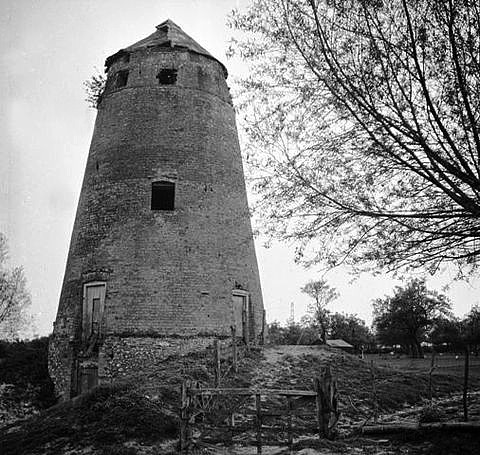
Fig. 0.3:
Edlesborough tower mill
(ca.1947), Buckinghamshire, now a private house.
We are fortunate that in Tring and the surrounding area, four of the
five windmills whose histories are given in this book survive.
Pitstone Windmill, now fully restored and preserved as a historic
monument, is cared for by the National Trust. The other three
have been converted to private dwellings at Tring (Goldfield), at
Wendover and on Hawridge Common. The fifth, Gamnel Wharf
windmill at Tring, was pulled down in 1911; although the only one of
the five local windmills not to survive, its site, ironically, is
now occupied by one of the largest flour mills in the country.
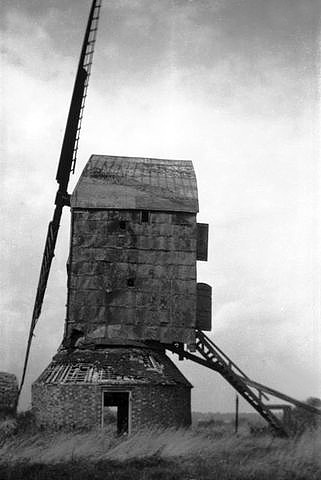
Fig. 0.4: Riseley post mill,
Bedfordshire (ca. 1933)
― demolished ca. 1946.
Further afield are examples of post mills at Brill and at Chinnor.
There is also a tower mill at Edlesborough ― alas, not visible from
the road ― that has been converted into a holiday home, while a
short distance away is Doolittle Mill, a rare example of a combined
wind and water mill, now an attractive private dwelling. And
not to disregard completely the competing technology, there are
working water mills in the locality at
Ford
End (Ivinghoe) and
Redbournbury (St. Albans). Both are open to the public,
the latter producing bread for sale in its adjoining bakery. |



