|
CHAPTER XVI.
LOCAL WINDMILLS TO VISIT
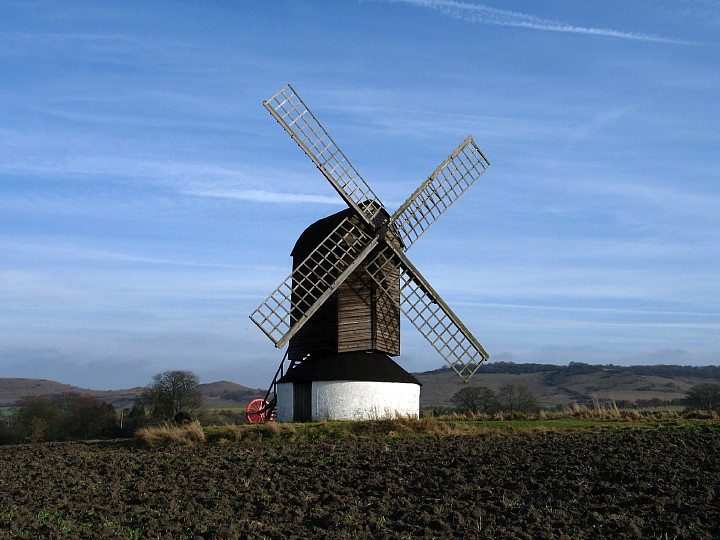
PITSTONE POST MILL
Website . . . .
http://www.nationaltrust.org.uk/pitstone-windmill/visitor-information/
Location: near to the junction of the B488 and B489
OS Sheet 165; SP 945 157
Pitstone mill is described in Chapter 6.
Although in mechanical working order, the mill is now a static
exhibit managed by the National Trust. It may be approached
and viewed from the outside at any time, but public openings are
generally on Sunday and Bank Holiday afternoons during the summer
months.
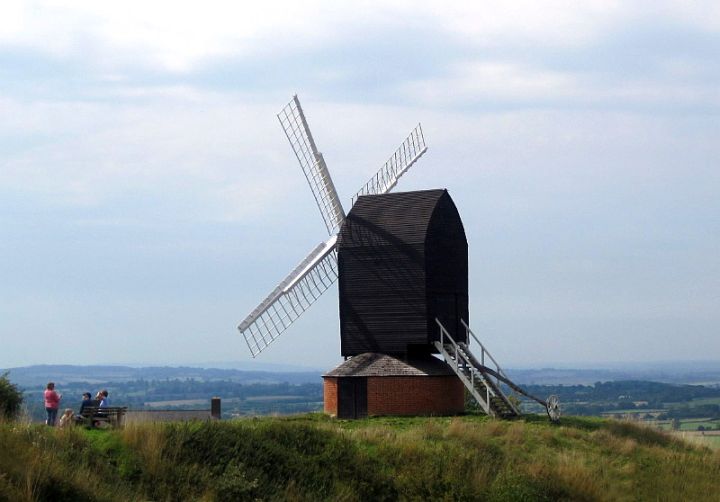
BRILL POST MILL
Website . . . .
https://www.buckscc.gov.uk/services/culture-and-leisure/brill-windmill/
Location: about ½ mile N.W. of the town
centre
OS Sheet 165; SP 652 142
A 17th century post mill, similar in style and vintage to that at
Pitstone and possibly by the same millwright. The windmill
stands on open ground at the end of Windmill Street, its elevated
situation giving a fine view of the surrounding countryside.
It may be approached and viewed from the outside at any time, but
public openings are generally on Sunday afternoons during the summer
months.
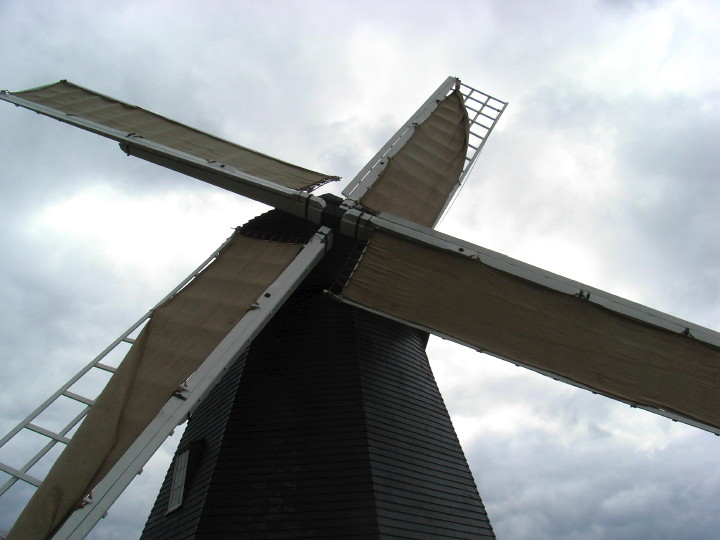
LACEY GREEN SMOCK MILL
Website . . . .
http://www.laceygreenwindmill.org.uk/
Location: behind ‘The Whip’ public house;
OS Sheet 165; SP 819 008
Lacey Green smock mill lies about two miles south-east of Princes
Risborough. It is believed to date from 1650, making it
Britain’s oldest smock mill. Judging by old photographs, the
mill was in a ruinous and derelict condition in 1970, but has since
been restored, quite miraculously, by a dedicated team of windmill
preservationists. The windmill is open to the public on
Sundays and Bank Holiday Mondays, from May to September, and
operates on some occasions.
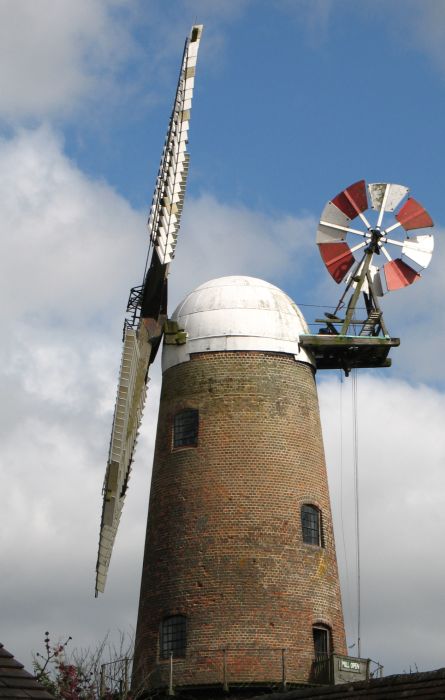
QUAINTON TOWER MILL
Website . . . .
http://philipwarnerpw.wix.com/quaintonwindmill#!your-visit/ccdv
Location: off Upper Street, N. of town centre;
OS Sheet 165; SP 746 202
Also known as Banner Mill, this 6-storey, brick-built tower mill
dates from 1832. It remained in operation as a windmill until 1881
when steam replaced wind power; milling had ceased altogether by
1900. Under the tender care of the Quainton Windmill Society, the
derelict mill was restored over a period of 23 years, returning to
full operation in 1997. The windmill, which overlooks the
picturesque village green, is open on Sunday mornings throughout the
year and operates when wind conditions are favourable. The George
and Dragon public house (on the Green) serves food, while the nearby
Quainton Railway Centre is another place of interest worth a visit.
Please confirm opening times before visiting.
CHINNOR POST MILL

Website . . . .
http://chinnor-windmill.blogspot.co.uk/
Location: in Mill Lane (junction B4009 & B4445)
OS Sheet 165; SP 749 010
Chinnor post mill was built in 1789 and ground wheat into flour
until 1923. By 1967 she was derelict and was pulled down to
make way for housing. Fortunately, much of the structure was
saved and the mill is presently being reconstructed on a site near
to its original home by a dedicated team of volunteers.
The mill’s construction is unusual, it having three (rather than the
usual two) cross-trees, which require six ‘quarter bars’ and brick
piers. Curved struts support a curb ring that stabilizes the
bottom of the buck (superstructure).
A visit to Chinnor mill provides a valuable opportunity to see a
post mill in the course of construction and to inspect the post,
quarter bars and piers, which are often difficult to see clearly
when enclosed in a roundhouse. The mill can be viewed
externally at any time.
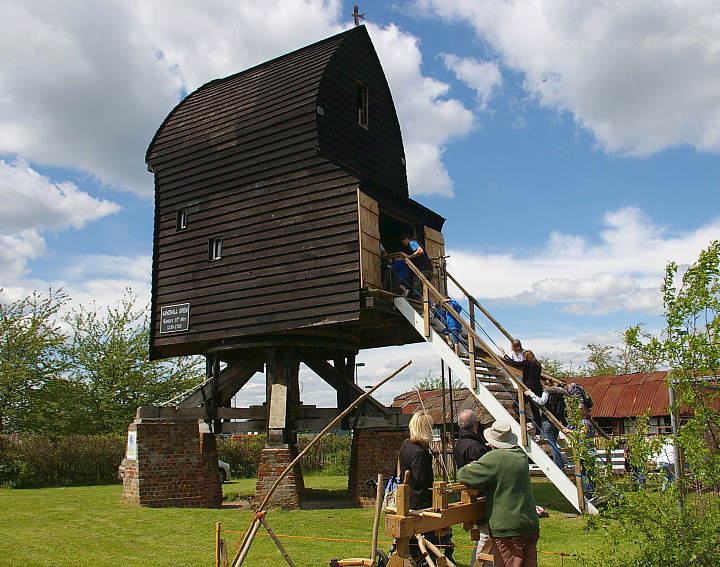
Since writing the original entry for Chinnor
Post Mill, there have been developments. The buck was lifted onto
its post in 2011, and the steps and fantail have been rebuilt. The
sails are being made professionally and will be fitted in the summer
of 2014. Work continues on the mill’s machinery with the aim of
producing flour.
You can see a video clip of the buck being
lifted into position on
YouTube.
――――♦――――
APPENDIX
OTHER LOCAL WINDMILLS
NOT OPEN TO THE PUBLIC
EDLESBOROUGH TOWER MILL

Location about ¼ mile N.W. of Edlesborough Hill;
OS Sheet 165; SP 982 192.
Edlesborough tower mill, also known as Simmons mill after the family
who owned it over many generations, is located on the eastern side
of the village on the Ouzel, astride the Bucks/Beds border. A
private drive leads to the mill, which is not visible from the
highway. The owner believes the mill was built c.1790; the only
references to it appear in A History of the County of Bedford:
Volume 3 (1912) . . . .
“The village is watered by numerous
streams, which rise at Well Head and on the Dunstable Downs, and
find their way eventually to the Ouzel, which forms the western
boundary. On its banks, slightly north of Edlesborough Hill, stands
Edlesborough Mill. Steam is employed here when insufficiency
of water prevents that power being utilized. On the other side
of the stream, in Buckinghamshire, is an old windmill, whose sails
were blown down seventeen years ago [c.1895].”
. . . . and English Windmills Vol. II. (1932) records that .
. . . “it has no sails and is derelict” (fig. 13.1).
The present owner has restored the body of the mill, which now
stands in carefully tended grounds, nicely set off against the Ouzel
and the landscaped millpond and mill race of its former neighbour,
the watermill — a delight to see. Today, the old windmill is
spending its retirement as a holiday flat to let.
DOOLITTLE COMBINED WIND
AND WATER MILL
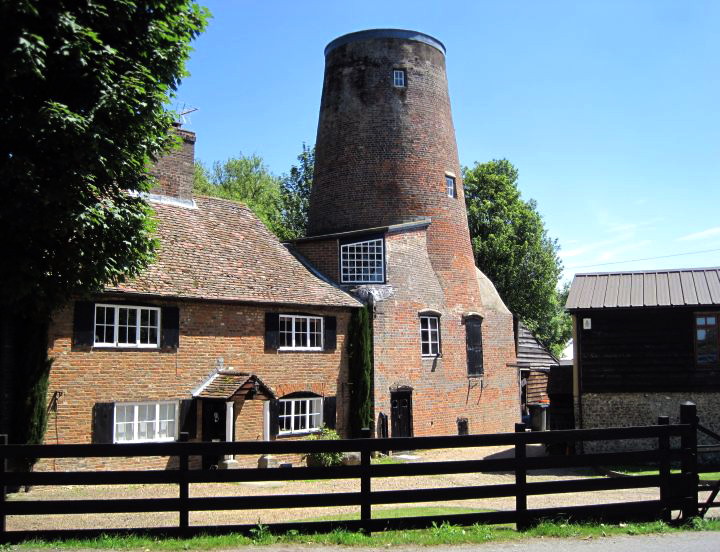
Location on Doolittle Lane 1¼ miles S.E. of Eaton Bray church.
OS Sheet 165; SP 990 202.
Doolittle mill is thought to have been built between 1815 and 1825.
It is a rare example of a combined wind and water mill, the water
mill being situated in the first two floors with the windmill in the
brick tower above. The windmill ceased operation in 1868 when
its sails were blown off and a steam engine was then installed.
It closed in 1921. Today, the mill is a private dwelling with
some commercial premises situated in the grounds. It can be
seen from the public highway.
Local folklore has it that Doolittle mill acquired its name — a
corruption of “Do Little” — because it is sited at the head of a
stream and hence, in dry weather when water flow was low, the water
mill was not capable of doing much work. It was then that
recourse was made to its sails and, later, to the steam engine.
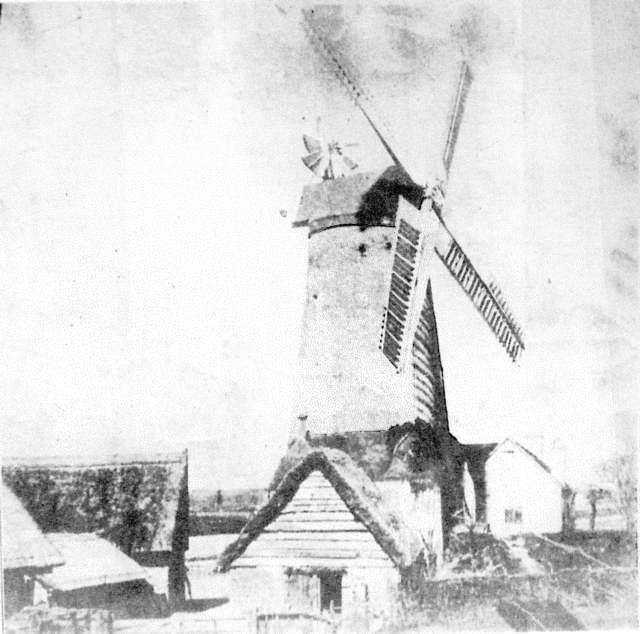
Doolittle mill pre-1868. |



