|
|
|
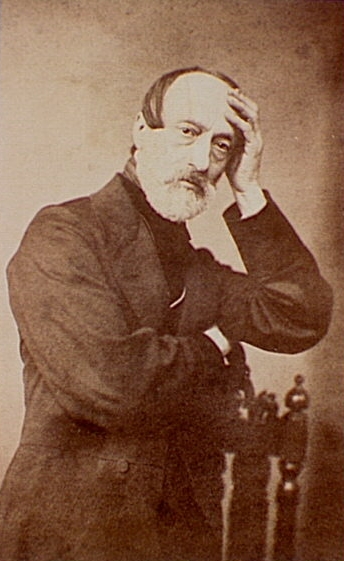
Joseph Mazzini.
(1805-72) |
Signor Mazzini has been, for years,
the best abused man in Europe. He has the misfortune to be
a republican; and, as if in illustration of Napoleon's remark,
that seems quite enough to turn a great many other people into
Cossacks, at the mere mention of his name. This, to some
extent, was shown in our own House of Commons lately, when a young, able
and eloquent servant of the state made a hundred sudden foes by
proclaiming himself Mazzini's friend. In the domain of
politics, it too often happens that names and nicknames,
words and watchwords, are accepted in place of
facts, and it is so much easier to do a great deal of wrong on the
surface of things than to penetrate to the real truth, and ascertain the
right which may underlie appearances. We should not dream of
going to our House of Commons, enlightened as it is, for the true
character of a man like Signor Mazzini. He will appear
better in history than in life. Such a man's chance is greater in
the literary than the political arena. We are somewhat
calmer; we can afford to be fairer. We remember that a great
Englishman, named John Milton, was a republican. We know that
another English, republican, Algernon Sidney, was a political exile.
These men had no justice from politicians in their own day.
They appealed to letters, and in literature their names became
immortal. It is before a literary tribunal that Signor
Mazzini now lays the facts of his public life.
According to his enemies this man answers to the
description of Coleridge's 'Ancient Mariner,' passing "like night from
land to land," and laying hands on any enthusiastic youth he may meet;
holding him with his glittering eye whilst he tells his strange story,
and, at parting, placing a poisoned dagger in the hand of the youth, and
pointing out the despot in whom the dagger is to find a sheath.
He is an ominous thing of darkness, like the Miltonic eclipse,
perplexing monarchs with fear of change—the red spectre of
revolution—the stormy petrel that heralds the tempest, and shrieks for
joy as the tide of destruction comes rising, rolling in. On
the other hand, his friends tell you that he has been as the dawn of a
better day for Italy. Around no modern name have opposing
hosts rushed to battle with a fiercer zeal. Many are the
martyrs who have gone to death proudly shouting this name coupled with
that of their beloved Italy. All who have known the man in
our country think nobly of him, and better of Italy for Signor Mazzini's
sake. In truth, we believe it was personal respect for him
which kept alive hope and effort for his country when times were dark
enough to make the English friends of Italy despair for the cause they
had at heart. Some of those who have known Signor Mazzini
best,—and these are not French policemen, but English gentlemen,—are
only too glad of an opportunity for testifying, with Mr. Carlyle,
that the calumniated exile is a man of genius and virtue, a man of
sterling veracity, humanity, and nobleness of mind.
In our opinion it is not too great a thing to say
that Signor Mazzini has done as much for the regeneration and
unification of Italy as his more famous compeer, General Garibaldi,
although it is not so easy to sum his work. All the world
can appreciate the man of action who does the great deed and sets it
shining in the dazzle of a great renown. His victory is
visible; we can see the work done. It is different with the
man of thought, whose greatest labour is accomplished in the dark; who
is compelled to work in secret, and keep himself as well as his doings
out of sight. The man of thought spends himself in giving
rootage to that new life which is destined to burst into full flower in
the victories of a man of action like Garibaldi. The many
can appreciate the glory of the flower, only the few think of the
rootage taken in the dark. Yet Signor Mazzini is to the
thinking few just what General Garibaldi is to the unthinking many.
Signor Mazzini was the first Italian of modern times
who saw that his country had a great future of new life before her.
He was one of the first to perceive that it was only sleep, not death,
which kept his country in her grave-clothes,—the first who had
sufficient faith to believe that she would wake and rise erect and
become a free nation. When most others despaired, or became
sceptical, he had faith that under the ruins of the past, the weedy
desolation of the present, there were springs of new life in the land.
He felt that, however effete the upper classes might be, however
helpless the
doctrinairés, there was still something sound in the heart of the
people; healthy blood enough to renew the whole body. He was
the first man in whom the idea of Italian unity became incarnate.
He saw and proclaimed the means of Italy's redemption, and devoted his
life to the attainment of that end. Through years of
suffering has he done desperate and determined battle for his idea,
given up friends and country and all the kindly comforts of home,
clasping to his heart a duty which to most men would be drear and cold
as a stone statue; fighting on from defeat to defeat, or sternly biding
his time in forced and desperate calm. For thirty years he
was the banner-bearer and lender of the forlorn hope for the unity of
Italy, before the flag waved out so triumphantly in the grasp of
Garibaldi. The successful fighter comes to remodel a country
and alter the map of Europe, but the exiled thinker marshalled the
forces and even sketched the plans of attack. It was
Mazzini's thought that leaped out in Garibaldi's deed; and it must have
been a proud moment for the thinker when the victor came to say how much
he owed to the lonely exile—making his way gently through the vast
crowds that embraced him so lovingly, and, with the world's eyes on him,
he went to pay his tribute to Mazzini, own how much he owed to his
teaching, and track the unity of Italy back to an almost forgotten
source.
It is now some forty-three years since Mazzini, then
a boy, was walking one day in the Strada Nuova of Genoa, with his mother
and an old friend of the family, when they were stopped by a tall
black-bearded man, with a stern countenance and a flaming eye, who held
out towards them a white handkerchief, merely saying, "For the
refugees." The Piedmontese insurrection had just been crushed, and
the wrecks of it, the revolutionists, came drifting to Genoa by sea.
Henceforth the boy was haunted by the thought of these men; and he used
to search them out and detect them by their appearance, their dress,
their warlike air, or by the signs of deep and silent sorrow on their
faces. He would have given anything to follow them; and they
awoke in him those dim yearnings which in after years caused him to
follow their footsteps, visibly printed in blood, along the path to
martyrdom. He began to study the history of their struggle,
and fathom the causes of its failure, until at length he fancied he had
found out
how the obstacles might have been conquered; for boyhood
supplies wings to surmount all obstacles. He thought and
thought, became sombre and absorbed, and appeared to have suddenly grown
old. Childishly enough, he determined to dress always in black,
fancying himself in mourning for his country.
Signor Mazzini's early tendencies and aspirations
were towards literature. Visions of historical dramas and
romances had floated before his mind's eye; poetic and artistic images
had wooed and caressed his spirit, but his long broodings over the
condition of his country led him to consecrate himself to sterner
patriotic work. He looked upon life as being more than
literature, and felt convinced that a free country and a noble national
life must precede any real vital Art, any worthy Literature.
He did not care to lend an artistic hand towards decorating a grave, by
flinging a few flowers to wither there; so he renounced all thought of a
literary career and struck into the rockier paths of political action.
This, he tells us, was his first great sacrifice. It was his
pen, however, that first drew attention to his name. He soon
became a member of the Carbonari, although no great admirer of their
complex symbolism and hierarchical mysteries.
So terrified, he says, were the governments of that
day at the revival of any memories calculated to make Italians think
less meanly of themselves, that they would have abolished history itself
if it had been in their power. He visited Guerrazzi, then
confined at Montepulciano for the offence of having recited a few solemn
pages in praise of a brave Italian soldier. The eye of
authority was soon fixed upon the young Mazzini, and he was speedily
within four prison walls, contriving to correspond with his friends
through the help of a little pencil which he had found betwixt his teeth
when eating the food sent to him front home. When his father
asked what the son was accused of, he was told that the time had not
arrived for answering that question, but that his son was a young man of
talent, very fond of solitary walks by night, and habitually silent as
to the subject of his meditations, and that the government was not fond
of young men of talent the subject of whose musings was unknown to it.
It was in his little prison-cell at Savona, up in a
tower, suspended betwixt sea and sky, that Mazzini got his first glimpse
of a great future for Italy. Looking through those
prison-bars, the first immature conception of Italian Unity and the
mission of his country inspired him with a mighty hope, that flashed
before his spirit like a star. It was then he saw the
possibility of a regenerate Italy becoming the missionary of a religion
of progress, unity and brotherhood, far grander and vaster than any that
she has given to humanity in the past. A new Italy with a
new Rome at its head, giving a new life to her people; a new word to our
world! The prison-walls faded away, but the dream stayed,
and the morning star of the patriot's life that rose so large and
beautiful still shines on as the evening star of the Exile's later day.
He says, "If ever—though I may not think it—I should live to see Italy
One, and to pass one year of solitude in some corner of my own land or
of this land where I now write, and which affection has rendered a
second country to me, I shall endeavour to develop and reduce the
consequences which flow from that idea, and which are of far greater
importance than most men believe."
Signor Mazzini found it was poor work trying to
strike a spark of life out of Carbonarism. His acquaintance
with Italian exiles in Francemade him feel sad and dispirited to find
how they were always looking for external help, always expecting the
great deliverance of one nation to come from another, instead of
believing that each must work out its own. The Carbonari,
he says, were mere sectarians, not the apostles of a national religion.
Intellectually, they were materialist and Machiavellian. The
ardour and energy of youth were intrusted to the direction of cold
precisionists, who had neither faith nor future. When the
time came for action on a national scale, they felt the want of a
sufficient bond of unity, and, not having a principle on which to found
it, they were always seeking for a prince. With leaders like
these, the Italian people, however ready to be led, never knew where
they were going! Signor Mazzini determined on starting his Society
of Young Italy. He believed that the salvation of his
country lay with the youth of it who would act, and not with a "class of
old-fashioned conspirators, who would diplomatize on the edge of the
grave." Nationality was to be the soul of his enterprise, and
Young Italy was to work for the nation's redemption, not be taught to
look for it elsewhere. It is true that Signor Mazzini placed the
Republic as a symbol beside the Unity of Italy on his banner.
He did not then, and, he tells us, does not now, believe that the
salvation of Italy can be accomplished by monarchy. "All that the
Piedmontese monarchy can give us, even if it can give so much, will be
an Italy shorn of provinces which ever were, are, and will be Italian,
though yielded up to foreign domination in payment of the services
rendered; an Italy the abject slave of French policy, dishonoured by her
alliance with despotism, weak, corrupted, and disinherited of all Moral
mission, and bearing within her the germs of provincial autonomy and
civil war."
Signor Mazzini had to begin his work, as he has had
to continue it, in exile. He had to erect on a foreign shore
his battery, wherewith he pounded the enemies of his own land who were
in possession. This was to fight at an immense
disadvantage. He was compelled to be an invisible leader of
men; a man of action almost shut up, far away from the scene, in a realm
of thought, and driven to work by subterranean means to the place where
he ought to have been openly in person; often doomed to marshal his
forces, plan the battle, and stand aloof to watch the failure, because
he was an exile.
In spite of all difficulties, however, Young Italy
was a success. Young men with souls virgin of interest or
greed, full of faith and chivalrous self-sacrifice, gathered round the
young chief, and they did a notable work. They sowed some
imperishable seed, and watered it lavishly with their blood.
They gave martyrs to their cause. And there is a time in the
history of enslaved nations when martyrs are not to be despised, however
these may be sneered at in later days. At least they enhance
the value of land, patriotically, by making some portions of the soil
sacred, and they leave an influence that works on in the minds of men
long after they are gone.
Signor Mazzini declares, "I never saw any nucleus of
young men so devoted, capable of such strong mutual affection, such pure
enthusiasm, and such readiness in daily, hourly toil, as were those who
then laboured with me." Their battery—the Press—was set up at
Marseilles, and Signor Mazzini's writings had to be smuggled into Italy,
sometimes inside barrels of pumice-stone, and even of pitch.
The little band baffled their ursuers and persecutors as they best
could, in many ingenious ways. Then, says Signor Mazzini,
"there began for me the life I have led for twenty out of thirty years—a
life of voluntary imprisonment within the four walls of a little room.
They failed to discover me. The means by which I eluded
search; the double spies who, for a trifling sum of money, performed the
same service for the prefect and for me—sending me copies of every order
issued by the authorities against me; the comic manner in which, when my
asylum was at last discovered, I succeeded in persuading the prefect to
send me away quietly, under the escort of his own agents, in order to
avoid all scandal and disturbance, and in substituting and sending to
Geneva in my place a friend who bore a personal resemblance to me,
whilst I walked quietly through the whole row of policeofficers dressed
in the uniform of a national guard;—it were useless to relate in these
pages, written, not for the satisfaction of the curiosity of the idle
reader, but simply to furnish such historical information or examples as
may be of service to my country."
In the year 1832, a certain Emiliani had been
attacked and wounded in the streets of Rodez, in the department of
L'Aveyron, by some Italian exiles. The men who wounded him
were sentenced to five years' imprisonment. In the year
following, on the 31st of May, this Emiliani and another person, both
being spies of the Duke of Modena, were mortally wounded by a young
exile of 1831, named Gavioli. At the time this deed was
done, Signor Mazzini avers that he had never heard of the existence of
these men; their aggressors were equally unknown to him. He
had nothing whatever to do with the affair. Nevertheless he
was charged with it, as leader of Young Italy, and the
Moniteur published the sentence of a secret tribunal with Signor
Mazzini's name as President and Secretary. This is
noticeable as the first calumny pinned with a dagger to his name.
At a later period, in 1845, Signor Mazzini reminds us, an English
Minister, Sir James Graham, who had revived the calumny, was compelled
by the information he received from the magistrates of L'Aveyron, to
ask Signor Mazzini's pardon in Parliament. But it was a lie
that took a good deal of killing, even if it be dead yet!
"Young Italy" was enthusiastically received by some
who have since been at enmity with it and its originators.
Gioberti chanted to it a sort of hymn of welcome.
There are working men, says Signor Mazzini, yet
living in Bologna, who well remember Farini loudly preaching massacre in
their meetings, and his habit of turning up his coat-sleeves to his
elbow, saying—"My lads! we must bathe our arms in blood."
Signor Mazzini writes a letter to Frederick Campanella concerning Signor
Gallenga, well known as a writer on Italy; not so well known as the
would-be assassin of the King, Charles Albert:—
"Towards the close of 1833, a short
time before the expedition of Savoy, a young man quite unknown to me
presented himself one evening at the
Hotel de la Navigation in Geneva. He was the bearer
of a letter from L. A. Melegari, enthusiastically
recommending him to me as a friend of his who was determined upon the
accomplishment of a great act, and wished to come to an understanding
with me. This young man was Antonio Gallenga. He had
just arrived from Corsica, and was a member of
Young Italy. He told me that from the moment when the
proscription began, he had decided to avenge the blood of his brothers,
and teach tyrants once for all that crime is followed by expiation; that
he felt himself called upon to destroy Charles Albert, the traitor of
1821, and the executioner of his brothers; and he had nourished this
idea in the solitudes of Corsica until it had obtained a gigantic power
over him, and become stronger than himself; and much more in the same
strain. I objected, as I have always done in similar
cases. I argued with him, putting before him everything
calculated to dissuade him. I said that I considered Charles
Albert deserving of death, but that his death would not save Italy.
I said that the man who assumed a mission of expiation, must know
himself pure from every thought of vengeance, or of any other motive
than the mission itself. He must know himself capable of
folding his arms and giving himself up as a victim after the execution
of the deed, and that anyhow the deed would cost him his life, and he
must be prepared to die stigmatized by mankind as an assassin.
And so on for a long while. He answered all I said, and his
eyes flashed as he spoke. He cared nothing for life; when he
had done the deed, he would not stir a step, but would shout
Viva l' Italia, and await his fate—tyrants were grown too bold,
because secure in the cowardice of others—it was time to break the
spell, and he felt himself called to do so. He had kept a
portrait of Charles Albert in his room, and gazed upon it until he was
more than ever dominated by the idea. He ended by persuading
me that he really was one of those beings whom, from the days of
Harmodius to our own, Providence has sent amongst us from time to time
to teach tyrants that their fate is in the hands of a single man.
And I asked him what he wanted with me—A passport and a little money.
I gave him a thousand francs, and told him that he could have a passport
in Ticino. Until then he did not even know that the mother
of Jacopo Ruffini was in Geneva and in the same hotel. Gallenga
remained there that night and part of the next day. He dined
with Madame Ruffini and me, but not a word passed between the two.
I allowed her to remain in ignorance of his intentions. She
was habitually silent from grief, and hardly ever spoke. During
the hours we passed together, I suspected that he was actuated by an
excessive desire of renown rather than by any sense of an expiatory
mission. He continually reminded me that since the days of
Lorenzino de Medici no such deed had been performed, and begged me to
write a few words explanatory of his motives after his death.
He departed and crossed the St. Gothard, whence he sent me a few
lines full of enthusiasm. He had prostrated himself on the
Alps, and renewed his oath to Italy to perform the deed. In
Ticino he received a passport bearing the name of Mariotti.
When he reached Turin he had an interview with a member of the
association, whose name he had had from me. His offer was
accepted, and measures were taken. The deed was to be done
in a long corridor at the court, through which the king passed every
Sunday on his way to the royal chapel. The privilege of
entering this corridor to see the king pass was granted to a few
persons, who were admitted by tickets. The committee
procured one of these tickets. Gallenga went with it unarmed
to study the locality. He saw the king, and felt more determined
than ever—at least he said so. It was decided that the blow
should be struck on the following Sunday. Then it was that,
fearful of obtaining a weapon in Turin, a member of the committee named
Sciandra, since dead, came to me at Geneva to ask me to give them a
weapon and tell them that the day was fixed. A little dagger
with a lapis lazuli handle, a gift, and very, dear to me, was lying on
my table. I pointed to it. Sciandra took it and
departed. Meanwhile, as I did not consider this act as any
part of the insurrectionary work upon which I was engaged, and in no way
counted upon it, I sent a certain Angelini one of our party, to Turin,
upon business connected with the association, under another name.
Angelini, knowing nothing of Gallenga or the affair, happened to take a
lodging in the same street where he lodged. Shortly
afterwards having through some imprudence, awakened the suspicions of
the police, he was returning one night to his lodging, when he perceived
that the house was surrounded by carabineers. He passed on,
and succeeded in escaping to a place of safety. But the
committee, knowing nothing about Angelini, and seeing the carabineers at
only two doors' distance from the house of the regicide, supposed that
the government had information of the scheme, and were Search of
Gallenga. They therefore caused him to leave the city, and
sent him to a country-house some distance from Turin, telling him that
the attempt could not be made on the next Sunday, but that if all things
remained quiet they would send for him on one of the Sundays following.
A few Sundays after they did send for him, but he was nowhere to be
found."
The first volume of Signor Mazzini's works ends with the memorable march
of the exiles into Savoy, under Ramorino, in the year 1834. |


