|
"Now the labourer's task is o'er!" I did not find Mr. Gerald Massey
singing those words, but I did find him a happy man—the Happy Warrior
who had accomplished his task. He might say that he has been
working against time for eternity, because now a book into which he has
been putting his head and heart is finished, and is about to appear
through Mr. Fisher Unwin.
It was this circumstance which took me to see Mr.
Massey at his little home in Norwood, where he has lived the simple life
of a recluse for many years. He will be eighty in May, which is
old as age goes with men, but Mr. Massey is not as others. He is
frail, weary and worn in body, but his mind is fresh and buoyant as a
boy's, and his eyes, which are the windows of a soul, shine bright and
sparkle mirth. "I shall," he said, "be talking and laughing five
minutes before I hop off." "If it were not," he added, a little
later, "that there has been guidance in my life, I might just as well
hop off tomorrow."
What a romance has Mr. Massey's life been! He
was born among the canal people of England—at Tring in Herts—and he
worked and sang himself upward until in the Fifties and Sixties he was
one of the voices of England. Some of his verse went round the
world like the tap of the British drum, but to a very different note.
Then he ceased to sing and gave himself to what he thought a greater
work; in the words of the sub-title of one of his second-self books, "To
recover and reconstitute the lost origins of the myths and mysteries,
types and symbols of religion and language, with Egypt for a mouthpiece
and Africa as a birthplace." He ceased being a poet to become a
searcher for the Light of the World, and the last thirty years of his
life and more have been unceasingly given to that quest. His
gleanings were described in "A Book of the Beginnings" which appeared in
1881, and in "The Natural Genesis" which came out two years later, and
to-day the series is being completed with a third work in two volumes,
"Ancient Egypt: The Light of the World."
"I have written other books," says Mr. Massey in his
preface, "but this I look on as the exceptional labour which has made my
life worth living. Comparatively speaking 'A Book of Beginnings'
was written in the dark, 'The Natural Genesis' was written in the
twilight, whereas 'Ancient Egypt' has been written in the light of day."
Well, that makes it clear why we should, at this
moment, desire to talk with Mr. Gerald Massey, and we shall take him
first as the ex-poet—a term at which he laughed but which he would not
repudiate—and then as the prophet digging backward in order to
illuminate the future.
I.
I asked Mr.
Massey if he did not sometimes shed a tear over the verse which he has
been so content to bury away, because, strange as it may seem, there
really is not an edition of his poetical works on the market. His
daughter, who inherits so many of her father's fine qualities, looked up
at this question and nodded assent to it. But the veteran himself
was not to be moved to tears over such a small affair as poetry,
although he has the tenderest heart of all the Grand Old Men of the
world.
"I once thought I might be a poet," he said, "but I
have come to this, that I would be more content with an ant-heap in
Central Africa than with a seat on the classical Mount of Parnassus.
The ant-heap, as you will know, was the first form of a building, the
suggester and originator of the conical hut of Africa. Verse
passes like a tide, but I must admit that the writing of mine taught me
to write prose. There is no school, no mental discipline, like the
composition of verse. I will tell you a curious thing in that
connection. I used to suffer from a pain in my side, and two or
three doctors—without charging me anything, I think—gave it as heart
trouble. I never wrote a stanza of poetry without feeling that
pain, whereas it did not bother me when I was writing prose. The
explanation, I suppose, was that the writing of verse meant a greater
demand on me, the concentration of some nerve-centre to a special
degree. There can be no doubt that while it lasts the writing of
poetry is a more acute, more exhausting action of the mind than the
composition of prose. I have sometimes spent a night getting a
stanza: I do not do so now."
There was a meaning in these last words, and I looked
at Mr. Massey and repeated them, waiting for his answer to the implied
question. His answer was a merry twinkle of the eyes, a quiet
laugh, a step half across the room and then a story, not a new story,
but one which put and illustrated what was in his mind.
"You have heard," he said, "of Jamie Thomson, a lazy
fellow—even though a Scotsman!—who, being found in bed one afternoon at
four o'clock and asked why he did not get up, replied 'I hae nae
motive.' I have no motive to write poetry, nor have I had for ever
so long. In England the shoemaker is always expected to stick to
his last. People won't allow a man to move from one mental task to
another. You are supposed to stick to what you began with.
But that is absurd. I gather that many of Thomas Hardy's admirers are
grumbling because he is writing verse instead of continuing his novels.
Why should they? Perhaps Hardy could say of his 'Dynasts,' as I
can say of this laborious new book of mine, that I have put more poetry,
more of the real spirit of poetry, into it than I wrote in all my verse.
I do not suppose other people will agree with that, not just yet, but
may be in a hundred years these pages will begin to have a message, at
least I hope so. It is nearly half a century since I published my
study, 'The Secret Drama of
Shakespeare's Sonnets'—a study with a far deeper origin than I could
explain in words but that volume is only just beginning, so I judge, to
have any effect on men's minds."
Here Mr. Massey travelled into a striking comparison
between the poet as such and the man of action. He was inclined to
think that the latter, if he happened also to be a thinker, had the
richer nature, for one reason because he was so constantly in touch with
humanity. He instanced Sir George Grey, our greatest Pro-Consul in
the higher range of governorship, as being fuller in the human sense
than even master poets like Browning or Tennyson could be. The
poet felt a thing vitally and gave it forth in words and there it was,
but the rich-natured man of action was constantly feeling, constantly in
touch with the throb of life. It was a very beautiful comparison
that Mr. Massey made in subtle, musical language which you needed to
hear before you could understand its full meaning. The end of it
was some special words of reminiscence about Tennyson whom he met once,
only once, and in London.
"Tennyson," he said, "was one of the first to write
me a kindly word about my poetry, and of the lectures which I was wont
to deliver on various subjects he wrote, 'If I were in, or near, London,
I would come to hear you myself.' It got to be understood that I
was to visit him at his home in the Isle of Wight, but somehow I never
did so, and it was not until one occasion when Tennyson came to London
to consult his doctor that we did actually meet. He was not in
very good health, the result, in part anyhow, of too much scribbling,
and he was in bed when I called. We had a long talk, among other
things on Spiritualism, the essence of which is surely expressed in
Tennyson's 'In Memoriam.' My poem, 'The Tale of Eternity,' is a
mere inventory of Spiritualism compared with his 'In Memoriam,' and he
certainly spoke as one having no doubt that Spiritualistic phenomena
were a reality. His most striking experience in the course of such
'sittings' as he had tried was the cold wave that he frequently felt
pass over his hands. My talk with Tennyson was very interesting
altogether, and I well remember the frank bluntness, almost roughness,
of his personality, which did not seem to agree with the Italian suavity
of his poetry. His 'Northern Farmer,' however, was a striking
exception to this, for there was a lot of Tennyson, the man, in it—he
had let himself go.
"Oh, yes," Mr. Massey, went on, being himself amused
at his reminiscences of those old poetic days, "oh, yes, I suppose I
might even have been a poet of society if I had cared. I might
have been supping with duchesses instead of living apart and writing
books about the origins of civilisation. I might have been
supping," he repeated, and fell into the nursery jingle:
|
"To bed! To bed!" says Sleepy Head,
"Tarry a while," says Slow;
"Let's have some nuts," says Greedy Guts,
"And sup before we go." |
A man who did
his best to help Mr. Massey to sup when he was writing poetry in the
middle Victorian days he remembers gratefully—Mr. Alexander Strahan, the
founder of Good Words, who is still happily with us, although the
English book-world no longer knows his activities.
"He was," said Mr. Massey, "always willing to help
the lame bird, and I was a pretty lame bird at times. He knew
poetry, he liked poetry, and he paid well for poetry. For
instance, he gave me £50 for my poem 'The Orphan Family's Christmas.'
'Will you,' he had requested me in so many words, 'write some things for
Good Words? 'I replied that I was getting ten guineas a
poem from Charles Dickens and ten guineas a lyric from Cassell's people,
to which he immediately replied, 'And we'll pay you ten guineas.'
My first poem in Good Words was one entitled 'Garibaldi,' from
which you can gather that it was contributed when that name was taking
possession of people's imagination. I am not sure whether it was
to the old Morning Herald or to the
Standard that I once sent a poem which brought me an editorial
letter to this effect: 'We like your piece very much, but will you do us
something milder on the same lines?' I am afraid I did not do them
anything milder on the same lines."
No; he has never done anything to order—never could,
and never will; for which salutations!
II
It will be seen
from the foregoing "unconsidered trifles," as Mr. Massey would call
them—if we could fancy him using so hackneyed a phrase—what a world he
turned his back on when he sounded his last post as a poet and took up
the studious career of Egyptologist—Egyptology on a little oatmeal, all
leading to the heart of Africa as the cradle of creation. Yes, it
is time to speak of his new book, and how can that be better done than
in a short poem, a sonnet it happens to be in form, which he has written
in proclamation of its meaning and intention, and as motto for the
title-page:
|
It may have been a Million years ago
The light was kindled in the Old Dark Land
With which the illumined Scrolls are all aglow,
That Egypt gave us with her mummied hand:
This was the secret of that subtle smile
Inscrutable upon the Sphinx's face,
Now told from sea to sea, from isle to isle;
The revelation of the Old Dark Race;
Theirs was the wisdom of the Bee and Bird,
Ant, Tortoise, Beaver, working human-wise;
The ancient darkness spake with Egypt's Word;
Hers was the primal message of the skies:
The Heavens are telling nightly of her glory,
And for all time Earth echoes her great story. |
How did the
author of that sonnet, which shows how richly the lyric gift remains in
him, even if he will not use it; how did he turn from poetry to prose in
as grave and serious a form as it could take?
"I was," he said, "seized with evolution, and I began
to apply it to the originals in sign language. Ignorance of the
primitive sign languages is the source of the greatest errors in
theology. The Christian doctrines are a literal misinterpretation of
ancient wisdom, and until you get a real knowledge of the sources of
things, you are left in error and misapprehension. You must get
down to the rootage, to the primal meanings, and that is what I have
been trying to do in what will now be six large volumes from my
pen—volumes in the publication of which I have spent all that I could
not spare. Five-and-twenty years ago a German Egyptologist, Herr
Pietschman, wrote very intelligently and well about my line of inquiry
as it had then been indicated in 'The Book of the Beginning.'" Mr.
Massey looked up that reference because he thought it as illuminating as
anything he could say, and here it is:
"This work belongs to the most advanced reconstruction researches by
which it is intended to reduce all language, religion and thought to one
definite historical origin; a kind of literature which thrives in
Germany, in a manner calling for no such apology as would be necessary
in America or England. The author differs, however, from all
similar writers in that he is an evolutionist, holding that he who is
not, has not yet begun to think, for lack of a starting point; that
black is older than white, whence the black race is first. It
follows that the first is in Africa, and Egypt the birthplace of the
original language and civilisation—the parent home which swarmed from
time to time like a beehive. This view, of which modern theology
has not yet dreamed, has not hitherto had any Egyptian research brought
to its support. This the author saw, and saw also that not only
must one be an Egyptologist but also an Evolutionist and of the newer
theology."
So much for a
German welcome for Mr. Gerald Massey, Egyptologist, twenty-five years
ago; and that led him to speak to me of the prospects of his coming
final volume. "I think," he said, "I care most about how it will
he received in Germany, in Japan and in India, where, I hope, there are
many people who will understand. We are far behind; we have a
perverted idea of these things, while the Japanese and the Chinese, say,
understand thoroughly. The Japanese, I take it, are the wisest set
of fellows on the earth's surface. They probably perceive that the
existing perversion of theology keeps nations asunder, that it is a
stumbling-block to the uniting of the races of the world, and that its
doctrines have really much to do with the prevalence of war. Some
Chinese mandarin, who had studied my 'Natural Genesis,' sent me this cap
of honour, as I suppose it to be"—and with that Mr. Massey went and
found for my inspection a Chinese biretta, as one might call it, of
black cloth with a red topknot. He popped it on to his head, whose
fine shape it showed in clear-cut lines, and then as playfully he took
it off and set it down on the table beside him, saying, "I value this
tribute, and I suppose the red topknot makes me a notable of some kind."
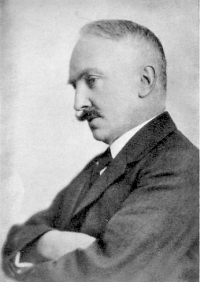
That was the moment to say he must be photographed in it, and he
consented, as see our portrait of him.
Yes, it is in Mr. Massey's mind that his new book may
be appraised at home in proportion as it comes back piecemeal from
abroad—from Germany or from France, or from Japan. He is
content to commend to the ages the truth, as he holds, which waits for
recognition in its pages, and he does so again in poetry, his old love,
from which all his struggles cannot quite get him away:
|

|
Truth is all-potent with its silent
power
If only whispered, never heard aloud,
But working secretly, almost unseen,
Save in some excommunicated Book;
'Tis as the lightning with its errand
done
Before you hear the thunder. |
|