|
FOR
many years Mr. Gerald Massey has lived in seclusion. He has set
himself, or, as he would say, has been set, a formidable task, and
devotes all his time and strength to its accomplishment. He
shrinks from publicity—"I am like a creature down at the bottom of the
ocean drawing breath from another world." He has never been
"interviewed" in this country, various interviewers having tried in vain
to induce him to submit to the process. He says he does not want
to be heard of until his magnum opus is finished. While
regretting that since 1870 he has only intermittently touched the lyre,
his friends and admirers of his poetry would rejoice to see him, in his
seventieth year, the storm and stress of his early days almost
forgotten, in his peaceful nest at Norwood, surrounded by his family,
and living a happy, quiet, industrious life. He is indifferent to
the world's estimate of himself and his work; not that he is in the
least cynical or misanthropic, but that he has reached a point where he
is unaffected by praise, blame, or silence. His study of Egyptian
lore seems to have invested him with sphinx-like assurance and
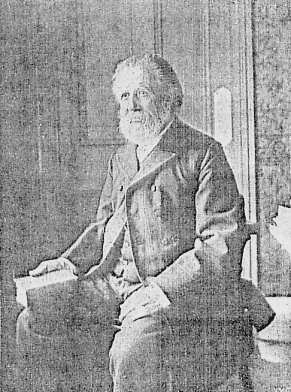
placidity. With a calm, passionless face, surrounded by fine grey
hair, a kind, tolerant expression in his steady grey eyes, and wearing a
red woollen cap, a white cravat (no collar), and a short check jacket,
he look's like a rabbi. Yet in intercourse you find him intensely
human, and altogether unlike the common notion of a mystic.
|
 |
|
Anru |
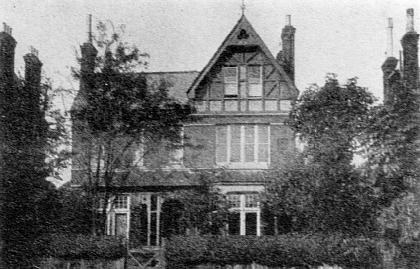
The name Mr. Massey has given to
the house in which he has resided for the past four years was suggested
by the special line of study he is pursuing,
Anru, or more correctly Aanru, being the Egyptian Garden
of Eden or Paradise. He came to Norwood from "Rusta," Lordship
Lane, Dulwich, where he lived three years. The previous thirteen
years (1877-90) were spent at Bordighera Villa, New Southgate.
Here he had much trouble and sickness, losing by death two daughters.
The old name of New Southgate is Colney Hatch, and, when he went to
reside there, paragraphs appeared in the American papers regretting that
Mr. Massey was in a lunatic asylum; the
New York Times was not at all surprised, having prophesied in a
leader where his opinions would land him! From 1866 to 1877
he had lived at Ward's Hurst, near Ashridge, Hertfordshire. The
late Lord Brownlow and his mother, Lady Marian Alford, were great
friends of the poet, and gave him this place for life. Lady Marian
actively interested herself in securing the Civil List pension of £100
enjoyed by Mr. Massey since 1864. Local associations may be traced
in Mr. Massey's poems, but external nature is to him chiefly background,
his interest being almost entirely in the human. "In Memoriam" was
written on the death of Lady Marian Alford's eldest son, Spencer, and
"Carmina Nuptialia" on the marriage of the present Lord Brownlow.
Many who are familiar with the poetry of Gerald
Massey know little of his history or personality. Few lives have
been more remarkable than his. Thomas Gerald Massey was born on
May 29th, 1828, in a flint-stone hut at Gamble Wharf, near Tring,
Hertfordshire. His father was a canal boatman. He traces
whatever he has out of the ordinary to his mother—"a fiery-spirited,
great-hearted little woman"—prototype of "Christie's Poor Old Gran,"
"Christie" (Christabel) being his eldest daughter. His schooling
was of the scantiest. He attended a British school and also a
night school in Tring, but says he did not get much from either.
At the age of seven he went into a silk factory, where he worked from
six in the morning until half-past six in the evening for ninepence per
week. He says, with a laugh at the recollection, that as a boy he
was an inveterate gambler, and on the Saturday lost all his first week's
wages at pitch-and-toss. When he had been some time at the factory
it was burnt down, much to his delight. He was then put to
straw-plaiting, and after three years at that he got a situation at a
boarding-school, but he had to leave—"because," he penitently explains,
"the girls used to kiss and hug me." So at fourteen he was packed
off to London. His first lines appeared in print in the
Aylesbury News in 1843. Soon afterwards he issued a
shilling pamphlet of poems. "Affectedly enough, I called it, after
Béranger, 'Poems and Chansons, by a Tring Peasant Boy.' What a
long time it takes to grow out of the affectation of youth, which is
only super-consciousness! That is the wonder of Burns—from the
first he seems to have been as unconscious as a bird."
He began life in London as an errand boy in a
draper's shop, and in the course of two or three years found himself
behind the counter. Meantime, he commenced to write what he now
describes as "wild, red republican rhymes." In '48 he joined in
the Chartist agitation, and on the memorable 10th of April was nearly
cut to pieces by the police at Kennington. In '49 he started a
monthly paper, The Uxbridge Spirit of Freedom, eleven issues of
which were published. In '50 he published "Voices of Freedom and
Lyrics of Love." About this time he came under the personal
influence of Maurice and Kingsley, became a socialist, and was for two
or three years one of their Secretaries. At twenty-two he married
a well-known spiritualist medium, "The Clairvoyant Jane," and some of
his tenderest poems were written at this period.
Having drifted into literature, he became associated
with Julian Harney (now, in his eighty-first year, lying seriously ill
at Richmond), who was then editing
The Northern Star, Fergus O'Connor's paper. When that
stopped they started
The Star of Freedom, which was financed by a man named Leblond,
head of the firm of Benetfink and Co. Mr. Massey also acted as a London
correspondent to the
New York Tribune. In 1854-5 he was secretary to Mazzini's
society, the Friends of Italy.
In 1854 Mr. Massey published what he considers his
first "volume," "The Ballad of Babe Christabel, and Other Poems."
It was an immediate success. "That was the only time," the author
remarks with a quiet smile, "that I ever had any 'booming.'
Hepworth Dixon caught sight of the little volume, and showed it to
Douglas Jerrold when they were going to spend a Sunday at Brighton.
Dixon wrote seven columns about it in the Athenæum, and Jerrold
wrote a flaming review in
Lloyd's. That sent it spinning. Five editions were
sold in one year; but as each had to be reprinted I did not make much by
it. Other reviews were quite as eulogistic as anything that has
been written about Rudyard Kipling. I did not dream of such
success. I wrote a great deal better verse after that which did
not get much recognition." Among those who were attracted by the
young poet was George Eliot, who took him as her model of Felix Holt.
Early in 1855 Mr. Massey removed to Edinburgh, where
he published "Craigcrook Castle." He lived in a flat in Henderson
Row for three or four years; here two of his children died, and here he
wrote "The Mother's Idol Broken." For a short time he edited
the Edinburgh Evening News, and also wrote for the
North British Quarterly Review, and for the Witness.
In 1856, Dixon asked him to review poetry for the Athenæum, and
this he did for ten years. He also wrote for the Quarterly
Review for five or six years under Macpherson's editorship.
Leaving Edinburgh in 1858, he took to the lecture platform, and for the
next ten years or so was in great demand all over the country. "I
have never had any diffidence in facing an audience; in fact, I was
hardly conscious of the audience. I seemed to be isolated, or,
rather, insulated." In March, 1866, his first wife died, and in
January, 1868, he married the present Mrs. Massey. Of the first
marriage there were three girls and a boy; two of the daughters are
living. Of the second marriage there were four girls and one boy;
two of the daughters and the son are dead. In 1869 he published
"The Haunted Hurst, A Tale of Eternity"—"founded," he says, "on a
personal experience in a house that
was haunted. This 'did for' me in a literary way. A
well-known editor spoke of me as having deserted Liberalism and gone
over to 'those spiritualists.' "
Since the appearance of the "Tale of Eternity," Mr.
Massey has written very little verse. In 1890 he issued a
collection of "poems old and new" in two volumes, under the title of "My
Lyrical Life." Several editions have been called for, and in each of
these he has inserted a few new short poems.
In 1872 Mr. Massey published a little volume
"Concerning Spiritualism," which has long been out of print. In
the same year he gave four Sunday lectures at St. George's Hall, and
publicly proclaimed himself a spiritualist: "Until then I had a
considerable lecturing connection, especially among Young Men's
Christian Associations—my poetry was accepted by the religious world as
particularly pious. I had between seventy and eighty winter
engagements; the season following my avowal of spiritualism I had only
seven!"
I asked Mr. Massey to tell me about the research work
in which he has long been engaged. "I had always been an
evolutionist since I thought out anything," he responded, and in 1870 I
got the idea that the human race originated in equatorial Africa.
I set to work, and tried to trace the origin of language, typology,
theology, etc., to Egypt. I found that our islands are full of
things Egyptian—place names, water-names, customs, etc. I have
compiled a vocabulary of a thousand English words derived from the
Egyptian. I have been at this work for twenty-seven years, and in
two or three more years I hope to complete my task. I have been
over the ground three times. First I treated the subject
philologically, and that is the result" pointing to two imperial octavo
volumes entitled "The Book of Beginnings: An Attempt to Recover and
Reconstitute the lost Origins of the Myths and Mysteries, Types and
Symbols, Religion and Language, with Egypt for the Mouthpiece, and
Africa as the Birthplace." "But I found that words did not go back
far enough—sign-language and hieroglyphics preceded words; so I tried
typology, and the outcome is 'The Natural Genesis'"—two volumes uniform
with "The Book of Beginnings." "My researches showed me the
necessity of something still more fundamental, and I am now working at
the earliest imagery and astronomical mythology. I wrote the first
two volumes in the dark, the second two in the twilight, and I am
writing the last two by day."
Mr. Massey drew my attention to a nest of large
pigeonholes, each containing a pile of matter—typewritten by his eldest
daughter, who helps him in his work. One division was labelled
"The Language of Animals;" another, "Totemism as a Primitive Mode of
Representation;" another, "Myth as a Primitive Diode of Representation;"
another, "The Kamite Astronomical Mythology;" these being four titles
out of a score or more sections of the concluding two volumes, which
will be entitled "Ancient Egypt the Light of the World." "I am
going to show," the author explained, "that Egypt was the light of the
world. Nothing could be clearer to my mind than the Egyptian
origin of the Babylonian mythology. When my work is done I shall
have established the Egyptian origin of the Hebrew legends and of the
Christian doctrines. To mention only three of the doctrines called
Christian. Six thousand years ago the Egyptians taught the
fatherhood of God, who was revealed to men by His own Son—He who says of
His Father, 'I utter His words to the men of the present generation
(i.e., the Living), and I repeat His words to the dead.' He taught
in two worlds—in one as human, in the other as a Spirit.
They had the Christian doctrine of the Trinity, with Osiris as the
Father, Horus as the Son, and Ra as the Holy Spirit, which three were
one in essence and threefold in identifiable phenomena. They had
their Christ or Anointed, who rose again from the dead as the Krst
Mummy, the spiritual body, or Sahu, in the person of Amsu-Horus. I
hold now that the authors of the documents from which the Gospels were
written must have worked from a copy of 'The Ritual,' and the
explanation of the great difference between John and the Synoptics is
that he has retained much more than they of the original matter. I
can parallel the sayings of Jesus one after another from 'The Book of
the Dead.' "
I asked Mr. Massey whether he reads much modern
literature. "Very little," he replied, "unless it is likely to
give me a new fact or suggestion, or help me to trace an origin. I
have read no poetry for years. I have not read Tennyson's and
Browning's later volumes; I read enough of their poetry in earlier life
when I used to review it. I reviewed Browning in the
Quarterly and Tennyson in the Athenæum. Darwin
speaks about certain faculties having died out in him; I don't think I
have lost the faculty of appreciating modern literature, but I certainly
have not cultivated it. I should read a new novel by Hardy or
Meredith. No, I have not read 'The Christian'; 'The Manxman ' is
the only book of Hall Caine's that I have read. The only paper I take is
the
Daily Chronicle. I never see the Athenæum or any of
the literary papers. My wife takes the Cornhill. I
can see the Nineteenth Century whenever I want to, but Mr.
Knowles has made it a mere collection of snippets; it is leading article
all through. I have come to think less and less of the mere
literary faculty; it is so limited, it is only a very small part of a
man."
"Did you ever meet Browning and Tennyson?"
"Yes. When my little book, 'Concerning
Spiritualism,' appeared, Lord Tennyson - then plain and preferable
Alfred—wrote to me saying, 'I have read your book more than once, and
have bought copies of it to give to friends.' Browning I used to meet at
Ashridge when he visited Lady Marian Alford. I wrote the article
in the Quarterly on Browning, which led the Spectator to
say that it was very timely, because the tide was running against him,
and it was glad the
Quarterly had set itself to stem it. I reviewed Browning
again and again in the
Athenæum."
"Matthew Arnold—Herbert Spencer?"
"Matthew Arnold wrote very kindly to me two or three
times, but I never met him. I used occasionally to see Herbert
Spencer at John Chapman's when I was doing work for the
Westminster, but I never spoke to him."
"Swinburne?"
"No. At one time I never opened the Athenæum without seeing
him classed with Wordsworth and Tennyson, which to me was simply
non-understandable."
About William Watson Mr. Massey remarked, "He has the
grand style, the grand manner, but I do not see the grand matter."
Mr. Massey told me that if he can complete the
undertaking in which he is engaged, he will consider his work is done,
and will be content to rest. "I shall exploit every grain of my
nature before I get through. I do not fool away my time or energy,
or run risks, but keep steadily on. At Ward's Hurst for a time I
worked twelve hours a day seven days a week. Now I sit down to my
desk about half-past nine. In the winter I work on until half-past
one, when I dine; in the summer I sometimes go out for a walk at twelve.
After dinner I always have a few minutes' nap; I find that a great help.
I work on until dark. I have a third meal about half-past six, and
go to bed soon after ten, and generally sleep like a top. I have
no theories as to diet. I very rarely go to town. For the
last eight years I have not gone out of the house during the six winter
months."
"How do you take exercise?"
"Generally in the evening I walk for an hour or two
round a table—say five miles. No, I don't get giddy; I am used to
circle-making"—this with a light laugh. "No, I don't find my life
monotonous or tedious. The explanation of my health and happiness
is that I do not rely on externals. You know Swedenborg and
William Blake claimed a kind of inner breathing. I know that is
possible. I have got at times to where I find there seems to be no
further need of expiring, it is all inspiration. I consider that
consciously or unconsciously we all draw life from the spirit-world,
just as we shall when we pass into it. I never felt younger than I
do now." Mr. Massey is the picture of health and contentment. |