|
THERE
seems to be an idea in England, which prevails with earnestness and enthusiasm
throughout the length and breadth of the island, that the United States are the
Atlantis of lecturers; and that when any one has earned or acquired a modest
portion of fame or notoriety, there remains for him but a tour through American
cities lecturing upon American platforms. It is probably not expected that
a third-rate novelist, for example, will be acknowledged as a first-rate
novelist after his return and by reason of his absence. But it is beyond
all question expected that his exchequer will be replenished, and that lodgings
and clubs will be attainable thereafter, which had been only sighed for
theretofore.
|
 |
|
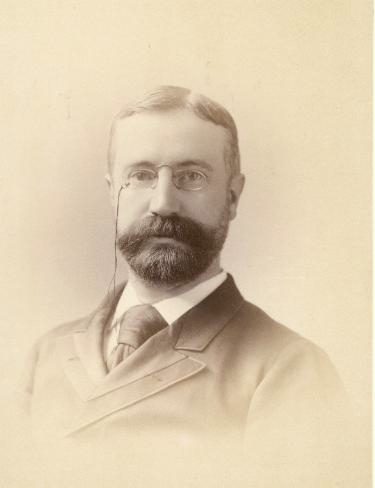
W. C. Brownell.
American journalist and critic.
(1851-1928) |
It would be an
anomaly certainly if there were not some foundation for this evidently
widespread and as evidently fatuitous confidence. But it is hardly less an
anomaly that this foundation should seem to bear an inverse proportion to the
structure which has been built upon it. And that it does bear this inverse
proportion is a matter not of conjecture at all, but of the last two or three
winters' history. It consists simply of what precedent may be considered
to have been established by the meagre success of the one and the abundant
success of another English lecturer in the United States.
When a dozen years or more ago Thackeray had written the
sketches which gave him popularity as a wit, and the book which above all his
others brought him fame as a creator, and had, quite beyond the expectation of
his friends and himself, "succeeded" as a popular lecturer in his own country,
lie came to the United States, and barely escaped "failing" here. And
when, long after the "American Notes" had ceased to be remembered, their author
revisited this country, where he had made his name as familiar in every
household as it was in England, the persons who were turned away disappointed
from the doors of his readings were more numerous than those who gained
admittance. The newspapers were full of what they called "ovations," and
any one who "had not heard Dickens" was curiously viewed by the society of the
day as lacking in some quality partly moral and partly mental. This
success was genuine; and it was beyond all precedent enormous. But it was
evidently attributed on the other side of the water to causes very different
from the true causes. It was manifestly considered that Mr. Dickens owed
his successful American tour to two facts: first, that he was a Briton, and
second, that his audiences were American. Stated in this way, these facts
do not seem to afford a very good basis for generalization both wide and exact.
But the contrary opinion prevailed very extensively, and very unworthy Elishas,
imagining themselves clothed upon with the mantle of this Elijah, soared upon
the east wind into our affrighted lyceum atmosphere, and there burst without
much brilliancy and went out without much flickering.
Thackeray is reported to have said of Carlyle, after a remark
which Carlyle's admirers will not consider complimentary, but will know how to
appreciate, "But he wouldn't go around the country exhibiting himself for so
much a night, as I am doing. "One can't help fancying that both Thackeray
and Dickens understood very well that they were simply exhibiting themselves to
American audiences—much as the Siamese twins
must have realized the nature of the process which brought them competence.
One can't help fancying that neither of these gentlemen regarded his lecturing
career as peculiarly creditable, or indeed as anything but a good way to earn
not only a livelihood but something more. Still it would not be exactly
fair—perhaps it never is exactly fair—to
prescribe to literary creators the governing rules by which their literary
creations are guided. And so, when Mr. Edmund Yates, whose heroes are
influenced not at all by the motive of acquiring dollars, but solely by the
motive of acquiring fame, concluded his arrangements with the American Literary
Bureau, and began his American tour, it would be no more than just to recognize
that Mr. Yates undertook his venture simply as a pecuniary speculation.
It is in this light precisely that Mr. Yates, and the many
English gentlemen who like him followed in the footsteps of Mr. Dickens, should
be judged; and judged in this light, it is a little astonishing how thin the
pretensions of Mr. Yates and his English friends appear. Mr. Yates may be
imagined to have set himself down and counted the cost of his undertaking
beforehand; in which event his soliloquy should have run somewhat as follows:
"In a certain light I have been before the British public for a number of years,
and in a somewhat dimmer light before the American public for a shorter period.
I first brought myself into notice by writing a personal sketch of Mr. Thackeray
at a time when anything said about him was sure of being read by his hosts of
friends and likewise by his many enemies. What I wrote the former called
an uncivil lampoon and the latter a piece of youthful folly. At all
events, it gave me, through a quarrel which it caused between Thackeray and
Dickens, not a little notoriety. That notoriety has increased with nearly
everything I have done. I have written a goodly number of candidly
speaking third-rate novels, which have been fairly remunerative here, and fairly
read in America. So as regards the first lyceum requisite—notoriety—I
am not badly prepared to lecture. As for subjects, my acquaintance with
Dickens will assuredly furnish me with an endless theme before a people which
has calmly endured almost a year of Mr. James T. Fields's recollections of the
same author; and as a literary man I can certainly be presumed to know all about
the peculiarities, professional and personal, of the literary men of the period.
The hollowness of this presumption, speaking candidly again, no one realizes
better than I do. But American audiences are notoriously not wise, and I
can say that Charles Reade looks like a farmer, and that Bulwer was very
aristocratic in his tastes, and that Collins 'lays himself out,' in American
vernacular, on his plots; and I can mention my quarrel with Thackeray with
graceful contrition, and speak of places which he frequented and I have visited.
Crowded into one lecture, or spread out rather over one lecture, that ought to
'take,' in American vernacular again. Then manifestly I can talk about
Hood, and, having the opportunity of selection, about as well probably as many
others who have done the same thing. My experience as a Parliament
reporter suggests another theme, and—on the
whole, I think I'll try it." If Mr. Yates had been a candid man, this is
the way in which he would have arrived at a determination to lecture to American
audiences. And philosophizing thus, he would have been mistaken in only
one point—the point which Mr. Yates and his
English brethren are wont to take for granted a trifle too easily—the
supposed fondness of the average American audience for foreign if inferior wares—disguised,
in these gentlemen's view, it may be, but very thinly disguised, as "lack of
discrimination," discernment, appreciation, or that quality which leads to the
detection of and disgustful and indignant turning away from pinchbeck and tawdry
display and all nonsense and superficiality, whether exposed for sale from the
lyceum platform or from any other stand. Mr. Yates found out his mistake
very quickly, it is to be presumed. It is to be presumed, too, that his
advice to his literary countrymen meditating a similar experiment was either
dissuasive or malicious.
But apparently Mr. Yates's advice was not sought.
Success was deemed too well assured. So a troop of literary gentlemen
followed rather rapidly in Mr. Yates's footsteps. Mr. George Macdonald was
closest on his heels. And it is only fair to say that Mr. Macdonald's
claims upon lyceum audiences were to those of his predecessor as sunlight unto
moonlight. He had not only endeared himself to a very large portion of
novel-readers years ago, but had won most cordial commendation from critics who
are ordinarily censors. The sturdy manliness and vigorous morals, and
quiet humour and peacefulness, which illuminate the pages of "Robert Falconer"
and the "Annals of a Quiet Neighbourhood," so remote from the flippancy which
contemporary novelists had imported from France, and called freshness, so remote
too from the other extreme of dullness which is felt to threaten "Annals" of any
sort of quiet neighbourhood—a complete
avoidance of both these blemishes, while truthfully and hopefully lighting up
the darkest struggles and deepest emotions of not Scotch nature or English
nature only, but of human nature as well—all
this was not only true, but known to be true by nearly every novel-reader in
America; by everybody who could by any chance be relied upon to make an atom of
a lyceum audience. And then, aside from his literary nearness to them, Mr.
Macdonald was in a sort endeared to Americans by qualities not at all literary,
but entirely personal. The story of his struggles, toils, earnestness, the
high standards by which he measured himself and others, his misfortunes, and his
bravery in every kind of moral conflict—all
served in a sort to endear him to many if not to most of the readers of his
books.
But Mr. Macdonald, it need not be said, was not brilliantly
successful as a lecturer. Those who remember his lecture on Burns are not
likely to forget that whatever were his qualifications for writing books, they
were not identical with his powers as a lecturer, and that whatever merits of
any kind he possessed, they were not made prominent, if at all apparent, on the
platform. Not a person in the audience on that occasion probably got a
better idea of Burns than that he before possessed. Neither was there much
amusement in the "Sermon to Young Men" which Mr. Macdonald preached at that
time. It is not every lyceum audience which is pleased at the substitution
of religious wares which it did not seek for literary wares which it did seek
and which it had some sort of right to expect. And this is precisely what
Mr. Macdonald did. Apparently he did it because he considered that his
mission was not so much literature as religion, and that for lyceum purposes one
was as fit as the other. This last is of course untrue, and Mr.
Macdonald's failure to perceive that it is untrue is what may be called Mr.
Macdonald's chief bar to success. To be sure there were other bars to his
success: an absence of grace, a bad arrangement, a hesitating delivery; a sort
of uncouthness, which could not be confounded with his Scotch accent a gaunt
presence, with none of the merits of elocution or other lyceum requisites which
are sometimes made to do service as cloaks for other defects—any
of these almost fatal, perhaps, but none so completely fatal as the sermonizing
tendency of his every sentence. People who had asked for something about
Burns got in return a discourse for the most part on purity and temperance—for
how many such discourses has poor Burns furnished the text!
—and went away, the charitably disposed soliloquizing, doubtless, "What a
big heart the man has!" but no one much wiser or much amused. Mr.
Macdonald may be considered to have found out for himself what beyond a doubt
his hearers did, and what it is hard to think he did not all along suspect—that
there was nothing of the lecturer in him.
With quite other credentials from the rest of these
gentlemen, Mr. James Anthony Froude came here to lecture; and if Mr. Froude is
to be believed, he came here for quite other ends. Briefly, he came
preceded by a very great and very splendid reputation, and came not from
pecuniary, but from missionary motives. It would not be strictly true to
say that Mr. Froude's course of lectures was a complete failure, but it would be
strictly untrue to say that it was a moderate success. As everybody will
remember, the passionate and plausible young Dominican father Tom Burke was
lecturing or preaching on saintly and secular subjects all over the country at
the time. And partly from his own over-boiling enthusiasm for Erin, and
partly egged on not only by his constituency of cooks and cabmen, but his
friends of family, he was induced to put on the gloves with Mr. Froude.
The contest was ostensibly a friendly one, as such contests are always called;
but the very partial success which attended Mr. Froude's lecturing venture may
not unfairly be ascribed to the earnestness and even bitterness of it. In
other words, it added the interest of discussion to what even Mr. Froude's
admirers must admit was not a juicy subject; and when the newspapers took sides
with some sharpness, and into a repetition of his lecture on O'Connell Mr.
Wendell Phillips infiltrated his view of British rule in Ireland, people's
curiosity was aroused to a certain extent. But even then the Irishman drew
very much larger if not so respectable audiences, and what there was worth
calling excitement was at no time at fever heat, nor did it last long; and when
it subsided, Mr. Froude subsided too, so to speak, and, giving up the hope of
converting America to an impartially English view of British atrocities in
Ireland, went home with his course unfinished. The reasons for the brevity
and the episodical nature of the brilliant historian's success are not far to
seek. An audience, once satisfied with a look at a renowned historian,
does not go again to hear him lecture if it makes up its mind that he is only a
great historian and not at all a great lecturer. Mr. Froude read his
missionary lectures very rapidly and with no oratorical eloquence. The
stenographers grumbled at the hurried and monotonous delivery, but their reports
were good enough to make people prefer reading them to listening to the
lectures. Even then they had no popularity. They were elaborations
of the most unpopular portion of Mr. Froude's History—absolutely
the worst portion he could have chosen to elaborate in a popular lecture series.
Probably their readers were fewer than Mr. Froude, disappointed as he
acknowledged himself, would care to think. Their subject was a special
subject dealing with a history which all Mr. Froude's brilliancy could not make
entertaining to more than a certain class; and unfortunately for Mr. Froude,
that class was not numerically important.
Long before the late Charles Kingsley thought of lecturing to
Americans, Americans had been delighted and instructed by his books.
Scarce a college student but had puzzled his professor with the metaphysics of
Raphael Aben Ezra in the famous chapter of "Hypatia." Scarce a family
library whose shelves did not contain well-thumbed copies of "Alton Locke" and
"Sir Amyas Leigh," and the shorter sketches of Mr. Kingsley. His
discussions with Dr. Newman, and the general understanding that perhaps
more than any other English writer he represented the conservative ground in the
controversies between the scientists and the religionists—endeavoured,
that is to say, to find a foothold which men who were extremists on neither side
could occupy in common with conscientiousness and intelligence—all
these things, if they did not endear Mr. Kingsley to them, certainly commanded
for him the respect and attention of educated Americans. Probably his
recent death was lamented here almost if not quite as much as it was by the
people among whom he lived and laboured.
Whatever Mr. Kingsley might write was certain of finding an
American audience, not only intelligent and discerning but large. But this
statement does not at all conflict with the statement that the American
audiences which cared to hear Mr. Kingsley lecture were not large enough to
insure the financial success of his course, nor discerning enough to enhance his
reputation. In other words, as it has all along been insisted, a writer of
fame and a lecturer of reputation are not always—as
a matter of fact it might be said not often—the
same, and qualifications are needed in the lecturer quite other than those which
insure the writer's success; and these qualifications, it will not be
strenuously denied, the late Mr. Kingsley did not possess. His lectures
were uttered in a kind of cathedral chant which made a humorously exaggerative
person suspect him of the ritualistic and reprehensible practice of intonation,
and of apparent absence of mind sufficient to mistake the lyceum audience for a
church congregation. In no sense of the word was he an orator, which alone
would be enough to explain his want of the success which, this apart, his
admirers might have expected for him. Doubtless Canon Kingsley never
claimed to be an orator. In that event it is only fair to say he did not
realize the importance of oratory to a successful lecturer. But in the
lectures themselves there was that which, from its constant iteration, has
become unattractive to American ears when coming from Anglican mouths. It
would be invidious and, unless a very strict standard were applied, unjust to
call it conscious flattery on the part of the late Mr. Kingsley. Very
likely Mr. Kingsley was entirely sincere, and considered it a courteous
compliment. Doubtless there is reason to attribute his expression of a
desire to see some American entombed in Westminster Abbey to the same sincere
fraternal regard which made it possible for Thackeray to look as he did upon the
American Revolution, and to express the views he did so constantly and with so
much admiration concerning the character of Washington. Nevertheless there
did seem to be a difference between the kindliness of Kingsley and the
kindliness of Thackeray for American men and American institutions. Upon
the whole, that of the former was not so discriminating; very likely, to be
sure, because no occasion occurred for Mr. Kingsley to offer his sincere
opinions on the other and less favourable side—no
opportunity to write such a letter, for instance, as the famous epistles
inscribed to Messrs. Broadway, Battery & Co., bankers. Still the
rapture with which his listeners were led to infer the whole British empire
would have looked upon a Westminster mural tablet celebrating the virtues of
some American did seem somewhat overestimated. Neither was it quite
possible to see how eyes that have beheld real cathedrals should look with
delight upon the church architecture of New York. In his lecture on
Westminster Abbey Mr. Kingsley not only went so far as this, but went to the
length of singling out as worthy of special admiration the architecture of Grace
Church. Now, despite the very patent fact, which has been quite exultantly
proclaimed by hostile and quite humbly acknowledged by friendly critics, that
the church architecture of New York is something very near absolute.
Poverty so far as the expression of either thought or beauty is concerned, there
are churches here or hereabouts which are goodly to behold. But it is very
certain that Grace Church is not one of them. If Mr. Kingsley had
expressed a genuine liking for Trinity, or had admired the Jewish Temple on
Fifth avenue, for instance, it might have been said that his kindliness and
charity had riveted his attention upon the exception rather than upon the rule;
which would have been very good of him. But when the wooden spire and sham
interior of Grace Church are held up to special admiration, it is next to
impossible not to draw the inference that Mr. Kingsley's compliment was rather
casual than discerning, although Mr. Kingsley may not have had much eye for
beauty in form or much knowledge of architecture. To be sure, to many
people this undoubtedly is trivial criticism; and so too would be a criticism of
Mr. Kingsley's ethnological wisdom when he astonished the Massachusetts
hotel-keepers and dry goods population with the information that they were
modern Berserkers and Northmen, so that as many as heard him marvelled greatly.
All the same it is not trivial; neither is it ill-natured. It would be
impossible for any one to say an ill-natured thing about Charles Kingsley,
living or dead. It is simply just to notice any and all manifestations of
what since Thackeray's day has been the besetting sin of many English cousins.
And so long as it is manifested in these ways, it will inevitably be detected
and disliked by American sensitiveness. But, besides anything positively
faulty in the lectures on the Northmen and on Westminster Abbey, neither of
those subjects could well be made of absorbing interest to American listeners;
and in connection with Mr. Kingsley's lecture on "The Stage as it Was," there is
a slender anecdote worth narration for the benefit of people who lecture, so to
speak, in search of a subject. When Mr. Kingsley delivered it on the first
occasion in this neighbourhood, an audience composed of old theatregoers, who
had not in years missed a "first night," whose scrap-books were filled with
newspaper notices of different performers and performances, and whose stacks of
old play-bills were mountainous, assembled to listen to what they, inexcusably
enough no doubt, presumed would be a talk about old plays and players thirty,
forty, fifty, or a hundred years ago. And when the lecturer began to talk
about the Greek drama, for which they cared absolutely nothing, and avoided all
mention of the English stage, for which they cared absolutely everything, they
very quietly and as decently as possible got up and went home. Really,
literary fame does not seem to draw a second audience to a lecture which is
uninteresting in its substance, its form, and its expression. So there is
Canon Kingsley's experience also to indicate the wide difference between
bookmaking and lecturing.
It is not, indeed, a necessary sequence that people who are
interested in books should be interested in popular lectures also. But
admitting that generally they are, it does not follow that they are interested
in the lectures equally with the books of the same person. The somewhat
brief and entirely uneventful visit of Mr. Edward Jenkins demonstrated that.
A few years ago nearly everybody was asking everybody else about his opinion of
"Ginx's Baby," which book made the genuine sensation in this country that it did
in England, and that fresh and pointed treatment of anything interesting to a
great many people always does make. And when that clever satire was
followed by another in the same vein, nearly everybody who had read about
"Ginx's Baby" wanted to read about "Lord Bantam." But when the author of
these clever satires came to the United States to lecture, they manifested no
great desire to listen to what he had to say. There was no ground for
supposing in the first place that he had anything to say. Possibly one
person in two who had read Mr. Edward Jenkins's clever satires knew that Mr.
Edward Jenkins wrote them. Probably not one person in ten cared whether
they were written by Mr. Edward Jenkins or by Mr. John Jones. The claims
of the author of "Ginx's Baby" to be read when he put forth "Lord Bantam" were
very proper and very properly honoured; but the claims of Mr. Edward Jenkins to
be listened to when he appeared upon a lyceum platform were not understood in
the first place and not acknowledged in the second. The "Saturday Review"
not long ago demonstrated to Mr. Jenkins that his qualifications for writing
clever satires were not at all at one with his qualifications for astonishing
the House of Commons with the clearness of his views or the eloquence of their
expression. Mr. Jenkins might have replied that his pretensions to
Parliamentary fitness were by no means based upon his authorship of clever
satires, though it is questionable if his electors would have agreed with him.
Or, on the other hand, he might have claimed that the authorship of these
particular clever satires was just ground for the supposition that the cause of
the workingman would be greatly benefited by the election of Mr. Jenkins to the
House of Commons. Neither of these retorts would have been true, though
either might have been sincere. But not only would both of them fail if
applied to the justification of Mr. Jenkins's lecturing career, but it is
inconceivable that there should have been any justification of that career
deemed possible by Mr. Jenkins or by the admirers of Mr. Jenkins as a writer of
clever satires.
A far more conspicuous illustration of the distinction
between lecturing and literary genius is afforded in the disastrous result of
Mr. Gerald Massey's experiment in this country. Mr. Massey
had had experience, and successful experience after a sort, in England.
Among other things, he had lectured on spiritualism, and had had "crowded
audiences" after a time. But lecturing on spiritualism in England and
lecturing on spiritualism in the United States Mr. Massey must have found to be
separate and distinct performances. In the first place, spiritualistic
phenomena are not regarded with much interest or curiosity in this country,
because the educated and intelligent members of the radical classes are neither
numerous enough nor otherwise important enough. In the second place, the
persons who are interested in spiritualistic discussions, and who are at the
same time respectable people, cared very little for what Mr. Gerald Massey had
to say on the subject. An accurate description of these people would not
represent them as specially humble or specially receptive, so far as theories
are concerned, however much they might be when strange and inconceivable
happenings are regarded. Who was Gerald Massey? And wherefore was it that
he came down from London to New York to explain "Why God did not Kill the
Devil"? And when the liberal thinkers among whom he had fallen, and who did
devote more or less of time and attention to him, heard him endeavour to show
that because he was a spiritualist he was not necessarily "a fool," instead of
announcing boldly that because he was a spiritualist he was therefore a wise
man, they lost interest in him too. Neither were Mr. Massey's lectures on
other than outlandish subjects listened to largely; and they were disregarded,
so far as they were disregarded, chiefly because Mr. Massey was in no sort of
sense a lecturer. An essay of Gerald Massey's on Charles Lamb might have
had many American readers. At all events, every one who knew something
authentic, or had heard something rumoured by Mr. Hepworth Dixon, about the
struggles of Gerald Massey's literary experience, would have felt sure of
finding something appreciative and sympathetic in such an essay. But why a
lecture? Why should a criticism upon the "Life and Writings of Charles Lamb" be
delivered from a platform, to a small audience, rather than be published in a
periodical or a book, to be read by a large audience, when the interest lies
solely in the criticism and not at all in its delivery? Why should Mr. Gerald
Massey lose sight of the invention of printing, and forget that to be a
rhapsodist nowadays means something more than that a man has a song to sing;
namely, that he can sing it in a better way than types can sing it for him?
Clearly Mr. Massey was the loser in doing this, and very likely very many people
who would have read Mr. Massey before he spoiled what he had to say by making an
oration of it, will refrain from reading his production now; confusing the
merits of his writing with the demerits of his speechmaking.
It is quite fair to class Mr. Wilkie Collins with his
countrymen who lectured here contemporaneously with his readings "from his own
works." For though Mr. Collins read and did not lecture, he read his own
productions, and so differed not a whit from most of the gentlemen already
spoken of, to whom reading a manuscript was delivering a lecture.
Furthermore, Mr. Collins essayed to do just what Mr. Dickens did; and, equally
with his lecturing countrymen, probably based his confidence of success upon the
success which had attended the readings of Mr. Dickens. But Mr. Collins
was mistaken. In the first place, the lyceum was not what it was when
Dickens delighted it; and in the second place, Mr. Collins was very far from
being as well qualified to delight it as was the author of "Pickwick." "A
Strange Story" gained nothing when told by his lips that it did not possess when
told by his pen; whereas Mr. Samuel Weller appeared in a most astonishingly
developed and effective way when his creator for the moment personated him.
It is conceivable that many people who might have considered "going to hear
Dickens" a snobbish way of putting "going to see Dickens," nevertheless formed
part of his audience because they felt the entertainment would be worth the
money. The reader was no tyro; he had written about and lived among
actors, had made the best of after-dinner speeches, had acquired whatever
reputation it is possible to acquire in unprofessional theatricals, and
moreover, had done before, and to everybody's delight, what he was expected to
do on these occasions. Essentially Mr. Collins was experimenting.
Even had he been his predecessor's equal in elocution and eloquence, he could
have expected nothing like the reward which the other reaped so easily.
The masterpieces of construction, with which he had interested, even intensely,
many Americans, had not earned for him anything of the feeling which Dickens's
books earned for their author. They were entirely objective—as
such and in other respects models of artistic novel-writing—nothing
more. So that even the author of unquestionably the best plot ever
developed in a finished novel—the "Moonstone "—had
nothing upon which to depend in his elocutionary experiment but elocution; and
elocutionary excellence Mr. Collins did not possess. As for the change in
the lyceum, that is as explainable as it is pardonable. Its patience had
worn out before Mr. Collins had a chance to try it further.
The American experience of "the coming Cromwell," it should
be said, was in that "great agitator's" opinion such as to warrant its
repetition. But it cannot be truthfully said that it afforded very
convincing proof that a prophet who is without honour in his own country is
certain to possess much of it elsewhere. It is possible that Mr. Bradlaugh
found more political friends in this country in a short experience than he has
gained in England during an average lifetime. The different character of
American institutions, the different way in which the people regard their
rulers, may have been one reason. The fact that it was not our system, but
somebody else's, that Mr. Bradlaugh abused, very likely was another. But
this last had also its disadvantages. Except in so far as another man is a
personal friend or enemy, or another nation is intimately friendly or intimately
hostile, a man or a nation is not particularly interested in seeing friends or
foes hit over the head. And so, when "the coming Cromwell" lectured on
"Republicanism in England" here, ill-informed Americans cared very little about
it, and well-informed Americans cared less about what "the coming Cromwell" had
to say about it. For Mr. Bradlaugh, it need not be disguised, has never
been much thought of in England. When he last ran for a seat in the House
of Commons his name was at the bottom of the polls. And the British
journals do not report his speeches, which it is folly to say they would not do
if they were of moment, or that they are kept from doing it by reason of
timorousness and prejudice. Americans well informed upon British politics
are not interested in hearing of the strength or weakness of an entirely
inconsiderable element in these politics. And Mr. Bradlaugh of course did
not show, because it is impossible for any one to show, that the Republican
Party in England is other than a creation of his imagination, without substance
or force. A country whose politics for centuries have remained essentially
the same and have manifested no tendency toward a great popular revolution,
whose government has been in the hands of one or the other of two parties from
immemorial time, is not likely to be suddenly torn asunder and to witness in the
general cataclysm a new and strange party arise bearing healing and Bradlaugh
upon its wings. Intelligent auditors of Mr. Bradlaugh, when he told them
something of this sort, did not believe it, and his unintelligent hearers
reflected, "Suppose it is true: what of it?" Of his lecture on the "House of
Brunswick" nearly the same statements may be made. Few people cared to be
told scandal about the heir apparent to the English throne, or about the
expenses of the present royal household. These were matters which
interested Englishmen rather than anybody else; and if accounts were true, they
did not interest Englishmen very greatly, there being in Great Britain, as in
other countries of age and experience, a good deal of loyal reverence for the
position of "ruler and chief over them," if not much servile regard for an
unworthy occupant of it. Mr. Bradlaugh had these disadvantages to labour
against; but he had also this in his favour, that he was a good orator. He
had a very effective and pointed way of putting things. He got on the
right side of a certain sort of an audience. He found out and flattered
its vanity, and scrupled at very little which lay in the path of his purpose at
the time. Not rarely he was eloquent—not
eloquent like Phillips, for instance, or others of our native stock, but
nevertheless very eloquent indeed compared with his own lecturing brethren.
Essentially he was a demagogue, but a demagogue in by no means the worst sense—rather,
artistically speaking, in the best sense. So that it cannot be objected to
him that he was in no way fitted for a lecturer, which cannot otherwise than be
objected to the rest of these gentlemen. What can be objected to him has
already been sufficiently indicated. It can be summed up briefly in some
lines recently quoted in a review of Mr. Bradlaugh's vulgar book on "Atheism,"
and meant to refer to the "utter futility" of Mr. Bradlaugh's visits to this
country to lecture to American workingmen:
|
"It is the old, sad story;
But the demagogue makes things worse,
When for pay or for paltry glory
He acts as a travelling curse.
The man who rants and clamours and cants
Is a downright plague and pest;
Pity that fools who have failed in the East
Should carry the war to the West." |
Not long after this, preceded in some small way by the praises of personal
friends, and at all events heralded to an appreciable extent by the newspapers,
one Dr. Porteous came to the United States. But for his evident confidence
in his own success and for his failure, there would be little by which to
associate him with the gentlemen who have been mentioned. What of positive
worth Dr. Porteous had done in his own country to advance his claims upon
American attention was not set forth, or was only very dimly set forth; but
estimated by his cis-Atlantic performances, there is little in Dr. Porteous to
commend his efforts either to careful consideration or to charity. It has
been suspected that the aims of Dr. Porteous were rather lofty than otherwise,
and that the attitude of a martyr to ecclesiastical tyranny, which has
apparently been forced upon him, was not unwelcome to that reverend gentleman;
that recognition as a "leader" of religious or secular "thought" had more charm
for him than recognition as an ecclesiastic of a conservative church. None
of which things matter much save in partially explaining the motives and
expectations of Dr. Porteous in his somewhat spasmodic lecturing career.
Notoriously that career was one of extreme insignificance. But it is worth
remark nevertheless because it affords an illustration of Anglo-fatuity more
conspicuous, if possible, than contemporary experiences. Dr. Porteous not
only had no grounds for putting forward the intimation that he was a good
lecturer, but, to judge by his choice of subjects for his ornate treatment,
there was nothing upon which he was specially qualified to lecture. It
will probably not be gainsayed that the attitude of the church toward popular
amusements had no new light thrown upon it by Dr. Porteous, or that the wit of
England, Scotland, Ireland, and various other lands received no original
exposition at his hands. It may not have yet occurred to Dr. Porteous, but
if he is ordinarily observant, or should set himself humbly and reverently to
the task of examination, it could hardly fail to occur to him that there is
rather an overplus of native twaddle in the lyceum, and that even an English
cousin may miss the shelter of that unconscious charity which makes some of our
native lecturers possible, and that sympathy which is sometimes considered
consoling in the absence of cash.
From the small army of misguided gentlemen it is cheerful to
turn to the two English gentlemen of whom one immediately preceded and the other
immediately followed them: Mr. Tyndall, namely, and Mr. Proctor. It is
probable that no more cordial appreciation and real enjoyment have ever been
called forth from an American audience than was called forth by both of these
gentlemen upon their every appearance. The people whose names are thought
to lend dignity to public occasions, of however great merit, were in the front
seats, and the large hall of the Cooper Institute overflowed into the street at
each of the six lectures delivered therein by Mr. Tyndall. One of the best
scientists in this city said of Mr. Proctor: "I consider that Mr. Proctor is the
best example of a meritorious and at the same time a popular lecturer that it
has ever been my good luck to listen to." The lecturer's audiences, in
their size and in their substance, bore out the statement.
It has been pointed out with a superficial significance that
of these eight English lecturers, the two whose experience in this country was
successful lectured on scientific subjects, whereas the exact converse is true
of those who lectured on literary subjects; whence the deduction is sought to be
conveyed that the American people are better pleased with science than with
literature, and have a keener sense of the merits of the artisan than of the
merits of the artist. Of course this is not true, and of course if it were
true, the circumstance mentioned would be neither a proof nor an indication of
its truth. There are many ways of explaining the genuine and indisputable
success of Mr. Proctor and Mr. Tyndall. But the most prominent and
effective cause of their success lies in the circumstance that they had
something to say and that they knew how to say it. Of the other gentlemen
heretofore mentioned, Mr. Froude only had anything to say, and Mr. Bradlaugh
only knew how to say anything. It is folly to pretend that because the
American people went to hear Mr. Tyndall, who taught as one having authority,
and refrained from going to hear Edmund Yates, who taught as the scribes, they
cared more about the polarization of light than about the plays of Shakespeare;
or that when they neglected the lectures of Canon Kingsley and Mr. Froude, they
were uninterested in English romance and English history. Mr. Tyndall is
by no means an indisputably greater man in his way than is Mr. Froude in his
way. And the difference between the lectures of the two did not consist so
much in the interest of what the latter had to say—though
it must be acknowledged that very few persons cared much for it—as
in the respective ways in which these two distinguished lecturers lectured.
Mr. Froude's way has already been described. Mr. Tyndall had the animation
of a schoolboy, the enthusiasm of a student, the clearness of a teacher.
He had all the electricity of a natural orator. His audience was not moved
more by his brilliant experiments than by his explanation and application of
them. The ordinarily arid wastes of optics, described by him, were green
fields and pleasant pastures. In a more moderate way something like this
may be said with equal truth of the lectures of Mr. Proctor on astronomy.
Both of these gentlemen might have had their names emblazoned on the scrolls of
fame in never so bold letters (as Mr. Froude had his), and unless they had
lectured in an entertaining way about an entertaining subject (which Mr. Froude
did not), people would have more or less studiously refrained from listening to
them as they refrained from listening to Mr. Froude. Clearly, credentials
of capacity to deal with any subject are of the least importance to the
prospective lecturer. Mr. Froude had these equally with Mr. Tyndall.
What is needed after that is the capacity to deal with it before an audience.
Of that Mr. Froude had none at all. The added trouble with the other
gentlemen was that they had neither the one nor the other. |



