|
THE
FRIEND OF THE PEOPLE.
SATURDAY,
FEBRUARY 14, 1852.
POEMS BY ALFRED TENNYSON.
7th Edition. Moxon.
WE commence our review of the Laureate's Poetry with
a notice of the critique upon Tennyson, in the last No. of the Critic,
signed "Apollodorus," which, to the initiated, meaneth Apollo George
Gilfillan, that mighty-worded Bard of Bombast. He commences with a
series of comparisons about Byron and Schiller, and Goethe and Tennyson.
Tennyson, he asserts to be like Goethe, an "imperfect whole." Now
it appears to us, that if one thing more than another can be
particularly averred of Tennyson, and his subtle genius, it is that it
is a brilliant perfect PART. In poetry, he
is not "a whole," his range is limited; in the grand chorus, he is but a
part; in the universe, he is but a world; but in that range he is a
great poet, and one of "earth's immortal few." In his part he is
perfect, and his world is a world of wondrous beauty and enchantment.
Whatever Tennyson does is perfected beyond any poetry of this century.
Wordsworth has left heaps of weeds and idle tares, amid the generous
harvest of his verse. Byron and Shelley have each written hundreds
of lines which, had they lived, they would have destroyed as "bosh;" but
we challenge any one to prove the same charge against this edition of
Tennyson's Poems. The Critic next asks, what he has done?
We answer, that he is the author of at least twenty poems, each of which
is as much the work of a great poet, and a born singer, as "Paradise
Lost," "The Revolt of Islam," or "Christibel." The measure of a
Poem's divinity lies not in its length. We believe it demands as
great a poet to write an immortal song, such as Auld Langsyne, or Auld
Robin Gray, as would suffice to write an Epic Poem. Tennyson is a
subjective poet; that is a teacher by thoughts, rather than by things; a
revealer of the inner, rather than a describer of the outer: and as
such, where is his peer? He is an Idyllic poet, and where are the
Idilliums of your Bions and Moschus's that shall for a moment compare
with his charming "Miller's Daughter?" He has produced some of the
sweetest Lyrics written this century; and, above all poetry of our
epoch, they possess the requisite quality of songfulness, by which they
sing of themselves. In proof of this, we have but to mention the
"May Queen," "New Year's Eve," and the Songs in the "Princess"—all of
which over-brim with beauty, exquisite tenderness, and the very naiveté
of genius. Tennyson is the most suggestive poet we know of.
His epithets are intuitions, and his thoughts possess a marvellous
creative power. Ask of the young rising poets of the day! Is
it not proverbial that they are all Tennysonian? Let George
Gilfillan question the poetry of Alexander Smith, whom he lately
championed in the Eclectic Review and the
Critic as a "New Poet," and a new star among the orbs of song.
Next to Carlyle, we should say Tennyson is the most irresistible in
compelling imitation. The young mind of the age follows him, as
our Dramatists since the Elizabethean era, have followed Shakespeare:
and many of those who decry him are indebted to him most. And no
marvel that he should possess this power; for who among the dead or the
living, can so reveal the poetic spirit to itself as Tennyson?
What has he done? He has written the "Lady of Shalott," one of the
deepest spiritual utterances of the time. The "Palace of Art," the
"Talking Oak," "Locksley Hall," the "Vision of Sin," the "Princess" and
"In Memoriam," a work which some think the Poem of this century.
These alone would entitle him to place his feet upon the mount of
Immortality.
But has he done aught like Festus?" urges the Critic.
We rejoice to say, No; for though that Poem contains some of the fittest
poetry in the English language, as a work of art it is an unlicked cub,
such as another generation, with a purer taste, wont bear.
"Or has he perpetrated any such terrific originality as 'Death's Jest
Book?' " Thank God, No! And no sin to him that he has not
turned his divine faculty into a disease, as poor Bedoes did—with his
mental morbidity and ghastly taste for cutting and carving dead bodies.
Heaven preserve us from such "terrific originality!"
After long floundering about, it comes out that our Critic
has been writing down Tennyson to exalt a friend of his, Thomas Aird,
whose inspiration would seem to be lightning from below, rather than
light from above, judging from the two principal productions mentioned
by his admirer:—to wit, the "Demoniac,'' and the "Devil's Dream," from
which he quotes a line or two about the sky of Hell being like a red
bewildered map, all scribbled over with crossed lightnings, which is
certainly very graphic, and also very geographic. But enough of
this; you cannot add a cubit to the stature of any man, nor take from
any man by such comparisons, though we may say that setting Thomas Aird
by the side of Alfred Tennyson, is somewhat like placing a bramble-bush
beside the Cedar of Lebanon. Having done with Apollo George
Gilfillan, we proceed. Tennyson is not universal-natured, nor
myriad-minded; he is not a Shakspeare—not a Milton; he is a distinct
individuality. The creator of a new era in poetry, and our
greatest living singer. We have said that he is essentially a
lyric poet. But he has also dramatic power, though scarcely
representative. This is most evident in the "St. Simeon Stylites,"
that graphic delineation of the dark spirit of fanaticism, which
delights in cursing self rather than in blessing others; and in
torturing the flesh that the spirit may aspire. Sublimer still is
the "Vision of Sin," in which Tennyson has struck one of the deepest
chords of his lyre, and shown what a lofty sense he has of the Poet's
mission. He does not look upon poetry as a mere glittering foil,
to be flashed at fence upon gala-days; but as a sharp and double-edged
sword, tempered to bear the brunt of fiery onset in the battle of life,
and to be wielded by a stalwart arm, nerved by a true heart and a brave
purpose, to pierce to the heart of Crime, Wrong, and Evil throughout the
world. Tennyson is likewise a great Democratic Poet—in his
treatment of things lowly, and his frequent utterance of stern frequent
utterances of stern and wholesome Democratic truths. He is a Poet
of passion; and surely Byron's fiery verse never ran with the lava of
intense feeling more mightily than "Love and Duty,'' and "Locksley
Hall;" which latter, in its blasting scorn for the rotten lies and
gilded hypocrisies of our social anarchy, for the brave resolve it
inspires, and the noble lesson it inculcates, stamps Tennyson as a great
teacher of his age. The "Princess" we look upon as one of the
noblest songs of Progress the age has heard; it dares to take up one of
our great social questions, and to champion the Rights of Woman.
With Tennyson's Poems we are in a garden of such radiant and fragrant
flowers, all heavy with balm and steeped in the dews of Paradise, we
scarce know where to choose and cull. Suppose we begin with the
good old legend of Coventry, "Godiva," the noble woman who rode naked
through the city on horseback to save the poor from the bitter burden of
her husband's taxes. It is still lovingly cherished by the people,
and who has not heard of "Peeping Tom of Coventry!"
|
GODIVA.
Not only we, the latest seed of Time,
New men, that ill the flying of a wheel
Cry down the past; not only we that prate
Of rights and wrongs, have loved the people well,
And loathed to see them over-taxed; but she
Did more, and underwent, and overcame,
The woman of a thousand summers back.
Godiva, wife of that grim earl, who ruled
In Coventry: for when he laid a tax
Upon his town, and all the mothers brought
Their children clamouring, "If we pay, we starve!"
She sought her lord, and found him, where he strode
About the hall, among his dogs alone,
His beard a foot before him, and his hair
A yard behind. She told him of their tears,
And prayed him "If they pay this tax, they starve."
Whereat he stared, replying, half amazed,
"You would not let your little finger ache
For such as these." "But I would die," she said.
He laugh'd and swore by Peter and by Paul:
Then fillip'd at the diamond in her ear;
"O ay, ay, ay, you talk! "Alas," she said,
"But prove me what it is I would not do."
And from a heart, as rough as Esau's hand,
He answered, "Ride you naked thro' the town,
And I repeal it;" and nodding as in scorn,
He parted, with great strides among his dogs.
So left alone, the passions of her mind
As winds from all the compass shift and blow,
Made war upon each other for an hour,
Till pity won. She sent a herald forth,
And bade him cry, with sound of trumpet, all
The hard condition; but that she would loose
The people: therefore, as they loved her well,
From then till noon no foot should pace the street.
No eve look down; she passing; but that all
Should keep within, door shut, and window barr'd.
Then fled she to her inmost bower, and there
Unclasp'd the wedded eagles of her belt,
The grim Earl's gift; but even at a breath
She linger'd, looking like a summer moon
Half dipt in cloud: anon she shook her head,
And shower'd the rippled ringlets to her knee
Unclad herself in haste; adown the stair
Stole on; and, like a creeping sunbeam, slid
From pillar unto pillar, until she reach'd
The gateway; there, she found her palfrey trapt
In purple, blazon'd with armorial gold.
Then rode she forth, clad on with chastity;
The deep air listen'd round her as she rode,
And all the low wind hardly breath'd for fear.
The little wide-mouth'd heads upon the spout,
Had cunning eyes to see; the barking cur
Made her cheek flame; her palfrey's footfall shot,
Light horror thro' her pulses: the blind walls
Were full of chinks and holes; and overhead
Fantastic gables, crowding, stared; but she
Not less thro' all bore up, till last, she saw
The white-flower'd elder-thicket from the field,
Gleam thro' the Gothic archways in the wall.
Then she rode back, clothed on with chastity:
And one low churl, compact of thankless earth,
The fatal by word of all years to come,
Boring a little augur-hole in fear,
Peep'd—but his eyes, before they had their will,
Were shrivell'd into darkness in his head,
And dropt before him. So the powers who wait
On noble deeds, cancell'd a sense misused;
And she, that knew not, pass'd, and all at once,
With twelve great shocks of sound, the shameless noon,
Was clash'd and hammer'd from a hundred towers,
One after one; but even then sihe gain'd
Her bower; whence reissuing, robed and crown'd,
To meet her lord, she took the tax away,
And built herself an everlasting name. |
(TO BE CONTINUED.)
THE
FRIEND OF THE PEOPLE.
SATURDAY,
MARCH 6, 1852.
TENNYSON'S POEMS.
[2ND. NOTICE.]
"LOCKSLEY HALL" is a tale of
thwarted true love, told in passionate soliloquy. The fine gold of
poetry boils up in it, as from the red-hot crucible of martyrdom, pure
and priceless. We purpose running through it, and extracting, as
space may permit. The Lover, while out with his comrades, finds
himself once more near "Locksley Hall," and dear and bitter
reminiscences crowd upon the memory of the olden love, and days that are
no more.
|
"Many a night from yonder ivied casement, ere I went
to rest,
Did I look on great Orion sloping slowly to the west.
Many a night I saw the Pleiads rising through the
mellow shade,
Glitter like a swarm of fire-flies tangled in a silver braid.
Here about the beach I wandered, nourishing a youth
sublime,
With the fairy tales of science, and the long result of
time:
When I dipt into the future, far as human eye could
see;
Saw the vision of the world, and all the wonder that
would he.
In the Spring a fuller crimson comes upon the Robin's
breast;
In the spring the wanton lapwing gets himself another
crest;
In the Spring a livelier iris changes on the burnish'd
dove,
In the Spring a young man's fancy lightly turns to
thoughts of love.
Then her cheek was pale and thinner than should be
for one so young,
And her eyes on all my motions, with a mute observance
hung.
And I said, 'My cousin Amy, speak, and speak the
truth to me,
Trust me, cousin, all the current of my being sets to
thee.'
On her palid cheek and forehead came a colour and a
light,
As I have seen the rosy red, flushing in the northern
night.
And she turned—her bosom shaken with a sudden storm
of sighs—
All the spirit deeply dawning in the dark of hazel
eyes—
Saying, 'I have hid my feelings, fearing they should do
me wrong.'
Saying, 'Dost thou love me, cousin!' Weeping, 'I have
loved thee long.' |
Is it not a sweet confession? Now mark the graceful and
joyous lilt of the next four lines.
|
Love took up the glass of Time, and turned it in his
glowing hands,
Every moment, lightly shaken, ran itself in golden
sands.
Love took up the harp of Life, and smote on all the
chords with might,
Smote the chord, of self that trembling, pass'd in music
out of sight. |
How exquisite and perfect that simile? If you smite the
harp-string, it passes into a winged sound, you can no longer see it.
So when Love smites the chord of Self in the harp of Life, all
selfishness passes away in music and trembling joy.
But stronger remembrances throng up, and the lover bewails
her deceit, and bursts out in bitter scathing scorn, for the man who has
supplanted him.
|
Falser than all fancy fathoms, falser than all songs have
sung,
Puppet to a father's threat, and servile to a shrewish
tongue!
Is it well to wish thee happy? having known me to
decline,
On a range of lower feelings, and a narrower heart than
mine!
Yet it shall be: thou shalt lower to his level day by day,
As the husband is, the wife is: thou art mated with a
clown,
And the grossness of his nature will have weight to drag
thee down.
He will hold thee, -when his passion shall have spent its
novel force,
Something better than his dog, a little dearer than his
horse.
What is this? his eyes are heavy, think not they are
glazed with wine,
Go to him, it is thy duty—kiss him—take his hand in thine,
It may be my lord is weary, that his brain is over wrought;
Soothe him with thy finer fancies, touch him with thy
lighter thought.
He will answer to the purpose, easy things to under-
stand—
Better thou wert dead before we, though I slew thee with
my hand!
Better thou and I were lying, hidden from the heart's
disgrace,
Rolled in one another's arms, and silent in a last embrace.
Cursed be the social wants that sin against the strength
of youth;
Cursed be the social lies that warp us from the living truth!
Cursed be the sickly forms that err from honest Nature's rule!
Cursed be the gold that gilds the straighten'd forehead of
the fool!
*
*
*
*
*
*
*
*
Can I think of her as dead, and love her for the love
she bore?
No! she never loved me truly: love is love for evermore.
Comfort! comfort scorn'd of devils! this is truth the
poet sings,*
That a sorrow's crown of sorrow is remembering happier
things.
Drug thy memories lest thou learn it, lest thy heart be
put to proof,
In the dead unhappy midnight when the rain is on the
roof. |
* Dante
How powerfully the following reminds us of Byron:—
O! I see thee old and formal, fitted to thy petty part,
With a little hoard of maxims preaching down a daughter's
heart.
'They were dangerous guides the feelings, she herself
was not exempt,—
Tritely, she herself had suffered'—perish in thy self-
contempt! |
But now shall HE overlive it? he must
mix himself with action, or die slowly in despair, the beautiful puppet
of his early worship has made shipwreck of his hopes, but he has
strength enough left to swim for shore, 'tis not such natures as his
that die of a broken heart, and wherever deep, divine Love hath brooded
and nestled, it hath dropt healing from its wings when it fled.
Though this arrow on which he staked so much, hath missed its mark, his
quiver of life is not yet empty. But what shall he turn to, every
door is barred with gold, and opens but to golden keys, all the markets
of the world overflow, and ever gate is thronged with suiters, he has
but an "angry fancy," he had been content to fight and fall in battle.
|
"But the jingling of the guinea helps the hurt that
honour feels,
And the nations do but murmur snarling at each
other's heels. |
What shall he do but return to his earlier faith in progress,
the divinity of the young?
|
"Men my brothers, men the workers, ever reading
something new,
That which they have done but earnest of the things
that they shall do.
Till the war-drum throb no longer, and the battle-flags
are furled,
In the Parliament of men, the Federation of the world.
Not in vain the distance beacons: forward! forward let
us range.
Let the great world spin for ever down the ringing
groves of change.
Through the shadow of the globe we sweep into the
younger day,
Better fifty years of Europe than a cycle to Cathay.
O! I see the crescent promise of my spirit hath not set,
Ancient founts of inspiration well through all my
fancy yet. |
And so it ends hopefully and cheerfully, dealing a deadly
blow to Werterism, and all such sickly sentimentality. It is brave
and healthful. It was the right thing at the right time, and like
new wine, it burst the old bottles which our Lovepoets have been corking
up for the last century. We have not interpolated with our own
observations, seeing that the object we have in view, is not so much
criticism, as to get as much of Tennyson's poetry in as possible.
Another object we have is to cull that kind of poetry which may be
easily appreciated. "In Memoriam," "The Two Voices," and his
deeper utterances may follow at some future time. Therefore we
extract the sweet little favourite of ours:—
|
"EDWARD GRAY."
"Sweet Emma Moreland of yonder town
Met me walking on yonder way
'And have you lost your heart?' she said,
'Are you married yet, Edward Gray?'
Sweet Emmy Moreland spoke to me:
Bitterly weeping, I turned away,
'Sweet Emma Moreland, love no more
Can touch the heart of Edward Gray.'
Ellen Adair she loved me well,
Against her father's and mother's will,
To-day I sat for an hour and wept
By Ellen's grave on the windy hill.
Shy she was, and I thought her cold;
Thought her cold and tied o'er the sea
Filled I was with folly and spite,
When Ellen Adair was dying for me.
Cruel, cruel, the words I said!
Cruelly came they back to-day:
'You're too slight and fickle,' I said,
'To trouble the heart of Edward Gray.'
Then I put my face in the grass,
Whispered, 'Listen to my despair,
I repent me of all I did,
Speak a little, Ellen Adair.'
Then I took a pencil and wrote
On the mossy stone as I lay,
'Here lies the body of Ellen Adair,
And here the heart of Edward Gray!'
Love may come, and love may go,
And fly like a bird from tree to tree:
But I will love no more, no more,
Till Ellen Adair comes back to me.
Bitterly wept I over the stone,
Bitterly weeping I turned away:
There lies the body of Ellen Adair,
And there the heart of Edward Gray." |
With another specimen of the Laureat's poetry we must, for
the time being, content ourselves, and, for the present conclude.
Genius is essentially Democratic in its instincts, and Tennyson we have
said, is a great democratic poet. Here is a song, though not put
into rhyme, full of our faith in the Future; and those ideas of
"Liberty" and "Brotherhood" written in every line of it.
|
THE GOLDEN YEAR.
"We sleep and wake, and sleep, but all things move,
The sun flies forward to his brother sun;
The dark earth follows wheel'd in her ellipse;
And human things returning on themselves,
Move onward, leading up the GOLDEN YEAR.
Ah, though the times, when some new thought can bud,
Are but a poet's seasons when they flower,
Yet seas that daily gain upon the shore,
Have ebb and flow conditioning their march,
And slow and sure comes up the GOLDEN YEAR.
When wealth no more shall rest in mounded heaps,
But smit with frëer light shall slowly melt,
In many streams to fatten lower lands,
And light shall spread, and man be liker man
Through all the seasons of the GOLDEN YEAR.
Fly happy, happy, sails, and bear the Press;
Fly happy with the mission of the Cross;
Knit land to land, and blowing havenward
With silks, and fruits, and spices, clear of toll,
Enrich the markets of the GOLDEN YEAR.
But we grow old, ah! when shall all men's good
Be each man's rule, and universal Peace
Lie like a shaft of light across the land;
And like a lane of beams across the sea,
Through all the circles of the GOLDEN YEAR?" |
G. M. |
|
____________________________________
THE
FRIEND OF THE PEOPLE.
SATURDAY,
FEBRUARY 21, 1852.
MEMOIRS OF MARGARET FULLER OSSOLI.
By R. W. EMERSON, and W. H. CHANNING. Three Vols.
Bentley.
THESE are among the most beautiful biographic books
we ever read, beautiful as "Carlyle's Life of Sterling." They are
America's noblest contributions to this class of Literature.
Margaret Fuller appears to have been one of those gallant spirits, who
start in the race with the loftiest hopes and aspirations, eager to
suffer, daring to do, and mighty to overcome; they loom upon us with
their large expectancy, and radiant with the morning-glory of youth that
clings about them, like the early Gods looming upon us through the
dawn-light of Time; but somehow they never reach the goal. The
flower of their glorious promise dies out, but the fruit does not
follow. The wondrous impressions of their powers and capabilities
produced upon their immediate circle of lovers and worshippers, does not
orb out to stamp itself upon the world. Such was John Sterling;
hence his public reputation bears no comparison to that estimate of his
genius entertained by his friends and admirers. They speak as
seers standing on the summit of their admiration, and their report to
us, seems exaggerated.
The impression produced by John Sterling in his own sphere,
and that of the celebrated Jewess, Rahel Levin of Berlin, are akin to
that of Margaret Fuller. She was a great talker, her speech was
eloquent as that of Coleridge, and her auditors would listen for hours
in rapt entrancement to her inspired utterance, powerful, passionate and
full of persuasion.
Margaret Fuller was born at Cambridge Port, Massachusetts, in
1810. Her father was a lawyer and politician, a man of great
energy, and rare determination of character. He became early aware
of his little daughter's remarkable capacity, and educated her more as a
boy than a girl. He crammed her with learning early and late, in
season and out of season. By this mistaken course of mental
discipline, Margaret's health was impaired for life; she became nervous,
and a sleep-walker, also assuming and pedantic; the natural result of
such an education. Even during her childhood she asserted her
superiority, and said to herself "I will be a queen," and she was obeyed
by her contemporaries, who bent to her with the upmost personal
devotion. She eagerly devoured all kinds of knowledge—abstruse and
philosophical, poetry and science; read Madame de Staël, Epictetus,
Milton, Racine, Berni, Locke, just when she had left school. It is
noticeable, that as a phenomenon rare in the history of female genius,
Margaret Fuller never isolated herself from her own sex, she did not
clutch at manhood, and endeavour to unsex herself, which has been done
by many of the "strong-minded," masculine feminities, a course as fatal
to the true development and graceful growth of Womanhood, as it is
hurtful to the beauty and nature of the spreading lush-green yew-tree,
to rob it of its branched glories, and torture it into the miserable
effigy of a peacock. Even while she published herself as foremost
among the emancipated sisterhood, she was always careful of her dress
and appearance, and by no mean disposed to waive her rights to
deferential treatment as a woman.
Margaret Fuller was early attached to German
Transcendentalism, and become a great lover of German Literature, sat in
judgment on Göethe, Schiller, Jean Paul, Belline and Gunderode.
She was a passionate student of music, and rhapsodised about
Beethoven; she also did her utmost to enter into the study of the
Painter's Art. In short, our heroine appears to have always acted
up to the principle announced among her confessions, when she says, "Very
early I knew that the only object in life was to grow." Such
are a few of the characteristics of this singular girl, and remarkable
woman; though her singularities did not interrupt her duties. On
the sudden death of her father, she acted a worthy and noble part in the
family, proving herself wise in counsel, brave in support, and great in
self-sacrifice. She went out and taught as a means of support to
the family, and thus postponed the undivided attention to authorship,
which would have enabled her to do justice to her large intellect and
poetical aspirations. In this hallowed home, the great woman
shines out with greater glory than world-wide fame could throw around
her. There is nothing glorifies human nature as much as the
beautiful, heroic spirit of self-sacrifice. There is no poetry
like that of playing a noble part in the nooks and bye-ways of the
world; no glory like that which gilds the martyr-lives wrought out in
supreme silence as solitude, unchronicled and unknown.
Margaret Fuller formed a close and very deep friendship with
Miss Martineau, while that lady was in America. She translated
"Eckermann's Conversation with Goethe," which made her reputation as a
translator. She spent a few years in Boston, talking, teaching
writing, and assisting her family; and in 1844 removed to New York to
assist Mr. Horace Greeley with the New York Tribune. She
afterwards went to France, and in Paris her first desire was to see that
large hearted, large-brained woman—Madame Dudevant, best known as
"George Sand." We extract Margaret's description of this great
genius, this noble lady, who has lived down more malignity and hatred
than any person of the time. We get a charming glimpse of her at
home.
"I went to see her at her house, Place
d'Orleans. I found it a handsome modern residence. She had
not answered my letter, written about a week before, and I felt a little
anxious lest she should not receive me: for she is too much the mark of
impertinent curiosity, as well as too busy, to be easily accessible to
strangers. * * * The servant who admitted me was in the
picturesque costume of a peasant, and, as Madame Sand afterward told me,
her god-daughter, whom she had brought from her province. She
announced me as, 'Madame Saleze,' and returned into the ante-room
to tell me, 'Madame says she does not know you.' I began to
think I was doomed to the rebuff, among the crowd who deserve it.
However, to make assurance sure, I said, 'Ask if she has not received a
letter from me.' As I spoke, Madame S. opened the door, and stood
looking at me an instant. Our eyes met. I never shall forget
her look at that moment. The doorway made a frame for her figure;
she is large, but well-formed. She was dressed in a robe of dark
violet silk, with a black mantle on her shoulders, her beautiful hair
dressed with the greatest taste, her whole appearance and attitude, in
its simple and lady-like dignity, presented an almost ludicrous contrast
to the vulgar caricature idea of George Sand. Her face is a very
little like the portraits, but much finer; the upper part of the
forehead and eyes are beautiful, the lower, strong and masculine,
expressive of a hardy temperament and strong passions, but not in the
least coarse; the complexion olive, and the air of the whole head
Spanish (as, indeed, she was born at Madrid, and is only on one side of
French blood). All these details I saw at a glance; but what fixed
my attention was the expression of goodness, nobleness, and power
that pervaded the whole,—the truly human heart and nature that shone in
the eyes. As our eyes met, she said, 'C'est vous,' and held
out her hand. I took it, and went into her little study: we sat
down a moment, then I said, 'Il me fait de bien de vous voir,' *
* * . She looked away, and said, 'Ah! vous m'avez écrit une
lettre charmante.' This was all the preliminary of our talk,
which then went on as if we had always known one another. She told
me, before I went away, that she was going that very day to write to me;
that when the servant announced me she did not recognise the name, but
after a minute it struck her that it might be la dame Américaine,
as the foreigners very commonly call me, for they find my name hard to
remember. She was very much pressed for time, as she was then
preparing copy for the printer, and having just returned, there were
many applications to see her, but she wanted me to stay then, saying,
'It is better to throw things aside, and seize the present moment.'
I stayed a good part of the day, and was very glad afterwards, for I did
not see her again uninterrupted. Another day I was there, and saw
her in her circle. Her daughter and another lady were present, and
a number of gentlemen. Her position there was of an intellectual
woman and good friend,—the same as my own in the circle of my
acquaintance as distinguished from my intimates.* * * Her way of talking
is just like her writing—lively, picturesque, with an undertone of deep
feeling, and the same happiness in striking the nail on the head every
now and then with a blow. * * * I forgot to mention, that, while
talking, she does smoke all the time her little cigarette. This is
now a common practice among ladies abroad, but I believe originated with
her."
Beautiful! is it not? And what a charming air of
self-complacency that little allusion to herself has. Margaret
next visited London, and we extract her visit to Carlyle's. We
imagine the "French, witty, and flippant sort of man," to be our friend
G. H. Lewes, who must have been laying himself out as Patroclus, playing
Nestor and Agamemnon to amuse the modern Achilles in his camp; if so,
Margaret evidently skimmed the brilliant surface of him, and did not
gauge the depths and under-currents.
"Of the people I saw in London, you will
wish me to speak first of the Carlyles. Mr. C. came to see me at
once, and appointed an evening to be passed at their house. That
first time I was delighted with him. He was in a very sweet
humour,—full of wit and pathos, without being overbearing and
oppressive. I was quite carried away with the rich flow of his
discourse; and the hearty, noble earnestness of his personal being
brought back the charm which once was upon his writing, before I wearied
of it. I admired his Scotch, his way of singing his great full
sentence, so that each one was like the stanza of a narrative ballad.
He let me talk now and then, enough to free my lungs and change my
position, so that I did not get tired. That evening, he talked of
the present state of things in England, giving light, witty sketches of
the men of the day, fanatics and others, and some sweet, homely stories
he told of things he had known of the Scotch peasantry. Of you he
spoke with hearty kindness; and he told with beautiful feeling, a story
of some poor farmer, or artisan, in the country, who on Sundays lays
aside the cark and care of that dirty English world, and sits reading
the Essays, and looking upon the sea. I left him that night,
intending to go out very often to their house. I assure you there
never was anything so witty as Carlyle's description of — —. It
was enough to kill one with laughing. I, on my Side, contributed a
story to his fund of anecdote on this subject, and it was fully
appreciated. Carlyle is worth a thousand of you for that; he is
not ashamed to laugh, when he is amused, but goes on in a cordial human
fashion. The second time, Mr. C. had a dinner-party, at which was
a witty, French, flippant sort of man, author of a History of
Philosophy, and now writing a Life of Göethe, a task for which he must
be as unfit as irreligion and sparkling shallowness can make him.
But he told stories admirably, and was allowed sometimes to interrupt
Carlyle a little of which one was glad, for that night he was more in
his acrid mood; and, though much more brilliant than on the former
evening, grew wearisome to me, who disclaimed and rejected almost
everything he said. For a couple of hours he was talking about
poetry, and the whole harangue was one eloquent proclamation of the
defects in his own mind. Tennyson wrote in verse because the
schoolmaster had taught him that it was great to do so, and has thus,
unfortunately, been turned from the true path for a man. Burns
had, in like manner, been turned from his vocation. Shakspeare had
not had the good sense to see that it would have been better to write
straight on in prose;—and such nonsense, which though amusing enough at
first, he ran to death after a while. The most amusing part is
always when he comes back to some refrain, as in the French Revolution
of the sea-green. In this instance, it was Petrarch and
Laura, the last word pronounced with his ineffable sarcasm of drawl.
Although he said this over fifty times, I could not ever help laughing
when Laura would come. Carlyle running his chin out, when he spoke
it, and his eyes glancing till they looked like the eyes and beak of a
bird of prey. Poor Laura! Lucky for her that her poet had
already got her safely canonized beyond the leach of this Teufelsdrockh
vulture. The worst of hearing Carlyle is that you cannot interrupt
him. I understand the habit and power of haranguing have increased
very much upon him, so that you are a perfect prisoner when he has once
got hold of you. To interrupt him is a physical impossibility.
If you get a chance to remonstrate for a moment, he raises his voice and
bears you down."
Margaret next went to Italy, as though, as she remarks, she
had known the completion of her destiny awaited her there, and to Italy
she went from France. We shall not have space in this notice to
tell the story of her singular and secret marriage with the Count
Ossoli, not speak of the proud part she played in the Roman Revolution,
and of the tearful catastrophe which closed the voyage home. All
is so graphic and picturesque that we must return to this biography,
notwithstanding our repugnance to these words—
(To be
continued).
G. M. |
|
MEMOIRES OF MARGARET FULLER OSSOLI.
By R. W. Emerson and W. H. Charming. 3. vols. Bentley,
London.
(Concluded from No. 3.)
FROM her childhood upwards; Margaret Fuller had
always imagined she was destined for some brilliant career, and
that she would achieve something great, though there sometimes came a
presentiment that it might be thwarted by some untoward fate. She
felt that she had not found her place in the world's market, as the
following passage from her journal will testify:—
"A noble career is yet before me, if I can be unimpeded by
cares. I have given almost all my young energies to personal
relations; but, at present I feel inclined to impel the general stream
of thought. Let my nearest friends also wish that I should now
take a share in more public life."
She was not at all contented with what she had written, a
sure sign of intellectual advancement, and regrets that she has not the
patience necessary for artistic details, remarking, that there never was
a great artist who did not love to chip his marble. Her works
written at this time, were, a pleasant "Summer among the Lakes," the
clear and melodious book, called "Women in the Nineteenth Century",
which has been reprinted in this country in Slater's Shilling Library;
also "Papers on Literature and Art" (collected from the New York
Tribune, and other American Journals), which evince polished ,taste,
subtle insight, critical acumen and a noble appreciation of the
beautiful. Long before she undertook her journey to Europe to
feast her soul on the literary society and art for which she pined and
yearned, this cry had burst from her intense heart, and was registered
among her other aspirations.
"With the intellectual I always have, always shall,
overcome; but that is not the half of the work. The life! the life!
Oh, my God! shall the life never be sweet?"
But the pilgrim to European shrines of art and beauty found
English domestic intercourse all too strained and fettered, and
affected, while that of France was too insincere for such a nature as
hers; and so she went to sweet and sunny Italy, the Garden of Eden that
still lives. Italy, the land of glorious song and noble
recollections! whose skies are ever blue, and whose face is ever
beautiful. At Rome the romance of her life-began. On the
evening of "Holy Thursday," 1847, she went to hear vespers at St.
Peter's. She proposed to her companions that some place in the
church should be designated, when, after the service, they should meet.
When at length she saw the crowd was dispersing, she returned to the
place assigned, but could not find her party. She walked about for
some time perplexed. Presently a young man of gentlemanly address,
came up to her, and begged, if she were seeking any one, that he might
be permitted to assist her; and together they continued the search
throughout the church. At last it became evident, beyond doubt,
that her party could no longer be there; and as it was quite late, they
went out into the piazza to find a carriage in which she might go home;
they could not find one, and Margaret was compelled to walk, with her
stranger friend, the long distance between the Vatican and the Corso.
At this time she had little command of the language for conversational
purposes, and their words were few, though enough to create in each
other a desire for further acquaintance. At her door they parted,
and Margaret, finding her friends at home, related the adventure.
This chance meeting at vespers in St. Peter's prepared the way for many
interviews, and before Margaret's departure for Venice, Milan, and Como,
Ossoli first offered her his hand, and was refused.
On this meeting Margaret remarks:—"It was singular, fateful I
may say. Very soon he offered me his hand through life, but never
dreamed I should take it. I loved him, and felt very unhappy to
leave him, but the connexion seemed so every way unfit. I did not
hesitate a moment. He however thought I should return to him, as I
did." She loved Italy, and when her American friends began to turn
homewards, she thought of Rome, broke away from them, and returned alone
to the Eternal city. When in London, she had made the acquaintance
of Mazzini, adopted his hopes, aspirations, and plans, for the freedom
of beloved Italy, and accepted confidences and commissions from him to
friends in Rome. At an early stage of her acquaintance with the
Marquis Ossoli,* she discovered in him evidences of the true
liberal faith, which only needed that the seed should be nursed, to
bring forth a glorious flower and this flower sprang up speedily in its
lusty beauty from the warm, brooding, influence of love; and they not
only exchanged the vows of the tender passion, but the sterner vows of
patriotism passed between them, and kindled mutual support.
Love, with such sympathies, seems to have satisfied the
hungry heart of this passionate pilgrim; though Ossili, as described by
her, does not seem to have been endowed with the qualities calculated to
have won the man-minded Margaret, save his sweetness of disposition, and
singleness of purpose; but love will perplex and put to rout all
calculation. He had offered his hand a second time and they were
married in December, 1847; it was a secret marriage, as if it had been
known, Ossoli would have been a beggared, banished, man. The
brothers of Ossoli inherited some property in common with him, and they
were all-powerful with the Pope, and the Cardinals; and, in Rome,
marriage with a Protestant would have been quite sufficient to have
caused the confiscation of his share of the property; so they were
married, and kept their secret. Their child was born, and still
they held on; as Margaret said, they were patient waiters for the
restored law of the land. The crisis in Rome ripening swiftly,
Margaret felt that she would at any cost to herself, gladly secure for
her husband and child a condition above want; and although it was a
severe trial, she bravely resolved to wait, and hope, and keep her
secret, rather than leave Rome, where, they were needed.
In the autumn of 1848, the cloud that had been long gathering
over Rome, at length burst. We extract the following from one of
Margaret's letter's of the 16th of November;—
"The house looks out on the piazza
Barberini, and I see both that palace and the Pope's. The scene
to-day has been one of terrible interest. The poor, weak Pope has
fallen more and more under the dominion of the cardinals, till at last
all truth was hidden from his eyes. He had suffered the minister,
Rossi, to go on, tightening the reins, and, because the people preserved
a sullen silence, he thought they would bear it. Yesterday, the
Chamber of Deputies, illegally prorogued, was opened anew. Rossi,
after two or three most unpopular measures, had the imprudence to call
the troops of the line to defend him, instead of the National Guard.
On the 14th, the Pope had invested him with the privileges of a Roman
citizen: (he had renounced his country when an exile, and returned to it
as ambassador of Louis Philippe.) This position he enjoyed but one
day. Yesterday, as he descended from his carriage, to enter the
Chamber, the crowd howled and hissed; then pushed him, and, as he turned
his head in consequence, a sure hand stabbed him in the back. He
said no word, but died almost instantly in the arms of a cardinal.
The act was of undoubtedly the result of the combination of many, from
the dexterity with which it was accomplished, and the silence which
ensued. Those who had not abetted beforehand seemed entirely to
approve when done. The troops of the line, on whom he had relied,
remained at their posts, and looked coolly on. In the evening,
they walked the streets with the people, singing, 'Happy the hand which
rids the world of a tyrant!' Had Rossi lived to enter the Chamber,
he would have seen the most terrible and imposing mark of denunciation
known in the history of nations,—the whole house, without a single
exception, seated on the benches of opposition. The news of his
death was received by the deputies with the same cold silence as by the
people. For me, I never thought to have heard of a violent death
with satisfaction, but this act affected me as one of terrible justice.
To-day, all the troops and the people united, and went to the Quirinial
to demand a change of measures. They found the Swiss Guard drawn
out and the Pope dared not show himself. They attempted to force
the door of his palace, to enter his presence, and the guard fired.
I saw a man borne by, wounded. The drum beat to call out the
National Guard. The carriage of Prince Barberini has returned with
its frightened inmates and liveried retinue, and they have suddenly
barred up the court-yard gate. Antonia, seeing it, observes,
'Thank Heaven, we are poor; we have nothing to fear!"
The events which followed are sketched in Margaret Fuller's
journals and letters. On the 9th of March, 1849, we find her
writing:—
"Mazzini entered by night, on foot, to
avoid demonstrations, no doubt, and enjoy the quiet of his own thoughts
at so great a moment. The people went under his windows the next
night, and called him out to speak; but I did not know about it.
Last night I heard a ring, then somebody speak my name; the voice struck
upon me at once. He looks more divine than ever, after all his
new, strange sufferings. He asked after all of you. He
stayed two hours; and we talked, though rapidly, of everything. He
hopes to come often, but the crisis is tremendous, and all will come on
him; since, if any one can save Italy from her foes, inward and outward,
it will be he. But he is very doubtful whether this is possible;
the foes are too many, too strong, too subtle."
During the infamous siege of Rome, Margaret Fuller was a
nurse in the hospital, and a lender among those noble ladies who left
their mansions and their luxuries, to stanch the bleeding wounds of the
wounded, and close the eyes of the dying. Here she laboured
heroically, all the while torn to pieces by contending emotions, being
separated from her baby which had been removed for safety, and intensely
anxious for her husband, who was fighting on the side of the
Republicans; she wrote:—
"I cannot tell you what I endured in
leaving Rome; abandoning the wounded soldiers; knowing that that there
is no provision made for them, when they rise from the beds where they
have been thrown by a noble courage, where they have suffered with a
noble patience. Some of the poorer men, who rise bereft even of
the right arm,—one having lost both the right arm and the right leg,—I
could have provided for with a small sum. Could I have sold my
hair, or blood from my arm, I would have done it. Had any of the
rich Americans remained in Rome, they would have given it to me: they
helped nobly at first, in the service of the hospitals, when there was
for less need; but they had all gone. * * * You say you are glad I have
had this great opportunity for carrying out my principles. Would
it were so! I found myself inferior in courage and fortitude to
the occasion. I knew not how to bear the havoc and anguish
incident to the struggle for these principles."
And now we come to the last notice of this proud struggle—so
damnably and cruelly crushed. We extract the following graphic
description of the hero Mazzini;—
"I did not see Mazzini, the last two
weeks of the republic. When the French entered, he walked about
the streets to see how the people bore themselves, and then went to the
house of a friend. In the upper chamber of a poor house, with his
life-long friends—the Modenas—I found him: Modena, who abandoned not
only what other men held dear,—home, fortune, peace,—but also endured,
without the power of using the prime of his great artist talent, a
ten-years' exile in a foreign land: his wife every way worthy of
him—such a woman as I am not. Mazzini had suffered millions more
than I could;—he had borne his fearful responsibility; he had let his
dearest friends perish; he had passed all these nights without sleep; in
two short months he had grown old; all the vital juices seemed
exhausted; his eyes were all blood-shot; his skin orange; flesh he had
none; his hair was mixed with white; his hand was painful to the touch,
but he had never flinched, never quailed; had protested in the last hour
against surrender; sweet and calm, but full of a more fiery purpose than
ever: in him I revered the hero, and owned myself not of that mould.
You say truly, I shall come home humbler. God grant it may be
entirely humble! In future, while more than ever deeply penetrated
with principles, and the need of the martyr spirit to sustain them, I
will ever own that there are few worthy, and that I am one of the
least."
The struggle was over, Rome was no home for the them,
and at length Margaret turned to America, they would go there where her
husband would welcomed, and she might earn a decent competence by her
pen. They set sail for America from Leghorn in a merchant ship,
the ill-fated Elizabeth. Not without dark presentiments and
fearful omens. "Beware of the sea," had been a singular prophecy
given to Ossoli when a boy, by a fortune-teller, and this was the first
ship on which he had ever set foot. On the voyage everything went
amiss, the captain sickened and died, her child Angelino was seized with
small-pox, but recovered. At last the coast of America was
reached. On the very eve of the passengers landing, a heavy gale
arose, the Elizabeth struck on Fire-fly Island. We have not the
space nor the heart to pass in review all the harrowing details of the
last night and morning, ere the ship went to pieces; we limit our
extract to the following:—
"One scream, one only, was heard from Margaret's
state-room; and Sumner and Mrs. Hasty, meeting in the cabin, clasped
hands, with these few but touching words: 'We must die.'—'Let us die
calmly then.'—'I hope so, Mrs. Hasty.' It was in the grey dusk,
and amid the awful tumult, that the companions in misfortune met.
The side of the cabin to the leeward had already settled under water;
and furniture, trunks, and fragments of the skylight were floating to
and fro; while the inclined position of the floor made it difficult to
stand; and every sea as it broke over the bulwarks, splashed in through
the open roof. The windward cabin walls, however, still yielded
partial shelter, and against it, seated side by side; half leaning
backwards, with feet braced upon the long table, they awaited what next
should come. At first, Nino, alarmed at the uproar, the darkness,
and the rushing water, while shivering with the wet, cried passionately;
but soon his mother, wrapping him in such garments as were at hand, and
holding him to her bosom, sang him to sleep. Celeste too was in an
agony of terror, till Ossoli, with soothing words and a long and fervent
prayer, restored her to self-control and trust. Then calmly they
rested, side by side, exchanging kindly partings and sending messages to
friends, if any should survive to be their bearer. But the end was
swiftly approaching, and the steward, whom Nino was so much beloved, had
just taken the little fellow in his arms, with the pledge that he would
save him or die, when a sea struck the forecastle, and foremast fell;
carrying with it the deck and all upon it. The steward and
Angelino were washed upon the beach, both dead, though warm, some twenty
minutes after. The cook and carpenter were thrown far upon the
foremast, and saved themselves by swimming. Celeste and Ossoli
caught for a moment by the rigging, but the next wave swallowed them up.
Margaret sank at once. When last seen she had been seated at the
foot of the foremast, still clad in her white night-dress, with her hair
fallen loose upon her shoulders. It was over,—that twelve hours'
communion, face to face with Death! It was over! and the prayer
was granted, 'that Ossoli, Angelino, and I may go together, and that the
anguish may be brief!' "
Thus ended the career of the passionate pilgrim, Margaret
Fuller. Her whole life was, passed in fever and storm; her large
heart ever yearned for the beautiful and the true, and what a sad end!
It would seem, as she has remarked, that it had been written by destiny,
that the fame for which she had so passionately thirsted, should be
denied her in death, as in her life-time, for with her was lost in the
wreck, the manuscript of a history of the recent revolution; on which
she had expended much time and labour, and staked her fame. The
blessings of all patriots be upon the name of Margaret Fuller, for the
noble part she played in Rome.
G. M.
* In the first notice he is called "Count" by mistake. |
|
____________________________________
THE
FRIEND OF THE PEOPLE.
SATURDAY,
FEBRUARY 21, 1852.
A VOICE FROM THE WORKSHOP; OR,
THOUGHTS IN RHYME.
By JOSEPH WOOD,
Stonemason. London; B. L. Green, Paternoster Row.
THE extent to which our friends of the Working
Classes perpetrate poetry (?) is really something alarming. It
would seem a Working Man's peculiar fatality, that should he take up the
pen he considers it incumbent upon him to struggle after rhyme.
This would not be so bad as a matter of private exercise, if our friends
would not so pertinaciously parade in print; but that seems inevitable.
We ourselves plead guilty to having been one of the rhyming culprits in
early life, and of rushing into publication before our beard, and God
forgive us that same, for we never shall forgive ourselves. The
only consolation we have whenever the circumstance starts up in memory
like Banquo's ghost, is to think, that if ever we should be driven to
commit a murder more fatal than the poetical one, and one that is
punishable by the laws of the land, we shall have the melancholy
satisfaction of adducing printed evidence of our insanity. WILLIAM
HOWITT
has told us that, when he edited the People's Journal, they had as
much 'Working Men's verse,' as would make a pile from table to ceiling.
These perpetrators seem utterly to ignore or to forget, the requisite
qualities for a poet. And here we would remind them, that a
poet must be born; that is he must he born with the germs of certain
faculties, which education of various kinds will develop into what we
call genius; a quality indefinable, although it always defines itself.
A man to become a poet should have a warm and nervous temperament, he
should be an intense man, large in heart and brain, his feelings and
passions must be swift and electrical. He should have large
ideality, the source of creative power, he should have the finest
perceptive powers; and that hallowing worship of beauty—that inward
light, which can stamp the divine impress of its own beauty.
He must also possess what we call Taste and Judgment, or the other
attributes will merely make him a glorified madman. But above all
he must have that vehement passion for melody, by which he lives a kind
of rhythmical life; which buoys his very footsteps into measured tune,
and his speech into song, and makes all discords to him unutterable
pain. There never was an inspired singer without these faculties
and attributes; and the Poet, has only been so, in the proportion he has
possessed them. But turn a man loose into any part of the world in
possession of these glorious gifts, and he will inevitably be a poet,
even though he should never jingle two rhymes together. Such a man
is compelled to sing as natural as the birds warble, the roses bloom,
and the waters flash and roll. Where the two or three have
succeeded, what thousands of failures have there not been! Many
still persist in thinking that to pick up an idea, which has probably
floated about the world for ages, and toss it up and down, picking up
another and another as the juggler does his balls, until they sometimes
manage half a dozen, up and down, and round and round—constitutes
poetry!
The time that is fruitlessly spent in this rhyming
sleight-of-hand, is truly lamentable. For the sake of our
humanity, ye Rhymesters! consider these, things! If you are Poets,
if you have the power to send the throb of hope through the universal
heart of the great human brotherhood, if you have the ear always
hungering for melody, and the eye always alive and sympathetic with
beauty, if you have the magic to unlock the sources of human smiles and
tears, if you have suffered all our sorrows, loved all our loves—then
sing, for the world hath need of ye, and the People wait for ye, and all
men will rejoice at your advent! If not, then speak what you have
to utter, in plain, honest, Saxon prose, which is the more immediate
medium of communication, and more commonly effective between man and
man.
We have been led to make these remarks from glancing at the
volume named at the head of this notice. Mr. Wood may be a good
stonemason, but is certainly no poet. We trust he will appreciate
our forbearance in abstaining from quotation; and that he, and others
disposed to rush into print, will reflect on the above observations.
G. M. |
|
____________________________________
THE
FRIEND OF THE PEOPLE.
SATURDAY,
APRIL 3, 1852.
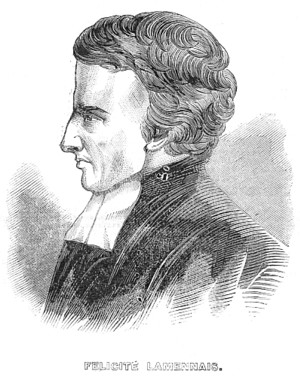
MEMOIR OF FELICITÉ LAMENNAIS.
BY
GERALD MASSEY.
WE
have great and true poets in prose as well as in rythm and rhyme,
witness the writings of David, Carlyle, Emerson, Mazzini, Geo. Sand,
&c., and among these prose-poets Lamennais takes the highest rank.
His writings are essentially poetry, tho' he never jingles rhymes; they
are full of great bursts of the Poet's heart, welling over with
tenderness and love; kindling again into fieriest enthusiasm as he pours
forth his glorious utterances with the sublimity of the old Hebrew
Bards. Lamennais is a grand type of the martyr, and in him is
humanity raised to the heroic level of the mighty hearts of olden time.
He is devoted as a saint to his religion, and his whole life has been
one long thought—one ceaseless effort to win his great ideal. In
these days of faithless, heartless, godless natures, it is a good and
blessèd thing to have the picture of such a man held up to us for our
admiration and imitation. When corruption has well nigh gnawed in
twain, the links that bind us to God, in the chain of existencies,—when
our eleventh commandment, which supersedes the other ten, is "every one
for himself, and devil take the hindmost," when we are all isolated by
artificial barriers, and wrapt up in our blind egotism, it is a good
thing to see a man who lives a life of pious simplicity and purity, who
lets not his faith die within him, but with a dauntless courage and a
never-tiring zeal, holds on to his belief in the earthly redemption of
Humanity, and the People's great and happy Future! It is good to
see a man whose heart bleeds for the sufferings of others, wailing over
the sorrows of the poor, and opening his generous nature to them, like a
land flowing with milk and honey, to carry healing to their innumerable
woes and sorrows. In the presence of such a man, we stand as on
the Mount of Transfiguration, and as the glory of a nobler nature falls
upon us, we feel like the Apostles of old, that "it is good to be here."
Lamennais is one of the greatest acquisitions to the
Democratic Camp, in modern times, because he has come forth from the
ranks of Despotism, an illustrious convert to our faith. He was
once Lamennais, the ultramontane Catholic, and trenchant Absolutist.
He is now the great champion of Republicanism and what we should call
Christian Socialism, whose "Words of a Believer" are a gospel in the
households of all Europe; this change has been accomplished by a series
of struggles and internal revolutions. He is, indeed, Revolution
personified. Whatever convictions have been over-turned in his
mind, and new ones wrought out, he has ever had the sincerity and
honesty to avow it, and the bravery to abide by the consequences.
How very few have this heroic courage! What masses of sneaking
slaves there are now bending down to the worshipped Lie, acknowledging
the established Sham, countenancing the solemn Hypocrisy—who know right
well they are rotten Lies, and that their creeds and systems have no
healthful, spontaneous vitality in them; that their life is only as the
ghastly grinning of the galvanised corpse, but they dare not say
so—they, having abdicated their Humanity, are no longer men. But
though they can mask before men in the World's Carnival, they cannot
mask them from themselves! There is a laughing, mocking devil
within, that cries out Sham and Trickster from the heart's every
hiding-place; while every cloud of the mind bursts into thunder and
lightning for witness to the terrible truth. But haply for the
World the Priest Lamennais had the necessary courage to cast the dust of
Error from his feet, come forth, and proclaim his sublime conversion in
words that have shaken the world.
In the painful and tedious march of Humanity from the
Egypt of Slavery to the Canaan of the Future, he is now in the vanguard;
we may call him an out-rider. With his eves fixed on the luminous
goal he hurries on impetuously and indefatigably. System after
system has fallen beneath him exhausted; but he gallops on, nor slackens
spur or pace; and what matter, though the dead steed remain behind, so
that the rider attain the journey's end?
Felicité Lamennais was born at Saint-Malo, in Brittany,
in the year 1782, in the same street as Chateaubriand. When very
young he lost his mother, and his father being altogether absorbed in
business, he was abandoned to himself from his earliest age, and grew up
almost without direction or restraint. The child was taught to
read by an old housekeeper, who stood to him in the place of a mother.
He soon manifested a remarkable desire to attain knowledge, which he
ever after retained. His elder brother gave him his first
instructions in Latin; but the wilful scholar soon growing tired of his
teacher, undertook to finish his education alone; by poring over the
Dictionary. In this he succeeded so well that at twelve he read
Plutarch and Livy. About this time he was confided to the care of
an old uncle; who lived in the country. The good man, not knowing
how to manage him, shut him up for whole days in his library. This
library was stocked with many of the works which at that time issued
from the French Press. It was divided into two compartments—one
was labelled "Safe Books," the other was called "Hell," as it contained
the works of Rousseau, Voltaire, Diderot, and other dangerous
philosophers. The mutinous scholar soon became so fondly attached
to the library, that what was intended for a prison became a palace of
pleasure. Being especially warned against the books contained in
"Hell," he read them with all the more avidity, and eagerly devoured
Rousseau, and Malebranche at an age when most children are amused with
top and ball. This strange miscellany of reading produced no
pernicious result, this flux of antagonist systems, and contradictory
theories, served to strengthen his mind, which grew apace, and developed
an instinctive pre-disposition to religious fervour and piety. In
common with the young spirits of his time, he shared the general
inquietude, and the stormy feelings that agitated the social, political,
and religious world, but his mind by nature had a strong religious bias,
and he shrunk from revolution then, with fear and trembling. We
all know that the greatest commotion is among the breakers that beat
upon the shore, and he was fearful of their sound and turmoil, and dare
not cut his little bark from its moorings; so he cast anchor in the
church. He sought repose in the arms of Faith. He had some
beautiful idea of an universal church, but meanwhile threw himself into
the embrace of the Church of Rome! But, how shall the true and
ever-developing man find rest there, or anywhere? There is no
rest. Existence means endless growth, ceaseless development.
It is, no doubt, a pleasant dream enough for lazy, lotus-eating lubbers,
like the Poet Gray, whose heaven consisted of a lounge on the sofa, with
a novel to read, but for a man of large heart, and lofty aspirations,
such rest is utter stagnation, and fossilization of the human heart.
And Lamennais with his noble nature, and its daily and hourly
revelations was not destined to remain amid the whore-mongering horde
that defile the "Spouse of Christ." He entered the Church at the
age of twenty-two. In vain did his father try to dissuade him from
the Priesthood, and imbue him with a desire for commercial pursuits—his
vocation was fixed.
He entered the College of Saint-Malo in the year 1807;
and about this time he published his first work—it was a translation of
a little work of Louis de Blois, called the "Spiritual Guide." In
the year following he published his first original work, entitled
"Reflections on the State of the Church in France." This book
contained the first war-cry uttered by Lamennais against religious
indifference, and is distinguished by great vigour of thought. The
Imperial Police took offence at some bold ideas on the renovation of the
Clergy in France, and the work was seized. In 1811, Lamennais took
the tonsure and entered the little seminary of Saint-Malo. Here,
in concert with his brother John, who was the superior at the seminary,
he wrote "The Doctrine of the Church as to the Institution of Bishops."
After the publication of this work Lamennais went to Paris, in the
beginning of 1814. The imperial star was on the wane. Shut
up in a wretched garret of the Rue St. Jacques, the unknown Priest
seemed to divine that the sphere of action for him was about to widen;
he prepared to receive the Bourbons with a shout of welcome, and to hurl
his anathema at the fallen Emperor; but the Hundred Days suddenly came
round, and he was compelled to fly for safety. He came to London,
where he attempted to support himself by teaching, and suffered the
severest privations. Being furnished with a letter of
recommendation to Lady Jerningham, sister of Lord Stafford, the future
tribune went humbly to solicit the situation as tutor to her children.
The noble lady scanned him and his thread-bare clothes; and then refused
his request point-blank, for the judicious reason that he would not
suit her, he looked such, a fool. As this may be the only
mention made of her ladyship in the future, let her have the full
benefit of the circumstance pinned to the page of History, like a poor,
buzzing cock chafer! Thus rejected, it was fortunate for the poor
priest that he found a home in the house of the Abbé Carou of Rennes,
who kept a boarding school in the neighbourhood of London.
Napoleon was a second time expelled from France, and Lamennais returned
again.
In 1816, at the age of thirty-four, he went to Rennes
to be ordained Priest, and returned to the Feuillantines to finish the
first volume of his Essay on Religious Indifference. This was his
first deed which commanded the attention of the World. With the
step of a giant, and at one bound, be leapt the abyss between obscurity
and glory. Europe was moved; his book was like a clap of Thunder,
and the Vatican trembled with joy. His bold style, beautiful
language, and impetuous energy carried all minds and hearts by storm.
In this book he stood forth as the champion of the church, and
challenged Infidelity to mortal combat. France was then in a kind
of spiritual death, and Lamennais had the ambition of inspiring it with
faith, and arousing it from its lethargy and indifference. Armed
with a nervous style and invincible logic, he broke through the
arguments of unbelief, and with audacious daring laboured to reconcile
the truths of philosophy and religion. He afterwards published
another two volumes, in which he displayed wonderful erudition, gathered
texts from all tongues, passed in review all ages, all nations, and all
places, and collecting , the scattered traditions of every fragment of
humanity, he formed thereof a colossal mass of human tradition.
This great task finished, in 1824 the Catholic priest repaired to Rome
to lay his work at the feet of the Holy Father. He found an ardent
admirer and supporter in Pope Leo XII. The Pontiff offered him the
cardinal's hat; but Lamennais refused the dignity, and made rise of his
credit no further than to procure the nomination, as nuncio to France,
of the Cardinal Lambruschini, who afterwards became one of his bitterest
enemies. Lamennais now speedily arrived at the first phase of the
revelation we have spoken of. The Government of the Restoration,
which he had laboured to bring into office, disappointed all his dreams,
and blasted all his darling hopes; he was disgusted, and his soul soon
burst into open revolt against the odious state of things. His
work, entitled "Religion considered in its Connexion with Civil Order
and Policy," was his first declaration of war. On account of this
book he was brought before the correctional police, and condemned to a
fine of thirty-six francs. He was defended by M. Berryer; and it
was on this occasion that he uttered his famous saying,—"I shall show
them what a priest is."
In 1829, he published his "Progress of Revolution and
War against the Church," and when the Revolution of July broke out he
hailed it as the dawn of universal republic; but not content with
dreaming, he set to work, and attempted the realization of his dreams.
He surrounded himself with a band of disciples, young, ardent, and
devoted. The Abbé Gerbet brought his pen, the Abbé Lacordaire his
eloquence, M. de Montalembert his influence, and together they undertook
the work of social regeneration. "The Future" was started as a
Journal which should unite the catholic with the liberal interests.
The writers spoke out bravely to the Papacy, "Your power is departing,
and faith with it. Do you wish to save them? Unite them both
to humanity, such as eighteen centuries of Christianity have made it.
Nothing is stationary in the world. You have reigned over
kings—those kings have enslaved you. Separate yourselves from
kings—offer the hand of fellowship to nations; they will sustain you
with their robust arms, and, what is better, their love. Abandon
the ruins of your ancient grandeur—thrust them away as unworthy of you.
Lamennais now proclaimed his sympathy for the suffering
and oppressed peoples of all lands. He proposed a union of nations
for the progress or all; he preached liberty for Poland, and the
emancipation of the Italian states from the despotism of Austria.
The people heard such language from a priest for the first time, with
great delight and approval. He became very popular with the
working-men, who began to think that such priests as he might be the
leaders destined to cross the Jordan at the head of the suffering
people. On the other hand, the dignitaries of the church began to
fulminate against this democracy in cassock, and strenuously solicited
from the Holy See a bull of censure. At Rome there was great
perplexity to know how to shut the mouth of the impetuous priest.
To put an end to uncertainty, Lamennais announced that he had suspended
his journal, and would go to Rome to solicit sanction or censure.
He at length received a letter from the Pope condemning in the most
positive manner the doctrines of "The Future." Lamennais for the
time submitted, and giving up the journal, retired from the arena for a
moment. But this was only to gather strength for the future
combat. Subdued in appearance, he did but withdraw to prepare his
terrible war-cry which rang through all Europe. "The Words of a
Believer" appeared in May, 1834. It burst like a bomb-shell on the
camp of Papacy and Despotism, and its explosion was answered with a
mighty shout of enthusiasm and anathemas, fierce enmities and passionate
admirations immediately rushed to battle around it. A letter from
the Pope reproved and condemned it, while the revolutionary party opened
its arms to the illustrious deserter from the church, and proclaimed him
courageous and great—the only priest in Europe. Other works
followed, which rendered his name hallowed and beloved by the people.
In his last book, "Modern Slavery," he shows that the labourer of the
present day is more fettered, more tortured, and more miserable than the
ancient slave; or the serf of the middle ages. The priest-democrat
Lamennais has in him something of the character of the warlike prelate
of the middle ages, who at the battle of Bouvines rejected all arms but
a club, because his religion forbade him to shed blood, and who in the
thickest of the fight blessed with one hand the numerous enemies he had
knocked down with the other. There is a continual struggle betwixt
his heart and head, but the head is victorious.
Lamennais has abandoned the Catholic dogma of
pontificial authority, but is still a Christian. He declares that
"Christianity, buried at present under the material wrapper that covers
it like a winding-sheet, will reappear in the splendour of its life,
which is perpetually young, while the world shall form one grand city,
which shall salute Christ as its supreme and final legislator."
In politics he is perhaps the most advanced among
modern reformers: he claims for the people direct sovereignty, with
absolute equality for dogma, and with a republican form of government.
He exclaims to the people, "Arise! Count your oppressors!
You are a thousand to one—the government belongs to you." His last
political production was a veritable appeal to arms. This book
entailed on the author a year's imprisonment. This was a
remarkable trial, as the prosecutor employed no other arms than the
written doctrines of Lamennais himself, when he was the champion of
absolutism.
This was especially galling, and he returned from this
trial quite crushed and broken down. He declared that he knew no
punishment equal to that of a man exposed to the public gaze, torn in
pieces by the weapons of his own forging, and overwhelmed by the weight
of his own arguments.
Such is our rapid sketch of this great man, one of the
noblest natures, and greatest intelligences of the present age. He
still labours on in the cause of the people, through the medium of the
press—he was editor of the "Workshop," and in conjunction with Madame
George Sand, who is one of his most enthusiastic disciples, he conducted
the "Independent Review." He is certainly one of the hardest
workers in the cause of human progress. His writings are read by
rich and poor throughout France, and are well known both in the Old
World and the New.
A friend of mine, who has seen Lamennais in his place
in the assembly, remarks, that you would not recognize one of the most
powerful agitators of our time, whose every word stirs the heart of the
people like a trumpet, in that little meek old man; his body is frail,
his face emaciated, and suffering has there deeply written its work of
years. He has the look of a man whose eyes have been continually
looking within, and if he raises them it is with a troubled glance,
which instantly cowers back upon itself; his brow and head are
beautifully formed, and gives ample proof that "whatsoever is done in
the heart is written upon the housetops." Beneath this unassuming
exterior dwells a spirit of the true heroic mould. He has now cast
in his lot with the people, and as their teacher and champion, let us
give him a right welcome greeting in the hearts and homes of English
working men. |
|
____________________________________
THE
FRIEND OF THE PEOPLE.
SATURDAY,
APRIL 24, 1852.
MEMOIR OF ROUGET DE LISLE.
"Author of the Marseillaise."
BY
GERALD MASSEY.
NOW
and again, a man may achieve immortality by one successful effort; but
such instances are few and far between. Wolfe is a case in point.
The "Burial of Sir John Moore," will live for ever, while most of its
author's other works have already passed into oblivion. But the
most illustrious instance is in the case of the Marseillaise Hymn.
No other work of De Lisle's is known. It stands alone in its
imperishable glory. The Poet is essentially the agent of Change,
the vice-regent of Revolution; and, whether it be the Warrior, the
Statesman, or the Priest, who strikes the hour of Revolution, be sure
the Poet moves the wheels behind. But never was this mission so
grandly manifested as in the instance of the Marseillaise. There
is far more poetry and electrical fire in the music than in the words.
The words are the expression of the French nation's thought of that
time, but the music is the beating of its heart, and all its
unuttered and unutterable feelings. Louis Phillippe knew this,
when, at a banquet given at the Tuilleries, his minister Guizot, asked
him to sing the Marseillaise, the old Mephistophiles complied, but he
sang the words to some other music. There was no response, no
enthusiasm; it fell dead—and the cunning old king, with a chuckle of
exultation, said, "That was the way to take the sting out of it, there
was no danger in the words, it was the music which contained the
meaning." And the old knave was right. That wonderful music!
Never was a strain so calculated to pierce and inspire the mass of Men!
Never was a strain so powerful to stir the wild beast of force in the
blood, and arouse all animal energies to arms. The martial swing,
and soaring of those notes, is all-conquering as the upward march of an
irresistible and all-consuming Fire! Listen to Carlyle, speaking
of this magnificent Song of Freedom, in his powerful picturesque way.
The Marseillais,
fédérés were the first to sing it en masse, on their route from
Marseilles to Paris, and from them it derived its name. He is
speaking of this march,—"These Marseillais remain inarticulate,
undistinguishable in feature, a black-browed mass, full of grim fire,
who wend there in the hot sultry weather, very singular to contemplate.
They have flung down their crafts and industrial tools, girded
themselves with the weapons of war, and set out on their journey of six
hundred miles to strike down the tyrant. They have left their
sunny Phœcian city and sea-haven, with its bustle and its bloom, and
wend onward amid the infinitude of doubt and dim peril, they
NOT
doubtful. Fate and feudal Europe having decided, come girdling in
from without: they having also decided to march within. Dusty of
face, with frugal refreshment, they plod onwards, unweariable, not to be
turned aside. Such march will become famous. The Thought
which works voiceless in this black-browed mass, an inspired Tyrtœaus,
Col. Rouget de Lisle, whom the earth still holds, has translated, into
grim melody and rhythm, into his hymn or march of the Marseillais:
luckiest composition ever promulgated. The sound of which will
make the blood tingle in men's veins, and whole armies and assemblages
of men will sing it with eyes weeping and burning, and with hearts
defiant of Death, Despot, and Devil." Ay, we believe it to be so
engraven on the French heart, that were it possible for a Column of
Frenchmen to girdle the World, they would march to the time of the
Marseillaise without ever getting out of step.
The sound of the Marseillaise is more dreaded in the camp of
Tyranny, than a thousand parks of artillery, it makes the Tyrants
tremble even in their triumphant car. It is the Soul of Revolution
rendered to us Rhythmically. There is no first-rate English
translation, the following is a literal rendering, but no literal
translation could give us
THE Marseillaise, because of the peculiarities of
the two languages, it could only be done by rendering the ideas
according to the English language and mode of thought.
THE MARSEILLAISE
IN ENGLISH PROSE.
|
Arise children of our mother-land!
The day of glory is come:
The bloody standard of tyranny is raised against us,
Do ye not hear the noise of those ferocious soldiers?
They come to slaughter your sons and comrades, in
your very arms.
To arms, citizens! form your battalions,
Let us march! and let the impure blood of our
enemies,
Moisten the furrows of our fields.
What means this horde of slaves,
Of traitors and conspiring kings?
For whom have these infamous plots
And fetters been so long prepared?
Frenchmen! for us: ah! what an outrage,
What fury should it not excite,
It is you to whom they meditate
Restoring the olden slavery!
To arms,
&c.
What! shall the cohorts of the stranger
Make the laws for our hearths?
What! shall their hireling battalions
Harass our own proud warriors?
Great God! shall our heads bow down
To a yoke prepared by the hands of slaves?
Shall the vilest of despots become
The masters of our destinies?
To arms,
&c.
Tremble tyrants! tremble traitors!
Tremble ye, abhorred by all;
Your parricidal projects shall at length
Receive their just reward.
All are soldiers to combat YOU!
And as our youthful heroes fall,
New ones shall spring from the very earth,
To maintain the fight against you!
To arms,
&c.
Frenchmen! give or withhold your blows
With generous magnanimity!
Spare the misled victims,
Who, with regret, take arms against you.
But those sanguinary despots,
But the accomplices of Bouille,—
All the tigers without pity
Who would tear the bosom of their mother,
Destroy them.
To arms,
&c.
O sacred love of the mother-land
Conduct, sustain our brave avengers;
Liberty, cherished Liberty!
Combat on the side of thy defenders:
Under our colours let Victory
Hasten at thy noble call;
And may the dying enemy see
Thy triumph and our glory.
To arms,
&c.
Verse sung by Children.
We shall enter on our career,
When our elders exist no more,
We shall find their dust and the trace of their
virtue.
Far less desirous of surviving them,
Than of partaking their graves;
We shall have the sublime pride,
Of avenging or of following them.
To arms,
&c. |
"These words," says Lamartine, "were sung in notes
alternately flat and sharp, which seemed to come from the breast with
sullen mutterings of national anger, and then with the joy of victory.
They had something as solemn as death, but as serene as the undying
confidence of patriotism. It seemed a recovered echo of
Thermopylæ—it was heroism sung. There was heard the regular
footfall of thousands of men walking together to defend the frontiers
over the resounding soil of their country, the plaintive notes of women,
the wailing of children, the neighing of horses, the hissing of flames
as they devoured palaces and huts; then gloomy strokes of vengeance,
striking again and again with the hatchet, and immolating the enemies of
the people, and the profaners of the soil. The notes of this air
rustled like a flag dipped in gore, still reeking in the battle-plain.
It made one tremble—but it was the shudder of intrepidity which passed
over the heart, and gave an impulse—redoubled strength—veiled death.
It was the "fire-water" of the Revolution which instilled into the
senses and the soul of the people the intoxication of battle.
There are times when all people find thus gushing into their national
mind accents which no man hath written down, and which all the world
feels. All the senses desire to present their tribute to
patriotism, and eventually to encourage each other. The foot
advances—gesture animates—the voice intoxicates the ear—the ear shakes
the heart. The whole heart is inspired like an instrument of
enthusiasm. Art becomes divine; dancing, heroic; music, martial;
poetry, popular. The hymn which was at that moment in all mouths
will never perish. It is not profaned on common occasions.
Like those sacred banners suspended from the roofs of holy edifices, and
which are only allowed to leave them on certain days, we keep the
national song as an extreme arm for the great necessities of the
country. Ours was illustrated by circumstances, whence issued a
peculiar character, which made it at the same time more solemn and more
sinister: glory and crime, victory and death, seemed intertwined in its
chorus. It was the song of patriotism, but it was also the
imprecation of rage. It conducted our soldiers to the frontier,
but it also accompanied our victims to the scaffold. The same
blade defends the heart of the country in the hand of the soldier, and
sacrifices victims in the hands of the executioner."
The best account of De Lisle and the origin of the
Marseillaise Hymn is by M. De Lamartine, in his Girondists. From
which we extract its history.
"There was, then, a young officer of artillery in garrison at
Strasbourg, named Rouget de Lisle. He was born at Lons-le-Saunier,
in the Jura, that country of reverie and energy, as mountainous
countries always are. This young man loved war like a soldier—the
revolution like a thinker. He charmed with his verses and music
the slow dull garrison life. Much in request for his twofold
talent as musician and poet, he visited the house of Dietrick, an
Alsatian patriot (maire of Strasbourg), on intimate terms.
Dietriek's wife and young daughters shared in his patriotic feelings,
for the revolution was advancing towards the frontiers, just as the
affections of the body always commence at the extremities. They
were very partial to the young officer, and inspired his heart, his
poetry, and his music. They executed the first of his ideas,
hardly developed, confidants of the earliest flights of his genius.
It was in the winter of 1792, and there was a scarcity in Strasbourg.
The house of Derrick was poor, and the table humble; but there was
always a welcome for Rouget de Lisle. This young officer was there
from morning to night, like a son or brother of the family. One
day, when there was only some coarse bread and slices or have on the
table, Dietrick, looking with calm sadness at De Lisle, said to him,
"Plenty is not seen at our feasts; but what matter if enthusiasm is not
wanting at our civic fetes; and courage in our soldiers' hearts. I
have still a bottle of wine left in my cellar. Bring it," he
added, addressing one of his daughters, "and we will drink to liberty
and our country. Strasbourg is shortly to have a patriotic
ceremony, and De Lisle must be inspired by these last drops to produce
one of those hymns which convey to the soul of the people the enthusiasm
that suggested it." The young girls applauded, fetched the wine,
filled the glasses of their old father and the young officer until the
wine was exhausted. It was midnight, and very cold. De lisle
was a dreamer; his heart was moved, his head heated. The cold
seized on him, and he went staggering home to his lonely chamber,
endeavouring by degrees, to find inspiration in the palpitations of his
citizen heart; and on his small clavichord, now composing the air before
the words, and now the words before the air, combined them so intimately
in his mind, that he could never tell which was first produced, the air
or the words, so impossible did he find it to separate the poetry from
the music, and the feeling from the impression, he sung everything—wrote
nothing.
Overcome by this divine inspiration, his head fell sleeping
on his instrument; and he did not awake until daylight. The song
of the over night returned to his memory with difficulty, like the
recollections of a dream. He wrote it down, and then ran to
Dietrick. He found him in his garden. His wife and daughters
had not yet risen. Dietrick aroused them, called together some
friends as fond as himself of music, and capable of executing De Lisle's
composition. Dietrick's eldest daughter accompanied them, Rouget
sang. At the first verse all countenances turned pale, at the
second tears flowed, at the last enthusiasm burst forth the hymn of the
country was found. Alas! it was also destined to be the hymn of
terror. The unfortunate Dietrick went a few months afterwards to
the scaffold to the sound of the notes produced at his own fireside,
from the heart of his friend and the voices of his daughters.
The new song, executed some days afterwards at Strasbourg,
flew from city to city, in every public orchestra. Marseilles
adopted it to be sung at the opening and the close of the sittings, of
its clubs. The Marseillais spread it all over France, by singing
it everywhere on their way. Whence the name of Marseillaise.
De Lisle's old mother, a royalist and religious, alarmed at the effect
of her son's voice, wrote to him: "What is this revolutionary hymn, sung
by bands of brigands, who are traversing France, and with which our name
is mingled?" De Lisle himself, proscribed as a royalist, heard it
and shuddered, as it sounded on his ears, whilst escaping by some of the
wild passes of the Alps. "What do they call that hymn?" he
inquired of his guide. "The Marseillaise," replied the peasant.
It was thus he learnt the name of his own work. The arm turned
against the hand that forged it. The revolution, insane, no longer
recognised its own voice."
Three times in history has this sublime hymn been the prelude
of Revolution, and yet again will it ring out its thunder-music, and
never had the world greater need of it than now! The people have
played a rare part in history since their aspirations first found
fitting utterance in its trumpet-tones, and what a part they have yet to
play, in working out their redemption, and in fulfilling their own proud
destiny! France has been bound hand and foot, and banded over
helpless to the infernal league of Jesuits and Despots. Even now
they meditate the blow, which, if struck successfully, would extinguish
the last spark of Freedom, and drive Progress back for a century.
But we will never despair for France, we will never sing defeat for
France. She has still a noble army of Working-men, such as in '48
said, "We will give six months of misery to consolidate the Republic;"
who, when the whole of Paris was in their hands, and their heartless
oppressors lay at their feet, kept guard over that property which their
labour had created for others, and not for themselves, and who hung up
at the nearest lamp-post the only thief known to commit pillage; and
who, in their sublime generosity, said, "With so much hope for the
future, we can afford to forgive the sufferings and the slavery of the
past." Glorious, but fatal words!
Yet with such sons as these, we will not despair of France.
She is the leader and the martyr of nations, ever ready, like the
patriot of old, to fling herself on the weapons of Despotism, so that
others may pass on to freedom through the gap which her devoted body has
made. Martyrdom and Victory are twins,—it is her Martyrdom to-day,
but Victory comes to-morrow. Yet once more shall the world thrill
to the voice of her Marseillaise, and the nations gather themselves
together for the battle of Freedom and Right. And this time is not
far distant, the trumpet of the time gives no uncertain sound; and let
the coward, the hypocrite, and the mammonite slink from the contest, the
true of heart will ever leap up at the sound of coming battle. The
giant of Revolution is not dead, and we tell the Tyrants they have but
caught one brief glimpse across the barricades of St. Antoine, in the
flash of musketry, and the cannon's red glare, of the power which shall
destroy them in the future.
The spaces between revolutions grow shorter each time; from
1783 to 1830, was 47 years; from 1830, to 1848 but 18 years; the next
will be shorter still, and then—
|
Old England, cease the mummer's part, wake Starveling,
Serf, and Slave,
Rouse in the majesty of wrong, great kindred of the brave;
Speak, and the world shall answer, with her voices
myriad-fold,
And men, like gods, shall grapple with the giant wrongs
of old;
Now mothers of the people, give your babes heroic milk;
Sires, soul your sons to daring deeds, no more soft words
of silk;
Great spirits of the mighty dead, take shape, and walk
our mind,
Their glory smites our upward look, we seem no longer
blind;
They tell us how they broke their bonds, and whisper "so
may ye,"
One sharp, stern struggle, and the slaves of centuries are
free!
The people's heart, with pulse like cannon, panteth for the
fray,
And brothers, gallant brothers, we'll be with you in that
day. |
|
|
____________________________________
THE
FRIEND OF THE PEOPLE.
SATURDAY,
APRIL 24, 1852.
MAZZINI AND THE FRENCH REFUGEES.
BY
GERALD MASSEY.
WE have ever been among the foremost of Mazzini's
admirers. We have looked up to him as a master in Israel; and
himself, and his holy cause of Italy's redemption have no more earnest
sympathisers than in us. As the man of thought and action
combined, we look upon him as second to none. When he was here an
exile, previous to the revolutions of '48 and '49, we treasured up his
noble aspirations for freedom, and gathered up his glorious words with
loving hands. And how we fought for Rome, through all that proud
and desperate struggle! We could not lift the strong arm in her
cause, but we fought at heart, and with tongue and pen, and all our
sympathies did battle for her. We watched the Italians, once more
worthy of their olden name and fame, battling on from glory unto glory,
in the divine glow of their deathless enthusiasm, with beating hearts,
and brightening eyes, and we yearned in agony over the fall. After
so many noble heads had been struck off, as they bent them at Freedom's
shrine—after so much brave blood had been spilled on the Altar of the
Fatherland to be baffled and defeated thus! Oh, but if we could
have worked our will, a noble nation would not have been murdered thus,
without a helping hand stretched forth to save! Not one Frenchman,
or Austrian, should have entered Rome, but, over the devoted corpses of
Englishmen, fallen side by side with Italians. Through all that
glorious struggle we watched the man, Mazzini, and our faith in him was
amply rewarded. We watched his patient toil, his heroic endurance
of suffering, how calmly and grandly he dilated, to fill the emergencies
of the terrible crisis, and when the Romans no longer stood at bay—and
the Republic sat no longer in the capital of the Cæsars, when the torch
of Liberty—kindled in Rome—was extinguished in the waters of the Seine,
and Mazzini was once more a wanderer and an exile, how our hearts leaped
up to welcome him to the shores of old England once again! He came
to us from the red field of his fight, beaten for awhile, baffled in his
noblest aspirations, and defeated in his loftiest hopes, and we hailed
him as the foremost man in all Europe, and greeted him as such! He
came to us simply as a patriot; without the prestige of rank, wealth or
state, and we welcomed him as a Conqueror, and enthroned him in our
warmest hearts. We honoured and loved him, for his toil and
suffering and martyrdom, in the cause of Italy. We honoured him
and loved him, for his noble simplicity of soul, his self-sacrifice, his
sublime faith in the heart and energies of his people, which seemed to
exalt them into a race of heroes, inspired with the prescience of
Victory. Therefore, it cannot be supposed that we are at enmity
with Mazzini, in raising our protest against some portions of his last
circular. We listened with pain to much that he enunciated at the
first Conversazione of the Friends of Italy; but we held our peace, as
that did not appear to us the place to pick a quarrel in. We
wondered what purpose his denunciations of some imaginary Communism,
conjured up expressly for the occasion, were intended to serve, unless
as a bait to the timid, time-serving slaves of the till. It seemed
marvellously like pandering; and we thought that it had been quite
enough for Mazzini to have repudiated Socialism as applied to Italy,
without making an indiscriminate attack upon the creed of many a
thousand in England, as well as the "neighbouring country."
We do not imagine Socialism to be applicable to Italy, as we believe it
will be the outcome and result of a far higher state of society than at
present exists in that country, but, surely that is no reason it should
be denounced in England and France. For a crushing answer to what
M. Mazzini advanced on that occasion, we have but to refer the reader to
the eloquent defence of M. Louis Blanc, in the Leader,
transferred, in part, to our columns. At the present moment, we
have a few words to say to Mazzini, on the circular above-mentioned.
It is natural, most natural, that he should feel bitter toward France
which so deeply wounded his heart, and so fatally destroyed his hopes
and work of many years, but the French Socialists are not to be held
accountable for this; the vengeance should not be wreaked on them!
In the Provisional Government they were in a minority by seven;—in June,
their forces were literally cut in pieces.
The rebuke of M. Mazzini administered to the Egotists, and
chiefs of systems, for their isolation, and cliqueishness, is richly
merited by most of them, each of whom must be the great "I AM,"
or like Achilles, skulking in his tent, they won't fight. But the
rebuke does not come gracefully from Mazinni, especially at such a time.
It must come from the French nation itself, to be of avail.
Moreover, it provokes retort, and thus dissention is sown, old
friendships are broken up into bitter and sorrowful feuds, the attacked
party becomes in turn the aggressor, as in the reply of the Refugees,
which needed not that to complete it, as it is perfectly appalling
in its smiting power. We read it, stunned, like one listening for
the first time to the thunder-crashes of a park of artillery.
Mazzini has evidently misunderstood the Socialists, and seems
determined to perpetuate the blunder. They have not "done all the
evil possible to the best of causes." Nor does it appear to us
that they err in propounding a Social system of reorganization, and of
attempting to work it out with the means within their immediate reach!
Nor do they lack that "action" which Mazzini defies; on the contrary,
they are essentially THE party of action. If
the "Republic" be sufficient for M. Mazzini and for Italy, it is not for
us; the Republic may mean the tyranny of Venetian Oligarchy, or American
Moneyocracy, or Brummagem Bonaparte's Ruffianocracy! Truly, as the
Refugees reply, the word "Republic" is enough for General Cavaignac, for
example—who massacred the people in June, 1848. Meanwhile, we
would express our earnest hope that we may see no more such deplorable
exhibition of antagonistic feelings among the chiefs of European
Democracy. It is terribly fatal just now. It is playing into
the hands, and rejoicing the heart of despotism. Let them take
warning of us! Look at our broken ranks, our party feuds, our
bickering leaders, and our consequent impotency! Woe! woe! to the
disunited! In vain have the countless hosts of martyrs and the
"unnamed demigods" fallen in battle—in vain are the brave hearts that
beat so high for freedom and right, and the heroic arms that were lifted
to do such deeds for liberty and mankind, now mouldering in the dust!
The peoples are, disunited! France lies bound and bleeding to
death, beneath the knife of the assassin, her noblest sons butchered.
France, swerved from the lofty purpose that beat in her heart and brow,
and nerved her arm in forty-eight! One by one, have our starry
hopes of her gone down, and we look for them in vain amid the gloom of
Freedom's firmament! AND THE PEOPLES
ARE DISUNITED! The inquisition plies its hundred tortures
in Rome, there is no more room in her prisons, though according to the
devil-hearted prefect of police, THERE is plenty
in the cemeteries! Where the Lombard, and the Roman, and the
Piedmontese, performed such prodigies of valour, and Mazzini— the Rienzi
of our time!—bade fair to reinstate Italy in all her olden glory, the
Priests and Cardinals reign rampantly. Berlin, Milan, and Hungary
wear the gyves and fetters as of old; with no token of life but a
groan!—And the peoples are disunited! And what hope is
there of unity among them, while their leaders, representatives, and
champions, are divided among themselves? Dear, God! how much more
of martyrdom, suffering, and uselessly expended bravery, will be
necessary to ripen the people for freedom, and to teach them they cannot
conquer their mutual oppressors but by pre-concerted, spontaneous,
co-operative action? and that the day of their triumphant sovereignty
will be that great day of the future, when they shall march together
against their oppressors and their organized forces, in one grand,
universal organization, of all for each, and each for all.
|
|