|
THE
FRIEND OF THE PEOPLE.
SATURDAY,
FEBRUARY 21, 1852.
JOHN MILTON, HIS LIFE AND GENIUS.
BY
GERALD
MASSEY.
|
MILTON!
thou should'st be living at this hour,
England hath need of thee: she is a fen
Of stagnant waters: altar, sword, and pen,
Fireside, the heroic wealth of hall and bower,
Have forfeited their ancient English dower
Of inward happiness. We are selfish men;
Oh! raise us up, return to us again,
And give us manners, virtue, freedom, power.
Thy soul was like a star, and dwelt apart,
Thou had'st a voice whose sound was like the sea,
Pure as the naked heavens, majestic, free,
So did'st thou travel on life's common way,
In cheerful godliness; and yet thy heart
The lowliest duties on herself did lay.
WORDSWORTH. |
FOR ever hallowed be the names of the mighty spirits
of yore, the star of whose lives so often set in darkness, in tears, and
in blood, to rise again in immortal glory! Thanks, eternal thanks
to the martyrs for liberty and the patriot friends of man, who held on
in the dark and desolate day, and bravely bore the banner of Freedom
through battle, storm, and strife, holding on to exile and even to
death. Blessings be upon the gallant hearts that have quivered on
the rack, and cracked in the furnace flame! And blessings on the
noble heads that have laid them down upon the tyrant's bloody block for
their last pillow, heroically preferring death in their present, that
the future might go free. They have done all this, and suffered
and bled for principles, the reward, and fruition of which could not be
reaped for ages. Aye, blessings on them all, all who have fought
for Liberty, and written their words and deeds upon the world's memory
in letters of electric light, and left their patriot names as watchwords
for us in the day of battle. They set our hearts yearning with the
true Promethean fire. There is no cause in the world richer in
heroes and martyrs, than this cause of English Freedom, in which we
combat to-day. Then let us gather up their glorious words with
loving hands, and treasure up their proud names with loving hearts.
In this phalanx of the Free, there is no nobler name than
that of John Milton. "John Milton, and the men of the
Commonwealth!" What a martial ring there is in the words as of the
clash of swords! and how they start a thousand stirring memories, a
thousand throbbing hopes. How bravely John Milton walked the
world; and what a sublime life he lived! He has written,
that a Poet should be in his life and person a true poem, that is, a
composition of the best and noblest things; and how grandly he realised
his conception!
Magnificent as is the poetry of "Paradise Lost," there
is more eloquent poetry in the life of the stern Republican, the poetry
of noble actions and deathless deeds. Of all our Poets, the life
of Milton was the grandest, the man-fullest, and the completest.
Shakspeare's was melodious and equable; mellowing into a life rich as a
summer sunset going down in glory. Coleridge's s was dreamy and
wierd-like. Byron's had all the lonely gloom and grandeur of the
tempest. His poetry sprang out of him like fruit forced from the
heated sides of Etna. Burns' was the "ower true tale" of life with
the fatal termination. And Keats' was the song of the
nightingale heard in the rich still summer night, pouring her passionate
soul out on the air in silver throbs of music, singing you into tears,
as though the old fable were true, which averred that she sang with a
thorn in her bosom. But the life of Milton was a colossal Epic
poem, and complete in all its parts. In his youth he was a model
of purity, no less than of beauty. In his manhood the stern and
valiant warrior in the Republican camp, the friend and coadjutor of
Hampden and Cromwell, the heroic defender of Freedom, whenever and
wherever attacked. And in his age, when he had battled and
wrestled for his cause till he was blind, when the Revolution was
thwarted by treachery and exhaustion, and the royal lecher Charles II,
had returned, with his pimps and prostitutes, to make the English Court
a beastly brothel; when the martyrs had gone headless down to death in
bloody shrouds; when his compeers Ireton and Bradshawe were dragged from
their tombs to rot upon way-side gibbets, still we find the immortal old
man, brave as his own Michael, "bating no jot of heart or hope," still
battling an in the good old cause, true as ever to his principles,
firmly as ever the Republican, writing down prelacy and kingcraft, and
all kinds of absolutism and arbitrary power, in despite of Despot,
Death, and Devil! "Do you not think your loss of sight is a
judgment of God upon you, Mr. Milton, for the murder of my father?"
asked the Duke of York, afterwards James II. "If I have lost my
eyes, your father lost his head," replied the dauntless old man.
In his old age and blind, he wrote "Paradise Lost," the greatest
fruit of the Revolution. Milton was essentially the man of his
time, not more the creation than the creator of that time; but like his
age, he was terribly in earnest, mighty, holy, and heroic! It
seems to us that he was the greatest among those great hearts whose
thunder-throbs sent the pulse of Freedom through all the world, and
through all time. He was the strongest personality and the
greatest individuality of that period. The force of his
personality is remarkable through all his works. In Shakspeare you
cannot identify the individual being, feeling, or sentiments, of the
author. Like the Creator of the Universe, he is invisible.
But John Milton is in every line he wrote. Shakspeare is greatest,
doubtless; he is nearest to the Creator; but on that account he is
isolated from us—we cannot climb to where he sits, and clasp him as a
brother, as we can John Milton, who comes home to our hearts in his own
personality.
Milton must stand next to Shakspeare as a genius!
He was a whole and complete man—full developed in body and brain, and
all his faculties fitly harmonised. He had a sublime imagination,
understanding the most subtle, reasoning powers, will and eloquence,
wit, rhetoric, and invective. He shone in all kinds of literature,
epical, dramatic, pastoral, in the elegy and the masque, in the hymn and
the sonnet, in song and satire, in discussion—historical, political, and
religious; he could do figuratively what Dr. Johnson denied; he could
hew the colossus from the rock, and carve heads upon cherry-stones.
Milton has been too generally looked upon as the Poet merely; he was a
great prose writer as well. The works he wrote in English and
Latin prose, number forty-eight. And he was a man in whom
patriotism was as heroical a passion as poesy. His prose works
have been too long ignored. The greatest of them, such as the
"Speech on the Liberty of Unlicensed Printing," his "Defence of the
People of England," and his "Eikonoclastes," are among the finest
specimens of prose writing in our language; truly "the precious
life-bloods of a master spirit, embalmed and treasured up to a life
beyond life."
We shall only have space to jot down a few details of
his life. Properly speaking, there is no life of Milton at all
worthy of the name; there have been many inadequate attempts,
principally by his enemies, who have each flung a stone upon the place
where he lies, until it has become a cairn, and that which was intended
to obliterate, has become his monument. John Milton. was born in
Bread Street, City of London, within the shadow of St. Pauls', on the
9th of December, in the year 1608. His father was a scrivener, and
distinguished for his classical attainments. John received his
early education under a clergyman of the name of Young, and was
afterwards placed at St. Paul's school, whence he was removed, in his
seventeenth year, to Christ Church, Cambridge, where he distinguished
himself for the facility and beauty of his Latin verses. It is
uncertain whether he ever passed the famous Pons asinorum,*
although it is certain that he was whipped for a juvenile contumacy, and
that he never expresses any gratitude to his Alma Mater. He
originally intended to have entered the church, but early formed a
dislike to subscriptions and oaths, as requiring what he calls an
"accommodating conscience;" and this dislike he retained to the last.
The true man is sure to gravitate towards his work, and the church was
not for Milton. Fancy the Rev. Mr. Milton! Meanwhile, his
father had retired from business to Horton, in Buckinghamshire, where
the young Milton spent five years in solitary study. Of these
years little is known, but it was there he lived deep in himself, and
gathered from all parts of the earth knowledge of all kinds that would
feed the fire of his mighty genius. It was then he brought out the
thews and sinews which were to enable him to go forth to wrestle with
prelate and king, and to throw them. It was then he gave the
eagle-wings to his spirit, on which, in after time, it soared to the
dizzy pinnacle of his lofty fame. It was at this period of his
life he composed those exquisite minor poems, which alone ought to place
his name side by side in glory with the sons of immortality.
"L'Allegro," "Il Penseroso,'' "Comus," and "Lycidas."
At the age of thirty he began his travels, and visited
Paris, Florence, Rome, and Naples. In Italy he met and became
acquainted with Galileo, "the starry Galileo with his woes," whom he
describes as "now grown old, a prisoner in the Inquisition, for thinking
in Astronomy, otherwise than as his Franciscan and Dominican censurers
would have him." How interesting to contemplate the meeting of two
such men as Milton an Galileo! How sublime their conversation!
The old man must have descanted eloquently upon his wrongs and
persecutions; for we know what manner of man he was by his proud and
deathless "It moves for all that," when released from the rack.
What grand conjectures of liberty in the future those two must have
nursed up between them. And how the heart of young Milton fed on
the deep fire burning in the old man's eyes—adding fresh intensity to
his zeal for the enfranchisement of thought.
In Italy the Poet grew and strengthened beneath its
sunny, ripening influence. At this time occurred a little romantic
incident. In his youth Milton, like the "eternal child" Shelley,
was exceedingly beautiful; so fair and comely that he was called the
lady of his College. When in Italy he had lain down to repose in
the heat of the day, in the fields, under the grateful shadow of some
trees. A lady of noble rank passing was greatly struck with the
appearance of the slumberer. She wrote a few lines in praise of
his beauty, laid them at his side, and went her way. When Milton
awoke, he found the lines, but the angel-visitant was gone. It is
further stated that he sought for her some time, but in vain, while she
followed him to England; and was so mortified at finding him by this
time married, that she died for love, with a broken heart.
Milton had intended to extend his tour to Sicily and
Greece, but the state of affairs in England drew him home. "I
deemed it dishonourable," he said, "to be lingering abroad, even for
improvement, while my fellow-citizens were contending for liberty at
home." In those words out-spoke the true heart of brave John
Milton. The Civil War had broken out, and he was not the man to
live in a state of inglorious quiet, while his countrymen fought for
their lives and liberties. So he came home and fought the good
fight with his pen, not because he shunned the sword, for he was an
admirable swordsman, and brave as Hector, but because he could aid the
popular cause best by the pen. He taught a school for his living,
and was afterwards Latin Secretary to Cromwell. He was three times
married, and but once happy in his wife, and that was the one selected
for him, and not by him. He defended the execution of
Charles I, and the government of Cromwell in several treatises.
His dream of a Republic was a Commonwealth based on the models of
antiquity. In all matters of Church and State his convictions were
in accordance with the doctrines of the extreme Republicans. On
the return of Charles II. persecution fell upon Milton. His name
was proscribed, and his books burned; he was compelled to abscond, and
it was a miracle that the god-likest head then lifted to brave the
tyrant, did not roll from the scaffold-block. But "Man is immortal
till his work be done," and Milton could not die so long as God had need
of him. So he escaped, and his enemies took counsel and said, "We
will let him break his heart in silence, we will neglect him; he is
poor, blind, and solitary, and the silence of the world, that has so
often rung with his fame, will crush him." But little did they
know the man. He struggled on manfully, and survived the crisis.
The barque in which he had shipped had gone to pieces at sea; but he was
a strong, daring swimmer, and won the shore, where he has built himself
an everlasting monument as the "Ebenezer" of his Deliverance—"Paradise
Lost." Who shall estimate how much his baffled hopes of the
revolution contributed to that name and subject? "Paradise Lost"
was sold to the publisher for five pounds. Between its publication
and his death but little occurred, save the production of "Samson
Agonistes," "A System of Logic," and a few other minor, but noble works.
In November, 1674 Milton expired. His health hall
been declining fast; "but such was the strength of his mind," says
Aubrey, "that even in the paroxysms of his fell disease, he would be
very cheerful and his dissolution was so easy that it was unperceived by
the persons in the bed-chamber."
There is a description of the death of Goethe in
Longfellow's Hyperion, so beautiful and so applicable to that of Milton,
that we are compelled to quote it.
|
"His majestic eyes looked for the last time on the light of a pleasant
spring morning; calm, like a god, the old man sat, and, with a
smile, seemed to bid farewell to the light of day, on which he had
gazed for more than eighty years. Books were near him, and the
pen which had just dropped from his dying fingers. 'Open the
shutters, and let in more light.' were his last words. Slowly
stretching forth his hand, he seemed to write on the air; and as it
sank down again and was motionless, the spirit of the old man was
gone."
|
Thus died John Milton, a man in whom there was no
guile, and "one in whom the elements were so well mixed," that Nature
might well say, "here is a man." After a life of incessant toil
the grand old warrior went to his rest unrewarded by the world he strove
to bless, and unappreciated by the nation he strove to emancipate.
But the same world that stones and crucifies the martyrs, also builds
their sepulchres and monuments. "O, world, a brave world art thou,
with thy SCORN and
GALL for the bleeding heart, and thy crown for
the corpse's brow.
|
"Milton thou should'st be living at this hour,
England hath need of ye!" |
Sings Wordsworth, and indeed she hath need that the spirit of Milton were
effervescing in the hearts of thousands, for the grand and splendid
purpose or his magnificent Era was drowned in blood and tears, like that
of the French Revolution, and yet remains to be accomplished. It
was to us and to the men of the coming time, the men of commonwealth
entrusted their infant cause, as they, its parents, sank with up-lifted
hands, and the tide of destruction swept over them. It was to us
they bequeathed the battle of freedom, as our proud heritage, when they
sank covered with wounds, and the mingling stouts of victory and defeat
rang in their dying ears. And are we traitors to the glorious
trust we bear? Have the countless host of martyrs met death with
smiling rapture in vain? Has all that seed of blood, and tears,
and prayers, and deeds, been sown in vain? Lives there no spark of
the olden fire, that the breath of freedom may kindle into flame?
Are our hearts all too cold to quicken the sovereign seed they sowed
into a generous harvest? Is the earnest heroic faith that throbbed
in the hearts of the puritan commonwealth, as with a Titan-pulse
for ever dead?
|
They were few, those hero hearts of old
Who played the peerless part!
We are fifty-fold, but the gangrene gold,
Hath eaten out Milton's heart!
With their faces to danger like freemen they fought
With their daring all heart and hand,
And the thunder-deed followed the lightning-thought
When they stood for their own good land. |
But we sneak and skulk about this England of ours as though we had no part
or lot in it, but to toil on, and suffer in silence. Englishmen
have become soulless slaves at home, and despised nonentities abroad;
and the state is so rotten that a good blast of the commonwealth men
would shake it into a fit of dissolution. Arouse ye dwellers in
the land of Milton and Cromwell! for we are on the brink of another such
a struggle as that of English Puritanism. The trumpet of Time
gives no uncertain sound. Amid all the troubles of the dark days
that fall upon us, let us not forget our mission, the establishment of
the establishment of the Republic Democratic and Social. This
is the grand idea labouring into birth which e causes the mighty
workings of the present. It is the motive impulse of all the
commotions of our age, and it hastens to a sure fulfilment. And
while the nations are stirring in the cause of right for the
accomplishment of this great purpose, shall we be found lagging in the
wake of the world? No! No! The true of heart will leap
up at the sound of coming battle, put on the panoply that is stronger
than steel, and join the people in their holy warfare against universal
tyranny. We cannot be Milton, my brothers, but we may strive to
imitate his devotedness, his earnestness, manliness, purity, and
patriotism; and there is none so mean and humble but may do something to
hasten on the time of which we dream, that shall crown long years of
blood, and tears, and misery, and degradation, when the poor man's heart
shall leap for gladness, and the desert of his life shall blossom as the
rose.
We may each and all do something toward revolutionising
the tides and currents of old England's heart, and to break the kingly
and priestly chains the men of the commonwealth so effectually loosened.
We may each and all do something toward winning back the Republic pure
and noble as that which Milton dreamed of, and happy as the old Roman,
one described so eloquently by the Poet:—
|
When none was of a party,
But all were for the State,
The rich man helpt the poor man,
And the poor man loved the great
When lands were fairly portioned,
And spoils were fairly sold,
And the Romans were like brothers,
In the brave days of old. |
* Ed.—in Mediaeval schools, the fifth proposition
in Euclid was used to weed out dunces. It was regarded as a narrow
bridge from the first four self-evident propositions to the beginning of
real geometry. |
|
____________________________________
THE
FRIEND OF THE PEOPLE.
FEBRUARY 22,
1852.
CO-OPERATION THE IMMEDIATE NECESSITY.
FOR eighteen hundred years have the disciples of
Christianity been crying aloud up and down the world. They have
suffered countless sufferings and murderous martyrdoms. By
hundreds and by thousands have they braved the rack and the stake, and
let out their noble lives in the dungeons of infernal inquisitions, or
expired with the triumph-cry of faith on their lips, and with up-thrust
hand, quivering through the furnace-flame. How many noble hearts
have gone down; how many heroic lives have bled out in darkness
and in tears! From that time to this they have gone on preaching
and teaching, announcing the redeemer not yet come, and the redemption
that is scarcely yet begun; and to-day they are preaching with forty
myriad parson-power
in this England of ours; and yet we have little more of true and practical
Christianity welded into our life, individual, and national, than
existed in old Rome, Jerusalem, or Babylon. Good they have done,
for they were the pioneers who beat out the old roads to freedom, and
their bleached bones have filled up many a terrible chasm which we have
had to pass, and their footprints are planted indelibly deep up many a
steep ascent which we have had to climb, leaving a blessing in their
track, so that those who followed after, with tears of joy, have sung
the names of those who had gone before. Yet the result is
miserably mean compared with the the outlay of blood and tears, labour
and life—and with what might brave been. And this it appears to me
is because they have merely gone on preaching and teaching, praying and
talking, and have not set about any practical realization of the
redemption they prophesied. These have always sought to inculcate
Christianity instead of so arranging the social machinery, and so
moulding humanity, that Christianity should have been developed as the
out-come of a natural growth! They have simply reversed the
old pagan doctrine, of nursing the flesh, at the expense of the spirit,
and anathematise and curse the flesh that the spirit may aspire—plunging
the body into hell-fire to burn the soul out pure for heaven, forgetting
that spirit and flesh must be developed harmoniously, and that both are
good, and that both have to be saved. They have not made
Christianity into a system of human education, which should have made it
as much an imperative necessity to do good and to be good, as the
present makes it compulsory to do evil and to be evil. Now it
appears to me that the advocates of the Charter, have pursued the same
course of talking everlastingly, talk, talk, nothing but talk these last
twenty years, save countless martyrdoms and endless sufferings; and
never was Chartism at so low an ebb as at present; never did we appear
farther from obtaining the Charter than now. After years and years
of toil and struggle, of wrestling and hoping, and frequent despairs,
here we are stranded in the middle of the nineteenth century, with no
more energy, heart, or brotherly trust, in each other than in the
beginning of the century, and little more done for the practical
realization of our principles. Let us, the working -classes,
distinctly understand our position. We all admit that political
power is only the means to an end, that end, as I take it, is to become
the masters of our own productions, and the distributors thereof.
That at once places our interests in a clear, broad light,
distinct from the other interests, and all other Classes. It is
the producers of wealth against all who live on them, by buying and
selling, and every other species of roguery curried on by force or
fraud. The producers against the world! that is our position.
We have to produce for ourselves, instead of paying to society eight
hundred per cent. to be allowed to produce. We have to
re-constitute society on such principles as shall render the fruit of a
man's labour the natural reward for his toil; and this, I maintain, can
only be done on the principle of co-operation, that is, of mutual help,
or all for each and each for all, instead of the present creed of hell,
of each for himself, and devil take the hindmost. Bear that in
mind, working-men—we must become the masters of our own labour and its
produce. There lies the root of the matter; and all your panaceas
that do not probe to that depth are not worth your consideration or
agitation. While all the helps that conduce to such an end are
truly acceptable.
Before I proceed to discuss the relative aid the franchise
would bring us in this matter, let us see who are the real masters of
the situation, the rulers of the world. The most important power
that crushes us now in England, is not that of king-craft. The
right divine of kings to perpetrate wrongs was exploded when our
ancestors abbreviated that champion of all despotism, Charles the First.
And
so little do we care for royalty as a nation, that it only exists
by virtue of its nonentity. Even the middle-class reformers would
go for a republic rather than touch the present relations of capital
and labour if they were guaranteed an immense reduction in the
taxation. Nor do the aristocracy possess this power; they are very
fast being swamped by the middle-class; half their lands are
IN
mortgage, and the other half would scarcely pay their enormous debts.
The power THEN that stands in the most direct
antagonism to us and to our interests, is the moneyed power of the
middle-class. Between us and them there is war to the death.
It is the liberty of labour, pitted against the despotism of gold.
And this despotism is as deadly and damnable as that of
feudalism. It is more prolific of misery than feudalism, for that
only crushed humanity in the gross mass; this despotism crushes us in
detail, man by man, woman by woman, and child by child. By giving
unlimited sway to capital in its murderous warfare with labour, labour
must be continually beaten—the weakest must go to the wall; it is a
battlefield where it is death to the weak, and triumph to the strong!
And labour is ever the weak, capital ever the mighty!
Again: under the iron regime of feudalism the crushed
slaves could make common cause, for they were one in their misery!
They could unite against their oppressors with a kind of mutuality.
But this is impossible with the tyranny we are bending our necks to! for
with unlimited competition, which is the beau ideal of
middle-class liberty, every man's hand is against his brother, and all
our interests are rendered antagonistic. They can buy us like
cattle in the world's market, because we are compelled to undersell each
other, and "needs must when the devil drives." And then, as though
it were not competition enough for the married man without offspring to
work cheaper and undersell the man with,—for the unmarried man to work
cheaper still, and undersell both—and lastly, for the children to work
cheapest of all, and undersell all adult labour—they pit flesh and blood
to compete with steam and fire—bone and muscle to compete with iron
shafts and never-tiring wheels, heedless of how much humanity must sink
and be scarified in the horrible strife. It is this power that
sets man against man, woman against woman, child against child in
unnatural warfare. Truly it is the "consecration of cannibalism."
Thus it menaces, uses, and conquers us, for it has all the organized
forces of society at its disposal; and thus, while it sets at work its
million engines of torture to rack and wound, to pinch and peel,
statecraft and law support it, the priest blesses it, and the soldier
enforces its inexorable decrees.
Thus, working-men, we stand face to face with this mammoth
tyranny, which, like Aaron's rod, swallows up all others; and all that
we do, is to struggle and scramble to get a little farther back from its
devouring jaws, our destruction being only a question of time.
Friends and brothers fall at our side and are torn from us to-day, and
our turn comes to-morrow.
From the foregoing remarks, our readers will see how little
sympathy we have with middle-class reformers. We fight a distinct
battle to theirs. They only seek further political power, to
enable them to stave off the social revolution which is inevitable.
We only seek political power, to enable us to consummate the social
revolution, which must follow. "Free trade" or "Protection" are no
watchwords for working-men, while they have not the power to ensure to
themselves the fruits of either. And now having made the necessary
preliminary remarks, I will, in future papers, endeavour to show the
immediate necessity of Co-operative Associations as a means of fighting
the battle of labour versus competition and monopoly, of the true
enfranchisement of our class, and of the realization of Freedom,
Equality, and Brotherhood.
GERALD
MASSEY.
* I see, by the last No. of Mr. Ernest Jones'
Notes of
Exclamation to the People, that he has fallen foul of what I
said in a previous
article. He urges that we shall have to pay this eight-hundred per
cent. to society still, and the 4 per cent. interest beside. A miserable
fallacy! seeing that our first step in Co-operative Association
recovers to its the profits of Capital, and previous cash of Mastership,
which, as every one knows, is as much, or more, than that of all the
workmen together. Thus,
WE RECOVER ABOUT CENT PER CENT
OF THE EIGHT HUNDRED
which, I calculate, Labour pays to society at present; but, more of this
hereafter.
|
|
____________________________________
THE
FRIEND OF THE PEOPLE.
MARCH 6,
1852.
PIERRE JEAN DE BÉRANGER,
HIS LIFE AND GENIUS.
BY
GERALD MASSEY.
|
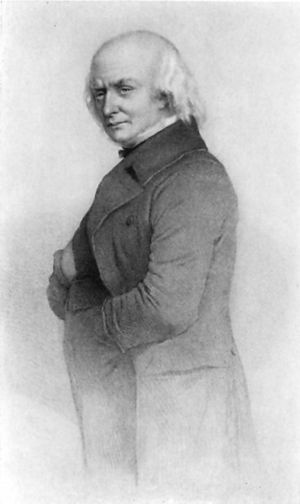 |
|
Pierre-Jean de Béranger
(1780 - 1857) |
THE
Poet of the People must be a lyric poet. Where the epic poem is
read once, the song is read and sung a thousand times. It is more
immediately appreciated—it does its work at once—while at the same time,
if it possess the true, immortal stuff, each repetition brings out
richer beauty, and adds to its power and popularity. The People's
Poet—"Song-writer," if you will—what nobler aspiration can there be?
To be crowned by the People as their Laureate of Song—Does not such a
man stand peerless among peers, and kingliest among kings? We had
rather be such a one, than author of the world's three great epics.
What a glorious thing to possess the magic to make the people laugh from
very fullness of joy, and the poor man's heart to break into singing!
To call up sweet tears into the eyes of those who seldom weep, and make
the rocky nature gush with the living waters of love. To kindle in
the cold, crusht being of the masses a sense of the beauty and grandeur
of this world of wondrous loveliness, with its rich over-brimming of
plenty and poetry, its eternal mountains laughing up in the face of the
sky, its glorious greenery, its spring-time and harvest, its budding
merry mornings, and tender starry midnights, its beautiful woman and
brave men, to accredit and reveal, the better nature that underlies so
much roughness, rudeness, and rockiness—to hymn the people's prayer for
nobler growth and development—to retouch and rekindle the defaced image
of God in the worn face of humanity, by calling forth the lineaments of
heavenly beauty—to sing the holy faith that—
|
There is no hearts so earthy, but at times
Hath eager leaps to clutch at nobler life,
And some blind gropings after better things.
That smiles of God live in the darkest being,
And soul-light glimmers ev'n on helot-brows,
Like mellow moonlight, silvering thro' a cloud! |
To trim the divine lamp of poetry in the hearts and hones of the poor, and
elevate the standard of humanity for all—to war with all oppressions
that retard the reign of love and the bond of brotherhood—to utter the
people's social and political aspirations—to turn the mask that
Falsehood wears into crystal, so that its hideous features may be
seen—to tear down the veil from all established shame and grinning
hypocrisies that sit in high places—such is the work of the
People's Poet! And such a poet is Béranger, the greatest Lyrist of
the age—Béranger, the poet, patriot, and philosopher.
In writing of Béranger, one is compelled to speak of
Burns, and Moore, as song-writers, to illustrate the position which
Béranger occupies in French song. They are all three recognised
national Poets; they have written volumes of national songs, and won
imperishable fame. Between Burns and Béranger, the likeness is
very striking. They have the same withering contempt of mere
wealth and state; both find inspiration in dear woman's charms; both
evince the same hearty and keen zest for conviviality. They have
both the same rich humour, and Shaksperian strokes of satire, and both
have the requisite power for song-writing; that lyrical bubbling of the
soul into song, which is the most essential inspiration. But,
Béranger had no such "advantages" as Burns, who wrote his immortal
lyrics to tunes which in themselves are half battles for immortality!
Those thrilling strains of olden melody which had for ages wailed, and
yearned, about his native land for spousal words. Eloquent with
the memories of a proud past, and hallowed by the smiles, and tears of
bye-gone generations. He caught up these harmonies which have a
power in their very tone, to make tears start in the eyes, and which
tremble among the heart-strings, and make them ring out fresh and
melodious, today, as ever rang the harp-strings, beneath the hands of
the ancient harpers. Burns had many a glorious starting-line, and
many a deathless chorus, which gathered up, and held the hopes and
aspiration of a nation, snatches of minstrelsy, in which the alarm of
battle, the Covenanter's Hymn, the Wail of the Martyrs, the Coronach,
and the Song of Victory, mingled and rolled in thunder-music adorn the
centuries on which the Poet seated himself as in a chariot of fire, and
went up in glory.
Béranger had no such aids, there were no fine fragments
of national minstrelsy already intensely dear to the popular heart, to
which he could wed his verse. He had no such secondary cause of
imperishable fame. His lyric measures are his own, and he had to
trust, solely to the inherent force of his own genius, and the
spontaneous sougfulness of his Chansons, to win their widening way to
the hearts of the People, and to the inheritance of everlasting life.
But he possessed the genius, the fiery zeal, the untiring heart, and the
indomitable energy necessary to the accomplishment of his splendid
purpose, of becoming the People's Poet, and he surmounted all barriers,
and conquered all hindrances.
Moore is by no means worthy of being classed with Burns
and Béranger, as a national poet, or people's song-writer. The
golden lyre of giant-hearted Robert Burns, and that of the
rough-and-ready Republican Béranger, do not accord with the elegant
little musical snuff-box of the Bard of Erin, which is made of brass,
and rings best on the drawing-room table. He has no claim to the
title of National Poet, and he never won his diploma in the school of
the poor, which must ever be earned by the People's Song-writer.
Where shall we look for the consuming fire of earnestness which attends
the patriotic passion in his songs? The bravest of them, and
the dearest to our hearts, are only taken as pegs to hang his splendid
raiment upon, a good investment of his cleverness, safe subjects, in
which he could expend his drawing-room patriotism. We know he
did not feel what he sung, that he had not the aspiration he simulated,
and his severe reprobation of Rousseau, in those lines on the hypocrisy
of genius, and its power of feigning, is his own condemnation. Has
he not written in the Appendix to the splendid illustrated edition of
the "Irish Melodies," "It has been said that the tendency of this
publication is mischievous, and that I have chosen those airs but as the
vehicle of dangerous politics, as fair and precious vessels from which
the wine of error may be administered. I beg of those respected
persons to believe that there is no one who deprecates more sincerely
than I do, any appeal to the passions of an ignorant and angry
multitude. But it is not through that gross and inflammable region
of society, a work of this nature ever could have intended to circulate.
It looks much higher for its audience and readers. It is to be
found on the pianofortes of the rich and educated. Of those who
can afford to have their national zeal a little stimulated without
exciting much dread of the excess into which it may hurry them."
O, but you're a humbug Tommy Moore! So you repudiate the people?
Well they can do without you. Byron said you dearly loved a
lord—and he knew you. How grand old Béranger would scorn such
snobbish flunkeyism as that. We should not say anything more about
the Bard of Erin, but that he continually provokes comparison with
Béranger in his choice of the same themes and we cannot but remark the
difference of their handling. Moore has written drinking songs,
happy, smart and of cunning workmanship. But he lacks the
roistering roaring, rollicking of the genuine Bacchanalian—its only a
sniggering intoxication, and any Lilliputian could get as drunk as that!
Béranger is jolly and unctuous as Falstaff. The wine of his song
effervesces and sparkles, and the bubbles burst, each tipping you the
wink of invitation, as he sends all care to the devil with his hearty
abandonment. Convivial lyrics are no favourites of ours; but we
mention this difference, to illustrate the natures of the two singers.
Moore merely brings out the pretty conceits of the man, while Béranger
goes straight to the heart, and opens it to you, rich and generous as a
ripe pomegranate cut right down the middle. Moore has written
love-songs. Many of them are exquisitely beautiful, true, and
tender things; but he seldom gives forth the sapphic yearing "as of a
god in pain," the deep earnestness of divine love, whose very wounds
flow with celestial ichor. He is in love with his muse's form and
face, rather than with the underlying and informing soul. He sings
what he thinks he ought to feel and see, rather than simply records what
he does feel and see. He is not inspired, and is continually
telling it, by his arduous make-believe, as fatally as a man babbling in
his sleep. He has few of those home-touches which reach the
universal heart of humanity. But it is in the political songs that
the grand difference is manifested. Moore's politics are a sham.
He does not dip his pen in the inkstand of his heart—he dips it in
rose-water, so that he may not stain his white kid-gloves. He does
not stir the blood nor rouse the heart as with the sound of a trumpet.
His songs have not the stuff in them that wakes a nation, and sends a
people to battle for liberty, with eyes weeping and burning, and hearts
beating defiance to all despotism. He does not sing of Liberty,
who cometh terrible as a Nemesis and glorious as an army with banners,
her footsteps red with the blood of the oppressor, and yet with a smile
in her eyes that lights up a divine radiance in the hearts and homes of
the poor! His is only a speculative freedom, and we feel
that one burst of heart like "Who fears to speak of Ninety-eight," is
worth all his tinsel, and glitter, and rhetoric. Béranger is the
true "Mountain of Light" on the ground-floor of the World's Exhibition,
with its subtle sparkle of inner life-light in the pure depths of it.
Moore is the radiant imitation, mounted up there in the gallery, very
brilliant, beautifully set, large and lustrous, but not diamond after
all, only cut-glass. In his political songs, Béranger is the
dauntless champion of the poor, the oppressed, and down-trodden victims
of social and political tyranny. He has slung them into the camp
of the tyrants, as they rushed from the furnace of his mind, like bolts
of steel welded white hot; and they have been as deadly and devastating
as the old GREEK FIRE.
He has spoken the words that despots quake to hear. The dwellers
in the world's high places, and the occupants of the thrones of power
have placed their ears to the ground, and trembled, as they have caught
the sound of the mustering of the long-oppressed, and the march of the
poor's grand army, timed to the music of Béranger's songs, and hurrying
to give them battle. The wrongs and persecutions of the people
never had fitter utterance than in his noble lyrics: they have no vile
conceits, tawdry trash, or stale-drunk sentimentalism. They are
sound, honest, and practical. He felt what he wrote, it sprung
from the living heart of the man, and went straight to the heart of the
people, whom he loved. He had their aspirations, and lived their
life, he hoped their hopes, wept their tears, was one with them in their
sorrows and their joys, their defeats and their victories. And
they have taken him for ever and—aye, to live in the hearts of the
people. "The People," says he, "that is my muse. They wanted
a man to speak them the language they love and understand, and who would
create imitators to vary and multiply versions of the same text. I
have been that man." Again he remarks, "When I say the people,
I mean the mob—I mean if you like the populace of the lowest grade.
It is not sensible to the blandishments of wit, nor to the delicacies of
taste; Granted. But for that reason it obliges authors to conceive
the more strongly, more grandly, to captivate attention. Adapt
then to its robust nature, both your subjects and your developments.
It is neither abstract ideas nor types they require of you. Show
them the naked human heart. I am persuaded that if there be
any sense of poetry left in the world, it is in their ranks we must go
to seek for it. Let as then try to make it for them, but to
succeed in this we must study the people." Brave advice that! the
truth of which has been well attested by the poet himself. But we
must pass on to the life of the poet. He himself says, "My songs
are myself," his life is written there; and one ought to be able to
quote many of his songs which illustrate various phases of his life, but
we shall have to confine ourselves to an outline of his personal
history. It is not very romantic, and has few startling incidents,
but it is a proud record of a grand man, who lived his own heroism,
carried his head loftily in spite of poverty, and bore himself bravely
through the world, and like Massena on the field of battle, when the
fight went sorest against him, he rose with the circumstance, was most
himself and went forth a conqueror, clad in the robes of victory!
Peter John de Béranger was barn in Paris on the 19th of
August, 1780, in the domicile of his poor old grandfather—his mother's
father—a tailor. This is recorded in one of his songs, and he
loves to dwell upon his connexion with the kind and honest old tailor,
who stitched hard to keep the poor, ricketty child in pap. It was
a poor prospect, notwithstanding a fairy did visit the poet in his
cradle, and endow him with the gift of song. This he also tells us
in rhyme in his "Tailor and the Fay." His father was born at
Flamin cour, near Peronne. He was a scapegrace, eccentric sort of
man and led a life, which, like Joseph's coat, was of many colours.
The father was proud of the name of Béranger, and in his stupid vanity,
would fain have founded some pretensions to a noble ancestry. This
the son sternly repudiated. "Eh! what?" he exclaims in one
of his songs, "Me noble? No, no—I am low born—very low."
Until he was nine years of age he remained with the old tailor at Paris.
He was then removed to Peronne (the revolution raging in all its fury),
where his father's mother kept a small inn. Here he fell in with
some books, odd volumes of Telemachus, and of the world-famous works of
Racine and Voltaire, and he thus gained an introduction to miscellaneous
literature.
When about twelve, he was struck with lightning on his
grandmother's doorsill, in spite of the holy water, with which, on the
approach of the storm, the venerable old dame had besprinkled him and
the house. At fourteen he was bound apprentice to a printer, named
Laisné, who was a good fellow, and whom Béranger has accordingly made
immortal. The honest printer was wont to write verses, and he,
too, encouraged the boy. "Sing, poor little one—sing," which,
according to the poet, was the fiat of the Creator at his birth—"Chante,
chante, panvre petit." His best practical education was at a
primary school, at Peronne, founded upon a plan of Rousseau. The
children were dressed and drilled as soldiers, and cultivated for
philosophers. Béranger was the most distinguished leader and
orator of this school, and enlightened citizens Tallien and Robespierre
with many a patriotic address from self and playfellows. This
course of life continued up to eighteen, about which time he began to
rhyme,—albeit he had to chirp many a year before he realized the
fullness of the good Fairy's gift.
He now returned to Paris, and for the first but not the last
time, did not know what to do for a dinner. Poetic influence now
began to operate on him in downright earnest; he is said to have burst
into tears the first time he heard the Marseillaise Hymn sung. His
sensitiveness was at all times the keenest. He now worked at "the
case" as a printer, and tried his hand at all kinds of poetry. He
attempted a drama, but on reading a few pages of Moliere, found it was
no go for him, and consequently gave up in despair. He next
commenced an epic poem of which Clovis was to be the hero! Summary
condemnation of this was the verdict of the future song writer. In
the midst of his glorious dreams of poetic fame, work failed, and
Béranger endured the bitterest suffering; and privations of want.
He thought of going to try his fortunes in Egypt; he remembered the same
notion had occurred to Napoleon when good dinners were scarce things
with him; "all great reputations come from the East," quoth he, and
Béranger endorsed the sentiment. He was, however, dissuaded, and
he held on at Paris, to suffer, study, love, and to triumph. At
the age of 23 he had written a large mass of verses, and beaten his
music out a little more clearly. But what to do with them? he was
too poor to print them and destitute of all resources, wearied with
broken hopes, versifying without object or encouragement, without
instruction and without advice, he conceived the notion of putting his
poems in an envelope and addressing them by post to Lucien Bonaparte,
brother to the future emperor. After a lapse of three days Lucien
sent for him, and generously gave him advice and assistance. He
presented Béranger with a small pension which he drew from the French
Institute; a means of support the poet enjoyed till 1812. He also
became a copying clerk in the University, where he toiled for twelve
years, at a salary of £80. He was expelled from this post by the
Bourbons on the publication of his first volume of songs. The
first collection was printed in 1815. Some of these first
offspring caught the popular ear and dwelt there. He was
especially happy in the burden or chorus of his songs. Music and
meaning were bound up in the refrain, like the knot tied at the whip's
end to enhance the smack of it. These songs were principally light
and joyous, mere caprices of a vagabond spirit; but political events
began to influence his mind and to give him another element to mould in
his poetry, and gradually his songs became more serious. This was
very apparent in the second collection, written between 1815 and 1821,
in which some of his finest songs appear. In these he speaks words
of cheer and consolation to the poor and afflicted; the epoch was
sorrowful, and the poet's song became serious, even sad. Béranger
was bitterly disappointed at the restoration of the Bourbons, not that
he was a thorough Bonopartist, for says he, "not all my admiration for
his genius could ever blind me to the crushing despotism of the
empire.'' But he shed bitter tears at the sight of the allied
armies entering Paris, and bled at heart that the Cossack should thrust
back the Bourbons upon them. Song after song rang out, boiling
over with scathing scorn, and stinging irony, burning, and maddening to
the sensitive French, as the red-hot sand, flung from the beleaguered
walls of Tyre, which pierced to the bone and marrow of the besiegers.
In 1821, Béranger published his second collection of songs,
10,000 copies were subscribed for, and the impression was immediately
sold. The writer was at once pounced upon by the government, which
had long waited the opportunity. His political songs had been
floating about for a long time, and had wrought an immense influence
with the people; but heretofore he had not owned his paternity to the
songs which he now did, by publishing them with his name.
Three months in prison was the government award. A
series of satires and lampoons still more biting and piercing than the
last was the fruit of his imprisonment. These were published so as
to defy the Censorship, being circulated from hand to hand, and sung in
the streets, and under the windows of his persecutors. The
government and the Jesuits were driven frantic, and at length he was
again imprisoned, this time it was for nine months with a fine of 10,000
francs, which was subscribed by the people. With the revolution of
July, his friends came into power, and pension and place were offered
him, which he refused, preferring to remain poor and independent.
His last collection of songs was published in 1833, and he then avowed
his intention of writing no more. "He retired," he said "from the
field while he had strength to leave it; often toward the evening of
life we permit ourselves to be to be surprised by sleep in our
arm-chair; better go wait its visit in bed. I haste to betake me
to mine, even tho' it be a rather hard one." When the revolution
of 1848 burst forth, Béranger was not forgotten by the people of France.
He was elected a member of the new legislature which honour he declined
in a characteristic letter, rich in kindly feeling.
Béranger has won that fame which is accorded to but few—a
reputation so difficult to acquire, to be read and be loved at the same
time, in the salons of the rich and great, and in the huts of the
peasantry. His songs have taken possession of the national voice,
the national ear, and the national heart. His lyrics are upon
every lip; they are heard in the convivial gathering, the circle of the
learned, the workshop of the ouvrier, and the barracks of the soldier:
they are sung in the palace and the cabaret; the mansion and the
guinguette; in the street and the field—throughout the length and
breadth of France. Never was there popularity so fervid and so
general. In his capacity as song-writer he has exercised more sway
over France than any writer or ruler ever has, or peradventure ever will
again. At the birth, the bridal, and the bier, his strains are
chaunted. Young maidens, standing in the rosy light of
first-love's everlasting dawn; and aged dames, sitting at the doors of
their cottage-homes, singing and knitting in the sun; the sailor before
the mast, and the soldier marching to liberty or death—each and all find
musical utterance for their varied feelings, in a song of Béranger.
He has been accused of licentiousness in his earlier songs; but the most
outré of these produce laughter; and as Mr. Shandy says in his letter to
Uncle Toby, "Thou knowest, dear Toby, there is no passion so serious
as lust." He has written love-songs, joyous songs, witty
songs, satirical songs, political songs, comic songs, and ironical
songs; he has written philosophical songs, which soar into the sublime;
patriotic songs, which have roused the hearts of thirty million people,
like the drum which beats the charge of battle. In short, we
should say that he is the world's unparalleled song-writer and lyric
poet. He combines the buoyancy and grace of Anacreon; the
startling fire of Pindar, the polished keenness of Horace, the stern
vivacity of Juvenal, the sublime earnestness of Moore, and the passion
of Burns; while in largeness of heart, in development of his own
intellectual being, in his reading and study of the human heart, in
depth of insight, and in dramatic power, he is akin to our own
Shakespeare. He is the Shakespeare of France. O, for one
arrow of fire from his battle-bow, to pierce between the joints of the
armour of this Napoleon the Little, when he lifts his murderous arm to
aim a blow at liberty.
But the bird of song is silent, and in the dearth of winter
one swallow would not make a summer. The Poet is way-worn and
weary; let him rest. He has done his work. He has lived his
life—a noble life, simple and philosophic as that of any sage of ancient
Greece. After he had borne the burthen in the heat of the day;
after his sorrows, struggles, self-sacrifices and sufferings, he retired
to the modest little cottage at Passy, where he has lived in seclusion,
only broken when, on some fete-day, his countrymen have insisted on
drawing his carriage home, with harness of twined flowers, garlanded by
the fair hands of his countrywomen. If ever there was a true man,
and a genuine, sincere patriot, it is Pierre Jean de Béranger. The
last songs we have seen of his were written, one in 1847. With the
true prophetic inspiration, he saw, as by instinct, the deluge that was
coming, as he sat watching from his mountain, where he dwells apart, and
sang, "Poor kings, they shall all be engulphed in the flood."
And they were too! only the foolish, tender-hearted peoples wouldn't let
them drown. Poor things! like the farmer who took up the up frozen
viper, and nestled it in his bosom to restore it, and to was stung for
his compassionate pains, THEY'LL KNOW BETTER NEXT
TIME. The other song, we believe the Poet's last, was the
"First Song to the New Republic," addressed to his dead friend, the old
Republican, "Manuel."
Béranger is said to be compiling an historical dictionary,
where under the head of each notable name, he will record his various
remembrances, political and literary, with his own judgments of persons
and circumstances. It would be unpardonable to pass over the life
of Béranger without a review of his songs, but this we must do in some
future paper, probably in a very early number. Meanwhile, let us
express a hope that the grey hairs of the brave old Bard may not go down
in sorrow to the grave, while his dear land is polluted by the scamp
Napoleon, and his rabble rout, but that he may yet live to see the
veritable Republic, and, like Simeon of old, clasp in his arms, the
"Christ that is to be," and bless his eyes with the sight, before they
close in peaceful death. VIVE
BÉRANGER.
|
|
____________________________________
THE
FRIEND OF THE PEOPLE.
SATURDAY,
MARCH 27, 1852.
WAS THOMAS MOORE A "HUMBUG?"
______________
SIR.—I take a very different view of
the character and genius of Thomas Moore to that expressed by Mr. G.
Massey in No. 5 of your journal. Béranger may be all your
correspondent asserts, and Thomas Moors be yet an honest man. Is
it necessary in order to exalt the character of one man that another
should be traduced? Is that an enviable fame which is built upon
the ruins of another man's reputation? Béranger's own genius is
based broad enough upon which to build a world-wide renown.
Why "Moore is by no means worthy to be classed with Burns and
Béranger as a national poet, or people's song-writer," I cannot tell;
unless it be that he was not unfortunate enough to be born in poverty
and wretchedness. Though never in poverty himself, Moore could
nevertheless fill the hearts of the humblest of his countrymen with
aspirations a liberty and virtue. He has displayed a devotion and
love for his native land in nearly every poem that has emanated from his
pen, which entitle him to rank among the most ardent advocates for
national freedom. What greater claim to being a national poet can
a man have than writing for all classes? In being read by
the "rich and educated" as well as by the poorest labourer in the land?
The poor alone are not a nation, any more than the wealthy.
That very expressive phrase, "a humbug," is applied to the
friend and associate of the ill-fated patriot, Robert Emmet, because he
deprecated any appeal to the "passions of an ignorant and angry
multitude." Will any man who wishes well to his country appeal to
the passions of any multitude, and least of all an ignorant one?
Then why apply an opprobrious epithet to Moore for not doing that which
every wise and good man would condemn? A multitude at any time is
a dangerous thing to deal with; and he who rouses its passions is as
likely to be swept away by it's fury as passions those against whom he
wishes to direct its rage.
Your correspondent remarks of Moore—"Byron said you dearly
loved a lord, and he knew you.'' It is true Byron did know Moore,
and entertained for him a respect amounting almost to affection.
It is also true that Moore loved a ''lord;" he loved Lord Byron,
probably Lord Bacon, and doubtless many others; but is he any the worse
for that? There have been lords better than many plebeians.
What proof is there in Moore's writings that he loved a lord for his
title merely? If he was fond of rank, why did he not obtain it for
himself? Surely a man man so popular as Moore in the days of
George IV. might easily have obtained a title for a little servile
cringing, if he had felt desirous of the "distinction." He was
never even poet-laureate.
Moore is blamed for not being so "jolly and unctuous" in his
Bacchanalian songs as Béranger. I think the weaker a song of that
nature is the better—in fact, better none at all. Many a one, has
been made a drunkard because some great man has been a "jolly fellow;"
just as many a young politician has become vapid and incoherent because
some popular leader has indulged in extravagant expressions.
"Convivial lyrics are no favourites of ours" says your correspondent;
yet, by a strange inconsistency, he prefers the most "roaring,
rollicking," &c.
I do not believe in the assertion that "Moore's politics were
a sham," and that he did not feel what he wrote. Moore, if
judged by his writings, will be found to be as sincere as any man who
ever wrote for the people. His whole soul seemed thoroughly imbued
with the spirit of liberty; and how he mourned over the sad fate of his
unhappy country is amply testified by the many appeals he has made on
her behalf to the hearts of his countrymen.
AUSTIN
HOLYOAKE.
TO AUSTIN HOLYOAKE.
SIR,—I object to the mode of your putting the
question, "Was Thomas Moore a humbug?" from I which it might appear that
I have laboured to prove him such. I was not speaking of the
general character of Moore, when I remarked, "O, but you're a humbug,
Tommy Moore." I had been quoting Moore's own words, which seemed
to me to contain unmitigated humbug and I would refer to those same
words for my justification. I have not "traduced him", nor "ruined
his reputation." Why "Moore is by no means worthy of being classed
with Burns and Béranger as a national poet or a people's song-writer,"
is, because he was never catholic among the population of his native
country as Béranger is; in vain has Mc. Hale turned his songs into
choice Irish, the peasantry don't know them, don't sing them, or care
for them, and not because "he was not unfortunate enough to be born in
poverty and wretchedness," though I believe the poet of the poor must
be born poor there, in support of which opinion I am happy to quote from
a letter of a dear friend of mine, the of author of the "Saint's
Tragedy," who remarks upon this subject: "I was speaking with Chevalier
Bunsen a short time since on the effects of the beautiful
song-literature of Germany, when he urged me to devote my powers to
writing songs for the people; and I answered him then, as I tell you
now, they must write them for themselves." Moore has not written
for all classes; I quote his own words: "But it is not through that
gross and inflammable mass a work of this nature could have been
intended to circulate. It looks much higher for its audience."
He repudiates what we call the people. How, then, should he be
compared to Burns and Béranger as a national poet? "That very
expressive phrase," a humbug, "was not applied to Moore because
he deprecated any appeal to the passions of an angry and ignorant
multitude," but because he made such appeal in such verse as—
|
Then onward the green banner rearing,
Go flash every sword to the hilt!
On our side is virtue and Erin,
On theirs, is the Saxon and guilt. |
And many others, especially in the lecherous tomtittery of the amorous Mr.
"Little," and then perpetrated such sneaking flunkeyism, as I quoted.
All who have read Byron's words, where he says, "Tommy Moore dearly
loved a lord," will know that he meant a lord in the titular sense,
rather then the natural one. I did not "blame" Moore for not being
so jolly and unctous as Béranger in his bacchanalian songs. I
expressly stated that convivial lyrics were no favourites of mine, and
that I merely noticed the difference, to illustrate the natures of the
two singers. I made no preference. I believe in no man's
patriotism, or love of country, who will take office under its
enslavers, and go cheek by jowl with its oppressors. Neither did I
intend any insidious attack upon Moore or his writings. I will
yield to none in admiration of much that he has written. He is
still the melodious Moore, many of his songs will live while the English
language lasts. But for all that, he may not be a national poet in
the sense we speak of Béranger, and he may be a "humbug" to the be
extent with which I charged him.
GERALD
MASSEY. |
|
____________________________________
THE
FRIEND OF THE PEOPLE.
SATURDAY,
MARCH 20, 1852.
SIDNEY SMITH AND CO-OPERATION.
______________
IT is written, "whom the gods intend to destroy,
they first drive mad;" and surely it was the unseen work of Destiny,
that the Masters of the Iron Trades should choose Sidney Smith for the
exponent of their opinions, and the defender of their faith. How
could they be so lamentably blind as to place their cause in the hands
of a man who, by the very force of his own ambition to write smartly and
vigorously, would be impelled to place the darkest side of their tyranny
in the clearest light. They should have sought to veil their
odious despotism and their cold-blooded economics in the most exquisite
sophistry; outspoken language is terribly fatal to them; but they have
chosen him for their champion, as "whom the gods intend to destroy they
first drive mad." It is generally known that Sidney Smith "does"
the articles headed "History and Politics," which appear on the first
page of the Weekly Dispatch. And therein he has been
fighting the battle of the masters against the men (in the Engineers'
strike now pending,) more strenuously than any other pen-bludgeoned
ruffian of the profligate Press.
Let working men remember they have no greater enemy
than the sham-liberal
Dispatch. It is as changeable a weathercock as the Times.
It is red-hot Republican when revolutions are rife, and to-day it is the
staunch adherent of the most damnable tyranny in the world. Any
working man who purchases it, or countenances the house where it is
taken, without a protest, is a traitor to his order. But, for the
present, we have to do with Sidney Smith. He has taken up the
cudgels against "Industrial Association and its Prophets," meaning
thereby the promoters of working men's associations. Now, Sidney
Smith is acknowledged to he a master of the epileptic style, a
perfect Elihu Burritt of slang-patois, in vituperation, coarse
abuse, and in the use of big, blatant, and-blasting epithets, he soars
into the Billingsgate sublime, and is unrivalled in his almighty power
of lying. His pen is like the tomahawk, and his words like the
war-whoop of a wild Indian. He has a most extensive vocabulary of
such words as "hullabaloo," "Catawampus," "Buggeroo," &c., and strings
them together with a facility an irate fish-fag might envy. But
every one must be aware that this low and miserable trick comes as easy
to the practised hand as the shamming of fits does to those wretched
impostors who torture themselves by the way-side for pity and for pence,
and who, from constant habit, can do it to the life, or beat Nature
hollow. This may be all very effective where all that is necessary
is to declaim, denounce, and damn, safe subjects, such as Sidney Smith
generally chooses to annihilate; but it fails miserably and utterly in a
discussion of the principles of Socialism. These must be examined
and debated with calm reflection and wise forethought, as they have to
be tested and wrought out in the light of all past experience. All
inflated farrago and bombastic balderdash fails here, and dies out with
the death of its own sound and fury. We have had all too much of
it, it's used up, a "departed coon," or, as Sidney Smith himself might
say, "That cock won't fight." He seems to be aware of this, and is
evidently paralyzed at finding his old tactics ineffectual. He has
much less bounce and swagger than usual; the most decisive thing he
dares, is to say, "We must put down Socialism, or it will put down us."
But he does not spring upon it with one of his electro-biological yells,
grapple with it, and dispatch it with his wonted swift success.
He dodges stealthily round about it, reminding one of the Battersea
Bantam sparring at the Brummagem Bruiser, and industriously squaring the
circle of a very safe distance, evidently with no intention of
hitting his giant-ship, for very obvious reasons. But, not being
able to refute the principles, or give them battle, it is still open to
Sidney Smith to malign and belie them, and to cast odium upon their
advocates, and at this dastardly work he is as much at home as any dirty
scion of London alleys, dabbling in the mud of his native gutter.
He flings it profusely, on the principle that by throwing plenty some
must stick. Pointing to France, he says, "We have seen what these
execrable principles have ended in, under a speculative politician
dexterous enough to take advantage of the antipathies which these
theories have engendered in all intelligent and reflective friends of
order and constitutional government. From such principles it will
be seen all thinking men have fled into the flinty bosom of a hard but
orderly despotism." We presume he alludes to what has been falsely
called Louis Blanc's organization of labour in the national workshops, a
scheme avowedly got up by certain members of the Provisional Government,
to frustrate the plans of M. Louis Blanc, and to disgust the mass of the
people with Socialism. Sidney Smith knows this as well as we do,
and it must have required all his rhetorical audacity and shameless
mendacity to have resuscitated the ghost of such a dead-and-damned Lie
for a bugbear to frighten the timid and timeserving slaves of capital.
He also asserts that the French co-operative workshops have been found
such a nuisance, that such of them as had not already expired, were,
with universal approbation, recently suppressed. Why, the fact is,
that out of the thousand that existed throughout France, there was
scarcely one in a hundred but was successful, and that almost the whole
thousand had to be shut up. Of course they were a nuisance to
the Bourgeoisie! He next threatens us, that "if we attempt to
carry out any such theories here; it will end in the entire
disfranchisement of the working classes," a result very awful to
contemplate. Sidney Smith is evidently "flabbergasted" to find
that the working classes do not eagerly substitute the tyranny of the
middle classes, and their chartered bully competition, in lieu of the
despotism of feudalism and aristocracy. This was why they combated
for the "poor man's cheap loaf," and battled for Freedom of Trade, not
that they loved freedom, but that they hated the landed interest.
The people having swallowed that gilded pill, Sidney Smith's mind was
made up that the age, yclept "golden," was to be ushered in upon us
while bowing down to them, the golden calves! instead of degrading
ourselves, as at present, by the impious allegiance to more queens, and
lords, and priests. But no, with us it is not a mere change of
tyrants. We shall not willingly inaugurate and establish the
régime of the Moneyocracy. We know them; we have weighed them, and
have no faith in them. Moneygrubs, with the brains at the back of
their heads! they have no generosity or self-sacrifice in them the
almighty L. S. D. is their god. They do not comprehend the
meaning of those sublime words, "Liberty, Equality, and Fraternity;" nor
the misery expressed in those bitter ones, "Employers and Employed."
Love has no altar in their hearts; and their canting respectability is a
gilded hypocrisy. Not in their hands will we place the destiny of
Labour, who do not comprehend the problem we seek to solve. Out
upon ye, hollow shams, and living lies, and promulgators of a system
that kills so slowly; men do not call it murder. Ah, thank God!
your principle of competition is a double-edged sword, and cuts both
ways, tyrants and slaves; it effaces the image of God from heart and
brow, and grinds the manhood out of both. But not for a mere
change of tyrants do we work; we seek the emancipation of Labour, so
that it may become master of the world. We demand the practical
realization of Brotherhood; we claim the Suffrage as a birth-right, and
demand to have the brand-mark of slavery effaced from our brows, so that
we may uplift them in human nature's nobleness, as sons of the same
Father, brothers of the same Christ, and children in the same family.
GERALD MASSEY
(To be concluded in No. 8)
______________
THE
FRIEND OF THE PEOPLE.
SATURDAY,
MARCH 27, 1852.
SIDNEY SMITH AND CO-OPERATION.
______________
(Concluded from No. 7.)
ONE of the first acts of the French Revolution, was
to abolish capital punishment; one of the first of ours would be to
abolish labour punishment. We would legislate to fetter human
misery, by destroying this proletariat, or speculation in man by man.
Nor do working-men accept the assistance of such men as Mr. Ludlow, Mr.
Vansittart Neale, Professor Maurice, the Rev. Charles Kingsley, and
others, because they intend, in return, to further the interests of the
landed aristocracy. We do not give them the hand of fellowship,
because the one proclaims himself a Monarchist and the other a
Conservative. Nothing of the kind. We meet them on the
common ground of humanity. They recognize the oneness and equality
of human nature. They acknowledge that it is the same nature with
their own that is degraded and trodden down by the vice and misery of
the present societary system, which fact, the mass of their fellows are
loathe to admit, until we clutch them in the ghastly arms of cholera and
death; and prove our title to kinship by killing them with the same
disease.
We respect, love, and work with them, because they
stretch forth a helping hand to aid our own efforts of self-help for our
deliverance. They have nobly come forth from their class and its
selfish interests, the ten men that are to be found, to save our
modern Gomorrah, to take their stand in the ranks of Labour, to
combat for justice and right. In doing this they have braved the
falling off of friends and the persecutions of enemies; and we shall not
listen in silence while they are being attacked, maligned, and
misrepresented by Sidney Smith, or any other unprincipled scribe.
Doubtless, we look upon co-operation from a very different point of view
to that of these men. We do not look upon it merely as the
substitute for political power; on the contrary, we believe that
political power is essential to consolidate or even to give fair vantage
ground to co-operative associations. Furthermore, we believe that
few working-men see the necessity of political power so clearly as those
engaged in association. This is one of the first lessons taught,
to learn which, if for no other reason, we would have men associate.
Are we not declared illegal at the outset? The laws of the country
do not afford us protection from robbery; therefore, we must have the
power of making and enforcing laws of our own. Let not our friends
of the working-class imagine that the men now engaged in co-operation
are raw enthusiasts, without foresight and experience. This
movement, if ever there was one, is essentially an honest one. It
is manned and worked by men tried and true—old Chartists and Socialists,
farther-seeing and farther-reaching than the men who have attacked it;
indeed, it contains the flower and chivalry of English democratic
workingmen, who with hearts not yet fossilized by political stagnation,
have determined to apply the means within their immediate reach for the
elevation of their order, and the advancement of their freedom.
Sidney Smith assures us that Socialism cannot take root here; it must
result in utter discomfiture. We never thought it would become a
religious faith with Englishmen as with Frenchmen; they have not the
enthusiasm to kindle. John Bull won't climb the greasy pole for
mere emulation; there must be the leg of mutton a-top. Neither can
you electro-biologize him into the belief that it is there; he must see
it with his eyes and touch it with his hands. But we always
believed that if you reduced it to a simple, tangible beginning, like
that of associations for production and distribution, it would be
grasped easily and eagerly. And such has been the case.
Association has taken root, and spread far and wide, throughout the
length and breadth of the land. We have given the world a grand
practical illustration of what working-men may do, if they will but
unite, and work for each other, instead of working against each other.
We have made the Utopia of yesterday the common-place practicability of
to-day. We can now say to our opponents, combat association in
theory and on paper, as you may, association in successful practice is a
far different thing. Now combat that. We have replied to
your taunts and sneers, by silently working out our much-maligned, but
glorious principles. You have laboured assiduously to prove we
could not succeed; but this little pointed interrogation "Have we been
successful?" pierces the wind-bag of your inflated sophistries, and the
answer brings you down to sudden collapse—"We have been eminently
successful." Look around for the fruit of this experiment.
It is not arrogated that an association here and there, if successful,
will save the world. But their rise and progress has been
anxiously marked by deeply interested thousands, and the name of
association has become a magic word of talismanic influence. It
has been a rallying sign for those who have long waited in doubt and
darkness, looking for a sign; and day by day, has the tide set in our
favour, gone surging and surging onward, and swift success has crowned
our efforts. Day by day has new strength been added to the
movement, not only in town and city, but in the obscure nooks of village
and hamlet. This is success which cannot be contravened.
These co-operative associations and
stores may yet go down, but
the lesson learned by those who have worked in them can never be
forgotten; the insight obtained into the practical working of
self-government—the glimpse they have caught of the beauty and blessing
of brotherhood—can never be effaced. They will have learned that
the man who is a slave in his own heart, and a tyrant in his own
household, would be a slave and a tyrant still, even though social and
political thraldom were abolished to-morrow, an experience which can
never be lost, while the fact of such associative success, in the face
of such difficulties, must live on as a matter of history, bearing proud
testimony to the truth and vitality of our principles. Of course,
the associative tree, like other fruit-trees, has not borne all ripe and
sound fruit for its firstlings; it has had its bitter crabs and rotten
windfalls; but this we may say, that its worst and rottenest fruit has
not been the result of natural growth, but of pernicious grafting, in
spite of which it has yielded a generous harvest.
GERALD MASSEY.
|
|
____________________________________
THE
FRIEND OF THE PEOPLE.
APRIL 10,
1852.
REVIEWS.
______
THE PROSE AND POETICAL WORKS OF EDGAR ALLAN POE.
3 Vols. John Chapman, London.
AMID the many conflicting theories on the origin of
Man, we still hold with a firm conviction to our own. We believe
man to be the offspring of some inferior animal, begotten by some
superior inhabitant of the fore-world. And does not the strange
compound he is made up of warrant us in this belief? "The piebald
miscellany Man," is he not, at best, composed of "great bursts of heart,
and slips in sensual mire?" At one moment he is all that the most
exalted nature could imagine or desire, and the next he is akin to the
beasts that perish, and frequently lower than they. Now, he is the
strong, soaring Intelligence, whose clear spiritual ken makes him the
Seer of the universal mystery, and the astronomer of the world's
glorious destiny,—he stands with one foot on sea, and one on land, and
grasps and wields the vassal elements to his purpose. And again he
is a Sampson shorn of his strength. He gropes blindly in the mists
of passion—the soul's starry garments are trailed in the mud of the
earth—and the being, lately but "little lower than the angels,'' revels
and wallows in the bestial delights of the brute. Many
illustrative instances of this twofold nature have been witnessed, as in
the persons of Sheridan, Edmund Kean, and others, but never more
mournfully and painfully than in the case of Edgar Allan Poe. He
was a poet of the finest perception, and had the greatest imagination of
all the American poets. He had a head of the true Shakespearian
mould, and was gloriously endowed by Nature, but he lacked the courage
and strength of hand to rein in the PASSIONS—those
proud beasts of FORCE, which, properly controlled,
constitute a man's glory, and are the coursers of the soul, which draw
the chariot of Genius up the steep and rugged mount of Immortality;—but
once the curb is loosened, and the governance lost, turn, and rend in
pieces, and devour the driver. He was as great a dreamer as
Coleridge, whose dreaming and projecting capacity, and lack of
persistency in fulfilling his magnificent intentions, was never better
summed up than in the words of Charles Lamb, who says, "Coleridge is
dead, and is said to have left behind him above forty thousand treatises
on metaphysics and divinity—ONE OF THEM COMPLETED."
Poe lacked the persistency necessary to the carrying out of his glorious
dreams, and we reckon INDUSTRY to Constitute some
THREE-FOURTHS of what is termed genius. He appears to have
possessed a power which might have made—at least, it gave promise of
making—his name and fame coeval with that of Shelley, and he has left
but a few fragments, and a most melancholy history. We had
contemplated giving a review of his poetry and his prose works, and
shall still give a quotation from his "descent into the Maelstrom,"
described with such weird and wondrous power; but we have certainly been
taken aback at seeing two issues of shilling books, containing some of
his thrilling tales, and several of his poems—the one issued by
Vizetelley, of Fleet-street, is by far the best, contains most, and is
very decently illustrated. Poe is almost totally unknown here, and
this "Readable Book" is in every way welcome. We give the
following beautiful allegory, which is of
HIMSELF, as, indeed, is most of his poetry; though,
unlike Byron, he does not immortalize the personal pronoun "I."
Still, all he writes is very intimate with him, and eloquent of him,
and, as in the "Raven," gives forth an echo of his personal history.
So with the "Haunted Palace," in which he symbols his happy beautiful
boyhood, and the broken-down miserable age, and the change twixt now and
then:—
|
THE HAUNTED PALACE.
In the greenest of our valleys,
By good angels tenanted,
Once a fair and stately palace—
Radiant palace—reared its head.
In the monarch Thought's dominion,
It stood there!
Never seraph spread a pinion
Over fabric half so fair!
Banners yellow, glorious, golden,
On its roof did float and flow,
(This—all this—was in the olden
Time, long ago,)
And every gentle air that dallied,
In that sweet day,
Along the ramparts plumed and pallid,
A winged odour went away.
Wanderers in that happy valley,
Through two luminous windows, saw
Spirits moving musically
To a lute's well-tuned law,
Round about a throne where, sitting
(Porphyrogene!)
In state, his glory well befitting,
The ruler of the realm was seen.
And all with pearl and ruby glowing
Was the fair palace door,
Through which came flowing, flowing, flowing,
And sparkling evermore,
A troop of Echoes, whose sweet duty
Was but to sing,
In voices of surpassing beauty,
The wit and wisdom of their king.
But evil things, in robes of sorrow,
Assailed the monarch's high estate.
(Ah, let us mourn!—for never morrow
Shall dawn upon him desolate!)
And round about his home the glory
That blushed and bloomed,
Is but a dim remembered story
Of the old time entombed.
And travellers, now, within that valley,
Through the red-litten windows see—
Vast forms, that move fantastically,
To a discordant melody;
While, like a ghastly rapid river,
Through the pale door,
A hideous throng rush out for ever,
And laugh—but smile no more. |
We will give a short sketch of his history and have done for the present.
Edgar Allan Poe was born at Baltimore, in the United, States, in
January, 1811. His father, David Poe, was a lawyer, and while very
young, he became enamoured of an English actress, named Elizabeth
Arnold. An elopement was the result, followed by marriage.
He left the law, and went on the stage with his wife; this profession
they followed for some few years, and then died within a short period of
each other, leaving behind them three young children in a state of utter
destitution. Edgar the eldest, was then about six years of age, a
child of great beauty and precocious wit. A Mr. John Allan, a
merchant of large fortune and liberal heart, who had been intimate with
his parents, and having no children of his own, adopted him, and
intended to make him his heir. In 1816, he accompanied Mr. and
Mrs. Allan to England, and after visiting various places, passed four or
five years in a school kept by the Rev. Dr. Bransby, at Stoke Newington,
near London. At the end of this period, he returned to the United
States, and entered the University at Charlottesville, where he led a
very dissipated life, although he manifested brilliant mental gifts, and
was in the first rank of the scholarship, he was the most reckless
student in the University, and was at length expelled for gambling,
intemperance and other vices. He quitted this place in debt,
although his allowances of money had been large and liberal. Mr.
Allan refused to pay some of his debts in gaming, upon which he wrote
him an abusive and insulting letter. Soon after he left the
country, with the intention of joining the Greeks, then in the midst of
their struggle with the Turks. He never reached his destination;
and the next we hear of him is at St. Petersburg, in Russia, where the
American minister is one morning summoned to a court of justice, to save
him from the penalties incurred in a drunken midnight debauch.
Through the ambassador's intervention, he was set at liberty, and
enabled to return to the United States. Mr. Allan did not receive
him very cordially, but still willing to assist him, he procured his
admission into the Military Academy. For a time all went on very
well, but his old habits of dissipation were soon renewed, and in ten
months he was cashiered. He was once more received into the family
of Mr. Allan, but it soon became necessary that he should close his
doors against him for ever; the reason urged if true, throws a very dark
shade on the quarrel, and very ugly light upon the character of Poe.
Whatever it may have been, they parted in anger, and never met again.
Mr. Allan died in the spring of 1834, and did not leave Poe a single
dollar.
He now published a volume of poems, which was so favourably
received, that he determined to devote himself to literature. His
contributions to the Journals, however, brought but little fame and less
money. He next enlisted in the army, and deserted. We next
hear of him as the competitor for a prize for the best tale, and another
for the best poem, in which contests he won both.
This success led to a literary engagement; he was sought out,
and found in misery, rags, dirt, and destitution, and placed once more
in a decent position. But his fatal habits continually thwarted
all the kind efforts of his numerous friends. We have not space to
follow Mr. Griswold through the sickening series of biographical
details, and a succinct and well-written memoir will be found in the
Shilling volume of "Readable books," to which we have previously
alluded.
We now come to his life's melancholy termination. On
Thursday, the 4th of October, he set out for New York, to fulfil a
literary engagement, and to prepare for his second marriage.
Arriving at Baltimore, he gave his trunk to a porter, and went into a
tavern to get some refreshment. Here he met old acquaintances who
invited him in to drink; all his resolutions and duties were forgotten,
and in a few hours he was in a beastly state of intoxication.
After a night of insanity and exposure, he was carried to a hospital,
where on the evening of Sunday the 7th of October, 1849, be died at the
age of 38 years. We recently saw it stated in a contemporary
publication, distinguished for its crochets for the people, and its
indiscriminate intrepidity of assertion, that "Poe like Burns, Shelley,
and Chatterton, died broken-hearted, maligned, and neglected." We
leave our readers to judge of the correctness of that remark.
Meanwhile, we shall sing no Jeremiad over the wreck of genius, nor pitch
into the world on the score of neglect and indifference. We know
that men of such vivacity of temperament, have a thousand posterns open
for the ingress of the serpent sin, which the mass of men have not, but
we do not think they err because of their excess of genius, but because
they have not genius enough, for the most illustrious men have
demonstrated that the greatest genius is compatible with self-respect
and common sense.
G. M.
EDGAR ALLEN POE
AND HIS ACCUSERS.
A response by ERNEST JONES,
published in NOTES TO THE PEOPLE.
In a recent
No. of "The Friend of the People," Mr. Gerald Massey has thought proper
amid some invectives against the "Notes," to malign the character of the
great and unfortunate American poet, Edgar Poe. The life of the
latter, with illustrative selections from his writings, was given in No.
34, page 668, of the "Notes."
It will there be seen who Mr. Allan was, why Mr. Allan "cut
him off with a shilling," —and what was the cause of difference between
them. Mr. Massey has evidently been fishing in the dirty water of
America—tittle-tattle, wherein the hireling pen of a sordid scribe has
tried to darken the reputation of one he could never hope to emulate.
It is sad to see the names of great men the prey of any petty vanity or
ignorant pique. Mr. Poe had his faults—but (and we say it
advisedly,) his virtues far outweighed them—and if the reader wants to
estimate aright the character of the departed bard, let him read the
splendid refutation of the base calumnies urged against him, a
refutation contained in the article by the editor of "The Home Journal,"
and let him read the life of Poe, by Thomas Powell, the eminent
dramatist, poet, and essayist, in his well-known work, entitled "The
Living Authors of America", first series, New York, Stringer and
Townsend, 222, Broadway, 1850, and especially the part comprised within
pages 120 and 133.
No one paid a more noble tribute to his virtues, than his
mother-in-law, Mrs. Clem.
For the rest, we would advise the critic to see whence he
gets his information, and what
it is worth, and to pause with reverence before he assails the illustrious
and martyred dead.
Let him study the following lines from the famous monody by
the great Byron, written in reference to similar, though far better
founded accusation.
|
ERNEST
JONES
(1819-69) |
"—Should there be, to whom the fatal blight
Of failing wisdom yields a base delight,
Those who exult when minds of heavenly tone
Jar in the music which was born their own,
Still let them pause—ah! little do they know
That what to them seemed vice might be but woe.
Hard is his fate on whom the public gaze
Is fixed for ever to detract or praise,
Repose denies her requium to his name,
And FOLLY loves the martyrdoms of FAME.
The secret enemy whose sleepless eye
Stands sentinel—accuser—judge—and spy,
The foe—the fool—the jealous and the vain;
The envious, who but breathe in others' pain,
Behold the host! delighting to deprave.
Who track the steps of glory to the grave,
Watch every fault that daring genius owes,
Half to the ardour which its birth bestows,
Distort the truth, accumulate the lie,
And pile the pyramid of calumny!
These are his portion—but if joined to these
Gaunt poverty should league with deep disease,
If the high spirit must forget to soar,
And stoop to strive with misery at the door,
To soothe indignity—and face to face
Meet sordid rage—and wrestle with disgrace,
To find in hope but the renewed caress,
The serpent-fold of further faithlessness,—
If such may be the ills which men assail,
What marvel if at last the mightiest fail?" |
|
|
____________________________________
THE
FRIEND OF THE PEOPLE.
APRIL 17,
1852.
REVIEWS.
______
THE POETICAL WORKS
OF WILLIAM WORDSWORTH.—Moxon.
How true it is that the eyes see only that which they bring
with them the power of seeing; thus, a Sunset, seen in the glorious
vision of a Claude or Turner, and transmuted on the canvass in all their
gorgeousness of colour, and more than rainbow richness of mingling
shifting, glancing, sweeping beauty, into a picture, must remain
unappreciated by the mass of men, as not akin to their common sunsets.
Does not this explain how it is that one person may find the charm of
beauty in the very face and form that all the world passed by unnoticed?
the eyes seeing only that which they bring with them the power of
seeing. Thus it is with our reading, we only appreciate that which
yields us our written experiences; all beyond, is blank to us; and
written in a foreign tongue. To understand more, we must first
live, get further experience, and thus widen and deepen our natures.
This is why Poets like Eliza Cook, and Charles Mackay, have their
audience of hundreds of thousands, while Wordsworth has only his tens of
thousands. The two former who are not poets at all, and have not
an atom of the Creative power, not a pulse of divine inspiration, yet,
fill the measure of their experience for the mass, who have not learned
to distinguish the voice of the mocking-bird, from that of the true bird
of song; the Brummagem pinchbeck from fine gold; Parisian paste from the
real gem. While the great poet of nature, Wordsworth, with his
grand revelations of beauty, his glorious dower of the faculty divine,
whose musical rhythm of language, is like the stately march of a
conqueror, and whose human tenderness is large as love, and tremulous to
tears, is comparatively a sealed fountain to the People. Yet,
suppose one came with the report that Wordsworth is essentially a poet,
the People should hear about, and read that his lamp is of the true fire
from heaven, with which he has gone down into the lowliest human heart,
and read the inscription which God has written on its narrow, dark,
chamber-walls, and proclaimed to the world that signs of beauty and
gleams of light, still illumine its darkness, that he more than any
other poet of all time, has called up the hidden beauty and the subtle
soul into the face of nature, as the chosen one calls up a beauty in the
face of the beloved one, which none other of the world could awaken
there—who would not listen to his words? Well, all this has
Wordsworth done, and more.
Unlike Byron, Wordsworth does not chronicle any particular
set of impulses, he does not ape the manners of the time to its face,
and by his contortions, move it to hatred, laughter, or tears. He
is neither local or temporary, indeed the next age will have to make
grand progress to come up with him, yet, to me, he appears as a
magnificently large mirror, akin to the grand old skies, and the ocean
in its summer calm, which, as we stand before it, serenely smiles back
our antics and our apeishness; our frivolities and follies being itself
unmoved. There is a gigantic calmness about Wordsworth, as of
magnificence dreaming! or of sublime architecture, such as
Schlegel characterizes as "frozen music." There is no blind hurry,
no fanatical enthusiasm; yet he has enthusiasm devoted and deathless;
as, for instance, in his love for his art, and his noble bravery in
bearing and living down the scorn, the opposition, the obloquy and the
hatred that was heaped upon him for half a century;—but it works in
silence. People say Wordsworth can never be a popular poet.
True, he cannot compete with Byron in rapidity and interest of
narrative, in exciting and stimulating the passions; not that he would
underrate the value of such stimulus, it has its mission in the work of
development. But he is the poet of a life beyond that: the
intellectual life; and although animalism has by no means done its work
in the world, yet, if their be any perfectibility in men, they must
become less animal and more intellectual, and in proportion to this
growth, must Wordsworth become popular. And after youth's grand
poetic debauch in the poetry of Byron, how healthfully invigorating is
the poetry of Wordsworth. It is like the embrace of mountain air,
and the draught of mountain springs; and it makes the blood blush with
health in the cheek, where late the flush of Hectic burned.
Wordsworth's principal characteristics are perfect simplicity, love, and
truthfulness; the subtlest penetration, great analytical power, the most
pathetic tenderness, a piercing persuasion of eloquence, and that
unequalled calm grandeur of greatness. He does not so much
idealize and imprint his own inner beauty upon all outward things, as
most poets do, and thus endeavour to exalt them; but he reveals the'
innermost meaning of things; and finds enough of beauty in themselves;
in this, he fulfils the old meaning the ancients attached to the word
Poet whom they called a "finder." Wordsworth is a
finder.
He does not sketch and design, but shows the great Design,
even in the mean and the flow. To him, a simple flower will bring
"thoughts that lie too deep for tears." We have said, he is not
the poet of passion, this was in accordance with his organization, he
has the very smallest animal power. If the portrait in this
edition of his works be like, and we do not doubt that it is, as it is
so much in accordance with his poetry, where he has written his life, he
has little or no amativeness, combativeness, and destructiveness; while
his perceptive faculties, his reflective powers, and the moral region,
are the largest we ever saw combined, saved in the head of Shakespeare.
This absence of passion, and impulse, and the preponderance of
reflective faculty, must render him too tranquil and philosophic for the
young, he is not the poet of youth. His song is the deep "still
music of Humanity" not a gay and giddy measure, his dance is in the
thought, not in the blood. His sympathies are for the mature.
He does not look on the conflict of life through tears, but with an eye
of patient faith. But, let us not spurn his teachings, because he
is not hot and impulsive as we are, let us listen as to the holy voice
of a Father. The words of wisdom often seem to fall on the heart
of youth, so warm of pulse, and so rich of colour, cold and chilling ,
but we shall appreciate them better bye and bye, when we have looked
upon this mystery of life from other than its enchanted side.
There is a suggestive power in the poetry of Wordsworth,
which surges the whole circle of our being, and goes on widening and
widening for ever. It cannot be gauged by its immediate effects.
It does not contain in itself the sum total of what it sings, but by
subtle hints of mighty meaning stimulates us to do and dare, and work
out for ourselves.
Wordsworth ought, always, to win a welcome from the people,
as the great revolutionist in modern literature. He first
maintained that the people were the source of poetry, that their simple,
Saxon speech, was the proper language of poetry, and for twenty years
was he pelted and hounded by all the hireling scribes of the press for
his innovation, which he maintained in spite of all odds, and now, there
is not a first-rate poem written but bears triumphant acknowledgment to
the truth of his doctrine. His influence on the literature of the
nineteenth century is wonderful—incalculable. He has done more
than any other man, towards curing fine-writing, and word-mongering.
There is a power and soul of beauty in some words that they constitute a
greater charm than the thought they are intended to symbolize, even as
the beautiful form and winning lineaments of one's love may sometimes
eclipse the charms of her mind, and a man thus led away will, in time,
become a mere word-painter, he will aim at being too rapturous, and
magniloquent, which is always a false strength, and the most profound,
equally with the most delicate thought, is most fittingly expressed in
the most simple Saxon words. This great fact Wordsworth
proclaimed, demonstrated, and rendered victorious. But it is time
for us to conclude our abstract remarks, and return to the poetry to
justify in some small measure, the praise we have, accorded to it; but
this we must defer until our next number.
G.M. |
|



