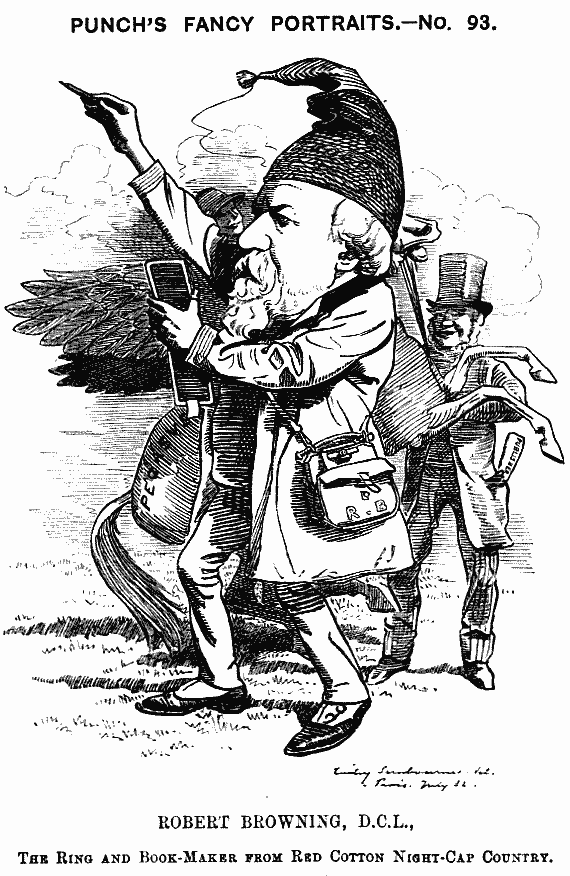
|
THE QUARTERLY REVIEW
VOLUME 118.— No. 235
July 1865.
BROWNING'S POEMS
BY
GERALD MASSEY.
___________
ART. III.—l. Dramatis Personae. London, 1864.
2. Robert Browning's Poems. 3 Vols. London, 1863.
|
 |
|
Robert Browning in Vanity Fair |
T a time like the present, when the tendency is for minds to grow
more and more alike, all thinking the same thoughts with the regularity
of Wordsworth's forty cattle feeding as one; when for a single original
poet, like Mr. Tennyson, we have a hundred tuneful echoes, and one
popular novelist has his scores of imitators, we think that a writer of
Mr. Browning's powers ought to be better understood than he is, and the
discrepancy lessened betwixt what is known of him by the few, and what
is thought of him by the many. He has qualities such as should be
cherished by the age we live in, for it needs them. His poetry
ought to be taken as a tonic. He grinds no mere hand-organ or
music-box of pretty tunes; he does not try to attract the multitude with
the scarlet dazzle of poppies in his corn; he is not a poet of similes,
who continually makes comparisons which are the mere play of fancy; he
has nothing of the ordinary technique of poetry; he has felt himself
driven, somewhat consciously, to the opposite course of using, as much
as possible, the commonest forms of speech. The language of his
verse is generally as sturdy as is the prose of Swift or De Foe.
Certainly these homely words are to be found in singular places, saying
strange things now and again,—many things not easily understood, and
many which good taste must condemn,—but the poetry is full,
nevertheless, of hearty English character. In his process of
thinking, he is the exact reverse of those writers who are for making
the most of their subject in expression. Mr. Browning can never
concentrate sufficiently.
The current opinion of his poetry, outside the circle of the
few who have thoroughly studied the subject, and met with their reward,
would be somewhat nearer the mark, supposing the poet had only written
his poem called 'Sordello.' That work has all the poet's faults,
and all the defects of his poetry. It has only a few of the
merits. Flung down, as it was, to make readers stumble on the
threshold of their acquaintanceship with a new poet, the obstacle has
remained in memory, and in the minds of many has influenced, if not
determined, their estimate of all that he has since written. 'Sordello'
has to answer for much of its author's lengthened unpopularity. It
revels in a mental motion swift as that of the Irishman who said with
him it was a word and a blow, and the blow came first. So with
'Sordello' we get blow after blow, and shock after shock, without
knowing what these are for. There is flash after flash of a
lightning energy, and all is dark again, before we have caught the
object that should have been illuminated.
The author certainly was not one of the 'serene
creators of immortal things' when he wrote 'Sordello.' It has not
the look of a finished poem. It rather represents the confusion of
the mental workshop, with the poem in the making and the poet hard at
it; the whole poetic process instead of the pure result. Even then
it sometimes looks as though the poet were tearing a poem to pieces, and
flinging the reader jewels by the lapful, rather than creating a work of
art, and giving his gems a worthy setting. The author may know his
own meaning, but it is not conveyed to us. Mr. Browning tells us
that there is little worth study in 'Sordello,' except the incidents in
the development of a soul. But for our part we cannot see how
'Sordello' the poet is evolved from the incidents of the story.
The inner life of the poet, and the outer movements of the history,
remain apart by hundreds of years; are never combined. The poetic
experience has much more of modern meaning than of ancient application.
Whatever the 'Sordello' of Italian story may have been, the poet of this
work has the mark of a nineteenth century creation. We hold the
poem to have been an imperfect conception, flawed from the first.
The author has, in the latest edition endeavoured to complete his work;
tried, as it were, to drop a keystone between the two sides of an
imperfect arch, by means of headlines to the pages, in spite of which
few readers will ever be able to cross the arch. Mr. Browning
will, after all, have to give up 'Sordello' to the rage of the irritated
reader, as Nelson gave up his Jacket when pursued by the bear, and rest
content with the knowledge that he is now safely past it by some
twenty-five years. He can afford to offer as a sacrifice that
serves a purpose a poem which was written by an immature dramatist, who
had strayed into narrative poetry by mistake, and erred in trying to
obtain certain modern reflections from an uncertain story of the past.
Next to 'Sordello,' which is an obstacle of the poet's own
making, the greatest hindrance to a proper appreciation of Mr. Browning
appears to us to lie in the critical treatment his poetry has hitherto
received. It has been dealt with just as though the writer had
been 'altogether such an one' as the rest of the poets of this century;
and half the objections that have been urged, half the faults that have
been discovered, really resolve themselves into a complaint that he is
not a subjective poet, but something quite different. Now the mass
of our nineteenth century poetry has been mainly subjective. Very
few are the characters in its whole range to which we could point
as uncoloured by the personality of the writer. We seem to have
lost the secret of the old dramatists, who could make plays that were
peopled with real human beings, and pour forth such a prodigality of
what we may call physical life. The objective poetry of simple
description, broad handling, and portraiture at first sight, seems to
have passed away with Scott. Indeed, it almost looks as
though in our time the poetic mind was divided against itself.
Instead of great poets, we have poets and novelists, the latter
employing themselves upon the rich range of human character, while the
former shut themselves up more and more in the special domain of their
own personal experience. Mr. Browning came at a time when there
was every likelihood that the excessive subjectiveness of our modern
poetry would lead to decay. He supplies a counter irritant.
He 'blows through bronze' oftener than through silver, a music
calculated to awake God Mars rather than 'serenade a slumbering
princess;' a 'medicated music,' as it was rightly called by
Elizabeth Barrett.
Mr. Browning is not one of those who can look upon men as
trees walking, and see all things through a misty glamour or a 'kind of
glory,' which is really a suffusion of self; not one of the
cloud-worshippers who, as Aristaphanes says, 'speak ingeniously
concerning smoke,' and who, in their inability to dramatise human
nature, are for ever endeavouring to humanise external nature, and
always paint it according to their special moods of mind. He
belongs to a robuster race of thinkers. His genius being dramatic,
he has to make his way to the heart of a character, conceal himself
there, and then, looking abroad through the eyes of the man or woman,
reveal their nature in their own speech. He is dramatic down to
his smallest lyrics. He is not present in person to help us in
making out his meaning. He cannot show us all he has to reveal,
from the describer's own personal point of view. We must be able
to reach many a point of view, according to the character of the
speaker. Let us quote an example of his way of working. Here
is a perfect little poem, entitled, 'My Last Duchess;' the scene is
'Ferrara,' and the Duke is the speaker.
|
'That's my last Duchess painted on the wall,
Looking as if she were alive: I call
That piece a wonder now: Frà Pandolf's hands
Worked busily a while, and there she stands.
Will't please you sit and look at her? I said
"Frà Pandolf " by design, for never read
Strangers like you that pictured countenance,
The depth and passion of its earnest glance,
But to myself they turned (since none puts by
The curtain I have drawn for you, but I)
And seemed as they would ask me, if they durst,
How such a glance came there; so, not the first
Are you to turn and ask thus. Sir, 'twas not
Her husband's presence only called that spot
Of joy into the Duchess' cheek: perhaps
Frà Pandolf chanced to say "Her mantle laps
Over my Lady's wrist too much," or "Paint
Must never hope to reproduce the faint
Half-flush that dies along her throat;" such stuff
Was courtesy, she thought, and cause enough
For calling up that spot of joy. She had
A heart . . . how shall I say? . . . too soon made glad,
Too easily impressed; she liked whate'er
She looked on, and her looks went everywhere.
Sir, 'twas all one! My favour at her breast,
The dropping of the daylight in the West,
The bough of cherries some officious fool
Broke in the orchard for her, the white mule
She rode with round the terrace—all and each
Would draw from her alike the approving speech,
Or blush, at least. She thanked men,—good; but thanked
Somehow,—I know not how,—as if she ranked
My gift of a nine-hundred-years'-old name
With anybody's gift. Who'd stoop to blame
This sort of trifling? Even had you skill
In speech—(which I have not)—to make your will
Quite clear to such an one, and say "Just this
Or that in you disgusts me; here you miss,
Or there exceed the mark;"—and if she let
Herself be lessened so, nor plainly set
Her wits to yours, forsooth, and made excuse,
E'en then would be some stooping, and I chuse
Never to stoop. Oh, Sir, she smiled, no doubt,
Whene'er I passed her; but who passed without
Much the same smile? This grew; I gave commands;
Then all smiles stopped together. There she stands
As if alive. Will't please you rise? We'll meet
The company below there. I repeat,
The Count your master's known munificence
Is ample warrant that no just pretence
Of mine for dowry will be disallowed;
Though his fair daughter's self, as I avowed
At starting, is my object. Nay, we'll go
Together down. Sir! Notice Neptune, though,
Taming a sea-horse, thought a rarity,
Which Claus of Innsbruck cast in bronze for me.' |
A slight examination will serve to show with what consummate art a world
of character is portrayed in that small poem. The person of the
speaker stands firmly full-drawn, as one of the portraits by Titian,
with their live eyes, and long beards, and black velvet dresses.
The proud bearing, together with the love of a proud bearing, the
indifference to shedding blood which had not the true-blue drop in it,
the gentlemanly way in which that 'matter of the murder' is delicately
implied, and the subject dismissed, as with a graceful wave of the hand,
for another passing glance at the bronze statue—the feeling for art
which sets the portrait above the wife, the painter's name over both—the
slight touch or two at which the dead face comes and smiles as in
life—all is done with the easy stroke of a master, and the verse, too,
is exquisitely modulated for its purpose, never pausing because it has
to rhyme its lines. From this quotation we may see how Mr.
Browning's poems have to be judged. They were not put together by
parts. Hence they are not to be enjoyed piecemeal. We cannot
point out that this is valuable for some deep thought or just
reflection, and another for a magnificent image. Each poetic
characteristic is merged in the human character which we find so
frequently unfolded with great fulness in a few lines.
These poems of Mr. Browning, which are dramatic in principle
and lyrical in expression, are not always easy to master. The poem
once presented, we get no help from the poet. He is only a dumb showman.
We have to work our way back from where the poet left off, and get to
the centre of the web, whence strike out all the rays of detail.
The complaint often made is that readers do not at once catch the idea,
which is the root of vitality to the poem. Now the question is,
not whether obscurity is a fault or not—we think it is a great fault,
and we should have thought Mr. Browning a much greater poet if he had
been free from it; but whether it is too much to ask one or two readings
of a few stanzas in order that something worth getting at may be
reached. Is it not well known that no true work of art with any depth in
it can be fathomed at first sight? that, as Bacon says, there is an
element of strangeness in all the highest beauty? The question is,
Is there something worth getting at in such poems? And we have to
answer emphatically in the affirmative. There may be difficulties
to unlock; but it is worth while to try to unlock them, for the sake of
the hidden treasure which they keep concealed. When we have
conquered, we are wealthier by a substantial gain. The result is
not like a pleasant ripple of emotion that passes away, or a mere play
of feeling, as with the subjective poem. We are the richer by some
new and original picture of life, of intricate character, of uncommon
manners, which has been almost engraved upon the mind by the process of
getting at it, and remains a possession for ever.
Another complaint is that Mr. Browning is unmusical.
But in every case we must first grasp the character before we can judge
of the fitness of the verse, or the quality of its music. The
music may not be our music, or Mr. Tennyson's music, or like anything we
ever heard in verse: that is not the point. The point is whether
the music and movement of the verse receive their impetus and government
in any sensible way from the character, so as to become its natural
expression. This we cannot determine until we know the character
well enough to be able to read the poem off at an unchecked heat, such
as may fuse all down into a music of a fit and efficient kind, that
could not be excelled for its purpose; which can only be done upon
acquaintance. It is often a very grave and difficult character
that has to be dealt with, and the smooth music and liquid lapse of
vowelled sounds which serve to convey mellifluous emotion would be
altogether inadequate to wrestle with the sterner strength. The
subjective lyric can wander at its own sweet will, and slip softly
through sunshine and shadow with pleasant murmurs for the dreamer's ear;
but the dramatic lyric has other work to do.
We think it quite probable that Mr. Browning has a peculiar
sense of music. He is, we have heard, an educated musician, and a
great lover of music. Indeed, we might learn this from his poems.
Now, it might be shown that some of the most melodious verse has been
written by poets who could not read music, or rather who put all their
feeling for music into their language, and the hidden quality has worked
more sweetly, perhaps because it was more a music of the spirit than of
the sense. Whereas the poet who could read music has sometimes
appeared harsh, crabbed, unequal, in the music of verse. With Mr.
Browning it would seem that his sense of music served to put into his
verse a greater use of accent than flow of melody; conducing to a kind
of
staccato mental notation in words; and that much of the
meaning in some poems was intended to be got at through this stress of
the
accent or dash of the notes. The whole poem entitled the
'Laboratory' would illustrate our remark. Here is one stanza:—
|
'He is with her; and they know that
I know
Where they are, what they do: they
believe my tears flow
While they laugh, laugh at me, at me fled to
the drear
Empty church, to pray God in for them!—I
am here! |
The accent serves to italicise the meaning in these lines.
It helps to make the music bite into the subject—so to speak—in a
most bitter way, corresponding to the feeling of the speaker. Then
the accent is often varied very suddenly, intricately, and is not
followed easily by the lovers of jog-trot verse and common metre.
The first two lines of the galloping ballad, called 'How they brought
the Good News from Ghent to Aix,' will afford us a brief specimen—
|
'I sprang to the stirrup, and Joris,
and he;
I galloped, Dirck galloped, we galloped
all three'— |
with their
sudden reversal of the accent in the second line.
Following out this cue we think it will be found that
the coarse, blunt, guttural sounds, and dogged stiffnecked movement of
the 'Soliloquy in the Spanish Cloister,' are characteristic; an
essential and effective part of the character, they aid materially in
embodying the imaginary speaker, as in the poem first quoted, the
supple, fluent movement, the low-toned suavity and colloquial case give
an insinuating grace of manner to the Italian Noble. Still the
question remains whether such harsh, abrupt sounds can be legitimately
introduced into poetry. We do not think them well suited to the
English language.
In his purely lyrical measures the poet appears at
times to tread a rugged path with lame feet, and it is not easy for the
mind of the reader to move to the measure. The music does not
meander. It is much more like a cascade that comes hurrying from
some far-off hill-top, leaping from crag to crag, and seems to split its
force in twain because of the haste with which it dashes at all
obstacles. Of this, however, we cannot judge apart from the
character of the speaker; we must distinguish before we are able to
divide the merits from the defects. Mr. Browning, in his dramatic
poems with a lyrical utterance, undertakes to do more than any lyrical
poet who ever lived. He writes under conditions hardly ever
attempted hitherto, and has given to the world many lyrics, dramatic in
principle, and lyrical in expression, containing a great amount and
variety of character. So that whatever flashes of lyric energy his
mind may be capable of kindling into, it is impossible for us to sum up
his lyrical power as we might that of Moore and Burns, who are all the
while singing their own sentiment or emotion, and have nothing else to
do! We cannot compare Mr. Browning's lyrics with those of any
subjective poet; he has called them Dramatic Lyrics for the very
purpose of distinguishing them from such. Nor may we judge him as
a lyrical poet by comparison with any subjective lyrist. We must
in both case appraise them on their own grounds; and if we applaud the
subjective lyrist because the movement of his verse felicitously
corresponds to the thought or emotion, then we must at least estimate
the fitness or beauty of the movement in the Objective Lyric by its
correspondence with the speaker's character, or the nature of the
action. If we were to judge the fine dramatic lyric entitled 'A
Grammarian's Funeral,' as we should a lyric of emotion set to its own
music, we should make little of it. We might probably think the
poet had gone to the extremest limit, out of the ordinary way, to
discover the most uncommon and uninteresting measure. But, let us
read it with an understanding of what is meant. It is the burial
of a man of learning who had toiled up through the dark to meet the
dawn; who was awake and working whilst the rest of the world were
asleep, or in gross darkness. He has done his work and shall have
a symbolic burial!
|
'Leave we the unlettered plain, its herd and crop;
Seek we sepulture
On a tall mountain, citied to the top,
Crowded with culture!
All the peaks soar, but one the rest excels;
Clouds overcome it:
No, yonder sparkle is the citadel's,
Circling its summit!
Thither our path lies; wind we up the heights:
Wait ye the warning?
Our low life was the level's and the night's;
He's for the morning!' |
So the bearers
chant as they carry up the corpse of the master, 'famous, calm, and
dead, borne on their shoulders;' and having reached the topmost height
they sing—
|
'Well, here's the platform, here's the proper place:
Hail to your purlieus,
All ye highfliers of the feathered race,
Swallows and curlews!
Here's the peak-top! the multitude below
Live—for they can, there.
This Man decided not to Live but Know—
Bury this man there?
Here—here's his place, where meteors shoot, clouds form,
Lightnings are loosened,
Stars come and go! let joy break with the storm,
Peace let the dew send!
Lofty designs must close in like effects:
Loftily lying,
Leave him—still loftier than the world suspects,
Living and dying.' |
Now, to our feeling, the movement of this verse is most dramatic, and
answers admirably to the character of the poem. It conveys a great sense
of going up-hill, and the weight of the burden,—together with the
exultation of the bearers, which gives them strength to mount; it
toils upward step by step—long line and short—best-foot forward,—and
altogether carries out the idea of a spirit that climbed in life, and a
burial that shall afford the dead rest at the effort's end, with his
resting-place in the pathway of the Morning.
We must understand the principles of Mr. Browning's
art, then, before we shall be on the way for interpreting his poems
rightly. A good deal of the difficulty in getting at them lies
here in the beginning. Next we must try to enter into the nature
of his genius, and its peculiar predilections. He has 'strange
far-flights' of imagination. He is fond of dwelling abroad, and of
working widely apart from the life and circumstances of our time.
He loves a gnarly character, or a knotty problem; a conflict that is
mental rather than emotional; and he has given full scope to his choice
at times in the strangest rhymes on record. He is not yet entirely
free from the mannerisms of 'Sordello.' Nor does he allow
sufficiently for the difficulties of his own conditions, and for those
of the reader in following him. Here, we think, is a grave fault
in art. But, what strikes us as one of the greatest drawbacks of
all, is this: that, whereas the subject selected, the character
portrayed, is often of the remotest from the common apprehension, it is
treated in a manner totally new to objective poetry. The objective
poets of the past dealt with their subjects in a simpler way, and more
in the mass. A few broad touches sufficed for their portraits; but
Mr. Browning will carry out the utmost fidelity of detail—painting in
all the minutiæ of a pre-Raphaelite foreground—whilst representing some
unfamiliar character, unknown scene, or rare circumstance. Thus
the matter may be recondite, the manner novel, and all the conditions
startling; the result is sure to be somewhat bewildering—especially at
first sight.
We shall meet with the same closeness of observation
and directness of description in the pictures of external nature.
There is a lunar rainbow in the poem of 'Christmas Eve,' which any one
who ever witnessed the phenomenon could swear to as drawn by a man who
had seen what he painted, and who painted what he saw. Suddenly
|
'The rain and the wind ceased, and the sky
Received at once the full fruition
Of the Moon's consummate apparition.
The black cloud-barricade was riven,
Ruined beneath her feet, and driven
Deep in the West; while, bare and breathless,
North and South and East lay ready
For a glorious Thing, that, dauntless, deathless,
Sprang across them and stood steady.
'Twas a moon-rainbow, vast and perfect,
From heaven to heaven extending, perfect
As the mother-moon's self, full in face.
It rose, distinctly, at the base
With its seven proper colours chorded,
Which still, in the rising, were compressed,
Until at last they coälesced,
And supreme the spectral creature lorded
In a triumph of the whitest white,—
A bow which intervened the night.
But above night too, like only the nest,
The second of a wondrous sequence,
Reaching in rare and rarer frequence,
Till the heaven of heavens were circumflext.
Another rainbow rose, a mightier,
Fainter, flushier, and flightier,—
Rapture dying along its verge!
Oh, whose foot shall I see emerge,
Whose, from the straining topmost dark,
On to the keystone of that are?' |
Of course a subjective poet might not have painted in this piercing,
keen-eyed way. He might have given us effects that should have
been produced according to our preconceived notions. He might have
brooded over the sight until it passed into memory with a sense of rest.
But Mr. Browning, in his imaginary person, saw a startling thing, and he
has reproduced it so as to create the precise effects in the reader's
mind that were felt by the startled seer, and not the conventional
effects which some people look for. He is describing of the
instant—the object itself; and not a dream of it. The truth is
that many persons, when they meet with a novel picture—something fresh
from nature, in poetry or painting—do not judge of its truthfulness by a
knowledge of, or reference to nature itself. They test it by what
they know of previous pictures in poetry and painting. If it be
unlike these; they are in haste to condemn it. If like what they have
been accustomed to, then it must be natural. Now, Mr. Browning's
work is the last to be judged in such a way as that. He does not
appeal to the second-hand knowledge of nature, but often to the very
rarest intimacy and clearest vision. Again, there is a great deal
of haze in current criticism with regard to poetry, which was first
breathed from the mind of Coleridge. Much of his criticism was
made to match the poetry of Wordsworth, in his exposition and defence of
the same. But the view which might be very just when applied to
Wordsworth, would do great injustice if forced on Mr. Browning and his
readers. In the one case it might shed a clear light, and in the
other only create a luminous mist. Coleridge would seem to
maintain that it is the true sign of greatness in poetry, indeed that it
is a part of the poet's work, to paint creation with an atmosphere and
tone out of his own mind; that in rendering objects he should seek for
the 'sense of something interfused,' and add it to what we see.
Mr. Browning would say, 'Let us have things first, their associations
afterwards. Let us reach the ideal through the real.'
Mr. Browning is, as we have already said, essentially a
dramatic poet. So long as he speaks through some clearly conceived
character we recognise the master's presence. When he speaks in
person, which he seldom does, he never quite reaches us or we him.
He has shown himself a skilful delineator of those conflicts in which
good and evil strive and wrestle for the victory, and noble spirits are
caught up in the tragic toils which death alone can loosen. He has
created characters intensely human, real enough to stir the profoundest
feelings, and exhibited them to us bound by the nearest and dearest ties
in that web of a bitter fate which is the dark delight of tragedy, which
loves to show us how they might be saved, even with a word, and we
cannot save them. The theatre would probably have unfolded more of
the theatrical part of his genius; he would have grown more in a
direction, toward the people, and cultivated such qualities as stir the
national feeling, instead of giving so great a range to those personal
predilections of his which cling to what is peculiar and problematic.
We should have seen less of the philosophic thinker, and felt more of
the emotional energy of the catholic poet. Likewise he would have
derived help from the actor, in giving a tangible embodiment to his
creations, and conveying to thousands of minds some personification of
those shapes of grandeur or of race which are now shut up in the pages
of a book. But we imagine that the theatre in our day is about the
last place Mr. Browning would care to be found in; and ever since he
wrote his plays the theatre and the poet have been pulling more widely
apart. The qualities that now-a-days win theatrical success are
precisely those which Mr. Browning has endeavoured to strain his poetry
quite clear of.
Howsoever unfitted for our stage his dramas may be,
many of the characters in his plays will take their place, and become
abiding presences on the stage of the reader's mind. There is 'Pippa,'
the Italian girl, a sunny little godsend, direct from heaven,
unconsciously touching the edge of other lives with a beam that flashes
through her own, and showing to the uplifted eye that 'God is in His
Heaven:' 'Luria,' the Moor, who can so magnanimously forgive a great
wrong: the 'Duchess Colombe,' who, like 'Pippa,' is one of everybody's
favourites: Poor 'Mildred,' with that
|
'Depth of purity immovable
Beneath the troubled surface of her crime': |
superb, haughty
'Ottima,' 'magnificent in sin:' 'Jules and Phene,'—and a long line of
characters that start into memory to show us how much we are indebted to
the poet, how greatly his art has enriched us.
If any one thinks Mr. Browning cannot enter into a
woman's, heart or paint the feminine character, let him especially study
the sayings and doings of the 'Duchess Colombe,' the latter part of the
'Plot on the Scutcheon,' and feel its ineffable pathos—the subtle force,
as of sun and rain on plants, which 'Polyxena' brings to bear on King
Charles, making the character grow visibly. The two
widely-different interpreters of the passion of love, who are at cross
purposes in the 'Balcony Scene.' There is not one of these plays
but contains fine characters and a great wealth of dramatic qualities:
whilst one alone, 'King Victor and King Charles,' would furnish proof
that the author possesses the secret of unfolding the character whilst
the action flows on continuously. We hardly know pathos more
piercing than that of the 'Blot on the Scutcheon,' pathos more grand
than that of 'Luria,' or pathos more passionate than in the 'Return of
the Druses.' Although it is almost as vain as trying to take a
dew-drop in hand, we extract a specimen of the latter. In the
closing scene 'Anael' has fallen dead, and her brother pleads with
'Djabal,' having a perfect belief in his supernatural powers to restore
her life.
|
'Save her for my sake!
She was already thine; she would have shared
To-day thine exaltation: think! this day
Her hair was plaited thus because of thee.
Yes, feel the soft bright hair—feel!
Just restore her life!
So little does it! there—the eyelids tremble!
'Twas not my breath that made them: and the lips
Move of themselves!
See, I kiss—how I kiss thy garment's hem
For her! She kisses it—Oh, take her deed
In mine! Thou dost believe now, Anael?—see,
She smiles! Were her lips open o'er the teeth
Thus, when I spoke first? She believes in thee!
Go not without her to the Cedars, Lord!
Or leave us both—I cannot go alone!' |
The conclusion
of this tragedy is splendid as some fierce sunset after storm. The
mustering of the dramatic forces, and the mustering of the 'Druses,' who
are 'bound for the land where their redemption dawns'—the words of the
dying leader who, with his last breath of life, leads them on the first
few steps of the way, and promises that he shall be with them, his
spirit will await them 'above the cedars,' see them return 're-peopling
the old solitudes;' the complexities of life made clear in death.
It is all exceedingly fine.
Mr. Browning has none of the humours of farce which the Elizabethans
supplied so plentifully, as sops to Cerberus, and which seem to have
been looked for in dramas ever since. But if he causes no horse-laughter
he has a contemplative humour of a rare kind. We should say that it is a
strong sense of the grotesque which caused him to take in hand several
of his singular subjects. See the curious poem entitled 'Sibrandus
Schafnaburgensis,' wherein the speaker describes the vengeance he
wreaked on a dry pedantic book which he had carried into the garden to
amuse himself with, and, seeing that Nature had nothing to do with
the inside, he left it to see what she would do with the outside of the
book.
Also in 'A Soul's Tragedy,' there is a comic creation
which is very droll. There has been a local revolution at Faenza,
as large as the little place could get up, and the Provost has been
killed. All is commotion when the Pontifical Legate comes trotting
quietly into the town, a portly personage on muleback, humming a 'Cur
fremuere gentes.' 'Ah,' he says to the populace, 'one Messer
Chiappino is your leader. I have known three-and-twenty
leaders of revolt!' and he laughs gently to himself. The way in
which he helps demagogues to 'carry out their own principles,' judges
'people by what they might be, not are, nor will be,' shows the leader
how not to change his principles but re-adapt them more adroitly,
turning him inside out softly as he might a glove on his hand, is
delightfully humorous. 'And naturally;' says the changing leader, 'time
must wear off such asperities (betwixt the opposite parties), the
bitterest adversaries get to discover certain points of similarity
between each other, common sympathies, do they not?' 'Ay,' replies
this humorist, full of smiling satire and wise insight, 'had the young
David but sat first to dine on his cheeses with the Philistine, he had
soon discovered an abundance of such common sympathies. But, for
the sake of one broad antipathy that had existed from the beginning,
David slung the stone, cut off the giant's head, made a spoil of it, and
after ate his cheeses alone.' Having quietly upset the revolution,
sent the leader to the right-about, put the keys of the Provost's palace
in his own pocket, he dismisses the populace to profitable meditations
at home with this finishing stroke to his homily:—
'You do right to believe you must get better as you get older. All
men do so, they are worst in childhood, improve in manhood, and get
ready in old age for another world. Youth, with its beauty and
grace, would seem to be bestowed on us to make us partly endurable till
we have time for really becoming so of ourselves, without their aid,
when they leave us. The sweetest child we all smile on, for his
pleasant want of the whole world to break up or such in his
mouth,—seeing no other good in it,—would be rudely handled by that
world's inhabitants, if he retained those angelic infantine desires when
he has grown six feet high, black and boarded: but little by little he
sees fit to forego claim after claim on the world, puts up with a less
and less share of its good as his proper portion,—and when the
octogenarian asks barely a sup of gruel and a fire of dry sticks and
thanks you for his full allowance and right in the common good of
life,—hoping nobody may murder him,—he who began by asking and expecting
the whole of us to bow down in worship to him,—why, I say he is advanced
far onward, very far, nearly out of sight, like our friend Chiappino
yonder. Good-by to you! I have known four-and-twenty
leaders of Revolt.'
Turning from the plays to the poems we find that a
large number of these are to be judged as the work of a dramatic poet
who has no stage. They are single-character pieces. The poet
has no aid from the actor, and we get no help in the making out from the
usual stage directions to the lookers-on, and from the shows and
circumstances of action. The poet has to dispense with the old
stage machinery. Also he has to rely more on the quick
apprehension of his readers. He requires that all their mental
powers be awake. To follow him fully in all his ramifications of
remote character the reader should be able to meet him halfway at the
outset. If it be a loss, however, for this writer to be limited to
dramatic fragments which have to be presented under these more difficult
conditions, he has his compensations. He is able to make points in
various directions where he could not have shaped out complete plays.
He can thus portray much that is of intense interest to us in our modern
days. There are dramas of mental conflict, such as could not be
shown on the stage in action; tragedies and farces that occur in the
intellectual sphere, as well as in the world of feeling, to be witnessed
by God and his angels rather than by men. Mr. Browning has taken
advantage of this liberty. He has thus given us such a daring
delineation of the struggles of some solitary soul, as we find in
Paracelsus; thrown off a most wonderful series of sketches and portraits
of character in attitude; produced things sometimes totally unlike
anything called 'poems' hitherto, but remarkable works of art
nevertheless. We allude now more particularly to 'Mr. Sludge, the
Medium,' and 'Bishop Blougram's Apology.' This dramatic latitude
has permitted Mr. Browning to indulge his taste for the untrodden paths,
his tendency to prefer such forms of character and such mental conflicts
as afford the more startling contrast, the swifter movement of thought,
the far-off foreign colour, showing everywhere the subtlest intuition in
following nature through some of her most secret windings. Also it
has allowed him free scope amongst his favourite subjects—painting and
music. He has portrayed the inner man and outer relationships of
characters, which in the hands of biography have so often lacked
interest because the life was uneventful. For example, if we turn
to that reproduction of the painter 'Lippo Lippi,' we shall see how he
has set before us, with his surroundings, the very man of a sensuous
southern soul, compelled to wear a shaven crown and a monk's serge
garb,—the merry eye twinkling from under the cowl,—the painter who so
conscientiously felt the 'value and significance of flesh,' doomed by
circumstances, and the monks, to be preached to in this style:—
|
'Your business is not to catch men with show,
With homage to the perishable clay;
Make them forget there's such a thing as flesh.
Give us no more of body than shows soul!
Why put all thoughts of praise out of our heads
With wonder at hues, colours, and what not?' |
The humour of the contrast is capital, and the painter, his art, the art
of his time, the local scenery, are all rendered with the most faithful
exactness. It has been pointed out with what truth Mr. Browning
writes of the Middle Ages being, as he is, always 'vital, right and
profound.' Mr. Ruskin remarks that there is hardly a principle
connected with the mediæval temper that he has not struck upon. He
says, 'I know no other piece of modern English prose or poetry, in which
there is so much told, as in these lines (the Bishop orders his tomb at
St. Praxed's Church), of the Renaissance spirit, its worldliness,
inconsistency, pride, hypocrisy, ignorance of itself, love of art,
luxury, and of good Latin.' The Bishop is on his death-bed, and he
has come to the conclusion that Solomon was right after all, and all is
vanity. So drawing his sons—if they be his sons, for he is not
sure that their mother may not have played him false—round his bed; he
gives directions for his sumptuous tomb which they are to erect in the
church. It must be rich and costly, and prominent enough for
Gandolf, his old dead enemy, who probably had his wife's heart, to
'See and burst for envy;'
and of
|
'Peach-blossom marble all, the rare, the ripe,
As fresh-poured red wine of a mighty pulse,
Old Gandolf with his paltry onion-stone,
Put me where I may look at him! True peach,
Rosy and flawless.' |
His epitaph must be 'choice Latin, picked phrase, Tully's every word'—
|
'No gaudy ware like Gandolf's second line—
Tully, my masters? Ulpian serves his need.' |
Then he will be able to rest in peace beneath his tabernacle amongst the
tall pillars, just in sight of the 'very dome where the angels live and
a sunbeam is sure to lurk;' there he can
|
'Watch at leisure if he leers—
Old Gandolf, at me, from his onion-stone,
As still he envied me, so fair she was!' |
The chief cause of the complaint which we hear, that Mr, Browning's
poetry is wanting in common human warmth and personal nearness,
undoubtedly arises from his genius being more intellectual than
emotional; and the intellect, unless drawn down, as it were, by the
heart, and made to brood in a domestic way, is apt to dwell aloof, and
remain remote. The higher the intellectual range, the larger and
more genial the humanity necessary to bring the poet home to the mass of
men. Impersonal as Shakspeare is, we do not feel that to be the
result of his remoteness from us. He is hidden by his nearness,
rather than lost in the distance. We lose him through
interfusion, not in isolation. He has passed into
invisibility. We feel his presence through his sympathy with his
subject. He floats the profoundest thoughts on a warm tide of
human feeling. He is able to waft us within reach of lofty
things—of all that may be uncommon with us, in virtue of his wealth of
those feelings which we share in common with him. Lack of this
human quality, which, like personal love, melts all barriers, fuses down
all difficulties, will for long, if not for ever, keep the poetry of Mr.
Browning an arm's-length farther from the popular heart. In
despite of this constitutional defect, however, he has shown a power
quite capable of moving the common human heart in portraying various
characters and conflicts of emotion. In addition to such proofs as
may be adduced from the dramas, there are certain little poems, special
favourites of ours, in which the intellect is more than usually
domesticated, and the poetry breathes the most fragrant warmth of
affection in the shyest of ways. One of these is a happy reverie
by the fireside, in which the husband looks back with brimming heart and
eyes to the hour—the very moment—when, 'at a touch of the woodland
time,' two lives—subtly as two drops of dew—closed together in one.
|
BY THE FIRE-SIDE.
'Oh moment, one and infinite!
The water slips o'er stock and stone;
The west is tender, hardly bright;
How grey at once is the evening grown—
One star, the chrysolite!
We two stood there with never a third,
But each by each, as each knew well:
The sights we saw and the sounds we heard,
The lights and the shades made up a spell
Till the trouble grew and stirred.
Oh, the little more, and how much it is!
And the little less, and what worlds away!
How a sound shall quicken content to bliss,
Or a breath suspend the blood's best play,
And life be a proof of this!
Had she willed it, still had stood the screen
So slight, so sure, twixt my love and her:
I could fix, her face with a guard between,
And find her soul as when friends confer,
Friends—lovers that might have been.
*
*
*
*
Oh, you might have turned and tried a man,
Set him a space to weary and wear,
And prove which suited more your plan,
His best of hope or his worst despair,
Yet end as he began.
But you spared me this, like the heart you are,
And filled my empty heart at a word.
If you join two lives there is oft a scar,
They are one and one, with a shadowy third;
One near, one is too far.
A moment after, and hands unseen
Were hanging the night around us fast;
But we knew that a bar was broker between
Life and life: we were mixed at last
In spite of the mortal screen.
The forests had done it; there they stood!
We caught for a second the powers at play;
They had mingled us so, for once and for good,
Their work was done—we might go or stay,
They relapsed to their ancient mood.' |
Another, entitled 'Any Wife to any Husband,' is a poem full of quiet
beauty and a most searching pathos. The subject is a dying woman,
or, at least, one who is gradually fading away—a true wife, who offers
up the last of her life in an incense of love for the husband. He
loves her, too; loves her with all manly fervour; would, if she lived,
love her to the end. This knowledge is sweet to her; but then,
measuring his love by her own great feeling, dilated to its present
height through nearness to death, 'this is the bitterness' to know that,
with all his truth and love, he will marry again when she is gone.
He thinks such a thing impossible, but she knows it will be. When
they loose hands, and she arises to go, he will sink; he will grope; he
will take another hand in his, and she must see from where she sits
watching—
|
'My own self sell myself, my hand attach
Its warrant to the very thefts from me.' |
See him—
|
'Re-issue looks and words from the old mint,
Pass them afresh, no matter whose the print
Image and superscription once they bore!' |
She thinks no
blame. It must all come to the same thing in the end. Back to her
he must come:—
|
'Since mine thou wast, mine art, and mine shall be,
Faithful or faithless, sealing up the sum
Or lavish of my treasure, thou must come
Back to the heart's place here I keep for thee!
Only why should it be with stain at all?
Why must I 'twixt the leaves of coronal,
Put any kiss of pardon on thy brow?
Might I die last and show thee!' |
How much the woman's wedded love transcends the man's, in ranges out of
sight! The poem contains a true statement of one of those facts of
life that make so much of the tragedy of the human lot, the pathos of
which is so intensely human.
Here, again, is a touching little 'interior' from
married life. There has been a quarrel, and, in the tearful calm
that follows, the wife steals closer into her husband's bosom with a
'woman's last word;' and, if women must have the proverbial last word,
they will seldom find one more apposite or beautiful under the
circumstances. The poem should be read slowly, the music being
helped out with thoughtful pauses, that are filled up with meaning:—
|
'Let's contend no more, Love; strive nor weep—
All be as before, Love,—only sleep!
What so wild as words are?—I and thou
In debate, as birds are,—hawk on bough!
See the creature stalking —while we speak
Hush, and hide the talking, cheek on cheek!
What so false as Truth is,—false to thee?
Where the serpent's tooth is, shun the tree.
Where the Apple reddens never pry
Lost we lose our Edens,—Eve and I!
Be a god and hold me with a charm—
Be a man and fold me with thine arm!
Teach me, only teach, Love!—as I ought
I will speak thy speech, Love,—think thy thought—
Meet—if thou require it—both demands,
Laying flesh and spirit in thy hands!
That shall be to-morrow, not to-night:
I must bury sorrow out of sight.
Must a little weep, Love,—foolish me!
And so fall asleep, Love, loved by thee!' |
At the risk of quoting lines amongst the best known of Mr. Browning's
poetry, we make room for these affectionate 'Home-Thoughts; ' being, as
we are, only too glad to catch the writer on English ground, where we
should like to meet with him oftener:—
|
HOME-THOUGHTS
FROM ABROAD.
'Oh, to be in England
Now that April's there,
And whoever wakes in England
Sees, some morning, unaware,
That the lowest boughs and the brush-wood sheaf
Round the elm-tree bole are in tiny leaf,
While the chaffinch sings on the orchard bough
In England—now!
And after April, when May follows,
And the whitethroat builds, and all the swallows!
Hark, where my blossomed pear-tree in the hedge
Leans to the field and scatters on the clover
Blossoms and dew-drops—at the bent spray's edge—
That's the wise thrush: he sings each song twice over,
Lest you should think he never could recapture
The first fine careless rapture!
And though the fields look rough with hoary dew,
All will be gay when noontide wakes anew
The buttercups, the little children's dower
—Far brighter than this gaudy melon flower!' |
|
HOME-THOUGHTS,
FROM THE SEA.
'Nobly, nobly Cape Saint Vincent to the north-west
died away;
Sunset ran, one glorious blood-red, reeking into Cadiz Bay;
Bluish mid the burning water full in face Trafalgar lay:
In the dimmest north-east distance, dawned Gibraltar grand and
gray;
"Here and here did England help me; how can I help England?"
—say,
Whoso turns as I, this evening, turns to God to praise and pray,
While Jove's planet rises yonder, silent over Africa.' |
Again, a
picture of life from the modern Italian point of view—
|
UP AT A VILLA—DOWN
IN THE CITY.
AS DISTINGUISHED BY AN ITALIAN PERSON OF
QUALITY.
'Had I plenty of money, money enough and to spare,
The house for me, no doubt, were a house in the city square;
Ah, such a life, such a life, as one leads at the window there!
Something to see, by Bacchus, something to hear, at least!
There the whole day long, one's life is a perfect feast;
While up at a villa one lives, I maintain it, no more than a beast.
Well now, look at our villa! stuck like the horn of a bull
Just on a mountain's edge as bare as the creature's skull,
Save a mere shag of a bush, with hardly a leaf to pull!
—I scratch my own, sometimes, to see if the hair's turned wool.
But the city, oh the city—the square with the houses! Why?
They are stone-faced, white as a curd, there's something to take the
eye!
Houses in four straight lines, not a single front awry!
You watch who crosses and gossips, who saunters, who hurries by;
Green blinds, as a matter of course, to draw when the sun gets high;
And the shops with fanciful signs, which are painted properly.
What of a villa? Though winter be over in March by rights,
'Tis May perhaps ere the snow shall have withered well off the
heights:
You've the brown ploughed land before, where the oxen steam and
wheeze,
And the hills over-smoked behind by the faint grey olive-trees.
Is it better in May, I ask you? you've summer all at once;
In a day he leaps complete with a few strong April suns!
'Mid the sharp short emerald wheat, scarce risen three fingers well,
The wild tulip, at the end of its tube, blows out its great red bell
Like a thin clear bubble of blood, for the children to pick and
sell.
Is it ever hot in the square? There's a fountain to spout and
splash!
In the shade it sings and springs; in the shine such foam-bows flash
On the horses with curling fish-tails, that prance and paddle and
pash
Round the lady atop in the conch—fifty gazers do not abash,
Though all that she wears is some weeds round her waist in a sort
of sash!
All the year long at the villa, nothing's to see though you linger,
Except yon cypress that points like Death's lean lifted forefinger.
Some think fireflies pretty when they mix in the corn and mingle,
Or thrid the stinking hemp till the stalks of it seem a-tingle.
Late August or early September, the stunning cicala is shrill,
And the bees keep their tiresome whine round the resinous firs on
the hill.
Enough of the seasons,—I spare you the months of the fever and
chill.
Ere opening your eyes in the city, the blessed church bells begin:
No sooner the bells leave off, than the diligence rattles in:
You get the pick of the news, and it costs you never a pin.
By and by there's the travelling doctor gives pills, lets blood,
draws
teeth;
Or the Pulcinello-trumpet breaks, up the market beneath.
At the post-office such a scene-picture—the now play, piping hot!
And a notice how, only this morning, three liberal thieves twere
shot.
Above it behold the archbishop's most fatherly of rebukes,
And beneath, with his crown and his lion, some little new law of
the Duke's!
Or a sonnet with flowery marge, to the Reverend Don So-and-so
Who is Dante, Boccaccio, Petrarca, Saint Jerome, and Cicero,
"And moreover," (the sonnet goes rhyming,) "the skirts of St. Pall
has reached,
Having preached us those six Lent-lectures more unctuous than
ever be preached."
Noon strikes,—here sweeps the procession! our Lady borne smiling
and smart
With a pink gauze gown all spangles, and seven swords stuck in her
heart!
Bang, whang, whang goes the drum, tootle-te-tootle the
fife;
No keeping one's haunches still: it's the greatest pleasure in life.
But bless you, it's dear—it's dear! fowls, wine, at double the rate.
They have clapped a new tax upon salt, and what oil pays passing
the gate
It's a horror to think of. And so, the villa for me, not the city!
Beggars can scarcely be choosers: but still—ah, the pity, the pity!
Look, two and two go the priests, then the monks with cowls and
sandals,
And the penitents dressed in white shirts, a-holding the yellow
candles;
One, he carries a flag up straight, and another a cross with
handles,
And the Duke's guard brings up the rear, for the better prevention
of scandals:
Bang, whang, whang goes the drum, tootle-te-tootle the
fife.
Oh, a day in the city-square, there is no such pleasure in life!' |
Notwithstanding that spirit of impatience to be felt in many of Mr.
Browning's pages, that tendency which we have admitted, to dart his
thoughts at us after the manner of these lines:—
|
'A shaft from the Devil's bow
Pierced to our ingle-glow,
And the friends were friend and foe!' |
or, to spring a
mine of thought in a moment, thus:—
|
'Me do you leave aghast
With the memories we amassed?' |
yet he has
given us poems in which the struggling forces have all blended in a
brooding calm. These are generally in blank verse, which does not
impose the difficulties of a more lyrical movement. One piece of
this quiet kind is a surpassingly beautiful picture of 'Andrea del Sarto
' and his wife; a twilight scene, full of the sweetest silvery greys.
It is twilight, too, in more senses than one. Twilight in the poor
painter's soul, whose love-longings bring him no rest; light up no
evening star large and luminous against the coming night. The poem
is sweet to sadness; the pathos of the painter's pleadings with the bold
bad woman whom he loved, and who dragged down his lifted arm, broke his
loving heart, is very touching. The evening hush, the twilight
tone, the slow musical speech, serve solemnly to lay bare the weary soul
and wasted life, and make clear the wreck lying below the surface, that
is trying so piteously to smile, with a cheery effort to love and labour
on.
There is a stately calm in the poem called the 'Strange
Medical Experience of Karshish, the Arab Physician.' Karshish is on his
travels, picking up the crumbs of learning, and he makes a report of his
discoveries in a letter to his master, Abib, the 'all-sagacious' in
medical art. But the real object of emptying his wallet is not to
show the curious spider that 'weaves no web,' the 'blue-flowering
borage,' the Aleppo sort, more nitrous than theirs at home, the three
'samples of true snake-stone,' or any other little rarities he may have
found. The secret truth is, he has met with one 'Lazarus, a Jew,'
and he wishes to report his case to the master; only, being ashamed and
bewildered at the hold which the man's story has taken upon his mind, he
approaches the subject in a stealthy way, and with windings truly
oriental. Of course the tale is despicable, still it were best to
keep nothing back in writing to the learned leech. He means only
to allude to it in an offhand manner; just skirt the edge of the
subject; but it fascinates him, and draws him into a whirling vortex of
wild strange thoughts which he cannot resist.
|
'And first, the man's own firm conviction rests
That he was dead (in fact they buried him),—
That he was dead and then restored to life
By a Nazarene physician of his tribe;
—Sayeth the same bade " Rise," and he did rise.' |
Such cases are diurnal, the master may reply. Not so 'this
figment.' For here is a man of healthy habit, much beyond the
ordinary; he is sanguine, proportioned, fifty years of age.
|
'Think,
could we penetrate by any drug,
And bathe the wearied soul and worried flesh,
And bring it clear and fair by three days' sleep!
Whence has the man the balm that brightens all?' |
He points out the effect of this trance on the mind of Lazarus, and the
way in which he takes up his after-life. This grown man now looks
on the world with the eyes of a child. He is witless of the size,
and sum, and value of things. Wonder and doubt come into play at
the wrong time, 'preposterously at cross-purposes.'
|
'Heaven opened to a soul while yet on earth,
Earth forced on a soul's use while seeing Heaven.
He holds on firmly to some thread of life
Which runs across some vast distracting orb
Of glory on either side that meagre thread,
Which, conscious of, he must not enter yet—
The spiritual life around the earthly life!
The law of that is known to him as this—
His heart and brain move there, his feet stay here.
So is the man perplexed with impulses
Sudden to start off crosswise, not straight on.
And oft the man's soul springs into his face
As if he saw again and heard again
His sage that bade him "Rise," and he did rise.' |
He works hard at his daily trade, all the humbler for the exaltation
that made him the proud possessor of such a secret.
|
'Sayeth he will wait patient to the last
For that same death which will restore his being
To equilibrium.' |
Some of his friends led Lazarus into the physician's presence obedient
as a sheep. He did not listen except when spoken to; he folded his
hands and let them talk, watching the flies that buzzed. And yet
no fool, says Karshish, nor apathetic by nature.
|
'This man so cured regards the curer then,
As—God forgive me—who but God himself,
Creator and sustainer of the world,
That came and dwelt in flesh on it a while!
And must have so avouched himself, in fact,
In hearing of this very Lazarus.' |
Of course, says Karshish, this is the raving of stark madness, and yet
here is a case before which science is dumb and made ashamed. What
is the fact in the presence of which he stands, and is touched with
awe?
|
'The very God! think, Abib; dost thou think?
So, the All-Great, were the All-Loving too—
So, through the thunder comes a human voice
Saying, "O heart I made, a heart beats here!
Face, My hands fashioned, see it in Myself.
Thou hast no power nor may'st conceive of Mine,
But love I gave thee, with Myself to love,
And thou must love Me who have (lied for thee!"
The madman saith He said so; it is strange.' |
The spell which this new fact, in the physician's experience, exercises
on his imagination, is most subtly and exquisitely portrayed. And
throughout, the character, so faithfully conceived, completely informs
the movement of the verse with its own spirit. We have no hurry,
no gasps of utterance, but a work perfect in manner as in matter, grave
and staid, the pauses answering to the pondering, and altogether fine in
expression as it is weighty in thought. This poem leads us up into
the highest range of Mr. Browning's poetic powers. He has the true
reverence for the Creator of all that beauty on which poetry is fed—the
clearest of all the seeing faculties—and recognises the Master of the
feast. His poetry, however, is not religious in a vague general
way, nor dry through being doctrinal: it is, as in 'Christmas Eve' and '
Easter Day,' passionately alive with the most intense yearning for a
personal relationship. In many places we shall find the influence
of the unseen treated as a solemn verity—the dark disc of this life's
orb edged with a touch of light from the next. But in the last-mentioned
poem the mystery of the Incarnation is pondered and proclaimed in the
most powerful way. In a 'Death in the Desert,' there is a close
grapple of thought with the Subject of Subjects. No one can
understand Mr. Browning's poetry without having fully examined these two
poems. The casual reader may possibly set the 'Christmas Eve' down
hastily as a strange mixture of grave matter and gay manner; a religious
subject loosely treated with quips and cranks of irreverent rhyme.
But this would be a mistake. The author has a sardonic way of
conveying certain hints of the truth when no other way would be so
effective. In this poem we have a contrast such as furnished a
hint of the true grotesque in art. But it is the work of a man
whose faith can afford the freaks of fancy.
The 'Death in the Desert' is one of Mr. Browning's finest
poems; a very lofty and solemn strain of religious thought. It is
evident that he takes great interest in the stir of our time, the
obstinate questionings of doubt, which will yet make the flame of faith
burn up toward heaven more direct and clear than ever. And he says his
say emphatically on the side of belief. It is a poem for the
profoundest thinkers, and yet a dramatic creation of exceeding beauty.
It embodies the death of the beloved Apostle St. John in a cave of the
desert, where he has been hidden from the persecution. This
chamber in the rock, a nestling-place of coolness and shadow, outside of
which is the blinding white sand, the 'burning blue,' and the desert
stillness, the waking up from his last trance to utter his last warning
words of exhortation to the watchers listening round, are all rendered
with impressive power. The dying man rises and dilates, 'as on a
wind of prophecy,' whilst in solemn vision his spirit ranges forward
into the far-off time, when in many lands men will be saying, 'Did John
live at all? and did he say he saw the veritable Christ?'
And, as he grows more and more inspired, and the energy of his spirit
appears to rend itself almost free from the earthy conditions, the rigid
strength of thought, the inexorable logic, the unerring force of will,
have all the increased might that we sometimes see in the dying.
We have no space left to touch the argument, but we should greatly
regret if the poem failed to be made known far and wide. After M.
Renan's 'Life of Jesus,' and the prelections of the Strasbourg school of
theological thought, it should be welcome as it is worthy.
In the course of our explorations and explanations we have
shown something of the poet's range, which is the result of peculiarity
as well as of power. He carries along each line of the radius
almost the same thoroughness of conception and surprising novelty of
treatment. We have also shown that the obscurity is not always
poetic incompleteness. It sometimes arises from the dramatic
conditions. In support of this statement we may remind readers how
much greater was the demand on their patience when Mr. Tennyson cast his
poem 'Maud' in a dramatic mould, than with his previous poems. At
other times it comes from the murky atmosphere in which the poet has had
to take some of his portraits in mental photography; the mystery of the
innermost life; the action of the invisible, which can only be
apprehended dimly through the veil. His genius is flexible as it
has been fertile. If he could have brought it to bear in a more
ordinary way by illuminating the book of life with traits of our common
human character, making the popular appeals to our home affections,—if
he could have revealed to the many those rich colours in the common
light of day, which have delighted the few in many a dark nook of nature
and desert-place of the past, he would have been hailed long since as a
true poet. His poetry is not to be dipped into or skimmed lightly
with swallow-flights of attention. Its pearls must be dived for.
It must be read, studied, and dwelt with for a while. The
difficulties which arise from novelty must be encountered; the poetry
must be thought over before its concentrated force is unfolded and its
subtler qualities can be fully felt. Coming fresh from a great
deal of our nineteenth-century poetry to that of Mr. Browning, we are in
a new world altogether, and one of the first things we are apt to do is
to regret the charms of the old. But the new land is well worth
exploring; it possesses treasures that will repay us richly. The
strangeness and its startling effects will gradually wear away, and
there will be a growth of permanent beauty. With all its
peculiarities, and all its faults, the poetry of Mr. Browning is
thoroughly sanative, masculine, bracing in its, influence. It
breathes into modern verse a breath of new life and more vigorous
health, with its aroma of a newly-turned and virgin soil.
There are plenty of poems for beginners. Simple lyrics like
the 'Cavalier Tunes,' brave ballads, and tender poems like 'Evelyn
Hope,' lead up to such fine romances as 'Count Gismond' and the 'Pied
Piper;' these again conduct the reader to a gallery of portraits in 'Men
and Women,' painted with the strength of Velasquez, the glow of
Giorgione, or the tenderness of Correggio. No one is forced to
plunge into the mysteries of 'Sordello' and get entangled there.
Curiously enough, the author in arranging his latest edition has printed
this poem last; the reader, if so minded, can reject it altogether.
The mass of poems is crowned, as we have stated, with noble religious
poetry, most suggestive and profound in thought, most Christian in
feeling.
We conclude with the latter part of the 'Pied Piper of
Hamelin.' The Piper had agreed with the mayor and magistrates, for
a thousand guilders, to clear the town of rats, had accordingly by his
music enticed all the rats into the Weser, where they were drowned, and
had been contemptuously denied his stipulated reward; whereupon he
proceeds to take revenge:
|
'Once more he stept into the street;
And to his lips again
Laid his long pipe of smooth straight cane;
And ere he blew three notes (such sweet
Soft notes as yet musician's cunning
Never gave the enraptured air)
There was a rustling that seemed like a bustling
Of merry crowds justling at pitching and hustling,
Small feet were pattering, wooden shoes clattering,
Little hands clapping, and little tongues chattering,
And, like fowls in a farm-yard when barley is scattering,
Out came the children running.
All the little boys and girls,
With rosy cheeks and flaxen curls,
And sparkling eyes and teeth like pearls,
Tripping and skipping, ran merrily after
The wonderful music with shouting and laughter.
The Mayor was dumb, and the Council stood
As if they were changed into blocks of wood,
Unable to move a step or cry
To the children merrily skipping by—
And could only follow with the eye
That joyous crowd at the Piper's back.
But how the Mayor was on the rack,
And the wretched Council's bosoms beat,
As the Piper turned from the High Street
To where the Weser rolled its waters
Right in the way of their sons and daughters!
However, he turned from south to west,
And to Koppelberg Hill his steps addressed,
And after him the children pressed;
Great was the joy in every breast.
"He never can cross that mighty top!
"He's forced to let the piping drop,
"And we shall see our children stop!"
When, lo, as they reached the mountain side,
A wondrous portal opened wide,
As if a cavern was suddenly hollowed;
And the piper advanced and the children followed,
And when all were in to the very last,
The door in the mountain-side shut fast.
Did I say, all? No! one was lame,
And could not dance the whole of the way;
And in after years, if you would blame
His sadness, he was used to say,
"It's dull in our town since my playmates left!
"I can't forget that I'm bereft
"Of all the pleasant sights they see,
"Which the Piper also promised me.
"For he led us, he said, to a joyous land,
"Joining the town and just at hand,
"Where waters gushed and fruit-trees grew,
"And flowers put forth a fairer hue,
"And everything was strange and new;
"The sparrows were brighter than peacocks here,
"And their dogs outran our fallow door,
"And honey-bees had lost their stings,
"And horses were born with eagles' wings:
"And just as I became assured
"My lame foot would be speedily cured,
"The music stopped and I stood still,
"And found myself outside the Hill,
"Left alone against my will,
"To go now limping as before
"And never hear of that country more! "
Alas, alas for Hamelin!
There came into many a burgher's pate,
A text which says, that Heaven's Gate
Opes to the Rich at as easy rate
As the needle's eye takes a camel in!
The Mayor sent East, West, North, and South,
To offer the Piper, by word of month,
Wherever it was men's lot to find him,
Silver and gold to his heart's content,
If he'd only return the way he went,
And bring the children behind him.
But when they saw 't was a lost endeavour,
And Piper and dancers were gone for ever,
They made a decree that lawyers never
Should think their records dated duly
If, after the day of the month and year,
These words did not as well appear,
"And so long after what happened here
"On the Twenty-second of July,
"Thirteen hundred and seventy-six:"
And the better in memory to fix
The place of the children's last retreat,
They called it the Pied Piper's Street—
Where any one playing on pipe or tabor
Was sure for the future to lose his labour.
Nor suffered they hostelry or tavern
To shock with mirth a street so solemn;
But opposite the place of the cavern,
They wrote the story on a column,
And on the great Church-window painted
The same, to make the world acquainted
How their children were stolen away;
And there it stands to this very day.
And I must not omit to say,
That in Transylvania there's a tribe,
Of alien people that ascribe
The outlandish ways and dress
On which their neighbours lay such stress,
To their fathers and mothers having risen
Out of some subterraneous prison
Into which they were trepanned
Long time ago in a mighty band
Out of Hamelin town in Brunswick land,
But how or why they don't understand.' |
|