|
HOGG'S INSTRUCTOR.
VOL. V.—JULY, 1855.
THE POETRY OF ALFRED TENNYSON.
BY GERALD MASSEY. |
|
'Poems by Alfred Tennyson'. Ninth Edition, 1854.—'The
Princess, a Medley.' Fourth Edition, 1851.—'In Memoriam.'
1850. London: Moxon. |
 |
|
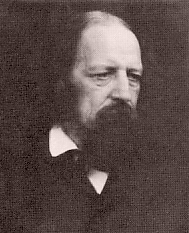
Alfred Tennyson
(1809-92) |
WAR and
Revolution are not those unredeemed evils which the peace-men would have
us believe them to be. The great, grim, terrible thing which appears to
tower up so darkly as an obstacle in the path of progress, may become
another Sinai, dreadful with the presence and eloquent with the voice of
the Almighty speaking his grand decrees in thunder and lightning,
and the terror of tempests. Rudely wakened from some voluptuous
dream, or suddenly called from the lighted halls of peace, we stand
looking out into the night, and, straining our eyes on the strife, we
hear the clang and tumult, the thunders and the shoutings, the cry of
the victor and the moanings of the wounded. War seems a fearful thing.
By and by our eyes become attempered to the gloom, and we perceive that
it has other aspects. Its lightnings often cleanse the moral atmosphere.
Its sword cuts clean through the flimsy draperies and hollow masks of
conventionality, sham, and artificiality. We get down to the ground-root
of things, and look in the unveiled face of the great Nature.
Fields may be heaped with slain, and mound and furrow
be red with carnage, but such seed is not sown in vain, and may produce
a worthy harvest in the after-years.
It is said of many young men who went out to the
Crimea, and who have seen the veil torn from the gorgon-face of Battle,
and been within arm's-length of death, that, though they left England as
thoughtless, vain, gay fops, they returned from that solemn experience,
sad, wise, earnest, valiant men. Even so is it with the life of
nations. War reveals what stuff they are made of, what endurance,
heroism, truthfulness, earnestness, is in them still; and, constituted
as man is, it is most necessary that these qualities be kept alive,
seeing that life is a continual combat, and it is well that the
battle-trumpet should rouse us from the pillow of sloth, the bent-knee
of slavery, and the all-fours of money-grubbing, into heroic attitude.
One of the best and most precious results of war, national struggles,
and the changes in religious, political, and social systems, is in the
new and vigorous life they give to literature. There the mortal
life lost by field and flood is caught up and rendered back to us
immortal by the hands of Poetry. What a tide of fresh life poured
through the heart of England after the mighty impulse of her
Reformation, and burst up in a new out-budding and flowering of poetry,
such as the world had never before seen. We also derive a
priceless heritage from the struggles of that handful of men who rose up
in England two centuries ago, and drew the sword for freedom, flinging
down the scabbard as a gauntlet of challenge at the feet of cowled, and
crowned, and mitred Tyranny. They gave to the nations a proud
flush of nobler life, a wider horizon to the whole human existence,
placed their country in the foremost van of the world, and left their
deathless names as watchwords that ring down far futures for the true to
battle by. That revolution gave us John Milton. It was
drowned in blood, but its ploughshare had cut deep, and its seed was
well sown and trampled in, and although each springing germ was watched
with jealous eyes and crushed in the budding, yet it struck deep root,
and sprang up in other lands beyond the sea. Scotland would never
have possessed her unrivalled wealth of national song, and her music so
unspeakably beautiful, but for her immortal traditions, her mountains
and glens, hallowed by the persecutions and martyrdoms of her
Covenanters; her heaths so often trampled by the footsteps of heroic
men, who marched to death as 'twere a bridal bed; her moors so often
reddened by the blood of the brave and chivalrous; the glorious men who
bore the Scottish thistle on banners bloody and torn through the burning
hell of battle in many a dark and desolate day, and kept the flame of
patriotism alive and unquenched amid the deluging rain of tears and
blood; the gallant hearts that have quivered on the rack, and cracked in
the furnace flame; the noble heads that have laid them down upon a
tyrant's bloody block for their last pillow; the deathless deeds that
have been done and written in the memory of men as in letters of
electric light;—these have been the inspirations that have made the
poet's song eloquent: The poetry was first written in deathless actions
before it became literature.
Of all the conflicts of arms and the societary
upheavings that have shaken the world in modern times, none have had a
more quickening influence on literature than those of the French
Revolution and the subsequent wars. The fountains of the great
deep of human life were opened, and the floodgates of tyranny were
burst, so that, when the floods subsided, the shores were rich with
jewels and treasures that had been surged up in the mighty motion of the
heaving waters. Men's hearts leaped: and burned within them as at
the sound of the trumpet of God, their eyes glowed with the light of
some great future, and through delicious tears they caught a glimpse of
a truer existence. There was such a surging of spirit, such a
quickening motion of mind, as much was felt in one year as would take
half a century to express. After a long night of starless gloom,
and servile trembling, and growing misery spent in feeble thought and
foolish fears, with a feeling akin to that of Lazarus waking within his
tomb, came the morning of action, motion, health, life! Then
followed the tug of grappling armies, and the nations were cast into the
fiery furnace of War. The ties and fears, the bonds of falsehood
and deceit, that had so long fettered the great human heart, were
withered, and burst. The tinsel, and the glitter, and the
masquerading habits are consumed utterly there, and nothing stands the
flaming ordeal save the naked strength of iron manhood.
Such times bring us face to face with what is
genuine; human life passes through its snake-like crises, in order that
it may slough off its worn-out, dirty, rotten coating, as the snake gets
rid of its skin. Artificiality cannot live in the presence of such
terrific earnestness; sloth cannot drowse in such a noise of combat;
imitation cannot compete with such primordial originality; and thus
literature benefits, and reaps a rich harvest from the fields of war.
In all these great eras it is the People—the great source and resource
of poetry—who, having held their peace so long, come forth to write
their poetry in sword-dints and strange hieroglyphs on the face of the
earth. What poetry there must be among this same People, to judge
by such sublime specimens, if we could but get at it!
If our monetary national debt, incurred during the
wars with France, be great, our national debt to poetry is still
greater. As our poetic outcome of that time, we have the following
magnificent result: Coleridge, Wordsworth, Byron, Shelley, Hunt, Keats,
Campbell, and Tennyson, not to mention others. These could never
have existed, as we now know them, but for the stirring circumstances of
the times in which they were moulded. Great times, great thoughts,
great feelings, produce great men, and these gave us a race of Titans.
Wordsworth has pictured the influence which the dawn of the French
Revolution had upon him. So has Coleridge. Byron was
begotten by the very spirit of Rebellion. Shelley's early poetry
was the French Revolution adapted to English verse. It is to his
martial lyrics, which are a fit chariot of song for the spirit of
British valour to ride in, flaming through the battle-field on the
wheels of conquest, and driving over the heads of its enemies, glorious
as a god, that Campbell owes his immortality. Not so manifest in
the poetry of Keats and Hunt is this influence, but very manifest in
their politics and in their lives, and their poetry is the issue of
their lives. It is less perceptible still in the poetry of
Tennyson; he is farther away from the scene, and the spirit of it did
not enter so much into his composition. Like a stone plunged into the
water, did that influence strike down into the existence of the former
poets, widening the circle of their whole being. In Tennyson we
have the distant and gentle ripple, with nothing of the tumult.
Nevertheless, he is one of the brood of giants who stepped into life
through the rent of Revolution, although he is in the second generation.
He is also related to his predecessors by his subjectivity.
The mention of this characteristic of the poetry of our century—its
subjectivity—as compared with the poetry of the Elizabethan era,
naturally leads us to a consideration of its causes.
Those grand fellows who lived and wrote in the golden
time of Elizabeth, appear to have been much more unconscious than our
brooding, thoughtful, modern mortals. They seem to have gone about
their work 'like noble boys at play.' The pressure of the time did
not lie heavy upon them as it does upon us. The national life was
up at 'glory's high flood-mark,' and they were borne on a tide of
triumph, buoyantly, hopefully, and cheerfully. England towered up
proudly amid the surrounding nations, like Saul among his warriors, a
head and shoulders above the rest. It was a proud thing to be an
Englishman in those days. To be heroic was a natural sort of
thing. Life was so strong within them, so enjoyable without.
They were brimful of physical health. The sheath of the body was
not overworn by the sword of the mind. Their thoughts were not
dammed up, nor the tides turned back upon their own souls. They
lived, and did not speculate on life with a morbid persistency, or lie
and watch the lazy stream of their own blood, poring on their own pulse,
and eating their own heart. They lived. They lived and they
wrought free and forcibly, even as the bird sings, and the waters roll,
and the wind blows, careless to know the wherefore, or analyse the law
that inspired. The great, enduring result seems to have flashed
out of their lives with a magical unexpectedness, doubtless as
surprising to themselves as to us. Genius thus freely and
naturally flowed forth in objective forms. The poet's nature ran
outwardly to embrace the universal humanity without let or hindrance.
Happy men! glorious time!
It is widely different with the poets of our century.
Poetry in our time is a continual protest against the pressure of
tendencies adverse to the full and free human development. She
fights a continual fight, disputing the ground inch by inch, with the
blind brute forces, with all kinds of tyranny, with all kinds of
scepticism and mammonism, which seek to encroach on her fields, and
commons, and wood-paths, and holy consecrated ground. She feels
somewhat like that criminal who was shut up in a prison, the walls of
which grew narrower day by day, until they closed in upon him and
crushed him. The force of circumstances which we have thrown up
around us is fast crushing all spiritual force out of ourselves.
The laws of mechanism lie on us like a mountain, and we have not the
faith that moves mountains and works miracles. Our lives are spent
in the search for what is immediately useful and practical; and should
the gods chance to come our way, we are not at home to spiritual
influences.
Our poetry is a protest against all this, and many
are the influences that re-act upon the poet, and concentrate his nature
within itself, and thus tend to make his thought and its utterance
subjective. It matters not in what position of society a poet may
have been born into our century, it is inevitable that he be subjective.
There may be infinite differences in the mode of manifestation. At
one time it is Campbell protesting against the brute power of wrong; at
another, Shelley shrieks his anathemas against priestcraft and
kingcraft. Now it is Byron striking with the naked energy of
desperation at the perplexing problems of life, individual and national;
again, it is the voice of Tennyson we hear soaring triumphantly above
the long agony of doubt, soothing as that of a sister leading the
bewildered mind out of the burning trance of delirium. The effect
of political persecution, of adverse criticism, of a generous desire to
fight the quarrel of others personally; these are all conducive to the
modern poet's subjectivity. Thus we find that the subjectivity of
our poetry is representative of the time and the circumstances that
produced it, as was the objective drama of the times of Shakspere.
In Tennyson this subjectivity has its culminating point. In him,
as has been well said, poetic inconsistency attains consistency.
He comprehends the best elements of his predecessors, together with an
added strength, grace, and beauty. His genius pours itself, as it
were, like
oil upon their troubled waters. He has attained a clearer calm.
He brings in the crowning dainties of that great poetic banquet which
has been spread before us during the past half-century.
The growth of Tennyson's mind and fame, like that of
all great things and enduring results, has been slow, gradual, and
certain. It took twenty years to produce what he has given us.
And looking upon these three books of poetry, we cannot but pronounce
them one of the most precious contributions ever added to poetical
literature. We look upon Alfred Tennyson as one of the greatest
poets of our century, and one of the very noblest that ever lived.
Not that he is the equal of Homer, Shakspere, and Dante; he is not a
great whole, so much as a brilliant, perfect part; but he is one of the
most nobly pure, one of the most exalting of poets. He gives
expression to the most ethereal sense of intellectual beauty in both
woman's and man's nature—or rather of the woman's in man. And this
delicate sensitiveness is united to a stern strength of thought, both
when he deals with nineteenth-century experience, or bears the burden of
the other world on his shoulders. His poetry is always the inmost
essence of the thing. Compare it with that of Wordsworth and Byron
in this respect, and you will find that, while they are content to take
first thoughts, and write down anything that comes, and consequently
have heaps of tares amid the harvest of their verse, his needs no
weeding, and will admit of none. He has jealously selected only
the choicest of his thoughts, and has exercised the most severe
censorship in choosing. It is the subtlest spirit of poetry which
he gives shape to, and robes in immortal beauty. He is the
exponent of some of the loftiest life and the deepest thought of our
time. Of all others, he most reveals the poetic spirit to itself;
hence all our young poets are Tennysonian. Then he is one of the
perfectest artists that ever wrought in verse, and one of the cunningest
masters of melody. In his poems all is in keeping, nothing
superfluous; all is necessary, and nothing accidental. There are
no jewels scattered at random, as if to show his wealth; all are fitly
set. All his pictures are appropriately and exquisitely framed,
and there are no unfinished sketches, no frescoes, daring in aim, and
feeble in execution. He will mark a distinct era in English poetry
far more effectually than ever Wordsworth will, when the world looks
back in the lapse of centuries.
At the outset, Tennyson made some slight return to
the old worship of word-mongering, which Wordsworth aimed at destroying.
And there is a soul of beauty in some words, which gives them a greater
charm than the thought they are intended to symbolise, even as the
beautiful form and winning lineaments of woman may at times eclipse the
charms of her mind; and this often dazzles and misleads the young and
inexperienced; they are borne away, aim at being too rapturous, and
become magniloquent, which is a false strength. The most profound,
equally with the most delicate thought, can be most fittingly expressed
in the simplest Saxon words. But this was soon cured, and in his
later poems he has scarce a rival in choiceness of diction.
It was a profound saying of Goethe's, and worthy of
universal acceptation, that the eyes can see only just so much as they
bring with them the faculty of seeing. Thus, a sunset sky seen
through the vision of a Turner, and transmuted into a picture, with all
his sparkling light, glory of colour, and rainbow richness of mingling,
shifting, cloud-swaling beauty, may be unappreciated by the mass of men,
as not akin to their ordinary sunsets—the painter having seen and
brought away more than they can identify; their mental vision being so
dim, his so clear and deep-piercing. Thus the lover, because of
his love, sees a beauty in the face of his beloved which none other may
have ever seen—the eyes seeing only that which they bring with them the
power of seeing. And thus it is with our seeing from the loftiest
outlooks of the soul. In reading, we only appreciate that which
yields us our written experiences; all beyond is blank to us, save that
we sometimes apprehend a dim something which is the motion of the
feelers being put forth by new growth. To understand more, we must
widen and deepen our natures by further experience and larger life.
This is why shallow poetlings, who have not an atom of creative power,
not a thrill of divine inspiration, yet fill their measure of experience
for the million, and are popular; while the great poet Tennyson, with
his loftier revelations of beauty, his wondrous dower of the 'vision and
the faculty divine,' his exquisite melodies, his great mind, which is a
glorious temple of thought, filled with heroic, rare, and most lovely
statues, wrought by the cunning hands of an imagination, sweet, subtle,
and strong as Raphael's, is comparatively unknown to them, or known, in
some dim wise, to be 'obscure.'
Many persons profess to see little in Tennyson.
This we can only regret for their sake. Perhaps they have not the
power of seeing what is in his poetry, they may have little in common
with him, no chord in harmony with his harp, which can vibrate to its
sound because in perfect tune. But they had far better pray for
more light, than go about preaching their own blindness. Others
are very fond of Tennyson, but think he is sometimes vague and obscure.
One of these latter urged to us in proof, that half-a-dozen different
readers will construe half-a-dozen different meanings from particular
passages. This is quite true, for we have found it so in reading
'In Memoriam' with others; nevertheless, instead of proving an obscurity
of utterance, this appears to me to prove that in each particular
instance the poet had dug up one of those gems of eternal truth which
may be six-sided, and capable of mirroring the readers' half-dozen
individual portions or interpretations. When I read an author, and
find I do not follow him deftly, and catch his meaning easily, I
attribute it to my own want of understanding, rather than to his
obscurity, especially if I have faith in him (which faith is the result
of my having found my method of reading the obscure passage again and
again to be successful); and it is astonishing how that which appeared
at first vague, and hazy, and nebulous, grows by fine degrees into
stars, and clusters of stars, with the 'further lookings on,' as the
vision gets more intense. Tennyson is never vague in expression—the
thought may be distant, the matter remote from us, the expression may be
involved, but it is never vague. He always knows what he wants to
say, and says precisely that which he meant to say. He is too
great an artist to daub and make confusion. The stream of his
speech may be deep, perhaps unfathomable to some, but never will you
find it muddy; you may make it so by your own splashings and
flounderings. 'But,' it is objected, 'poetry ought to be plain to
all, and it is the poet's first duty to make himself understood.
We can understand Shakspere and Burns; they are clear enough; is
Tennyson greater than they?' Not greater, but different. The
conditions demanded of a lyric that may be sung in a tap-room, and a
drama written to interest an audience of the Globe Theatre, are
different to those demanded of an 'In Memoriam.' In the one case,
we have the poet's genius diffused through a variety of characters, or
voicing a sentiment common to all, for artistic purposes and ends.
In the other, we have the poet hymning his own high thoughts, his far
imaginings, his subtle instincts of beauty, his self-questionings, his
visions seen from the altitude of his poet's nature, and nine out of ten
of the human beings represented on the stage with the interest of action
may come nigher home to our business of life than the lofty musings of a
poet who sings with a self-introverted eye of his own unspeakable love
and sorrow. In the one case, it is broad human nature appealing to
broad human nature; in the other, it is the poet's nature appealing to
the poet's nature in us, and we can only respond in so far as we possess
the nature of the poet. This, of course, narrows the popularity
and appreciable influence of the subjective poet. I say
appreciable, because you cannot gauge the influence of Mr Tennyson by
any reference to the sale of his books; he is one of those men, few of
whom are in the world together, and who are the fountainheads of
thought, in relation to whom the mass of writers are the digestive
organs that take in their food and circulate its new life through the
great body of the people.
Another will urge that he has done nothing like
'Festus,' or that terrific originality, 'Death's Jest-book.' Thank
Heaven, he has not; one of each kind was quite enough for us. We
have to judge Tennyson by what he has done, and what he is, and not
blame him for what he has not done, and is not. Tastes differ:
some prefer one poet, some another. It may be remembered that,
when a singing-match was about to take place between the nightingale and
the cuckoo, the donkey was chosen for an umpire. Long-ears, having
listened attentively until the contest was over, gravely gave his
decision:—the nightingale sung very well, said he, but for a good plain
song he preferred the cuckoo. So much for difference of taste and
judgment. Another argues that Tennyson lacks passion and
earnestness. Nay, not so; only he does not often let you see him
in a passion, or hear him cursing in it. Noble passion he has, but
he does not pour it forth while effervescent or in ferment, and
therefore mixed with dregs and lees. It has to pass the clarifying
process of his judgment, and ripen into spirit under the influence of
his imagination. Strong feeling merely would not set him singing;
he does not get his inspiration from a tumult and a tingling in the
blood; not until these are transfigured in the 'light that never yet was
seen on sea or land,' would he break silence. It is his colossal
calmness, the absence of blind hurry, that is often mistaken for a want
of passionate earnestness. That he has passion, even in the
popular sense, is shown by 'Locksley Hall;' and that he has terrible,
bitter earnestness, is shown by the 'Vision of Sin;' but these elements
he would now look upon as the raw materials of poetry. Let us take
him as he is, and for what he is. One great function of the poet
is to give expression to the beautiful, wheresoever he may find it—to
give a voice to that dumb Spirit of loveliness, and harmony, and truth,
which haunts us everywhere, seeking an interpretation of her dumb show.
And surely it is a good thing to get beauty into our souls, and into our
lives; and surely he does well who translates a single page of this
precious language.
Tennyson's poetry is a very world of beauty—a weird
world of wondrous beauty. Calm and smiling it rises out of the
vexed and stormy ocean of our century, all fair as Aphrodite clad in her
supernal loveliness. Wordsworth's world towers up grandly as after
the deluge, full of strength and majesty, bearing the poetic ark on its
shoulders. A look of eternity is in its aspect. Healthy, healing
waters spring from its sides, which are not so barren as they appear at
a distance. It has habitable pastures, inspiring breezes, that
blow a rose of dawn in the face, and spots and colours of beauty, that
make the eyes brighten and the heart glad. Shelley's fronts the
skies, like the Alps of a sphere where no snow falls, and frost is never
known; so fantastic, yet aspiring, are the forms into which its beauty
runs and leaps. At times they are half-shrouded with a faint, fair
mist, through which veil their loveliness looks dim and more divine; and
again they are lit and flooded with auroral hues and unimagined
splendours. Their sides are clothed with rainbows of bloom, and
are musical with singing birds, and falling waters, while at their base
are deep, tangled, haunted wildernesses, to lose yourself in which is
far pleasanter than finding yourself in almost any other place.
Byron's world is a volcano not yet extinct. How it glared on us
through the night of the past, like the dwelling-place of some fiery
demigod, vivid as the pinnacle of that hall in Dante's hell, glowing red
hot through the gloom. And still, to many eyes, does it soar in
its terrible beauty, grand as a midnight conflagration. 'Festus'
is a sort of hell in harness, with the devil driving. Keats' world
is a body of physical beauty, with a soul of sensuousness, and it floats
in a sea of 'rich and ripe sensation:' a world where Pan is deity, and
all life lies as in infancy, or drunkenness, sucking nectared sweets
from the bosom of the air. Birds sing dainty love-ditties, flowers
bloom and blush for very deliciousness of pleasure, fruit ripens, and
becomes the Hebe of appetite out of merry wantonness, and woos you with
a smile that says how much it could reveal: and human life thoroughly
enters into the life of tree, and fruit, and flower. You lie still
in a dreamy reverie, with half-shut eyes, aching all over with
satisfaction, lulled as in lotus-land, and only wake up to a fresh
banquet of beauty, and to be kissed back into a languorous oblivion by
the soft, warm pressure of the superincumbent air.
But Tennyson's world is like that other fairer,
better, purer world of beauty, of which we get brief glimpses from the
delectable mountains of imagination. It lies somewhat nearer
heaven. The coarse and robust nature will have to mount to its
topmost window before it can get a peep at it. The sensual will
have to cast their goat-hoofs, and get wings, before they can touch its
holier ground. To those who see nothing in nature but a producer
of corn, coal, iron, and wood, nothing in the sun but a time-piece,
nothing in the ocean but a beast of burden, the sum of whose lives is
getting and spending—to them it is an invisible world. But others
will see in it a real and divine possession; a world where the mortal
meets with the immortal; a world enriched with the presence of shapes of
the subtlest loveliness, and most royal souls, which are the ministrants
in this house Beautiful—or rather, world of beauty. There we hear
voices which have the 'large utterance of the early gods,' and see the
loftier spirits of the past move with their grandly solemn pace. There
is
|
'Music, which gentlier on the spirit lies
Than tired eyelids upon tired eyes,' |
there the most delicate aromas of
poetry impregnate the air, and make it breathe like that of paradise.
The beauty, the balm, and the bloom of sensuousness are spiritualised,
by being exalted to a loftier altitude. The light that lies on the
face of that world is not a coloured light, but a white radiance; for
the red flush of passion is not known, and beauty has found a more
ethereal expression in that serene region: it is a soft subdued light,
like the tender glory of moonlight, or the placid smile of affection on
a loving countenance that is pale with the intensity of its love.
Here you may get interpreted those strange hints that visit the mind in
its mystic moods and high imaginings, and everywhere will you feel the
'spirit of the years to come, yearning to mix itself with life.'
Altogether, as we have before said, the poetry of Alfred Tennyson
constitutes a world of exceeding loveliness, a world of peculiar beauty,
unique in all literature. His poetic luxury is so refined and
delicate, it requires an educated taste to appreciate it, just as some
wines do; it is never animal, never of the earth earthy, never of the
flesh fleshly. It could never have been produced by any one
possessed of exuberant animal spirits, and ruddy
flesh-and-blood-fulness. When his verse 'trembles and sparkles as with
ecstacy,' it is intellectual, and not a dance of the blood. Love
with him is passion hallowed, sublimated, and consecrated. He has
none of the fire, the rapture, and the consumption of Byron. He is
the poet of a nobler and loftier life. In this respect, we would
make the success of his poetry the gauge to show how far the world is
advanced in purity, love, and spirituality; just as we would take that
of Byron to show how far it is gross, animal, and fleshly. No
doubt Byron would poll the larger number of votes—so much the worse for
poor humanity. But, in proportion as we grow less material, and
more spiritual, more fitted to apprehend the perfect beauty, does Byron
die out, and Tennyson dilate upon our growing perceptions. And
after that grand debauch with the fire-waters of Byron, which we look
back upon, how pure, how fresh, and sparkling with health is the poetry
of Tennyson! It is a slow process the transformation of the
material into the spiritual, but in proportion to this change must the
poetry of Tennyson win its widening way with the world; and he can wait,
for he has built upon foundations which are neither local nor temporary.
The great poet has in a great measure to create his
own audience. There have been those who have been popular in their
own time; but, even with these, it was not always their highest
qualities that were so immediately appreciated—they had to wait for the
growth of intelligence, and the elucidation of time. Others, who
have been great in some special direction, and whose poetry has
possessed, in a smaller proportion, the elements of universal
popularity, have had to bide their time, which has often tarried long.
The dramatist and the lyrist have the greatest chance of immediate
popularity, because they deal more especially with human passions and
feelings, which are the common property of all; and this constitutes a
ground on which both unintellectual and intellectual may stand.
Indeed, the greater the dramatist or lyrist, the greater the certainty
of being popular at once and for ever. Let the sentiment be
genuine and the expression direct, and they will reach the heart of the
most uneducated. It is different in the cases of poets like
Wordsworth and Tennyson, who work in poetry's special domains, and not
in her common pastures. They are partial poets, and can never
compete for popularity with the universal, like Shakspere and Burns.
It is the same to-day as it has been in the past:
seldom that the great poet obtains immediate recognition. He alway
transcends, and can never be gauged by, the standard of current
criticism. We call for the poet of our own time, but we should not
know him were he in our midst. We look for a peculiar sign, and
lo! there is no sign. We map out a programme of what he should be,
and of the work he should do, and it comes to pass not so, but the
'reverse of so.' We ask for a man who shall not be like ourselves,
but something different, and behold! he is most like unto us—most human,
and being most human, is most divine. We expect him to come into
the world with the pomp and pæan that may attend his departure. We
anticipate him wearing his crown and singing-robes, but he toils on in
secret, painfully climbing the ascent necessary for the poet's vision,
and in joy and sorrow, hoping, despairing, and triumphing, weaves the
prophet's mantle out of the threads of a many-coloured life. He is
far on in advance of us, and 'dwindles in the distance;' we can only get
from him, and of him, what he leaves us by the way. And the world
only sees him in his just proportions, when he has planted his tired
feet on the mountains of Immortality, and stands glorified with a finer
light, and is seen through the mist of worshipful or regretful human
tears.
One of the pleasantest thoughts that arises in
reviewing the poetry of Alfred Tennyson is, that he is not one of the
illustrious departed, but still among us, and still a comparatively
young man not much above forty years of age. We may hope for yet
greater things from him. The interesting event of marriage has
taken place since he gave us 'In Memoriam,' consequently we may look for
a growth of poetry gathered from a novel world opened up in his nature.
There is nothing like the sweet influence of a noble woman for
quickening and enriching a poet's genius. He has also a young
family springing up around him, and putting forth their green leaves and
tender blossoms about the parental stem—another fine source of
inspiration: we never live truly, until we live our lives over again in
those of our children. But, with a prayer that blessings be
showered upon him, as he tends his garden of beauty, and rears fresh
crops of poetry, we must turn to that which he has already written.
We have heard Tennyson called a dainty poet of the
drawing-room; and some have the idea that he is a 'beautiful' poet, in
the boarding-school-miss sense of the word. All such know him not.
The grasp of his intellect is strong as its apprehension is fine.
For a specimen of magnificent power—of 'strength reposing on its own
right arm'—take his 'Ulysses.' No piece of sculpture was ever dug
out of Greece more perfect, no picture was ever more truly informed with
the spirit of antiquity. There is a majesty about it as of
the early gods, that loom upon us so large and lovely through the
dawn-light of time. It has a colossal calm as of 'magnificence
dreaming.' What sweet serenity! what pearl-like purity! what
solemn grandeur! what sustained music! attend it, and convey it, like
some newly-discovered god of wisdom, from Greece right home to its in
England.
It is a great mistake to think that anything Tennyson
gives us is meaningless. His verse never moves with 'aimless
feet.' Everything is crammed with meaning, often meaning within
meaning. Sometimes it may be so subtle, and evolved with such
consummate art, that the very perfection is a concealment to the
careless looker-on, just as the spinning-top appears to be standing
still from the swiftness of its motion. Take, for example, that
lovely allegory of the 'Lady of Shalott,' which I have heard called a
soulless thing. It appears to me to image the fall of genius,
which we have so often seen painfully realised in our own times, in
poetry the most ethereally beautiful. The Lady of Shalott is the
Psyche or soul, the Island of Shalott, where she lives, is the body.
Here the world surrounds her, and the stream of human life flows by:—
|
'But who hath seen her wave her hand?
Or at the casement seen her stand?
Or is she known in all the land?' |
No, she has wedded Solitude; she
works in silent secrecy. She does not beckon to the pleasures that
pass. She does not join the gay troops that go laughing on their way
down to the Vanity Fair of Camelot. No one hath seen her standing
idle at the window. That is, the poet must not hunger and thirst after
fame, and he must preserve sacred his own individuality; say to the
lusts of the flesh, Stand off, for this is holy ground; and let the
money-grubbing world go by, unhailed, unheeded. Thus the Lady of Shalott
sings her song in her island lonelihood, as the nightingale sings in her
darkling privacy:—
|
'Only reapers, reaping early
In among the bearded barley,
Hear a song that echoes cheerly,
From the river winding clearly,
Down to tower'd Camelot:
And by the moon the reaper weary,
Piling sheaves in uplands airy,
Listening, whispers, "'Tis the fairy
Lady of Shalott."' |
There will always be a few minds up
and awake in the morning of the times who will hear the song of genius,
and it will fall like dew from heaven on those who have borne the burden
of life in the heat of the day:—
|
'There she weaves, by night and day,
A magic web with colours gay:
She has heard a whisper say,
A curse is an her if she stay
To look down to Camelot.' |
She works her work; 'and little
other care hath she.' She has a mirror in which she sees the
'shadows of the world appear.' That is the poet's nature, which
reflects all that it is necessary for him to see, so long as he
preserves it clean and pure:—
|
'And in her web she still delights
To weave the mirror's magic sights.' |
For, mark the solemn warning:—
|
'Often through the silent nights
A funeral, with plumes, and lights,
And music, went to Camelot.' |
Wrecks of the world's great
might-have-beens were these, who rose proudly, like stars of the first
magnitude, but soon shot again into the darkness; souls that fell from
their high thrones and lofty seats, in stooping to that which was
beneath them. They looked down to Camelot. So the Lady of
Shalott is at length seduced to look down to Camelot by Sir Launcelot,
who comes singing and glittering in radiant vesture and grand
adornments. This is popularity, dangerous popularity, unworthy
fame, which the poet must not seek, must not follow, must not think of:—
 |
'She left the web, she left the loom,
She made three paces through the
room,
She saw the water-lily bloom,
She saw the helmet and the plume,
She look'd down to Camelot.
Out flew the web, and floated wide;
The mirror crack'd from side to side;
The curse is come upon me, cried
The Lady of Shalott.' |
|
|
Her nature being now warped from
its original aims, she descends from her eminent estate, and becomes
careless whither she drifts. She takes a boat, and tricks it and
herself out for public notice, and floats down to Camelot. The
bright spirit gradually dims; the song she sings dies gradually low; the
inner eyes wax gradually blind; and she drifts into Camelot dead.
The people are astonished at her beauty, and he who had brought her
there—
|
'Sir Launcelot mused a little space;
He said, "She has a lovely face;
God in his mercy lend her grace,
The Lady of Shalott."' |
If the reader
cannot apply this allegory, surely all will flash upon him at the
mention of one word, and that word
Burns. I fancy another signification may be found in the
poem, but this one may stand for the notice. All great poets are
great teachers likewise, and I might fill some pages in showing how
great a teacher of his age Tennyson is; but have little space left.
Take 'The Princess,' for instance; how full of fine wisdom it is, and of
application to the circumstances of the time. The grand object of
the poem is to show that woman is not man in an undeveloped state, and
all her attempts to unsex herself, all her leaps to pluck at manhood,
will end in utter failure. She cannot belie her nature with
impunity; her heart of flesh will turn into a heart of stone, and she
will out man man. There is nothing more pitiful than your
downright 'emancipated' woman! Woman is most noble, most loveable,
most womanly, when
she is most herself; and it is precisely because she has not the
liberty and right to be most herself that we war with our present
system, and not because it does not permit her to become masculine; for
we believe that all attempts to train her into manhood will prove as
false and unnatural, as it is to clip the glorious branches off the
spreading yew-tree, and torture it into the poor miserable effigy of a
peacock. Where a woman has succeeded in such an emancipation, she
has most likely succeeded also in crushing those tender affections that
cling about the heart, and tremble into life as love! The milk of
human kindness has curdled and soured her being, instead of
creaming, to enrich it. She has slain her sweeter, dearer
self, and fossilised the woman's heart within her. We once knew
such an one, and the Lord preserve us from such another. For
love's sake, and for the sake of humanity, let woman be educated up to
the holiest offices and noblest duties of life, and, moreover, fulfil
them. Let her be educated and developed in accordance with her
nature and destiny; let her be taught to cherish all that is pure,
great, and ennobling; let her mind be familiarised with lofty thoughts
and patriotic deeds, and she will learn to think and act nobly and
greatly.
All this is finely portrayed and beautifully
illustrated in this poem of 'The Princess.' With a false ambition
she unsexes herself, cuts away from her heart all the budding tendrils
of love with an inexorable knife—that otherwise true and tender heart
becomes frosted up with blind and erring pride, and the sweet springs of
affection. are seated at their fountainhead. She becomes a mere
repository of mummied learning, and vividly does the poet show the fatal
effects of her false ambition, and the deadening results of belying her
own nature, and assuming that of man. But hers is an error that
must be kissed out of her rather than whipped out, and at length her
hardened heart melts in the great and glorifying light of priceless
human love, and becomes a warm, living thing, pulsing with boundless
humanity; and all her better self—the angel-side of her nature—shines
out in the dewy radiance of love's holy dawn. Her proud
self-reliance is broken, and she feels the delicious happiness of being
humbled by love. But what exaltation there is in such a fall! It
is the dumb, cold marble quickened into warm, breathing, living, loving
life, stepping from the lofty pedestal of her isolation, and sitting at
the feet of the beloved, a perfected, satisfied woman! glorifying and
glorified.
Here is the high argument of the poem, full of fine
wisdom, extracted from the loving talk of the prince and princess, who
are nursing up grand conjectures and hopeful prophecies of dear woman's
future, which, to them, wears all the luminous beauty of richest
promise:—
|
'The woman's cause is man's: they rise or sink
Together, dwarf'd or godlike, bond or free:
If she be small, slight-natured, miserable,
How shall men grow? But work no more alone.
For woman is not undevelop'd man,
But diverse: could we make her as the man,
Sweet love were slain; his dearest bond is this—
Not like to like, but like in difference.
Yet in the long years liker must they grow;
The man be more of woman, she of man;
He gain in sweetness and in moral height,
Nor loose the wrestling thews that throw the world;
She, mental breadth, nor fail in childward care,
Nor lose the childlike in the larger mind;
Till at the last she set herself to man,
Like perfect music unto noble words;
And so these twain, upon the skirts of time,
Sit side by side, full summ'd in all their powers,
Dispensing harvest, sowing the to-be,
Self-reverent each, and reverencing each,
Distinct in individualities,
But like each other, even as those who love.
Then comes the statelier Eden back to men;
Then reign the world's great bridals, chaste and calm,
Then springs the crowning race of human-kind.
* *
* *
*
Dear, look up, let thy nature strike on mine,
Like yonder morning on the blind half world:
Approach, and fear not: breathe upon my brows:
In that fine air I tremble; all the past
Melts mist-like into this bright hour; and this
Is more to more, and all the rich to-come
Reels, as the golden autumn woodland reels
Athwart the smoke of burning weeds. Forgive me,
I waste my heart in signs; let be, my bride!
My wife! my life! Oh, we will walk this world
Yoked in all exercise of noble end,
And so through those dark gates across the wild
That no man knows. My hopes and thine are one:
Accomplish thou my manhood and thyself;
Lay thy sweet hands in mine, and trust to me.' |
|
|
There is also
lofty teaching in those allegories, 'The Palace of Art' and 'The Vision
of Sin.' The latter is a terrible vision and portrayal of a 'crime
of sense avenged by sense.' The poet 'had a vision when the night
was late.'
|
'A youth came riding toward a palace gate.
He rode a horse with wings, which would have flown,
But that the heavy rider kept him down.' |
(Alas! how many
of us do that, and fetter down to earth the spirit that was meant to
aspire!)
|
'And from the palace came a child of sin,
And took him by the curls, and led him in,
Where sat a company with heated eyes.' |
Here the youth
spends his body-and-soul-destroying days and nights in enervating
pleasures and voluptuous revelry. And every morning 'God made
himself an awful rose of dawn unheeded.' That is, God was
personified in the crimson morning that flamed through the palace
windows, and looked on their carnival of sensuality with awful eye—in
vain. The poet sees Age, and Disease, and Nemesis, coming slowly,
but surely, out of the future in a heavy vapour and the black darkness
of the grave, which steal on for many a month and year to wrap this
child of sin as in swaddling clothes for hell. Then comes a
ghastly change:—
|
'I saw within my head
A grey and gap-tooth'd man, as lean as death,
Who slowly rode across a wither'd heath.' |
He has become a ribald, rotten
reprobate; an atheist to all virtue, a mocker at all good. He
chants a strain fearful enough to be chanted to a company of lewd,
leering, hoary old Lechers, damned to the lowest region of hell.
What a picture for Lust and Luxury to contemplate! A gap-toothed,
lax-eyed old sinner, with one foot in the grave, his hand having the
frailest, tremblingest hold of life, his flesh almost quickening into
reptile life, gloating on the most horrible thoughts that he can find in
his mental devil's den! 'Sit thee down, and have no shame,' he
mumbles:
|
'We are men of ruin'd blood;
Therefore comes it we are wise:
Fish are we that love the mud,
Rising to no fancy flies.
Virtue!—to be good and just—
Every heart, when sifted well,
Is a clot of warmer dust,
Mix'd with cunning sparks of hell.
Oh! we two as well can look
Whited thought and cleanly life
As the priest, above his book
Leering at his neighbour's wife.
Chant me now some wicked stave,
Till thy drooping courage rise,
And the glow-worm of the grave
Glimmer in thy rheumy eyes.
Fear not thou to loose thy tongue;
Set thy hoary fancies free;
What is loathsome to the young,
Savours well to thee and me. |
|
|
The conclusion of this poem is fine
as all this is bitter and fearful, and illustrates the poet's
large-hearted charity. How mournfully pleading is that, 'Is there
any hope?'—
|
'To which an answer peal'd from that high land,
But in a tongue no man could understand;
And on the glimmering limit, far withdrawn,
God made himself an awful rose of dawn.' |
What a grand ending it has, and so
have many of his short poems; they leave you standing, like Cortez and
his men, 'silent upon a peak in Darien.'
A brave and healthful lesson is inculcated in
'Locksley Hall.' It is an immense improvement on the old Werterian
sentimentality and Byronic misery. It was the right thing at the
right time, and, like new wine, it burst the old bottles that previous
love-poets had been so long filling with their tears of utter despair.
In this poem, the lover resolutely determines to overlive his mischance,
and will not die slowly in despair; the beautiful puppet of his early
worship has made shipwreck of his hopes, but he has strength enough left
to swim for shore. 'Tis not such natures as his that die of a
broken heart, and wherever deep, divine love hath brooded and nestled,
it hath dropped healing from its wings when it fled. Though this
arrow on which he staked so much hath missed its mark, his quiver of
life is not yet empty. And so it ends hopefully and cheerfully,
with its outlook of promise into the future.
And what a dainty Ariel the muse of Tennyson becomes
at will, singing songs that steal upon you like the sweet South, songs
that flow from the very spirit of melody gracefully and naturally, as
rich notes from the skylark. Here are two:—
|
A DEAD SORROW TURNED TO A
LIVING LOVE.
'As through the land at eve we went,
And pluck'd the ripen'd ears,
We fell out, my wife and I,
Oh we fell out, I know not why,
And kiss'd again with tears.
For when we came where lies the child
We lost in other years,
There above the little grave,
Oh there above the little grave,
We kiss'd again with tears.'
_________
A LULLABY.
'Sweet and low, sweet and low,
Wind of the western sea,
Low, low, breathe and blow,
Wind of the western sea!
Over the rolling waters go,
Come from the dying moon, and blow,
Blow him again to me;
While my little one, while my pretty one,
sleeps.
Sleep and rest, sleep and rest,
Father will come to thee soon;
Rest, rest, on mother's breast,
Father will come to thee soon;
Father will come to his babe in the nest,
Silver sails all out of the west,
Under the silver moon:
Sleep, my little one, sleep, my pretty one,
sleep.'
_________
|
|
|
What a pictorial
wealth he has lavished on his poetry! A perfect gallery of pictures
might be collected from his writings. Spenser has been called the
poet of painters; but Tennyson is almost as rich in paintings. He
is a Turner among modern poets. The muse of painting seems to have
taken to verse in our day. Why do not the painters take their
revenge on her, and paint her verses? They should begin with the
poetry of Tennyson, with whom the muse of painting as well as poetry
loves to sit. Let us copy a few of his pictures, portraits, and
bits of still-life into our tapestry.
Was ever Venus rendered, in colour or in stone, more
lovely and more perfectly, than in these lines from 'Enone?'
|
'Idalian Aphrodite beautiful,
'Fresh as the foam new-bathed in Paphian wells,
'With rosy slender fingers backward drew
'From her warm brows and bosom her deep hair
'Ambrosial, golden round her lucid throat
'And shoulder: from the violets her light foot
'Shone rosy-white, and o'er her rounded form,
'Between the shadows of the vine-bunches,
'Floated the glowing sunlights as she moved.
'She with a subtle smile in her mild eyes,
'The herald of her triumph, drawing nigh,
'Half whisper'd in her ear, "I promise thee
'The fairest and most loving wife in Greece."
'She spoke and laugh'd: I shut my sight for fear.' |
In addition
to the loveliness of the picture, note the fine intuition of the
concluding lines.
What a noble picture also is this from the 'Morte
D'Arthur!'—
|
'Then saw they how there hove a dusky barge,
Dark as a funeral scarf from stem to stern,
Beneath them; and descending, they were 'ware
That all the decks were dense with stately forms,
Black-stoled, black-hooded, like a dream—by these
Three Queens, with crowns of gold—and from them rose
A cry that shiver'd to the tingling stars.
Then murmur'd Arthur, " Place me in the barge;"
And to the barge they came. Then those three Queens
Put forth their hands, and took the King, and wept.
But she that rose the tallest of them all,
And fairest, laid his head upon her lap,
And loosed the shatter 'd casque, and chafed his hands,
And call'd him by his name, complaining loud,
And dropping bitter tears against his brow,
Striped with dark blood; for all his face was white
And colourless, and like the wither'd moon
Smote by the fresh beam of the springing east;
And all his greaves and cuisses dash'd with drops
Of onset; and the light and lustrous curls
That made his forehead like a rising sun
High from the däis-throne—were parch'd with dust;
Or clotted into points, and hanging loose,
Mix'd with the knightly growth that fringed his lips.
So like a shatter'd column lay the King.' |
|
|
In realising his
dreams of fair women, Tennyson has some most lovely poetical creations,
and he has lavished 'riches fineless' upon their portraits, which are
set in frames of fine gold. Look at the 'Gardener's Daughter:'—
|
'One arm aloft—
Gown'd in pure white that fitted to the shape—
Holding the bush, to fix it back, she stood.
A single stream of all her soft brown hair
Pour'd on one side: the shadow of the dowers
Stole all the golden gloss, and, wavering
Lovingly lower, trembled on her waist—
Ah, happy shade—and still went wavering down,
But, ere it touch'd a foot that might have danced
The greensward into greener circles, dipp'd,
And mix'd with shadows of the common ground!
But the full day dwelt on her brows, and sunn'd
Her violet eyes, and all her Hebe-bloom,
And doubled his own warmth against her lips,
And on the bounteous wave of such a breast
As never pencil drew. Half light, half shade,
She stood, a sight to make an old man young. |
Or glance lovingly for a moment at
this specimen of artistical and imaginative power from 'Godiva:'—
|
'But ever at a breath
She linger'd, looking like a summer moon
Half dipp'd in cloud; anon she shook her head,
And shower'd the rippled ringlets to her knee;
Unclad herself in haste; adown the stairs
Stole on; and, like a creeping sunbeam, slid
From pillar unto pillar, until she reach'd
The gateway; there she found her palfrey, trapp'd
In purple, blazon'd with armorial gold.' |
Mr Leigh Hunt has likewise sung a
very sweet strain on the subject of this 'naked deed thus clothed in
saintliest beauty' in his new volume. In quoting these pictorial
passages, I have forborne to italicise any particular lines; what need,
when all are so perfect? It is song and picture in one.
In painting little pictures of English scenery,
Tennyson has scarce a rival. Who gives so much in so little as he
does? His eye selects with an instinct as marvellous as it is
certain, it penetrates to the innermost spirit of things, and renders up
its secret in lines more graphic and living than Retzch's. A few
talismanic words, and the rounded perfection rises, whether it be a
shape of homeliest beauty, or an image of dim, delicious, dreamy
loveliness, perfect in melody, perfect in colour, perfect in form.
Here are a few instances, not confined to landscape, but all
illustrative of his power of getting so much in so little:—
|
'Behind the valley, topmost Gargarus
Stands up and takes the morning'
'The swimming vapour slopes athwart the glen,
Puts forth an arm, and creeps from pine to pine,
And loiters, slowly drawn.'
'The ragged rims of thunder brooding low,
With shadow-streaks of rain.'
'The dim red morn had died, her journey done,
And with dead lips smiled at the twilight plain,
Half fallen across the threshold of the sun,
Never to rise again.'
'Night slid down one long stream of sighing wind,
And in her bosom bore the baby, Sleep.'
'Love took up the harp of life, and smote on all the chords with might,
Smote the chord of self, that, trembling, pass'd in music out
of sight.'
|
|
|
(This couplet contains one of the
most exquisitely perfect images in the whole range of literature—an
image that stands on perfection for its pedestal. If you strike
the string of a harp, it vanishes in a kind of winged sound; so, when
the hand of love strikes the chord of self in the harp of life, all
selfishness passes away in music and trembling. What a thing to
think over and to doat upon!)
|
'A still, salt pool, lock'd in with bars of sand,
Left on the shore, that hears all night
The plunging seas draw backward from the land
Their moon-led waters white.'
'And all her thoughts as fair within her eyes,
As bottom agates seen to wave and float
In crystal currents of clear morning seas.'
'Morn, in the white wake of the morning star,
Came furrowing all the orient into gold.'
'The last red leaf is whirl'd away,
The rooks are blown about the skies.'
'Couch'd at ease,
The white kine glimmer'd, and the trees
Laid their dark arms about the field.'
'Autumn laying here and there
A fiery finger on the leaves.'
'Oh, mother, praying God will save
Thy sailor, while thy head is bow'd
His heavy-shotted hammock-shroud
Drops in his vast and wandering grave.' |
|
|
My space is exhausted, and how little have I said, how much remains to
be written! I have said nothing of that noble 'In Memoriam,' so
full of love, 'passing the love of woman,' so touchingly eloquent in its
passionate vibrato of grief, so full of dearly human tenderness, so
wide-ranging and lofty in its poetry—altogether, the greatest religious
poem written in our language. Many last words of love, and
gratitude, and admiration, claim utterance; for Tennyson has acquired
that happy fame which amounts to personal affection with his readers.
May that affection re-act upon him with fresh tides of inspiration.
[Since writing the above, we have seen the welcome announcement of
'Maud, and other Poems,' which may offer another opportunity for
returning to the Poetry of Alfred Tennyson.]
GERALD MASSEY.
_____________ |
|
See also:
-
Massey on
Tennyson's poetry, published in the
Christian Socialist, August, 1851.
-
Massey on
Tennyson's 'Princess' (The Rights of
Women), published in the Christian Socialist, September, 1851.
-
Massey's
review in the Edinburgh News, 'Tennyson's
New Volume of Poems' (Maud and other
poems - July 1855).
|
|



