|
LUCIFER
Vol. 1, October 1887, p135.
ARE THE TEACHINGS ASCRIBED TO JESUS CONTRADICTORY?
――――♦――――
THERE are none so blind
as those who won't see, excepting those who can't!
In Light, for September 10th, there is a letter from
Dr. Wyld, who writes as follows: "In the last number of Light
there is a quotation from the Spiritual Reformer in which the
writer shows the absurdity of the idea that Jesus was not an historic
being. But while thanking the writer for this contribution, I
would take the strongest objection to his assertion that many of
Christ's teachings are contradictory and mistaken. This is an
assertion occasionally made by Spiritualists, and whenever I have met
with it I have asked for evidence of the assertion, but hitherto I have
received none.
But that might surely have been easily supplied. Here,
for example, are a few very direct contradictions in the speaker's own
words. Every one knows how secret were the teachings in their
nature; how secretly they were conveyed in private places apart; how
secretly his secrets were to be kept; and yet in presence of the High
Priest Jesus makes the astounding declaration: "I have spoken openly
to the world; I always taught in synagogues; and in secret spake I
nothing."—John xviii. 20.
Jesus, in keeping with the mythical character, is made to
claim equality and identity with the Father. He says (John x. 30),
"I and my Father are one;" but in the same book (John xiv. 28),
he says, "The Father is greater than I"—(Cf. Matthew xiv. 36.)
Again, he claims superiority over his Father. "The Father
judgeth no man, but hath committed all judgment to the Son. As I
hear I judge" (John v. 22, 30). And then in the same gospel he
says, "I judge no man," (John viii. 15.) "If any man
hear my words and believe not, I judge him not; for I came not to judge
the world," (John xii. 47). Again, "I am one that bear
witness of myself. Though I bear witness of myself, yet my record
is true," (John viii. 14, 18); which is contradicted by (John v. 31)
"If I bear witness of myself, my witness is not true." He
says (John v. 33, 34) that "John bare witness unto the truth, but I
receive not testimony from man," and then tells the disciples, who
are supposed to have been men, that "they also shall bear witness"
to or of him (John xv. 27). Again he says, "Let your light so
shine before men that they may see your good works," (Matthew v.
16). But "Take heed that ye do not your alms before men to be
seen of them" (Matthew vi. 1).
"Resist not evil, but whosoever shall smite thee on thy
right cheek, turn him the other also," (Matthew v. 39); for "all
that take the sword, shall perish with the sword," (Matthew xxvi.
52). Nevertheless, "He that hath no sword let him sell his
garment and buy one," (Luke xxii. 36). "I came not to send
Peace but a Sword," (Matthew x. 34). "Be not afraid of them
that kill the body," (Luke xxii. 4). Nevertheless "Jesus
would not walk in Jewry because the Jews sought to kill him," (John
vii. 1).
I merely ask, for the sake of information, are these
statements contradictory or are they not?
I will but offer one or two specimens of the more
serious and fundamental contradictions in the olla podrida of
teaching assigned to Jesus. The teaching of the alleged founder of
Christianity in the Gospel according to Matthew (ch. xix. 12), is that
of the Saboi, the self-mutilators, who are still extant as the Russian
Skoptsi [NOTE] and
who emasculate themselves to save their spermatic souls as Origen is
reputed to have done. Jesus is made to say, "There are Eunuchs
which made themselves Eunuchs for the Kingdom of Heaven's sake. He
that is able to receive it, let him receive it." And then in the
opening verses of the very next chapter, the same teacher says, "Suffer
little children and forbid theme not, to come unto me; for of such is
the Kingdom of Heaven." But those who became Eunuchs for the
Kingdom of Heaven's sake could not be suffering the little children to
come unto him or to them. They would be forbidding them to come at
all. If the Kingdom of Heaven be
such as the children of Eunuchs it must be non-extant. As
Hood's deaf shopman said of the crackers going off, there were so many
reports he did not know which to believe.
And where is the sense of talking so much nonsense
about the "Golden Rule " or the Divine humanity on behalf of one who
carried on the blindest warfare against human nature itself? Who
declared that "If any man come to me and hate not his father and
mother, and wife and children, and brothers ands sisters, and his own
life also, he cannot be my disciple" (Luke xiv. 26). And who
promised that every follower of his who "left house, or parents, or
brethren, or wife, or children, for the Kingdom of God's sake should
receive manifold more in the present and in the world to come life
everlasting." Well may the crateful Musselman cry in his
adorations, "Thank God OUR Father has no
Son!"
But, I do not charge these contradictory sayings and
teachings to any personal character. The collectors are but making
use of the Kurios, the Lord of the pre-Christian Mythos, the
mystical Christ of the Gnostics, as a puppet to represent them and their
divers doctrines. They make the human image of a God of Love to be
the preacher of everlasting punishment, and the bearer of a fan with
which he fans the fires of hell; a false foreteller of that which never
came to pass, and the forerunner of a fulfilment which did not follow.
In short, they make this Marionette Messiah dance to any particular tune
they play.
Jesus is posed as the original revealer of a father in
Heaven, whereas the doctrine of the Divine Fatherhood was taught in
three different Egyptian Cults during some four thousand years
previously.
Dr. Wyld implies that I deny the existence of a
personal Jesus. That is the misrepresentation of ignorance.
But the sole historical Jesus acknowledged by me is the only one who was
ever known to the Jews, to Celsus, to Epiphanies, as the descendant of JOSEPH
Pandira, he, who according to Irenæ]us, lived to be over fifty years of
age.
This, I admit, was not the kind of Jesus whom the
Christians find in the Gospels and honour as a God.
The Gospel histories do not contain the biography of
Ben-Pandira, the son of Joseph. Nor was it intended that they
should. Their Jesus is the mythical Christ, the Horus of 12 years,
and the adult Horus of 3o years; the Lord of the age, Æon or Cycle, who
came and went, and was to come again for those who possessed the Gnosis.
Another writer in Light, a week earlier, could
not understand how any one can deny the personal existence of the
"Historical Christ!"
The Historical Christ! You might as well
demand our belief in the historical Chronos—Time, in person—or the
historical Ghost, in man or out of him. If the writer knew
anything of the pre-Christian Spiritualism—anything of the true nature
or even the meaning of the name—he would perceive the Historic
Impossibility of the personal Christ. An "Historical Christ" is as
much a nonentity as the historical Mrs. Harris. But, cui bono?
I have no hope in these matters of any orthodox Christian Spiritualists.
They have to learn the primary lesson, at last, that Historic
Christianity was not founded on our facts until it has buried them!
That it was the negation of Gnosticism, the antithesis of phenomenal
Spiritualism. That it substituted faith for facts; a physical
resurrection for a spiritual continuity, and a corporeal Christ for the
trans-corporeal man.
The Christian Revelation leaves no room for modern
Spiritualism, and they are logically, truly Christians who reject it!
It recognises no other rising again except at the last day, and then
only for the few who believed in Jesus (John vi. 40). The
Christians have no other world but one at the end of this; no other
spirits extant excepting their physical Christ and the devil.
People who will see nothing contradictory in direct
opposites, no difference betwixt black and white, but rather the
necessary duality of antiphonal truth, who can accept a
misinterpretation of mythology for the Word of God, are of little
account as witnesses for Spiritualism. They who tell a story about
the whale swallowing Jonah are not likely to be credited when they come
with another that looks very like Jonah swallowing the whale.
Professed believers in the literal truth of the Gospel fables are of
necessity "Suspects" as witnesses for abnormal and extraordinary
facts.
Pointing to his antagonist on the platform, O'Connel
once enquired of his audience, "Can ye believe a single word that a
gentleman says who wears a waistcoat of that colour?" It
was yellow, and they couldn't.
What is the use of taking your "Bible oath" that this
thing is true, if the Book you are sworn upon is a magazine of
falsehoods already exploded or just going off?
Moreover, the Christian Priesthood has been preaching
through all these centuries that the dead do not return; and the
living have believed them.
Dr. Sprenger has calculated that nine million persons
have been put to death as Witches, Wizards, or Mediums, since 1484, when
Pope Innocent VIII. issued his Bull against Spiritualism and all its
practices, which were considered to be the works of the devil.
Besides, if the Christian scheme of damnation be true,
as assigned to the teaching of Jesus, no humane person should want to
know that there is any hereafter.
Spiritualism can make no headway where it has to draw
after it this dead weight of a tail.
Christian Spiritualism also ostentatiously proclaims
that it has nothing in the world to do with "Woman's Rights,"
"Vaccination," or any such merely human interests. It would seek
to create an interest in another life, whilst ignoring the vital
interests of this. But that is to sign its own death warrant and
to seal its own speedy doom. This is to repeat the mistake and
follow the failure of the Christian system of saving souls for another
life whilst allowing them to be damned in this. At the same time,
it would drag Spiritualism into the bankrupt business of Historic
Christianity and bind up a third testament to save the other two, as a
sort of Trinity in Unity. But as a system of thought of religion,
or morals and a mode of interpreting nature, Historic Christianity is
moribund and cannot be saved, or resuscitated by transfusion of new
blood into it; not if you bled Spiritualism to death in trying to give
it a little new life. They try in vain to make our phenomena
guarantee the miracles of mythology as spiritual realities. They
try in vain to tether the other world in this and make it draw for the
fraudulent old faith. They keep on jumping up and down to persuade
themselves and others that they are free. But it is only a
question of length of chain, for those who are still fettered fast at
foot upon the ancient standing-ground.
I have not answered the writer in the paper quoted by
Light, and approved by Dr. Wyld, for the reason that his
acquaintance with my data was too limited to make discussion profitable
or useful. Those data are already presented in accessible books
and pamphlets, and there is no need for me to repeat them is reply to
him. Those who undertake to write on so perplexing a subject ought
to be able to illuminate it and enlighten their opponents. The
problems are not to be solved by any amount of personal simplicity.
I am always ready to meet any competent and well-informed defender of
the faith upon the platform or in the press. I should prefer it to
be a bishop, who is also an Egyptologist. But beggars are not
allowed to be choosers. I am prepared at any time to demonstrate
the entirely mythical and mystical origin of the Christ, and the
non-spiritual, non-historical beginnings of the vast complex called
Christianity.
GERALD
MASSEY.
* Of whom there are large colonies along the Black Sea and the coast of
Imeretia and Poti.
[Any "Bishop Egyptologist," or even Assyriologist, of whom
we have heard there are not a few in England, is cordially invited to
defend his position in the pages of LUCIFER.
The "Son of the Morning" is the Light-Bearer, and welcomes light
from every quarter of the globe.—ED.]
[NOTE.—As Lucifer
cannot concur in the exclusively
exoteric view, taken by Mr. Massey, of this allegorical, though
none the less philosophical, scripture, the next number will contain an
article dealing with the esoteric meaning of the New
Testament.—ED.]
――――♦――― |
|
THE AGNOSTIC ANNUAL
1888.
THE NAME AND NATURE OF THE CHRIST.
――――♦――――
HAVING stated in my
lecture on "The Historical Jesus
and the Mythical Christ" that the Egyptian hieroglyphics were never
read by the Greeks or Romans, I have been challenged to show how the
Mythos, which was shrouded in a dead language, could, in its
astronomical and mystical phases, have been reproduced in Greece and
Rome if, as I have asserted, the Greeks and Romans did not read the
hieroglyphics.
My answer is that the Mythos and the gnosis of its
doctrines were carried out of Egypt into Persia or Chaldea, Palestine,
Greece, and Rome by the underground passage of the Mysteries,
which were continued as Essenic, Mithraic, Hellenist, and Christian, by
all who were initiated knowers belonging to the various societies and
sects of the Gnostics; for, whatsoever the race or religion, they were
all Gnostics, as the masters of those who knew. It is to Egypt we
must turn for our anchorage in fundamental facts, and to the Gnostics
for a true interpretation of the facts which have been falsified to
become the basis of historic Christianity. This is our one way of
getting at the origin of the Christ by nature and by name. The
historic representation was mythical and mystical before it was made
historical.
The Christ was pre-extant as a typical teacher, the Word of
Truth, Logos, or Manifestor of the divine nature in humanity; but this
was not in any one particular personality. The humanisers of the
Mythos set up that personality as Jesus the Christ, and then attributed
to him the sayings and parables and the mythical miracles that were also
pre-extant.
The Gnosis had three phases—astronomical, spiritual, and
doctrinal, and all three can be identified with the Christ of Egypt.
In the astronomical phase the constellation Orion is called the Sahu,
or mummy. The soul of Horus was represented as rising from
the dead and ascending to heaven in the stars of Orion. The
mummy-image was the preserved one, the saved, therefore a portrait of
the Saviour, as a type of immortality. This was the figure of a
dead man, which, as Plutarch and Herodotus tell us, was carried round at
an Egyptian banquet when the guests were invited to look on it and eat
and drink and be happy, because, when they died, they would become what
the image symbolised—that is, they also would he immortal! This
type of immortality was called the Karest, or Karust, and
it was the Egyptian Christ. To Kares means to embalm,
anoint, to make the Mummy as a type of the eternal; and, when made, it
was called the
Karest; so that this is not merely a matter of name for name, the
Karest for the Christ.
We are able to get beyond a Greek word signifying the
anointed, or greased; we can here identify a determinative in the domain
of things.
This image of the Karest was bound up in a woof
without a seam, the proper vesture of the Christ! No matter what
the length of the bandage might be, and some of the mummy-swathes have
been unwound that were 1,000 yards in length, the woof was from
beginning to end without a seam. The god Osiris or Horus is made
into the
Karest as preparer of the way for the souls in the underworld, that
"All the dead should have passages made to him through his embalment"
(Rit. Ch., 162)—that is, through his being the mythical and typical
Christ: in one aspect the sun of the resurrection at Easter. Now,
this seamless robe of the Egyptian Karest is a very tell-tale
type of the mystical Christ, who becomes historic in the Gospels as the
wearer of a coat or chiton, made without a seam, which neither the Greek
nor the Hebrew fully explains, but which is explained by the Eyptian
Ketu
for the woof, and by the seamless robe or swathing without seam that was
made for eternal wear and worn by the Mummy-Christ, the image of
immortality in the tombs of Egypt.
When the woman anoints Jesus with an alabaster cruise of very
costly spikenard, and the disciples murmur at the waste, he says: "She
hath wrought a good work; she hath anointed my body aforehand for the
burying"—or, she did it to prepare me for burial. A mode of making
the Mummy-Christ beforehand! Further, Jesus is put to death in
accordance with the instructions given for making the Karest.
Not a bone must be broken. The true Karest must be perfect
in every member. "This is he who comes out sound; whom men know
not is his name."
In the Gospels Jesus rises again with every member sound,
like the perfectly-preserved Karest, to demonstrate the physical
resurrection of the mummy. But, in the Egyptian original, the
mummy transforms. The deceased says: "I am spiritualised. I
am become a soul. I rise as a God." This transformation into
the spiritual image, the Ka, has been omitted in the Gospel, and,
as a result, the Christian Christ is neither physical nor spiritual; the
Gnostic types having been continued without the Gnosis.
Not only is Jesus, the Canonical Christ, represented by the
mummy-image, he is also described in "The History of Joseph the
Carpenter" as ordering the old man to he mummified. No worm
or smell of death is to proceed from his body. Not a bone of it is
to be broken; not a hair is to be changed; no part of it is to perish;
mummy-like, it is to remain entire and uncorrupted until the Banquet of
a thousand years. And when they came where the body was laid, and
brought the mourning garments to wrap the corpse in, according to the
Jewish mode of burial, they found that Joseph held his shroud as if it
were fastened; for so did it adhere to his body that, when they desired
to take it off, it was immovable and inseparable. Nor could they
find any edges in the shroud (ch. 27). He also was bound up in the
seamless robe of the mummy.
My contention, or rather explanation, is that the author of
the Christian name is the Mummy-Christ of Egypt, called the Karest,
which was a type of the immortal spirit in man, the Christ within (as
Paul has it), the divine offspring incarnated, the Logos, the Word of
Truth, the Makheru of Egypt. It did not originate as a mere
type! The preserved mummy was the dead body of any one that
was Karest, or mummified, to be kept by the living ; and, through
constant repetition, this became a type of the resurrection from (not
of!) the dead.
The corpse of the Hottentot anointed with ochre, or that of
the Red Indian painted thick with the trader's vermillion, or even the
doll carried by the Chippewa Widow to represent her dead husband, is a
type of the preserved deceased, that has the same significance as the
Karest, or the Christified Image which preceded the Crucified
by thousands of years.
Not one of the meanings assigned to the Christian name can be
traced to the historic character. The Gnostic form of the name
Chrest, or Chrestos, denotes the Good God, not a human original,
and from that we derive the Latin Chrestianus, signifying
sweetness, goodness, or benignity; an early version of Matthew Arnold's
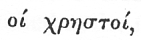
"Sweetness and Light." The Chrestoi, as the Good people,
were pre extant. Numerous Greek inscriptions show that the
departed, the hero, the saintly one—that is, the "Good"—was styled
Chrestos, or the Christ; and from this meaning of the "Good" does
Justin, the primal apologist, derive the Christian name. This
identifies it with the Gnostic source, and with the "Good God" who
revealed himself according to Marcion—that is, the Un-Nefer or
Good-opener of the Egyptian theology.
In the process of setting forth the Christ as an historic
character he is made to repudiate this title of the "Good." "Why
callest thou me the good?" Which exhibits the Christ of the Gnosis
in the act of divesting himself of divinity in the course of being
humanised.
The Christ was represented by a figure that was both male and
female, as it appears in the Book of Revelation, and is also portrayed
in the Christian Iconography. Cyril of Jerusalem says the
Christians call the Anointed One Male-female. That is the
same type of both sexes as the epicene Horus, Venus Barbatus, the horned
Astarte, the Assyrian Zikarat, the Male-ess, the masculine goddess
Neith, the mummy, and many other representatives of the biune being, the
personified spirit of either sex. It was continued as the Christ
of both sexes and the male-female Sophia. But this type could not
be made real in historic personality, except as an hermaphrodite.
The Androgynous Christ, like the Karest, is of necessity
non-historic, and a mystical type that can only be explained by the
Gnosis, not by the history. Tertullian tells us that the
Christian name was derived from "unction;" in this case, as Miss
Dunstable says, "ointment did it." And in the Clementine
Recognitions it is announced that the father anointed his son with "oil
that was taken from the wood of the Tree of Life, and from this
anointing he is called the Christ;" whence the Christian name.
This again is Egyptian. Horus was the anointed son of the father.
The mode of anointing him from the Tree of Life, portrayed on the
monuments, is very primitive indeed; and the Horus of Egypt was
continued in the Gnostic Christ, who is reproduced upon the Gnostic
stones as the intermediate link betwixt the Karest and the
Christ, also as the Horus of both sexes.
By means of the Karest type the Christ and the
Christians can both he traced in the ancient tombs of Egypt. The mummy
was made in this likeness of the Christ. It was the Christ by name,
identical with the Chrestoi of the Greek Inscriptions. Thus the
honoured dead, who rose again as the followers of Horus-Makheru, the
Word of Truth, are found to be the Christians,
on the Egyptian
monuments. Ma-Kheru
is the term that is always applied to the faithful ones who win the crown
of life and wear it at the festival which is. designated "Come thou to
me"—an invitation by Horus the Justifier to those who are the " Blessed
ones of his father, Osiris"—they who, having made the Word of Truth the
law of their lives, were the justified =
the Christians, on earth.
The original form of the Christ-name is Chrestos,
not Christus. In Boekh's "Christian Inscriptions," numbering 1287,
there is no single instance of an earlier date than the third century
wherein the name is not written Chrest or Chreist.
In the time of Lactantius the name was pronounced
Chréstus, and he tells us that the change of the word from Chrést
to Christ was an ignorant error. The Latin Chréstiani is
still represented by the French Chrétiens, in which the s
is abraded. Chrest, and not Christ, is also the Gnostic form
of the name; and the Gnostics were the true Christians, who preserved
the types, the doctrines, the hidden wisdom, including the sacred names,
in all purity and sanctity. This spelling of the name as Chrest or
Chrést in Latin is supremely important, because it enables me to prove
the identity with the Egyptian Karest or Karust, the name
of the Christ as the embalmed mummy, which was the image of the
resurrection in Egyptian tombs, the type of immortality, the likeness of
the Horus, who rose again and made the pathway out of the sepulchre for
those who were his disciples or followers. Moreover, this type of
the Karast or Mummy-Christ is reproduced in the catacombs of Rome.
No representation of the supposed historic resurrection of Jesus has
been found on any of the early Christian monuments. But, instead
of the missing fact, we find the scene of Lazarus being raised from the
dead. This is depicted over and over again as the typical
resurrection where there is no real one! The scene is not exactly
in accordance with the rising from the grave in the Gospel. It is
purely Egyptian, and Lazarus is an Egyptian mummy! Thus Lazarus,
in each representation, is the mummy-type of the resurrection;
Lazarus is the Karest, who was the Egyptian Christ, and who is
reproduced by Gnostic art in the Catacombs of Rome as a form of the
Gnostic Christ, who was not and could not become an historical
character.
Further, as the thing is Egyptian, it is probable that
the name is derived from Egyptian. If so, Laz (equal to Ras) means
to be raised up, while
aru is the mummy by name. With the Greek terminal
s this becomes Lazarus. In the course of humanising the
mythos the typical representation of the resurrection found in the tombs
of Rome and Egypt would become the story of Lazarus being raised from
the dead. This Karast type of the Christ in the Catacombs is not
limited to Lazarus.
In a fifth century representation of the Madonna and
child from the cemetery of St. Valentinus, the new-born babe lying in a
box or crib is
also the Karest, or mummy-type, further identified as the divine
babe of the solar mythos by the disk of the sun and the cross of the
equinox at the back of the infant's head. Thus the child-Christ of
the historic faith is born, and visibly begins in the Karest
image of the dead Christ, which was the mummy-type of the resurrection
in Egypt for thousands of years before the Christian era. This
doubles the proof that the Christ of the Christian Catacombs was a
survival of the Karest of Egypt.
Moreover, as Didron shows, there was a portrait of the
Christ who had his body painted red! It was a popular
tradition that the Christ was of a red complexion. This, too, may
be explained as a survival of the Mummy-Christ. It was an
aboriginal mode of rendering things tapu by colouring them red.
The dead corpse was coated with red ochre—a very primitive mode of
making the mummy, or the anointed one. Thus the God Ptah tells
Rameses II. that he has "re-fashioned his flesh in vermillion."
Besides which, the Initiated in the Greek mysteries were daubed or
anointed with clay (Demosthenes, "De Corona," 313). This anointing
with red ochre is called
Kura by the Maori, who likewise made the Karest or Christ.
We see the mummy-image continued on another line of
descent when we learn that, among other pernicious heresies and deadly
sins with which the Knights Templars were charged, was the impious
custom of adoring a Mummy that had red eyes. Their Idol, called
Baphomet, is also thought to have been a mummy.
The ground-root of a really religious feeling was first
planted with the buried dead. It was the departed who opened the
door of another life and left it just ajar for those who remained
behind. This is continually the case with us in our own
individual lives, and such was the common experience in the remotest
past. By this root in the grave the dead communicated with
the living. Hence the first holy places were made sacred to
the living by the dead. The earliest sanctuaries of the
living were the resting-places of the dead. The primary
cause of settling down to the work of civilisation was the clinging to,
and being clung to by, the dead. The primal ownership of
land was invested in the dead. The tomb was the first
temple, and the temple was at the centre, the heart, of future cities.
The grave-stone was the primitive altar, the sarcophagus the first
communion table. The Mummy was the earliest human image of
the Christ.
I do not doubt that the ancient Roman festivals called
the Charistia were connected in their origin with the Karest
and the Eucharist as a celebration in honour of the manes of
their departed kith and kin, for whose sakes they became reconciled at
the friendly gathering once a year.
It is here, then, we have to seek the essential
connection between the Egyptian Christ, the Christians, and the Roman
Catacombs. These Christian Mysteries, ignorantly explained to be
inexplicable, can be explained by Gnosticism and Mythology, but in no
other way. It is not that they are insoluble by human reason, as
their incompetent, howsoever highly paid, expounders now-a-days pretend.
That is but the puerile apology of the unqualified for their own
helpless ignorance—they who have never been in possession of the gnosis
or science of the Mysteries by which alone these things can be explained
in accordance with their natural genesis. In Egypt only can we
read the matter to the root, or identify the origin of the Christ by
nature and by name, to find at last that the Christ was the Mummy-type,
and that our Christology is mummified mythology.
GERALD MASSEY.
[Since the foregoing was written Mr. Massey has forwarded
the following note.—As I am desirous of getting within striking distance
of the historic Christians, you are at liberty to do all you can in
challenging a reply to my article on 'The Nature of the Christ' from the
Bench of Bishops, Revisors, Egyptologists, or other defenders of the
historic faith."] |
――――♦―――― |