|
 |
|
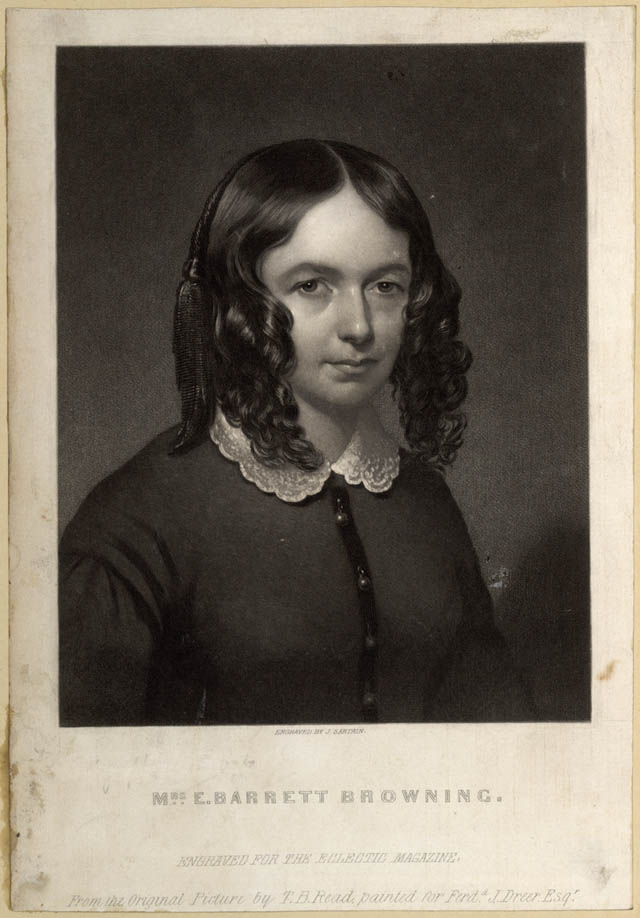
Elizabeth Barrett Browning
(1806-61) |
IN
his Essay upon Joan of Arc, De Quincey thus addresses Woman, not as the
general mother, but as the general sister: 'Woman, sister—there are some
things which you do not execute as well as your brother, Man; no, nor
ever will. Pardon me, if I doubt whether you will ever produce a
great poet from your choirs, or a Mozart, or a Phidias, or a Michael
Angelo, or a great philosopher, or a great scholar.' With perfect
fairness might our sister retort that there are many things which she
can execute better than her brother. She might also urge something
more to the point, in the fact that woman has done very great things
both in art and literature since De Quincey's words were written—the
greatest things probably she has ever done. She has not yet
produced her Shakspeare, her Newton, her Bacon, her Handel; and most
likely never will. But what she has done during the last twenty
years is quite sufficient to make man look down on her from his
intellectual throne with less of the smile of superiority. In more
than one department of literature she has run almost abreast of her
brother in the race. It is very doubtful if the highest and
richest nature of woman can ever be unfolded in its home life and wedded
relationships, and yet at the same time blossom and bear fruit in art or
literature with a similar fulness. What we mean is, that there is
so great a draft made upon woman by other creative works, as to make the
chance very small that the general energy shall culminate in the
greatest musician, for example. The nature of woman demands
that to perfect it in life which must half lame it for art.
A mother's heart, at its richest, is not likely to get adequate
expression in notes and bars, if it were only for the fact that she must
be absorbed by other music. That which makes the mother
wealthiest, will at the same time hinder the artist by at least
one-half. Thus a woman-Shakspeare would really have to be doubly
as great as the man Shakspeare, for he had not to bear a family with all
its precious burdens; nor does it appear that he paid very much
attention to his family when it had been borne for him. So that,
if woman should never stand on an equality with her brother at his
noblest height, she may fairly plead inequality at starting, and more
hindrances by the way. Great writers are the exception amongst
men, and they must be still more so amongst women. Women, who are
happy in all home-ties, and who amply fill the sphere of their love and
life, must, in the very nature of things, very seldom become writers.
For most women, the whole of life is uttered in the one word 'love,' the
whole world compressed in the one word 'home.' They live the
reality in such fulness, that there is no imperative need to seek refuge
in an ideal world. And then, where is the incentive to sing or
write? Perfect joy does not often set people writing. Joy is
a more unconscious thing than sorrow. The reason why sorrow
has inspired so many singers, is because it appeals so much more to the
consciousness. It turns the eyes more within. And then it
babbles, is more communicative, and loves to ease the heart of its
burdens by telling its troubles. It is also lessened by being
shared. Woman will seldom be able to 'catch up the whole of
life, and utter it;' it will generally be only the half of life, and
because it is only the half will she often strive to utter it.
Nevertheless, where the nature of woman is drawn or driven to seek
expression in art or literature, by all means let her have warm welcome
and brotherly cheer. She has many a tender and vivid revelation to
make which is sealed to man. But her deeper intuitions demand an
alliance with the most massive powers, ere the great books will be
written of which her nature affords the index.
In art and literature, woman has no past to speak of.
Never till our time has she come upon the stage so excellently equipped
for conquest, and with such a glory of intellectual power. Since
De Quincey wrote his words, we have seen Rosa Bonheur handling her
palette and pencil with manly mastery,—a worthy sister of Sir Edwin
Landseer himself. We have had fiery little Charlotte Bronté
emerging from those lonely Yorkshire wolds, with the wild Celtic blood
working weirdly in her English veins; the magnetic sparkle of uneasy
light kindling her eye, and holding the whole nation to listen to every
word of her strange, startling story. The ancient Mariner himself
was not more successful. We have seen George Eliot lay hold of
life with a large hand, look at it with a large eye, feel it with a
large heart. We have seen her lifting the film of familiarity, and
making the most commonplace lives most interesting. The low,
barren flats of life have been enriched by her humour and quickened by
her loving smile, until they have become more fertile than the most
highly cultivated plots of literature. And we have acknowledged
that, within novelist limits, she is almost a prose Shakspeare for her
knowledge of human nature, and her power in delineating character.
We might enumerate many more of our sister's latter triumphs, but have
to speak of perhaps her greatest. For De Quincey himself would
have admitted that in Mrs Browning we have woman's nearest approach to a
great poet. We call her the greatest woman-poet of whom we have
any record. Not a complete and perfect poet by any means; but
great in virtue of her noble fire of passion, her inspired rush of
energy, which vitalizes wherever it moves, and the good, true, loving
heart that beats through all her works,—thrilling tenderly or heaving
mightily. We often think it would astonish many writers of the
past who have been very much over-praised, and who got their fame just
in time, if they could see what is being done in our day, and has been
done since theirs. They would be surprised to find what a wealth
of delight there was in human life which they left untouched, what
depths of sorrow they never sounded, what heights of felicity they never
attained, or even saw clear of the mist; what new lands and waste places
have been brought into cultivation; what new worlds have been discovered
—Australias and Californias of literature, rich in virgin gold.
Not only would they be startled at the new mines opened, but also at the
manner of working them. The closer contact, the clearer
observation, and fuller detail, would seem quite as marvellous as the
ampler range. And so, if a poetess like Sappho could but see the
wealth of poetry poured forth profusely by Mrs Browning,—see what we
demand now-a-days before we apply the name of poet,—see the long years
of lonely toil, the slow accumulation of results, the variety and
combination of mental powers required,—we can fancy that she would
shrink from her own fame.
The publication of the 'Last Poems' of Elizabeth
Barrett Browning, as well as of the fifth edition of her collected
poems, affords us the opportunity, or rather seems to lay on us the
duty, of attempting a more full delineation of her genius than our pages
have yet supplied. Even should we be tempted to repeat passages
which are familiar to many readers, we shall readily be excused, on
account of the intrinsic beauty of the poems themselves, and the deeper
interest which they derive, both from the growing fame of Mrs Browning,
and the mournful fact that her 'Last Poems' have now been given to the
world.
As a poet, she stands among women unrivalled and
alone. In passionate tenderness, capaciousness of imagination, freshness
of feeling, vigour of thought, wealth of ideas, and loftiness or soul,
her poetry stands alone amongst all that has ever been written by women.
Her faults have too often furnished a subject for the critic and
criticastor during her lifetime for us to care to dwell upon them, now
we have heard the last thrillings of her harp-strings. They lie on
the surface of her works, and have their rootage in the depth of her
being, and circumstances of her early life. A certain
disproportion betwixt the matter and the manner at times is one of them.
But it would be very shortsighted to charge her with insincerity, when
she uses larger language than the matter may warrant; for the fault lies
in the strength of her sincerity striving and struggling with stammering
lips, and insufficient mastery of the force within her. Again,
there was some flaw in her musical faculty. She seems to have had
the lyrical impetus, the real leaping of the soul into song, without
the power of making the words dance to the internal tune. Her
strongest feelings could not fuse the music into sufficient fluency, her
most pressing thoughts did not 'voluntary move harmonious numbers.'
This makes many of her noblest lyrics difficult to read, and lessens the
enjoyment.
Her work is always best when she is most restrained
by the nature of the subject, or the stress of the measure. Her
great strength, full of starts and ebulliant overflows, moves the more
steadily and gracefully in proportion to the weight of responsibility or
fetter of form which she carries. In the 'Portuguese Sonnets,' for
example, the fiery spirit is subdued into a softer and more womanly
strength. The great heart heaves more gently, the passionate voice
is low with a murmuring tenderness. In 'Casa Guidi Windows,' the
measure does much to keep the straining mental vigour within bounds.
In 'Aurora Leigh,' we see, as it were, all the proud wilfulness and
audacity and quick blood of a magnificent girlhood, in which nature is
far too strong for the ties of custom or the formalities of art.
Stirred to the depths of her being, and inspired with a purpose, she
lashes out in all directions, and her energy exposes all her faults and
failings. The voice is often elevated beyond the
musical pitch. Her mind often flashes out its thoughts in the
zig-zag of the lightning, as it were, rather than in the straight line
of solar light. We are frequently more impressed with the display
of force than with the amount of work, and feel inclined to say with the
Scothwoman to Dr Brown when he put forth so much superfluous strength to
'catch a crab,' and fell backwards in the boat,—'Less pith, and more to
the purpose.' Again, in her prodigal abundance, she sows her seed
of thought too thick and too fast,—forgetting that the crop does not so
much depend on the quantity sown, as on the proportion that takes root,
and that too much brings forth too little: half would have been better
than the whole.
Another fault is that of incongruity. This
undoubtedly arose from her education, and from her spending her early
life so much apart. But many of her apparent incongruities,
arising from remote allusions, are increased, if not occasioned, by the
reader's not detecting the connection, from not knowing or not
remembering at the moment the fact that supplies it. One of her
critics, for instance, takes her to task for these lines:—
|
Never flinch,
But still, unscrupulously epic, catch
Upon the burning lava of a song,
The full-veined, heaving, double-breasted age:
But when the next shall come, the men of that
May touch the impress with reverent hand, and say,
Behold, behold, the paps we all have sucked! |
And he cries out against the savage
contrast of burning lava and a woman's breast, because in the latter are
concentrated the fullest and sweetest ideas of life. But that was
not the side of the metaphor which was uppermost in the writer's mind,
or which will flash first in the mind of any one who recalls the lava
mould of that beautiful bosom found, if we remember rightly, amongst the
ruins of Pompeii.
Another charge has been brought against Mrs Browning,
that her language is at times coarse, and her boldness almost
irreverent. The same thing has been urged against Charlotte
Bronté. In both cases the breadth of utterance is the result of
unsullied purity of thought and feeling. Women like these, of free
and lofty spirit, who have lived apart from society, are frequently
unconscious of that which appeals most to the consciousness of others.
But it should always be remembered, that it is the high privilege of
virtue to be able to speak what vice would blush to utter, and to know
no shame. It may be that, in such a matter, we are the furthest
from the noblest nature,—not the writers who maintain their prerogative
of plain speaking.
One great defect in Mrs Browning's mental character,
which is the parent of many defects in her poetry, is her want of
humour. This is one of the quickest and most clear-sighted of all
the faculties, and as keenly alive to the incongruous in ourselves as in
the acts of others. It has the power of enlarging the eye, making
the look calm, the head wise, the wisdom ripe. It is always
putting forth kindly feelers, and trying to embrace the whole world in
its geniality. It lubricates dry places, puts a smile into the
saddest aspect of things, makes allowance for discrepancies, and has a
sympathy with the crippled intentions, the arrested developments, the
premature failures of life. What the faculty of humour is worth to
a writer, may be seen in George Eliot's works, where it has flowered in
such quiet fulness as may not be seen more than once in a century.
This want in Mrs Browning may have been in great measure a matter of the
physical health. If the humour of abundant life with its overflow
of animal spirits, could but have run riot for awhile through her veins,
it would have effectually cleared her blood of its early sick-room
taint. This brings us naturally to the life which she lived, and
out of which she made her poetry.
The world in
general has got its first glimpse of Elizabeth Barrett through Miss
Mitford's kind old eyes, that dwelt so lovingly on the young
Greek-student girl, living her lonely London life with books for
companions, instead of women and men. We have seen an early poem
of hers on 'Mind,' or some such title, printed earlier than the
classical period of her studies. It showed the brain at work
before the heart had sent up its inspirations. It revealed a young
poet of such parts, that she needed all that we sum up in the word
'life,' to ripen her nature, and do justice to her great gifts.
Every shoot put forth by her expanding existence ought to have come into
contact with such kinds of food as would have assimilated healthily.
These should have been—grasping the human world, and the world of
flowers and leaves, beasts and birds. The sea, it seems, should
have sent its salt freshness, the old grey mountains have contributed
strength, the green country its sweetnesses, the spring-wind should have
given her blood a brighter bloom, the blue heaven and golden sunshine
have made her spirits dance within her; and these should have led her
out with ruddy cheek, happy light heart, and ready hand, into the
companionship of live human beings, all of which might have enriched her
nature by giving or receiving. Instead of this, we hear of the
early doom indoors, the dim life in the sick-room, the mental life
kindled and burning at the expense of the physical, the long train of
many sufferings, the way of life sad and shadowy to be walked wearily in
ill health, and the vista marked across at the end with an early grave.
Such was the life and prospect which have been sketched for the young
poetess in her early years. We doubt whether in this case, as in
others, the lot was really so bad as our imaginations are apt to colour
it, especially when it has been drawn by the imaginations of others.
We have met with people who have assured us that the sisters Bronté by
no means lived the dismal life that we had realized; and that, amidst
all the loneliness and misery, they often managed to extract a good deal
of pleasure from life. Still there was enough shutting up, in the
case of Elizabeth Barrett, to set her mind growing in the world of books
when it ought to have been expanding in a world warm with life: the mind
was growing, as it were, in a dark cellar, when it should have been
shooting and striking root out of doors under the breathing influence of
spring.
The whole tendency of this life was to grow apart
from that material which is the very clay in which the poet works.
At any time, the strong imagination has difficulty enough to get
fleshed, as we may phrase it, so as to dwell in common human forms, walk
in common human footsteps, and speak our common human language. It
is no easy matter to catch Pegasus, and put him into harness. But
when the outer world is mainly closed, and the inner world of
consciousness unhealthily quickened and stimulated, the difficulty of
bringing the imagination to bear for working purposes is many times
greater. Ordinary men and women grow up naturally in the ordinary
forms. They are moulded to the ordinary condition of things, while
the consciousness is awaking gradually. They seldom feel lost with
surprise at the state of matters in which they have grown up. They
do not feel eager to use the stride of a disembodied spirit, and so step
forth over this world's boundaries. They take kindly to the law of
gravitation. They are fitly fleshed, and don't hear the music of
the spheres, but are quite content to tread in the everyday track.
If strongly moved by emotion, the soul can find room to palpitate within
the senses, and is not for ever trying to flap its wings without, and
soar over the heights that hem it round. There are spirits,
however, that seem not to grow up in this natural way, receiving food
and growth through the senses. They appear to have dropt on the planet
ready made. They often go wailing round our world, and seek in
vain to get in: so they dwell apart, all eyes for the sorrows and
wrongs, the scars and rents of humanity; all ears for the cry of pain,
that is heard high above the music of pleasure,—low for very
happiness—because the voice of misery is shrill. They see all the
more of life's manifold mournfulness, because feeling so little of its
joy, that fills so many a life to the brim of felicity. They only
hear the ringing of the empty cup when it is dashed down? There
was something of this in Mrs Browning, and she found many doors into
life closed to her during those early years. This will account for
her endeavours to make a world of her own, not being native to ours,
which she did with an intrepidity of impulse more daring than man's
deliberate valour, or rather with the courage of a child that is not
tall enough to apprehend the obstacles which are visible to a loftier
vision.
From various causes, much of our modern subjective
mind is in a similar condition to that indicated by Sydney Smith, when
he described some small friend of his as having his intellect,
improperly exposed. It does not get sufficiently immersed in
matter for ordinary human contact. The matter is to be found in
human life. The poet must marry that. His love must be a
wedded love, and not a love apart, or it will fail of its rightful
issue. Milton was quite right in holding it necessary that the
poet should acquire an insight into all seemly and generous affairs.
Wordsworth, on the other hand, tells us of his feeling so much apart at
times, as to be compelled to clasp a tree in order that he might make
sure of his own identity. And we cannot help thinking that it
would do many others a world of good to clasp a wife or husband, and an
armful of children. Literature is, or should be, the expression of
life; and to reach a full and complete expression, the writer must live
the life in its manifold fulness and completeness. The poet must
take this world for better or for worse, and be united to humanity in
all its highest, and some of its sorrowfullest relationships. Mrs
Browning commenced far away from our ordinary world of women and men,
and her writing was, as a natural result, all too far from our business
and our bosoms. Our main interest in her, as she sits darkly in
the shadow of Æschylus, is one of curiosity and wonder. After
marvelling at the course of her studies, we marvel that she should not
have brought from them any touch of the Greek statuesqueness of style,
the marble calm of its form and finish. Evidently there was not
much affinity of nature to attract, or there would surely have been some
Greek likeness in the English poet's art. The reader must be
aerially equipped for travelling in cloudland if he is to follow the
poetess through several of her early poems. The atmosphere of
these heights is too rare for common human breathing, and the heights
themselves appear too unsubstantial and shadowy to offer any real
foothold, if they could be reached. Nevertheless, they show a spacious
mind, richly and diversely furnished; aspiration tending heavenward,
irresistible as burning flames, and a courage more glorified in failure
than much which has stood crowned with the world's success. She
has dared to grapple with such a subject as the Crucifixion, and look on
its agony through the eves of seraphs, who saw the sight, and heard the
cry that Heaven did not answer. Of this poem—'the Seraphim'—the
poetess speaks thus in her epilogue:—
|
I, too, may haply smile another day
At the far recollection of this lay,
When God may call me in your midst to dwell,
To hear your most sweet music's miracle,
And see your wondrous faces. May it be!
For His remembered sake, the Slain on rood,
Who 'rolled His earthly garment' red in blood
(Treading the wine-press), that the weak, like me,
Before His heavenly throne shall walk in white. |
The day for
smiling thus has now come for her.
Very many fine passages might be extracted from the 'Drama
of Exile,' and their brilliance would be always warm with heartheat,
their floweriness always fragrant. The most human thing—and it is
most piercing—is where the poor, fallen nature, having drunk of the
bitter cup, and added its clear seeing to the eyes, can forgive Lucifer
for very pity, and with such pathos of forgiveness, that he starts back,
stung by this unlooked-for revelation! For Adam is able to see in
the clear light of his great grief, that Lucifer has also fallen!
He comprehends by the vast brows, and melancholy eyes, and outlines of
faded angelhood, that he must have fallen from heights sublime; and it
must have been a mighty fall to his present place. What darkness
of desolation, what blank majesty there is in these lines:—
|
It seems as if he looked from grief to God,
And could not see Him. |
We must touch
upon one or two of Mrs Browning's smaller poems of another period, and
pass on to those of a later time. Here are a few
stanzas calmer and more musical than usual, and they linger in the
memory, soothing and unforgetable.
|
Of all the thoughts of God that are
Borne inward unto souls afar,
Along the Psalmist's music deep,
Now tell me if that any is,
For gift or grace, surpassing this,—
"He giveth His beloved sleep?"
What would we give to our beloved?
The hero's heart, to be unmoved,
The poet's star-tuned harp, to sweep,
The patriot's voice to teach and rouse,
The monarch's crown, to light the brows?
He giveth His beloved sleep.
What do we give to our beloved?
A little faith all undisproved,
A little dust to overweep,
And bitter memories to make
The whole earth blasted for our sake.
He giveth His beloved sleep.
"Sleep soft, beloved," we sometimes say,
But have no time to charm away
Sad dreams, that through the eyelids creep.
But never doleful dream again
Shall break the happy slumber, when
He giveth His beloved sleep.
For me, my heart that erst did go
Most like a tired child at a show,
That sees through tears the mummer's leap,
Would now its wearied vision close,
Would child-like on His love repose,
Who giveth His beloved sleep.
And, friends, dear friends, when it shall be
That this low breath is gone from me,
And round my bier ye come to weep,
Let One most loving of you all
Say, "Not a tear must o'er her fall:"
"He giveth His beloved sleep." |
The 'Romance of
the Swan's Nest' is naively natural in feeling, and exquisitely told.
Little Ellie sits alone musing to herself as she dips her naked feet in
the stream that flows musically by. She knows of a swan's nest
among the reeds, but will not tell the secret to any one until the
destined lover shall come; and after having done great deeds, and wooed
and waited long, he shall kneel at her knee, and to him she will
discover the swan's nest among the reeds. Having settled the
matter to her own smiling satisfaction, Little Ellie rises from her
dream, and thinks she will just peep in on the eggs, as is her daily
habit. Alas, the eggs are gone, the wild swan has deserted her
nest, and rats have gnawed the reeds. They who can see deep enough
may find a subtle allegory in the simplicity of this ballad.
'Bertha in the Lane' is a favourite with most of Mrs
Browning's readers, and it is one of her best minor poems. It is a
page from that red-leaved book of the human heart sacredly inscribed to
woman's hidden suffering. Nothing, perhaps, will more astonish us
in the next life than to see revealed the unknown self-sacrifice that
has been lived by woman in this life. Here is an instance which
the poet has made known. The elder of two sisters has been beloved
until the lover sees the younger one, when his passion pales for the
other, and kindles for her. The elder sees the change, and at
length hears of it unawares. She determines to give place to the
younger, and fold the robe of pain lightly about the breaking heart.
She is soon worn and wearied out in the struggle, innocently on her
death-bed confesses all to her sister, who has been so innocently happy
in her stolen love; but there must be no regret, as there is no
reproach.
|
I had died, dear, all the same;
Life's long joyous jostling game
Is too loud for my meek shame.
I am pale as crocus grows,
Close beside a rose tree's root;
Whosoe'er would reach the rose,
Treads the crocus underfoot. |
There is one last leap of the old
love, one flickering forth of the old affection before the life-flame
expires for ever.
He might come for a word of parting,—the poor heart listens!—
|
Are there footsteps at the door?
Look out quickly. Yea or nay?
Some one might be waiting for
Some last word that I might say.
Nay! so best, so angels would
Stand off clear from deathly road,
Not to cross the sight of God. |
The poetess is
coming nearer home to us, and getting closer to the beating heart of
humanity. Her hold of life is growing larger and surer, and
by-and-by she will win a gentle nestling place in the affections of all
true and noble lovers with certain sonnets called 'From the Portuguese,'
which were not found in the language of Camoens, but in her own womanly
heart.
These Portuguese sonnets contain a very tender
history. They are an illuminated leaf in the book of life that was
hitherto poor and pale, wanting the warm lights and colours of the
vitalest human affection. Hitherto the writer has lived apart
somewhere on the boundary of life, with the wan light of another world
whitening her face, and the dusky shadows of the past darkening it as
they hovered near. At times she seemed closer to them than to us,
and better fitted to understand them than hold converse with us.
She turned from the banquet prepared sumptuously with life's cates, and
wines, and dainties, and put aside the proffered pleasures. She
saw the happy faces, and felt the happy hearts in the ring of merry
voices, all the while fearful lest her own pulse should take too large a
leap. She looked and saw that it was good, but turned away
murmuring, 'Not for me; not for me.' The confession of this
self-abnegating soul being drawn gradually towards the marriage-feast of
noblest minds, all the while pleading its own unworthiness, and glowing
into highest beauty with the efforts of modest self-disparagement, is
one of the most 'secret, sweet, and precious' things in all poetry.
|
I thought once how Theocritus had sung
Of the sweet years, the dear and wished-for years,
Who each one in a gracious hand appears
To bear a gift for mortals, old or young:
And, as I mused it in his antique tongue,
I saw in gradual vision, through my tears,
The sweet, sad years, the melancholy years,
Those of my own life, who by turns had flung
A shadow across me. Straightway I was 'ware,
So weeping, how a mystic shape did move
Behind me, and drew me backward by the hair,
And a voice said in mastery as I strove,
"Guess now who holds thee?" "Death," I said. But
there
The silver answer rang, "Not Death, but Love." |
Although it is Love and not Death
that has caught her, the startled spirit urges her unfitness for Love,
her familiarity with Death. She still treats it as a mistake. She
pleads her unlikeness to the wooer. He is a guest for queens, a
singer of poems such as would make the dancers on palace-floors stop to
listen to his music, and watch his lips. Why should he pause at
her door, to let his music fall in golden fulness? The casement is
broken, the bats and owls build without the house; there is desolation
within. Such a shadow must not stand in his light. He must
go. Yet she will remember him in her prayers; and when she
beseeches God, He will hear the beloved name, and see within her eyes
the 'tears of two.' But soon there steals a new dawn over the face
of things. To love and be beloved makes a wonderful change in the
way of looking at life. Still, what can she, so poor, give back in
return for so rich a love? Nothing. No high gifts or graces.
She has nothing to give but love. Perhaps there is something
worthy of acceptation in mere love! For when she murmurs to
herself the simple words, 'I love thee,' she stands transfigured, and
feels glorified; and the flush rises up from breast to brow with a ruby
large enough for others to see that it is the very impression made by
Love's signet-ring. Then comes this surprise of thought:—
|
Beloved, my Beloved, when I think
That thou wast in the world a year ago,
What time I sat alone here in the snow,
And saw no footprint, heard the silence sink
No moment at thy voice . . . but, link by link,
Went counting all my chains, as if that so
They never could fall off at any blow
Struck by thy possible hand. . . . Why thus I drink
Of life's great cup of wonder! Wonderful,
Never to feel thee thrill the day or night
With personal act or speech,—nor ever cull
Some prescience of thee with the blossoms white
Thou sawest growing! Atheists are dull
Who cannot guess God's presence out of sight. |
We feel it
almost sacrilege to go on summarizing these sonnets, for they have the
fairy fineness of the gossamer, the delicacy of dew all a-tremble, in
their loving delineation of tender minutiæ, such as love delights to
pore over.
|
I marvelled, my Beloved, when I read
Thy thought so in the letter, I am thine—
But . . . so much to thee? Can I pour thy wine
While my hands tremble? Then my soul, instead
Of dreams of death, resumes life's lower range.
I yield the grave for thy sake, and exchange
My near sweet view of heaven for earth and thee. |
The growth of a
new interest in life and this world is beautifully told. We are
made to feel how the fresh tendrils that love puts forth twine about the
soul, and hold it to earth. It is drawn towards a closer
nestling-place irresistibly, as the heart of the mother-bird is drawn
down into the nest full of new life. And from thence it looks on
the vast cold expanse around, and shrinks from the unknown region into
which its aspirations once soared.
|
Let us stay
Rather on earth, Beloved, where the unfit
Contrarious moods of men recoil away
And isolate pure spirits, and permit
A place to stand and love in for a day,
With darkness and the death-hour rounding it. |
With what
subtle, sweet casuistry she gradually convinces herself, at the same
time informing us with much delightful simplicity that men are more than
the visions with which she once lived, and that the gifts of God put our
best dreams to shame! And then how naturally this leaning together
of two hearts, until two persons touch, begets a desire of being
together, and this, again, brings forth the longing for
keeping together. The happy companionship of two makes the
loneliness of one all the more lonely!
|
Ah, keep near and close,
Thou dove-like help! and, when my fears would rise,
With thy broad heart serenely interpose. |
The reader will
easily surmise that we are now pretty close to the church door, and will
feel too reverent to set foot in the sanctuary. But, after our
eyes are veiled to the vision of marriage life, the closing confession
is still heard; and this was the full meaning of the heart's emphatic 'I
will,' when the knees bent at the altar with the great weight of its
love.
|
How do I love thee? Let me count the ways.
I love thee to the depth, and breadth, and height
My soul can reach, when feeling out of sight
For the ends of being and ideal grace.
I love thee to the level of every day's
Most quiet need, by sun and candlelight.
I love thee freely, as men strive for Right;
I love thee purely, as they turn from Praise.
I love thee with the passion put to use
In my old griefs and with my childhood's faith.
I love thee with a love I seemed to lose
With my lost saints; I love thee with the breath,
Smiles, tears, of all my life! and, if God choose,
I shall but love thee better after death. |
We have treated
these sonnets personally, and cannot help it. The veil of disguise was
always thin, the features were visible and unmistakeable within, and the
loving eyes glowed through it. Mrs Browning is always a personal
poet.
Almost all the great poets of our century have been
so. We cannot here enter upon a consideration of the causes which
make the Elizabethan poets dramatic and impersonal, and the Victorian
poets subjective and personal. But Mrs Browning, is remarkably and
intensely personal. She does not sing her song, and present you
with it as something apart from herself, finished and sent forth to the
world with the artist's love and farewell. You cannot separate her
and her poetry. She is patent in every line. Her own nature
is felt, her own spirit shines, her own voice pleads through all her
poetry. Not only is this so, but you are obliged, as it were, to
be with her in the act of writing. She does not sing to you in the
distance; she writes in your presence. You see the face flashing
white with thought, the eye kindled large with feeling, the hand
trembling in its eagerness to scatter round the thick-coming throng of
emotions, ideas, and fancies. Indeed, you hear the very scratching
of the hurrying pen on the paper. The great poets of the objective
class do not do thus, and yet there is in it a marvellous charm.
The larger number of readers of poetry prefer this kind of
relationship, to the personal poet; they can get so much nearer home to
the poet nature in this way,—the personality in flesh and blood is so
much more powerful with them than the ideal creations of the dramatists.
So that this kind of poets, and poetry, and way of working, has its
compensations,—after all that has been said against its narrower limits
and lowlier place.
Mrs Browning, we repeat, is intensely personal.
Her appeals have in them the sharp cry of a woman's voice, at times
piercingly pathetic. She does not solicit our sympathies merely
with pen and paper; but the poetess comes herself, and pleads her cause
in person. She goes straight to the heart of the matter, and does not
stand upon ceremony; right on through many a conventionalism she goes,
not careful to walk in the world's ways, or use its favourite phrases.
In that cry of the children, which is only second to Hood's 'Song of the
Shirt' in its expostulation with society, there is a striking instance
of her piercing personal intensity, where she presents the naked, warm,
beating, and bleeding child-heart in the path that so many are treading,
and sorrowfully asks if they can trample it under foot.
All the forming forces about her early life
undoubtedly tended to sharpen her mind to this personal point, and it is
natural that she should penetrate further, and win her greatest success
in this personal way. Being so little dramatic, having so little
will, or wish, or leisure to go out of herself, and enter into the
individuality of others, she is all the more effective in description.
It is here that she finds neither let nor hindrance, and her genius
reaches to its full stature. We may see this if we go back to the
time of 'Duchess May,' and that description of her mounting on horseback
in front of her husband for the double death-ride, as though it were
some mount of transfiguration, and she shone all over, glorified with
the spirit of self-sacrifice, as with a proud smile she lighted the way
to their dark bridal.
Her power in delineating by means of description is
equally great, whether she sets before us an angel whose 'eyes were
dreadful, for you saw that they saw God,' or she paints the portrait of
'Dog Flush,' the darling of luxurious fortunes, nursed and petted in the
lap of plenty, his two eyes looking out on you, golden-clear, from
between the long lazy ears, and every silken hair burnished with soft
splendour.
She could make of her descriptive power almost a new
art; a something which quite reversed the old ideas of the word
'descriptive' when applied to poetry, she could crowd so much meaning
into so few words. Take a few of her poet-pictures in
illustration:—
|
Here Homer, with the broad suspense,
Of thundrous brows, and lips intense
Of garrulous god-innocence.
There, Shakspeare, on whose forehead climb
The crowns o' the world. O eyes sublime,
With tears and laughters for all time!
And Schiller with heroic front,
Worthy of Plutarch's kiss upon't,
Too large for wreath of modern wont.
And Chaucer with his infantine,
Familiar clasp of things divine.
That mark upon his lip is wine.
And Burns, with pungent passionings
In his deep eyes.
And Shelley, in his white-ideal,
All statue-blind. |
Or glance for a
moment at that wonderful poem, 'Aurora Leigh,' and see how this power
runs through it, redeemingly and enrichingly, almost making up for all
the want of dramatic aptitude. What immortal touches it lavishes,
and what things to think over it supplies! To mention only a few at
random. Who can ever forget that description of the nestled
babe in its little soft bed, warm and ruddy with life, the tiny
'holdfast hands' which had closed on the mother's finger as it went to
sleep, and 'kept the mould of it;' and the blue eyes slowly opening wide
on its mother. Or the descriptions of Lady Waldemar, the beautiful
woman-serpent brightening with some new glory of colour, and enfolding
some fresh grace of form with every deadly motion, which show us that
the devil never stole on mankind more caressingly, or was more cleverly
detected and portrayed. The sketch of Lord Howe, too long for us
to quote, is perfect. So is that hint of Sir Blaise:—
|
Good Sir' Blaise's brow is high,
And noticeably narrow; a strong wind
You fancy might unroof him suddenly,
And blow that great top attic off his head,
So piled with feudal relics. |
The description of Marian Earle
driven forth—
|
The swine's road, headlong o'er a precipice,
In such a curl of hell-foam caught and choked. |
and of poor blind Romney, as he
stands pale in the moonlight, stretching out his arms towards the
'solemn, thrilling, proud, pathetic voice' of Marian. Here the
passion goes right to the heart-roots and shakes the tears down by
storm, from those who are not lightly moved.
Before writing 'Aurora Leigh,' Mrs Browning had done
far more in poetry than any other woman living or dead. In that
poem, she set herself to do what no man in our time has attempted: that
is, to recover the lost ground which the poets have given up to the
novelists. Many of our living writers of romance would, if they
had lived in the Elizabethan era, have written dramas in verse, instead
of prose novels in three volumes. The novel, however, seems now to
lord it over the whole world of incident, and, up to the time of 'Aurora
Leigh' at least, appeared to be pushing the poet out of the world, or
rather, was shutting him up closer day by day in his own narrow
subjective world, until he was somewhat like the criminal, the walls of
whose prison closed in on him hour by hour.
In 'Aurora Leigh,' Mrs Browning has made a most
plucky effort to break from this prison-house of poetry, and enlarge the
boundaries of the poet's outer world. To our thinking, she has
completely succeeded in competing with the novelist. She has given
a narrative-interest to her work which carries the reader along eagerly
to the end; at the same time she has scattered such a profusion of
thought, and such a wealth of fancies, by the way, that you may go back
again and back again for ever, and not gather up all the good things.
If the writer could have put forth as much strength of art in repression
as there is fervour of nature in ebulliance, if her force had only been
rounded with Tennyson's finish,—' Aurora Leigh' would have been by far
the greatest poem yet written in our century. Greatest it is in
virtue of its immense riches of poetry, and in the power which it shows
of clothing with immortality the spirit of our time. But it was
not evolved and finished with that pondering patience whereby the master
artists have reached their perfectness. There was not time enough
for such an amount of matter to acquire the highest shape. We
admit that 'Aurora Leigh' often has the look of much of our nineteenth
century work, and seems lettered with 'our time,' rather than for all
times. It not only reflects the life and thought of our century in
manifold aspects, but the work also mirrors the feverish haste, the
conflict of opposite elements, and all the perplexities and difficulties
out of which we are to escape, it seems, if we will only hurry on fast
enough. We are speaking of the building from the outside. There is
rich and rare work within. There is length, and breadth, and height;
looks of grandeur to 'threaten the profane,' and dainty filagree to
charm the fastidious; while so numerous are the golden lights of
imagination, that it seems to be one great flame of beauty!
There is pretty sure to be something in a work like
'Aurora Leigh,' which will not be rightly judged by the time in which it
is written; we mean in the relationship of material supplied by that
time to artistic purposes. A similar difficulty to that which the
sculptor meets with in arraying his marble in the dress of to-day, will
have to be faced by the poet who shall try to do what Mrs Browning has
done. The purists will cry out on much as being totally unfit for
poetry; the lovers of high art will exclaim against the introduction of
that which they consider so low. This is a matter not to be
settled these hundred years, and then we fancy readers will often be
thankful for many things which the critics of our time condemned as
unworthy. Especially will this be so with much that they have
objected to in Tennyson's 'Maude,' and Mrs Browning's 'Aurora Leigh.'
The great failure, artistically speaking, of the
latter poem, is in the author's almost passionately frantic endeavour to
clutch at the utmost reality. Now, we ourselves are pre-Raphaelite
in our reach after reality; that is, we look upon reality as the better
name for the highest ideal, because it puts the seekers on a surer road,
and in a truer attitude. But we do not ask that the realists in
painting or poetry shall show themselves to us with the muscles all
starting, and the forehead sweating in the strain after it. We
must not have the endeavour painfully thrust on us, that should be
hidden in the art. The reality should be reached as a matter of
course. The minutiæ, the slow step by step, and touch by touch, of
a loving and patient spirit, should all be concealed. It is for
the critical mind to expound and insist, to take the skeleton in pieces
and put it together again for our edification; it is for the artist to
clothe the skeleton with flesh and blood, and make it live.
There is nothing conscious or prepense in the
realism of Shakspeare. He can work with infinite detail, and
reach reality where never man did; but he does not set about doing it as
though he said, ' Now, see what a realist I am going to be.' All
is natural, and like the working of natural forces without personal
effort. He is so perfectly en rapport with his work, that
his mastery over it seems as natural as play. Of course, this
power could only be thus perfect in one whose familiarity with all forms
of humanity was so great, that he could put on purple in its palaces of
stately passion, or creep on hands and knees to peer into its dim caves
of crime. Mrs Browning is so much in earnest, that she cannot hide
her efforts to grasp at reality. She comes to her work of 'Aurora
Leigh' with a great flush and tumult of new life in her, and a stronger
grasp of this world. She has not chosen a subject, as Tennyson
does, to mould into perfect shape through years and years of calm and
patient toil. A purpose has seized her soul, and she must follow
it. She is tremendously in earnest, and she will be utterly real
on low ground as well as high, on commonplace subjects as well as on
rare. And so she goes at her work with brimmed eyes, and hurrying
lips, and beating heart. On, on she goes, with great bursts of
feeling and gushes of thought, that follow one another with a
spontaneity that is always surprising, often startling, and sometimes
savage. Look not for the calm and finish of a Greek statue
from such an attitude of mind, and such a woman's work. It is not
a statue, for it is shaped out of human flesh and blood. You see
the heart heave within a form vital from top to toe: there is fire in
the eyes, breath between the lips, the red of life on the cheek; it is
warm with passion, and welling with poetry, in the double-breasted
bounteousness of a large nature and a liberal heart.
These 'Last Poems' of Mrs Browning bring us to ground
that we have not yet touched on here—her love for Italy, her record of
personal impressions received in that land, and her many cries for its
deliverance. We need not now go back to 'Casa Guidi Windows;' and
we have little to say of the 'Poems before Congress,' save that we think
she saw the deliverer with other eves than ours, as he came over the
Alps in the great dawn of deliverance, arrayed in splendours not his
own, and inspired with other motives than his admirers at the time saw.
One thing we have to acknowledge, here as elsewhere, is the courage with
which she never hesitates to lift up her voice for what she considers
the right. She is instant in season and out of season.
Politics do not improve her temper, artistically speaking. They
are not calculated to calm such a throbbing heart as hers. They
will not bring forth any such quaint music as that from the song of a
tree spirit in the' Drama of Exile,' who thus rocks the listening sense
as on one of her own swinging branches—
|
The Divine impulsion cleaves
In dim movements to the leaves,
Dropt and lifted, dropt and lifted,
In the sunlight greenly sifted,
In the sunlight and the moonlight,
Greenly sifted through the trees.
Ever wave the Eden trees,
In the nightlight and the noonlight,
With a ruffling of green branches,
Shaded off to resonances,
Never stirred by rain or breeze. |
They will not
call up in all its delicate loveliness and pure splendour any more such
graceful fancies as this:—
|
So, young muser, I sat listening
To my fancy's wildest word;
On a sudden through the glistening
Leaves around, a little stirred, |
Came a sound, a sense of music,
which was rather felt than heard.
|
Softly, finely, it unwound me,
From the world it shut me in,
Like a fountain falling round me,
Which, with silver waters thin,
Holds a little marble Naiad sitting smilingly within.
|
Instead, we have such fierce
flashes as this, with its lightning like vividness. Anything more full
of awful suggestion than the two last lines we do not know:—
|
Peace, you say?—yes, peace in truth:
But such a peace as the ear can achieve
'Twixt the rifle's click and the rush of the ball,
'Twixt the tiger's spring and the crunch of the tooth,
'Twixt the dying Atheist's negative
And God's face—waiting after all!' |
Or such a picture as this of poor
Peter, in his present Roman difficulty:—
|
Peter, Peter, he does not speak;
He is not as rash as in old Galilee:
Safer a ship, though it toss and leak,
Than a reeling foot on a rolling sea!
And he's got to be round in the girth, thinks he. |
There are better things in these
'Last Poems' than the political. The poem 'Mother and Poet' is glowing
with noble fire. Here is one fine natural touch from it. The
speaker is a poetess and a mother, who has two sons dead for Italy:—
|
What art can a woman be good at? Oh, vain!
What art is she good at, but hurting her breast
With the milk-teeth of babes, and a smile at the pain?
Oh, boys, how you hurt! you were strong as you
pressed.
And I
proud by that test. |
There is a very touching plea for
Ragged Schools, and the children that may be found in our streets:—
|
In the alleys, in the squares,
Begging, lying little rebels;
In the noisy thoroughfares,
Struggling on with piteous trebles.
Wicked children, with peaked chins
And old foreheads! there are many
With no pleasures except sins;
Gambling with a stolen penny.
Sickly children that whine low
To themselves and not their mothers,
From mere habit,—never so
Hoping help or care from others.
Healthy children, with those blue
English eyes, fresh from their
Maker, Fierce and ravenous, staring through
At the brown loaves of the baker. |
We could have
wished to quote at length the poem called Lord Walter's Wife.' In
its dramatic fulness and fitness, it is perfect; the changes are
exquisitely managed, and full of delightful surprise.
But in taking our farewell of Mrs Browning we rather
recur to some of her earlier utterances, which first told us that
whatever deficiency there might be in her power of grasping this world,
and embracing the whole round of human life, her anchor was made sure
and fast to another world, and she could ride at rest or stem the waves,
in full reliance that if her 'bark sank 'twas to another sea.' The
life she lived apart had its compensations for her, and she was laying
up for the life to come, in that time which we have spoken of, when we
might have wished her to have been dwelling more in our common world.
What she then wrote was not sent forth to stir so fiercely in the bosom
of the time, but 'calm with abdication.' She could drop from her lips
words both calm and wise. Possibly these things are more to
her now than even her later writings, and they touch us more nearly now
she is gone. Amongst other soothing or cheering and
heartening things, we call to mind from her true Christian philosophy
those utterances in which she tells us how we overstate the ills of
life. Do we weep? then let us thank God that we have no greater
grief than we can find tears for. In tears the grief will arise
and depart. Thank God for grace, ye who only weep. We are
all too apt to do as fretful, restive children do when forbidden
out-of-doors: we lean against the window-panes, and sigh until our
breath dims the clear glass, and the prospect is confused, and we are
doubly shut in,—prisoners to the natural boundaries, and prisoners to
the breathings of our own impatience. The imaginations that were
given us to bring heaven down, we use in making the worst of this world.
We walk upon the shadow of hills, and pant like climbers.
We sigh so loud, that we frighten the nightingale from singing. We
take the name of holy grief in vain; for holy it is, because sacred to
Him by whose grief came all our good. We are too ready with our
complaints. Not seeing the meaning that runs through all life's
noises, we often murmur, 'Where is the measured music, the certain
central tune?' while the angels may be leaning down from their golden
thrones to catch it and smile, and whisper, How sweet it is! We
are sent on earth to toil; to wrestle, not to reign; to be patient with
our own troubles, and ready to speak a word of cheer to others who
suffer.
|
The least flower with a brimming cup may stand,
And share its dewdrop with another near. |
It is this ground we choose for
parting, because, if we ever meet again, it will be here.
The poetess is gone. Her work is finished,
however unfinished the works may be. Undoubtedly they but faintly
shadowed forth the magnificent soul that dwelt awhile in the weak
womanly form, as we judge by the efforts she made to get expression for
what was labouring within her. Yet we are grateful for all that
has been left to us by this most glorious amongst poetesses, lofty
amongst women, and, we doubt not, most blessed among happy spirits.
And we rejoice in the belief that such a soul yet lives to unfold all
its forces in other ways, and reach nobler successes than were possible
for it here.
|
Nor blame we death, because he bare
The use of virtue out of earth,
Who know transplanted human worth
Will bloom to profit otherwhere.' |
And whether we sit summing up the
poet's work on earth or silence guard her fame, we know,
|
That somewhere out of human view,
Whate'er her hands are set to do,
Is wrought with triumph of acclaim. |
GERALD MASSEY. |



