 |
|
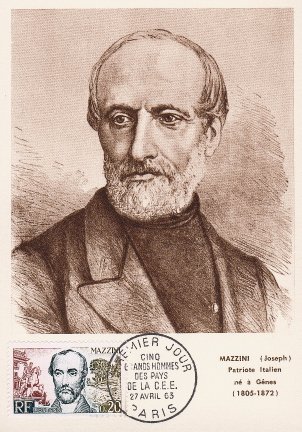
GIUSEPPE
MAZZINI
(1805-82) |
THE rarest
produce of this world of ours is not its mines of ore, its jewelled
Indies, its fruitful lands and overflowing granaries; but its great
hearts and great minds, these are its riches beyond price. The
great and veritable history of this world, also, is to be found written
in the lives of its noble women and great men. If it were possible
to cancel the existence of those Greek and Roman heroes whose lives and
deeds are chronicled in old Plutarch, with the chief painters and
sculptors, and writers of ancient Greece and Rome, how miserably mean
would be the remains of those illustrious nations! Or try to fancy
our own England without its Alfred, Shakspere, Milton, Newton, Coeur de
Lion, Elizabeth, Bacon, Caxton, Watt, Cromwell, Nelson, and some others
who have wielded sword and pen, or thrown the inkstand at the head of
the Devil Ignorance! You cannot realize it. England would
not be England with out them. Nor could any number of small men
and mediocrities supply their fill their spheres. I am somewhat of
a hero-worshipper, and think it good to venerate the heroic. To
believe in the heroic tends to make heroes, for men grow into the
likeness of that which they look upon. I do not advocate that we
should cling to the glittering skirts of great men to the abnegation of
our own self-reliance and personality, but with a loving trust in their
superior strength, and with an admiring and worshipful recognition of
the divinity that is within them, and shines through them, and flashes
from them, in wise speech and noble deed.
We should look up to them as to our elder, wiser
brothers, by sympathy to grow with their growth, and be lifted toward
their loftier stature. For not only do they bring the gods down to
us, but they, exalt us to the gods. The veriest dwarf may increase
the length of his stride as he walks on his life journey by earnestly
endeavouring to track the footprints of the giants who have gone before.
It is from the lives of great men that we shall get the rarest glimpses
of the divine significance of life and the glorious promise and
unfathomable possibilities that lie in our human nature. Great men
have spoken their 'bravo sublunary things,' done their heroic deeds, and
lived their grand lives, that we may also become great. Let us
learn to love and reverence them, and we shall not fail to comprehend
them: for love is such a luminous revealer and tutor that it makes us
like the uneducated woman who is mated to an intellectual husband, and
who understands him and climbs to the height of his character in the
light and strength of her great love. But where shall we find our
great man, our hero, in these days of small things? Live there now
such men as have glorified the past? Yes: great men are among us
to-day; great men are standing on the threshold of this 'our wondrous
mother age.' They are walking in our midst, although our minds may
not be large enough to mirror their altitude. It has been said
that no great man is a hero to his valet, but surely the reason lies
more in the valet's want of insight than in the hero's want of noble
attributes. Who that has marked the life and watched the work of
Joseph Mazzini will gainsay that he is a great man and a true hero—a
genuine worshipful Presence? He is a man who, in an age of dwarfs
and pigmies, has attained something like the old Roman stature of soul,
the old Roman force of intellect and bravery of heart. He is a man
of the kingliest faculties. As a man of thought and deed combined,
he is second to none that we have heard of. Mazzini is the son of
that glorious mother of greatness, ITALY.
Italy! that makes the heart leap up and the eyes brighten at the mention
of her name. Italy! the loved and the lovely, the everliving Eden
of the world. Italy! with its peerless wealth of genius, its
hallowed shrines of art for passionate pilgrims, its glittering host of
glorious men, and its long array of martyrs. Italy! that
stands before the world its best glory and worst shame, the victim of
innumerable wrongs—that is not and never can be a slave in spirit,
though the Austrian fetters hang heavy on her chafed limbs. Italy
is the nursing mother of Mazzini, who is the fitting child of such a
parent.
I do not intend to make this article a biographic
sketch, but will jot down in it something about the man, and his work,
which is the redemption of Italy. Mazzini is the worthy son of the
country which has borne the Gracchi, Cato, Brutus, Marcus Aurelius,
Cicero, and Cincinnatus; Dante and Titian; the sweet and gracious
Raphael and massive Angelo; the martyred Bandiera and that poor boy the
son of a washerwoman, the plebian humbler of patrician pride, the man
who kindled the fire of freedom into such a blaze in old Rome that
lighted the whole world,
RIENZI. Indeed he is a modern Rienzi.
There are some noticeable points of resemblance between Cola de Rienzi
and Joseph Mazzini. There is in both the same early and ardent
devotion of their lives to the emancipation and regeneration of their
beloved Italy, the same persistency in carrying out a cherished idea,
the same self-sacrifice, the same breadth and grandeur of character, the
same self-reliance in action, and proud bearing under defeat.
History sometimes repeats itself, and it would almost seem that, in the
person of Mazzini, Rienzi had revisited the earth, sadder and wiser
through subliming suffering, stronger through stern experience, to
accomplish the work begun five centuries ago. Both have been
inspired with the one idea of uniting Italy into a vast Republic, one
and indivisible, with Rome for its proud head. Both have alike
been thwarted by petty princes and royal robbers, who have parcelled out
Italy that they may conquer piecemeal and murder in detail. Both
have spent some of the best years of their lives in exile; and both have
had one glorious grip at the throat of their country's oppressors,
though Mazzini's hold was all too brief. Both went into exile a
second time: but here let the parallel end. Not but what Mazzini
will return a second time to reign, even as Rienzi did: he will return,
he shall return, but the victory will be nobler, the end more glorious.
Our Rienzi is wiser by the experience of five hundred years, and he will
not fail to pluck the fruit that is ripening within his reach. Who
doubts that Mazzini shall yet triumph that has watched the course of his
life—whether nursing his studious youth with traditions of Roman virtue,
kindling his soul with visions of Italy's coming glory, inspiring Young
Italy with his own great love of country, working on with patient
endurance through partial defeat, and through long years of martyrdom
bating no jot of heart or hope,—or in that proud straggle for Rome,
Italy and Liberty, in 1849? Did you mark his heroic toil, his
unblenching endurance of suffering? Did you see how calmly and how
grandly he dilated to fill the emergencies of that grim crisis?—how
gallantly he rode the waves of adverse circumstances?—how firmly and
untremblingly he stood beneath the burden of his great cause, and
supported a weight that must have crushed a lesser man? And yet it
was so like him, and came so naturally to him, as though he had been
born for it.
Mazzini is one of the clearest and deepest Seers of
our time. He has a hand which is as prompt to execute as his thoughts
are quick to conceive. He has the self-reliance which can stand
alone against the whole world. He has the earnestness which claims
victory as its own high prerogative by natural right.
What Cecil said of Raleigh is applicable to Mazzini—he can 'toil
terribly.' He has what Napoleon called the
'two-o'clock-in-the-morning' kind of courage, or rather he keeps eternal
watch. He is generous and magnanimous to a fault, if that be
possible.
Mazzini is the prophet, teacher, and inspirer of a
Faith, not a tailoring or tinkering systematizer of details. He is
a leader in the vanguard of Humanity, and you must not expect to find
him looking after the commissariat in the rear. Others will do
that: and every one to his work, and the tools to him who has the
peculiar art to handle them!
Mazzini had no such lease of power in Rome as Rienzi
had. Yet for the time and opportunity he worked wonders and
performed the utmost of human possibility. Through all that tragic
struggle he was to be found everywhere, cheering, directing, organizing,
inspiring. Who forgets his thirty days and nights' toil—his
self-sacrifice, his sublime faith in the heart and energies of the
people, and that heroic bearing of his which seemed to exalt those who
looked upon him into a race of heroes inspired with the prescience of
victory, so contagious was his calm courage?
All this and more will be found treasured up for
Immortality, when the History of Heroism shall come to be written, and
will form one of its sublimest chapters. Grand, clear, and lovely
does the character of Mazzini shine out in the expiring light of that
Roman Revolution! Here is a graphic picture of him after all was
over, by one who knew him well, and who laboured with him in the
glorious struggle, poor Margaret Fuller! 'Mazzini has suffered
millions more than I could. When the French entered, he walked
about the streets to see how the people bore themselves, and then went
to the house of a friend. In the upper chamber of a poor house I
found him with his life-long friends the Modenas. Mazzini had
borne his fearful responsibility: he had let his dearest friends perish;
he had passed all these nights without sleep; in two short months he had
grown old; all the vital juices seemed exhausted; his eyes were all
blood-shot, his skin orange: flesh he had none: his hair was mixed with
white: his hand was painful to touch. But he had never flinched,
never quailed, had protested in the last hour against surrender: sweet
and calm, but full of a more fiery purpose than ever: in him I revered
the Hero, and owned myself not of that mould.'
When all was over in Rome, and the torch of liberty
which he had kindled was extinguished, Mazzini left for Marseilles, and
from thence he went to Lausanne, in Switzerland. It was here he
wrote his crushing letter to De Tocqueville, De Falloux, and
Montalembert, the Jesuitical crucifiers of Rome's young Republic,
convicting them of the most dastardly lies, and heating the
branding-iron seven times hot in the forge of his mighty intellect,
wherewith History shall set the mark of Cain on their foreheads.
Various other eloquent works have been written by him, and the
State-papers of Mazzini are the noblest political manifestoes in the
archives of Europe: there is nothing of the kind approaching them for
heart or earnestness, save a few which emanated from the English and
French Revolutions.
Mazzini is one of the few unsuccessful great men that
are not used up and killed out by defeat. It is difficult for the
world to see the hero in the unsuccessful man. But Mazzini has
stamped his impression upon it as indelibly as the image of a king upon
the coinage from his mint, and all the tricks and artifices of his
enemies cannot deface the heroic features. The world still
believes in Mazzini, and the tyrants tremble in their triumphal cars at
the mention of his name. When he speaks, one half the world
listens and gathers up his words to run post for him. His hair has
turned grey; he is, among men, a king of sorrows, crowned with scars.
But his eye of faith is bright as ever, and lifted with as sublime a
confidence; his hope and heart are steadfast and unshaken still.
As Napoleon said of Massena, we may say of Mazzini, he never was so much
himself, or so great, as when the battle went the sorest against him,
when be rose up in all the magnitude of his might, his roused soul put
forth its rarest energies, put on the robes of victory, and went forth
to conquer.
Mazzini still lives; and looking upon his past who
can doubt that there is a great future in store for him? Italy is
not dead, and has not said her last word. True, she lies hushed as
in the silence of the grave. True, her martyrs are sleeping in
their bloody shrouds, or are led out day by day to fall by the Austrian
or Swiss bullet. True, it is midnight in Rome, and the owls, and
bats, and creeping things of priests are out on their soul-murdering
errand. True it is that the reaction reigns rampantly, that Rome,
Milan, Berlin, and Hungary wear the gyves and fetters as tightly as of
old, with no token of life save a death-cheer or a groan. True,
that France has swerved from the lofty purpose which beat in her heart
and brain and nerved her arm in '48. But for all these things we
will not despair. The battle goes sorely for the soldiers of
freedom, but it will make the grand triumph more signal and bright. Nor
for long shall Priest, Pope, and Cardinal darken the sunny homes of
Italy with their presence.
But we are forbidden to speak of Italy now. We
are in league with Austria, our natural ally! Austria, false as
hell, cruel as hell, and whom we hate with the hate of hell. And
do Englishmen suspect the price we pay for Austria in this Russian war?
It is that we are not to permit Italy and Hungary to rise! That is
the bond, as sure as death. In the face of present circumstances,
the apathy of Englishmen, and the cunning of secret diplomacy, we have
but one consolation. It is this. Our statesmen are not
altogether the arbiters of fate, and absolute decreers of events.
At any moment they may quarrel among themselves. The brotherhood
of wrong and robbery is but a weak bond. And at any moment the
popular forces may explode in revolution. England is silent about
Italy, but we mean Italy, and Hungary, and Poland, in every cry we hurl
at Russia. We mean Italy, and Hungary, and Poland, in every cheer
we send to the Turk!
GERALD MASSEY. |



