THE TWO WORLDS
April 2, 1909
PROFESSOR MAX MÜLLER AND EVOLUTION.
SIR,—Profound respect (based upon a careful study of
his great works on religion, language, etc.) for years past leads me to
a gentle protest against the writer, W. H. Simpson, whom I think
somewhat unjust to the Professor. If non-evolutionists are running
round a beaten track or endless circle, very well, let it be so.
The track or circle is infinite, so there is room for all, but without
the work of Professor Max Müller there would be no modern or ancient
Spiritualist science and philosophy, because that erudite scholar proved
the source, origin, derivation, and significance of words or
name-symbols, and traced them to their source back of nature.
Spiritualists should study his works, for we owe him gratitude and
thanks for pointing out to us the source of religious names, types, and
symbols, and also giving us philological light and reason where before
all was dark and superstitious confusion; in fact, Gerald Massey's
works are continuations or reflections of Professor Max Müller's studies
and researches into the origin and derivation of language.
|
 |
|
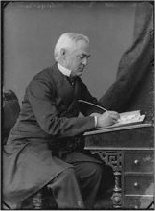
Friedrich Max Müller
1823 - 1900 |
Max Müller was "guilty of falsehood," says Mr. Simpson, "a
pseudo-scientific, semi-orthodox authority, unwise leader of the foolish."
All this because the Professor argued that "the ancestors of the human race had
a primitive intuition of God." Well, how is this disproved? Does
evolution deny it? Not at all, it confirms it, and so does W. H. Simpson,
for he goes on to say what the Professor does not deny, that "enormous periods
of time must have elapsed before our first ancestors were evolved."
Exactly! And when they were evolved, how does W. H. Simpson disprove that
he or they had a primitive intuition of God. Let us stick to the point,
and not fly off at a tangent, or abuse learned professors of language and
science, even if they do reside at Oxford. Let us not make a fetish of a
word. What is evolution? Why is the word opposed to the idea of a
primitive intuition by man of God? If evolution is still going on, where
does the theory for spirit continuance, identity, and permanence come in?
Mr. Simpson's argument causes him to do worse than run in a circle. He
runs away with himself and falls over himself. Vaulting ambition, as
Shakespeare says, lands him over the horse and flat on the other side. If
evolution for man means no beginning, no ending, but eternal progression, then
personal consciousness and persistency and identity of individuality beyond the
grave are a fiction and untrue. On the other hand, I believe the Professor
was right; that, go back ages, or cycles of millions of years for your first man
or men, and intuitively we must believe that primitive man had some germ
consciousness or spark of an idea of some Power or Being greater than himself.
If not, produce evidence to the contrary.
Eastwood-road, Rayleigh, Essex.
T. MAY.
____________________________
THE TWO WORLDS
May 7, 1909
PROFESSOR MAX MÜLLER AND EVOLUTION.
__________
W. H. SIMPSON
__________
I NOTICE in a back number of THE
TWO WORLDS a letter signed T.
May. This correspondent takes exception to some observations of
mine which occur in an article that appeared in a previous issue of this
journal. Not many years since, Max Müller spoke of " . . . a
primitive intuition of God, who had in the beginning revealed himself as
the same to the ancestors of the whole human race." These remarks
I characterised thus: "This announcement affords a good illustration of
falsehood confidently put forward to pass current as truth." This
is a perfectly fair criticism of the published opinions of any public
man, more especially as I endeavoured to justify my statement in the
succeeding part of my essay. And this was no more than saying a
theory provably false had been put forward as true. One might say
the same, without offence, of the Bishop of London proclaiming from his
pulpit an historical fall of Adam and Eve and an historical redemption
by Jesus. It would be quite another thing, though, to charge the
Bishop with intentional and wilful falsehood. Yet that is just
what I am accused of doing in the case of Professor Müller by my
assailant, who does not scruple to thus misrepresent what I say: "Max
Müller was guilty of falsehood, says Mr. Simpson."
There are people who cannot enter into a discussion without
at once becoming personal. I had no intention of descending to
personalities in this instance; it is not my mode of conducting a
discussion, strange as it may appear to one who seems to favour that
method himself, and who is so ready to put the most offensive
construction upon my words. As this gentleman has evidently failed
to understand the matters dealt with in my article, it would be quite
useless to enter into any further discussion with him.
We cannot take him seriously when he makes such an assertion
as the following: "Gerald Massey's works are continuations or
reflections of Professor Max Müller's studies and researches into the
origin and derivation of languages." This is very much the same as
saying Charles Darwin's works are but "contributions and reflections" of
the British and Foreign Bible Society. Mr. May must be jesting,
for it is quite impossible for any reasonable person to make such a
statement seriously. The whole of Gerald Massey's work for the
last forty years has been in direct opposition to all that was held to
be true by Max Müller. Massey has absolutely proved to
demonstration—by thousands of examples and illustrations—that all the
Aryan school of non-evolutionists, with Max Müller at the head, have
followed the wrong track, and are consequently completely and entirely
in error. There is no point of contact anywhere between Massey and
Max Müller. Massey starts at a different point, and arrives at a
different conclusion. The theories of the two men are as
diametrically opposed to one another as the Biblical creation and
evolution are.
In a criticism of the first great work published by Massey,
"A Book of the Beginnings," this is what Nature had to say about
the book: "It must he admitted that the author has a full right to
oppose that system of comparative philology which has been built up from
Sanskrit, the supposed oldest representative of the Aryan languages, to
the utter neglect of the older, Egyptian, Sumerian, Babylonian, and
Chinese. The stately edifice built upon the sand of Sanskritism
already shows signs of subsidence, and will ultimately vanish like the
baseless fabric of a vision." This prophecy is now fulfilling
itself. The edifice referred to here was upbuilt by Max Müller and
his followers—a structure that Gerald Massey's works have completely
demolished.
What did Sir Richard Burton, the marvellous linguist,
scholar, traveller, and explorer, say of Massey's work, writing in
The Athenæum:
"Gerald Massey has lately applied the key (Egyptian) to certain
hieroglyphics found in Pitcairn's Island, and it seems to me he has
struck the right line in his system (e.g., of the Kamite origins).
In the oldest times within the memory of man we know of only one
advanced culture, of only one mode of writing, and one literary
development, viz., those of Egypt . . . In working out the subject
his general view appears to be perfectly sound. He has met with
rough treatment from that part of the critical world which is lynx-eyed
to defects of detail, and stone-blind to the general scheme. He
has charged, lance at rest, the Sanskrit windmill, instead of allowing
the windy edifice to fall by its own weight. Still, his leading
thought is true: we must begin the history of civilisation with Egypt."
Thus it can be seen from these extracts that those who understood the
subject dealt with by Massey recognised at once that he altogether
disagreed with Max Müller, the chief exponent of man's Aryan origin, and
the Sanskrit school of philology. No one possessing the slightest
"knowledge of the nature and scope of Massey's investigations, and the
theory he deduces therefrom, could gravely assert that his works "are
continuations and reflections" of any previous investigators, "studies
and researches into the origin and derivation of language"; least of all
those of the very man with whom he was in direct conflict and to whom he
was opposed in every respect—Max Müller.
In the Dutch Litteraturzeitung, Herr Pitschmann,
speaking of "A Book of The Beginnings," remarks:
"This book belongs to the most advanced reconstruction
researches, by which it is intended to reduce all language, religion,
and thought to one definite historic origin. . . . The author, however,
differs from all similar writers in that he is an Evolutionist,
holding that he who is not, has not begun to think for lack of a
starting point. This view, of which modern philology has not
yet dreamed, has not hitherto had any Egyptian researches brought to
bear to its support. This the author saw, and saw also that
not only must one be an Egyptologist, but also an Evolutionist."
This passage clearly shows that Gerald Massey did not follow
in the footsteps of any predecessor, but that he struck out for himself
a new line of exploration. He even speaks with some contempt of
the Aryaniste and their Sanskrit philology. After reading the
first two volumes of Massey's work, Professor Alfred Russel Wallace
spoke of that book as a wonderful work, but expressed the fear lest
there might not be a score of people in England who were prepared by
their previous education to understand the book. Certainly my
critic is not amongst the number. But Mr. May, writing as he does
in so free and easy, so irresponsible and jocular a manner, cannot be
taken seriously. Perhaps he only intended to make a little cheap
and easy fun at my expense. If so, so be it. If he really
means in sober seriousness all he has written in his letter, then,
indeed, the engineer is hoist with his own petard. The joker has
outjoked himself, and we may all then join in the laugh that he has
raised against himself.
____________________________
THE TWO WORLDS
May 28, 1909
MASSEY, MÜLLER, AND EVOLUTION.
SIR,—A very few words are sufficient as reply to Mr.
W. H. Simpson's remarks on my previous note. First, I am not
joking, nor in the habit of even trying to joke on such subjects as
those in question. I stated that which Massey admits in his
"Natural Genesis" and last work on "Egyptology," that his researches and
Müller's were on parallel lines, or, as I put it, supplementary of each
other; they both aimed at a common goal, viz., truth. Massey in
several places states that he was indebted to Müller for indicating the
best path to take in sifting and sorting out the intricate, involved,
and apparently contradictory myths and legends of Egypt and India upon
religious origins. I have taken the trouble to study both
Massey and Müller, and Spiritualists, if they want to know the
truth, must go and do likewise. Perhaps an offer of mine may be
acceptable to Mr. Simpson, who repeats a platitude, which is over and
over again stated, regardless of truth, from Secularist and Spiritualist
platforms and papers, that "the Biblical creation and evolution are
opposed to each other." I shall be glad to give the sum of £200 to
Mr. Simpson, or any Spiritualist or Society he likes to name, if he can
produce any evidence from the Bible itself which is opposed to,
contradicts, or controverts the theory of evolution. The task is a
formidable one, considering that since the theory of evolution was
launched, say 20 years ago, there have been scores of books issued from
the press by reputable authors, showing that the Bible theory of
creation and evolution are not irreconcilable, antagonistic, or mutually
destructible. Mr. Simpson, I notice, quotes some anonymous
reviewer in an old number of Nature as an authority for Massey
versus Müller. I cannot congratulate him on his choice.
Still, we live and learn, and perhaps Mr. Simpson has some first-hand,
up-to-date evidence regarding Genesis and evolution. Why not ring
up Massey from Olympus and ask him to settle the point. When in
doubt, try the spirits, this is spiritual advice. But Dr. Johnson
tells us that it takes a hammer and nail to get a joke into a Scotsman's
head, so I had better say to Mr. Simpson, in the words of Mark Twain,
"This is not a goak."
T. MAY.
Eastwood-road, Rayleigh, Essex.
____________________________
THE TWO WORLDS
June 18, 1909
Professor Max Müller and Gerald Massey.
_________
W. H. SIMPSON.
_________
IN THE TWO
WORLDS of April 2nd a letter was published signed
"T. May." In the course of this communication the writer declared
that "Gerald Massey's works are continuations or reflections of
Professor Max Müller's studies and researches into the origin and
derivation of language." In my reply on May 7th I contradicted
this statement, which is erroneous, and supported my denial by
quotations from various reviews of "The Book of Beginnings," which
clearly indicated that those who understood the nature and scope of
Massey's investigations recognised that he was entirely opposed to the
system of comparative philology which Max Müller had upbuilt from
Sanskrit.
Mr. May has the assurance to assert in his latest
pronouncement, published in this journal on May 28th: "I stated that
which Massey admits in his 'Natural Genesis,' and last work on
Egyptology, that his researches and Müller's were on parallel lines, or,
as I put it, supplementary of each other . . . Massey in several places
states that he was indebted to Müller for indicating the best path to
take in sifting and sorting out the intricate, involved, and apparently
contradictory myths and legends of Egypt and India upon religious
origins." Yet Massey point blank denies Max Müller's fundamental
postulate of man's Asiatic origins, and proves by thousands of instances
that man's primordial home was Africa, and not Asia. Massey says
in the preface of "The Natural Genesis": "The main thesis of my work
includes the Kamite (African) origin of the pre-Aryan matter extant in
language and mythology found in the British Isles—the origin of Hebrew
and Christian theology in the mythology of Egypt—the unity of origin of
all mythology, as demonstrated by a world-wide comparison of the great
primary types, and the Kamite origin of that unity. . . the origin of
all mythology in Kamite typology—the origin of typology in gesture
signs—and the origin of language in African onomatopœa . . . Evolution
teaches us that nothing short of the primary natural sources can be of
final value, and that these have to be sought in the Totemic and
pre-paternal stage of Sicology, the pro-religious phase of mythology,
and the ante-alphabetical domain of signs in language." All this
was undreamt of in Max Müller's philosophy.
In the beginning of "The Natural Genesis" we read: "An
unfathomable fall awaits the non-evolutionist misinterpreters of
mythology in their descent from the view of a primeval and divine
revelation made to man in the beginning, to the actual facts of the
origins of religion. A 'primitive intuition of God,' and a God
who 'had in the beginning revealed Himself as the same as to the
ancestors of the whole human race' (Max Müller, 'Chips,' vol. I.,
pp. 366-368) can have no existence for the evolutionist. The 'primitive
revelation,' so called, had but little in it answering to the notion
of the supernatural. It was solely what early man could make out
in the domain of the simplest matters of fact." We are also
told by Massey: "... it has been affirmed by Max Müller, and maintained
by his followers, that the radical meaning and primitive power of
certain words (and sayings) must be obscured or lost for them to become
mythological; and that the essential character of a true myth
consists in its being no longer intelligible by a reference to the
spoken language (Comparative Mythology, 'Chips,' vol. IL, pp.
73-77). Such teaching of 'comparative mythology' is the result of
its being limited to the Aryan area, and if the myth be no longer
intelligible in the later
languages, we must look for it in the earlier" (see "The Natural
Genesis," section iii., p. 135).
Here it will be seen Massey absolutely denies and disproves
the conclusions previously arrived at by Max Müller. Again Massey
points out: "But words did not have their beginning in any known form of
the Aryan languages" (as asserted by Max Müller and others) "and
the proto-Aryan is unknown to them . . it is only by the aid of what is
here designated as Comparative Typology that we could ever reach the
stages of language in which the unity of origin can be recoverable.
Gesture signs and ideographic symbols alone preserve the early language
in visible figures. We are unable to get to the roots of all that
has been pictured, printed, or written, except by deciphering the signs
made primally by early man. The latest forms of these have to be
traced back to the first before we can know anything of the origins.
These are the true radicals of language, without which the philologist
has no final or adequate determinatives, and hitherto these have born,
left outside the range of discussion by Grimm, Bop, Pictet,
Müller, Fick, Schleicher, Whitney, and the rest of the Aryan school"
(see "The Natural Genesis," section v., pp. 241, 242).
At the commencement of this section, too, Massey remarks: "
The Aryanists have laboured to set the great pyramid of language on its
apex in Asia, instead of its base in Africa, where we have now to seek
for the veriest beginnings. My appeal is made to anthropologists,
ethnologists, and evolutionists, not to mere philologists limited to
the Aryan area, who, as non-evolutionists, have laid fast
hold of the wrong end of things." Massey also, in vol. I.,
p. 243, speaks of the Aryan school of philologists as ". . .the builders
up of language backwards." These passages speak for themselves,
and show that there is no justification for Mr. May's assertions that
"Gerald Massey's works are continuations or reflections of Professor Max
Müller's studies and researches into the origin and derivation of
language," or that "Massey. . .was indebted to Müller for indicating the
best path to take in sifting and sorting out the intricate, involved,
and apparently contradictory myths and legends of Egypt and India upon
religious origins." Max Müller, not being an Egyptologist, could
certainly have given Gerald Massey no information of any value regarding
Egypt. Massey, on the contrary, had studied Egyptology for ten or
twelve years, though he tells us he never puts forward his own readings
of the inscriptions unsupported by the best authority obtainable.
Massey, as an Evolutionist, commenced his inquiries into the
origin of language ages upon ages farther back than any previous
investigators. He started at a different, point, pursued a
different course, arrived at a different conclusion to Max Müller.
This is not merely a matter of opinion that may be held by one person
and contradicted by another. It is a matter of fact that cannot be
denied by anyone acquainted with the subject. "Mr. Simpson, I
notice, quotes some anonymous reviewer in an old number of Nature
as an authority for Massey versus Müller. I cannot
congratulate him on his choice," says my opponent. Since "The Book
of Beginnings" was published in 1881, necessarily the number of
Nature is an old
one; a book published more than twenty years ago would scarcely be
reviewed to-day. That, a criticism appeared in such a periodical
as
Nature is a sufficient guarantee of its value, even though it be
unsigned; besides, this criticism does not stand alone, as it was
supported by Sir Richard Burton and Herr Pitschmann, whose opinions of
the work I cited. "The Book of Beginnings," at the time of its
publication, was also favourably mentioned by The Modern Review
and
The Theosophist (Madras). This is what The Journal of
Science said of "The Natural Genesis:
"Mr. Massey is an independent thinker. After a
prolonged and laborious inquiry, he rejects certain modern theories as
to the origin of civilisation and the formation of language. He is
no believer in the Aryan hypothesis. . . He shows that
language is derived, not from abstract roots"—as Max Müller and the rest
of the Aryanists would have us believe—"but from signs and symbolic
actions far antecedent. . . For the first time perhaps we have
inquiries into primitive philology, mythology, and the early history
of our species untainted by the preconceived notion of an absolute and
quantitive distinction between man and the lower animals . . . The
section on 'Typology and Language' must ultimately give Comparative
Philology a new departure and a more rational character. . . We
would, indeed, bespeak for Mr. Massey's work the earnest attention of
all Evolutionists."
My antagonist seems anxious to start a fresh subject for debate, as shown
by this reckless proposition: "I shall be glad to give the sum of £200
to Mr. Simpson, or any Spiritualist or Society he likes to name, if he
can produce any evidence from the Bible itself which is opposed to,
contradicts, or controverts the theory of evolution." I am not
discussing evolution as applied to the Biblical account of creation with
Mr. May, and have not the least intention of doing so. Still, if
he is really so eager to come forward as the champion Biblical apologist
and reconciler of the irreconcilable, he has only to publish his
challenge in the Rationalistic press, say in Watts' Literary Guide,
and he will soon meet with an Evolutionist able to vanquish him and win
the £200.
Mr. May commences observations with this solemn assurance.
"First, I am not joking, nor in the habit of even trying to joke on such
subjects as those in question." And yet he winds up his letter
with these words:". . .it takes a hammer and nail to get a joke into a
Scotsman's head, so I had better say to Mr. Simpson, in the words of
Mark Twain, 'This is not a goak."' Mr. May disclaims all intention
of trying to be funny, and yet inveighs against the stupid Scotsman who
cannot see a joke which requires a nail to give it a point, a hammer to
drive it in. Doubtless there are people existing unable to
appreciate that peculiar form of jocularity indulged in by my
opponent—the hammer and nail style of humour.
______________________
[NOTE.—We
cannot devote further space to this discussion.—EDITOR.] |



