 |
The Burns Centenary Competition.
SPONSORED BY THE DIRECTORS
OF THE
CRYSTAL PALACE COMPANY.
(1858) |
|
1. |
The Competition: the Preface to Burns Centenary Poems: A Collection
of Fifty of the Best published by the Competition Judges in 1859. |
|
2. |
Press comment on the Competition entries (The Living Age) and the
awarding ceremony held at the Crystal Palace (The Scotsman).
|
|
3. |
Isa Craig's winning entry; the six runners-up; and other unplaced
entries by the Scottish artisan poet
James Macfarlan and the pre-Raphaelite painter John Everett Millais.
[Ed.―some entries are untitled.] |
|
|
See also . . . .
Isa Craig: biographical sketch,
poetry and prose. |
| |
Ebenezer Elliott
(The "Corn Law Rhymer"): "The Character of Burns." |
| |
Joseph Skipsey (The "Pitman
Poet"): essay on Robert Burns. |
|
_______________________________ |
|
Littells' Living Age
OCTOBER, NOVEMBER, DECEMBER, 1859.
The Burns Centenary Poems.
Selected and Edited by George Anderson and John Finlay.
London Hall, Virtue, and Co.
|
|
This collection contains poems by
Gerald Massey, Stanyan Bigg,
Mrs. Norton, Mr. Cayley,
and Mr. Millais, to which the
public have probably referred with some interest and curiosity. On
the whole, however, we must say that, as far as this collection is
concerned, the award of the judges is sustained. Mr. Massey’s
verses, though full of fine thoughts, are harsh and unmusical, and not
sufficiently appropriate. The latter defect is also the one most
conspicuous in Mr. Bigg’s otherwise meritorious performance. The
following lines are some of the best in the entire collection—
|
And in his verse we hear her wild winds moan,
The rapid rustle of her brooks, and roll
Of her rude rivers, as they dash and foam
In tawny fury round the shepherd’s home. |
Mrs. Norton’s poem is written in
heroics, a measure of which she is not mistress, and it is besides too
vague and pointless for the object with which it was composed. Mr.
Cayley's poem, and that of Mr. Millais, possess nothing to distinguish
them from the mass of contributions. Among the remaining poems we
have discovered none equal to Miss
Craig’s; but in saying this we must add an expression of regret that
no simpler, manlier, and juster portraiture of the poet was elicited by
“the celebration.” Burns was habitually guilty of drunkenness and
fornication. No fine words can disguise that fact. We may
express the result of these propensities by saying that “his regal
vestments were soiled, and his crown of half its jewels spoiled,” if we
like. That is a question of taste. But such is not the puny,
finicking way to do justice to a grand human being like Burns. No
allusion at all should, in our opinion, have been made to these
faults—”a man’s a man for a’ that.” But if they were mentioned at all,
it should have been in a totally different manner, and not under a mass
of unmeaning imagery about crowns and jewels.—The Press.
______________ |
|
The Scotsman
27th January, 1859
LONDON
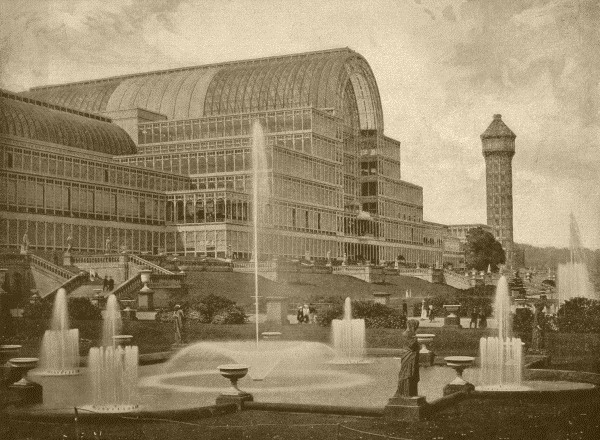
At the Crystal Palace, the Burns Centenary was celebrated on Tuesday
with much enthusiasm. Upwards of 14,000 persons were present
during the day. There was a grand concert and great interest was
imputed to the proceedings by the unveiling of Calder Marshall's bust of
Burns, and the exhibition of a number of relics of the poet. The
recitation of the prize poem, however, was the chief attraction, and at
three o'clock the scene from nave to transept, and orchestra to
orchestra, and gallery to gallery, presented an imposing amphitheatre of
listeners riveted to the spot, until Mr Phelps appeared upon the
platform and enjoined silence. He opened the envelope with the
mottos of the author of the successful poem, and announced it to be "Isa
Craig, Ranelagh Street, Pimlico." He then recited the poem with
much taste and elocutionary power. The Morning Herald, in
noticing this stage of the proceedings, says:—"At the close of the
recitation of the poem by Mr Phelps, a proclamatory placard was hoisted
over the orchestra, the name of the successful competitor not having
been caught by multitudes around, with the inscription in large black
rubrics on a white ground of 'The author of the poem is Ian Craig.'
Calls then arose for Isa Craig to come before the scenes, and
multitudinous and mysterious were the conjectures indulged in by the
bystanders as to who Isa Craig could really be. Some suggested
that it was a mistake for 'Ailsa Craig;' others read it Esau Craig;
while many pronounced the whole affair to be a mystery and a myth,
seeing that the fortunate prizeholder did not make her appearance to be
complimented. The crowd indulged in these dreamy disquisitions and
conjectures until the scene and the subject were altogether changed by
the striking up of the band for the supplemental concert. From all
that we could ascertain, however, from the most reliable sources, we
find that Isa Craig is a young Scots lady, and that the mysterious
monosyllable 'Isa' is a breviate or nomme de plume for Isa-bella;
that she belongs to the single sisterhood, and has been a contributor to
Chambers' Journal, the Scotsman, and the Englishwomen's
Magazine, and is said to have published a small volume of poems.
From feelings either of timidity or poetical delicacy and pride, Miss
Craig neither came before the curtain, nor did she pay a visit to the
Company's treasury to receive the fifty guineas, although the check had
been waiting for her acceptance all day. Speaking of the prize
poem and its author, the Morning Star says:— "speculation has
been rife as to who was the author of the above very beautiful
composition, and the name of more than one distinguished person has been
confidently mentioned. There is even now a shrewd suspicion that
'Isa Craig' hides a name much less obscure."—The Caledonian Society
celebrated the Centenary by a dinner at the London Tavern—Mr R Marshall
in the chair. The Times states that during the dinner
(which included a huge haggis) the company were solaced with the sounds
of the bagpipe, and when it is mentioned that not fewer than five
pipers, blowing might and main, marched at one times round the tables,
some idea of the harmony that prevailed will be conveyed to the
readers.—A banquet also took place at the Guildhall Coffee House, at
which Mr James Hannay presided and proposed, in felicitous terms, "The
Memory of Robert Burns."
The Centenary was celebrated by banquets at Manchester, Liverpool,
Newcastle, and Bristol. These demonstrations appear to have been
mostly hearty and successful. At Manchester, the Mayor presided,
and the toast of the evening was proposed, in an elegant speech, by
Professor Scott of Owens College.
______________ |
|
THE WINNING ENTRY:
THE SIX BEST RUNNERS-UP:
also some unplaced entries, including those
submitted by the
Scottish artisan poet
JAMES MACFARLAN,
the pre-Raphaelite artist
JOHN EVERETT MILLAIS,
A.R.A.,
and the poets
GEORGE JOHN CAYLEY
and ROBERT WILLIAM THOM.
_____________ |
|
1. MISS
ISA CRAIG |
|
2. FREDERIC
W. H. MYERS, CHELTENHAM |
|
3.
"Gaudente terrâ, vomere laureato, et trinmphali aratore," |
|
4. GERALD
MASSEY |
|
5. MRS
HENRY
W. PHILLIPS |
|
6. ARTHUR
J. MUNBY, TRIN. COLL.,
CAMBRIDGE |
|
7. J.
STANYAN BIGG |
|
JAMES MACFARLAN
[see also Macfarlan web pages] |
|
JOHN
EVERETT MILLAIS, A.R.A. |
|
THE HON. MRS
NORTON |
|
GEORGE JOHN CAYLEY |
|
ROBERT WILLIAM
THOM [see also
Robert Wm. Thom web page] |
ED.— readers interested in this topic might also wish to
read
VERSES
SUGGESTED BY A VISIT
TO THE TOMB
OF BURNS
by the Blackburn poet
HUGH
GARDINER GRAHAM,
which is of this period. |
|



